What Happened to Lydac Neuroscience? The Company Connecting Stephen Ray and Andrew Chancellor
The Men Behind Wellbeing — Chapter Seven
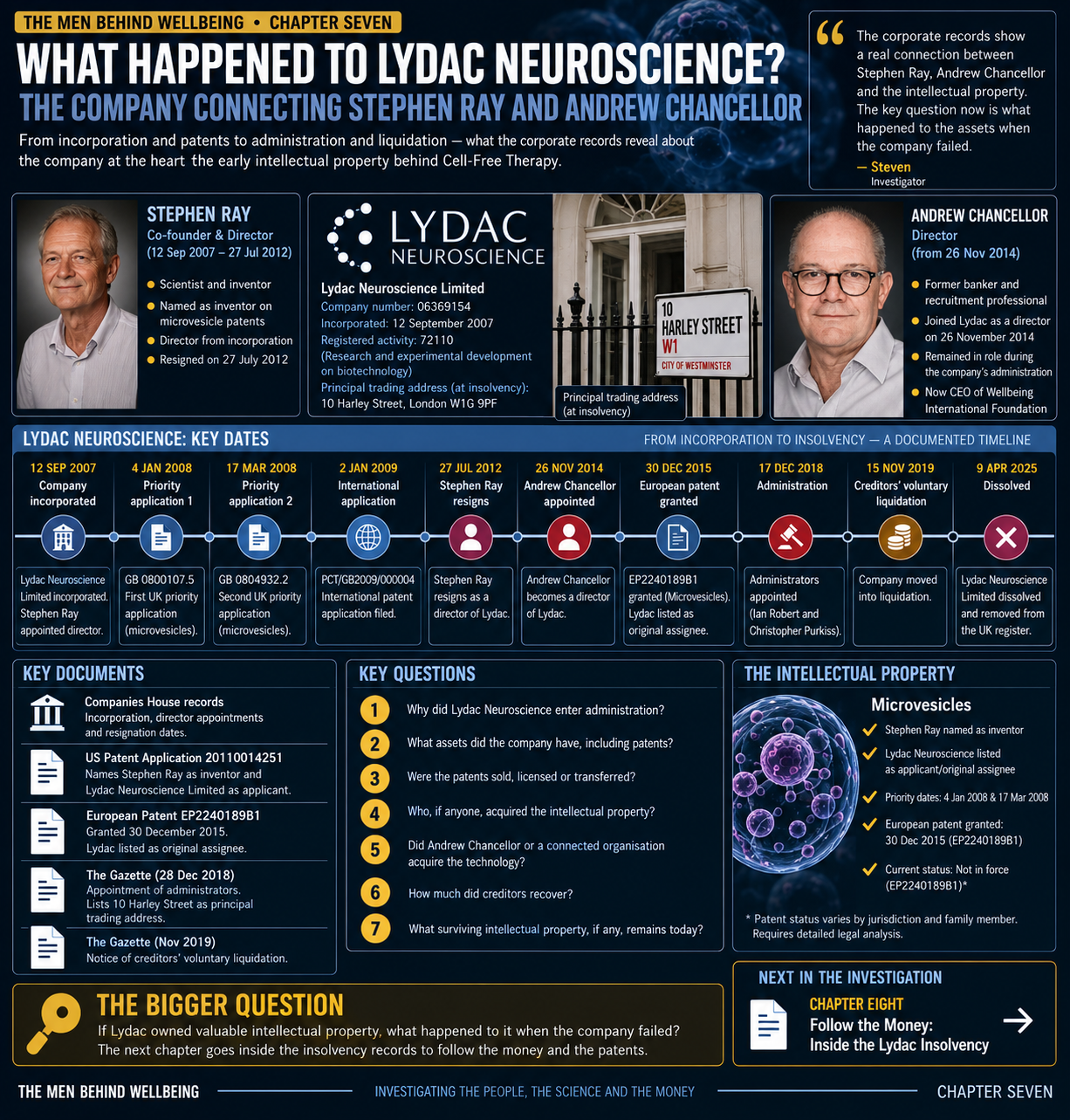
Before Wellbeing International Foundation, before Cell-Free Therapy and before its current investment story, there was another biotechnology company. Stephen Ray helped establish it. His microvesicle patents were associated with it. Years later, Andrew Chancellor became one of its directors. Then the company entered administration, liquidation and ultimately disappeared. Understanding what happened to Lydac Neuroscience may be essential to understanding where the science behind Wellbeing really came from.
For the last several chapters, this investigation has followed the people behind Wellbeing International Foundation.
That trail has taken us backwards.
From Andrew Chancellor's present role as Chief Executive.
To Stephen Ray's scientific history.
Then into the patent records surrounding Ray's earlier work on microvesicles.
And those patents repeatedly led to the same company:
Lydac Neuroscience Limited.
At first, Lydac appeared to be little more than a historical name attached to old intellectual-property records.
It isn't.
Companies House records reveal something considerably more important.
Stephen Ray was a director of Lydac Neuroscience from the day the company was incorporated.
Years later, after Ray had left, Andrew Chancellor became a director of the same company.
Then Lydac collapsed.
Administrators were appointed.
The company moved into liquidation.
And eventually, in April 2025, Lydac Neuroscience ceased to exist.
That creates an important new line of investigation.
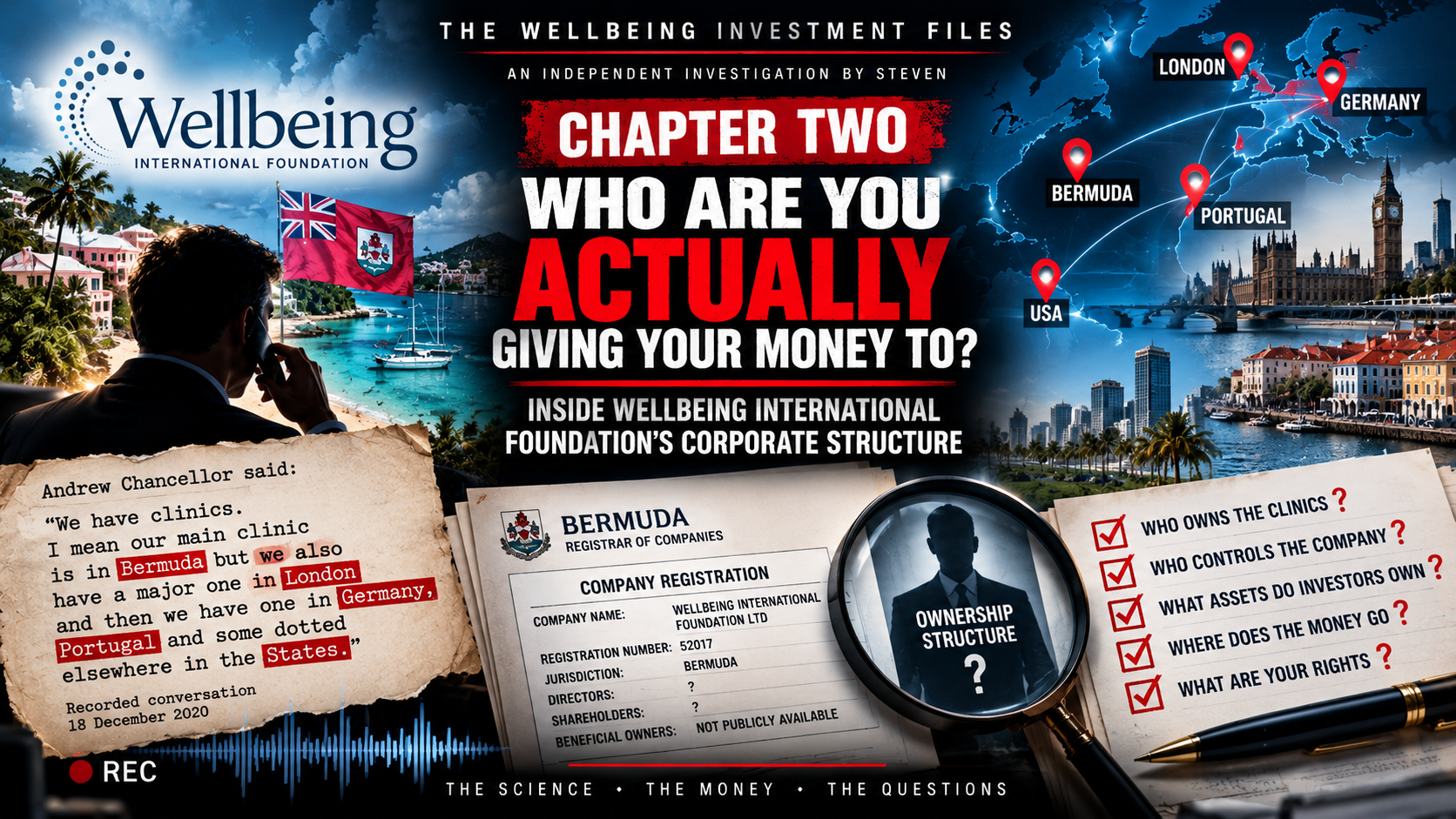
Because today Stephen Ray and Andrew Chancellor appear together again at Wellbeing International Foundation.
And Wellbeing is promoting Cell-Free Therapy—a treatment whose scientific explanation places considerable emphasis on extracellular vesicles.
So before we can properly understand Wellbeing's present scientific and commercial proposition, we need to understand the company that appears much earlier in this story.
What exactly was Lydac Neuroscience?
What did it own?
What happened to it?
And ultimately:
What happened to its science?
Lydac Neuroscience Begins in 2007
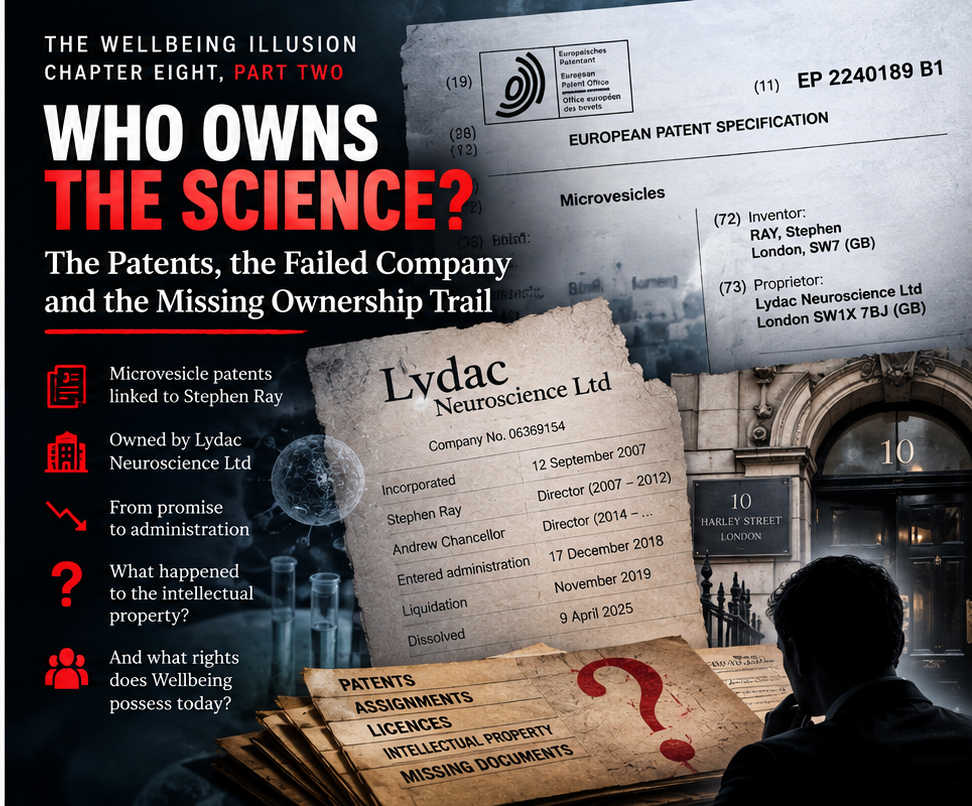
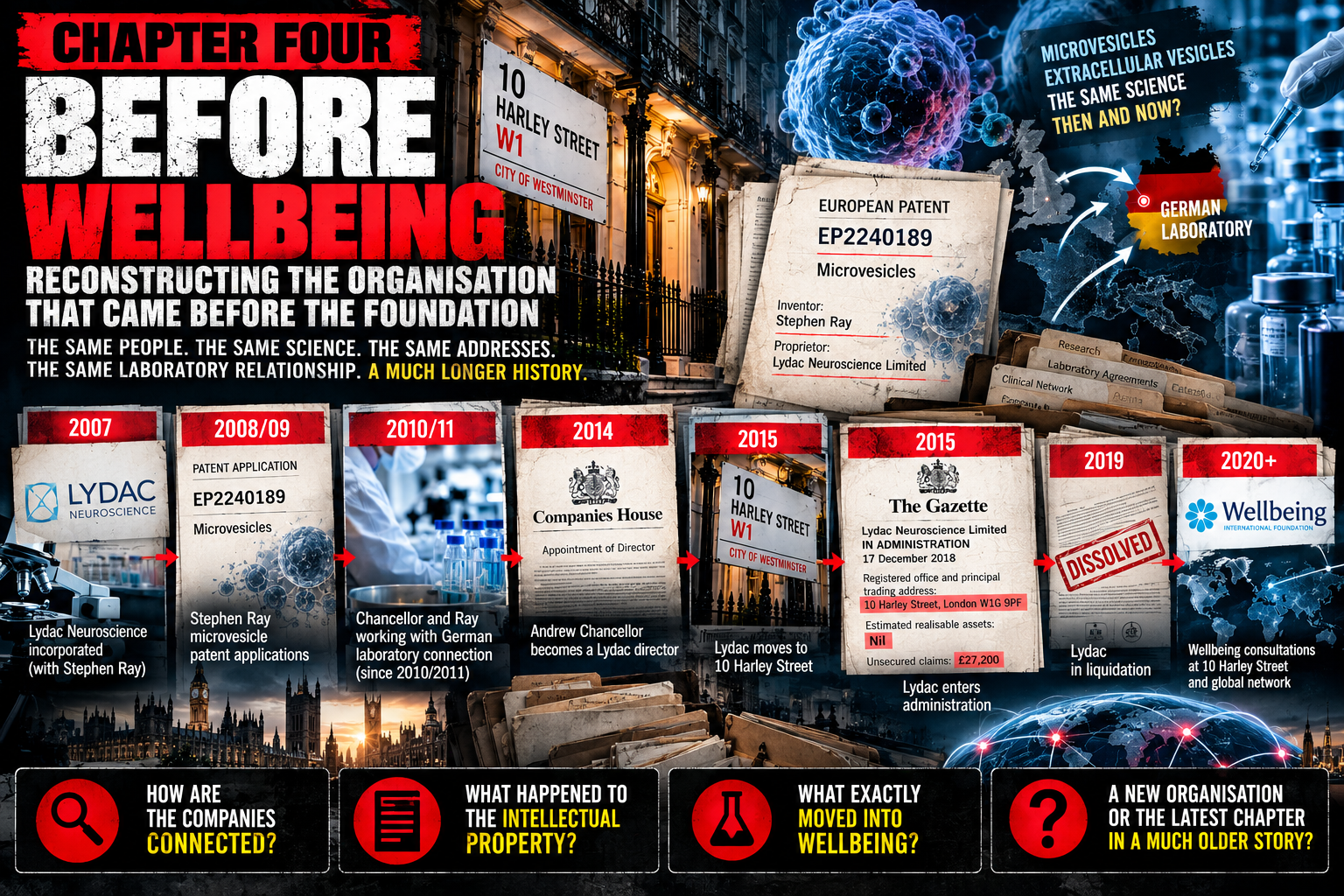
Lydac Neuroscience Limited, company number 06369154, was incorporated in England on 12 September 2007.
Its registered business activity was:
72110 — Research and experimental development on biotechnology.
This was therefore not simply a consultancy or general commercial company.
Its stated purpose placed biotechnology research at the centre of the business.
And on the very day the company was incorporated, Stephen Ray became a director.
Companies House records show Ray remaining in that position until 27 July 2012.
That date becomes particularly significant when placed beside the patent history.
Within Months, the Patent Trail Begins
The earliest priority date we have identified for Ray's microvesicle technology is:
4 January 2008.
A second UK priority application followed on:
17 March 2008.
Then, on 2 January 2009, an international application was filed under:
PCT/GB2009/000004.
The resulting patent family includes the international publication WO2009/087361 and European patent EP2240189B1.
The European patent is titled:
Microvesicles.
Stephen Ray is named as inventor.
And the original assignee is:
Lydac Neuroscience Limited.
That chronology is important.
Lydac was incorporated.
Ray became a director.
Within months, priority applications relating to microvesicle technology began appearing.
The company then became the corporate assignee associated with that intellectual property.
That gives us something far stronger than a loose historical association.
Lydac sat directly within the early commercial history of Stephen Ray's microvesicle science.
What Was Ray Trying to Patent?
The patent documentation describes methods involving microvesicles, including the production of immunologically matched autologous microvesicles.
The specification discusses potential therapeutic and cosmetic applications.
In simplified terms, the technology concerned biological material derived from cells and the signalling components associated with that material.
This is interesting because extracellular vesicles are now central to the scientific language surrounding Wellbeing's Cell-Free Therapy.
But we need to be disciplined here.
I am not claiming that Ray's Lydac patent is identical to the Cell-Free Therapy offered by Wellbeing today.
We have not established that.
Microvesicle and extracellular-vesicle science has developed significantly since these patents were first filed.
Processes can change.
New intellectual property can be developed.
Manufacturing methods can evolve.
And an older patent may cover only particular claims within a much larger modern process.
But the scientific overlap is sufficiently obvious to justify investigating the relationship.
Especially because the scientist is the same.
Stephen Ray Leaves Lydac
On 27 July 2012, Stephen Ray resigned as a director of Lydac Neuroscience.
This is another point where accuracy matters.
Andrew Chancellor did not immediately replace him.
There was a gap of more than two years.
Corporate records identify Bruno Butti as a director during part of the intervening period.
So it would be inaccurate to write:
“Chancellor took over Lydac from Stephen Ray.”
We do not have evidence for that.
What we can say is more precise—and potentially more interesting.
Stephen Ray was a director during the company's formative period and the development of its early microvesicle intellectual property.
He left in 2012.
Then, in 2014, another person who would later become central to Wellbeing entered the same company's history.
Andrew Chancellor Arrives
On 26 November 2014, Companies House records the appointment of:
Andrew William Chancellor
as a director of Lydac Neuroscience Limited.
On the same date, Bruno Butti's directorship was terminated.
This is the first hard corporate record directly placing Chancellor inside the company associated with Ray's earlier microvesicle intellectual property.
That is significant because Chancellor's own later accounts of his move into biotechnology place Stephen Ray at the centre of that transition.
In interviews, Chancellor has described meeting Ray and becoming interested in the commercial potential of his research.
He has described conversations evolving into discussions about how the science might be commercialised and brought into clinical use.
Now we have a corporate record that adds another layer to that story.
Chancellor did not merely encounter a scientist with interesting research.
He subsequently became a director of the biotechnology company historically associated with that scientist's microvesicle intellectual property.
But Ray and Chancellor Were Not Directors Together
This distinction deserves repeating.
Stephen Ray resigned:
27 July 2012.
Andrew Chancellor was appointed:
26 November 2014.
Their directorships therefore did not overlap according to the records we have established.
That does not weaken the connection.
It simply defines it correctly.
Both men appear in the history of the same biotechnology company.
At different times.
And years later both appear again inside Wellbeing International Foundation.
That is the documented connection.
Anything beyond that requires additional evidence.
Lydac Moves to Harley Street
Another development followed.
On 16 June 2015, Lydac changed its registered office to:
10 Harley Street, London W1G 9PF.
Harley Street carries obvious prestige within British medicine.
But an address alone tells us nothing about the scale of clinical or scientific activity taking place there.
The important point for this investigation is chronological.
By mid-2015:
Andrew Chancellor was a director.
Lydac was registered at Harley Street.
And Ray's earlier microvesicle patent family was still progressing.
Then, later that year, something important happened.
The European Microvesicle Patent Is Granted
On 30 December 2015, European patent EP2240189B1 was granted.
The title:
Microvesicles.
Inventor:
Stephen Ray.
Original assignee:
Lydac Neuroscience Limited.
This creates an unusual corporate timeline.
Ray had left Lydac more than three years earlier.
But the patent originating from the earlier research continued through the patent system.
And by the time the European patent reached grant, Andrew Chancellor was a director of Lydac.
That does not mean Chancellor invented the technology.
The patent identifies Ray as inventor.
It does not mean Chancellor personally owned the patent.
The assignee was the company.
But it does mean Chancellor was directing the company during a period when significant intellectual property originating from Ray's research was reaching patent grant.
That fact becomes important later.
Something Else Was Happening at Lydac
Despite being registered as a biotechnology research company and being associated with patent activity, Lydac's Companies House record shows dormant accounts in the years preceding its collapse.
Dormant accounts were filed for the financial years ending:
30 September 2015
30 September 2016
and:
30 September 2017.
That initially appears strange.
How can a biotechnology company associated with patent development and a Harley Street address be dormant?
But “dormant” should not automatically be interpreted as suspicious.
An intellectual-property holding company may conduct little accounting activity.
Research or commercial work may occur elsewhere.
Patents may be held inside a separate corporate vehicle.
Licensing arrangements can separate intellectual-property ownership from trading activity.
So the dormant accounts do not establish wrongdoing.
They do, however, create a question that becomes much more important when we see what happened next.
A Strike-Off Warning Appears
On 30 August 2016, a First Gazette notice for compulsory strike-off was issued against Lydac.
The action was subsequently discontinued on 1 October 2016.
Compulsory strike-off proceedings can arise for relatively ordinary administrative reasons, such as failure to make required filings.
Because the action was discontinued, Lydac remained registered.
Again, there is no basis for turning that into an allegation of misconduct.
But it belongs in the chronology.
By 2016, the company's position on the register had already required attention.
Then, two years later, the situation became much more serious.
December 2018: Lydac Collapses Into Administration
On 17 December 2018, administrators were appointed to Lydac Neuroscience Limited.
The official Gazette notice identifies the administrators as:
Ian Robert
and:
Christopher Purkiss
of Kingston Smith & Partners LLP.
The notice records Lydac's principal trading address as:
10 Harley Street, London W1G 9PF.
And it describes the company's business as:
Research and experimental development on biotechnology.
This was no longer an administrative strike-off issue.
This was formal insolvency.
Professional administrators had been appointed.
Creditors existed.
Assets and liabilities had to be examined.
And suddenly, something we had discovered earlier in this investigation becomes extremely important.
The patents.
What Happened to the Intellectual Property?
This is where the Lydac story becomes much more than corporate history.
We know Lydac had been associated with Ray's microvesicle intellectual property.
We know Lydac was recorded as assignee on relevant patent records.
So what happened to those rights when administrators arrived?
Were they still owned by Lydac?
Were they valuable?
Had they been licensed?
Had some rights already lapsed?
Had they been assigned elsewhere before administration?
Were they subsequently sold by the administrators?
Were they transferred during liquidation?
Or had the commercially important science moved beyond those original patents entirely?
At this stage, we should not pretend to know.
But the question has become unavoidable.
Administration Generates a Paper Trail
Fortunately, insolvency leaves documents.
Companies House records a substantial series of filings following the appointment of administrators.
On 28 January 2019, a nine-page Statement of Affairs was filed.
On 9 April 2019, a 31-page Administrator's Proposal followed.
On 10 April 2019, the result of a creditors' meeting was filed.
Then, on 19 July 2019, a 17-page Administrator's Progress Report appeared.
These documents matter because they potentially tell us what Lydac possessed when it failed.
Assets.
Liabilities.
Creditors.
Estimated recoveries.
And potentially:
intellectual property.
This is where the next stage of the investigation has to go.
Administration Did Not Save the Company
Lydac did not emerge from administration as a rescued biotechnology business.
On 15 November 2019, the administration ended and Lydac moved into:
Creditors' Voluntary Liquidation.
The Gazette records Ian Robert and Christopher Purkiss as liquidators and identifies the transition as an exit from administration.
From that point onward, Lydac was being wound up.
But the process took years.
Liquidators' statements of receipts and payments continued to appear through subsequent reporting periods.
The company remained legally present while the winding-up process continued.
Finally:
9 April 2025.
Lydac Neuroscience Limited was dissolved.
After nearly eighteen years, the company disappeared from the register.
But Intellectual Property Does Not Necessarily Die With a Company
This is perhaps the most important point in Chapter Seven.
A company can disappear.
Its technology does not necessarily disappear with it.
Patents can be sold.
Applications can be assigned.
Licences can continue.
Research data can move.
Know-how can be transferred.
Scientists can continue developing technology elsewhere.
An insolvent biotechnology company may actually possess intellectual property that survives long after the company itself is gone.
That is why we cannot simply conclude:
Lydac failed, therefore the story ended.
The opposite may be true.
The failure of Lydac may be precisely where the next part of the story begins.
Because Stephen Ray Did Not Disappear
Today, Stephen Ray appears at Wellbeing International Foundation.
Wellbeing describes him as its Senior Scientific Consultant.
It credits him with more than thirty years of academic and commercial experience in cell therapy.
And Wellbeing's scientific narrative surrounding Cell-Free Therapy places extracellular vesicles among the biological components of the treatment.
That brings us back to the patents.
Microvesicles.
Extracellular vesicles.
Autologous biological material.
Stephen Ray.
The terminology and scientific history overlap sufficiently to require investigation.
But again:
overlap is not proof that the technologies are legally or technically identical.
That is exactly what we now need to determine.
Andrew Chancellor Did Not Disappear Either
Andrew Chancellor also appears today at Wellbeing International Foundation.
He is its Chief Executive.
His own public account of his move into biotechnology describes meeting Stephen Ray and becoming interested in commercialising the research.
And we now know that Chancellor subsequently became a director of the very biotechnology company associated with Ray's earlier microvesicle patents.
This gives us a chronology that is becoming increasingly difficult to dismiss as irrelevant.
Stephen Ray.
Lydac.
Microvesicle patents.
Andrew Chancellor.
Lydac's insolvency.
Then:
Stephen Ray.
Andrew Chancellor.
Wellbeing International Foundation.
Cell-Free Therapy.
That does not establish a continuous legal ownership chain.
It establishes the need to find one—or establish that none exists.
This Is Why We Are Investigating Lydac
It is important not to lose sight of this.
We are not interested in embarrassing someone because an old company became insolvent.
Businesses fail.
Biotechnology companies fail.
Research companies fail.
Administration itself is not evidence of fraud or wrongdoing.
Our interest in Lydac is much more specific.
Lydac appears to have held intellectual property associated with the science of a man who is now central to Wellbeing's scientific story.
And one of Lydac's later directors is now Wellbeing's CEO.
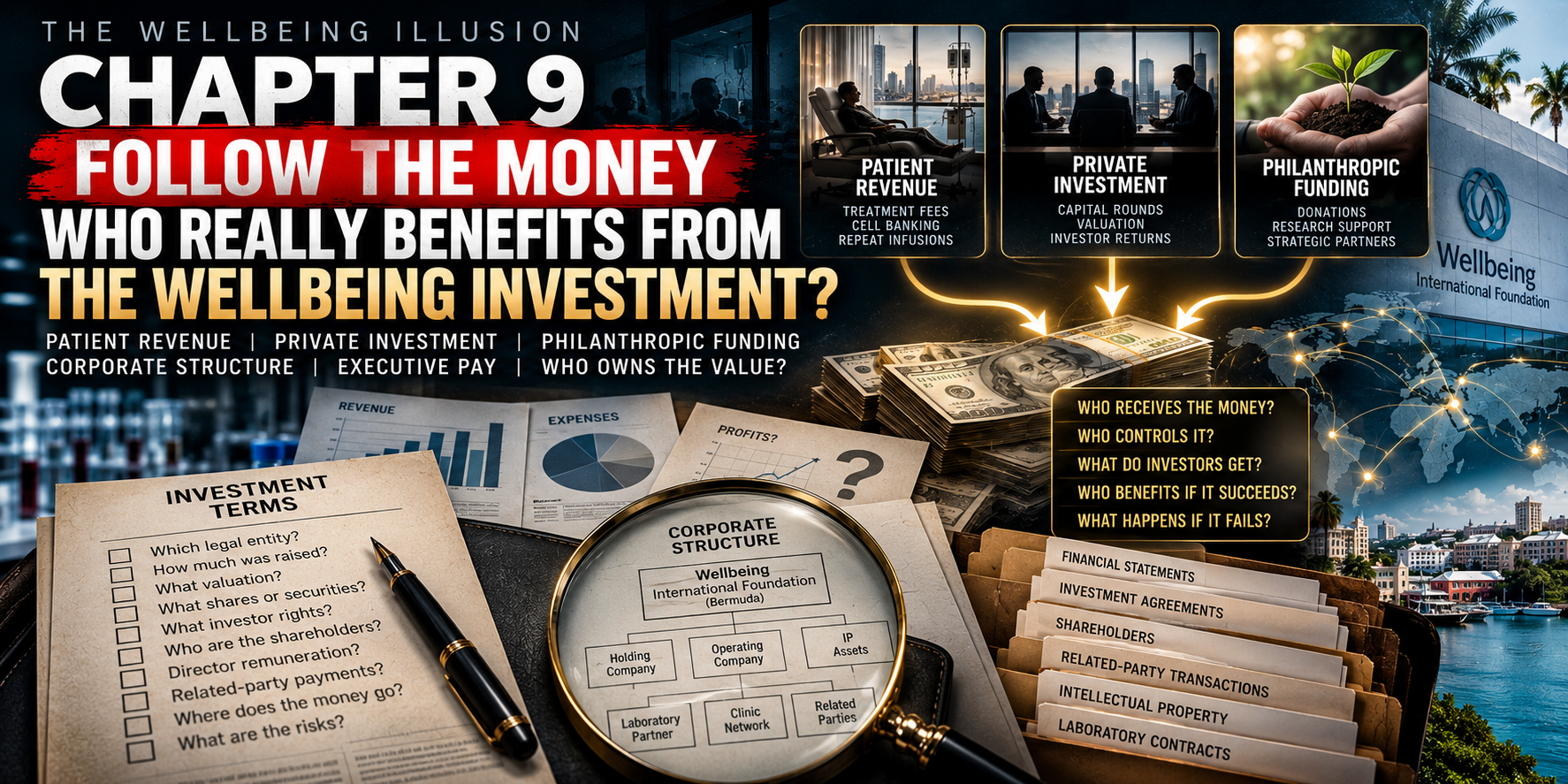
That makes the fate of Lydac's intellectual property potentially relevant to understanding the origins and ownership of the technology being promoted today.
And Now There Is an Investment Dimension
There is another reason this matters.
Wellbeing is not simply presenting scientific ideas.
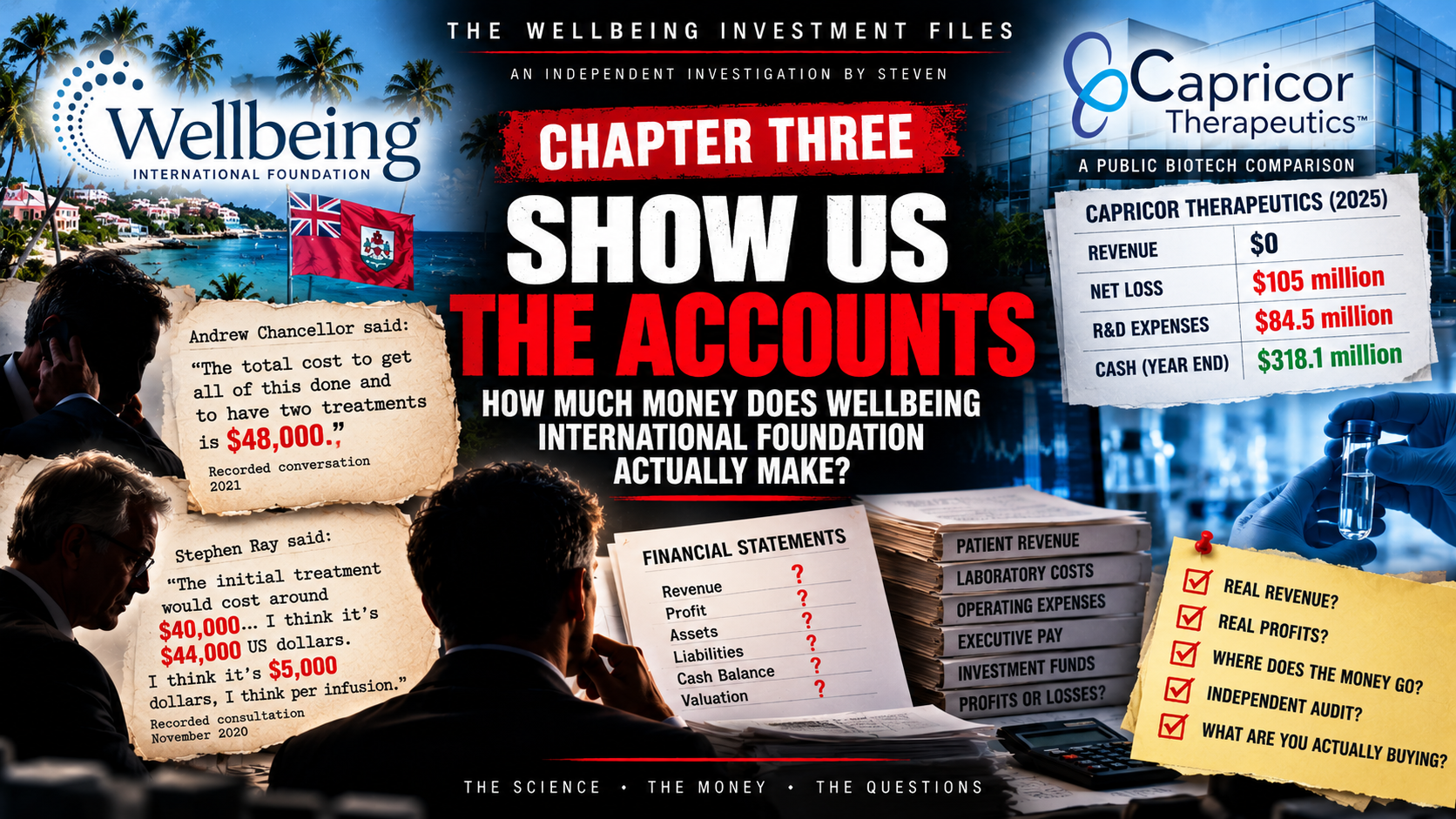
In 2026, it announced the opening tranche of a new capital raise.
Wellbeing says the money will support its research programme, clinical relationships, documentation and expansion.
That introduces investors into the story.
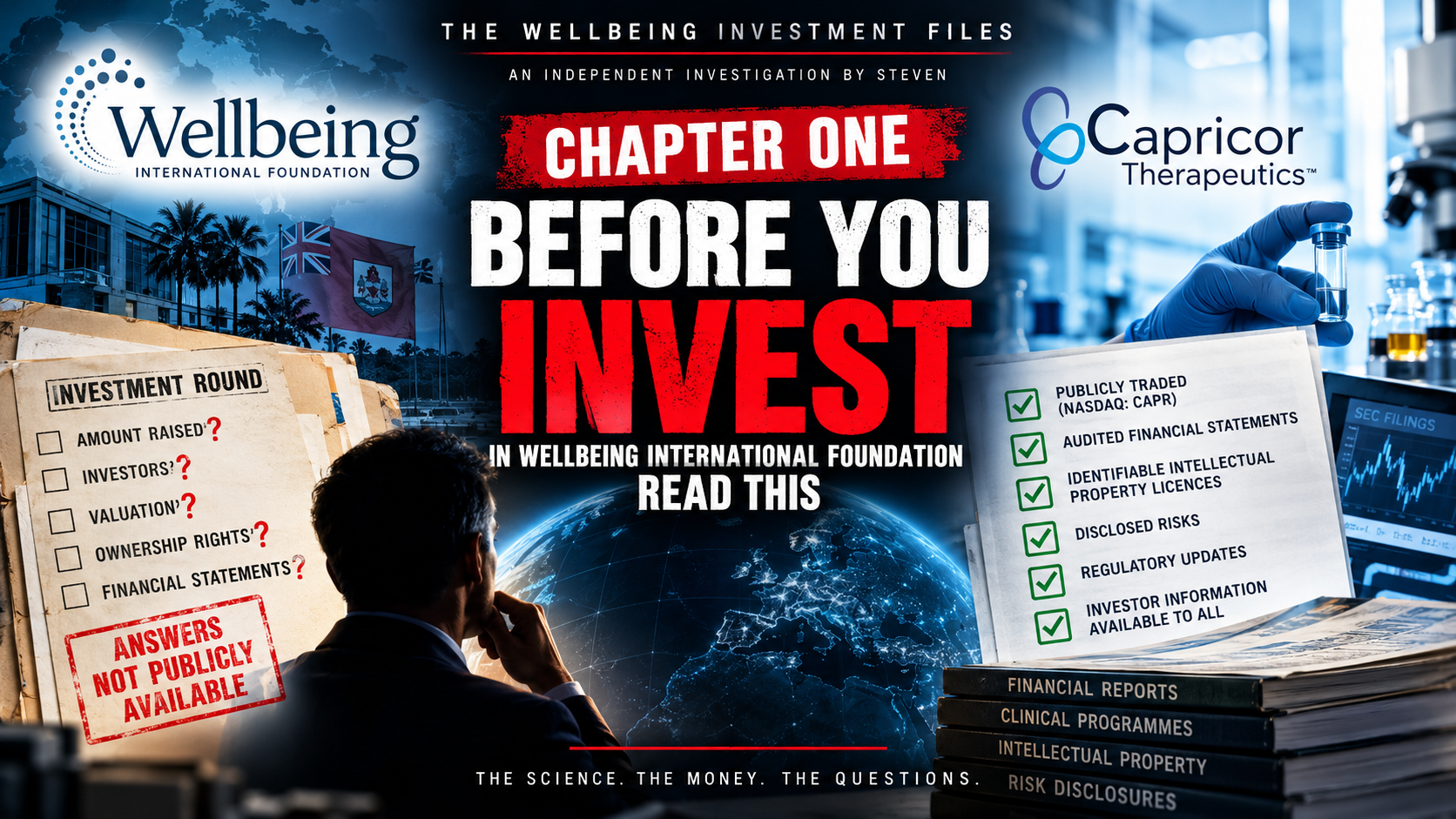
And intellectual-property ownership is fundamental to biotechnology investment.
An investor needs to understand what they are investing behind.
Patents?
Licences?
Trade secrets?
Manufacturing know-how?
Clinical data?
A scientific team?
Or technology whose historic patent ownership sits somewhere else?
None of those structures is inherently illegitimate.
But they represent very different investment propositions.
The Question We Cannot Yet Answer
At this stage, I cannot responsibly say:
Wellbeing owns Lydac's intellectual property.
I cannot say:
Wellbeing acquired Lydac's patents.
I cannot say:
Andrew Chancellor acquired the technology during the insolvency.
I cannot say:
Stephen Ray transferred it.
And I cannot yet say:
Wellbeing's current Cell-Free Therapy is covered by the old Lydac patents.
We have not established those things.
But equally, we have not yet found the documentary bridge explaining how the technology moved from its historical corporate setting to the commercial and scientific proposition being presented today.
That is the gap.
The Timeline We Can Establish
What we can establish is already significant:
12 September 2007 — Lydac Neuroscience Limited incorporated; Stephen Ray appointed director.
4 January 2008 — first UK priority application associated with the microvesicle patent family.
17 March 2008 — second UK priority application.
2 January 2009 — international patent application filed.
27 July 2012 — Stephen Ray resigns as director.
26 November 2014 — Andrew Chancellor becomes a director.
16 June 2015 — Lydac's registered office moves to 10 Harley Street.
30 December 2015 — European microvesicle patent EP2240189B1 granted.
17 December 2018 — administrators appointed.
28 January 2019 — Statement of Affairs filed.
9 April 2019 — Administrator's Proposal filed.
19 July 2019 — Administrator's Progress Report filed.
15 November 2019 — Lydac moves from administration into creditors' voluntary liquidation.
9 April 2025 — Lydac Neuroscience Limited dissolved.
That chronology is no longer speculative.
It comes from corporate, insolvency and patent records.
What We Need to Find Next
The next stage of this investigation is now very clear.
We need to open the insolvency file.
Not merely read the filing titles.
We need the actual contents.
We need to know:
Why did Lydac enter administration?
Who were the major creditors?
How much was owed?
What assets did the company possess?
Were patents or intellectual property listed?
What value was placed upon them?
Were they sold?
Were they licensed?
Were they transferred before administration?
Who acquired them?
What did creditors ultimately recover?
And above everything:
Where did the microvesicle intellectual property go?
A Right of Reply
There may be perfectly straightforward answers to all of this.
Andrew Chancellor may be able to explain exactly what happened to Lydac's intellectual property.
Stephen Ray may be able to explain how his subsequent science developed beyond the original patents.
Wellbeing may be able to demonstrate that its current Cell-Free Therapy is based on later technology entirely separate from Lydac's intellectual property.
Or it may possess legitimate licences or assignments that simply aren't apparent from the public material we have examined.
We would welcome that clarification.
Because the objective here is not to manufacture a scandal.
It is to establish the documentary history.
Conclusion: The Company Disappeared. The Science Didn't.
Lydac Neuroscience no longer exists.
Its name now survives primarily in Companies House records, Gazette notices and patent databases.
But the people associated with its history continued.
Stephen Ray continued.
Andrew Chancellor continued.
And the scientific field around extracellular vesicles continued.
Today, Ray and Chancellor are together at Wellbeing International Foundation.
Wellbeing is promoting Cell-Free Therapy.
It is presenting a scientific heritage built around decades of research.
And it is seeking investment to support its future.
That makes the fate of Lydac's intellectual property more than an historical curiosity.
If today's technology is unrelated to the Lydac patents, we need to establish that.
If it evolved from them, we need to understand how.
If those rights were transferred, we need to find the transaction.
If they were licensed, we need to understand the licence.
And if the old patents ceased to matter because entirely new intellectual property replaced them, then we need to identify what that new intellectual property actually is.
The company disappeared.
The science apparently did not.
So now we follow what happened when the money ran out—and what happened to the assets when Lydac Neuroscience collapsed.
Next: Chapter Eight — Follow the Money: Inside the Lydac Neuroscience Insolvency
Lydac entered administration while Andrew Chancellor was its director. In Chapter Eight, we go inside the insolvency process: the Statement of Affairs, the Administrator's Proposal, the creditors, the assets and the liquidation. Most importantly, we begin looking for what happened to the intellectual property that once sat at the centre of Stephen Ray's microvesicle research.
Recent Posts