Behind the Investment: Where Does Wellbeing International Foundation's Money Go?
The Wellbeing Illusion — Chapter Nine

A scientific breakthrough can attract attention. A compelling patient story can inspire hope. An international network of clinics can create confidence.
But when an organisation begins raising private investment, an entirely different set of questions becomes necessary.
Questions that cannot be answered by patient testimonials, scientific biographies or photographs of medical facilities.
Who receives the money? Who controls the business? What assets support its valuation? And what does an investor actually own?
These questions now sit at the centre of our investigation into Wellbeing International Foundation, the organisation promoting a biological intervention known as Cell-Free Therapy, or CFT.
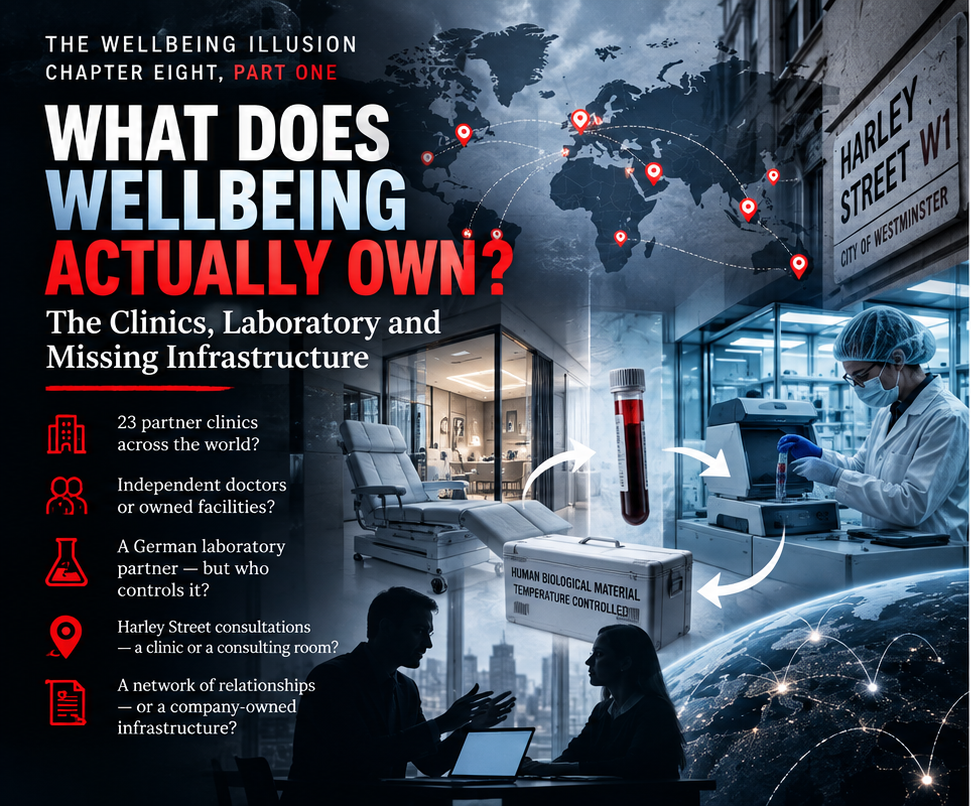
For several chapters, we have examined the organisation's clinical network, German laboratory arrangements, scientific history, clinical evidence and historical intellectual-property connections.
We found a complex picture involving independent medical providers, external laboratory relationships and an earlier biotechnology company associated with some of the scientific personnel now connected with Wellbeing.
None of those findings establishes financial misconduct.
But they make the next stage of the investigation particularly important.
Because in March 2026, Wellbeing publicly announced that it had closed the first tranche of a private capital-raising round.
The announcement marked a significant moment.
The organisation was no longer simply presenting a medical programme to prospective patients.
It was also describing an opportunity for private capital to support its future development.
And that raises a question every prospective investor should be able to answer.
What exactly is the investment funding, and who stands to benefit?
The Capital-Raising Announcement
Wellbeing's March 2026 announcement stated that the opening tranche of its capital round had closed.
The organisation described the investment as supporting continued scientific work, documentation, operating capacity and expansion of its clinical relationships.
It also indicated that the wider fundraising process remained open.
Specific investment amounts, financial terms and participating investors were not publicly identified.
Wellbeing explained that detailed financial information was handled separately through its legal and finance team.
There is nothing inherently unusual about that arrangement.
Private companies frequently disclose sensitive financial information directly to prospective investors rather than publishing it openly.
Investment agreements, valuations and shareholder details may be subject to confidentiality.
However, there is an important difference between announcing a successful fundraising milestone and demonstrating the financial condition of a business.
A capital-raising announcement does not establish profitability.
It does not establish the company's valuation.
It does not show the amount of money held in the bank.
And it does not reveal what percentage of the organisation has been sold.
Those questions require financial documents.
The announcement is therefore evidence of what Wellbeing publicly reported about its fundraising activity, not independent proof of the financial merits of the investment.
First Identify the Company
The first difficulty in assessing a private investment is often surprisingly basic.
Which legal entity is actually issuing the investment?
Wellbeing International Foundation is the name presented publicly.
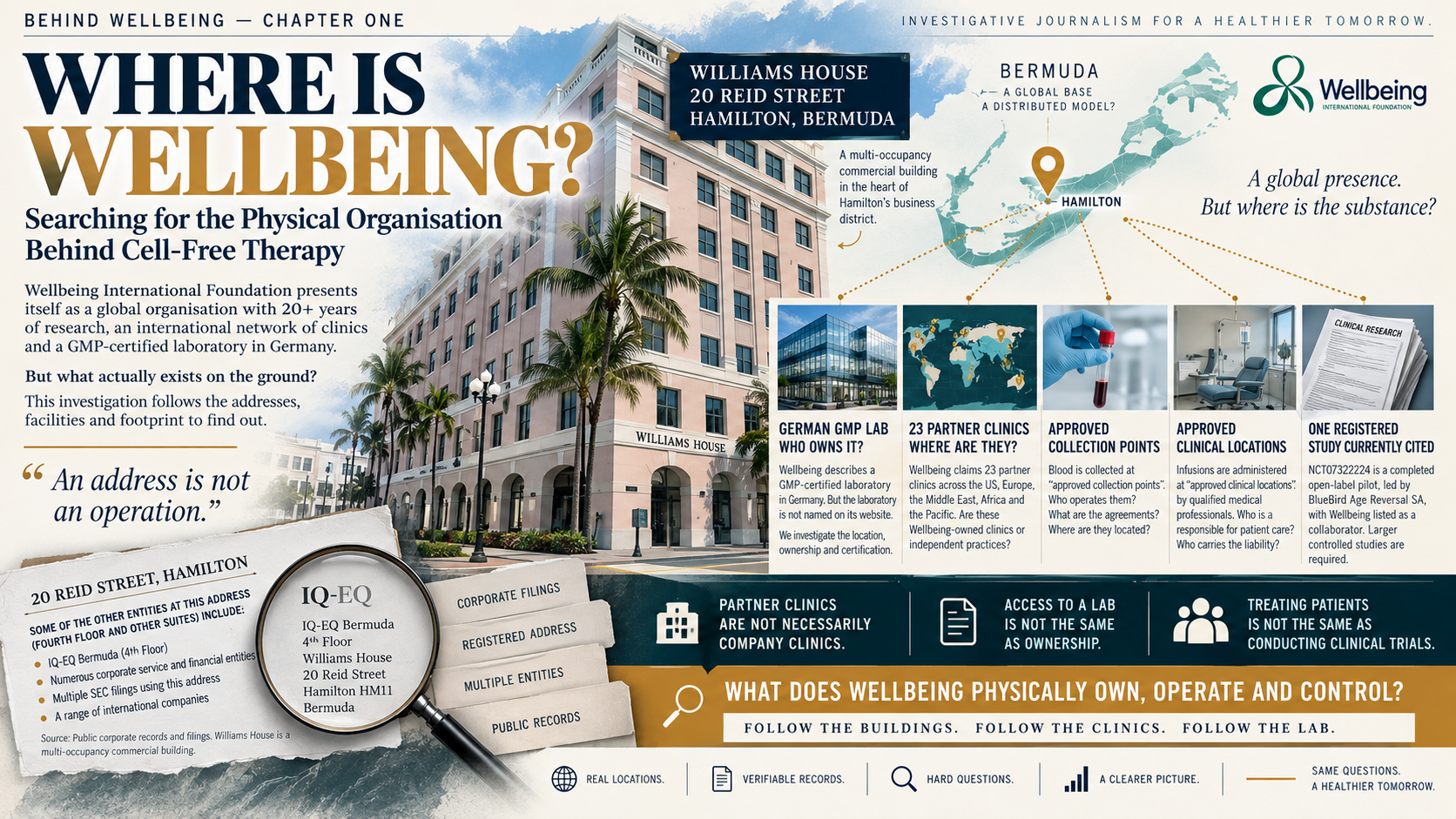
Its website identifies a headquarters in Hamilton, Bermuda.
But a public-facing organisation and the legal company issuing shares or other investment instruments are not necessarily the same entity.
A business may operate through a holding company, subsidiaries, affiliated companies or separate commercial vehicles.
That structure can be entirely legitimate.
It can also make investment analysis considerably more complicated.
An investor may believe they are acquiring an interest in an international biotechnology operation.
But the rights attached to that investment depend on the specific company issuing it.
Does that company own the intellectual property?
Does it receive the patient revenue?
Does it control the laboratory agreements?
Does it hold the clinical contracts?
Does it own shares in the operating companies?
Or is it primarily an entity through which investment is collected and allocated?
The answers determine what the investor is buying.
A percentage of one company does not automatically provide ownership of every business associated with the same commercial network.
Before considering potential returns, an investor needs a complete understanding of the corporate structure.
Three Different Sources of Funding
Wellbeing's public explanation of its financial model identifies three broad sources of support.
Private investment.
Patient revenue.
Selective philanthropic engagement.
These sources serve different purposes and create different financial obligations.
Patient revenue is generated when individuals purchase treatment-related services.
Investment capital is contributed under specific financial arrangements, potentially in exchange for shares or other economic rights.
Philanthropic support may be provided to advance a mission without creating an ownership interest.
There is nothing inherently problematic about combining these sources.
Research-oriented businesses sometimes depend on investment while generating commercial revenue and receiving external support.
But the accounting treatment and legal rights attached to each source matter.
Patient payments should not be confused with investor contributions.
Investment proceeds should not automatically be treated as operating revenue.
And philanthropic contributions should not be assumed to create shareholder rights.
The organisation's use of the word Foundation also deserves clarification.
The name alone does not establish that the relevant legal entity is a registered charity, a nonprofit organisation or prohibited from distributing profits.
Those matters depend on its registration and governing documents.
For anyone considering investment, the distinction is fundamental.
What We Learned About Patient Pricing
Historical material obtained during our investigation provides an indication of the commercial scale of Wellbeing's treatment programme.
During consultations recorded in 2020 and 2021, prospective patients were quoted substantial amounts for treatment arrangements.
One historical discussion referred to an initial programme costing approximately $40,000, with subsequent infusions discussed at a substantially lower price.
Another involved an American prospective patient being quoted approximately $48,000 for a two-treatment arrangement.
These figures must be understood in context.
They were historical quotations.
They are not verified current prices.
They do not establish how many patients purchased treatment.
And they are not proof that the quoted sums were ultimately received.
Nevertheless, they demonstrate that the programme has historically been marketed as a high-value medical service.
That matters because a business charging tens of thousands of dollars per patient may generate significant gross revenue.
But the treatment price is only the beginning of the financial calculation.
The Difference Between Revenue and Profit
A patient paying $40,000 does not mean Wellbeing earns $40,000 in profit.
The treatment pathway involves multiple services and potentially multiple businesses.
There may be charges for medical consultations, blood collection, biological-material transportation, laboratory processing, quality control, storage and clinical administration.
There are also ordinary operating expenses.
Staff salaries.
Professional fees.
Insurance.
Marketing.
Research.
Administration.
Regulatory and legal advice.
And the costs associated with maintaining an international commercial network.
The central question is how much revenue remains after these costs.
Consider a purely illustrative example.
If 100 patients each paid $40,000, the total amount billed would be $4 million.
That sounds substantial.
But it would not establish that Wellbeing itself received all $4 million.
It would not establish the company's profit.
And it would not tell us whether the business was financially sustainable.
The payment arrangements between the patient, laboratory, clinical provider and coordinating organisation would determine how the revenue was distributed.
Without those agreements and the relevant accounts, any calculation of profitability would be speculation.
Following the Payment Through the Treatment Network
The international structure examined in earlier chapters becomes particularly relevant when we consider the financial pathway.
A patient may receive a consultation in one country.
Their blood may be collected by an independent practitioner.
The sample may be transported by a specialist courier.
Processing may take place at a German laboratory.
The finished preparation may then be administered at another medical facility.
Each stage may involve a separate legal entity.
Who invoices the patient?
Who collects the full treatment fee?
Does the laboratory invoice Wellbeing or the patient?
Does the treating physician receive a fixed fee or a percentage of the treatment price?
Does the clinical facility charge separately?
Are referral payments involved?
Which organisation retains the remaining commercial margin?
These questions are not allegations.
They are the basic mechanics of understanding a distributed healthcare business.
A company can coordinate a valuable international service without receiving every payment generated by the network.
The financial statements should therefore distinguish the revenue of the central organisation from the wider economic activity associated with its partners.
The Physician Programme and Its Commercial Incentives
Wellbeing's published physician partnership programme offers another insight into its financial strategy.
The programme is aimed at established medical practitioners, including those already involved in regenerative procedures.
It promotes opportunities associated with premium services, patient acquisition, repeat infusions and cell banking.
This is a commercial proposition as well as a medical one.
The organisation is encouraging practitioners to incorporate its programme into existing businesses.
For a physician, the attraction may include additional patient services and new revenue opportunities.
For Wellbeing, the arrangement may provide access to patients and clinical facilities without requiring the organisation to establish its own clinics in every location.
That can be a commercially efficient strategy.
But it creates questions about financial incentives.
Are physicians paid for administering treatment?
Are they rewarded for referring patients?
Are they offered revenue-sharing arrangements?
Do they receive recurring income from repeat procedures or biological-material storage?
And what safeguards ensure that commercial incentives do not interfere with independent medical judgment?
We have not established the contractual answers.
The point is that the financial structure of a medical partnership can be as important as its clinical structure.
Patients should be able to understand who is responsible for their care.
Investors should be able to understand who receives the revenue.
The Attraction of Repeat Treatment
One aspect of Wellbeing's business model deserves particular attention.
Repeat infusions and cell banking.
From a commercial perspective, repeat business can be extremely valuable.
A patient who purchases one treatment generates a single transaction.
A patient who returns for additional procedures may generate revenue over several years.
If biological material is stored for future use, ongoing storage fees may create another source of income.
This could make the business less dependent on continually recruiting new patients.
But projected recurring revenue is not the same as demonstrated recurring revenue.
The relevant figures would include the number of active storage customers, repeat-treatment rates, annual revenue per patient and the percentage of customers who discontinue the service.
Those are measurable indicators.
Without them, it is difficult to determine whether the model produces predictable income or merely offers the possibility of doing so.
An investor should distinguish between the commercial opportunities described in marketing material and the actual financial performance recorded in the accounts.
Who Controls the Organisation?
Wellbeing's leadership structure includes chairman Max Lewinsohn, chief executive Andrew Chancellor and scientific personnel associated with the development of its treatment programme.
Its public materials also identify members of the Lewinsohn family in senior commercial roles.
Family participation in a private business is not inherently unusual or inappropriate.
Many established companies are controlled by founders and their relatives.
But investors need to understand the difference between management, ownership and control.
A director may manage a company without owning a majority of its shares.
A shareholder may possess substantial economic rights without managing daily operations.
And voting arrangements may allow one group to retain control even after new investors contribute capital.
The questions are therefore straightforward.
Who holds the voting shares?
Who can appoint or remove directors?
Who approves major expenditure?
Who determines executive remuneration?
Who can authorise the sale of company assets?
And what rights do new investors receive?
These questions become especially important when minority investors may have limited influence over management decisions.
Related-Party Transactions: Why They Matter
In any privately controlled business, related-party transactions deserve careful examination.
A related-party transaction may involve a company paying a director, shareholder, family member or another business connected with them.
Such transactions can be entirely legitimate.
They may include salaries, consultancy fees, loans, property arrangements or payments for specialist services.
But they should be appropriately authorised, recorded and disclosed where required.
Why does this matter?
Because the amount of money entering a company does not necessarily tell investors how much value will remain for shareholders.
A business may generate revenue while incurring substantial management expenses.
It may pay consultants.
It may repay loans.
It may purchase services from connected businesses.
None of these payments is automatically improper.
But investors should understand their nature, amounts and commercial justification.
We have not established that Wellbeing has made improper related-party payments.
Nor have we established the remuneration of its directors.
The question is whether prospective investors receive sufficient financial disclosure to assess the company's expenditure and governance arrangements.
The Scientific Assets and the Financial Valuation
The ownership questions raised in Chapter Eight now become financially significant.
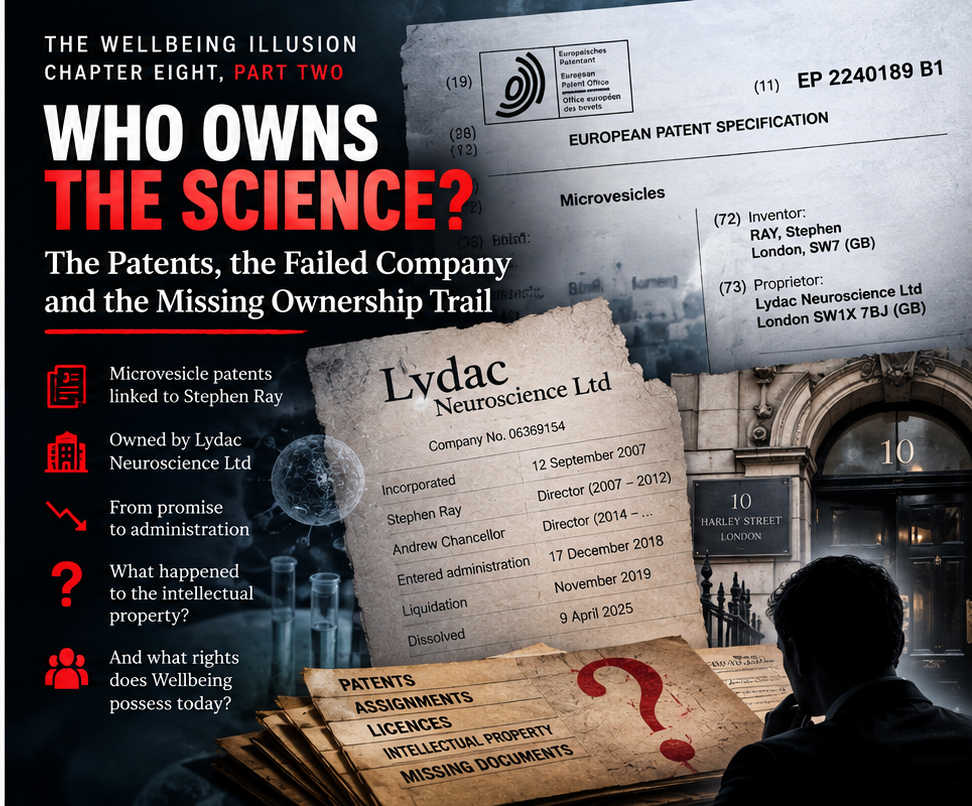
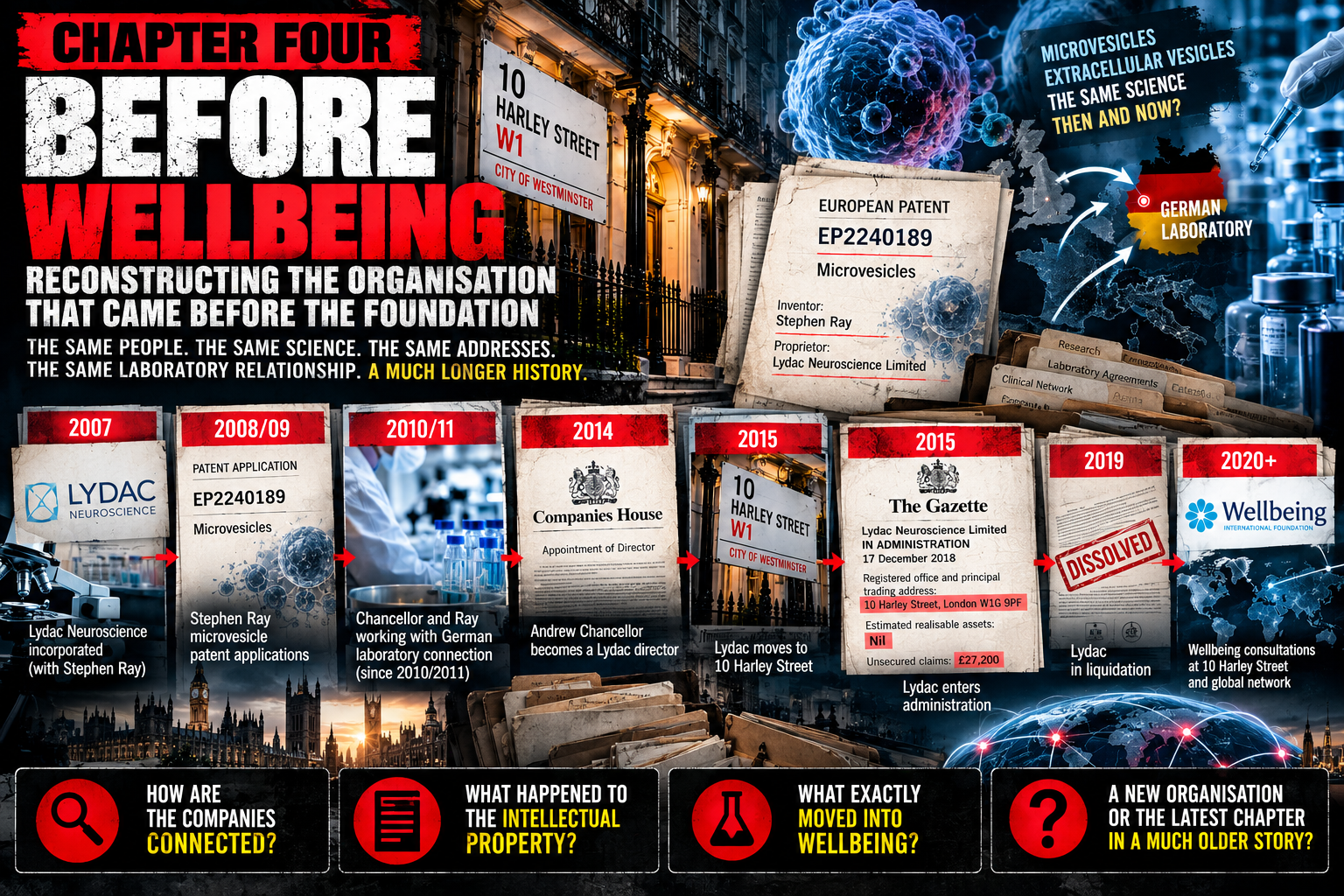
Our earlier investigation identified a historical microvesicle patent family associated with Lydac Neuroscience Ltd.
Stephen Ray was named as an inventor.
Lydac was the original patent applicant and assignee.
The company subsequently entered administration, liquidation and dissolution.
We did not establish that Wellbeing's present CFT technology uses those patents.
Nor did we establish that any intellectual-property transfer was improper.
But the history illustrates an important principle.
A biotechnology company's valuation depends partly on the rights it actually owns or controls.
If a business owns valuable patents, those rights may contribute to its worth.
If it licenses technology, the terms of the licence matter.
If its processes are protected through confidential know-how, the legal arrangements controlling that knowledge matter.
And if the technology depends heavily on an individual scientist or an external laboratory, investors need to understand the commercial consequences of that dependency.
Scientific experience can be valuable.
But it is not automatically a company-owned asset.
How Much Is Wellbeing Worth?
This is the question at the centre of any investment round.
What valuation has been placed on the company?
And how was that valuation calculated?
A biotechnology business might be valued using current financial performance, projected revenue, proprietary technology, clinical data, commercial contracts or anticipated future growth.
But each method carries assumptions.
A business generating reliable profits can be assessed differently from one that remains dependent upon external capital.
A company with exclusive intellectual-property rights may have a different competitive position from one operating through non-exclusive partnerships.
And a treatment supported by large, controlled clinical trials may have a different risk profile from one supported primarily by exploratory research.
Wellbeing's 2026 capital announcement does not publicly disclose the valuation or the securities issued.
That does not mean prospective investors cannot obtain the information privately.
But without those details, an outside observer cannot determine whether the investment price is reasonable.
The Clinical Evidence Still Matters
The financial investigation cannot be separated from the scientific one.
Wellbeing's peer-reviewed pilot study, published in Frontiers in Aging in June 2026, provides early human research data.
It is an important addition to the organisation's published evidence.
But it was a small, open-label, single-arm study without a control group.
Sixteen participants were enrolled and fourteen completed the programme.
The intervention involved several components, including lifestyle measures, supplements and two infusions of autologous conditioned media.
That design limits the conclusions that can be drawn about the independent effects of CFT.
The study does not establish clinical efficacy through a controlled comparison.
It does, however, provide a basis for further investigation.
For investors, this distinction matters.
A promising pilot study may support additional research.
It does not guarantee regulatory acceptance, widespread clinical adoption or future commercial success.
Further trials may require significant funding.
And the results may not confirm the expectations created by early observations.
That uncertainty is a central feature of biotechnology investment.
Where Will the New Capital Be Spent?
Wellbeing's announcement identifies research, documentation, operational capacity and clinical-network expansion as areas supported by the 2026 fundraising.
Those categories cover a wide range of possible expenditure.
Scientific research may involve laboratory experiments, analytical testing, clinical studies or work with independent institutions.
Documentation may involve technical reports, regulatory submissions or scientific publications.
Operational development may include personnel, administration, systems and infrastructure.
Network expansion may involve recruiting physicians, establishing new partnerships and marketing services.
All can be legitimate uses of capital.
But investors need a budget.
How much is allocated to each category?
What milestones are expected?
What evidence will demonstrate that the expenditure has achieved its purpose?
How long will the capital last?
And what happens if the organisation requires another round of investment before those milestones are reached?
These are ordinary questions in private-company finance.
Without a detailed use-of-funds statement, it is difficult to judge whether the amount being raised is appropriate for the proposed development programme.
The Risk of Future Dilution
An investor acquiring shares in a private company must also consider what happens when additional capital is raised.
If the company issues more shares, an existing shareholder's percentage ownership may decrease.
This is known as dilution.
Dilution is not inherently unfair.
It is a common consequence of financing growth.
But the effect depends on the terms.
Does the investor have pre-emption rights?
Can they participate in future rounds?
Are there convertible instruments that may become shares?
Do any existing investors hold preferential rights?
Could a future fundraising round take place at a lower valuation?
And what happens if an investor cannot contribute additional capital?
These questions can substantially affect the eventual return.
Owning a percentage of a business today does not guarantee retaining the same percentage indefinitely.
Bermuda and the Question of Investor Protection
Wellbeing identifies Bermuda as its headquarters.
Bermuda is an established international corporate jurisdiction.
Its use does not imply wrongdoing.
But the jurisdiction governing an investment affects shareholder rights, reporting obligations, dispute resolution and insolvency procedures.
An investor based in the United Kingdom or Europe should not assume that the protections familiar from domestic company law automatically apply.
The relevant rights depend on the actual issuing entity, its constitutional documents, the investment agreement and applicable law.
Where are disputes resolved?
Can minority shareholders inspect financial records?
What information must directors provide?
Are shares transferable?
Can investors require an exit?
What happens if the business is sold?
And how are shareholder interests treated if the company becomes insolvent?
These matters should be established before funds are transferred.
The Documents That Matter More Than Marketing
By this stage, the investigation reaches a clear conclusion.
The most important unanswered financial questions cannot be resolved through promotional material.
They require documentation.
A prospective investor should be able to examine the identity of the issuing company, its corporate structure, the investment terms, the capitalisation table and the rights attached to the securities offered.
They should also understand the financial statements, liabilities, related-party arrangements and proposed use of funds.
Where technology forms a substantial part of the valuation, the relevant intellectual-property rights and manufacturing agreements should be examined.
And where future revenue depends upon patient treatments, investors should receive reliable financial information about pricing, costs, margins and repeat business.
This is not an extraordinary standard.
It is conventional commercial due diligence.
Private information does not necessarily have to be published to the world.
But it should be available to those being asked to place capital at risk.
What the Public Record Does Not Establish
Our investigation has identified Wellbeing's reported 2026 fundraising activity and several features of its commercial model.
We have examined historical patient pricing discussions, its physician partnership programme, its international treatment pathway and the earlier corporate history associated with its scientific personnel.
But the public information examined does not establish the complete financial position of the investment entity.
We cannot independently confirm the total capital raised.
We cannot establish the valuation used.
We cannot identify the complete shareholder structure.
We cannot calculate the company's profitability.
We cannot determine the distribution of patient revenue among the participating businesses.
And we cannot establish the economic interests of every person or entity connected with the organisation.
Those limitations are important.
They do not establish financial impropriety.
They do not prove that investors have been misled.
And they do not mean the company lacks commercial value.
They mean that the public evidence is insufficient to reach reliable conclusions about the investment's financial merits.
Who Really Benefits?
The answer may involve several groups.
Patients may benefit if the treatment produces meaningful clinical results.
Physicians may receive income from providing medical services.
The laboratory may earn revenue from processing biological material.
Wellbeing may receive commercial revenue from coordinating and supplying the programme.
Employees and consultants may receive remuneration.
Shareholders may benefit if the company becomes more valuable.
And investors may eventually receive financial returns if the business succeeds and their investment terms provide for them.
These outcomes are not mutually exclusive.
A commercially successful healthcare business can create benefits for multiple participants.
But the distribution of financial rewards depends upon contracts, ownership rights and actual financial performance.
Without those records, identifying the ultimate beneficiaries would require assumptions that the evidence does not support.
The Difference Between a Medical Opportunity and an Investment Opportunity
This is the distinction that prospective investors must understand.
A medical intervention may be scientifically interesting without being clinically proven.
A company may generate substantial revenue without producing substantial profit.
A commercial network may operate across numerous countries without owning the facilities involved.
And a business may possess valuable expertise without owning every element of the intellectual property associated with its scientific history.
Each of these distinctions affects valuation.
Each affects risk.
And each matters when private capital is being raised.
The financial proposition must therefore be assessed independently of the scientific narrative.
Investors are not simply purchasing belief in a treatment.
They are acquiring contractual and economic rights in a particular legal entity.
Those rights determine whether they benefit from the company's success.
And they determine their exposure if the business fails.
The Final Question
Our investigation into Wellbeing International Foundation began with its scientific and medical claims.
It moved through the international clinical network, the German laboratory, historical patient experiences, published research and the intellectual-property trail.
Now it has reached the financial structure.
The organisation has publicly reported raising private capital.
It has described a commercial model supported by patient revenue, investment and selective philanthropic engagement.
And it has outlined plans for continued scientific and operational development.
But the public record does not provide enough information to establish the valuation, profitability, ownership structure or financial risk of the investment.
Those matters require documents that cannot be replaced by testimonials, scientific biographies or fundraising announcements.
This does not mean Wellbeing cannot be a legitimate commercial enterprise.
It means that its commercial merits must be demonstrated through the same evidence expected of any serious private investment.
Who owns the assets?
Who controls the company?
Where does the revenue go?
What rights do investors receive?
And what happens if the anticipated commercial success never arrives?
Until those questions are answered with verifiable financial and legal records, the investment proposition remains impossible to assess independently from the public material alone.
The most important lesson is therefore not that private biotechnology investment should be avoided.
It is that scientific promise and financial value are two different things.
A compelling story may explain why someone becomes interested.
Only proper due diligence can establish what they are actually buying.
Coming Next — The Investment Test: What Happens When We Ask for the Documents?
Our investigation now turns to the evidence that could resolve the remaining questions.
The company registrations.
The shareholder structure.
The financial statements.
The intellectual-property agreements.
The laboratory contracts.
And the terms of the investment itself.
Because the real test of an investment proposition is not how impressive it appears in a presentation.
It is whether the documents support the value being placed upon it.
Public reference material
- Wellbeing — March 2026 Capital Round Announcement
- Wellbeing — Physician Partnership Programme
- Wellbeing — Treatment Process
- Wellbeing — About
- Wellbeing — Contact and Headquarters
- Frontiers in Aging — 2026 Pilot Study
- ClinicalTrials.gov — NCT07322224
- Companies House — Lydac Neuroscience Ltd
Editorial note: Historical patient quotations are distinguished from verified current prices and financial results. This article examines public disclosures and unanswered due-diligence questions; it does not allege that Wellbeing or its personnel have engaged in financial misconduct.
Recent Posts