Where Is Wellbeing? Searching for the Organisation Behind Cell-Free Therapy
Behind Wellbeing — Chapter One
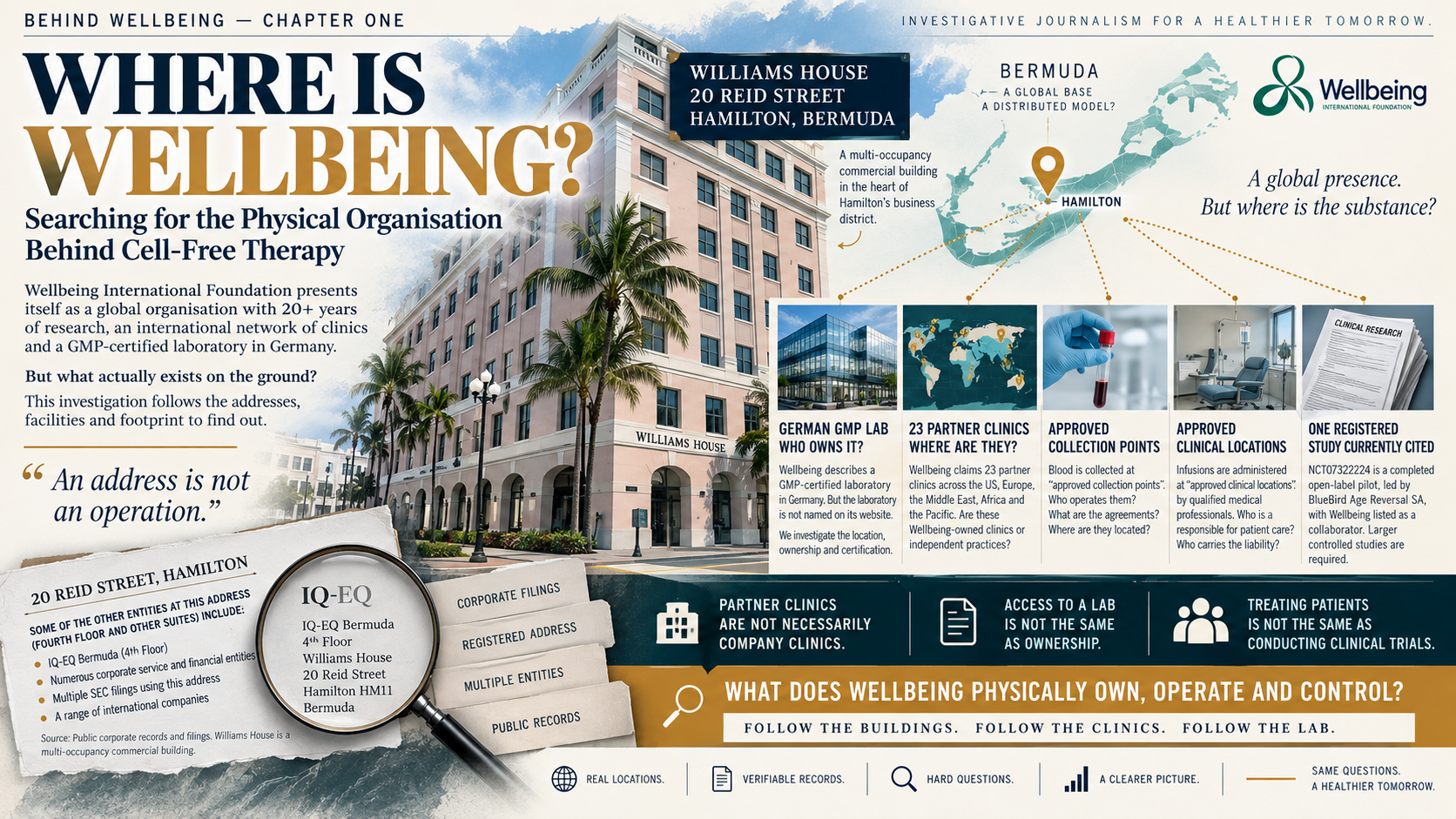
Wellbeing International Foundation describes more than twenty years of research, a German GMP-certified laboratory and an international network of partner clinics. But when you strip away the website, the scientific language and the global map, what does Wellbeing itself physically own and operate? This new investigation starts with a simple question that turns out to be surprisingly difficult to answer: where, exactly, is Wellbeing?
Sometimes the most revealing questions are the simplest.
For months, I have investigated the people behind Wellbeing International Foundation.
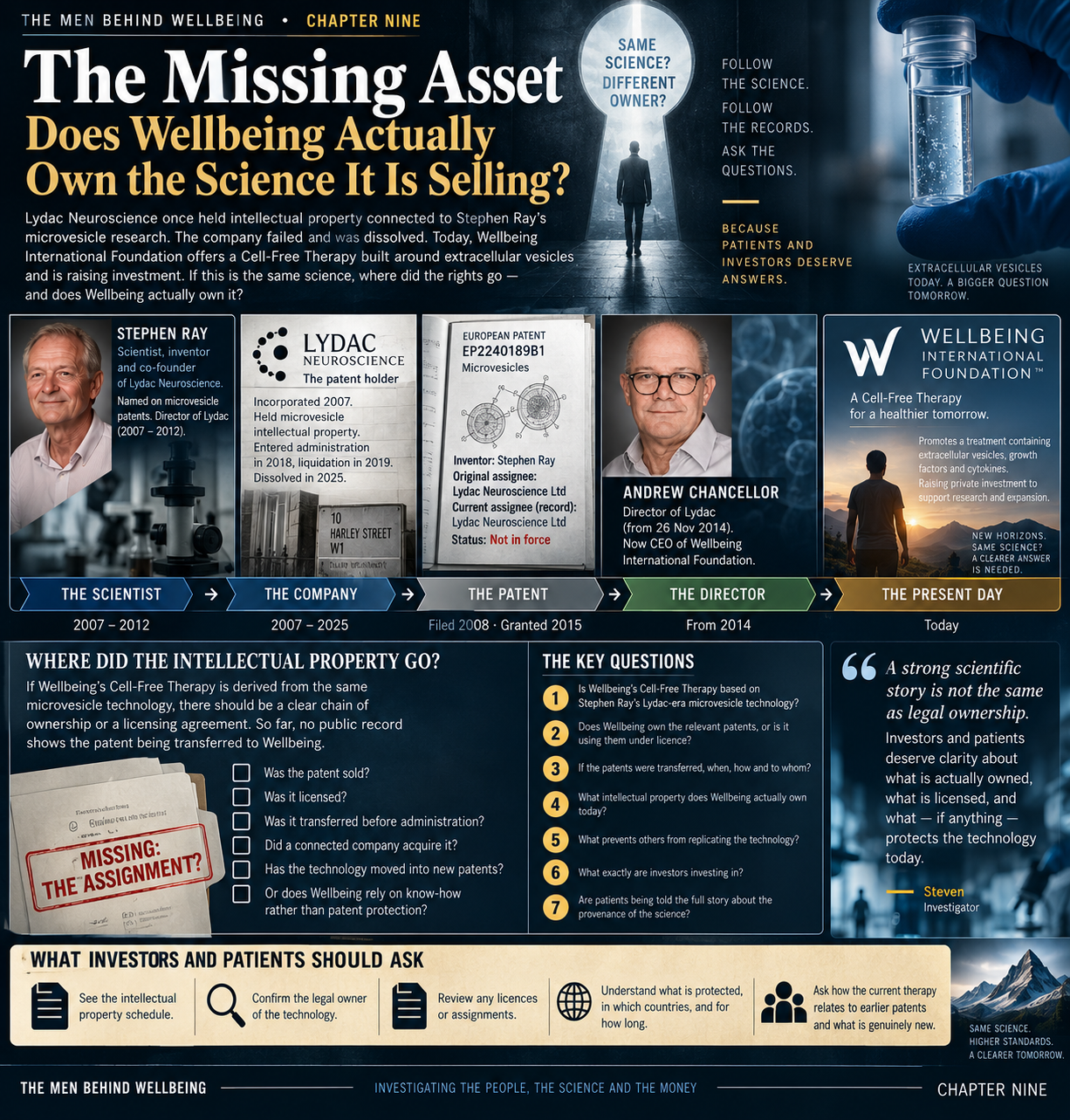
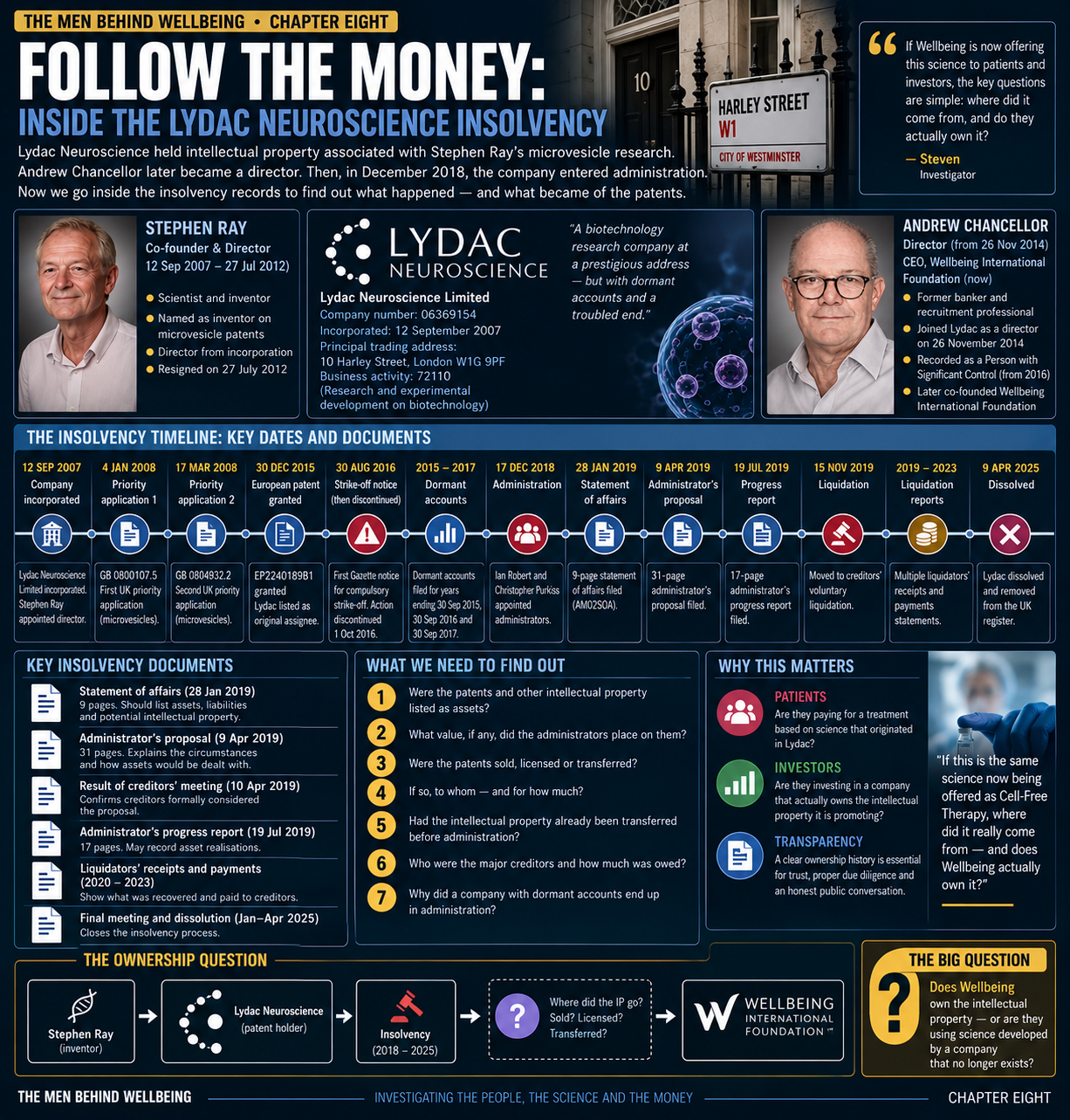
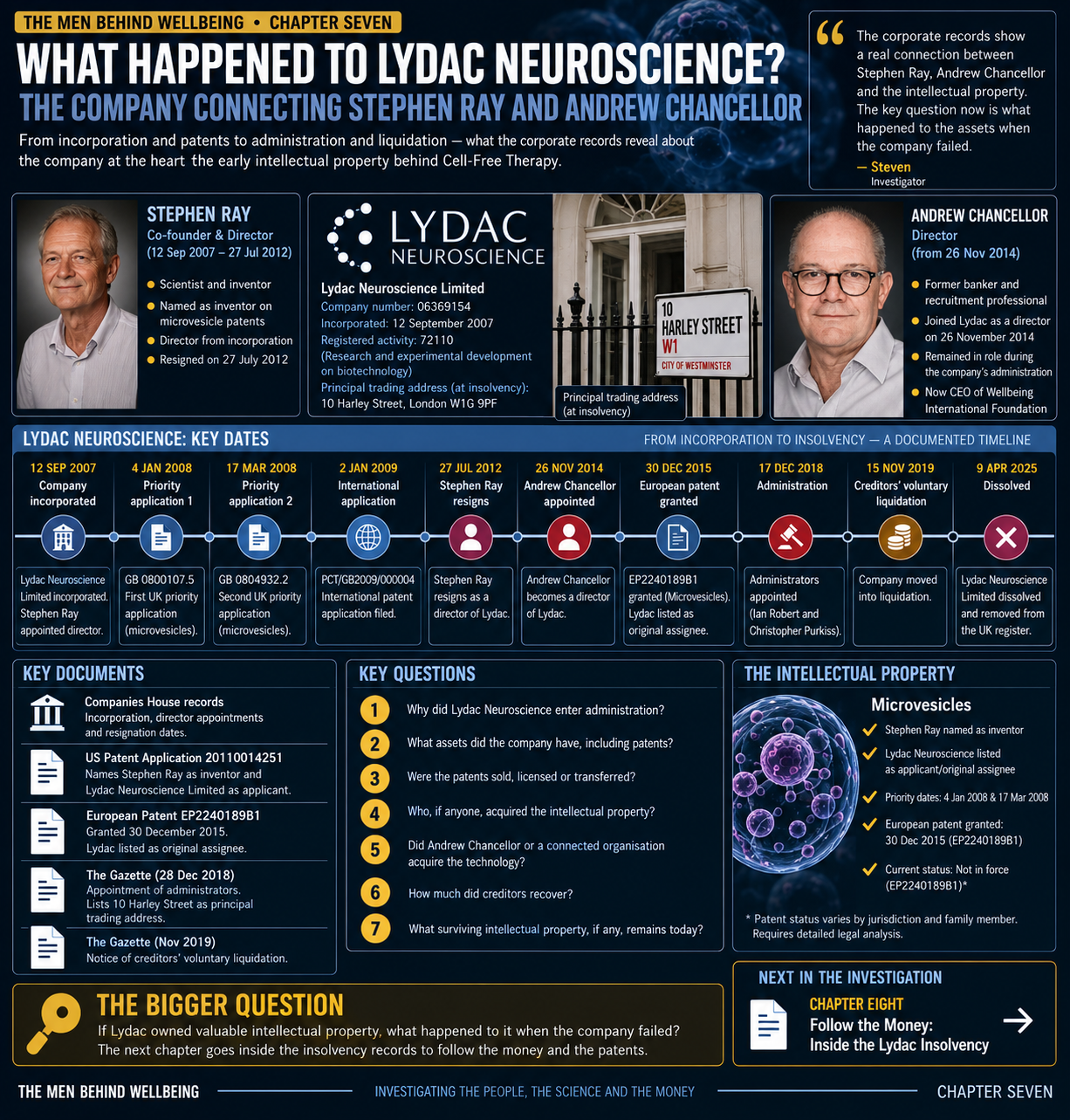
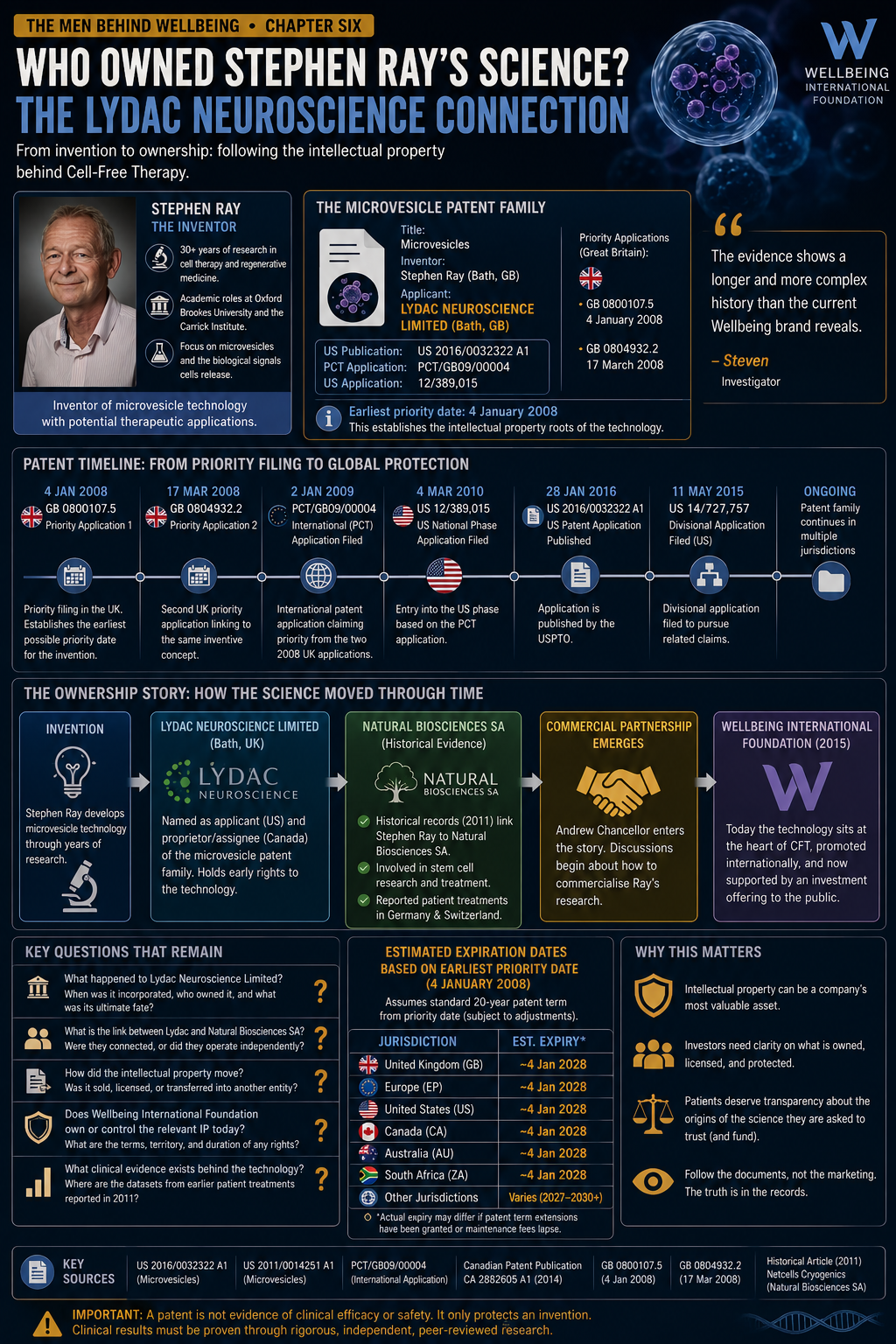
I have followed Andrew Chancellor.
Stephen Ray.
The patents.
Lydac Neuroscience.
The science.
The investment proposition.
But while researching the organisation, another question kept returning.
Where is Wellbeing?
Not where its website can be accessed.
Not where a patient can apparently receive an infusion.
Not where one of its partners operates.
I mean something much more literal.
Where is the organisation?
Where are its offices?
Where are its laboratories?
Where are its clinics?
Where are its doctors?
Where are its researchers?
And which of those facilities does Wellbeing International Foundation actually own, lease, operate or control?
That question begins a completely new investigation.
What Wellbeing Presents to the World
Wellbeing's current website presents an international regenerative-medicine organisation.
Its About page states:
20+ years of research.
20+ delivery locations.
A GMP-certified laboratory.
And a worldwide network of 23 partner clinics.
It lists locations across the United States including Austin, Dallas, Detroit, Los Angeles, Louisville, New Orleans, New York, Philadelphia, Reno, San Francisco, Seattle, St Louis and Virginia Beach.
European locations include Dresden, Faro, Lisbon, London, Monaco and Nice.
Dubai, Johannesburg and New Zealand are also listed. (Wellbeing International Foundation)
At first glance, that is an impressive international footprint.
But look more carefully at the terminology.
It doesn't say:
23 Wellbeing clinics.
It says:
23 partner clinics.
That is a very different proposition.
A Network Is Not Necessarily an Estate
There is nothing inherently wrong with operating through partners.
Modern businesses do it constantly.
A company can build a large international operation without owning every building from which its service is delivered.
Indeed, an asset-light business can sometimes scale much faster precisely because it doesn't need to purchase clinics, employ every physician or construct laboratories in every country.
But if that is Wellbeing's model, patients and prospective investors should understand it accurately.
Because there is an enormous difference between saying:
“We operate internationally through 23 partner clinics.”
and creating the impression of an organisation possessing an international estate of clinical facilities.
The first question of this investigation is therefore simple:
How much of Wellbeing's international footprint actually belongs to Wellbeing?
Start at Headquarters
Wellbeing's current contact page identifies its headquarters as:
Hamilton, Bermuda.
Interestingly, that page currently provides no street address for the headquarters. It simply gives the organisation's name, Hamilton, Bermuda and an email address. (Wellbeing International Foundation)
Elsewhere in Wellbeing's public history, Williams House in Hamilton has been associated with the organisation.
That gives us somewhere to investigate.
But finding an address is only the beginning.
A corporate address does not automatically tell us the nature of the operation conducted there.
It could be a substantial operational headquarters.
It could contain executives and administrative staff.
It could be a serviced office.
It could be a shared business centre.
It could primarily provide corporate administration or correspondence facilities.
All of those arrangements can be perfectly legitimate.
What matters is establishing which description is accurate.
What Actually Happens in Bermuda?
This is where the questions begin.
How many Wellbeing employees work from Bermuda?
Does Andrew Chancellor routinely work from the Hamilton headquarters?
Does the scientific team operate there?
Are patients ever seen there?
Is any CFT processing performed there?
Is biological material stored there?
Are clinical records maintained there?
Is there laboratory infrastructure?
Or is Bermuda primarily the corporate and administrative centre of the organisation?
None of those possibilities should be assumed.
They should be documented.
Because when an organisation presents itself internationally, the difference between its registered presence and its operational presence matters.
Then Look for the Clinics
Wellbeing makes the position clearer on its own website.
Its current About page says it delivers through:
“a network of more than twenty partner clinics”
and later describes:
“a delivery network of 23 partner clinics.” (Wellbeing International Foundation)
This is significant.
Wellbeing isn't presently describing these locations as an estate of clinics it owns.
It is describing a network.
That immediately changes the question.
Instead of asking:
Where are Wellbeing's 23 clinics?
we need to ask:
Who owns the 23 clinics through which Wellbeing operates?
The Treatment Process Provides Another Clue
Wellbeing's own description of the CFT journey says a patient's blood draw takes place at an:
“approved collection point.”
The sample is then transported under controlled conditions to the GMP laboratory in Germany. (Wellbeing International Foundation)
Again, the terminology is important.
Approved collection point.
Not necessarily:
Wellbeing clinic.
This begins to reveal a potentially very different organisation from the conventional image of an international medical group.
It may be a distributed network connecting separate components.
Patients.
Collection sites.
A laboratory partner.
Independent clinics.
Physicians.
Logistics.
And a central organisation coordinating the process.
If that is the model, there is nothing inherently improper about it.
But that is the model we need to investigate.
Wellbeing Is Actively Recruiting Existing Clinics
The physician section of Wellbeing's website provides perhaps the clearest indication of how this network is being expanded.
Wellbeing markets CFT directly to practitioners who already provide PRP and regenerative services.
It describes CFT as a premium addition to an existing PRP practice.
Its partnership programme includes a tier specifically aimed at:
“High-Volume PRP Practitioners.”
The business benefits promoted to potential partners include a premium service offering, recurring annual revenue through cell banking, repeat infusions and marketing and patient-acquisition support. (Wellbeing International Foundation)
That is commercially interesting.
It suggests Wellbeing can potentially expand its geographical reach without building a new Wellbeing clinic in every city.
Instead, an established clinic joins the network.
From a business perspective, that could be extremely efficient.
From an investigative perspective, however, it means the phrase “global presence” requires some unpacking.
Twenty-Three Locations Does Not Necessarily Mean Twenty-Three Wellbeing Facilities
Imagine an independent regenerative-medicine clinic in California.
It already has doctors.
Treatment rooms.
Nurses.
Insurance.
Patients.
PRP equipment.
Clinical licences.
It then becomes a Wellbeing partner and begins offering CFT.
Wellbeing can now legitimately have a clinical relationship in that city.
But the bricks and mortar still belong to somebody else.
The clinicians may work for somebody else.
The medical licences may belong to somebody else.
The clinic's patient database may belong to somebody else.
The treatment rooms belong to somebody else.
That doesn't make the partnership meaningless.
But it means we need to distinguish between:
reach
and:
ownership.
Those are not the same thing.
So Who Actually Treats a Wellbeing Patient?
This becomes one of the most important questions.
A patient contacts Wellbeing.
They go through an initial consultation.
Blood is collected.
The sample travels to Germany.
It is processed.
The resulting preparation returns.
The patient receives an intravenous administration.
But who medically treats that patient?
Who is the physician of record?
Who employs the physician?
Who carries professional indemnity?
Who determines whether the patient is medically suitable?
Who stores the clinical notes?
Who reports an adverse reaction?
Who provides emergency care if something goes wrong?
And under whose clinical licence is the procedure performed?
Those questions become especially important when medical services cross company and national boundaries.
Then We Reach Germany
If the partner clinics form one side of the Wellbeing model, the German laboratory appears to form another.
Wellbeing's contact page currently describes:
“Germany (Laboratory)”
followed by:
“State-of-the-art GMP-certified laboratory for cell-free preparation processing.” (Wellbeing International Foundation)
Its About page is more revealing.
It says day-to-day operations are coordinated between Wellbeing's central team, the:
“German GMP-certified laboratory partner”
and the clinician network. (Wellbeing International Foundation)
That single word matters.
Partner.
This appears to indicate that the German laboratory is a laboratory partner, rather than establishing from the website that Wellbeing itself owns the facility.
If so, that is not necessarily a problem.
Biotechnology companies frequently outsource manufacturing and processing to specialist facilities.
But now we need to know who that partner is.
What Is the German Laboratory Called?
This is one of the most obvious questions raised by the public website.
On the pages reviewed for this article, Wellbeing repeatedly refers to the German GMP-certified laboratory.
But the current contact page doesn't identify its corporate name or street address. (Wellbeing International Foundation)
So let's find it.
What company operates it?
Where in Germany is it?
Who owns it?
Which regulatory authority oversees it?
What GMP certificate does it hold?
What exactly is the scope of that certification?
Does the certification specifically cover the processes relevant to CFT?
How many people work there?
And what contractual relationship exists between the laboratory and Wellbeing?
These questions are not peripheral.
The laboratory appears to be one of the most important physical components in the entire CFT process.
“GMP Certified” Is Not the End of the Question
GMP means Good Manufacturing Practice.
It is an important concept in pharmaceutical and biological manufacturing.
But simply seeing the letters GMP should not end an investigation.
Certification has a scope.
Facilities have authorised activities.
Certificates have issuing authorities.
Inspections have dates.
Products and processes can fall into different regulatory categories.
Therefore we should be able to move beyond:
“GMP-certified laboratory in Germany.”
We should be able to identify the actual facility and examine the documentation supporting that description.
That will be one of the next stages of this series.
Now Look at the Research
Wellbeing currently says it has invested:
“20+ years of ongoing research into autologous biological preparations.” (Wellbeing International Foundation)
Its Research Library is substantial.
At the time of this investigation it contained 235 papers across 11 fields of research, including work on extracellular vesicles, ageing, orthopaedics, manufacturing and related regenerative biology. (Wellbeing International Foundation)
But there is an important distinction.
A research library demonstrates that a scientific field has a literature.
It does not mean Wellbeing conducted all of that research.
Much of the library consists of papers produced by independent researchers around the world. (Wellbeing International Foundation)
So another part of this investigation will separate three different things:
research about extracellular-vesicle biology;
research involving Wellbeing personnel;
and:
clinical research specifically testing Wellbeing's CFT.
Those categories should never be treated as interchangeable.
There Is Now a Clinical Study
This point also needs to be corrected carefully because the public record has developed.
It would be wrong to say Wellbeing has no clinical study.
Wellbeing currently identifies the protocol registration NCT07322224 and cites a peer-reviewed pilot published in Frontiers in Aging in June 2026. (Wellbeing International Foundation)
The study involved a 17-week multimodal longevity programme.
Sixteen healthy adults enrolled.
Fourteen completed it.
It was single-arm and open-label.
Most importantly, the programme combined several interventions:
lifestyle optimisation;
supplementation;
and intravenous administration of autologous pro-regenerative cell-conditioned media.
Wellbeing itself correctly acknowledges that the reported changes reflect the entire multimodal programme, not CFT in isolation. (Wellbeing International Foundation)
That is an important scientific limitation.
Wellbeing Makes an Interesting Admission
Its current About page contains a particularly useful statement.
Wellbeing says:
“The peer-reviewed pilot named above is the only clinical study we cite.” (Wellbeing International Foundation)
That deserves attention.
The same organisation describes:
20+ years of research.
Yet its current public position identifies one clinical study that it cites.
That doesn't mean twenty years of research didn't occur.
Laboratory research is research.
Preclinical research is research.
Method development is research.
Scientific observation is research.
But clinical trials are a particular form of research.
And treating patients over many years is not automatically equivalent to conducting controlled clinical trials.
That distinction will become central to this series.
Testimonials Are Not Clinical Evidence
Interestingly, Wellbeing itself now makes this distinction.
Its About page says its testimonials and case studies are patient-reported accounts and explicitly says they are not offered as evidence of efficacy. (Wellbeing International Foundation)
That is an appropriate distinction.
A patient can sincerely report feeling dramatically better.
An athlete can sincerely believe treatment transformed their recovery.
Those experiences may be important to the individuals concerned.
But they don't substitute for controlled clinical evidence.
So if Wellbeing refers to years of clinical experience, we need to understand exactly what evidence was generated during those years.
Where Are the Researchers?
Then comes another surprisingly basic question.
Where does Wellbeing's research actually happen?
At the German laboratory?
At universities?
At independent research organisations?
At partner clinics?
Through consultants?
Through collaborations?
Wellbeing describes Stephen Ray as its Senior Scientific Consultant and describes a wider team and research programme. (Wellbeing International Foundation)
But if we want to understand the physical substance behind the organisation, we need to identify where that scientific work takes place.
Does Wellbeing operate its own research laboratory?
Does it employ laboratory scientists directly?
Does it own research equipment?
Does it maintain dedicated scientific facilities?
Or is the research function itself largely collaborative and outsourced?
Once again, neither structure is automatically problematic.
But they represent very different kinds of biotechnology organisation.
Perhaps We Have Been Looking at Wellbeing the Wrong Way
This investigation may ultimately reveal something relatively straightforward.
Perhaps Wellbeing isn't intended to resemble a traditional clinic group at all.
Perhaps it is essentially a coordinating organisation.
A central team.
A scientific protocol.
A laboratory partnership.
A network of clinicians.
Independent treatment facilities.
Logistics.
Patient relationships.
Research collaborations.
And intellectual know-how.
That could be a viable business model.
Indeed, it could explain how an organisation can develop a presence across numerous cities without constructing clinics around the world.
But it would also mean that when evaluating Wellbeing, we shouldn't measure the size of the organisation simply by counting pins on a map.
We should measure what it actually owns and controls.
This Becomes Extremely Important for Investors
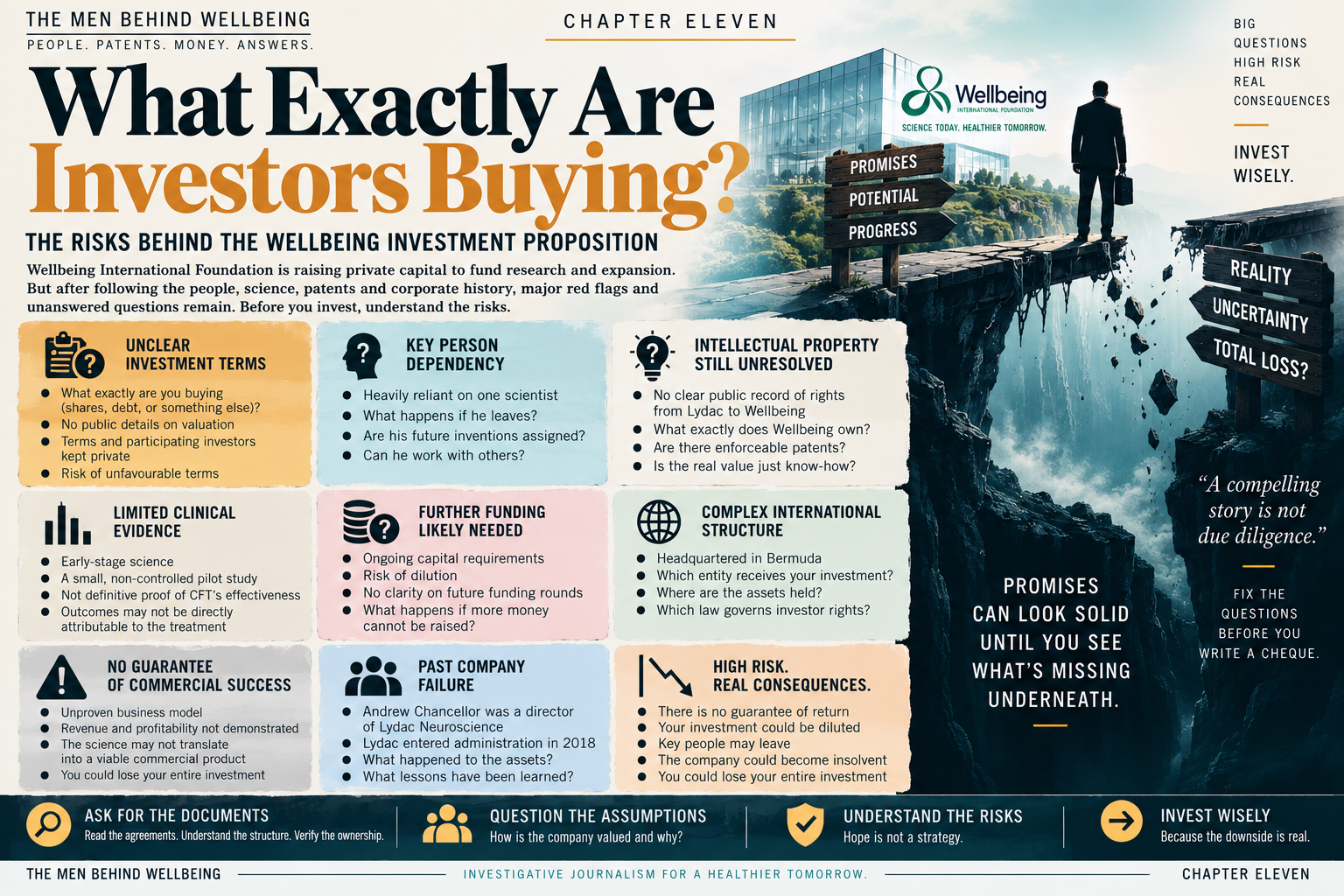
This investigation follows directly from our previous examination of Wellbeing's 2026 capital round.
Wellbeing confirmed in March 2026 that private capital is supporting continued research, expansion of its clinical-relationship network, documentation work and operational capacity. (Wellbeing International Foundation)
Now consider the investment proposition alongside what we are beginning to discover.
If the clinics are independently owned...
if the laboratory is a partner...
if key scientists are consultants...
if treatment is delivered by independent clinicians...
then investors need to understand what assets actually reside inside the entity receiving their money.
That doesn't automatically make it a weak investment.
Some extraordinarily successful companies own relatively little physical infrastructure.
But their value usually rests somewhere else:
proprietary technology;
patents;
exclusive licences;
software;
data;
contracts;
brands;
trade secrets;
or highly defensible intellectual property.
Which brings us straight back to the question we raised in the previous series.
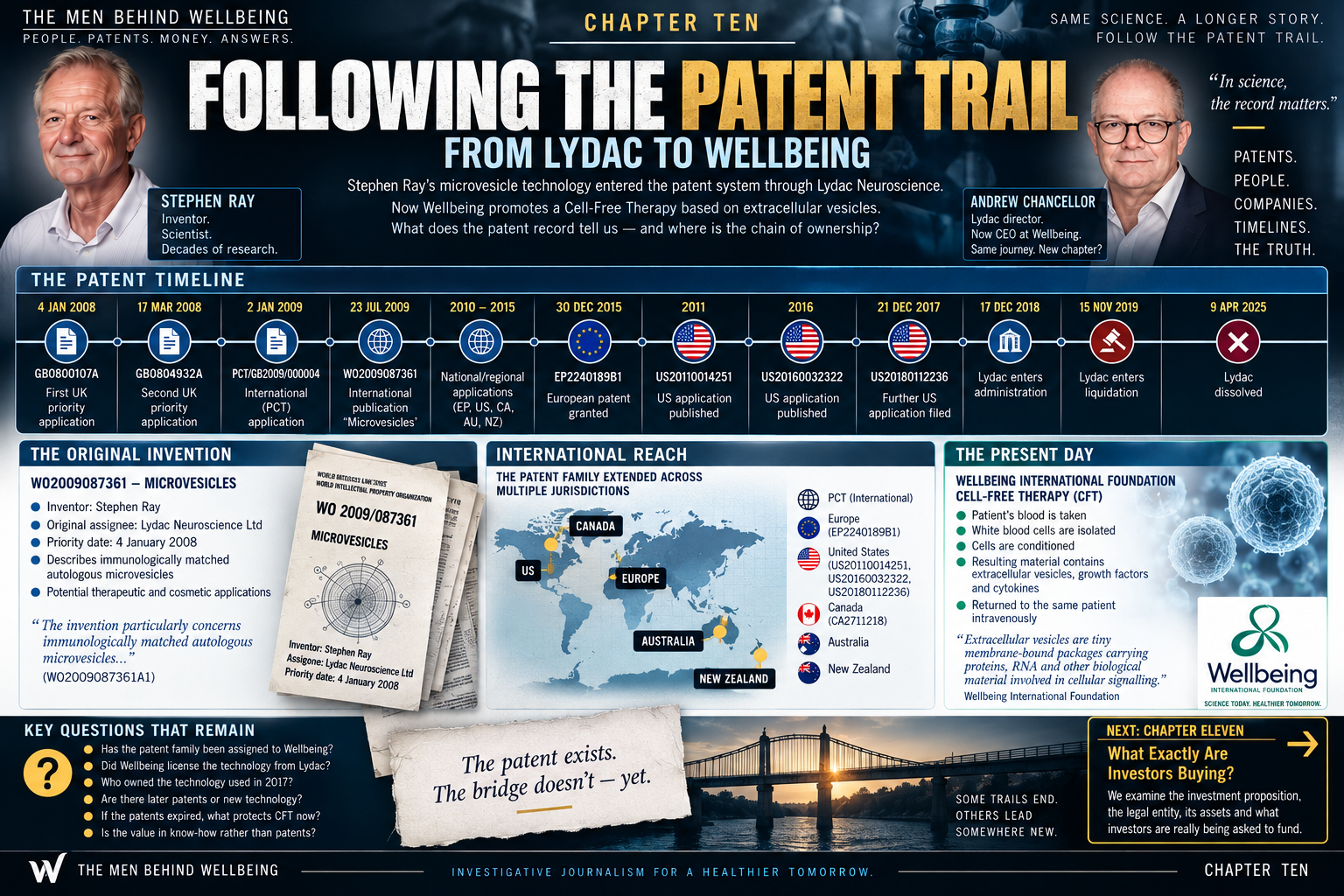
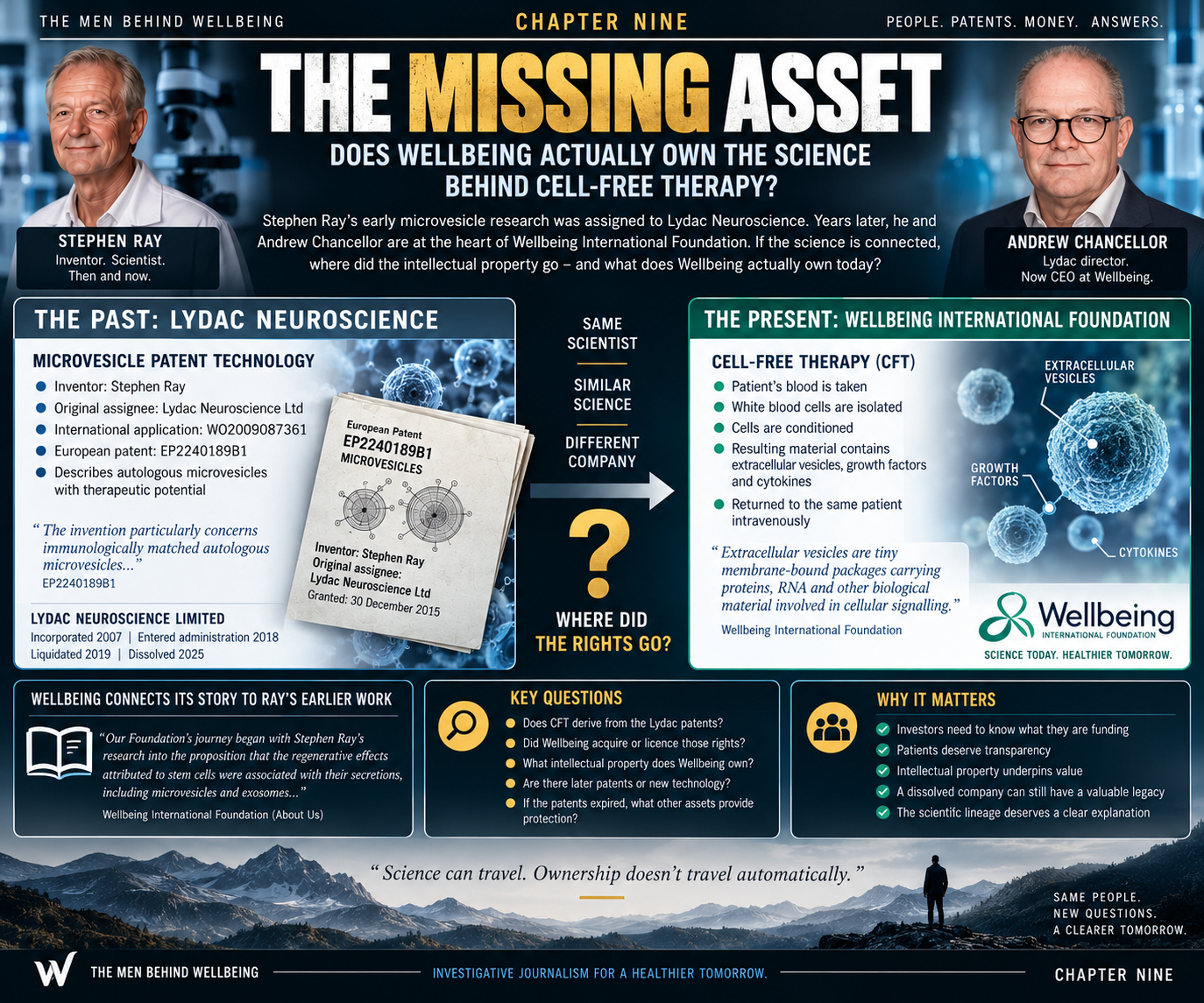
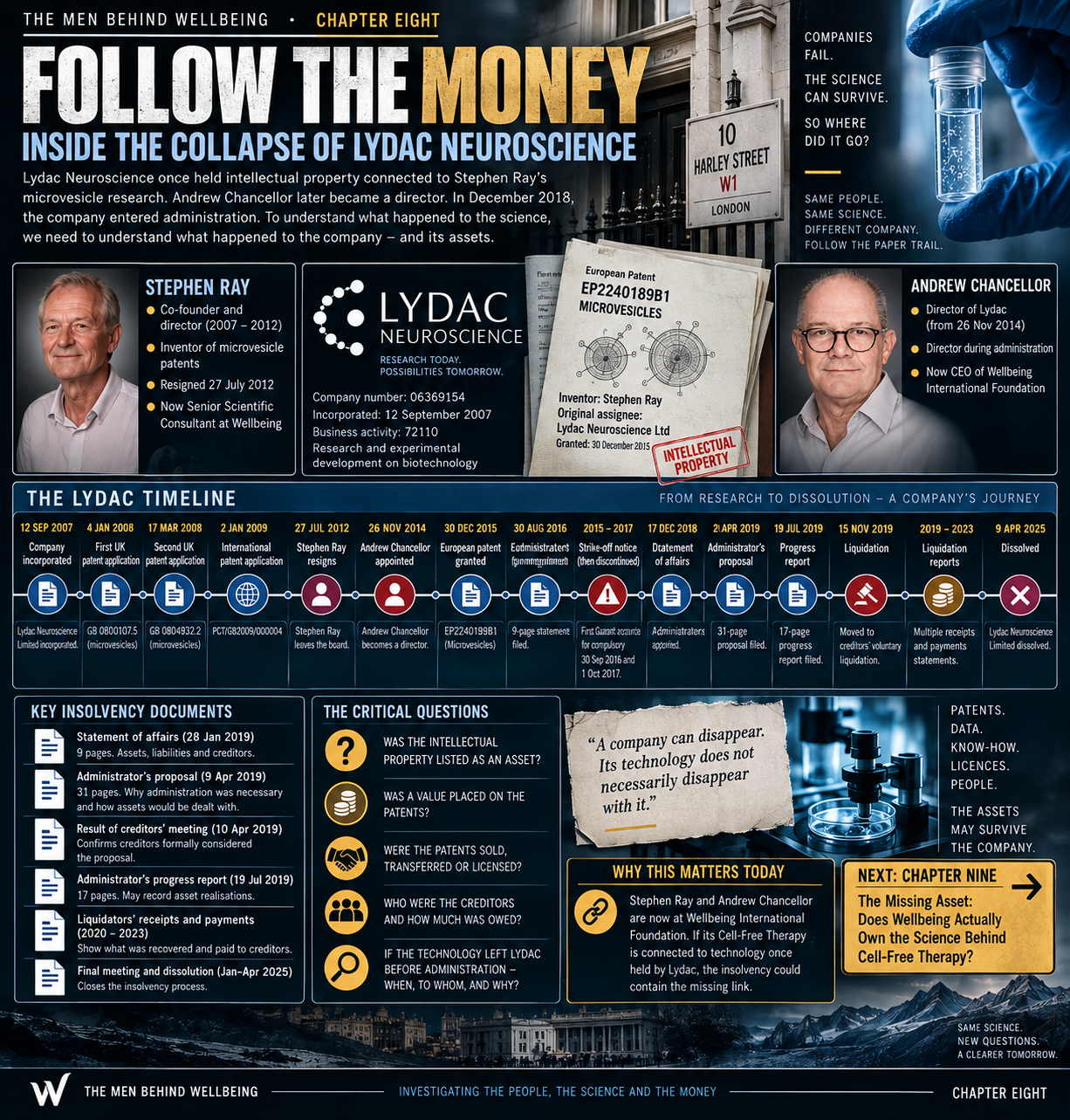
What does Wellbeing actually own?
Compare That With a Conventional Medical Research Institution
Later in this series we will make a proper comparison.
Not an emotional one.
Not:
big hospital good, small company bad.
That would tell us very little.
Instead, we will compare verifiable infrastructure.
When examining an established clinical research institution, we can often identify:
research facilities;
laboratories;
principal investigators;
trial sponsors;
ethics approvals;
registered clinical studies;
manufacturing infrastructure;
medical staff;
clinical sites;
published results;
and institutional ownership.
Then we will apply exactly the same categories to Wellbeing.
The objective isn't to declare that every biotechnology organisation should look like a hospital or university.
It is to determine what kind of organisation Wellbeing actually is.
Twenty-Three Clinics: Let's Identify Every One
Wellbeing has given us an excellent starting point.
It says there are 23 partner clinics.
So let's find them.
One by one.
For each location we can ask:
What is the clinic called?
Who owns it?
Who is the responsible physician?
Does the clinic advertise CFT independently?
When did it join the network?
Is CFT regularly available there?
Does Wellbeing have an exclusive agreement?
Is it simply an infusion location?
Who invoices the patient?
Who carries clinical responsibility?
And what part of the patient's payment remains with the clinic?
By the end of that exercise, we should have a much clearer picture of what “23 partner clinics” actually means.
Then We Find the Laboratory
The same applies to Germany.
Find the company.
Find the facility.
Find the regulator.
Find the certificate.
Find the authorised activities.
Find the ownership.
Find the directors.
Find the relationship with Wellbeing.
And determine exactly what happens to a patient's blood between arrival at the laboratory and departure of the final preparation.
That could become one of the most important chapters in this entire investigation.
Then We Find the Research
Twenty-plus years.
Let's document it.
Not the 235 papers written throughout the wider scientific field.
Wellbeing's own research lineage.
Which experiments?
Which institutions?
Which researchers?
Which publications?
Which clinical protocols?
Which patient cohorts?
Which registered studies?
Which ethics approvals?
Which datasets?
Which results?
And which of those records can be independently verified?
Again, the answer may be substantial.
But the evidence should tell us.
What We Have Established So Far
At this stage, the public record supports several important facts.
Wellbeing identifies Hamilton, Bermuda as its headquarters. (Wellbeing International Foundation)
It describes a German GMP-certified laboratory, and its own About page refers to that facility as a laboratory partner. (Wellbeing International Foundation)
It describes its international treatment presence as a network of 23 partner clinics, rather than stating that it owns 23 clinics. (Wellbeing International Foundation)
Its treatment process uses approved collection points and sends samples to Germany. (Wellbeing International Foundation)
Its physician programme actively recruits established practitioners and promotes CFT as a premium service offering with recurring cell-banking and repeat-infusion revenue opportunities. (Wellbeing International Foundation)
It has a peer-reviewed human pilot associated with its programme, while explicitly acknowledging that the results apply to the entire multimodal protocol rather than CFT alone. (Wellbeing International Foundation)
And Wellbeing itself currently says that this pilot is the only clinical study it cites. (Wellbeing International Foundation)
Those are facts.
The conclusions come later.
What We Have Not Established
We have not established that Wellbeing is merely a virtual organisation.
We have not established that its headquarters is only a registered address.
We have not established that its partner clinics are improperly described.
We have not established that the German laboratory lacks appropriate certification.
We have not established that Wellbeing lacks genuine scientific infrastructure.
We have not established that its distributed business model is inappropriate.
And we have not established that its claimed research history is false.
Those questions require further evidence.
That is precisely what this series will investigate.
Questions for Wellbeing
There is a straightforward way for Wellbeing International Foundation to clarify much of this.
What is the complete legal identity and registration number of Wellbeing International Foundation?
What physical premises does Wellbeing itself currently own or lease?
How many people work from its Bermuda headquarters?
What operations are actually conducted there?
Does Wellbeing own any of the 23 partner clinics?
Can Wellbeing identify all 23 clinics publicly?
Who owns and operates the German GMP-certified laboratory?
What is the laboratory's full legal name and address?
Which authority issued its GMP certification?
What precisely does that certification cover?
Does Wellbeing operate its own research laboratory anywhere?
How many scientists does Wellbeing employ directly rather than engage as consultants or collaborators?
Which clinical studies specifically investigating CFT have been conducted during the claimed research history?
And which physical and intellectual assets are actually owned by Wellbeing itself?
Clear answers would substantially improve public understanding of the organisation.
Conclusion: Find the Organisation
This investigation isn't about whether an organisation needs a marble headquarters or its own hospital.
It doesn't.
It isn't about suggesting that outsourcing is suspicious.
It isn't.
And it isn't about arguing that a biotechnology company must own every laboratory or clinic it uses.
Many don't.
The question is much simpler.
What is Wellbeing International Foundation?
Is it principally a biotechnology research company?
A medical-services organisation?
An intellectual-property business?
A treatment-network coordinator?
A licensing operation?
A research foundation?
A commercial patient-services network?
Or some combination of these?
Twenty-three partner clinics can create an impressive international map.
But partner clinics are not necessarily company-owned clinics.
A laboratory partnership provides access to sophisticated infrastructure.
But access is not necessarily ownership.
Twenty years of research can represent an enormous body of work.
But research in the wider scientific field is not necessarily research conducted by the organisation itself.
And an address in Bermuda establishes a corporate presence.
It does not, by itself, tell us what happens behind the door.
So this new investigation will do something very simple.
We are going to find Wellbeing.
Building by building.
Clinic by clinic.
Scientist by scientist.
Study by study.
Contract by contract.
And laboratory by laboratory.
Because before patients put their trust in an organisation—and before investors put their money into it—they should be able to answer one extraordinarily basic question:
What physically exists behind the name Wellbeing International Foundation?
Next: Chapter Two — The Clinics That Aren't Wellbeing Clinics
Wellbeing says its international reach includes 23 partner clinics. In Chapter Two, we start identifying them. Who owns them? Who employs the doctors? Which clinics publicly advertise Cell-Free Therapy? Which are collection points, which administer infusions, and which are something else entirely? Most importantly: when Wellbeing says it has a global clinical network, how much of that network does Wellbeing itself actually own or control?
Recent Posts