What Exactly Are Investors Buying?
The Men Behind Wellbeing — Chapter Eleven
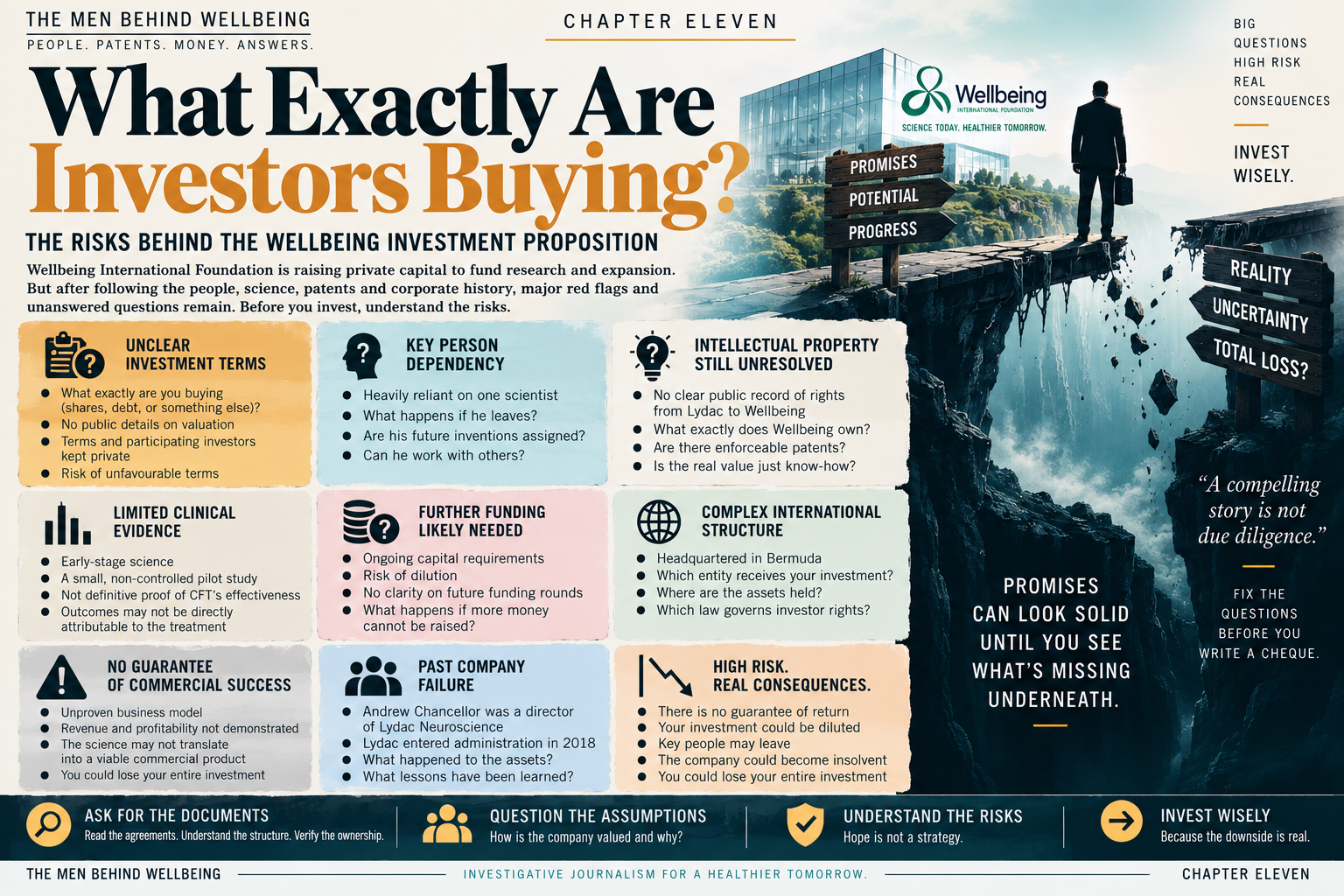
Wellbeing International Foundation has confirmed that it is raising private investment to fund research, clinical relationships and its continuing operations. But after following the people, patents and corporate history behind the organisation, a much more basic question emerges: before an investor transfers their money, what exactly are they buying?
By Steven
There is a point in almost every biotechnology story where science becomes finance.
The language changes.
Research becomes opportunity.
Experiments become potential.
Clinical networks become scalability.
Intellectual property becomes valuation.
And people who were previously being asked to believe in the science are suddenly being asked to put money behind it.
Wellbeing International Foundation reached that point publicly in March 2026.
The organisation announced that it had closed the opening tranche of its 2026 capital round. It also confirmed that the round remained open at the time of the announcement. Wellbeing said the money would support its research programme, expansion of clinical relationships in the United States and Europe, documentation work and the operational capacity required to support its existing patient population. (Wellbeing International Foundation)
There is nothing unusual about a biotechnology organisation raising private capital.
Research costs money.
Scientists cost money.
Laboratories cost money.
Clinical studies cost money.
Regulatory work costs money.
International expansion costs money.
The important question isn't why Wellbeing is raising investment.
It is:
What does the investor actually receive in return?
We Know a Funding Round Exists
Wellbeing's announcement is unusually clear about what it does not publicly disclose.
The organisation says that the specific terms, amounts and participating investors are private and held by its legal and finance team. It says detailed investor communication is handled separately from its public news pages and provided directly to parties with a legitimate interest. (Wellbeing International Foundation)
For a privately held organisation, confidentiality around investment terms isn't inherently unusual.
But it creates a limitation for anyone attempting to assess the proposition from the public record.
From Wellbeing's public announcement alone, we cannot establish:
the amount raised;
the valuation applied;
the identity of the investors;
the percentage of ownership issued;
the precise investment instrument;
the rights attached to that investment;
or the financial projections used to support the valuation.
Those answers may exist in private investor documents.
But without those documents, an outside observer cannot properly evaluate the transaction.
And that is where due diligence must begin.
First Question: What Legal Entity Are You Investing In?
Before considering the science, an investor should ask something far more mundane.
What is the exact legal name of the entity receiving my money?
Wellbeing describes itself publicly as privately held, founded in 2015 and headquartered in Bermuda. Its LinkedIn profile identifies Williams House in Bermuda as its primary location. (LinkedIn)
Its website also identifies Hamilton, Bermuda as its headquarters. (Wellbeing International Foundation)
But a brand name and an investment vehicle are not necessarily the same thing.
A prospective investor needs the legal entity's full registration details and constitutional documents.
Then comes the next question.
What is being issued?
Ordinary shares?
Preference shares?
Convertible securities?
Debt?
Some other contractual economic interest?
Until that is known, saying someone has “invested in Wellbeing” tells us remarkably little about what they actually own.
Then Comes the Valuation
Suppose an investor is offered shares.
What is the company worth?
More importantly:
How was that valuation calculated?
Biotechnology valuations can incorporate future potential because early-stage companies may have relatively little current revenue compared with what investors hope their technology could eventually produce.
But that makes the assumptions behind the valuation extremely important.
An investor needs to understand how much value is attributed to:
existing revenue;
the clinical network;
scientific know-how;
intellectual property;
research data;
future treatments;
international expansion;
and future scientific validation.
Without the valuation methodology, an investor is being shown the price without necessarily being able to examine the foundations underneath it.
Intellectual Property Becomes Crucial
This investigation has already uncovered something that becomes considerably more important once money enters the story.
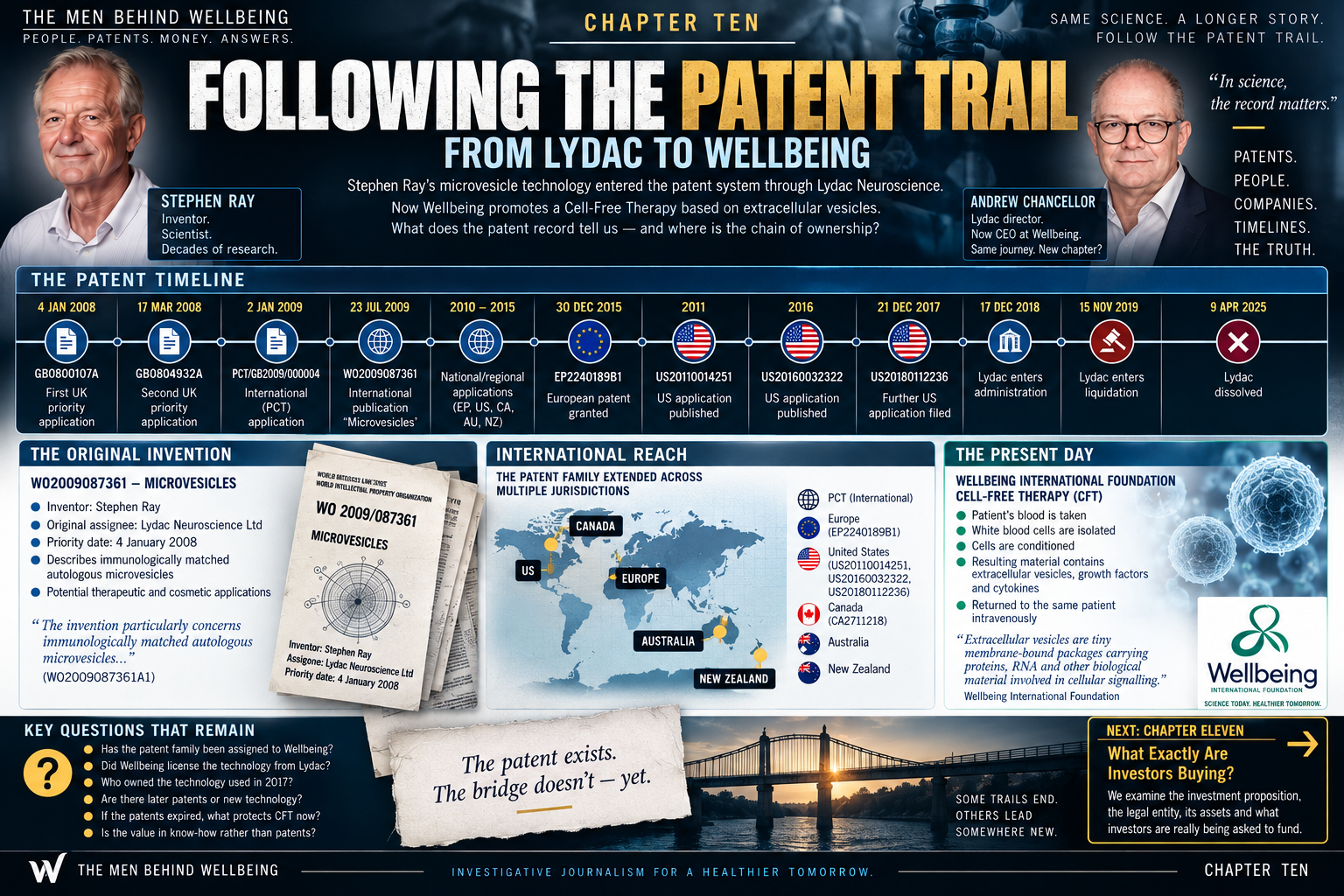
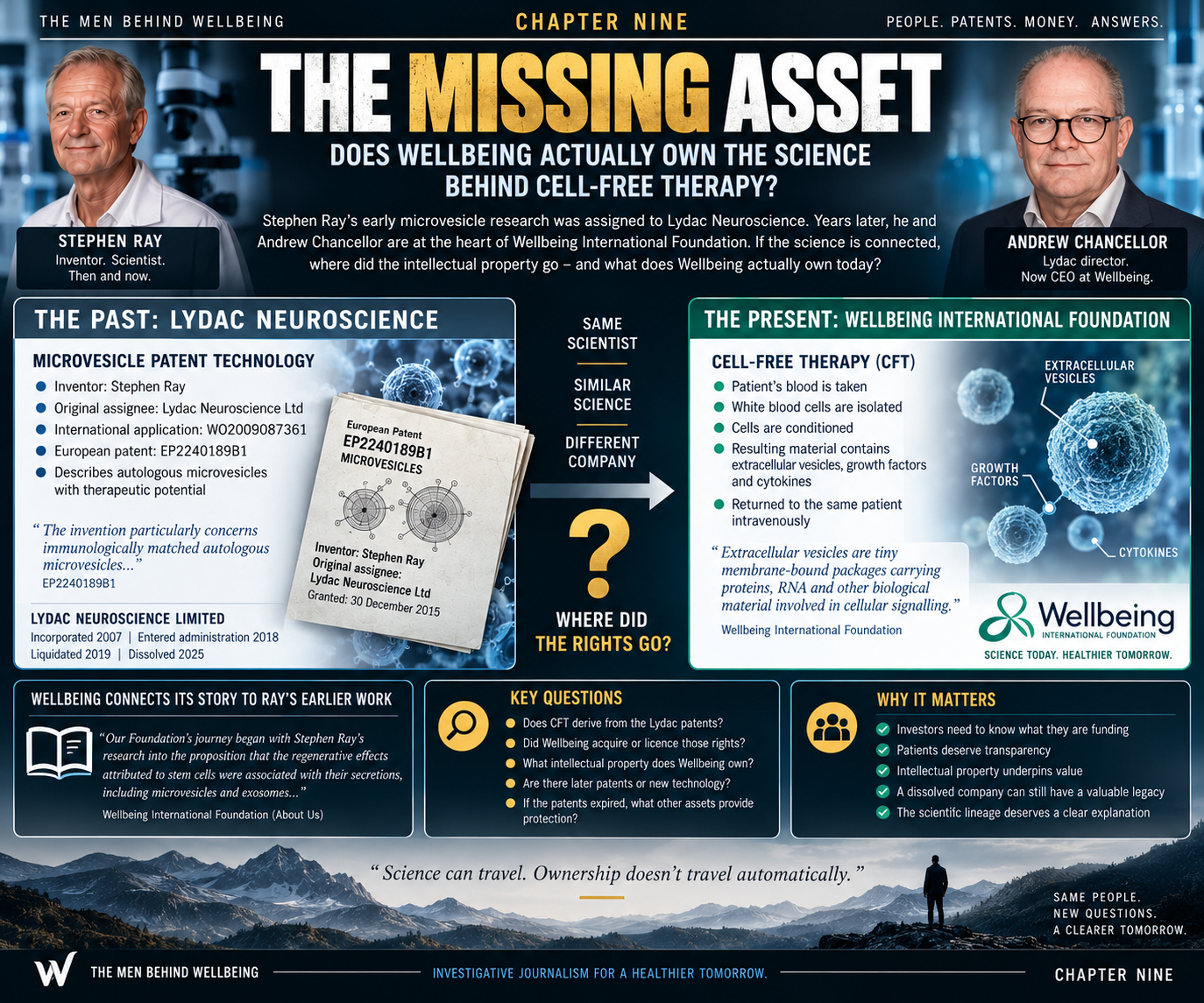
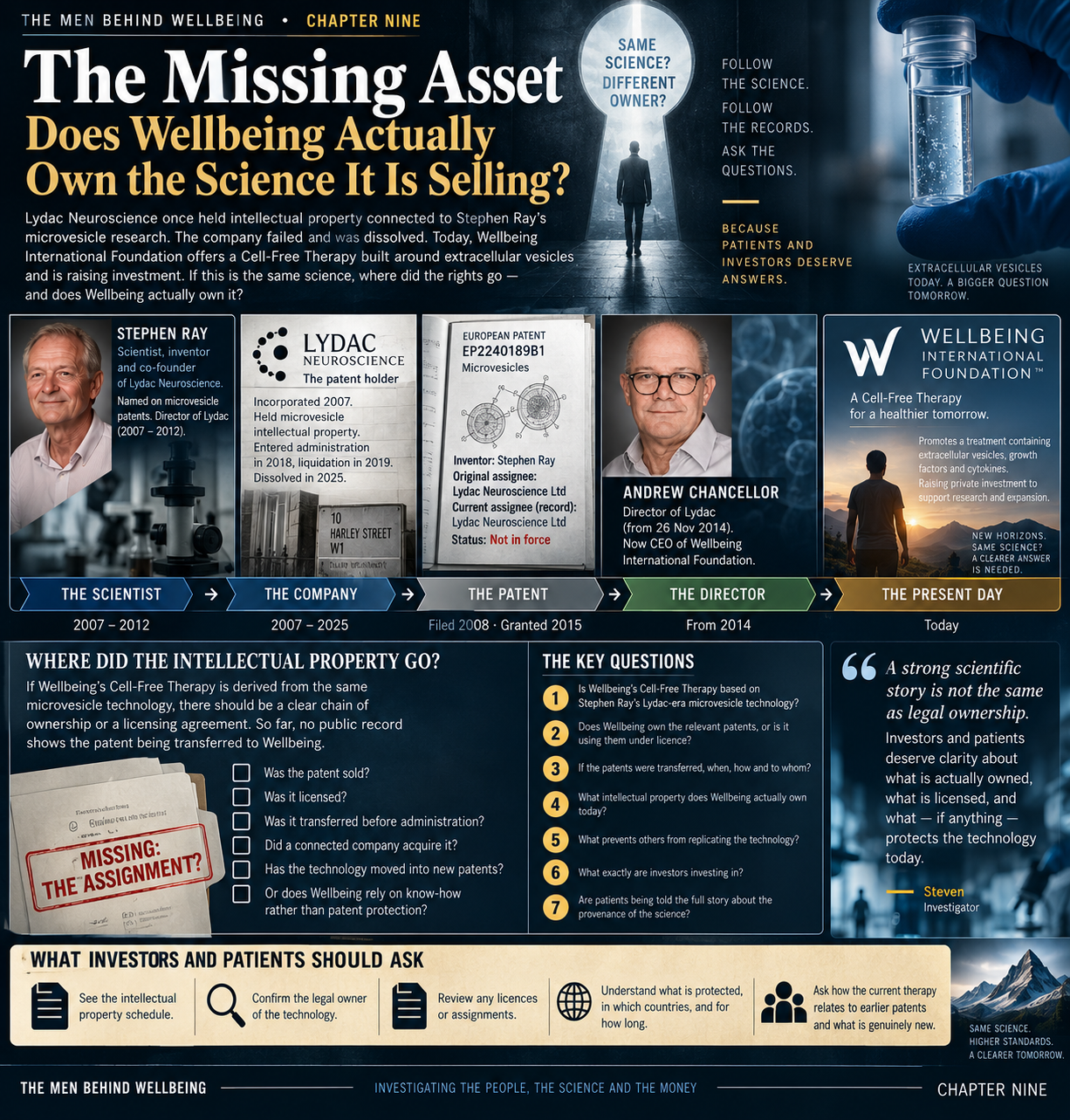
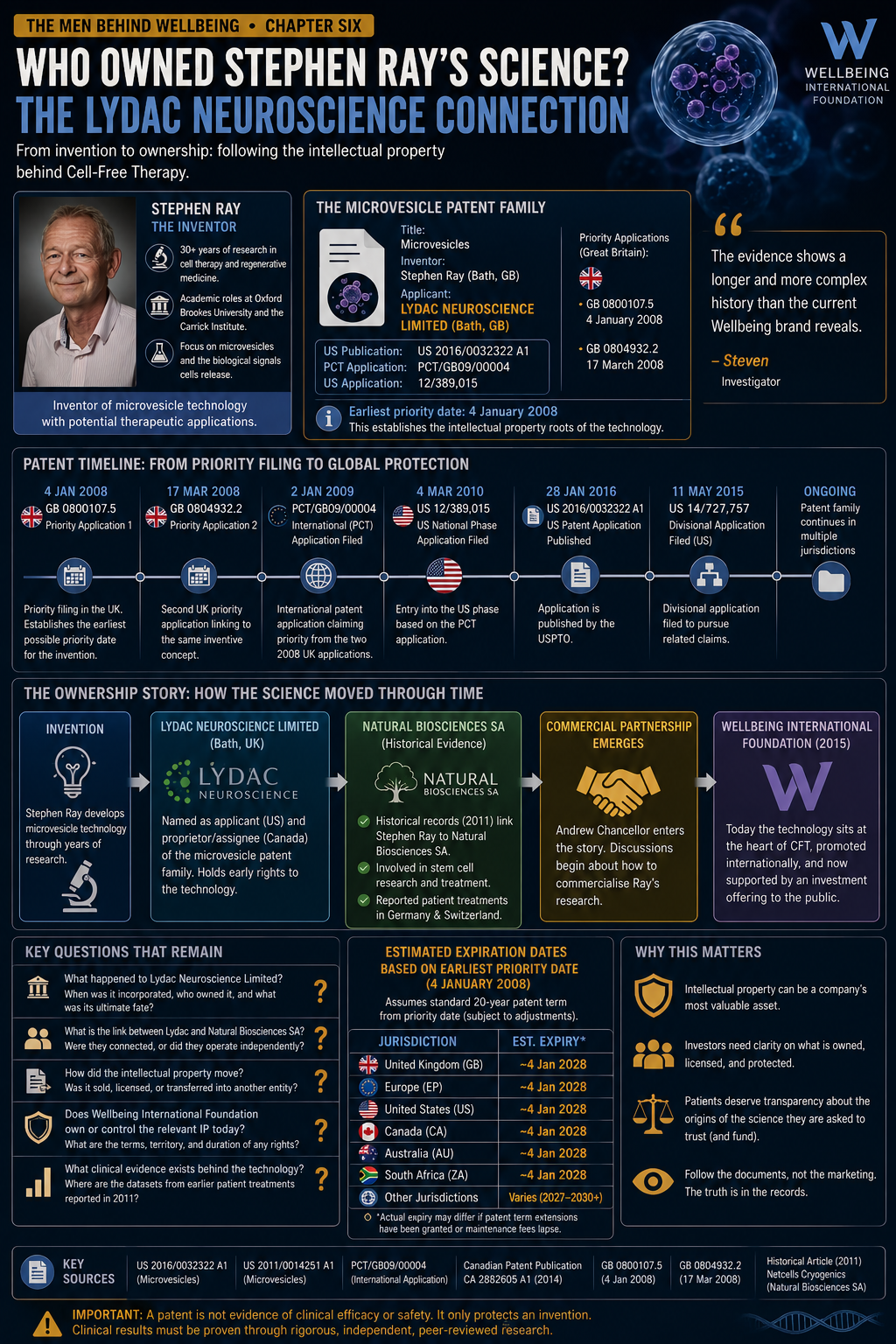
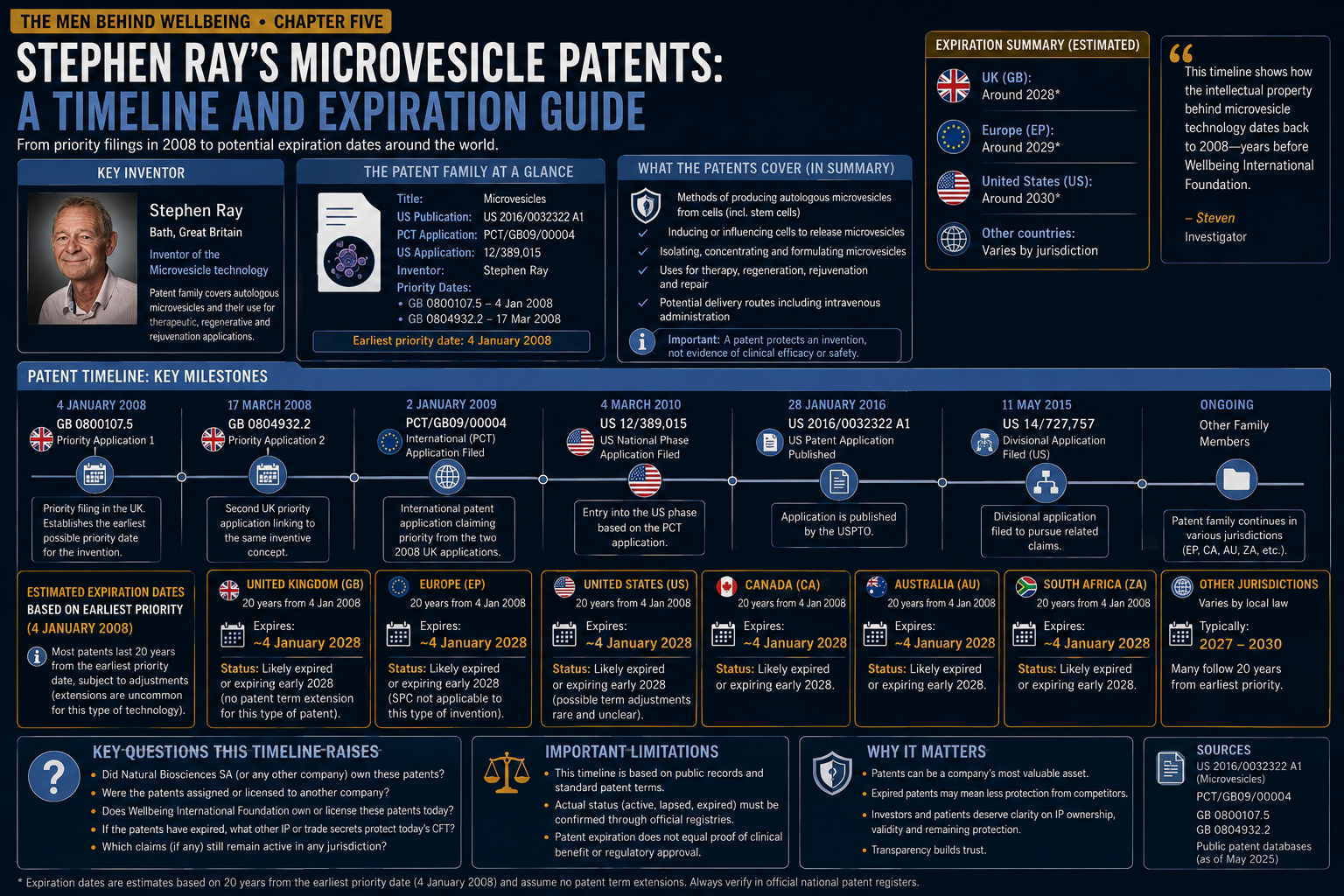
Stephen Ray's historical microvesicle work entered the patent system through Lydac Neuroscience.
Those patents described autologous microvesicle-related biological technology.
Today, Wellbeing describes Cell-Free Therapy as an autologous preparation involving regenerative signalling material, including extracellular-vesicle biology. (Wellbeing International Foundation)
Similarity does not establish that the historical patents cover today's CFT.
It does not establish infringement.
And it does not establish that Wellbeing lacks legitimate rights to its current technology.
But our earlier investigation did not locate, in the public patent material examined, a documented assignment establishing that the historical Lydac patent family was transferred to Wellbeing.
That leaves an obvious investor question:
What proprietary scientific assets does the company being funded actually own?
Perhaps the Old Patents Don't Matter
There is another perfectly plausible possibility.
Perhaps the historical Lydac patents simply aren't commercially important to modern Cell-Free Therapy.
Technology changes.
Patents expire or cease to remain in force.
Manufacturing techniques develop.
New knowledge emerges.
And twenty years of scientific development can make an earlier patent relatively unimportant.
If that's the answer, investors should establish what replaced it.
Is modern CFT protected by newer patents?
Trade secrets?
Confidential processing protocols?
Exclusive licences?
Laboratory agreements?
Proprietary datasets?
Clinical know-how?
Or some combination of these?
Because somewhere inside an investable biotechnology proposition should normally be an answer to a fundamental question:
What stops somebody else doing the same thing?
If the Asset Is Know-How, Who Owns the Know-How?
This becomes particularly important because Stephen Ray remains central to Wellbeing's scientific story.
Wellbeing publicly identifies him as its Senior Consultant Scientist. (Wellbeing International Foundation)
The word consultant deserves attention from an investment perspective.
Not because consultancy is unusual.
It isn't.
But if a significant proportion of the organisation's scientific value resides in knowledge held by an individual consultant, investors should understand the contractual arrangements surrounding that knowledge.
Does Wellbeing own the protocols?
Are inventions automatically assigned?
Does it have exclusive rights to Ray's work?
Who owns improvements?
What happens to the technology if the relationship ends?
Can the knowledge be transferred to another scientific team?
Those are not allegations.
They are basic key-person and intellectual-property questions.
Then Look at the Evidence
Wellbeing now has genuine peer-reviewed human research associated with its programme.
Its 2026 Frontiers in Aging paper studied a 17-week multimodal longevity programme. Sixteen participants enrolled and fourteen completed it.
But the study was single-arm and open-label.
Importantly, the intervention didn't test Cell-Free Therapy by itself.
Participants underwent lifestyle optimisation and supplementation alongside intravenous administration of autologous conditioned media. Wellbeing itself acknowledges that the reported results reflect the complete multimodal programme rather than CFT in isolation. (Wellbeing International Foundation)
That distinction is extremely important for investors.
The paper demonstrates that research is taking place.
It does not, on its own, establish the independent clinical effect or eventual commercial success of CFT.
Wellbeing's current website goes further and explicitly says this peer-reviewed pilot is the only clinical study it cites. (Wellbeing International Foundation)
That gives investors something concrete to assess.
But it also demonstrates how early the publicly cited clinical evidence remains.
A Scientific Field Is Not the Same as a Proprietary Product
Wellbeing maintains an extensive research library covering extracellular vesicles, ageing, regenerative signalling and related biology. (Wellbeing International Foundation)
That literature can establish that the underlying scientific field is real and actively researched.
But papers written by independent researchers do not automatically establish that Wellbeing owns commercially defensible technology.
This distinction matters.
There are really two questions:
Is extracellular-vesicle biology scientifically interesting?
and:
Does Wellbeing own something proprietary and commercially defensible within that field?
Those are not the same question.
An investor should not confuse evidence supporting an area of science with evidence establishing ownership of a particular commercial opportunity.
What Does Wellbeing Physically Control?
There is another issue we are now investigating separately.
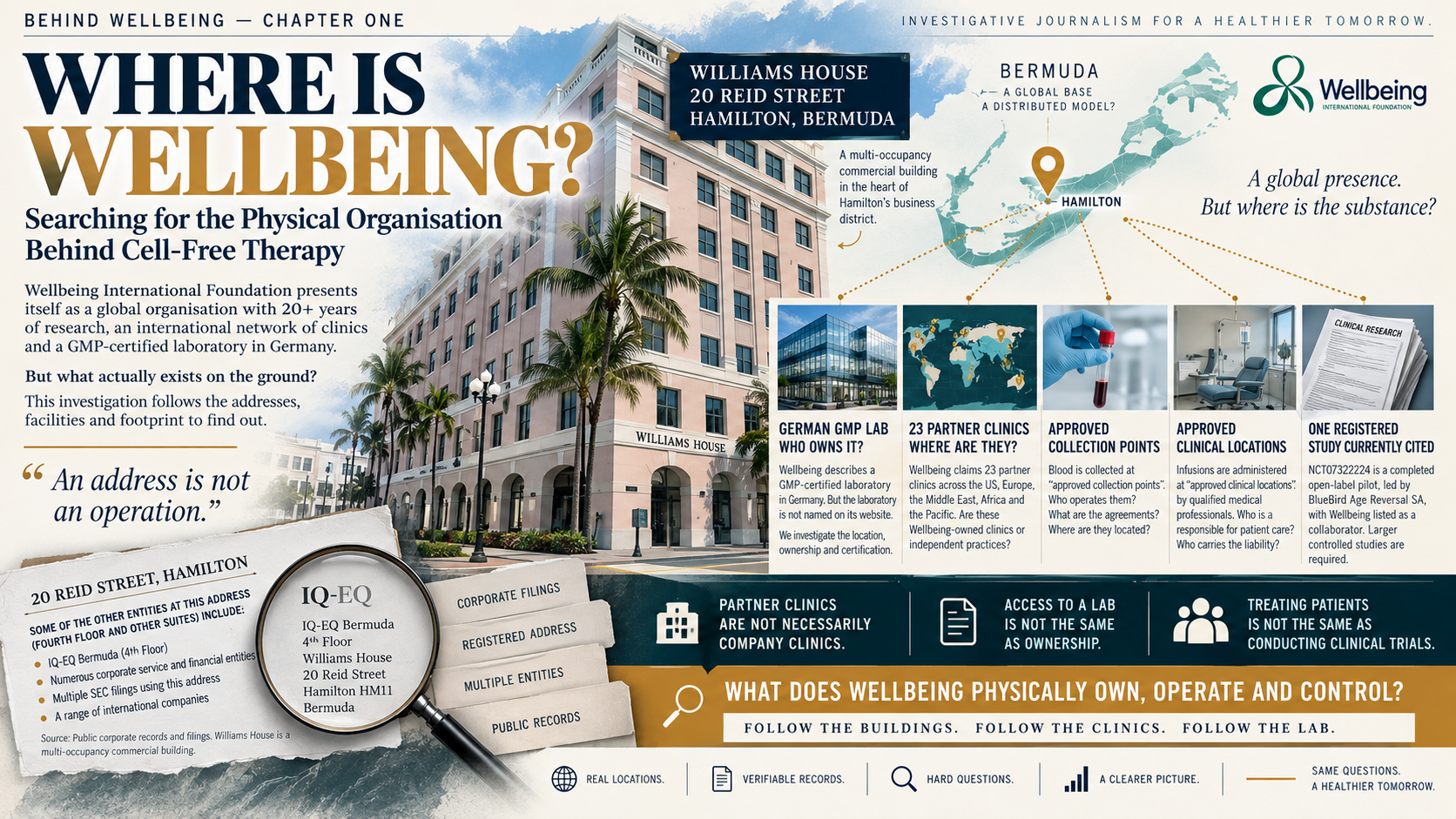
Wellbeing describes a global presence built around a GMP-certified laboratory in Germany and a delivery network of 23 partner clinics. (Wellbeing International Foundation)
Again, the terminology matters.
Partner clinics.
The investment question is therefore not simply how large the network appears.
It is what Wellbeing owns or contractually controls.
Does Wellbeing own the German laboratory?
Does it own any of the clinics?
Are the clinical relationships exclusive?
How long do those contracts last?
Could a partner leave?
Who owns the patient relationship?
Which entity receives patient revenue?
An asset-light network can be extremely valuable.
But access to infrastructure and ownership of infrastructure are different things.
Investors need to understand which they are paying for.
Now Add the Corporate History
There is another reason for asking these questions.
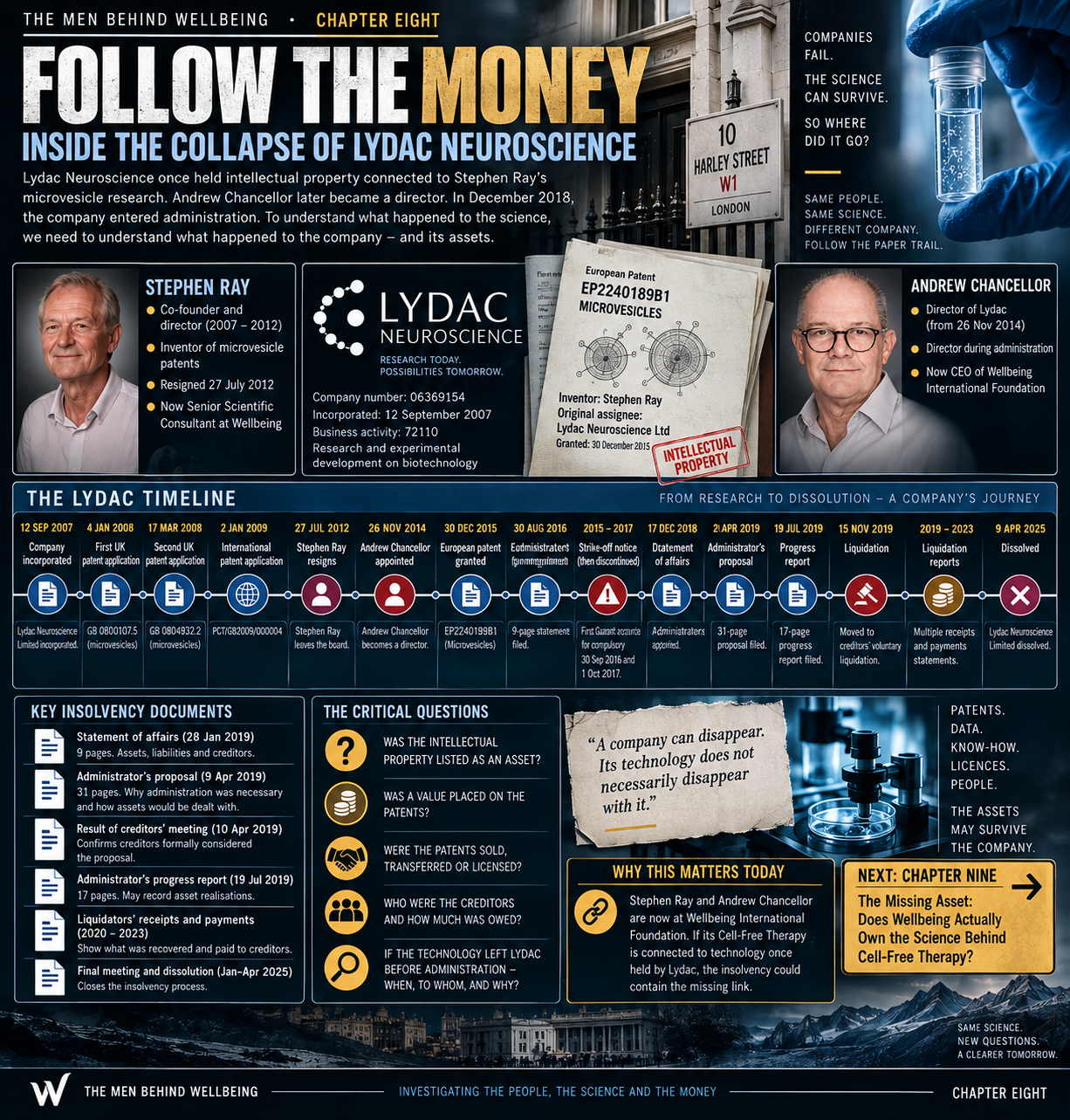
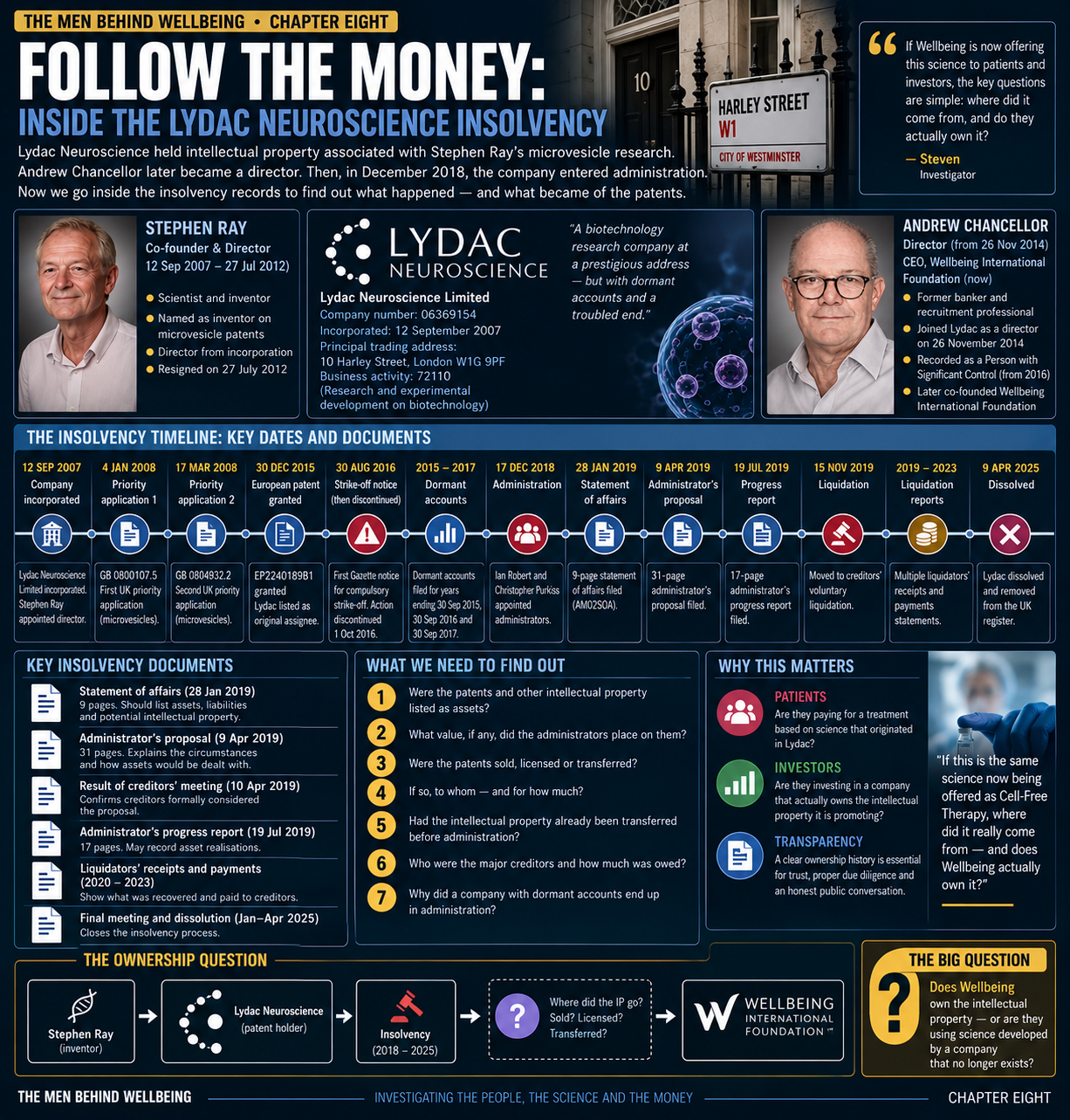
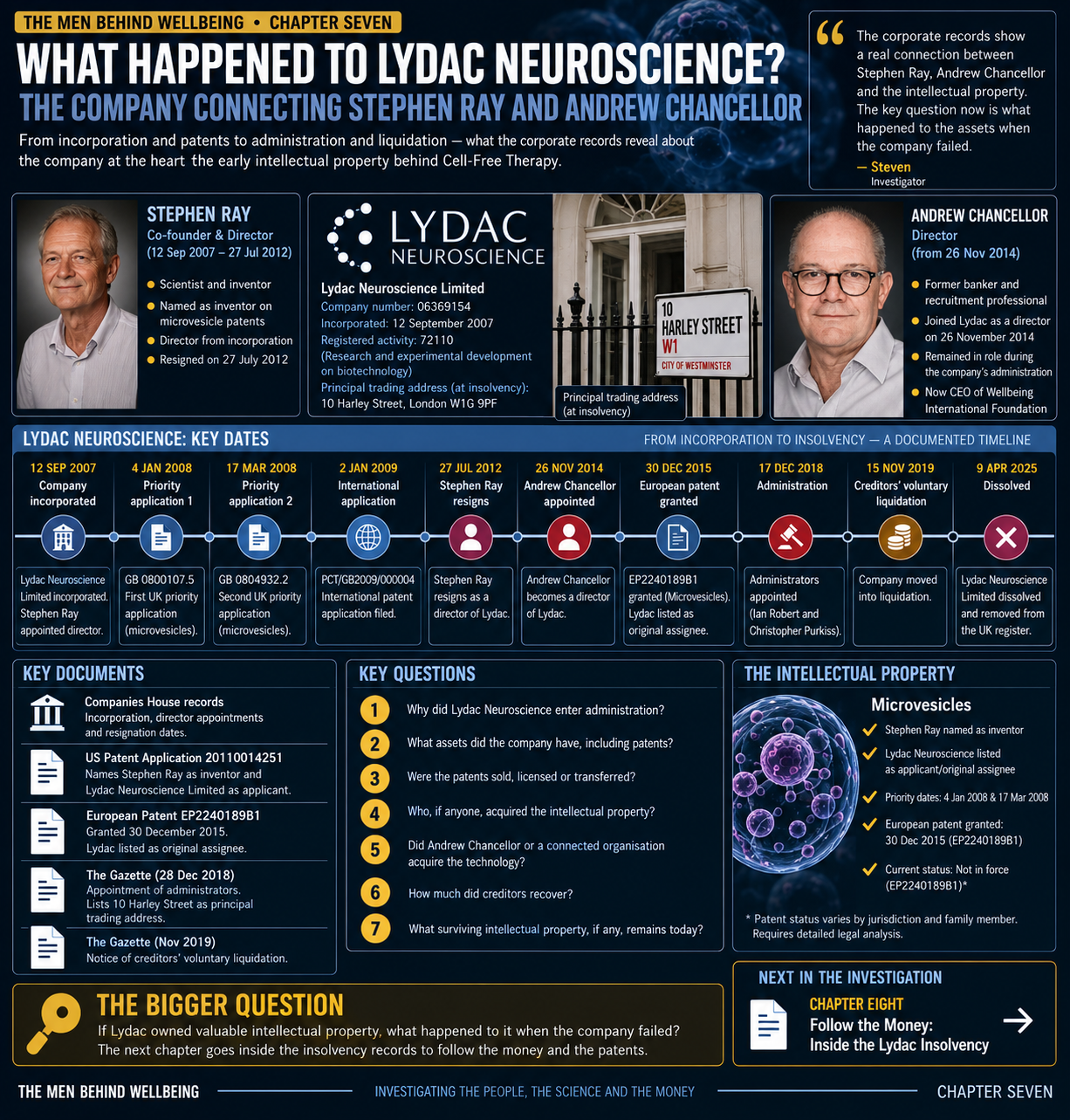
The earlier chapters of this investigation established a documented connection between Stephen Ray's historical scientific work and Lydac Neuroscience.
Ray was an early director.
Andrew Chancellor became a director later.
Lydac subsequently entered administration.
That history does not establish misconduct by either man.
Nor does the failure of one biotechnology business predict the future of another.
But it does demonstrate why ownership matters.
When a company is successful, investors focus on valuation.
When a company fails, everybody suddenly wants to know:
Who owns the patents?
Who owns the equipment?
Who owns the contracts?
Who owns the data?
Who gets paid first?
And what assets are actually left?
That is why those questions should be asked before investing rather than afterwards.
Wellbeing Says This Is Not a One-Off Funding Event
There is another sentence in Wellbeing's announcement that deserves attention.
The organisation says the 2026 round forms part of a longer-term funding cadence and that historically its funding has combined private investment, patient revenue and selective philanthropic engagement. (Wellbeing International Foundation)
That isn't inherently concerning.
Biotechnology companies frequently require multiple financing rounds.
But repeated fundraising introduces another investor risk:
dilution.
If additional shares are issued later, an existing investor's percentage ownership can decrease unless they have appropriate participation or pre-emption rights.
That makes several questions essential.
How much capital will Wellbeing require after this round?
How long does the present capital last?
What milestones must be achieved before another round?
What happens if those milestones aren't achieved?
And what protections do existing investors have if new capital is raised on different terms?
The Question Nobody Likes Asking
Investment presentations naturally concentrate on what happens if everything works.
The science progresses.
Clinical evidence strengthens.
The network expands.
More patients arrive.
Revenue grows.
New markets open.
The company becomes more valuable.
But proper due diligence requires the opposite thought experiment.
What happens if it doesn't?
Suppose the scientific evidence develops more slowly than anticipated.
Suppose commercial adoption disappoints.
Suppose regulatory requirements become more expensive.
Suppose a laboratory or clinical relationship ends.
Suppose a key scientist leaves.
Suppose another financing round becomes necessary but cannot be completed on attractive terms.
What does the investor own then?
That question is uncomfortable.
It is also one of the most important questions in private investment.
Could an Investor Lose Everything?
Yes—in principle, an investor in a private early-stage or speculative biotechnology venture can lose their entire investment.
That statement isn't specific to Wellbeing.
It is a fundamental characteristic of high-risk private investment.
What we cannot responsibly say from the public information currently available is that Wellbeing investors will lose their money, or that such an outcome is likely.
We do not possess the private investor pack.
We do not have the complete financial statements supplied to investors.
We do not know the investment valuation.
We do not know its cash position.
We do not know its complete contractual asset base.
We do not know the terms investors have negotiated.
Those documents could materially change the assessment.
But that is precisely why they matter.
Don't Invest in the Story. Invest in the Documents.
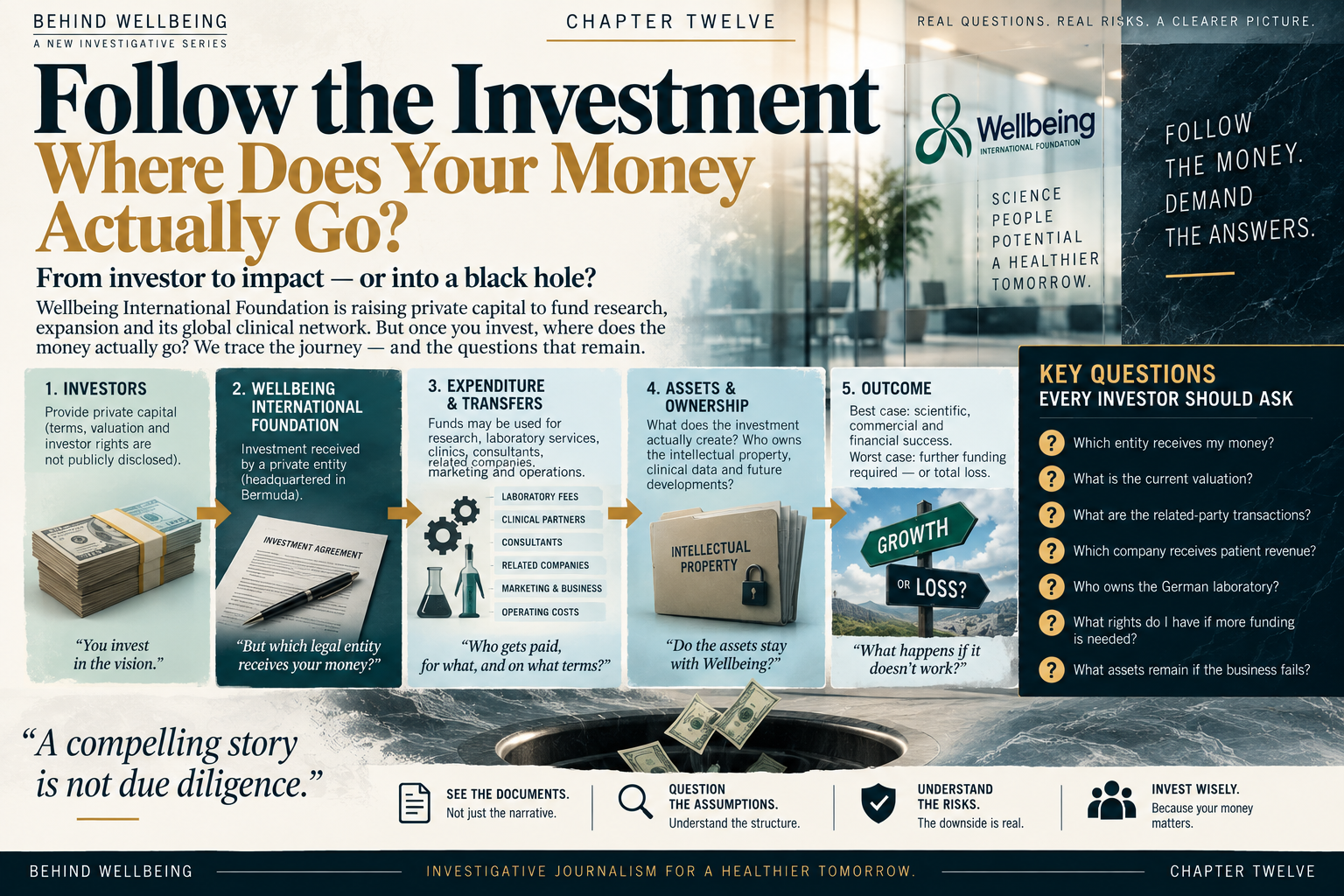
An investor considering Wellbeing should be able to obtain a comprehensive due-diligence package.
I would want to see the precise legal identity of the investment entity, its constitutional documents, current capitalisation table, investment agreement, share or security class, valuation, financial statements, management accounts, liabilities, cash position, monthly expenditure and expected runway.
Then I would want the scientific assets.
The complete intellectual-property schedule.
Patent ownership.
Patent assignments.
Licences.
Trade-secret arrangements.
Laboratory contracts.
Agreements covering Stephen Ray's existing and future scientific work.
Ownership of future inventions.
Clinical data rights.
Then the commercial assets.
Patient revenue.
Clinic agreements.
Laboratory relationships.
Material related-party transactions.
Revenue projections.
And finally the downside provisions.
Voting rights.
Pre-emption rights.
Preference rights.
Dilution.
Liquidation rights.
And what happens if another funding round cannot be completed.
That's not excessive scrutiny.
That is what investing in an emerging biotechnology proposition demands.
There Is a Simple Way for Wellbeing to Answer This
Wellbeing could remove much of the uncertainty by answering a relatively short series of questions.
Which precise legal entity received the 2026 investment?
What security or economic interest did investors receive?
What valuation was applied?
What assets does that entity own?
Which intellectual property does it own or exclusively license?
Does it own the German laboratory?
Does it own any of the partner clinics?
Which entity receives patient revenue?
How much cash runway does the 2026 round provide?
What future capital requirements are anticipated?
What rights protect existing investors against dilution?
And:
If the business ceased operating, what assets would remain inside the investment entity?
If comprehensive answers are already contained in Wellbeing's private investor materials, prospective investors should examine them carefully.
What We Are Not Saying
There is an important distinction between unanswered questions and evidence of wrongdoing.
This investigation has not established that Wellbeing's valuation is unreasonable.
It has not established that investors have been misled.
It has not established that Wellbeing lacks legitimate intellectual-property rights.
It has not established that investor funds are being improperly used.
It has not established that Wellbeing is financially distressed.
And it has not established that investors will lose their money.
What we can establish publicly is narrower.
Wellbeing is raising private capital.
The organisation says the amount, terms and participants are private. (Wellbeing International Foundation)
Its publicly cited clinical evidence presently includes a small, uncontrolled, multimodal pilot rather than a large controlled CFT-specific trial. (Wellbeing International Foundation)
And important questions concerning the precise investment structure, asset ownership and intellectual-property position cannot be answered completely from the public material we have examined.
That is where the investment risk becomes worthy of scrutiny.
Conclusion: What Exactly Are You Buying?
There may ultimately be excellent answers to every question in this chapter.
Perhaps Wellbeing has comprehensive IP agreements.
Perhaps its investor documents contain detailed financial accounts.
Perhaps the laboratory contracts are extremely strong.
Perhaps its clinical network is secured through long-term agreements.
Perhaps its valuation is supported by revenue and assets we cannot see publicly.
If so, prospective investors should be shown that evidence.
Because an investment decision this complex shouldn't depend upon what somebody believes Wellbeing might eventually become.
It should begin with what exists today.
What does the company own?
What does it control?
What does it earn?
What does it owe?
What rights does the investor receive?
And what remains if the optimistic scenario never happens?
A scientific story can be exciting.
A market opportunity can be enormous.
A management team can be confident.
A treatment can be promising.
None of those things, individually or collectively, eliminates investment risk.
Before investing in the future, establish ownership of the present.
Because if everything doesn't go according to plan, the most important question isn't what Wellbeing might have become.
It is what the investor actually owns.
Next: Chapter Twelve — Follow the Investment: Where Does Your Money Actually Go?
In Chapter Twelve, we stop looking at the investment from the outside and follow the money itself. Which legal entity receives it? Where does patient revenue go? Who is paid for laboratory services, research and clinical work? Which assets are created with investor capital—and who ultimately owns them? Because before asking how much an investment could return, there is another question worth answering: where did the money go in the first place?
Recent Posts