The Men Behind Wellbeing — Chapter Six
Who Owned Stephen Ray’s Science? The Lydac Neuroscience Connection
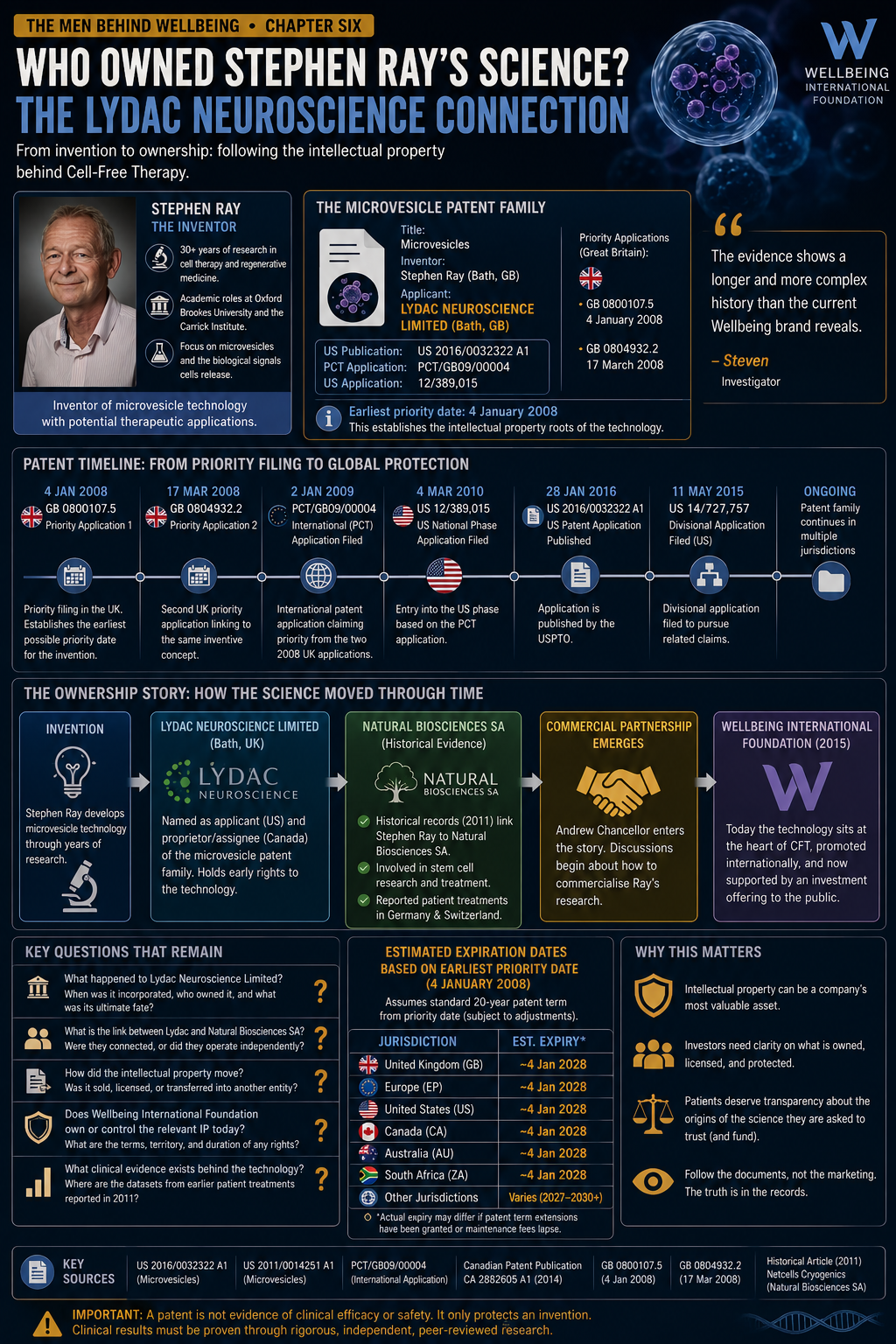
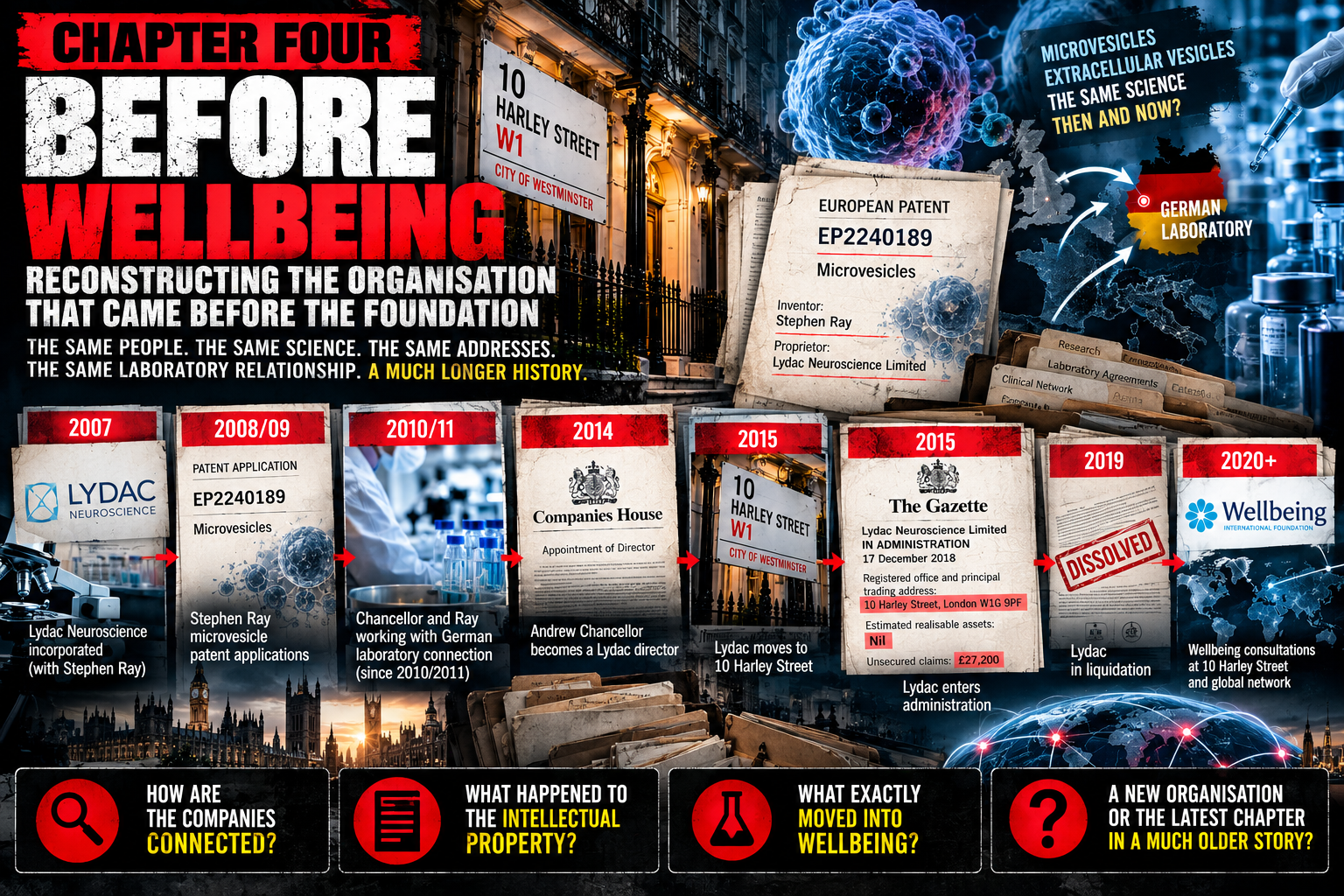
We found Stephen Ray's microvesicle patent trail. Now another company has emerged from the official records: Lydac Neuroscience Limited. What role did it play, what did it own, and how—if at all—did that intellectual property eventually reach Wellbeing International Foundation?
Patent investigations have a habit of changing direction.
You begin looking for one company.
Then the documents give you another.
That is exactly what has happened here.
In Chapter Five, I established that a Stephen Ray of Bath is named as inventor on a patent family involving microvesicles, autologous cells and potential therapeutic applications.
The earliest priority applications date to 2008.
But there was another name sitting inside the patent record that deserves considerably more attention.
Not Wellbeing International Foundation.
Not Natural Biosciences SA.
But:
Lydac Neuroscience Limited.
And unlike some of the historical material examined previously, this isn't simply a name appearing in a promotional article.
It appears directly in patent records.
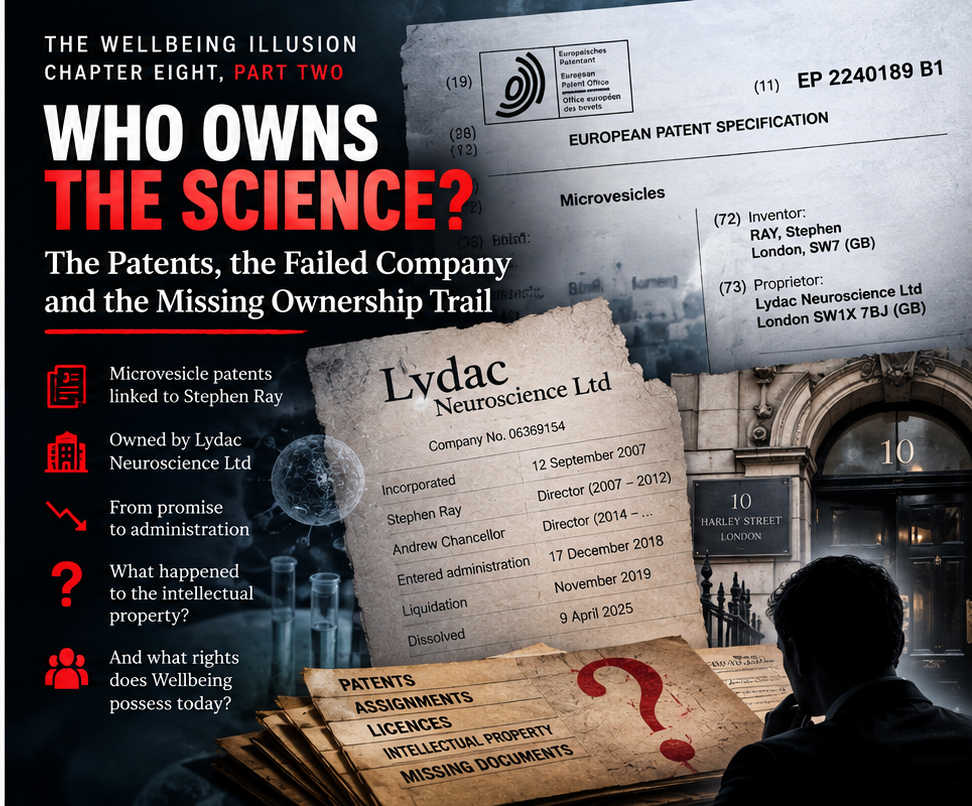
Lydac Neuroscience Limited Appears in the Microvesicle Patent Record
The US application published in January 2011 identifies the invention as:
Microvesicles
It identifies:
Inventor: Stephen Ray (Bath)
and then something extremely important:
Applicant: LYDAC NEUROSCIENCE LIMITED (Bath).
US Patent Application 20110014251 — Microvesicles
That materially advances this investigation.
We are no longer merely trying to infer which company might have been connected to Ray's intellectual property.
We have a company explicitly identified within the patent documentation.
The Canadian Record Strengthens the Connection
There is further evidence.
An official Canadian Intellectual Property Office publication records a patent from the same international family.
It identifies:
RAY, STEPHEN, GB
as inventor.
And:
LYDAC NEUROSCIENCE LIMITED, GB
as the proprietor or assignee.
The record also identifies the international application:
PCT/GB2009/000004
with British priority applications dating from January and March 2008. (Publications Canada)
That is much stronger evidence than a corporate biography.
It establishes a documentary relationship between:
Stephen Ray
the microvesicle intellectual property
and
Lydac Neuroscience Limited.
Inventor Does Not Necessarily Mean Owner
This corrects an important assumption that readers could easily make.
Stephen Ray being named as inventor does not necessarily mean Stephen Ray personally owned the commercial rights.
Patent systems distinguish between the person who invents something and the legal entity holding rights to exploit that invention.
An employee may invent something owned by their employer.
An inventor may assign their rights to a company.
A company may subsequently sell those rights.
A licence may permit another company to exploit them without transferring ownership.
In this case, the documentary evidence presently available points directly toward Lydac Neuroscience Limited as an important holder of rights associated with the patent family. (Justia Patents)
That creates an entirely new corporate trail.
So What Was Lydac Neuroscience Limited?
That is now one of the most important unanswered questions in this investigation.
We need to establish:
When was Lydac incorporated?
Who founded it?
Who were its directors?
Who were its shareholders?
Was Stephen Ray a director or shareholder?
Who financed the company?
What other intellectual property did it hold?
Did Andrew Chancellor ever become involved?
What eventually happened to the company?
And critically:
what happened to its intellectual property?
Because if Lydac controlled patents relevant to technology subsequently commercialised elsewhere, the movement of those rights matters enormously.
Natural Biosciences Has Not Disappeared From the Story
This discovery does not mean the Natural Biosciences evidence was irrelevant.
Quite the opposite.
A historical South African publication from 2011 describes:
“Natural Biosciences SA – a company with expertise in stem cell research and treatment”
and discusses Ray's work involving secretory factors produced by cells. (Netcells)
The same article states that Natural Biosciences was treating patients on a compassionate basis in Germany and Switzerland and working with Netcells Cryogenics in South Africa. (Netcells)
That is remarkable historical material.
It suggests that by 2011, Ray's work was not confined simply to patents and laboratory theory.
It was being publicly associated with patient treatment.
But we must distinguish two separate propositions.
Lydac appears in the patent records.
Natural Biosciences appears in historical treatment and commercial material.
The relationship between those two organisations remains to be established.
Two Companies, One Scientist
We therefore have an intriguing situation.
Stephen Ray appears in the intellectual-property history associated with Lydac Neuroscience.
He also appears historically associated with Natural Biosciences SA.
And years later he appears as the senior scientific figure associated with Wellbeing International Foundation.
That gives us at least three corporate or organisational names surrounding the same broad scientific story:
Lydac Neuroscience Limited
↓
Natural Biosciences SA
↓
Wellbeing International Foundation
But I deliberately put no connecting arrows of ownership between them yet.
Because chronology is not proof of succession.
One organisation appearing after another does not establish that it acquired the first organisation's assets.
That connection must be demonstrated.
The Missing Document Is the Assignment
What we need now is remarkably specific.
Patent assignment records.
If Lydac owned the intellectual property and that technology subsequently became part of Wellbeing's commercial operation, there should potentially be a legal mechanism connecting the two.
An assignment.
A sale.
A licence.
An acquisition.
A transfer.
Or another contractual arrangement.
That document—or the absence of one—could become extremely important.
What We Need to Establish
The ownership investigation now has four distinct stages.
Stage One: Inventor
Stephen Ray is named as inventor.
That is documented. (Justia Patents)
Stage Two: Early rights holder
Lydac Neuroscience Limited appears as applicant in the US record and proprietor/assignee in an official Canadian record. (Justia Patents)
Stage Three: Natural Biosciences
Historical material connects Ray with Natural Biosciences SA and describes the organisation as involved in stem-cell research and treatment. (Netcells)
Stage Four: Wellbeing International Foundation
Today, Ray's scientific history forms an important part of Wellbeing's presentation of the origins of its technology.
What remains missing are the legal bridges between those stages.
Another Patent Complicates the Story Further
Searching Ray's patent history produced something else.
The microvesicle application is not the only biological intellectual property associated with a Stephen Ray matching this research area.
Patent databases also identify earlier applications involving the administration of RNA.
One is titled:
Method Of Genotypically Modifying Cells By Administration Of RNA
The applicant is listed as:
Fischer Education Project Limited
with inventors:
Stephen Ray and Michael Fischer. (Justia Patents)
Another is described as:
Method of Treatment by Administration of RNA.
Again, this broadens the historical intellectual-property footprint.
It suggests Ray's involvement with commercialisable biological inventions predates even the 2008 microvesicle priority applications.
That deserves its own investigation.
The Scientific History Is Becoming Longer
This is important because Wellbeing's current story can easily appear relatively recent.
A regenerative-medicine organisation.
Modern extracellular-vesicle science.
Cell-Free Therapy.
A longevity programme.
A 2026 peer-reviewed pilot.
But the intellectual-property trail we're uncovering stretches considerably further backwards.
RNA-related applications.
Microvesicles.
Lydac Neuroscience.
Natural Biosciences.
Patient treatments reportedly occurring in Europe by 2011.
Then the later commercial relationship involving Andrew Chancellor.
And eventually Wellbeing.
This does not demonstrate that every organisation used precisely the same therapy.
Nor does it establish uninterrupted ownership.
But it demonstrates something increasingly important:
the commercial history surrounding Ray's biological research appears to be much older and more complicated than the current Wellbeing brand.
Patients Were Apparently Being Treated Years Ago
The 2011 South African article deserves particular attention.
It describes Natural Biosciences as treating patients on a compassionate basis in Germany and Switzerland, reportedly with positive results. (Netcells)
That raises a completely different set of questions.
Which patients?
Which diseases?
How many?
What exactly were they administered?
Who were the treating physicians?
Which clinics were involved?
Under which regulatory framework?
Were outcomes formally recorded?
Were adverse events recorded?
Were results subsequently published?
Were these the patients whose outcomes helped form the basis for later commercial claims?
These questions are potentially more important than the patents themselves.
Where Is the Clinical Dataset?
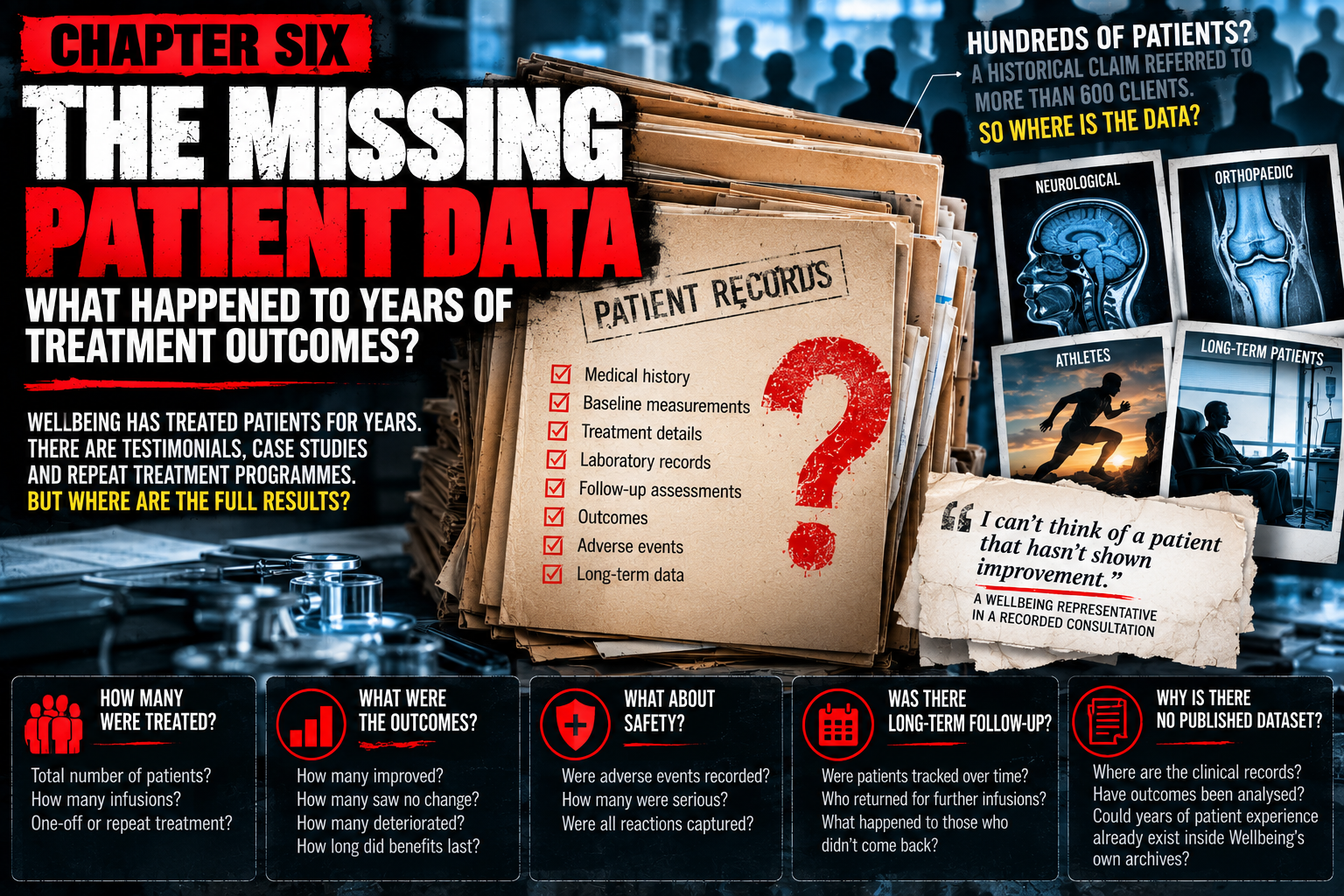
If patients were receiving related biological interventions by approximately 2011, then potentially fifteen years of clinical experience now separates those reported treatments from the present day.
That raises an obvious question:
Where is the dataset?
If dozens—or perhaps hundreds—of patients have subsequently received versions of this technology, there should potentially be substantial observational evidence.
Diagnosis.
Treatment protocol.
Dosage.
Follow-up.
Outcomes.
Failures.
Adverse events.
Duration of benefit.
Long-term consequences.
That information would be scientifically valuable.
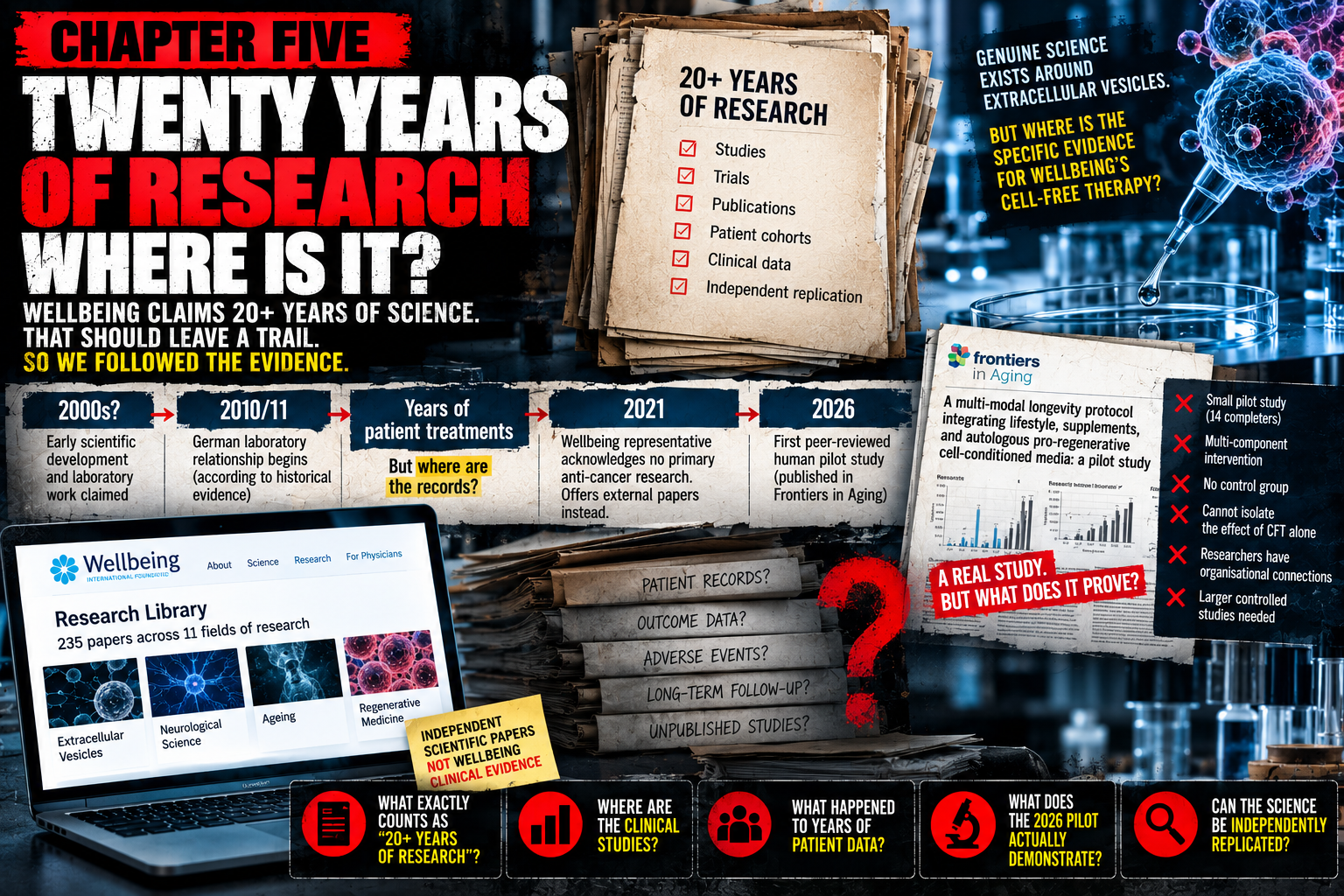
Yet the peer-reviewed longevity pilot we investigated earlier involved only fourteen participants completing a multi-intervention programme.
That creates an intriguing contrast.
A technology with intellectual-property roots extending back toward 2008.
Historical reports of patients being treated by 2011.
Yet comparatively limited peer-reviewed human evidence presented publicly today.
That deserves explanation.
Then Andrew Chancellor Enters the Timeline
This is where our previous chapters reconnect.
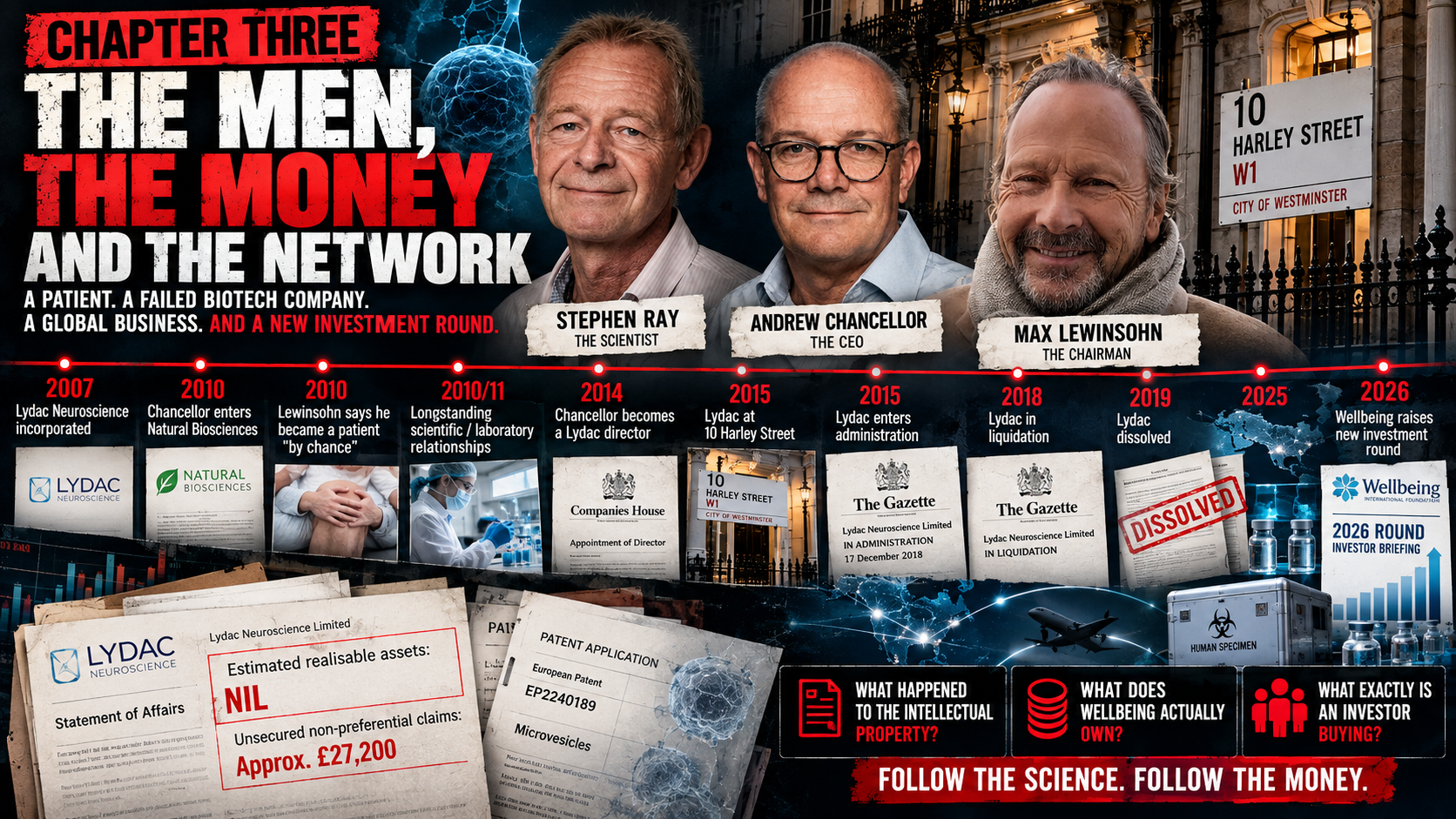
Chancellor says he met Stephen Ray and eventually began discussing how Ray's research could be commercialised.
But we now know Ray's intellectual-property and commercial history already extended back years.
So the question becomes more precise:
At what point did Chancellor enter this existing structure?
Was Lydac still operating?
Was Natural Biosciences operating?
Who controlled the patents when Chancellor became involved?
Did Chancellor invest?
Did he acquire rights?
Did he establish a new organisation?
Was Wellbeing created around licensed technology?
Or did the technology pass into another entity first?
These are no longer vague historical questions.
We have names and patent numbers with which to investigate them.
The Investment Question Becomes Even More Important
Wellbeing is now raising investment capital.
That makes the intellectual-property chain particularly important.
An investor considering a biotechnology company should understand precisely what assets the company owns.
If the technology underpinning Cell-Free Therapy derives partly from patents originally held by another company, an investor would reasonably want to know:
Does Wellbeing own those rights today?
Does it have an exclusive licence?
How long does that licence last?
What territories does it cover?
Can it be terminated?
Are royalties payable?
Are patents still active?
Which parts of the current process are actually protected?
And what happens when the patents expire?
Those aren't hostile questions.
They are basic biotechnology due diligence.
The Expiration Question
There is another reason the dates matter.
The earliest British priority applications in this patent family date from 2008. (Justia Patents)
Patent terms are jurisdiction-specific and can be affected by later filings, divisionals, maintenance, extensions and other legal factors.
So we should not simply declare that every related patent expires on one particular date.
But a patent family with roots in 2008 naturally raises an important commercial question in 2026:
How much enforceable patent protection remains?
That becomes particularly relevant when valuing a company whose investment proposition may partly depend upon proprietary technology.
The exact status needs checking patent by patent and jurisdiction by jurisdiction.
What We Can Now Establish
The evidence has moved considerably beyond where we were two chapters ago.
We can now establish that Stephen Ray is named as inventor on a microvesicle patent application with roots in British priority filings from 2008. (Justia Patents)
We can establish that Lydac Neuroscience Limited appears as applicant in the US patent record. (Justia Patents)
An official Canadian patent publication identifies Lydac Neuroscience Limited as proprietor/assignee of a patent arising from the same PCT application. (Publications Canada)
Historical material separately connects Ray with Natural Biosciences SA and reports that organisation as involved in stem-cell research and treatment. (Netcells)
We can also establish that Ray's patent history includes earlier biological inventions involving RNA. (Justia Patents)
What we cannot yet establish is the complete ownership chain connecting those entities to Wellbeing.
And that distinction matters.
Conclusion: We Found an Earlier Owner
Chapter Five asked:
Who owned the science?
We now have part of the answer.
The documentary record points toward Lydac Neuroscience Limited as an early corporate holder associated with Stephen Ray's microvesicle intellectual property. (Justia Patents)
That is a significant development.
But it creates a larger mystery.
Because today it is Wellbeing International Foundation promoting Cell-Free Therapy.
Between those two points sit years of corporate history.
Natural Biosciences appears.
Patients were reportedly being treated.
Andrew Chancellor enters the story.
New organisations appear.
Investment capital becomes involved.
And somewhere along that journey, the technology—or technology descended from it—becomes part of today's Wellbeing proposition.
The investigation therefore has a very specific next task.
Follow the ownership.
Not the scientific claims.
Not the testimonials.
Not the biographies.
The legal ownership.
Because if we can determine what happened to Lydac Neuroscience and its intellectual property, we may finally be able to establish how Stephen Ray's science travelled from an early biotechnology company into the organisation now asking both patients and investors to put substantial amounts of money behind it.
Next: Chapter Seven — What Happened to Lydac Neuroscience?
The patent records identify Lydac Neuroscience Limited as an early holder of Stephen Ray's microvesicle intellectual property. Now we investigate the company itself: its directors, shareholders, finances, eventual fate—and where its intellectual property went.
Recent Posts