Before the Trial: What Happened to Years of Patient Outcomes?
The Wellbeing Illusion — Chapter Six
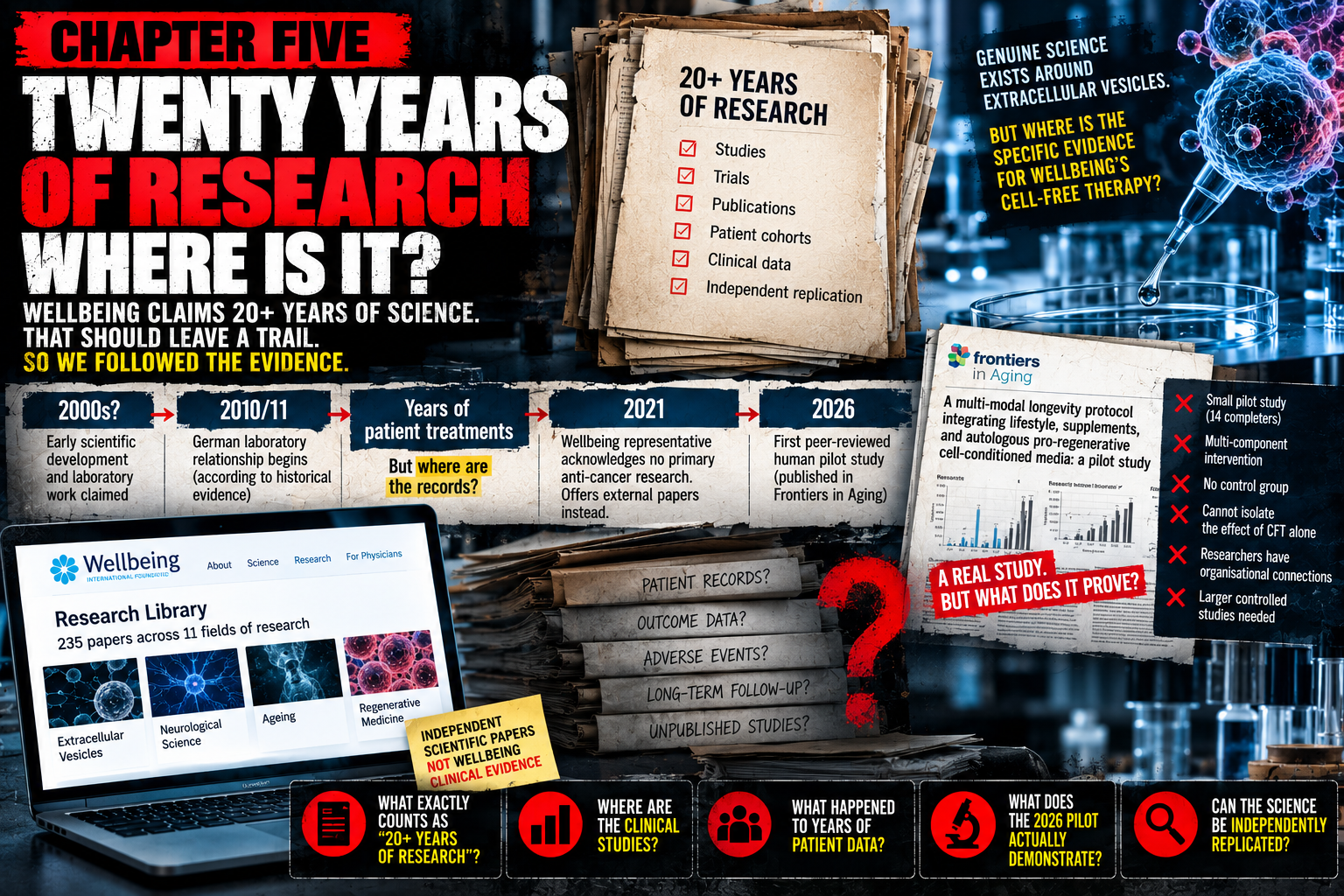
In Chapter Five, we followed Wellbeing International Foundation's claim of more than twenty years of science.
We found something important.
The scientific history appears to be genuinely old.
The laboratory relationships appear to be old.
The protocols appear to have evolved over many years.
And people were apparently receiving versions of the intervention long before the peer-reviewed pilot published in 2026.
That creates a problem — but also potentially an extraordinary scientific opportunity.
Because every patient leaves evidence.
A medical history.
A reason for treatment.
A biological sample.
A laboratory record.
An infusion.
A response.
Perhaps another infusion.
Perhaps improvement.
Perhaps no improvement.
Perhaps an adverse reaction.
Perhaps nothing happened at all.
After years of treating patients, those individual experiences should begin forming something much more important than a collection of testimonials.
They should begin forming a dataset.
So this chapter asks a very simple question:
What happened to everybody?
The Patients Came Before the Published Study
This is the first fact we need to establish.
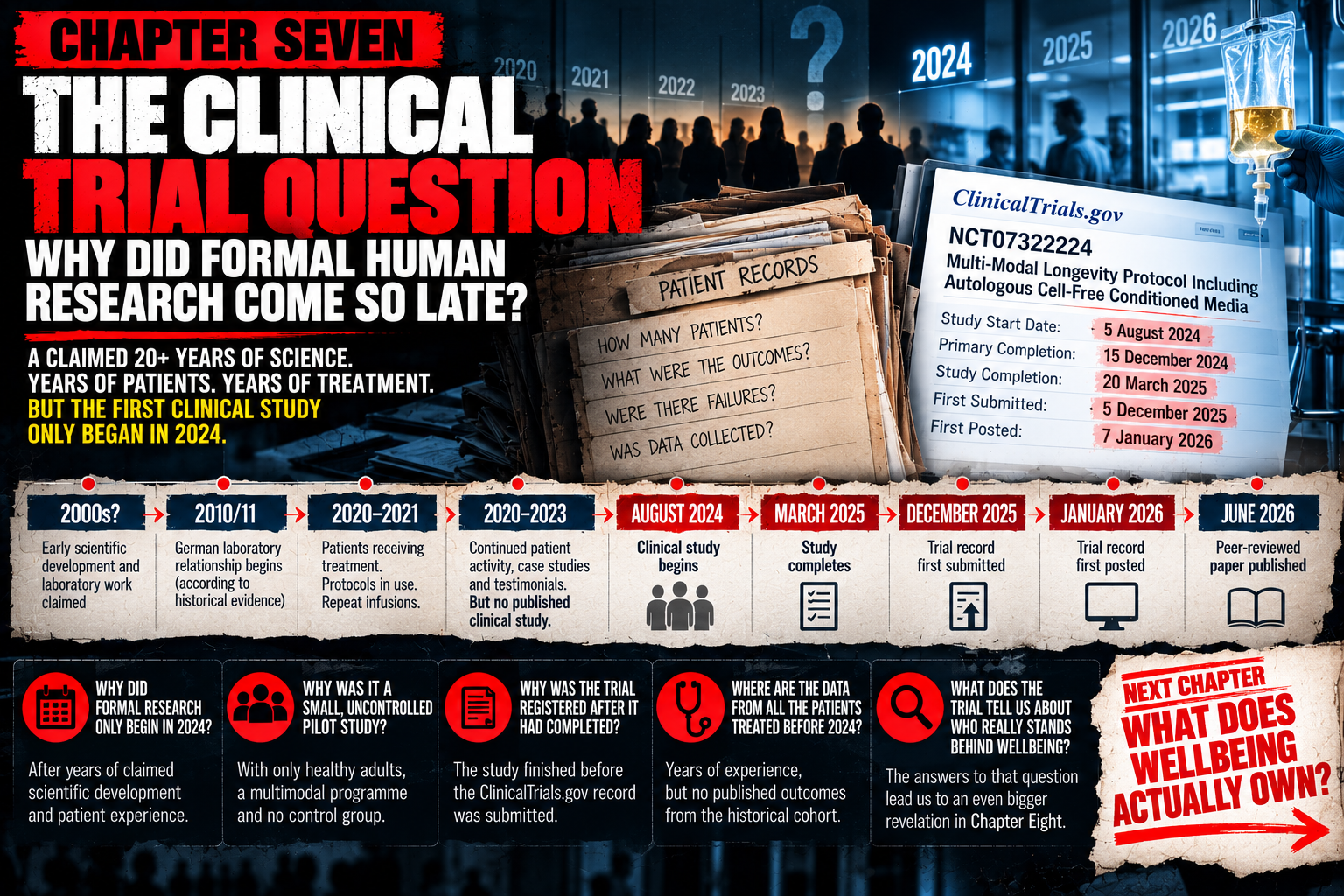
The peer-reviewed pilot associated with Wellbeing was conducted much later than the patient activity documented in our historical investigation.
Our covert archive contains recorded consultations from 2020 and 2021 discussing blood collection, laboratory processing in Germany, intravenous administration and repeat treatments.
The conversations don't sound like people discussing a hypothetical therapy that might one day be offered.
They describe an intervention already being provided.
Wellbeing's own published history also contains patient stories predating the 2026 paper by years.
So when the formal study eventually arrived, it did not mark the beginning of human exposure to the intervention.
Patients had apparently come first.
And that means those patients potentially represent years of information.
Our Investigation Found Claims of Hundreds of Clients
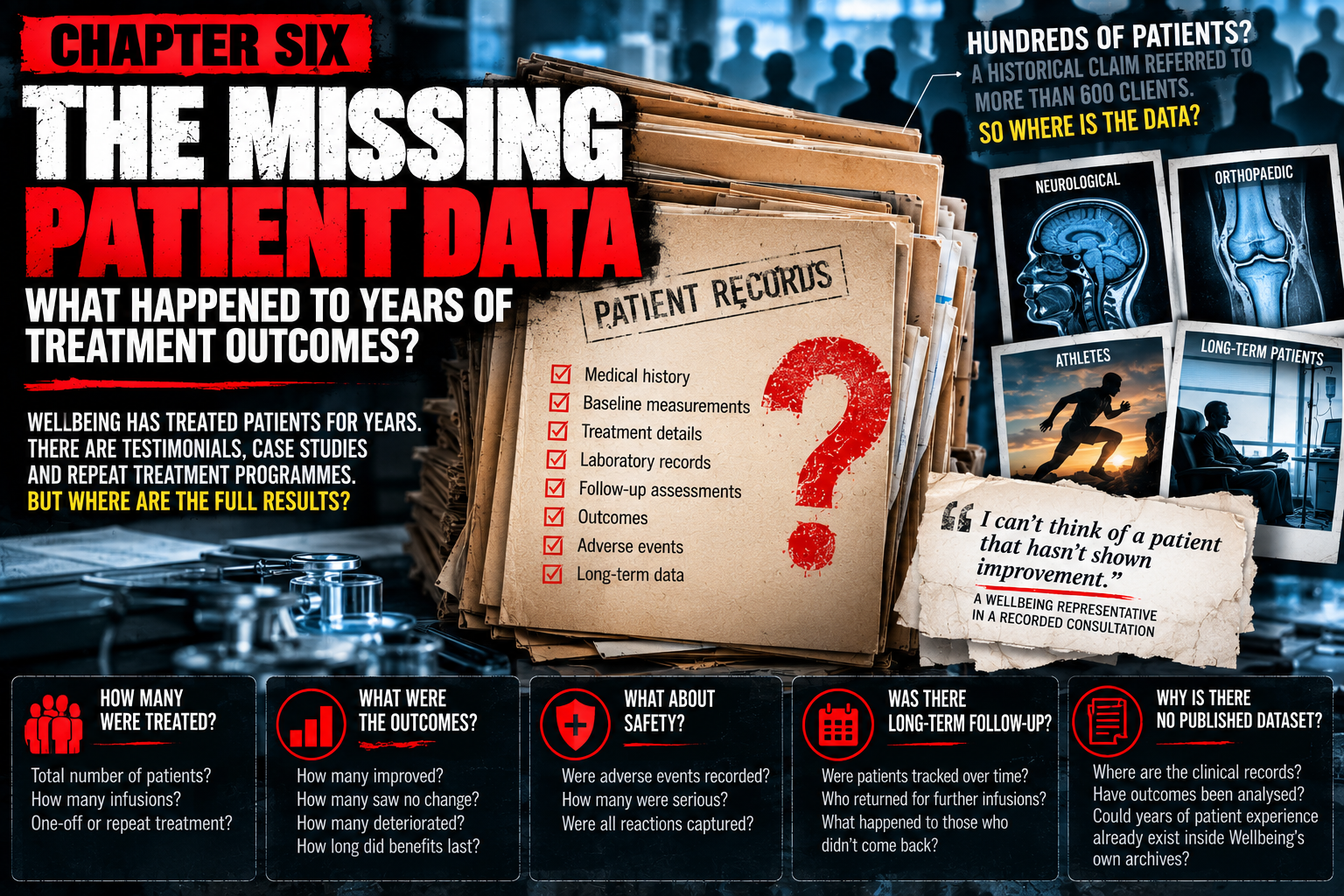
Historical investigative material reviewed for this series contains claims that Wellbeing had already dealt with hundreds of clients.
One historical figure recorded during the investigation referred to more than 600.
We have not independently audited patient files to verify that number, so we are not presenting 600 as an established total.
But the claim itself matters.
Because even if the true number were substantially lower, a significant historical patient population should have created an enormous amount of information.
If the number really was in the hundreds, the opportunity becomes even more significant.
Imagine 600 properly documented patient histories.
Six hundred baseline assessments.
Six hundred treatment records.
Six hundred sets of follow-up data.
Potentially thousands of individual infusions.
That could begin answering questions a testimonial page never can.
Who Improved?
This is the obvious question.
But it isn't enough.
Scientific outcome data require a denominator.
It isn't enough to identify ten patients who say they improved.
We need to know whether those ten came from:
twelve patients;
one hundred patients;
or one thousand patients.
Those would represent completely different outcomes.
The question therefore isn't simply:
How many success stories exist?
It is:
What percentage of everyone treated experienced an objectively measurable improvement?
And then:
What happened to everyone else?
Our Covert Recordings Contain an Extraordinary Historical Claim
During one covert consultation concerning a knee injury, a senior member of Wellbeing's scientific team discussed previous experience with knees.
Professional American football and ice-hockey players were mentioned.
The representative said:
“we've got a lot of experience with knees in particular”
Then came a remarkable statement:
“I can't think of a patient that hasn't shown improvement.”
Another representative present during the conversation responded:
“There hasn't been one.”
Read that again.
Not one.
If supported by systematically collected clinical data, that would be an extraordinary result.
Potentially an extremely important one.
But the statement immediately creates questions.
How many knee patients were there?
What qualified as improvement?
Pain reduction?
Mobility?
MRI findings?
Return to sport?
Reduced medication?
Avoidance of surgery?
Who assessed the improvement?
How long did it last?
And most importantly:
Where are those results?
“Improvement” Needs a Definition
This matters enormously.
Imagine somebody enters treatment saying their knee pain is eight out of ten.
Three months later they say it is four.
That is useful information.
But even then, we need context.
Did they also undergo physiotherapy?
Lose weight?
Stop playing sport temporarily?
Receive steroid injections?
Take anti-inflammatory medication?
Have surgery?
Change training?
Did the pain later return?
Now imagine something much stronger.
Every knee patient undergoes the same validated assessment before treatment.
Pain score.
Range of movement.
Strength.
Imaging.
Functional testing.
Medication.
Previous interventions.
Then the same measurements are repeated after treatment.
Now the word improvement begins to mean something scientifically.
Without a standardized starting point, however, it becomes difficult to determine exactly what changed.
Our Recordings Raise Questions About Baseline Medical Information
Another historical recording becomes important here.
A senior scientific representative was questioned directly about the medical records patients supplied.
His answer was:
“Sometimes they are extensive from their own doctors. Sometimes they are less so.”
He explained that his role was primarily to explain the science rather than provide the medical treatment.
That distinction is important and should be respected.
It does not prove that no physician subsequently assessed the patient.
It doesn't prove that proper medical supervision was absent.
But from a research perspective, the statement creates an obvious problem.
If medical records varied substantially between patients, how consistent were the baseline measurements?
Because without knowing precisely where a patient started, determining how far they improved becomes difficult.
Another Consultation Revealed the Same Problem
In another historical conversation, a prospective patient discussing a serious previous illness asked whether records from previous doctors would be required.
The response indicated that the patient could complete the medical-history information himself, with particular emphasis placed on listing medication.
Again, one historical conversation cannot establish the process used for every patient.
Nor does it prove that further medical documentation wasn't subsequently obtained.
But it reinforces the same research question.
Was there a standardized baseline dataset for historical patients?
If there was, it could be extremely valuable today.
Testimonials Only Show One Side of the Population
This is where testimonial evidence becomes dangerous if misunderstood.
A testimonial may be completely genuine.
The patient may sincerely believe the intervention changed their life.
But testimonials naturally select unusual or successful experiences.
Someone who experiences a dramatic improvement is likely to tell people.
They may remain in contact with the organisation.
They may agree to be interviewed.
They may provide photographs.
They may recommend the treatment.
But consider another patient.
They pay for the intervention.
Nothing noticeable happens.
They don't return.
They don't provide a testimonial.
They simply disappear.
Unless every patient is systematically followed, that person can vanish from the evidence.
The website gradually fills with success stories while the non-responders become invisible.
That is why clinical research requires denominators.
Wellbeing Itself Now Acknowledges This
The current Wellbeing website makes an important distinction.
Its patient testimonials and case studies are described as patient-reported experiences rather than evidence establishing efficacy.
That is scientifically appropriate.
Wellbeing International Foundation — About
But it creates another question.
If the testimonials aren't evidence of efficacy, where is the systematic outcome information from the wider historical patient population?
Because those are the patients who could potentially tell us whether the testimonials are typical.
One Published Case Demonstrates the Problem Perfectly
One of Wellbeing's published case studies concerns a patient with Motor Neurone Disease.
According to Wellbeing's account, the patient was diagnosed in 2017 and subsequently received regular infusions over approximately three and a half years.
The family believed the intervention helped slow progression.
That experience is understandably powerful.
But Wellbeing's own case study contains an extremely important acknowledgement:
“We have no data to prove the difference the therapy made…”
That sentence should not be buried.
Scientifically, it is one of the most important statements in the entire case.
Because it recognises the difference between:
“We believe it helped.”
and:
“We can demonstrate that it helped.”
Those are completely different propositions.
But Why Wasn't There Data?
This is where the case becomes even more interesting.
According to Wellbeing's own account, the patient received repeat infusions approximately every three months over several years.
That potentially represents numerous opportunities for structured follow-up.
What happened at those intervals?
Was respiratory function measured?
Mobility?
Speech?
Muscle strength?
Weight?
Medication?
Quality of life?
Hospital admissions?
Neurological progression?
Were recognised disease-progression scales used?
If objective measurements were collected repeatedly, then there may actually be meaningful longitudinal data.
If they weren't, an extraordinary research opportunity may have been lost.
The Athletes Present an Even Greater Opportunity
Wellbeing's history also contains numerous elite athletes.
That population is particularly interesting because professional athletes generate enormous amounts of objective data.
Injury dates.
Imaging.
Strength testing.
Training load.
Performance statistics.
Return-to-play dates.
Surgery.
Rehabilitation.
Medication.
Days unavailable for competition.
If substantial numbers of professional athletes received the intervention, retrospective analysis could potentially be extremely informative.
How long did comparable injuries normally take to recover?
How long did they take after CFT?
Did recurrence rates change?
Did objective performance change?
Did imaging change?
How many athletes reported no benefit?
How many required surgery anyway?
Those are measurable questions.
They are far more powerful than:
“I felt better.”
Follow the Patient, Not the Testimonial
This investigation therefore takes a different approach.
Take every patient.
Start at the beginning.
Why did they seek treatment?
What was their diagnosis or reason for treatment?
What was their baseline condition?
What medical evidence existed?
What preparation did they receive?
Which version of the protocol?
How many infusions?
What other treatments occurred simultaneously?
What happened after one month?
Three months?
Six months?
One year?
Did they improve?
Stay the same?
Deteriorate?
Return?
Stop treatment?
Experience an adverse event?
Die?
Become lost to follow-up?
Every one of those outcomes matters.
Not just the success stories.
What Happened to the People Who Never Came Back?
This may be one of the most important unanswered questions.
Repeat patients are easy to observe.
Satisfied clients remain visible.
Professional athletes may maintain contact.
But the patient who receives one treatment and disappears is scientifically important.
Why didn't they return?
Perhaps one treatment was sufficient.
Perhaps they couldn't afford another.
Perhaps they moved.
Perhaps they experienced no improvement.
Perhaps their condition deteriorated.
Perhaps they received conventional treatment elsewhere.
Perhaps they died.
We don't know.
And that is exactly the point.
In clinical research, a patient lost to follow-up doesn't simply cease to matter.
They become part of the analysis.
Then There Is Safety
Efficacy is only half the equation.
The other half is:
What went wrong?
Wellbeing currently describes CFT as autologous and cell-free and presents the intervention as having a favourable safety profile.
The 2026 pilot reported no adverse events among its small participant population.
That is encouraging.
But a small pilot cannot establish the safety profile of an intervention reportedly used across a much larger historical population.
If hundreds of patients have received the intervention over many years, the historical safety database could be considerably more informative.
How many total infusions have been administered?
How many immediate reactions occurred?
How many delayed reactions?
How many infections?
How many hospitalisations?
How many unexpected inflammatory responses?
How many events were considered unrelated?
How many were considered possibly related?
Perhaps the answer is almost none.
If so, that would itself be valuable evidence.
But safety becomes scientifically meaningful when there is a denominator.
For example:
Three adverse events across 2,000 infusions.
That tells us something.
Simply saying serious problems have not generally been seen tells us much less.
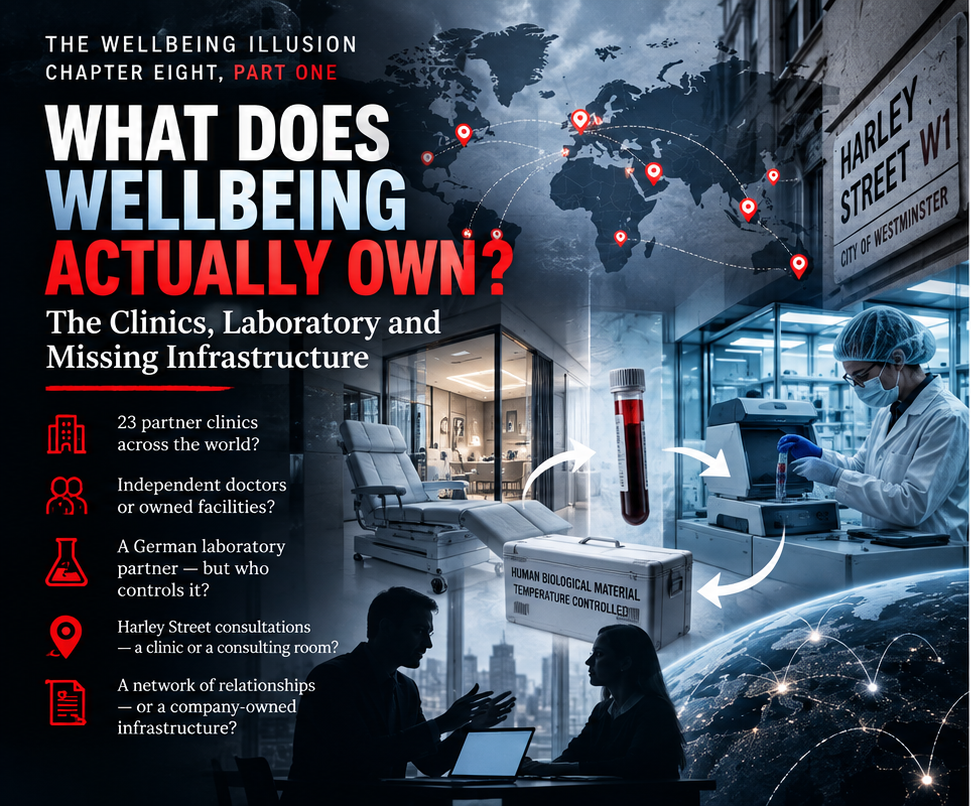
The Laboratory Should Already Have Part of the Record
There is another reason this question matters.
The treatment process itself requires documentation.
Blood is collected.
The sample is identified.
It is transported.
It reaches the laboratory.
It is processed.
Quality checks are performed.
The preparation is released.
It is returned.
It is administered.
Wellbeing's current process describes controlled transport, chain of custody, laboratory processing, quality testing and optional cell banking.
Wellbeing International Foundation — The Process
That creates a documentary trail.
And our historical covert investigation contains another intriguing detail.
During one recorded conversation, a senior Wellbeing representative discussed biological material stored in preservation tanks in Germany.
He claimed some stored material dated back to around 2010 and was periodically checked.
We have not independently inspected those storage records and therefore cannot verify that historical claim.
But if correct, it suggests that the biological archive itself could extend back many years.
That should mean identifiers.
Dates.
Storage records.
Processing records.
Release records.
Quality records.
And potentially repeat use involving the same patient.
Now connect those laboratory records with patient outcomes.
Suddenly, something extremely interesting becomes possible.
The Dataset May Already Exist
This is the possibility we cannot ignore.
Perhaps Wellbeing has far more evidence than is publicly visible.
Perhaps the information sits across different systems.
Patient files.
Laboratory records.
Clinical notes.
Follow-up calls.
Emails.
Infusion records.
Stored samples.
Questionnaires.
Medical records.
Repeat-treatment histories.
If those sources can be linked and properly anonymised, Wellbeing may already possess a substantial real-world dataset.
It could potentially answer questions that the current pilot cannot.
Which patients responded?
Which didn't?
How long did effects last?
Did repeat treatment produce different outcomes?
Did protocol changes alter results?
Were certain patient characteristics associated with stronger responses?
How frequently did adverse events occur?
That would not replace randomized controlled trials.
But it could provide an enormously useful foundation for designing them.
Or Perhaps the Dataset Doesn't Exist
There is another possibility.
Years of patients may have been treated without systematic research-grade follow-up.
Medical histories may have varied.
Outcomes may have been collected informally.
Successful patients may have remained visible.
Non-responders may have disappeared.
Testimonials may have accumulated while structured outcome data did not.
If that happened, years of patient experience may have produced surprisingly little scientifically usable evidence.
We cannot currently establish which explanation is correct.
But the difference between them is enormous.
One possibility means an important historical dataset is waiting to be analysed.
The other means an extraordinary research opportunity may have been lost.
The 2026 Pilot Shows What Was Possible
This is why the recent pilot matters beyond its results.
For those participants, researchers established a structured protocol.
There were baseline measurements.
There were defined outcomes.
There was a defined intervention period.
There was laboratory documentation.
There was analysis.
There was a scientific paper.
Whatever its limitations, that is research.
Now compare that with the years before it.
If structured measurements could be collected in 2024 and 2025, why weren't comparable systems apparently producing published evidence much earlier?
Perhaps they were.
If so, where are the results?
That question leads directly into the next stage of this investigation.
The Missing Denominator Changes Everything
After six chapters, this may be one of the simplest and most important questions we have asked.
How many people were actually treated?
Without that number, virtually every success claim loses context.
Suppose 90 out of 100 patients improved.
That would demand serious scientific attention.
Suppose 90 out of 10,000 improved.
That tells a very different story.
Suppose virtually everyone improved, as one historical consultation appeared to suggest for knee patients.
Then publish the cohort.
That could be extraordinary.
But without knowing the denominator, we simply cannot know what the visible success stories represent.
We Need the Failures as Much as the Successes
This is perhaps the greatest difference between marketing and science.
Marketing asks:
Who can tell our best story?
Science asks:
What happened to everybody?
The people who improved matter.
The people who didn't improve matter.
The people who deteriorated matter.
The people who stopped responding matter.
The people who never came back matter.
The people who experienced adverse events matter.
And the people who received treatment and experienced absolutely nothing matter.
In fact, scientifically, some of those failures may ultimately teach us more than the successes.
Because they help establish when an intervention doesn't work.
Years of Patients Should Have Created More Than Stories
This investigation isn't claiming that historical patient data were deliberately hidden.
We have not established that.
Nor have we established that no comprehensive patient database exists.
It may exist.
But after examining the public material and the historical evidence available to us, we have not located a comprehensive published analysis of the entire historical patient population.
That leaves a remarkable gap.
Because Wellbeing's own story tells us the patients were there.
Our covert investigation tells us treatments were being discussed and provided years ago.
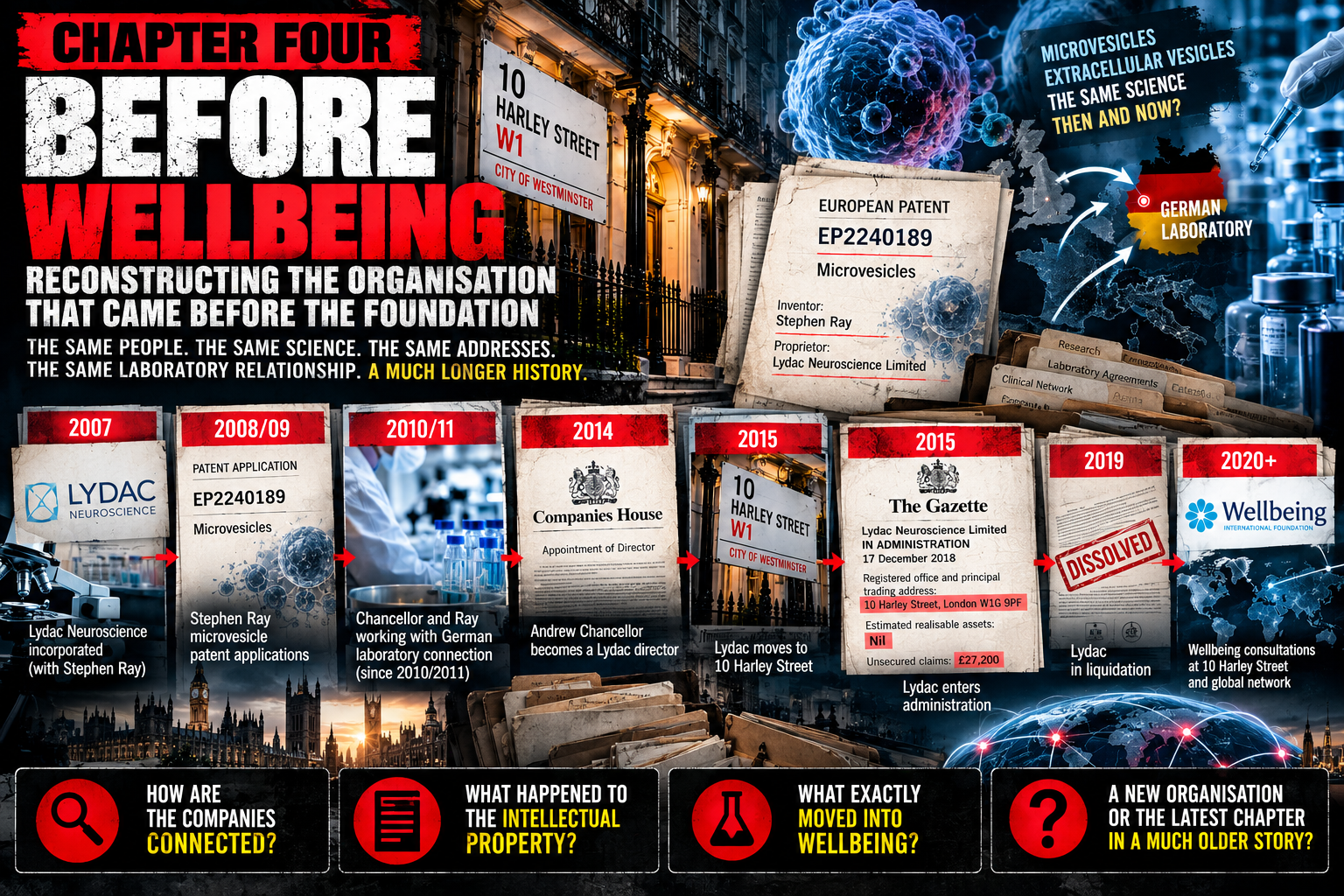
The laboratory history tells us biological processing was already established.
The testimonials tell us some people returned repeatedly.
And the current organisation tells us follow-up forms part of the clinical journey.
The missing piece is what happened when all those individual experiences were put together.
This Is Bigger Than Testimonials
The question isn't:
Can Wellbeing find patients who say they benefited?
Clearly it can.
The question is:
When every patient is counted, what does the complete picture show?
That is where efficacy signals begin to emerge.
That is where safety signals appear.
That is where non-responders become visible.
That is where extraordinary claims either become more compelling or begin to weaken.
And that is where years of commercial treatment can begin transforming into scientific evidence.
If the records exist, they may contain some of the most important evidence Wellbeing possesses.
If they don't, the question becomes much more difficult.
Because patients appear to have been receiving the intervention long before formal published human research arrived.
And that means our investigation now has to put dates against the science.
When exactly did treatment begin?
When did systematic research begin?
When was the first formal human study conducted?
When was it registered?
And was that registration made before the researchers knew the results — or afterwards?
Those dates matter.
A great deal.
Because in the next chapter, the timeline finally becomes visible.
And once it does, the gap between years of patients and formal clinical research becomes impossible to ignore.
Next: Chapter Seven — The Clinical Trial Question: Why Did Formal Human Research Come So Late?
Patients appear in the story years before the clinical trial. Laboratory protocols appear years before the clinical trial. Claims of extensive experience appear years before the clinical trial. In Chapter Seven we put the dates side by side — treatment, study commencement, study completion, trial registration and publication — and ask why the formal evidence arrived so late in a scientific story said to stretch back more than twenty years.
Recent Posts