The Invisible Clinic Network: Where Are Wellbeing International Foundation’s 23 Partner Clinics?
The Wellbeing Illusion — Chapter Two
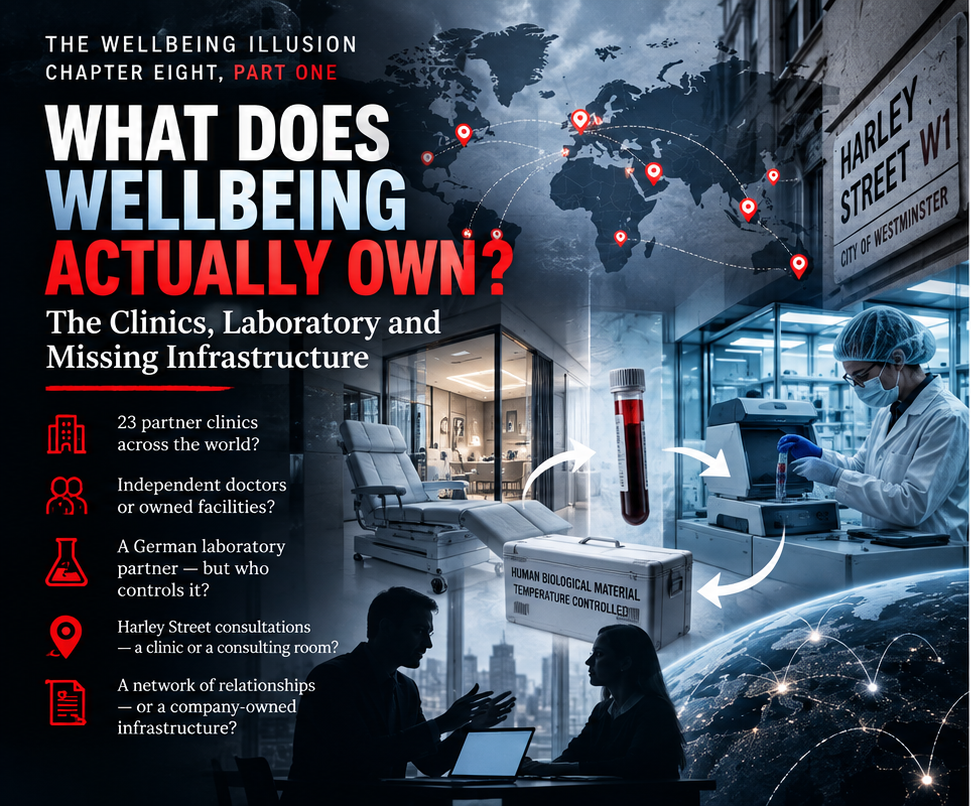
Twenty-three partner clinics.
More than twenty delivery locations.
A German laboratory.
Operations spanning the United States, Europe, the Middle East, Africa and the Pacific.
That is the international footprint presented today by Wellbeing International Foundation.
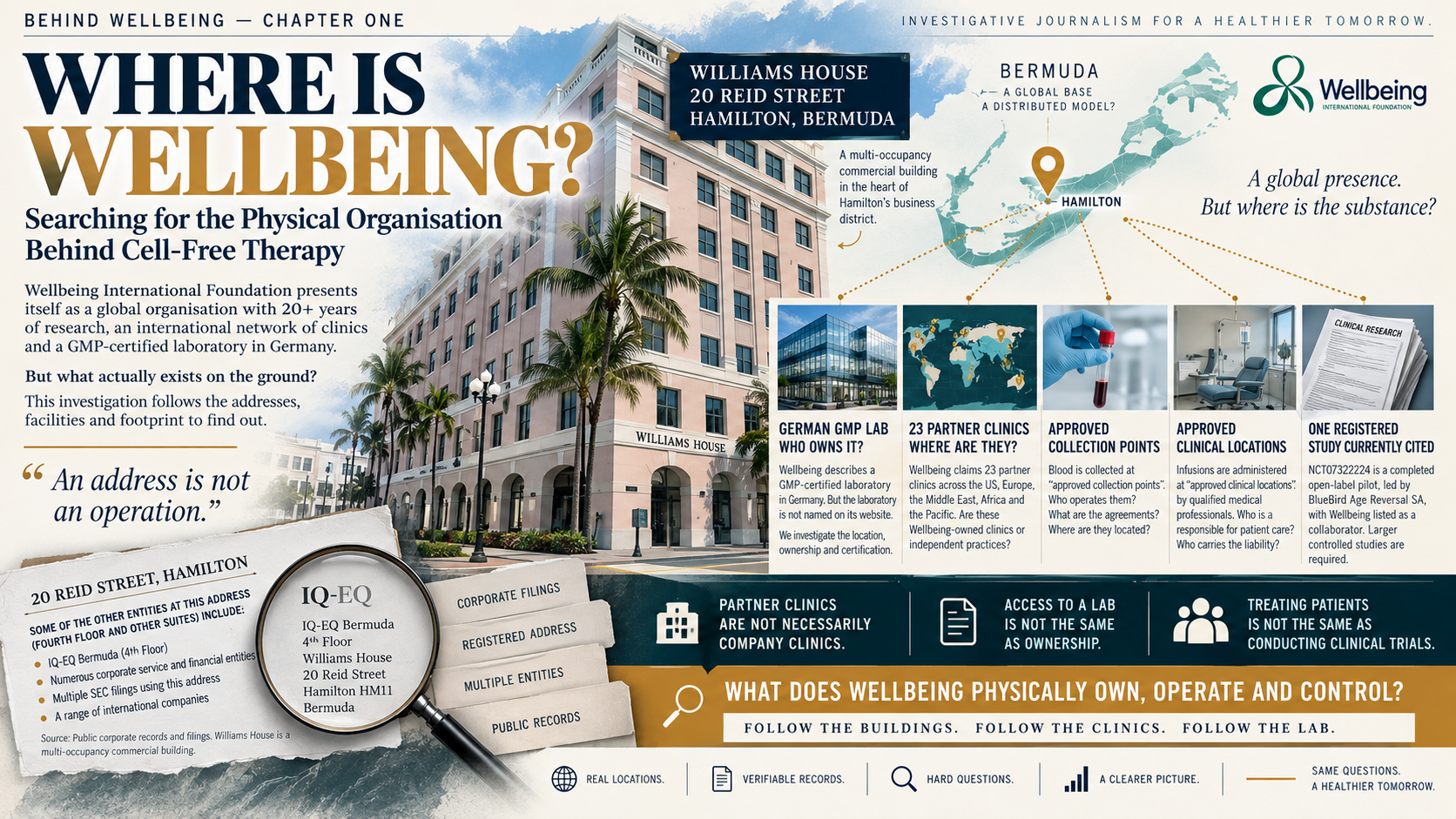
On its current website, Wellbeing describes itself as operating through a worldwide network of 23 partner clinics, supported by a single German laboratory. It lists locations stretching from Los Angeles and New York to London, Monaco, Dubai, Johannesburg and New Zealand. Wellbeing International Foundation
It sounds substantial.
But there is an obvious problem for anybody attempting to investigate that network.
Wellbeing doesn't publicly identify those 23 partner clinics on the page where it makes the claim.
It identifies places.
And a place is not a clinic.
That distinction takes us directly into one of the most important questions surrounding Wellbeing International Foundation:
What exactly does Wellbeing mean when it says it has 23 partner clinics?
Twenty-Three Clinics — But Which Clinics?
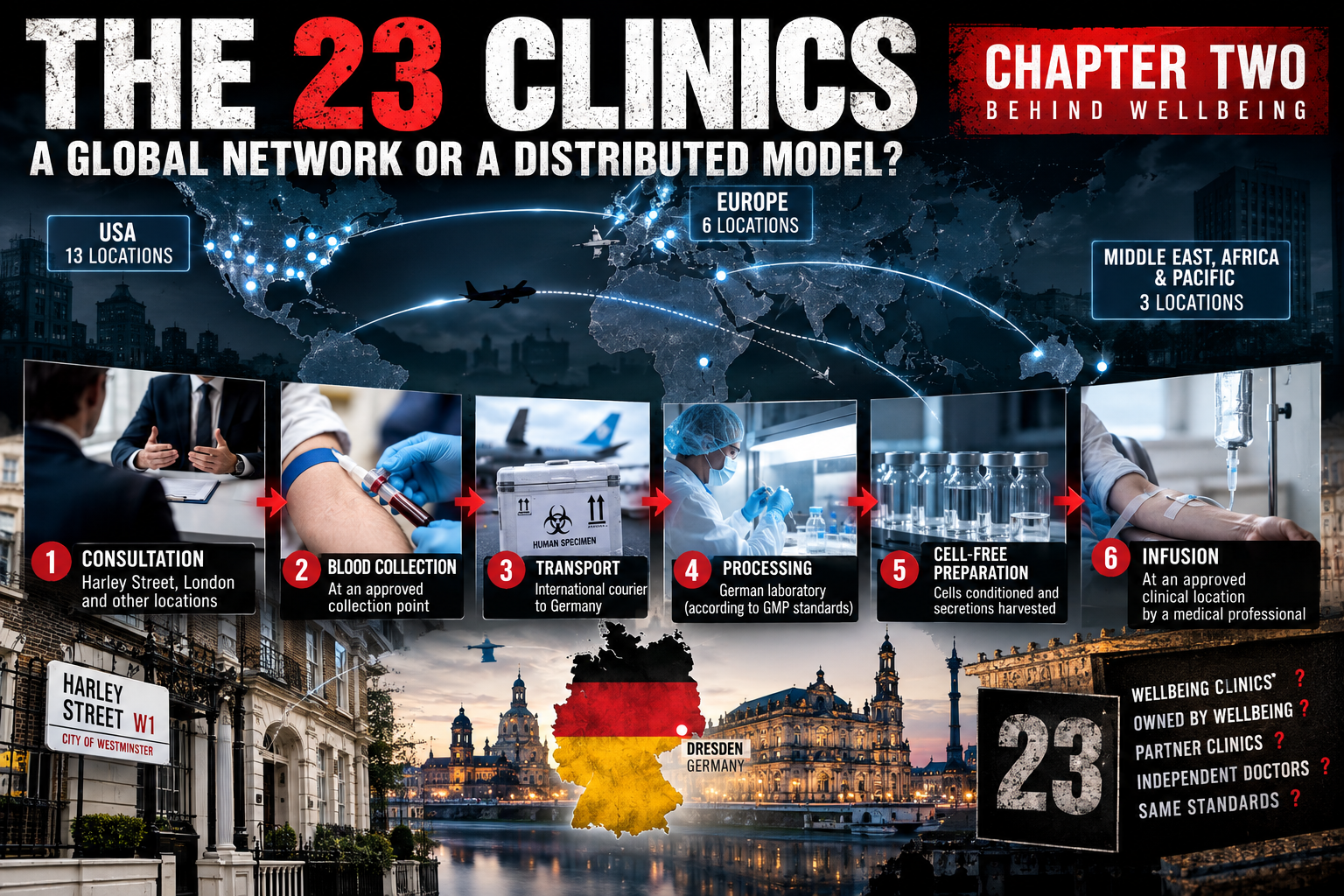
Wellbeing's current About page lists its geographical presence as follows.
In the United States:
Austin, Dallas, Detroit, Los Angeles, Louisville, New Orleans, New York, Philadelphia, Reno, San Francisco, Seattle, St Louis and Virginia Beach.
In Europe:
Dresden, Faro, Lisbon, London, Monaco and Nice.
Elsewhere:
Dubai, Johannesburg and New Zealand. Wellbeing International Foundation
Count them.
There are 22 named geographical locations.
Yet further down the same page, Wellbeing describes a:
“delivery network of 23 partner clinics.” Wellbeing International Foundation
That is not necessarily a contradiction.
There could be two partner clinics in one listed location.
The location list may be illustrative rather than exhaustive.
A newly added clinic may not yet appear in the geographical list.
But the discrepancy produces an extremely simple question:
What are the names and addresses of the 23 clinics?
We searched for that answer.
We could not find a complete public directory on Wellbeing's current website identifying all 23 clinics by clinic name, street address and responsible physician.
A City Is Not a Clinic
This sounds obvious, but it matters.
“New York” doesn't tell a prospective patient where treatment takes place.
“Los Angeles” doesn't identify the medical provider.
“London” doesn't tell us which regulated clinic is involved.
And “New Zealand” does not even identify a city.
For a medical network, those details matter because they establish considerably more than geography.
They allow a patient to identify who is actually treating them.
They allow somebody to check professional registration.
They allow inspection of regulatory records.
They establish which legal entity operates the premises.
They help establish who carries clinical responsibility.
And they allow a patient to distinguish between a facility owned by Wellbeing and an independent medical practice that provides services to Wellbeing patients.
Those are completely different things.
Wellbeing Actually Gives Us an Important Clue
Read Wellbeing's own language carefully.
It doesn't generally describe these locations as a chain of Wellbeing-owned hospitals or medical centres.
It calls them:
“partner clinics.” Wellbeing International Foundation
That word changes the picture considerably.
A partner clinic could be an entirely independent medical business.
It could have its own doctors.
Its own premises.
Its own licences.
Its own insurance.
Its own patients.
Its own medical records.
Wellbeing might simply have a commercial or clinical relationship allowing CFT patients to use the facility.
There is nothing inherently unusual about that model.
Medicine routinely operates through partnerships, referral networks and contracted providers.
But it means that saying an organisation has a presence in 23 clinics is very different from saying it owns or operates 23 clinics.
And Wellbeing's own current physician-recruitment programme provides further insight into how this network is apparently being constructed.
Wellbeing Is Actively Recruiting Existing Doctors
Wellbeing currently has an entire section of its website devoted to recruiting physicians.
It specifically targets practitioners already involved with PRP and regenerative medicine.
The proposition is not simply scientific.
It is also commercial.
Wellbeing tells prospective physician partners that CFT can become a “premium service offering”, discusses recurring revenue from cell banking, repeat infusions and marketing and patient-acquisition support. Wellbeing International Foundation
It offers three partnership tiers:
Team Physicians
Academic & Research Physicians
and:
High-Volume PRP Practitioners. Wellbeing International Foundation
The last category is particularly revealing.
Wellbeing describes these as established regenerative practices ready for premium positioning and offers them a revenue model, projections, patient-outcome data access, brand association and marketing support. Wellbeing International Foundation
This looks considerably less like a conventional company opening 23 of its own clinics around the world.
It looks more like a distributed partnership network built around existing independent practitioners.
Again, that isn't inherently a criticism.
But it is a fundamentally different business structure.
And It Helps Explain How Treatment Can Happen Almost Anywhere
Our investigation uncovered historical conversations that make considerably more sense when viewed through this modern partnership model.
During a recorded conversation with a prospective American patient, Andrew Chancellor was asked how treatment could be organised in the United States.
His answer was striking.
He explained that the blood could be taken:
“pretty much anywhere”
and that the infusion could similarly be organised in many places.
When the prospective patient referred to their doctor administering the treatment, Chancellor corrected the assumption:
“Well not your doctor, we can find a doctor for you.”
The discussion indicated that Wellbeing would organise both the physician and the medical courier.
That conversation took place years before the present website's description of 23 partner clinics.
But viewed from 2026, the underlying model suddenly becomes much easier to understand.
The important component may never have been a chain of buildings carrying a Wellbeing sign.
The important component may have been the network.
The Patient, the Clinic and the Laboratory Can All Be Somewhere Different
Wellbeing's current published treatment process effectively confirms this distributed structure.
The patient begins with a consultation with the Wellbeing clinical team.
Approximately 150ml of blood is then drawn at an:
“approved collection point.”
The sample is transported under controlled conditions to the laboratory in Germany.
Processing takes place there.
The final preparation is subsequently administered at an:
“approved clinical location”
by qualified medical professionals. Wellbeing International Foundation
Notice the terminology.
Not necessarily a Wellbeing clinic.
An approved collection point.
An approved clinical location.
And a laboratory in another country.
The consultation, blood collection, biological processing and infusion therefore do not necessarily need to occur within the same organisation or even the same jurisdiction.
That is a very different architecture from what most people might imagine when they read about an international organisation with 23 clinics.
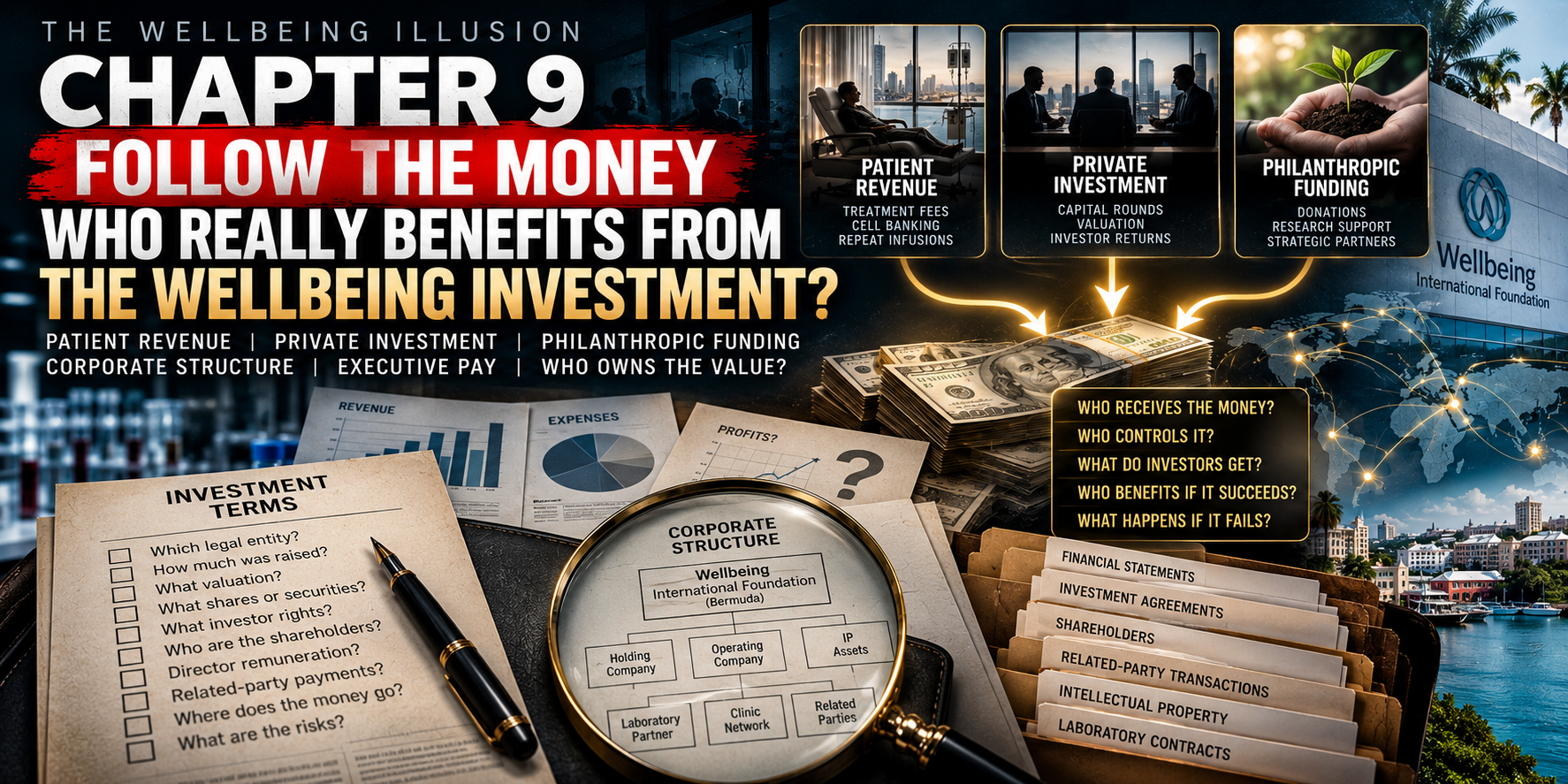
So What Does Wellbeing Actually Own?
This becomes the central question.
Does Wellbeing own any of the 23 clinics?
We have not established that it does.
Does it employ the physicians working inside them?
We have not established that for the entire network either.
Does it lease dedicated clinical rooms?
Does it contract independent physicians?
Are some clinics simply authorised to perform blood draws and infusions?
Are there different arrangements in different countries?
The public website does not provide enough information to answer those questions across all 23 locations.
Wellbeing's wording instead consistently points towards partnerships and clinical relationships.
Even its March 2026 investment announcement says new capital is supporting expansion of its:
“clinical-relationship network”
in the United States and Europe. Wellbeing International Foundation
That is unusually useful wording.
Not clinic acquisitions.
Not new Wellbeing hospitals.
Not construction of treatment centres.
Expansion of clinical relationships.
Follow the Blood
Perhaps the simplest way of understanding the organisation is to stop following the clinic map and follow the patient's blood instead.
A patient could begin in one country.
A local practitioner takes approximately 150ml of blood.
The biological sample is transported internationally.
It reaches Germany.
Cells are isolated and processed.
Wellbeing says the resulting cell-free preparation contains extracellular vesicles, growth factors, cytokines and other signalling molecules. Wellbeing International Foundation
Material can be banked.
A preparation is eventually returned for administration.
The patient attends an approved clinical location.
A medical professional performs the infusion.
That means the Wellbeing product or service appears to depend upon a chain of organisations and individuals, rather than necessarily one vertically integrated medical institution.
And every link in that chain matters.
Who Is Responsible for the Patient?
Imagine something goes wrong.
Who holds the medical record?
Who conducted the medical assessment?
Who decided the patient was suitable?
Who prescribed or authorised the procedure, where applicable?
Who collected the blood?
Who became responsible for it during international transportation?
Who accepted it in Germany?
Who processed it?
Who performed quality-control release?
Who authorised its return?
Who received it at the destination?
Who performed the infusion?
And who is clinically responsible if an adverse event occurs afterwards?
Those questions are not allegations.
They are the ordinary questions produced by a distributed medical-delivery model.
The more organisations involved in delivering a biological preparation, the more important the chain of responsibility becomes.
Wellbeing Now Names Some Clinical Personnel
There has been an important development here.
Wellbeing's current website provides substantially more information about its clinical team than older versions did.
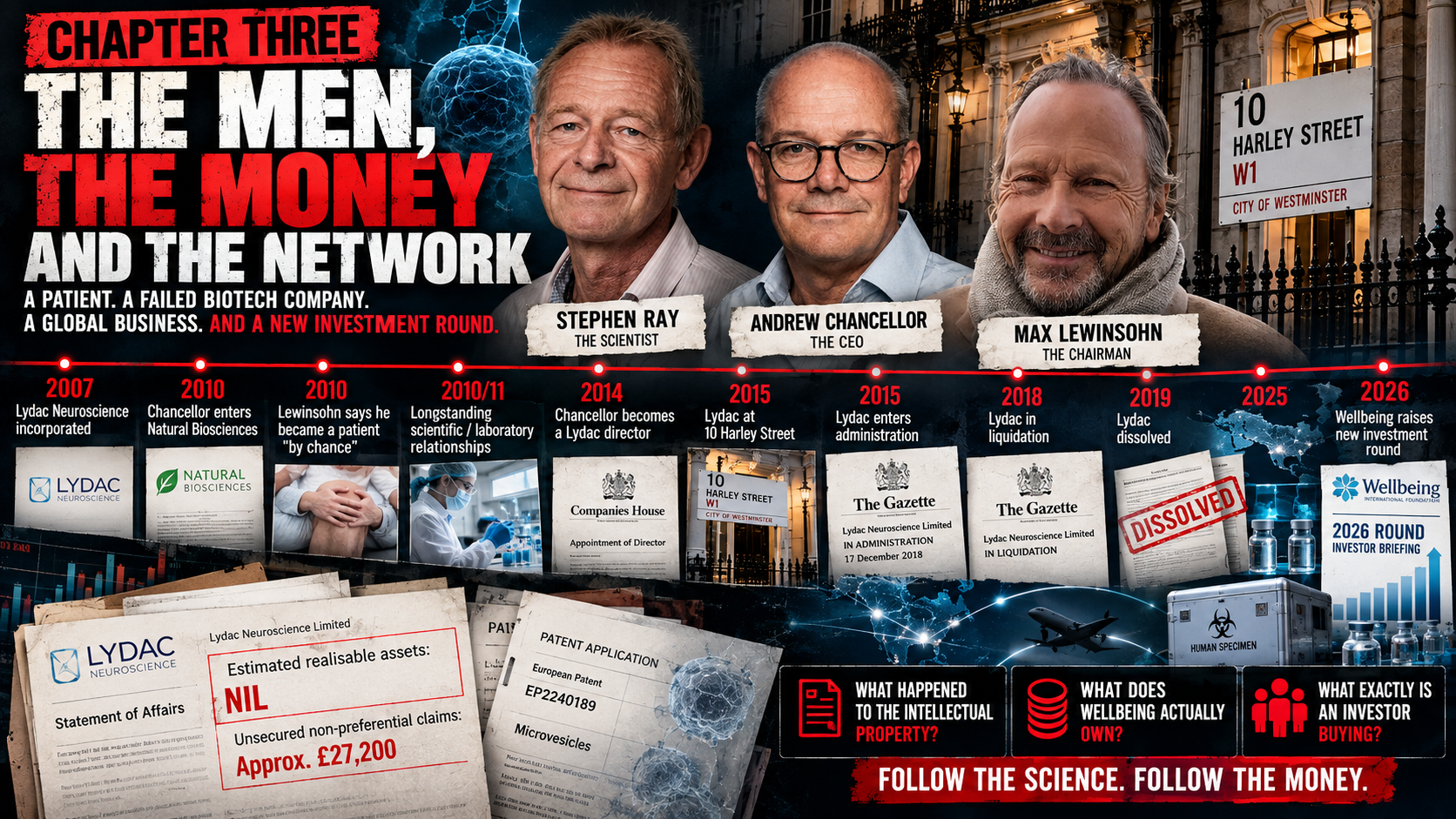
For example, it identifies Chris Icamina as Senior Clinical Consultant and says he performs both blood draws and infusions while working alongside partner physicians as they begin delivering CFT.
It identifies Melanie Scaggs as Senior Nursing Consultant and says she performs blood draws and infusions. Wellbeing International Foundation
That is useful disclosure.
But it still doesn't answer the wider question.
Who are the responsible physicians at the 23 partner clinics?
Why Not Publish the Directory?
This is perhaps the simplest question in this chapter.
If the network consists of 23 established medical clinics operating across multiple countries, why not publish:
clinic name;
full address;
responsible physician;
professional registration;
services performed there;
and whether the clinic is owned, contracted or independently partnered?
There may be perfectly reasonable explanations for not publishing such a directory.
Relationships change.
Some facilities may value patient privacy.
Certain locations may operate by appointment only.
Contracts may differ.
But for an organisation placing “Transparency” among its stated core principles, a public clinic directory would remove considerable ambiguity. Wellbeing International Foundation
The German Laboratory Raises the Same Question
The clinic network isn't the only part of the organisation described geographically rather than corporately.
Wellbeing's Contact page identifies:
Bermuda — Headquarters
and:
Germany — Laboratory.
The laboratory is described as a:
“State-of-the-art GMP-certified laboratory for cell-free preparation processing.” Wellbeing International Foundation
But the Contact page itself does not name the laboratory's operating company or give its street address.
Again, that does not establish that anything is wrong.
But it means a prospective patient cannot use that page alone to independently verify the facility processing their biological material.
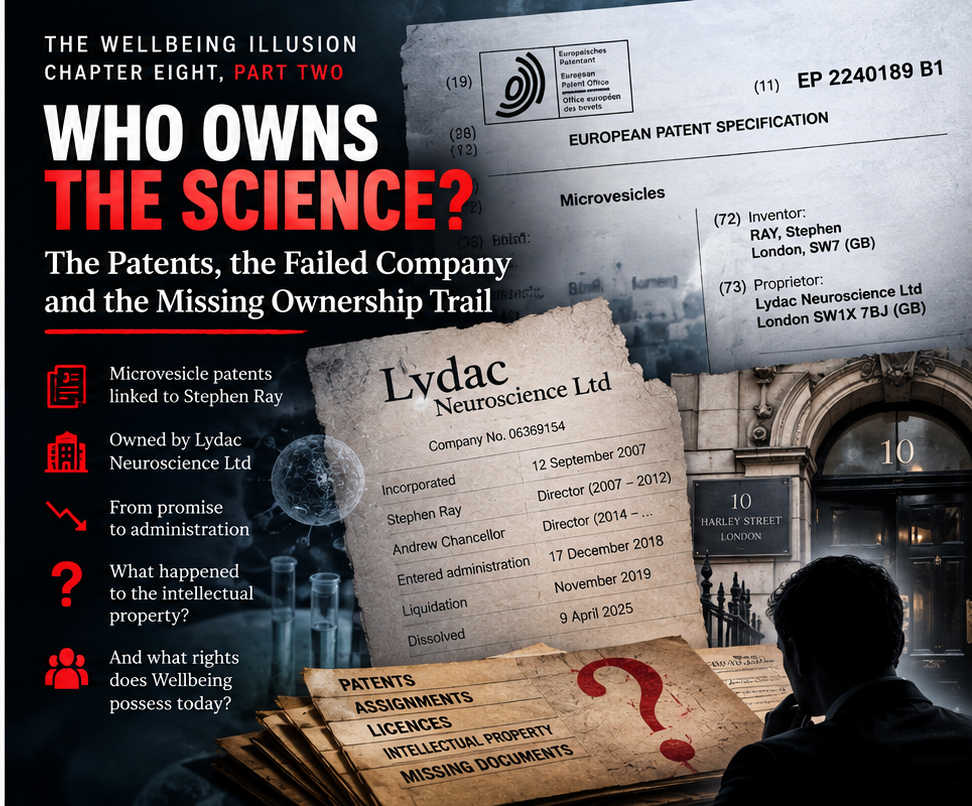
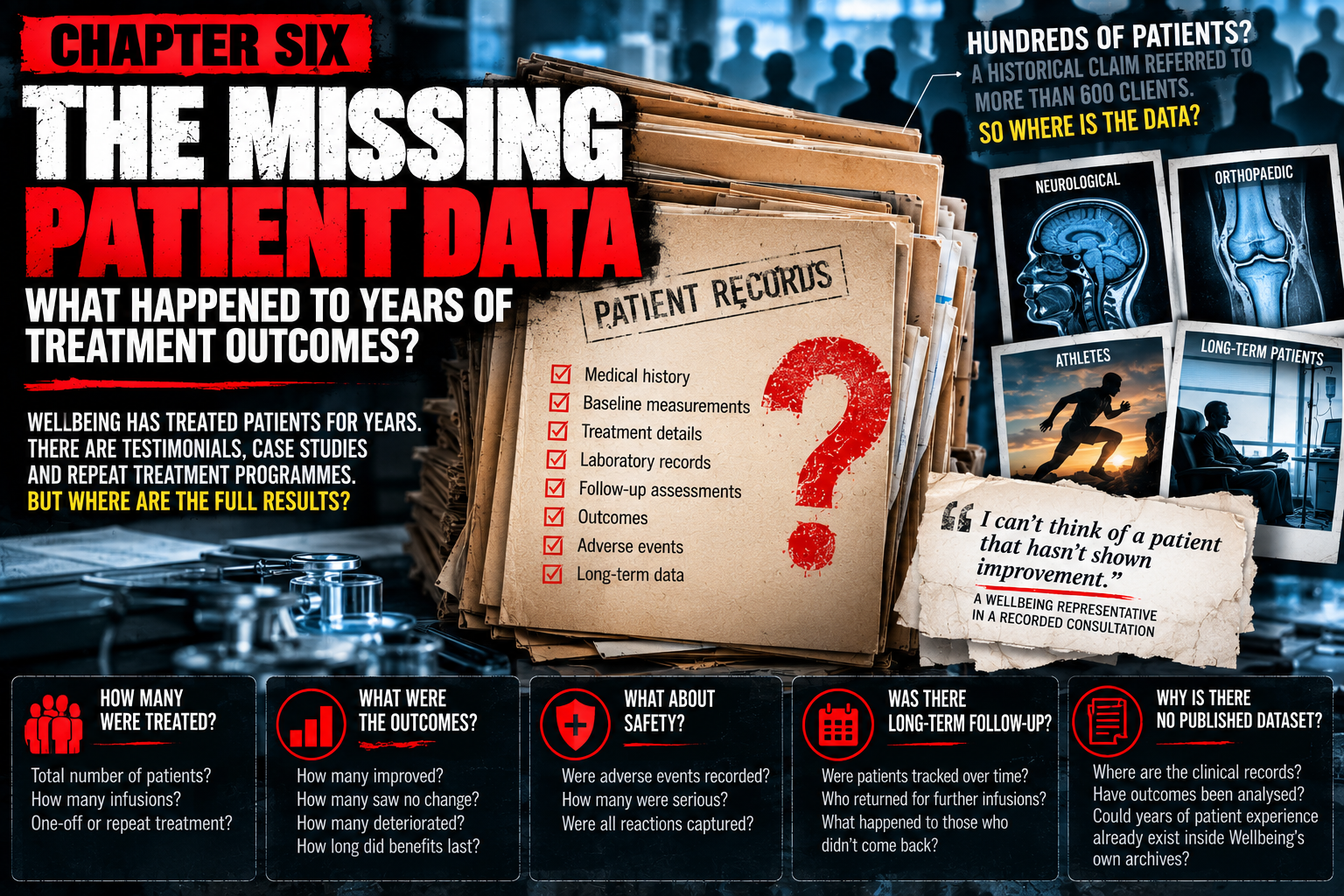
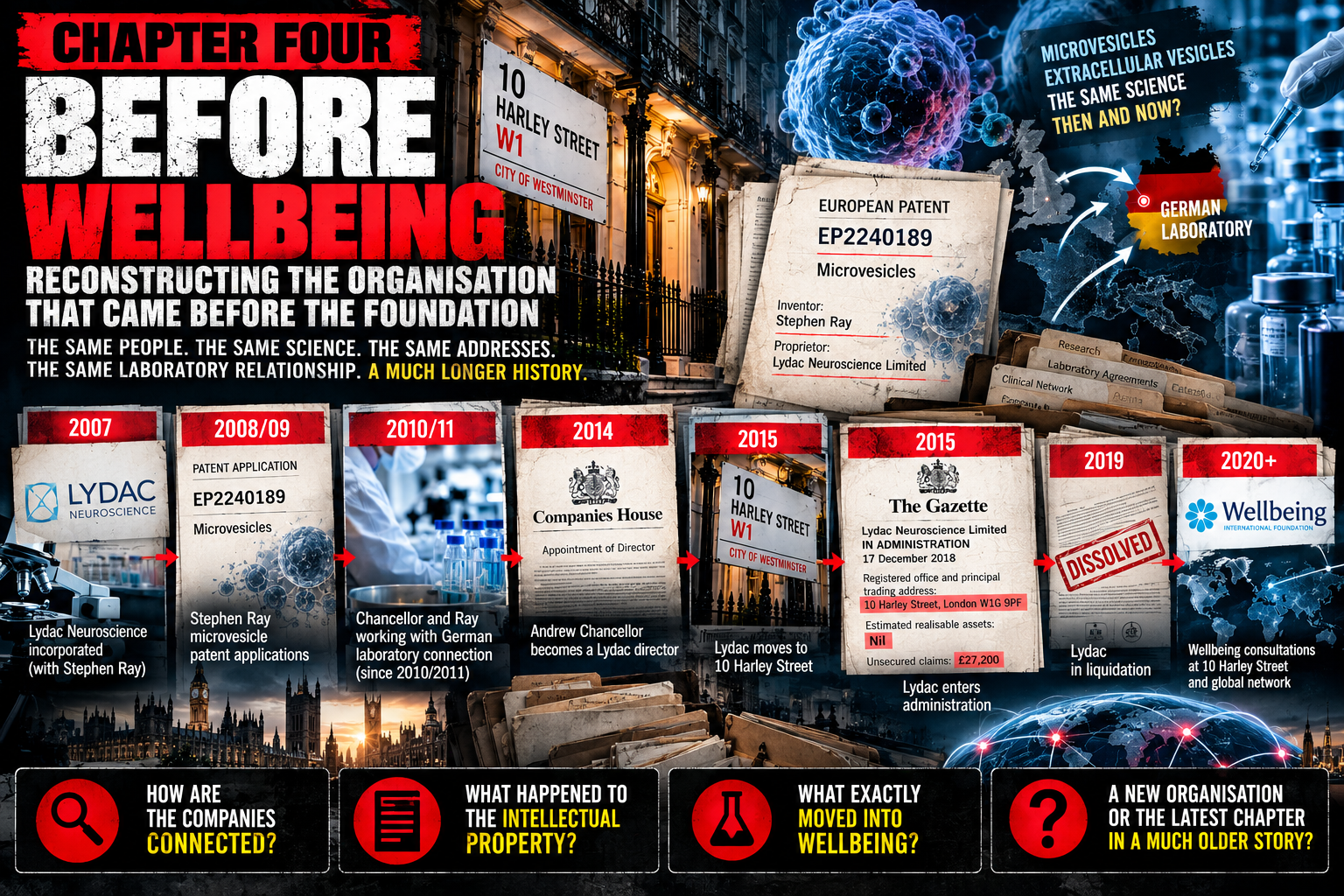
And our investigation has uncovered evidence that the German laboratory relationship goes back much further than the current 23-clinic network.
Behind Closed Doors, the History Was More Revealing
In a recorded 2021 discussion concerning the German processing facility, Chancellor described the relationship as longstanding.
He said that he and Stephen Ray had worked with the German laboratory connection since approximately 2010 or 2011.
The laboratory representative himself remembered the relationship as potentially extending even further back.
More importantly, the conversation revealed how responsibilities were divided.
Chancellor described Ray as designing the protocols.
The German representative said the laboratory carried out Wellbeing's protocols and was responsible for quality and process control.
This is important because it suggests the distributed model is not something recently created to support the current 23-clinic expansion.
The underlying structure appears to have existed for years.
Science and protocols in one place.
Laboratory processing in another.
Patients elsewhere.
Clinical administration through separate medical locations.
The Website Has Changed — But the Architecture Looks Familiar
Wellbeing's current website is more explicit than its earlier public material.
It identifies partner clinics.
It identifies clinical personnel.
It describes the collection process.
It explains transportation.
It acknowledges that the German facility is part of the processing chain.
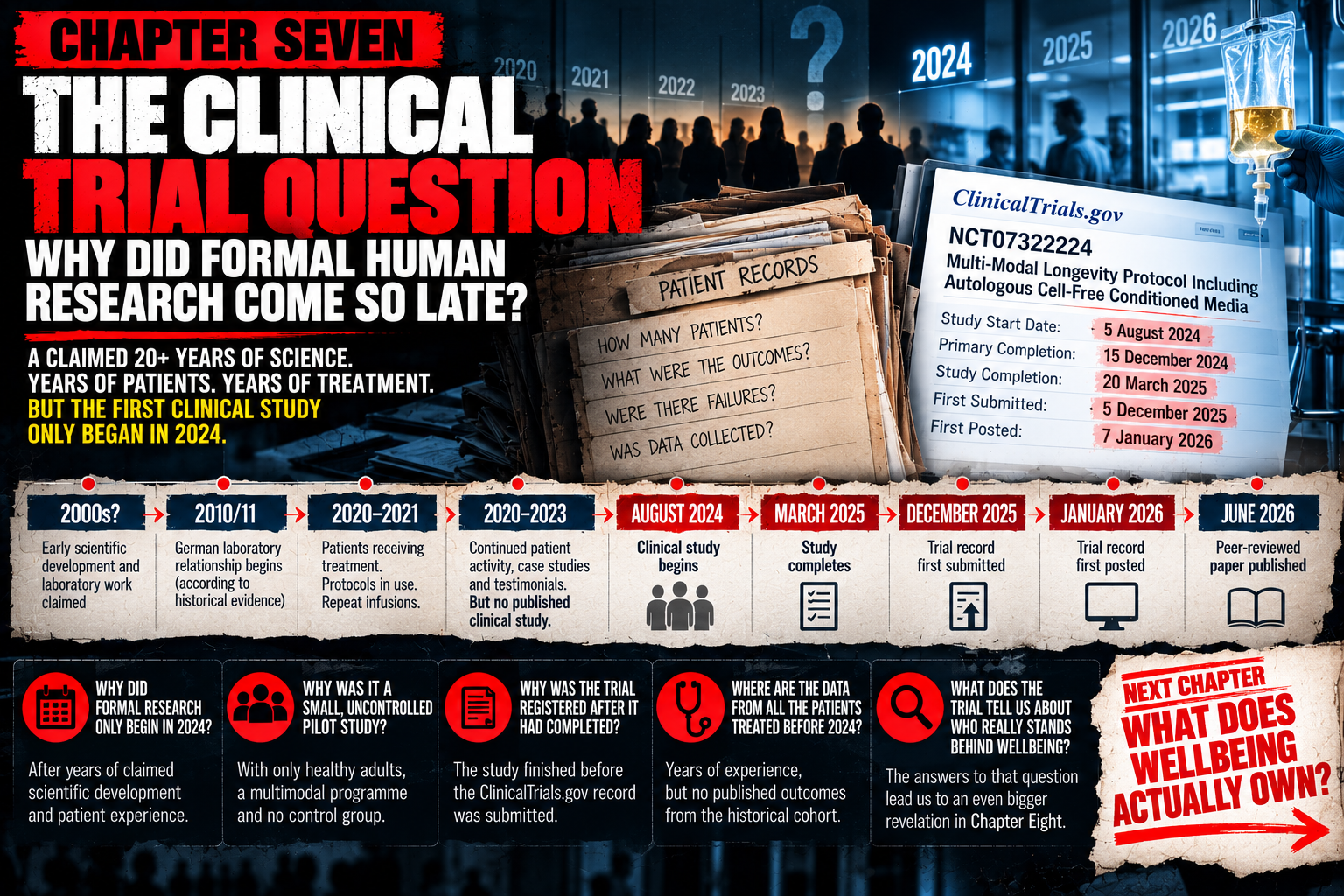
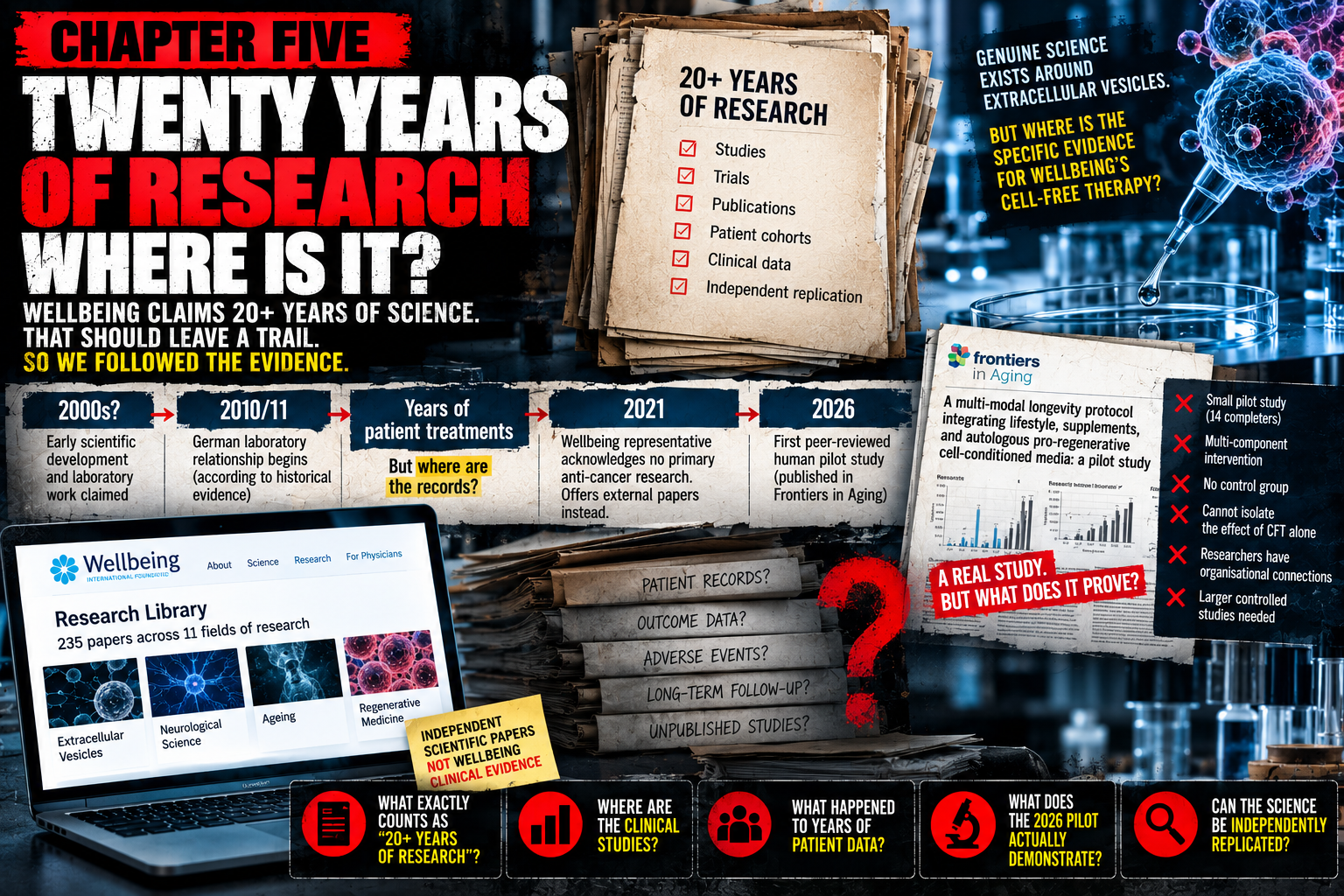
It now also explicitly states that testimonials and case studies are patient-reported accounts and are not offered as evidence of efficacy, while describing its peer-reviewed pilot as the clinical study it cites. Wellbeing International Foundation
Those disclosures matter and should be acknowledged.
But underneath the new presentation, the same fundamental question remains.
What is Wellbeing itself?
Perhaps We Have Been Looking for the Wrong Thing
Maybe searching for 23 buildings with Wellbeing International Foundation signs above their doors misses the point entirely.
Perhaps there aren't supposed to be 23 conventional Wellbeing clinics.
Perhaps Wellbeing is better understood as the organisation sitting between the different components.
Between patient and practitioner.
Between practitioner and laboratory.
Between laboratory and infusion location.
Between scientific protocol and clinical delivery.
Between biological material and international logistics.
Between independent physicians operating across multiple jurisdictions.
If that is the model, then the real asset isn't necessarily the buildings.
It is the network.
And that would explain a great deal.
But Networks Need Transparency Too
An asset-light medical model isn't automatically inferior to an organisation owning hospitals and laboratories.
In some circumstances it can be considerably more efficient.
But outsourcing physical infrastructure doesn't outsource the need for accountability.
In fact, it can make transparency more important.
Patients should be able to understand which organisation performs each stage of the procedure.
Investors should be able to distinguish assets owned by Wellbeing from services purchased from third parties.
Physicians considering joining the network should understand where responsibility begins and ends.
And regulators should be able to identify which legal entity performs which regulated activity.
That requires more than dots on a map.
Twenty-Three Clinics May Be the Wrong Number to Focus On
After investigating Wellbeing's global footprint, we are beginning to think the headline number may actually distract from the more important story.
Whether the current number is 22, 23 or eventually 50 isn't the central issue.
The central issue is:
What constitutes a Wellbeing partner clinic?
If an independent PRP practitioner joins the partnership programme, does that practitioner's existing medical practice become another Wellbeing partner clinic?
If so, the network could expand rapidly without Wellbeing purchasing a single new building.
Its physician page actively markets exactly such an expansion strategy, including revenue opportunities, cell banking, repeat infusions and patient acquisition. Wellbeing International Foundation
That could be a commercially effective model.
But it is not the same thing as building an international chain of regenerative-medicine centres.
And patients and investors should understand the distinction.
The Questions Wellbeing Could Answer Immediately
There is a straightforward way for Wellbeing International Foundation to settle most of this.
Publish the 23 clinics.
Name them.
Identify their responsible physicians.
Explain which are owned and which are independent partners.
Identify the German laboratory legal entity and the certification covering the relevant processing.
Explain which organisation has responsibility for the patient at each stage.
Explain who owns and stores the clinical records.
Explain who receives payment for the medical procedure.
And explain precisely what Wellbeing means when it says somebody is treated through its worldwide network.
Those answers would transform this investigation.
Because they would replace inference with documentation.
The Invisible Network
So where are Wellbeing International Foundation's 23 clinics?
We now have a more nuanced answer than when we began.
Wellbeing publicly identifies a large international geographical footprint.
It publicly states that there are 23 partner clinics. Wellbeing International Foundation
It openly recruits existing physicians into its network. Wellbeing International Foundation
It describes a process in which blood can be collected at an approved collection point, processed in Germany and administered at an approved clinical location. Wellbeing International Foundation
And its investment announcement describes the underlying structure as a clinical-relationship network. Wellbeing International Foundation
Put those pieces together and Wellbeing begins to look less like an international chain of conventional clinics and more like a central organisation coordinating a distributed network of independent clinical relationships around a single biological-processing system.
That may be exactly what Wellbeing intends.
But if it is, then patients and investors deserve to see the network clearly.
Not merely the cities.
Not merely the map.
Not merely the number 23.
The clinics.
The doctors.
The laboratory.
The contracts.
And the chain of responsibility connecting them all.
Because when biological material leaves one medical location, crosses international borders, enters a laboratory in another country and eventually returns to a patient through another practitioner, the most important question isn't how many dots appear on a map.
It is:
Who is responsible at every step?
Next: Chapter Three — Who Is Actually Treating the Patient?
We follow the clinical chain from the first Wellbeing consultation to blood collection, German laboratory processing and the final infusion. Who assesses the patient? Who makes the medical decision? Who is the physician of record? And where does Wellbeing's responsibility end and the independent doctor's begin?
Recent Posts