Behind the Global Network: What Does Wellbeing International Foundation Actually Own?
The Wellbeing Illusion — Chapter Eight, Part One | Alternative Edition
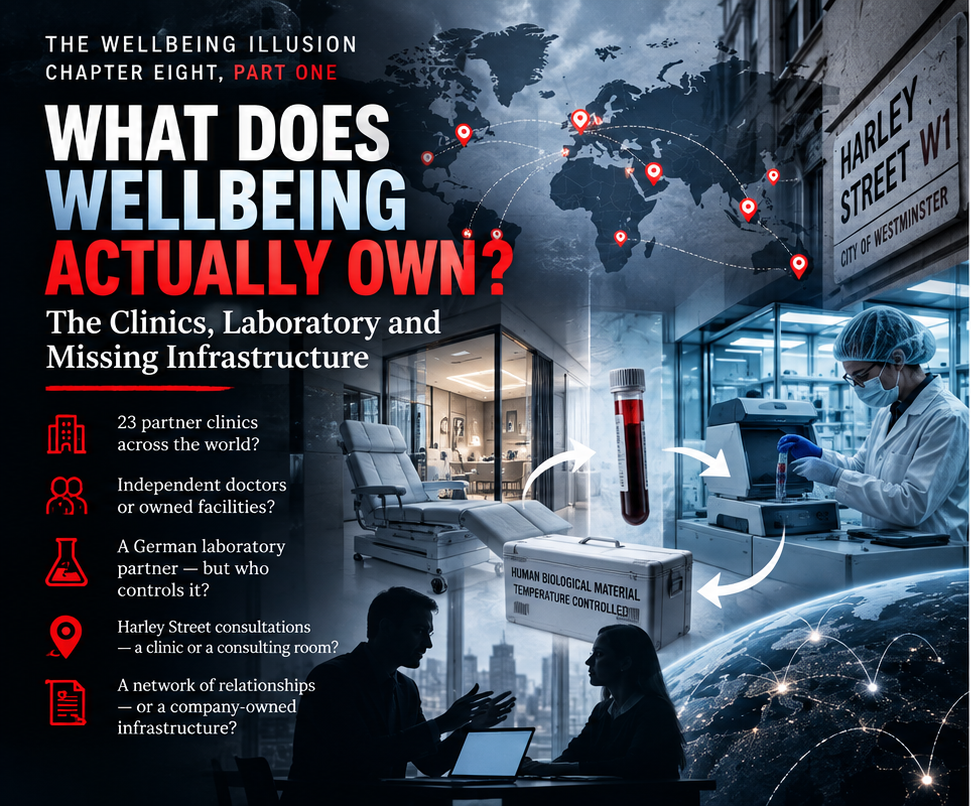
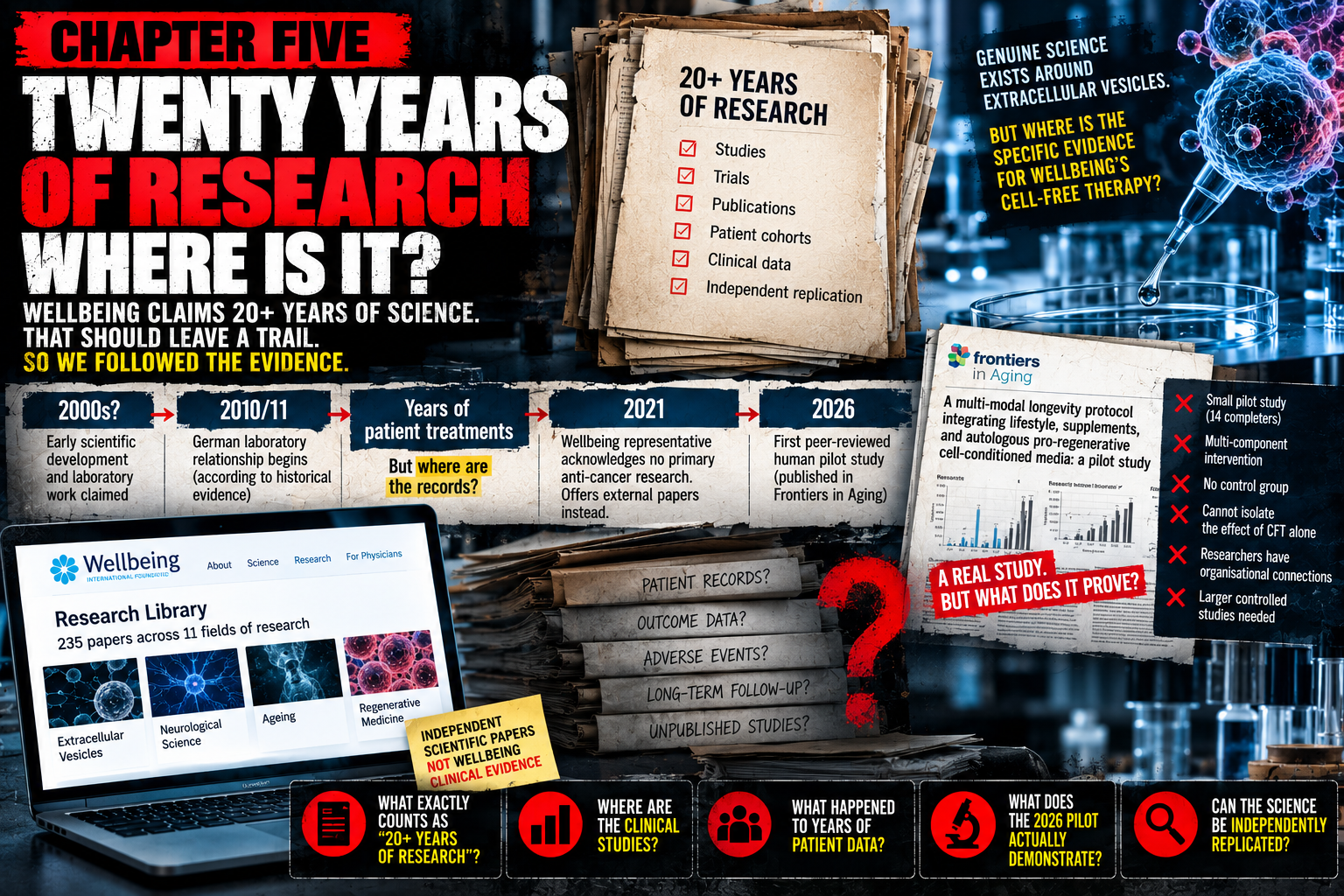
An international network of medical clinics. A specialist laboratory in Germany. Doctors across multiple countries. A sophisticated biological treatment process. More than twenty years of scientific development.
Taken together, these are the ingredients of what appears to be a substantial international biotechnology operation.
They are also central to the public presentation of Wellbeing International Foundation, the organisation promoting a treatment known as Cell-Free Therapy, or CFT.
But behind the international reach and scientific language lies a basic business question that deserves considerably more attention.
How much of this medical infrastructure actually belongs to Wellbeing International Foundation?
It is a question about ownership, operational control and the commercial substance of the organisation.
Because there is an enormous difference between owning a medical facility and having an agreement with one. There is a difference between employing a specialist and working with an independent practitioner. And there is a difference between operating a laboratory and commissioning a laboratory to carry out a proprietary process.
All are legitimate business arrangements. But they represent very different assets, obligations and risks.
Our investigation set out to establish which of these arrangements lies behind Wellbeing's international medical network.
The International Image
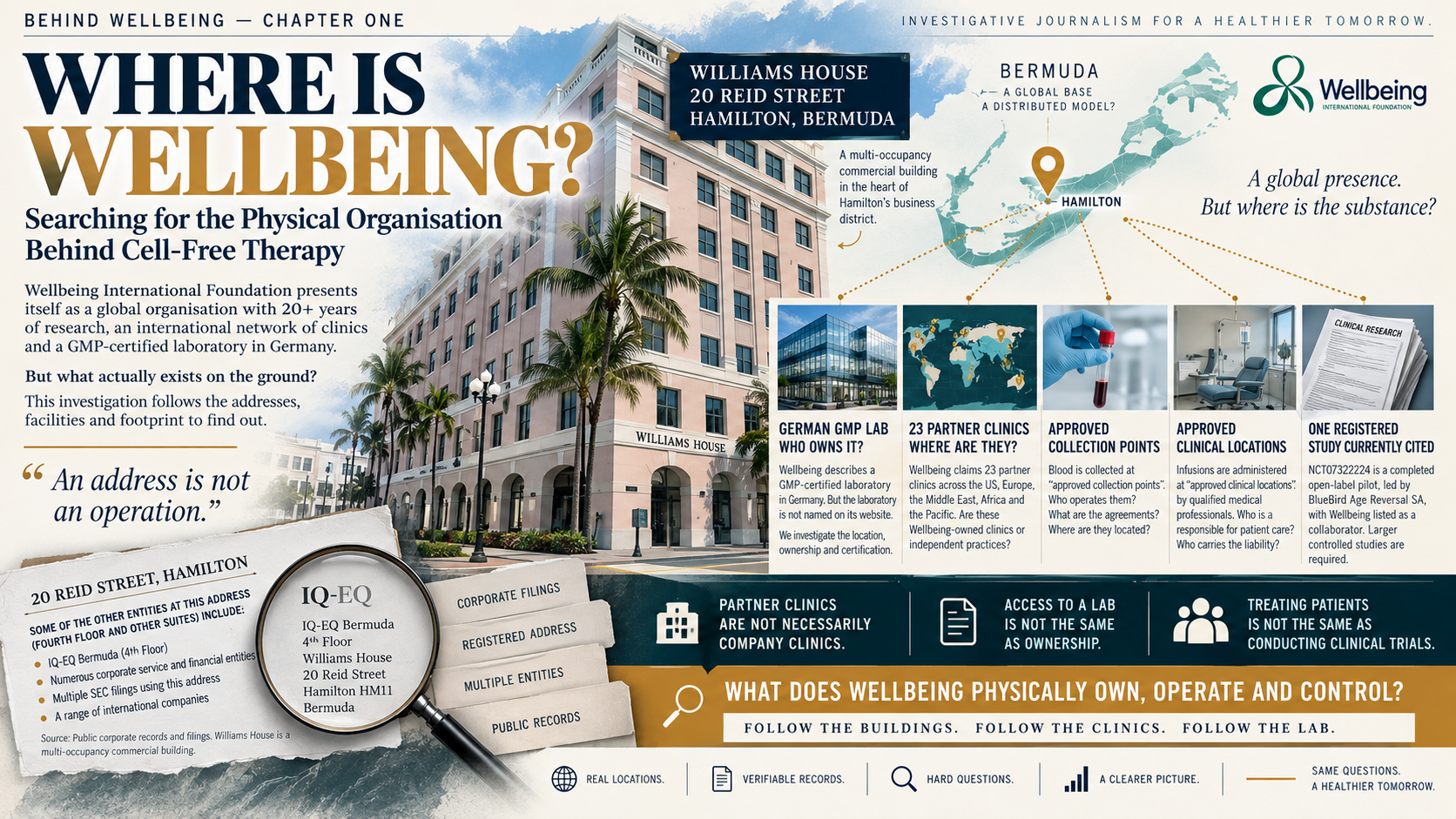
Wellbeing International Foundation presents itself as an organisation with access to an extensive international clinical network.
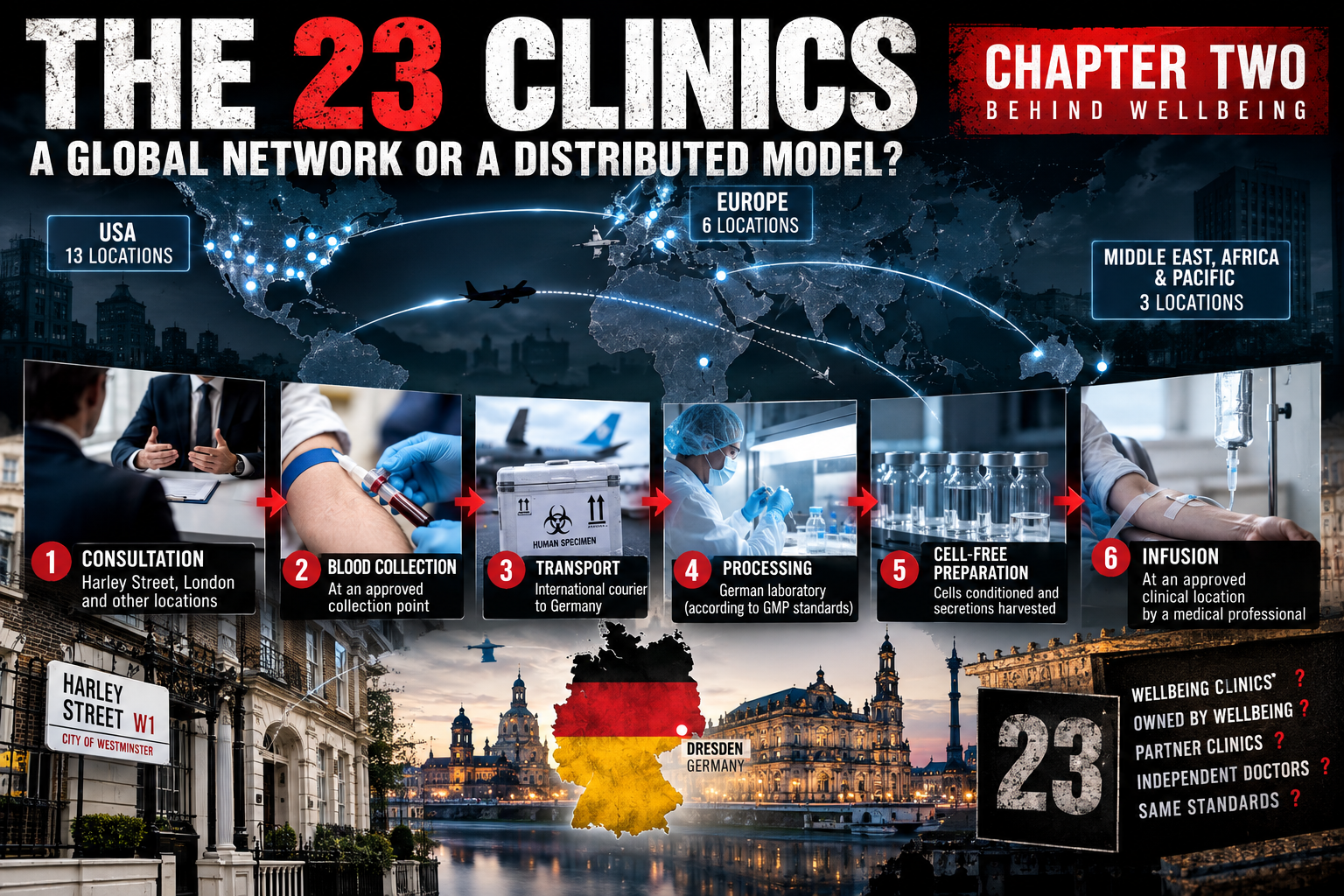
Its published materials describe 23 partner clinics, specialist laboratory processing in Germany and medical relationships spanning multiple jurisdictions.
The organisation also promotes an approach in which a patient's biological material is collected, transported, processed and subsequently administered as part of its CFT programme.
For someone unfamiliar with the business, the presentation can suggest a substantial medical infrastructure extending across the world.
But an international presence does not necessarily mean international ownership.
A company can coordinate medical services in numerous countries while owning relatively little physical infrastructure.
Indeed, some of the world's most successful healthcare businesses operate through external providers, licensing agreements and specialist contractors.
The question is not whether such an arrangement is legitimate.
The question is whether the scale of the organisation's commercial relationships is being confused with the scale of its owned assets.
And in Wellbeing's case, that distinction is particularly important.
The Significance of One Word: Partner
Wellbeing's description of its network repeatedly uses the term partner clinic.
It may sound like a minor detail.
It is not.
A partner clinic is not necessarily a subsidiary, branch or property owned by the organisation referring patients to it.
It may be an entirely independent medical practice that has agreed to provide particular services.
That arrangement could involve collecting blood samples, administering an infusion, conducting consultations or providing clinical supervision.
The clinic may have its own medical licence, professional insurance, employees and patient-record systems.
Wellbeing may coordinate the treatment while the clinic provides the medical environment in which it takes place.
This is an entirely plausible operating model.
But it means that counting partner clinics tells us relatively little about the organisation's physical assets.
A business claiming relationships with 23 clinics has not thereby demonstrated ownership of 23 clinics.
To establish ownership, we would need to identify the individual facilities, their legal operators and their relationship with Wellbeing.
That information would also help answer another important question: how secure are those relationships?
An independent clinic may be able to terminate its arrangement. It may work with competing providers. Its medical personnel may change.
Unless there are enforceable agreements providing otherwise, access to a network can be more fragile than ownership of the infrastructure itself.
Following the Treatment From Patient to Laboratory
Wellbeing's published treatment process provides an insight into the organisation's operational structure.
The pathway begins with patient assessment and the collection of a blood sample at an approved location.
The biological material is then transported to Germany for specialist processing.
Following processing and quality checks, the preparation is returned for administration at an approved clinical site.
At first glance, this appears to be a seamless medical programme.
Operationally, however, it involves several potentially separate businesses.
There may be a medical practitioner responsible for collecting the blood, a transport company handling biological samples, a laboratory carrying out the processing, and another medical professional responsible for administering the final preparation.
Each stage carries its own legal, clinical and commercial responsibilities.
Who holds the patient's medical records?
Who is responsible for the biological material during transport?
Which organisation holds the relevant laboratory authorisations?
Who releases the processed preparation?
Which clinician assumes responsibility for administering it?
And if something goes wrong, which organisation is legally accountable?
These questions cannot be answered simply by describing the overall process as Wellbeing's treatment programme.
The treatment pathway may be coordinated centrally, but that does not establish central ownership of every component.
Germany: The Laboratory at the Centre of the Business
The German laboratory occupies a particularly important position in Wellbeing's commercial model.
Without the processing stage, the treatment cannot proceed in the manner publicly described.
The laboratory is therefore more than a peripheral supplier.
It is central to the delivery of the intervention.
That makes its ownership and contractual relationship with Wellbeing especially significant.
Does Wellbeing own the facility? Does it employ the laboratory personnel? Does it possess the manufacturing equipment? Or does it contract an independent specialist laboratory to process the biological material?
Wellbeing's public materials describe a laboratory partnership.
That wording does not establish company ownership.
Our historical investigation uncovered further evidence of how the relationship operated.
During a recorded discussion obtained in 2021, representatives connected with Wellbeing and the German laboratory discussed a working relationship stretching back approximately a decade.
The conversation described a division of responsibilities between scientific protocol development and laboratory processing.
One representative explained that Stephen Ray designed the protocols used by the programme.
The laboratory representative described the German facility's role as carrying out those protocols and handling process and quality-control responsibilities.
This historical material supports the existence of a substantive laboratory relationship.
But it does not establish that Wellbeing owned the laboratory.
In fact, the division of responsibilities raises a more interesting commercial question.
If the scientific methods are developed by one party and the manufacturing work is carried out by another, who owns the process itself?
That is not necessarily the same question as who owns the building.
And it may be considerably more important.
What Happens if the Laboratory Relationship Ends?
Consider the practical implications of relying upon an external laboratory.
If the arrangement is exclusive, long-term and protected by comprehensive contracts, it could provide Wellbeing with considerable commercial security.
If the relationship is non-exclusive or terminable, the organisation may face different risks.
Could another laboratory take over the processing?
Would Wellbeing have the right to transfer the protocols?
Would a replacement facility need to undergo technical validation?
Who owns improvements developed during years of manufacturing?
Who controls the documentation necessary to reproduce the preparation consistently?
Could the existing laboratory work with other companies offering similar biological services?
These questions are especially relevant when a business's principal offering depends upon a specialist manufacturing process.
A laboratory agreement can be commercially valuable.
But its value depends upon the rights it grants.
An investor assessing such a business would need to examine the agreement rather than simply assume that the laboratory represents an asset owned by the central organisation.
The GMP Question
Wellbeing's public material also refers to GMP-related laboratory standards.
Good Manufacturing Practice is an important concept in the manufacture and quality control of medical and biological products.
But claims about GMP require precision.
A facility operating according to GMP principles is not necessarily making the same statement as a facility holding a particular regulatory manufacturing authorisation.
The precise meaning depends upon the documentation, issuing authority, activities covered and regulatory framework.
During our historical investigation, a German laboratory representative described operations conducted according to GMP standards.
Wellbeing's present-day material refers to a GMP-certified laboratory.
These descriptions may reflect different periods or different aspects of the laboratory's quality arrangements.
They do not, by themselves, establish the precise scope of certification.
To independently verify the position, the relevant questions would include which legal entity holds the certification, which facility it covers and whether its scope includes the particular biological preparation involved in CFT.
The issue is not whether the laboratory is capable of sophisticated processing.
It is whether the regulatory claims can be matched to identifiable authorisations and responsible legal entities.
For a treatment involving the collection, international transportation, processing and administration of human biological material, that distinction matters.
Harley Street: An Address Is Not a Medical Institution
Another part of the investigation took us to 10 Harley Street in London.
Harley Street has a longstanding association with private medicine, specialist consultations and prestigious clinical practices.
It is an address that can carry considerable reputational weight.
Historical investigative material established that Wellbeing-related consultations took place at 10 Harley Street during 2020 and 2021.
But the presence of consultations at a medical address does not establish ownership of a medical clinic.
Independent practitioners and commercial organisations can legitimately use consulting rooms, shared premises or sessional facilities.
A prestigious address can provide access to a professional environment without representing a substantial property asset.
The important questions are therefore operational rather than geographical.
Was Wellbeing running a permanent clinic at the premises?
Was it using rooms provided by another operator?
Were consultations conducted by independent practitioners?
Who held responsibility for the clinical service?
And which entity maintained the patient records?
The available historical evidence establishes the connection with the address, but not the ownership of a permanent Wellbeing-operated medical facility there.
Harley Street also has another significance in this investigation.
Its connection with an earlier biotechnology company will become important when we examine the history of the scientific technology.
A Network Built Around Independent Physicians
Wellbeing's physician partnership programme provides perhaps the clearest indication of its broader commercial strategy.
The programme invites medical practitioners, including those already involved in regenerative procedures, to incorporate CFT into their practices.
It describes opportunities involving premium treatment services, patient acquisition, repeat infusions and biological-material banking.
This is a recognisable business-development model.
Rather than building a medical clinic in every city, an organisation can work with practitioners who already possess the premises, equipment, professional registrations and clinical infrastructure needed to treat patients.
The central organisation provides access to its programme and coordinates the specialist components.
Such a structure can allow rapid geographical expansion without the enormous expense of establishing and staffing company-owned facilities across multiple countries.
It can also be commercially attractive.
But it raises an important question about what is being counted when an organisation describes its international reach.
Is it counting facilities it owns?
Facilities with exclusive agreements?
Independent practices that have agreed to participate?
Or clinical locations capable of providing services when required?
The public description of a partner network does not, on its own, resolve these distinctions.
The Difference Between Access and Control
This is the central issue.
Access to a medical facility can be commercially useful.
Control over that facility can be more valuable.
Ownership may provide a different level of security again.
A company may have access to a network of independent clinics but limited influence over their staffing, operating hours, financial stability or long-term participation.
It may coordinate an international laboratory process without owning the manufacturing facility.
It may rely upon individual scientific consultants without owning every element of their earlier research.
None of these arrangements is necessarily problematic.
But together, they create a business that may depend heavily upon contracts and personal relationships.
The durability of those arrangements becomes essential to understanding its value.
If a key partner leaves, can the service continue?
If the scientific adviser departs, does the company retain the rights and technical knowledge required to manufacture the preparation?
If a laboratory relationship ends, can production be transferred?
If independent clinicians withdraw, can replacement providers be recruited without disrupting patients?
These are questions about commercial resilience.
And they are particularly relevant when an organisation is promoting a medical intervention that requires coordination across international borders.
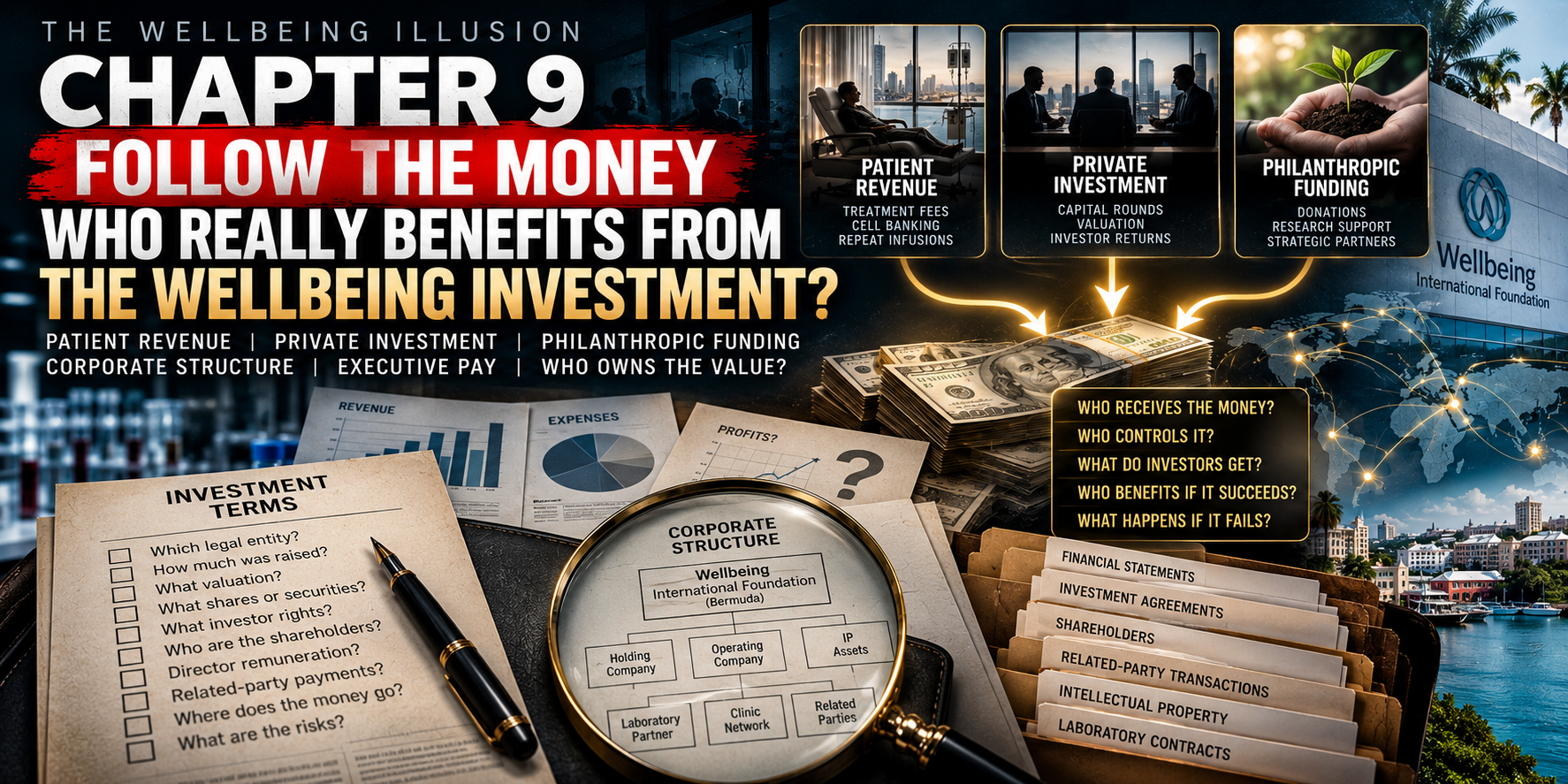
What Assets Could Actually Make Wellbeing Valuable?
There is an important possibility that should not be overlooked.
Perhaps the most valuable part of Wellbeing's business is not its physical infrastructure at all.
In biotechnology, a company can have relatively few buildings and still possess considerable commercial value.
That value may reside in intellectual property.
A patented invention.
A proprietary biological-processing method.
Exclusive manufacturing rights.
Confidential scientific know-how.
Research data.
Or contractual rights that competitors cannot easily reproduce.
If Wellbeing possesses strong, enforceable rights to a distinctive technology, those rights could be considerably more important than owning clinics or laboratory equipment.
But that brings us to a different kind of ownership question.
Not where the treatment is delivered.
Not where the blood is processed.
But who owns the scientific process being commercialised.
And whether the organisation has the legal right to use, license, develop and protect it.
What the Investigation Has Established
The evidence examined so far supports a picture of an international programme operating through multiple clinical and laboratory relationships.
Wellbeing publicly describes a network of partner clinics.
Its treatment process involves collection, transportation, laboratory processing and clinical administration.
Historical investigative material documents a longstanding German laboratory relationship.
The organisation's physician programme promotes cooperation with established medical practitioners.
And consultations associated with Wellbeing historically took place at a recognised Harley Street medical address.
These are meaningful operational connections.
They should not be dismissed.
But they do not, by themselves, establish ownership of the underlying facilities.
We have not independently verified that Wellbeing owns its advertised partner clinics.
We have not established that it owns the German laboratory.
We have not examined the contracts governing the clinical network.
And we have not established the complete asset position of the legal entity operating the commercial programme.
That does not mean the relevant contracts or assets do not exist.
It means the public presentation is insufficient to determine the extent of ownership and control.
The distinction is essential.
Because an organisation can appear international in scale while remaining dependent upon external businesses for much of its operational infrastructure.
The Discovery That Changed Our Direction
By this stage, our investigation had reached a crossroads.
We had followed the patient pathway.
We had examined the clinic network.
We had traced the German laboratory relationship.
We had revisited the Harley Street consultations.
And we had looked at the organisation's strategy for recruiting independent physicians.
The same question kept returning.
If so much of the infrastructure operates through relationships, where does the organisation's distinctive commercial value actually reside?
The answer might lie in something that cannot be photographed.
Something that does not require an impressive medical address.
Something that may be far more valuable than a building or a laboratory.
Intellectual property.
So we began searching patent records.
We examined the historical scientific work associated with Stephen Ray.
We searched British company filings.
We followed earlier corporate appointments.
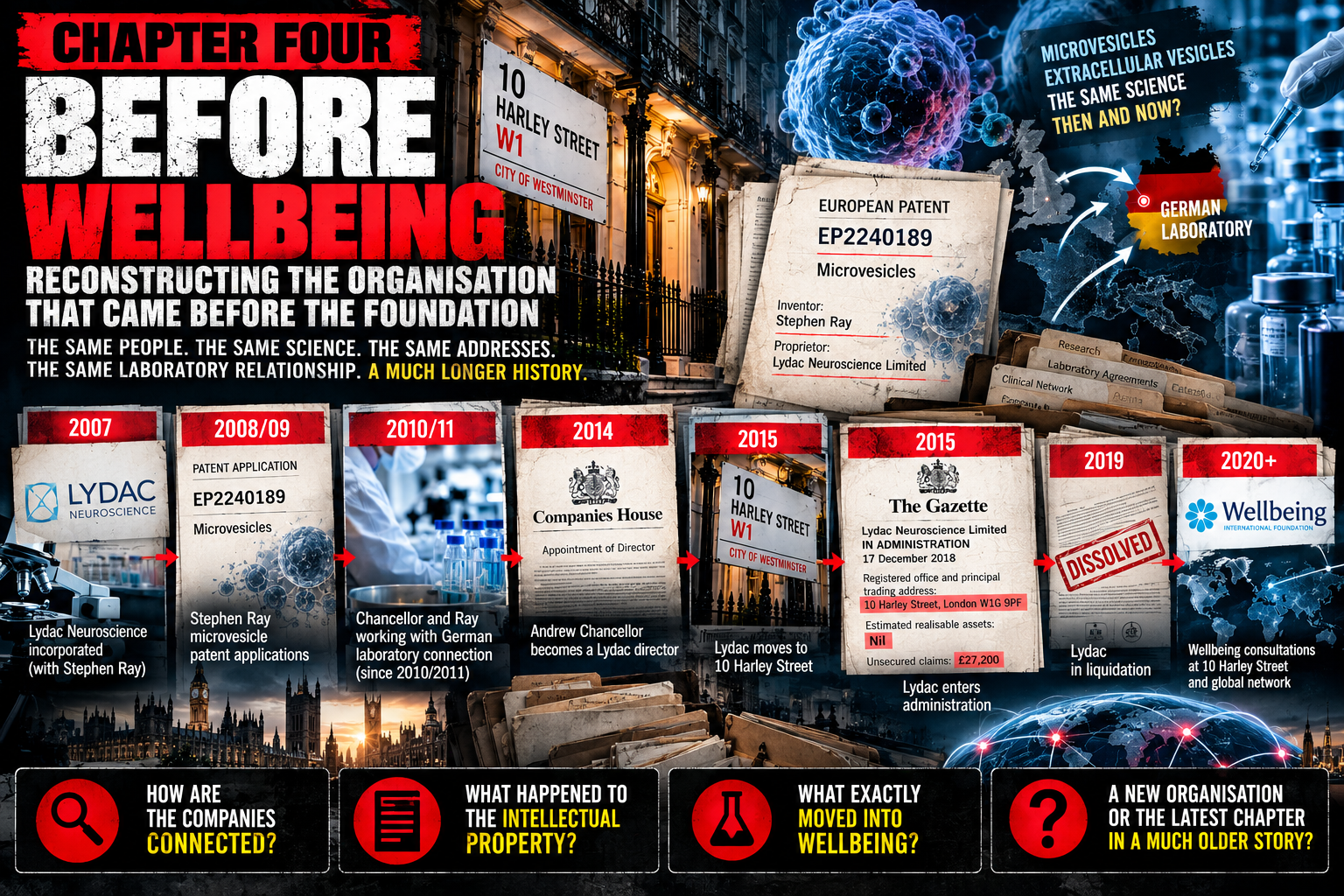
And we uncovered a biotechnology company whose history reaches back to the scientific foundations of the Wellbeing story.
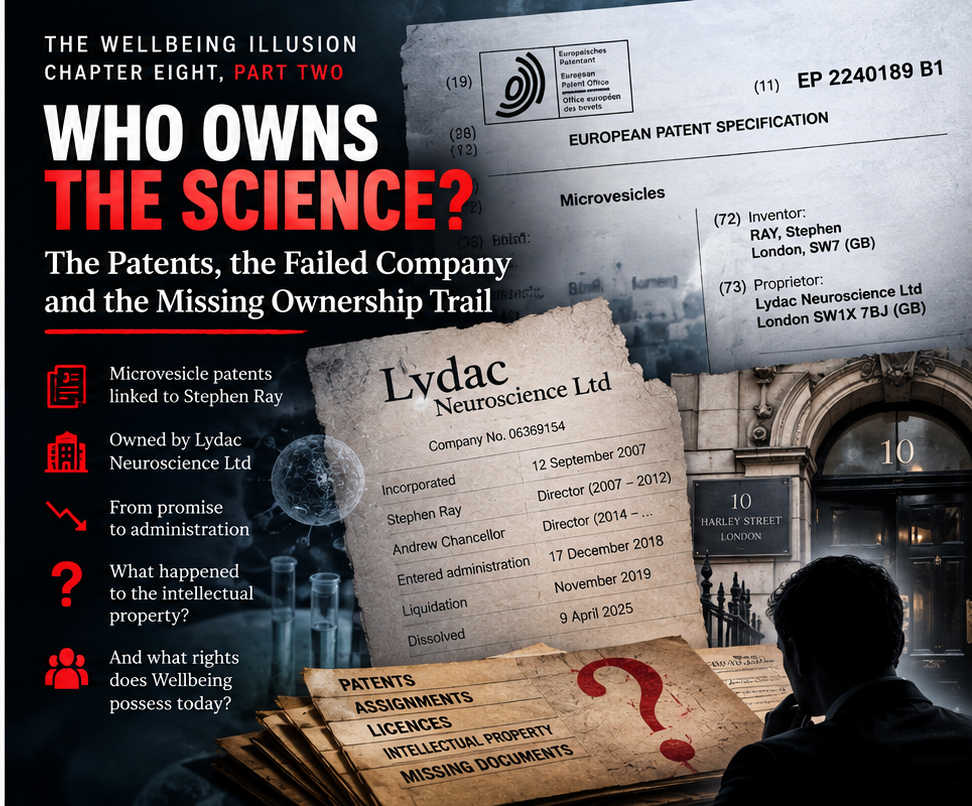
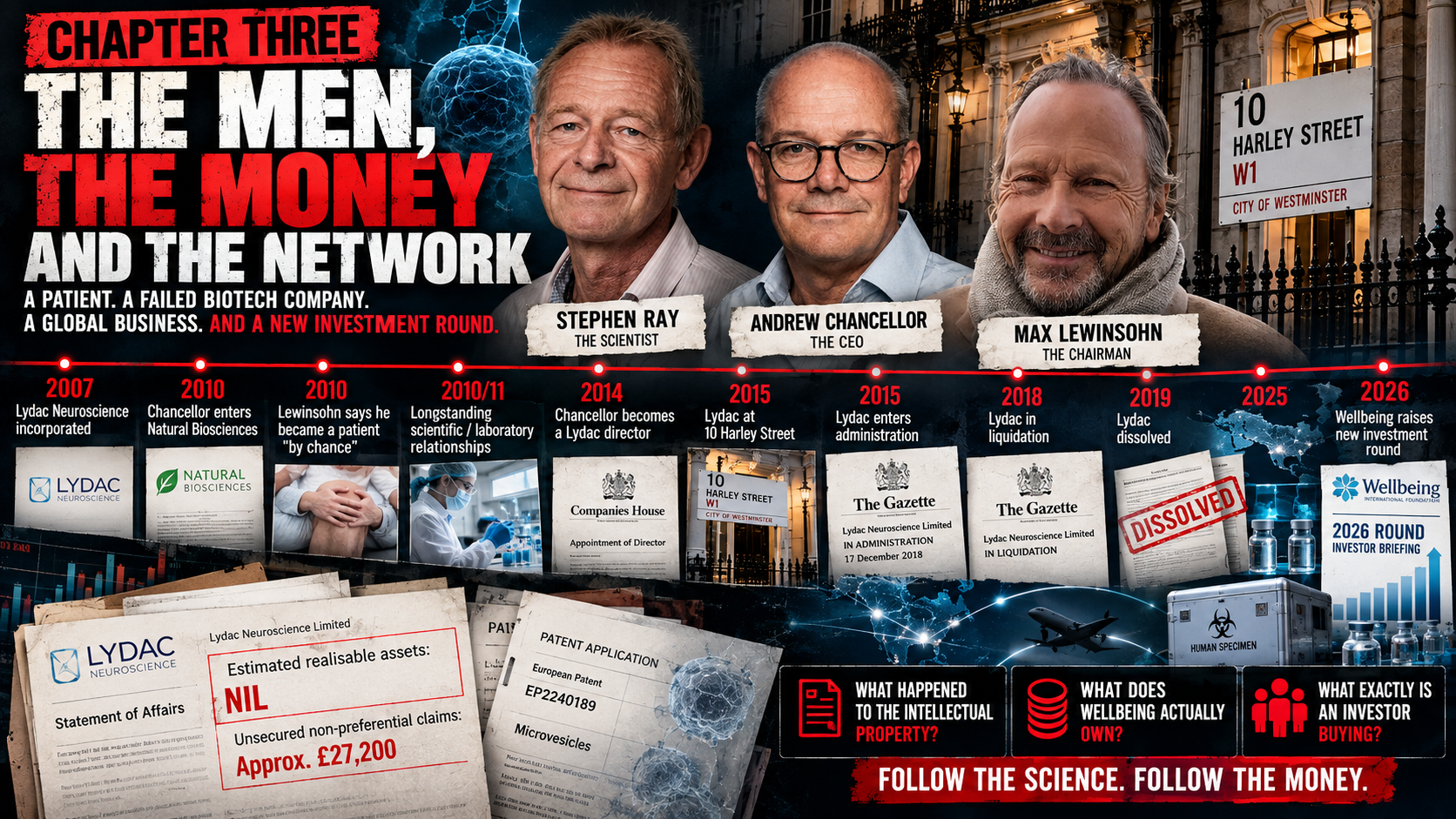
The company was called Lydac Neuroscience Ltd.
Its name appears in historical microvesicle patent records.
Stephen Ray was a director during its early years.
Andrew Chancellor became a director later.
The company subsequently entered administration and liquidation before being dissolved.
Those facts do not establish that Wellbeing acquired its intellectual property, nor do they prove that the present CFT process uses the earlier patented methods.
But they introduce a crucial question that the clinic and laboratory investigation could never answer.
Who legally owns the science behind the treatment?
That question leads us away from medical addresses and into the records of patents, companies, directors and intellectual-property rights.
And the story becomes considerably more complicated.
Coming Next — Who Owns the Science? The Patents, the Failed Biotechnology Company and the Missing Ownership Trail
The investigation continues with the historical patent records, Lydac Neuroscience, Stephen Ray and Andrew Chancellor.
We examine what the corporate documents establish, what happened to the earlier company and why the legal ownership of scientific technology matters to anyone assessing Wellbeing's commercial claims.
Because access to a laboratory is one thing.
Having a scientist on your team is another.
But owning the technology on which a business depends is something entirely different.
And it is that distinction we investigate next.
Public reference material
- Wellbeing International Foundation — About
- Wellbeing — Treatment Process
- Wellbeing — Physician Partnership Programme
- European Patent EP2240189B1 — Microvesicles
- Companies House — Lydac Neuroscience Ltd
Editorial note: This article distinguishes documented corporate and historical connections from questions of ownership that remain unverified. References to recorded historical conversations are based on material obtained during the investigation; confidential sources are not identified.
Recent Posts