Follow the Investment: Where Does Your Money Actually Go?
The Men Behind Wellbeing — Chapter Twelve
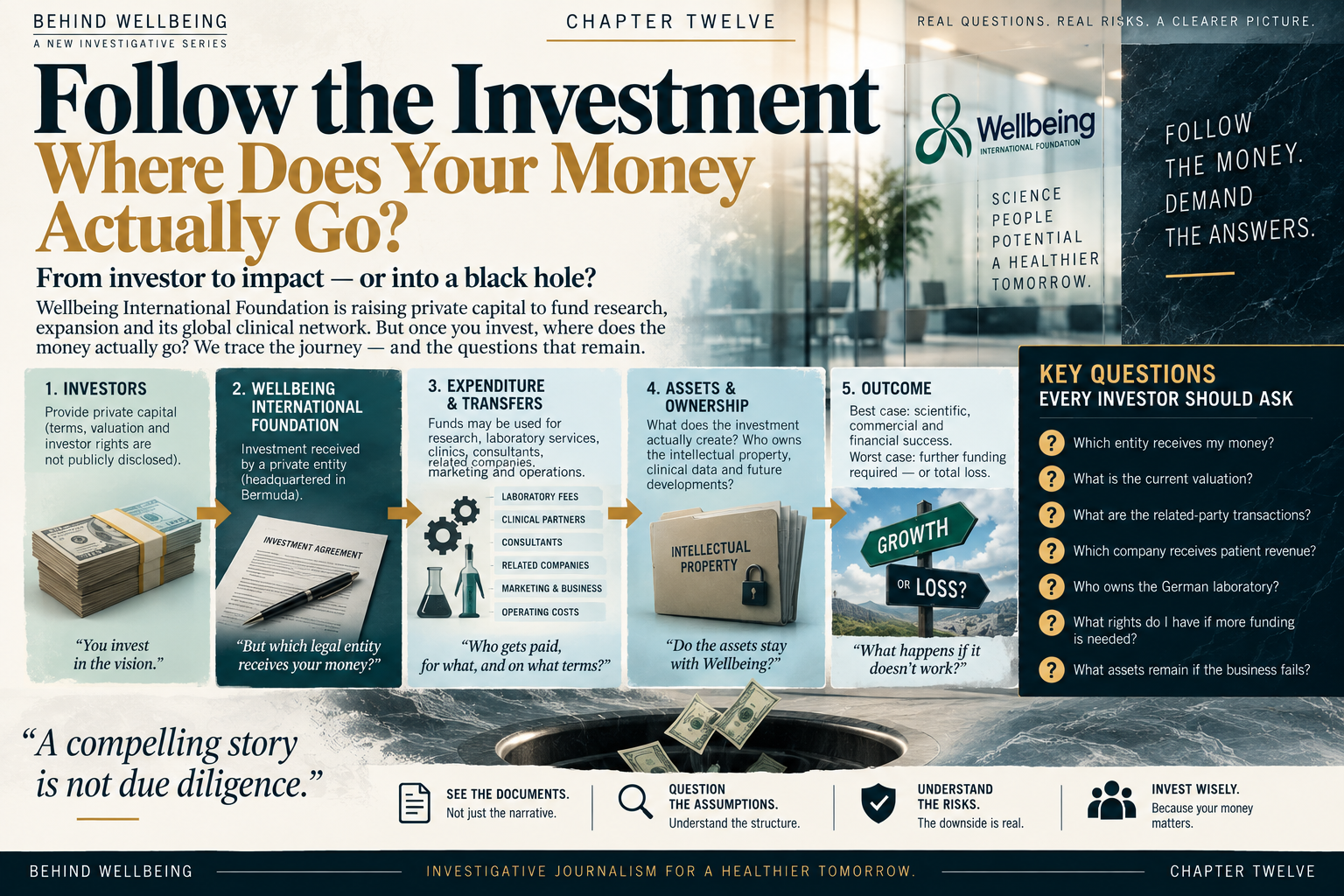
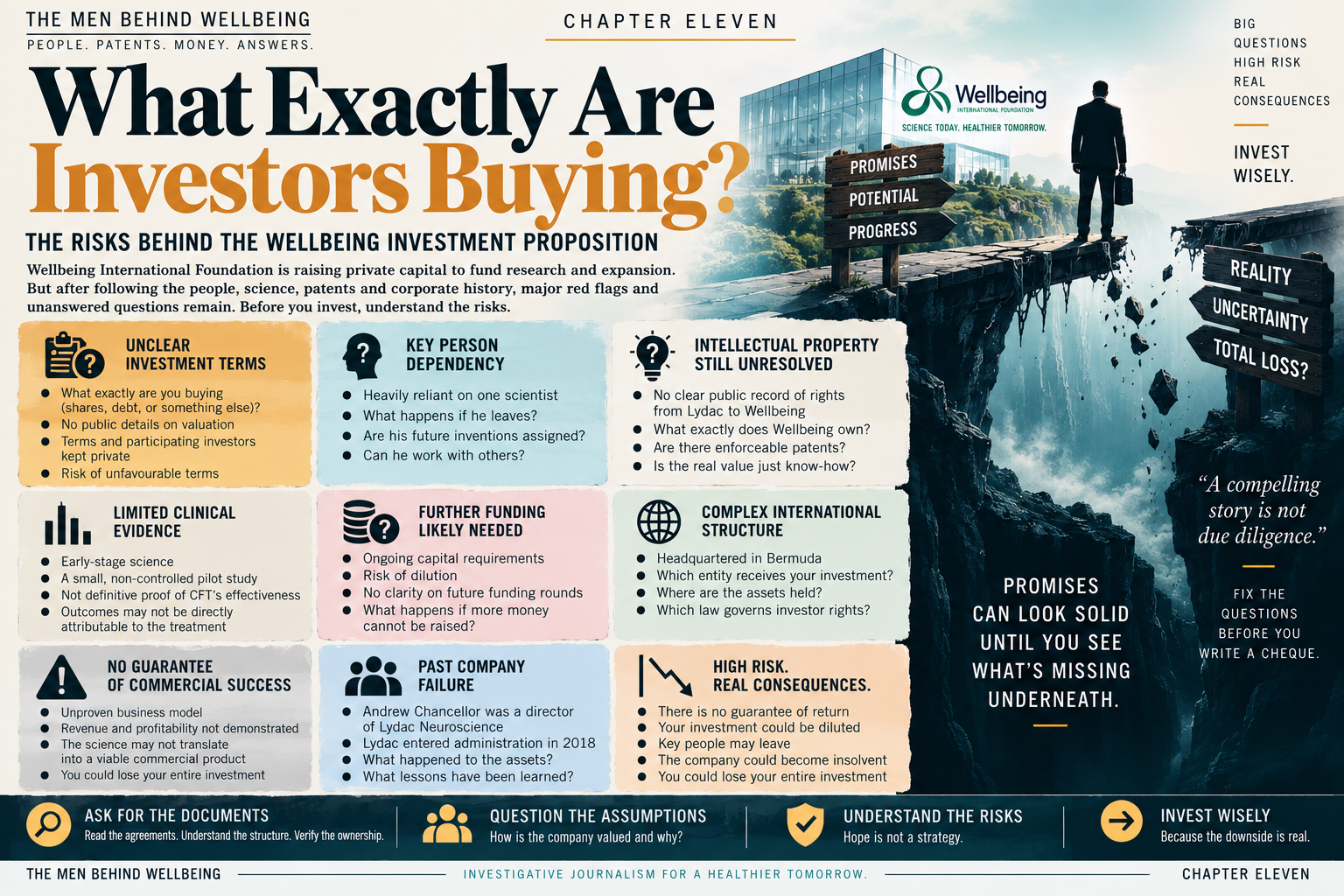
Wellbeing International Foundation is raising private capital to fund research, clinical relationships and international expansion. Chapter Eleven asked what investors are actually buying. Now we ask the question that should come immediately afterwards: once the money has been transferred, where does it actually go—and who ultimately owns what that money creates?
Investment stories usually begin with potential.
How large could the market become?
How valuable could the technology become?
How many patients could eventually be treated?
How many countries could the organisation enter?
But there is another way to investigate an investment.
Start with the money.
Take away the projections.
Forget the future valuation.
Forget what the company might eventually become.
Imagine an investor transferring £100,000 into the 2026 Wellbeing International Foundation capital round.
Then ask:
Where does that £100,000 actually go?
Not metaphorically.
Not according to a presentation.
Not according to a future business plan.
Legally and financially.
That question takes us somewhere very different.
Wellbeing Has Confirmed It Is Raising Capital
Wellbeing announced in March 2026 that it had completed the opening tranche of its 2026 capital round.
The organisation said that the round remained open and that capital would support continuing research, expansion of its clinical-relationship network, documentation work and the operating capacity required to support its existing patient population.
Wellbeing also said its historical funding model had combined private investment, patient revenue and selective philanthropic engagement.
Importantly, it stated that specific amounts, terms and participating investors were private matters handled through its legal and finance team.
That means we can establish that money is being raised.
What the public information doesn't provide is the complete route that money takes once it enters the organisation.
And that route matters.
Start With the Receiving Bank Account
Before transferring investment capital, there is an extraordinarily simple question an investor should ask:
What is the exact legal name attached to the bank account receiving my money?
Not the trading name.
Not the website name.
Not simply:
Wellbeing International Foundation.
The complete legal entity.
Its jurisdiction.
Its registration number.
Its legal form.
And its relationship to the organisation whose science and commercial potential have been presented to the investor.
This matters because investing in a brand and investing in a legal entity are two completely different things.
Only one of them gives you enforceable rights.
Which Wellbeing Are You Investing In?
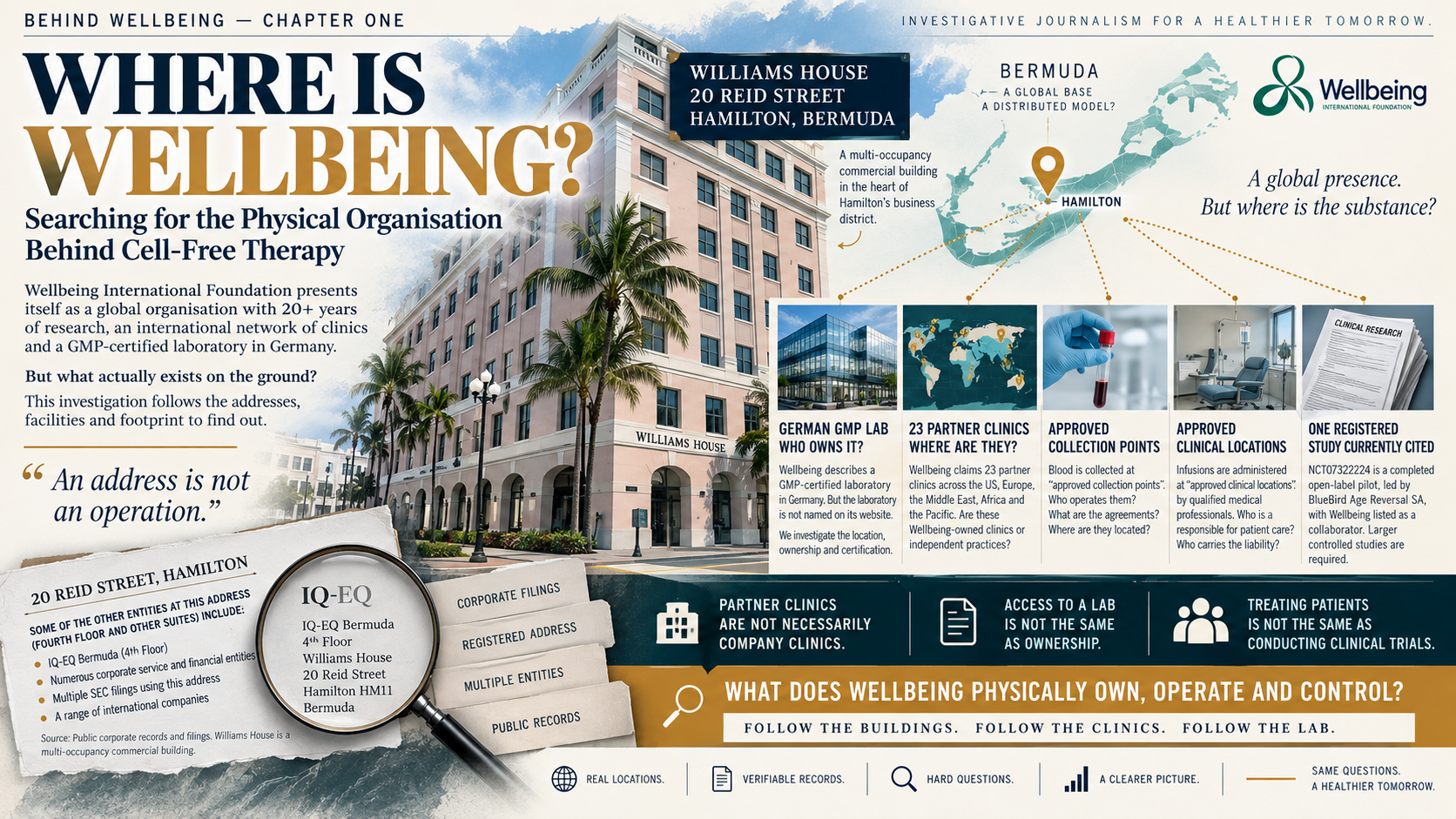
Wellbeing publicly identifies Bermuda as its headquarters and describes itself as a privately held organisation. Its public-facing material also describes operations and relationships extending across multiple countries.
International structures are completely normal.
A biotechnology organisation might legitimately have:
a holding company in one jurisdiction;
research activity in another;
laboratory processing somewhere else;
clinical partners across several countries;
and intellectual property held by yet another entity.
That structure isn't inherently concerning.
But it makes the corporate diagram extraordinarily important.
An investor needs to know:
Which box on that diagram am I buying into?
Follow the £100,000
Let's continue with our hypothetical investment.
The investor transfers £100,000.
Some of that money might support research.
Some might pay laboratory expenses.
Some might support employees or consultants.
Some might pay lawyers and accountants.
Some might fund marketing.
Some might finance clinical-network expansion.
Some might fund data collection, scientific documentation or regulatory work.
Some might simply support ordinary operating expenses.
There is nothing inherently problematic about any of those uses.
That is what investment capital is for.
But the investor should be able to see a use-of-funds schedule showing how management expects the capital to be deployed.
Because “research and expansion” is a strategy.
It isn't an accounting breakdown.
Who Gets Paid?
This is the next layer.
If Wellbeing pays for scientific work, who receives the money?
If it pays for laboratory processing, which company receives it?
If it pays clinical partners, who are those partners?
If it pays consultants, who are they?
If it funds research, which organisation performs that research?
If it pays licensing fees, who owns the licensed asset?
And are any recipients connected to directors, shareholders, consultants or senior figures within the organisation?
Again, payments to connected parties are not automatically problematic.
Related-party transactions occur throughout legitimate business.
But investors should know about them.
Related-Party Transactions Matter
Suppose an investor puts £100,000 into Company A.
Company A then pays £30,000 to Company B for laboratory services.
If Company B is completely independent, that is one commercial relationship.
If Company B is owned or controlled by somebody connected to Company A, that is another.
It may still be entirely legitimate.
But the investor needs disclosure.
They need to understand:
who owns the supplier;
what service is being provided;
how the price was determined;
whether alternative suppliers exist;
and whether the transaction was negotiated on ordinary commercial terms.
This is why sophisticated investors ask for a schedule of related-party transactions before investing.
Then Follow the Patient Money
Wellbeing's own capital announcement says its historical funding has included patient revenue.
That introduces another extremely important question.
Which legal entity receives the patient's money?
Imagine an investor owns shares in Company A.
But patients pay Company B.
Company C owns the laboratory.
Company D owns the intellectual property.
And Company E contracts with the clinicians.
That could represent a perfectly legitimate international corporate structure.
But the value of Company A depends upon the contractual relationships connecting those companies.
If an investor believes they are buying exposure to the entire commercial ecosystem, they need to establish that the investment entity actually receives the economic benefit from that ecosystem.
Who Invoices the Patient?
This should be straightforward to establish.
When a patient purchases Cell-Free Therapy:
Who sends the invoice?
Who appears on the credit-card statement?
Who receives the bank transfer?
Does the partner clinic charge the patient?
Does Wellbeing charge the patient?
Does another organisation charge the patient?
Does the clinic retain a percentage?
Does Wellbeing receive a fee?
Does the laboratory receive a separate processing charge?
Without understanding that transaction, it is difficult to understand the business model.
And without understanding the business model, it is difficult to value the investment.
The Partner-Clinic Model Makes This More Important
Wellbeing currently describes its international clinical presence as a network of partner clinics.
Its treatment information refers to approved collection points and approved clinical locations rather than describing every treatment location as a Wellbeing-owned clinic.
Its physician programme also invites existing practitioners to join the network.
That suggests an asset-light or distributed model may form an important part of the business.
There is nothing inherently wrong with that.
It can actually be highly efficient.
But from an investment perspective, it creates a distinction between:
owning an asset
and:
having contractual access to somebody else's asset.
Those are not economically identical.
The German Laboratory Becomes Critical
Wellbeing repeatedly describes CFT preparations as being processed through a GMP-certified laboratory in Germany.
That laboratory therefore appears to be an important component of the treatment pathway.
So an investor should establish:
Does Wellbeing own it?
Does a Wellbeing subsidiary own it?
Is it independently owned?
Does Wellbeing simply contract with it?
Is the agreement exclusive?
How long does the agreement last?
Can either party terminate it?
Who owns the processing protocols?
Who owns improvements developed during processing?
Could Wellbeing transfer production to another laboratory?
And what happens to the business if that relationship ends?
This isn't a minor operational issue.
If the therapy depends upon specialised processing, the entity controlling that processing may hold an important part of the commercial value chain.
Now Follow the Intellectual Property
This is where the previous chapters become relevant again.
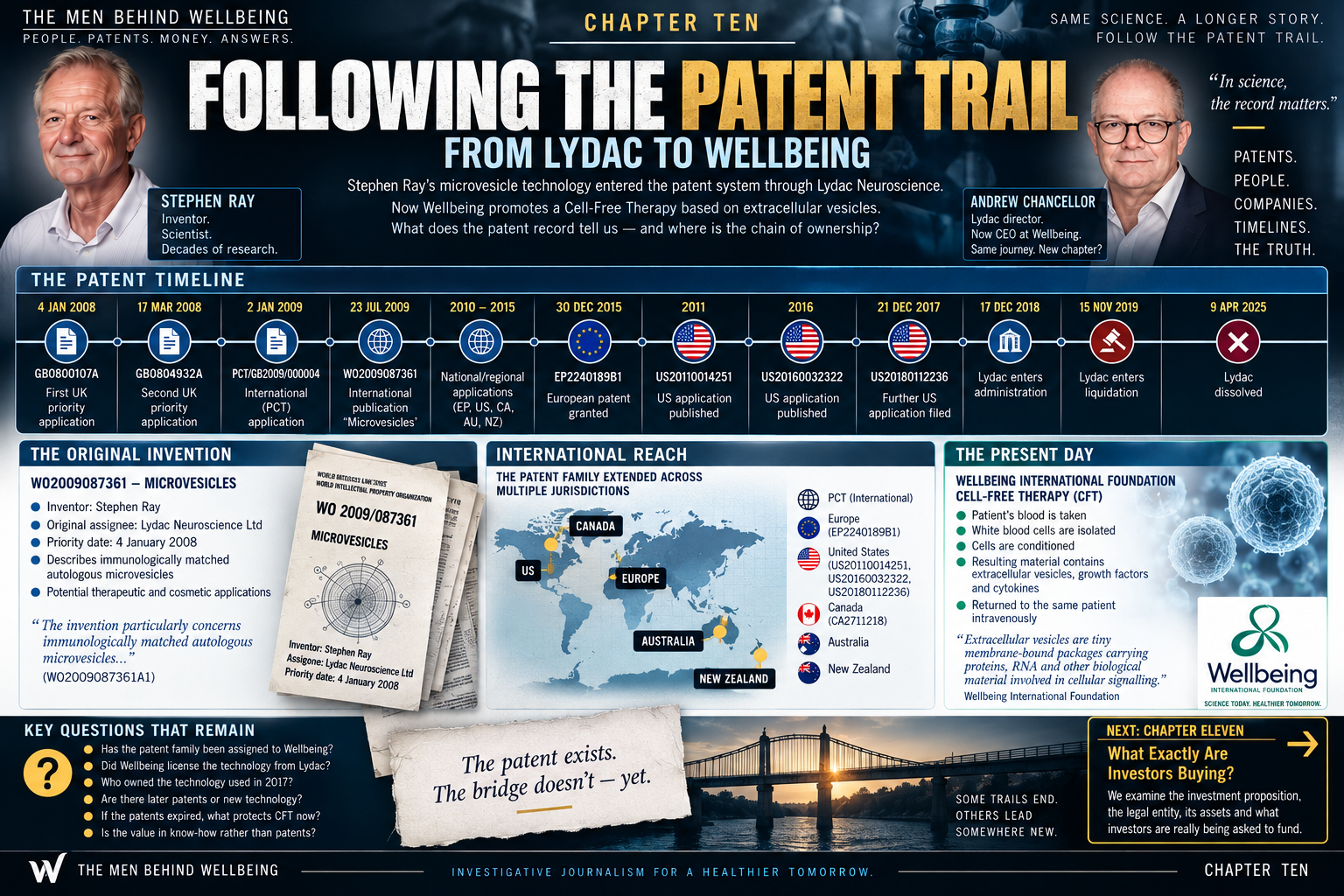
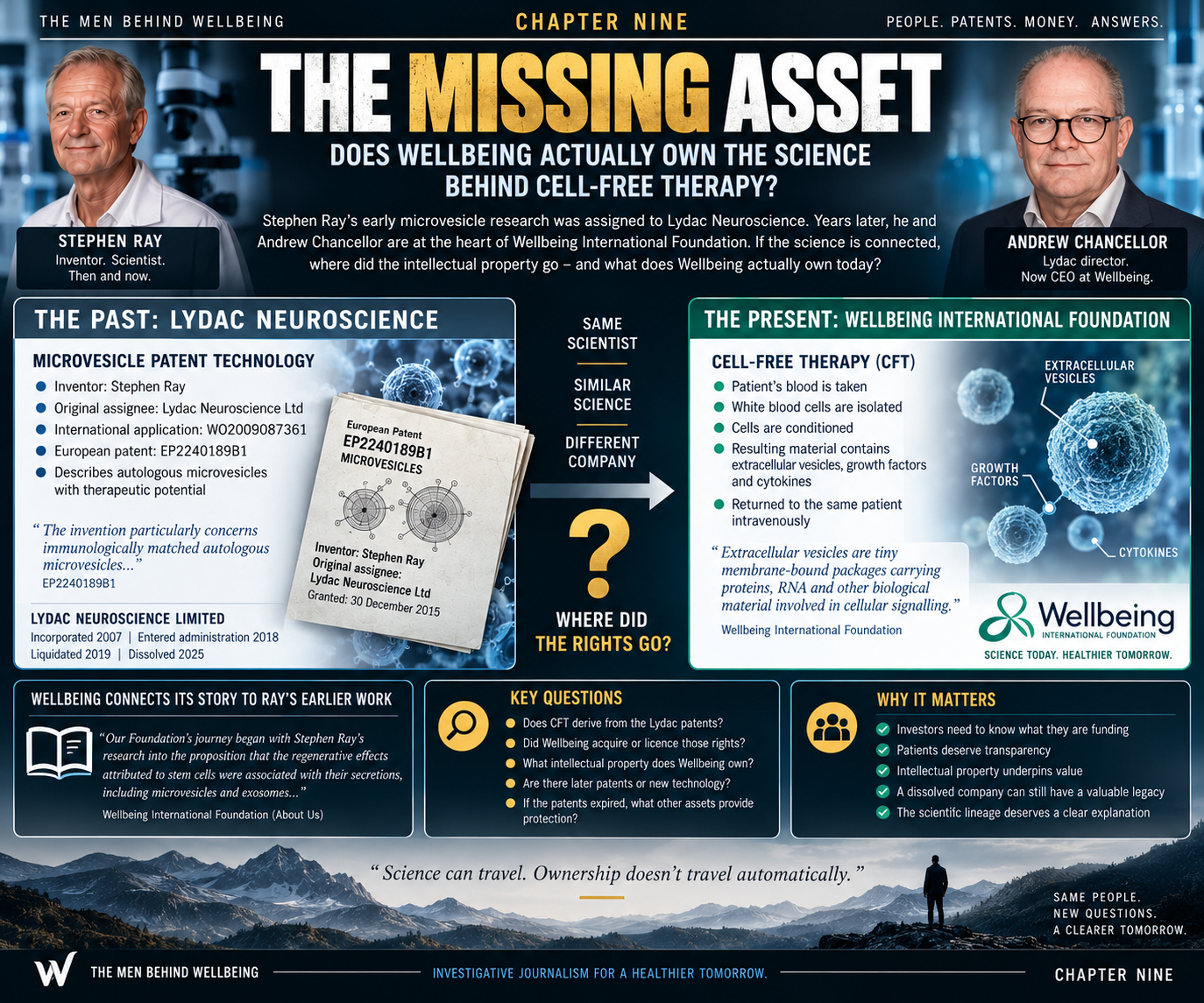
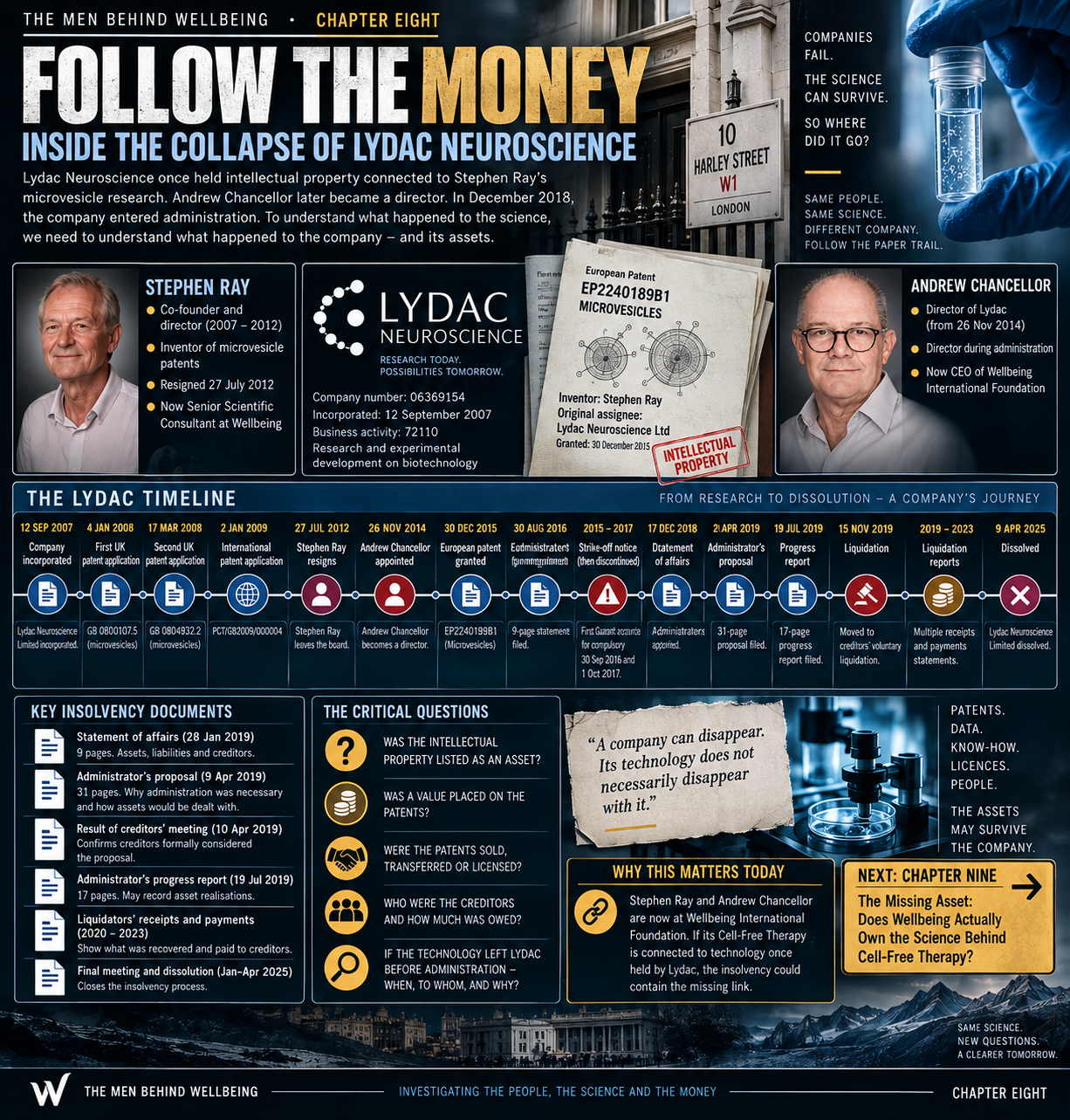
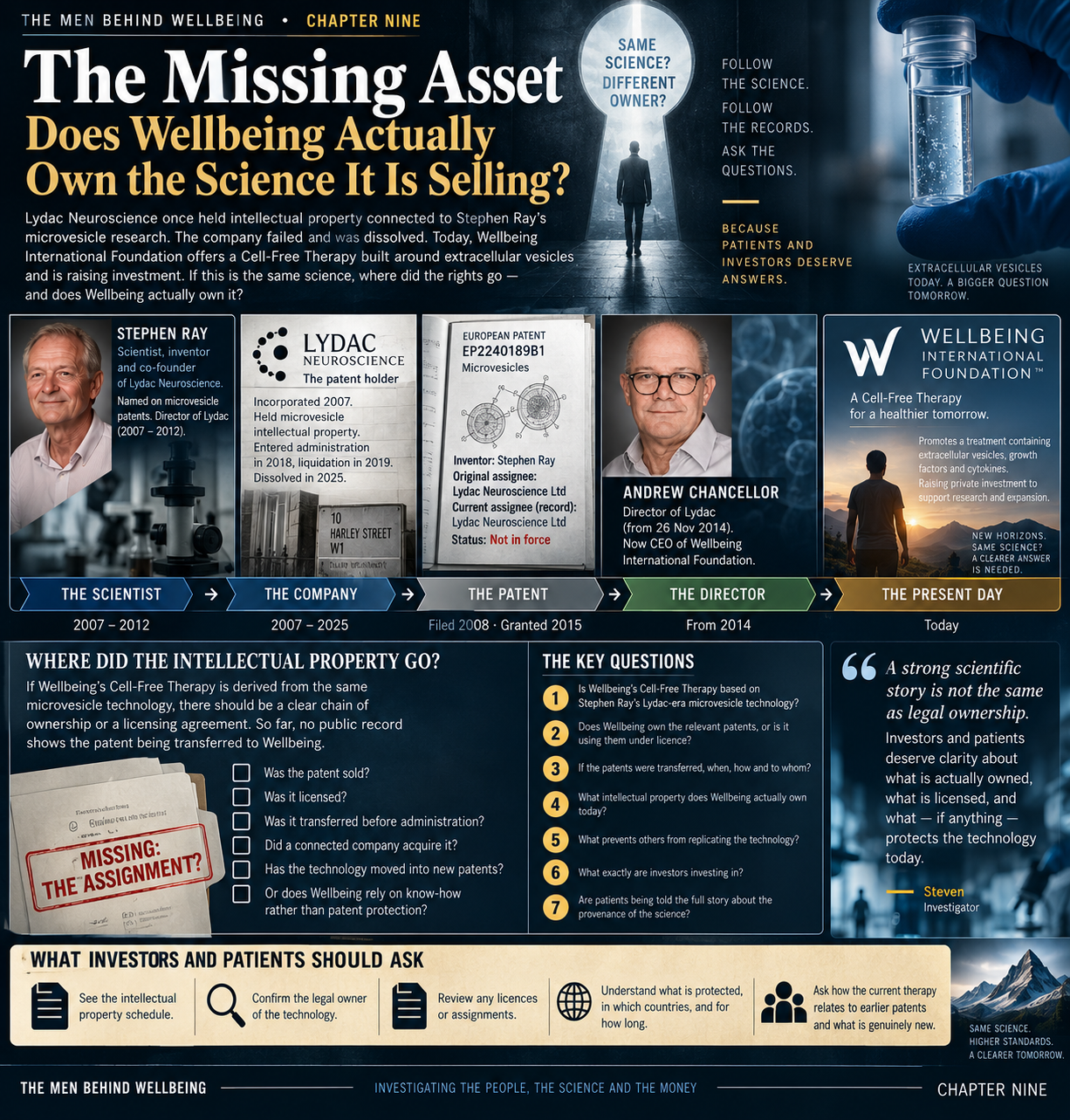
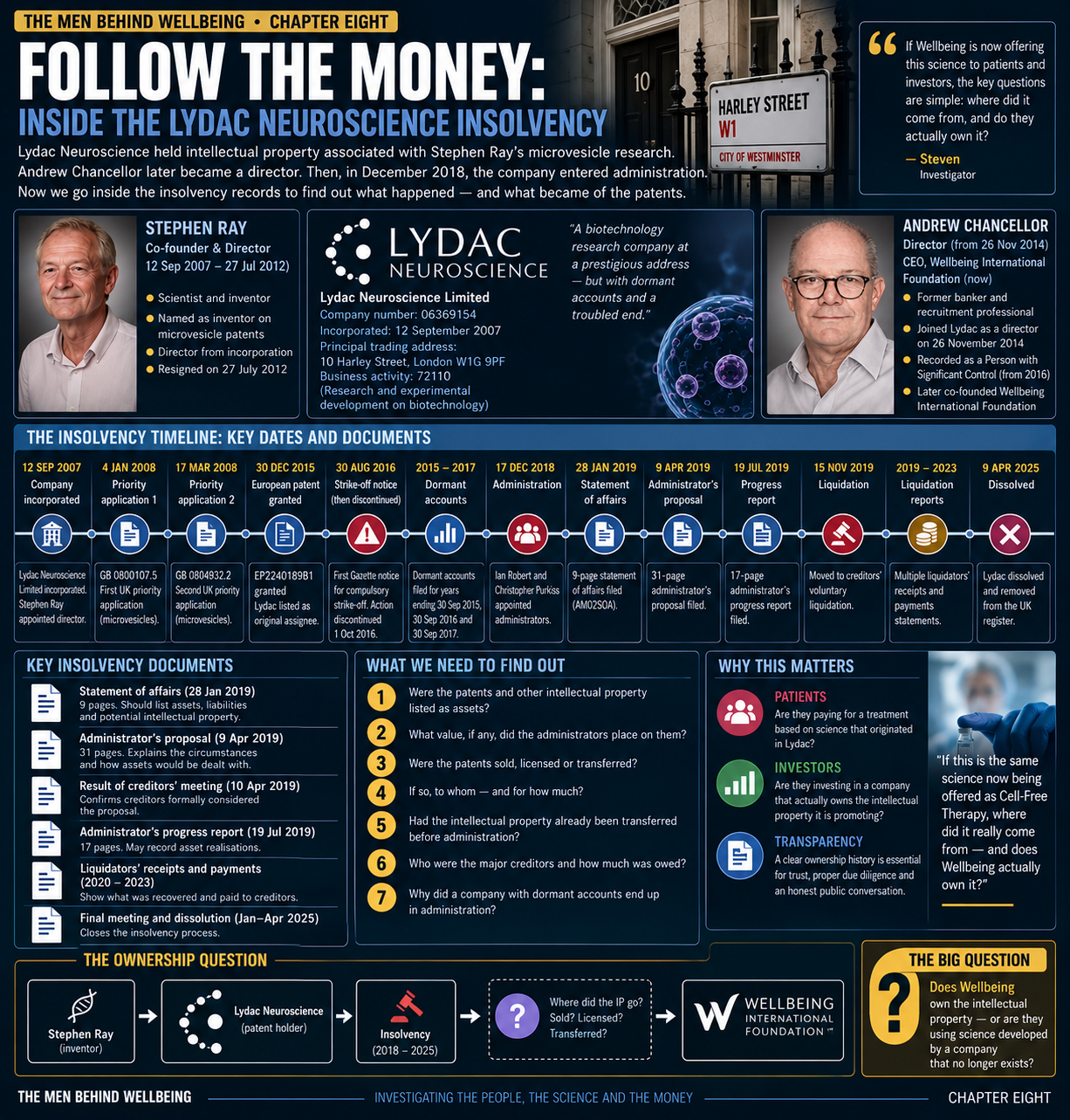
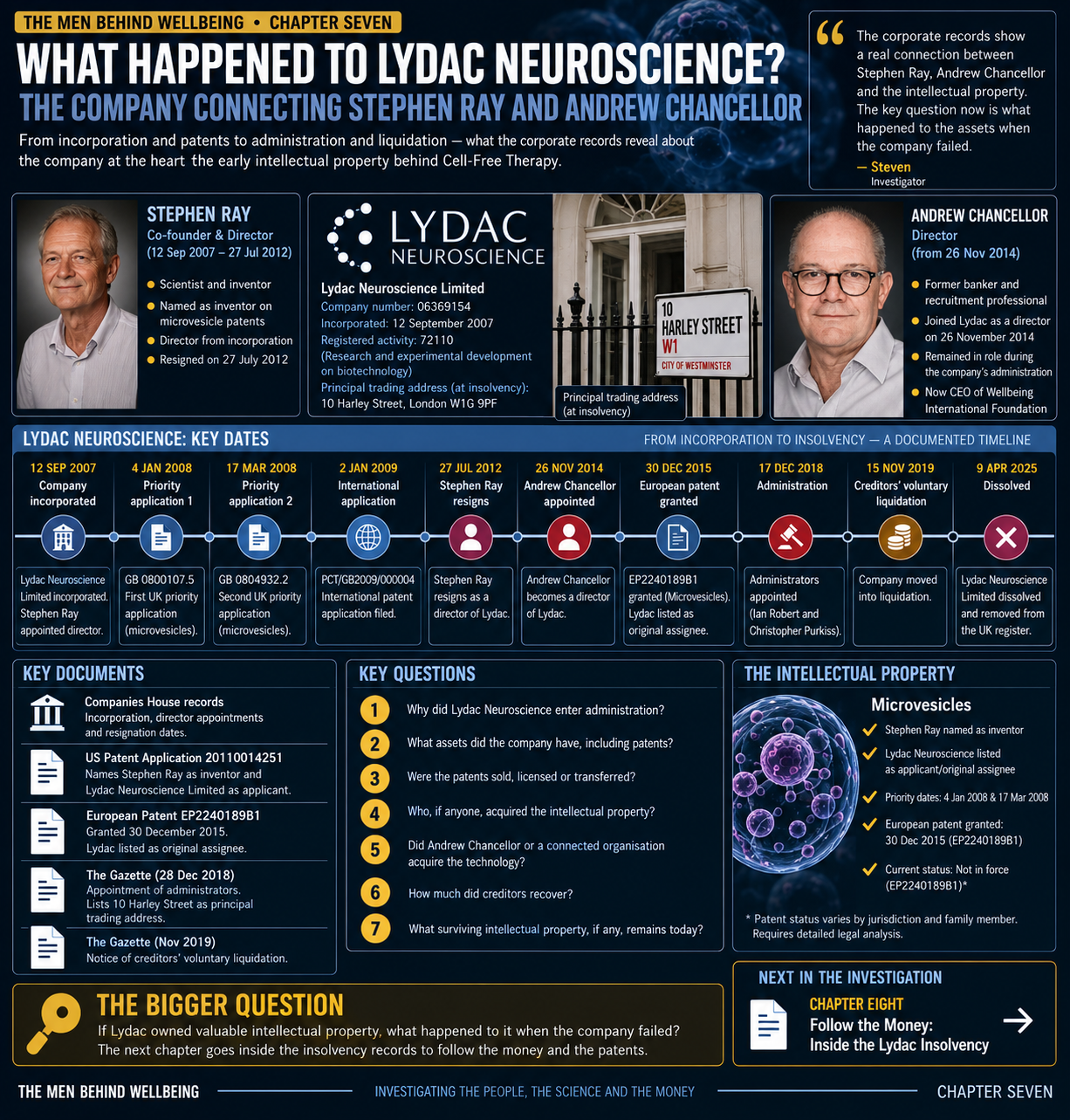
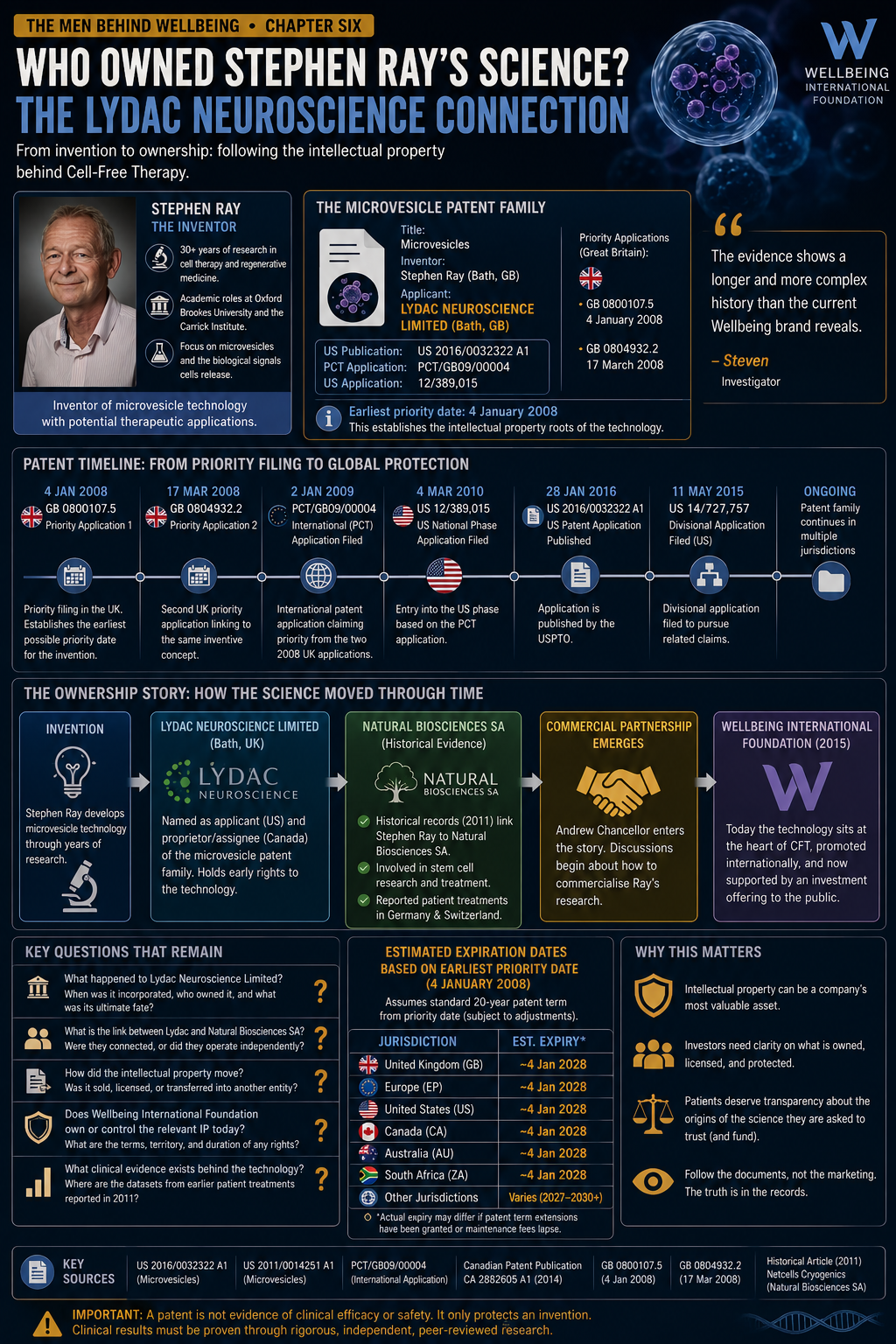
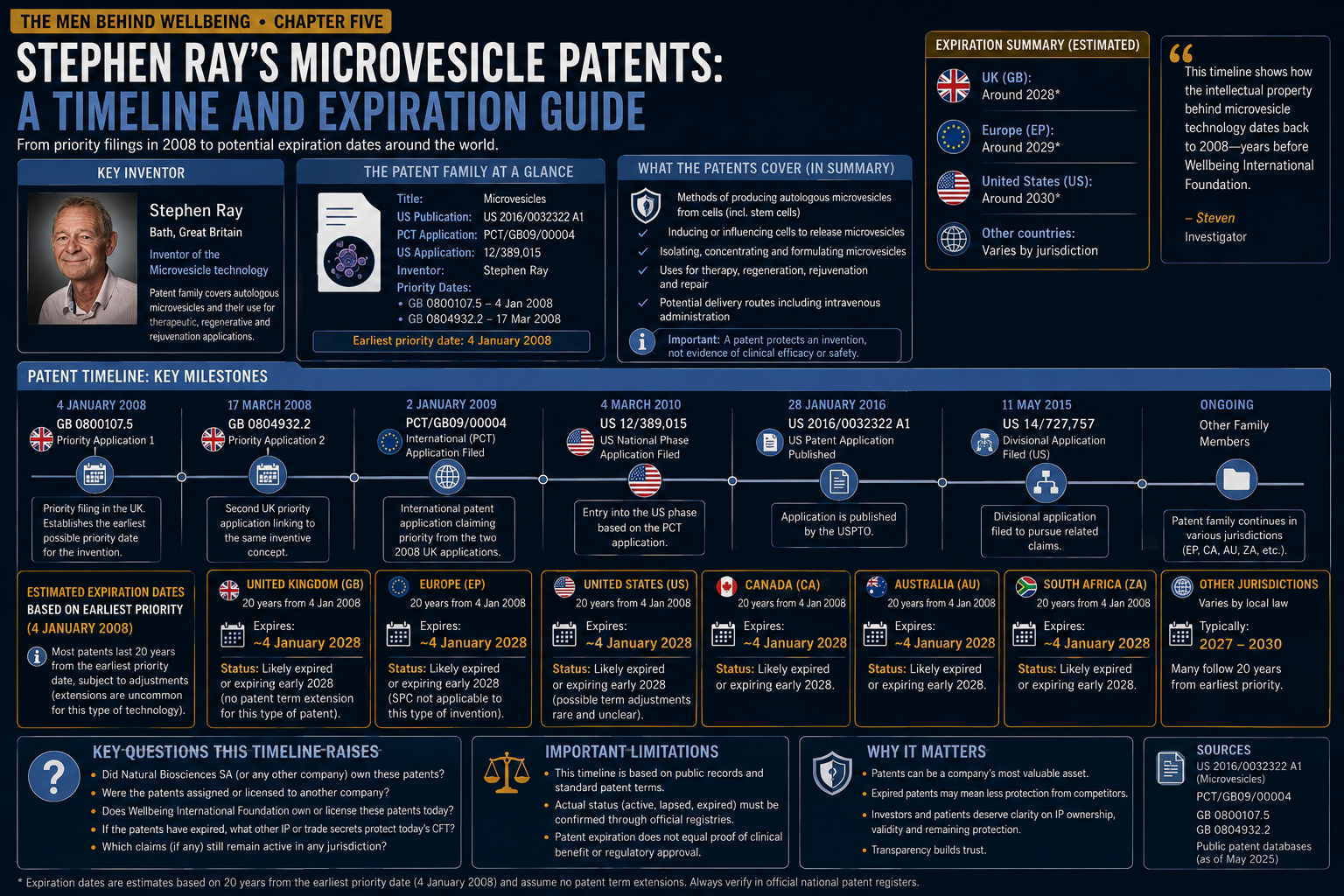
We established that Stephen Ray's historical microvesicle work produced a patent family originally associated with Lydac Neuroscience.
We also established that Wellbeing's modern CFT proposition involves autologous biological material associated with extracellular-vesicle biology.
But similarity doesn't establish that the old Lydac patents and modern CFT are legally or technically identical.
Modern CFT may involve later developments.
Different processes.
Trade secrets.
New know-how.
Licensing arrangements.
Or technology that falls outside those earlier patent claims.
What remains important for investors is this:
Who owns the technology being developed with their money?
Imagine Investor Money Creates the Next Breakthrough
Suppose some of the 2026 capital funds research.
That research produces an improvement to CFT.
Perhaps researchers discover a better conditioning process.
A better isolation technique.
A more effective preparation method.
A new biomarker.
A new clinical protocol.
Or something sufficiently novel to patent.
Who owns it?
The investment company?
Stephen Ray?
The laboratory?
The researcher who developed it?
A research partner?
A separate IP company?
Or several parties jointly?
That question should already be answered contractually.
Because investor capital can fund the creation of extremely valuable intellectual property.
The investor needs to know whether that value remains inside the entity they funded.
The Same Applies to Clinical Data
Data can become an important biotechnology asset.
Suppose investor money funds patient monitoring and clinical research.
Hundreds of patients eventually generate biological measurements, treatment histories, outcomes and follow-up information.
Who controls the resulting dataset?
Who has the right to analyse it?
Who can publish it?
Who can use it commercially?
Can another company access it?
What happens to it if a commercial relationship ends?
And what rights does the investment entity have over research funded using its shareholders' capital?
These are questions sophisticated biotechnology investors routinely investigate.
Now Follow the Scientists
There is another form of capital that doesn't appear neatly on a balance sheet.
Knowledge.
Stephen Ray remains central to Wellbeing's scientific narrative.
If important elements of CFT depend upon his knowledge and experience, then investors need to understand how that knowledge has been secured within the company.
Does Wellbeing own documented protocols?
Are inventions automatically assigned?
Does Ray have an exclusive agreement?
Could he work with another organisation?
What happens if he retires?
What happens if the relationship ends?
Could another scientific team reproduce the process without him?
This is known as key-person risk.
It doesn't imply anything negative about the individual concerned.
It simply recognises that a business becomes more vulnerable when substantial value depends upon a small number of people.
Now Follow the Research
Wellbeing says some investment capital supports continuing research.
We know that a peer-reviewed longevity pilot associated with Wellbeing has now been published.
But the study was small.
It was open-label.
It was single-arm.
And it evaluated a multimodal programme rather than isolating CFT as the only intervention.
Wellbeing itself says that this is the clinical study it currently cites and acknowledges the need for further research.
So investors should ask another financial question:
How much additional capital will be required to generate substantially stronger clinical evidence?
Because research programmes rarely end after one pilot study.
Research Has a Price
A larger controlled clinical study requires money.
Potentially substantial amounts of it.
Participants must be recruited.
Investigators paid.
Sites organised.
Samples processed.
Data collected.
Statistics performed.
Safety monitored.
Documentation maintained.
Results analysed.
Regulatory requirements satisfied.
And if multiple indications are investigated, the process can repeat.
Therefore an investor shouldn't simply ask:
How much has Wellbeing raised?
They should ask:
How much will Wellbeing ultimately need?
Those are very different questions.
Which Brings Us to Cash Runway
One of the most important figures in an early-stage investment is surprisingly simple.
How many months until the money runs out?
That is the company's runway.
If Wellbeing raises a particular amount and spends a particular amount every month, an investor should be able to estimate when additional financing might be required.
Without management accounts, cash balances and expenditure figures, we cannot calculate that from the public information.
But an investor with access to the private investment documentation should.
Because another financing round introduces another risk.
Dilution
Suppose an investor purchases 5% of a company.
The company later requires considerably more capital.
New shares are issued.
If the original investor doesn't participate—or lacks appropriate protections—their percentage can fall.
That doesn't necessarily mean they lose money.
If the company becomes substantially more valuable, a smaller percentage could still be worth much more.
But dilution needs to be understood.
Investors should therefore know:
What pre-emption rights exist?
What share classes exist?
Can new preferred shares be created?
Who approves future capital raises?
Can convertible instruments dilute existing shareholders?
What happens in a down-round?
And how much future funding does management currently anticipate?
Then Ask the Question Nobody Wants to Ask
What happens if another funding round doesn't happen?
Not because we are predicting that outcome.
Because responsible investment analysis examines downside as well as upside.
Suppose research takes longer than expected.
Suppose patient growth is slower.
Suppose regulatory requirements increase.
Suppose clinical expansion costs more.
Suppose another round is required during difficult financial conditions.
And suppose sufficient capital cannot be raised.
What happens?
This is where the earlier questions about ownership become extremely important.
If Everything Stops Tomorrow, What Is Left?
Imagine Wellbeing stopped trading tomorrow.
Again, this is a hypothetical stress test—not a prediction.
What would remain?
Cash?
Laboratory equipment?
Property?
Patents?
Licences?
Research data?
Clinical contracts?
Patient receivables?
Trade secrets?
Software?
Brand value?
Or would a substantial proportion of the company's perceived value depend upon relationships, future research, future patient revenue and continued access to external infrastructure?
This is where investors discover the difference between:
potential value
and:
recoverable value.
Lydac Neuroscience Demonstrates Why This Matters
The historical Lydac story makes this question impossible to ignore.
Lydac was involved in biotechnology.
Stephen Ray was an early director.
His microvesicle inventions became associated with Lydac's patent portfolio.
Andrew Chancellor later became a director.
And Lydac eventually entered administration before moving into creditors' voluntary liquidation and ultimately dissolution.
None of that establishes misconduct.
Nor does it predict Wellbeing's future.
But it demonstrates something extremely relevant to investors.
Companies can disappear while science survives.
People survive.
Knowledge survives.
Patents can survive.
Research can survive.
Commercial ideas can survive.
But shareholders own rights in a particular legal entity.
That distinction becomes painfully important when a company becomes insolvent.
This Is Why Investors Must Follow Assets, Not Personalities
An investor might have enormous confidence in Andrew Chancellor.
Or Stephen Ray.
Or the science.
Or the extracellular-vesicle field.
But investment ownership doesn't attach itself to confidence.
It attaches itself to legal rights.
If a scientist leaves, the investor doesn't own the scientist.
If a partner clinic leaves, the investor doesn't own the clinic.
If an independent laboratory terminates a contract, the investor doesn't own the laboratory.
If intellectual property belongs to another entity, the investor doesn't automatically own that either.
What matters is what the investment company owns and what it can enforce contractually.
What I Would Ask to See
Before transferring money, I would want a documentary map of the entire structure.
Not a presentation.
Not a brochure.
Not a scientific explanation.
A legal and financial map showing the investment entity, shareholders, subsidiaries, associated companies, laboratory relationships, clinical partners and intellectual-property ownership.
Then I would want the financial information.
Current cash.
Revenue.
Patient revenue specifically.
Monthly operating expenditure.
Debt.
Liabilities.
Amounts owed to connected parties.
Expected research expenditure.
Laboratory expenditure.
Management remuneration.
Consultancy expenditure.
Marketing expenditure.
And projected cash runway.
Then I would want the contractual information.
Laboratory agreement.
Clinical-network agreements.
Key consultant agreements.
IP assignments.
Licences.
Research agreements.
Data ownership.
And related-party contracts.
Only then can an investor properly answer:
Where does my money go?
The Public Record Cannot Give Us All Those Answers
This needs to remain clear.
Wellbeing has explicitly said that detailed investment information is handled privately with legitimate interested parties rather than published through its news pages.
Therefore, the fact that we cannot answer these questions from its website does not establish that Wellbeing cannot answer them.
The documents may exist.
Investors may already receive them.
Contracts may comprehensively protect the organisation.
Financial information may be supplied under confidentiality agreements.
We simply cannot assume either way.
The appropriate response isn't accusation.
It is:
Show the documents.
Questions for Wellbeing
For the purposes of this investigation, I would invite Wellbeing International Foundation to clarify the following.
What precise legal entity receives capital from the 2026 investment round?
Which bank-account entity receives those funds?
What investment instrument is being issued?
Which entity receives patient revenue?
Does Wellbeing own the German laboratory used to process CFT?
If not, who owns it and what contractual relationship exists?
Does Wellbeing own any of the partner clinics?
What proportion of investment capital is expected to fund research?
What proportion funds operating expenditure?
Are material payments made to related parties?
Who owns intellectual property created through investor-funded research?
Who owns clinical data generated through that research?
What contractual rights does Wellbeing hold over Stephen Ray's existing and future CFT-related intellectual property?
What is Wellbeing's current monthly cash expenditure?
What runway does the present funding round provide?
When does management currently anticipate requiring additional capital?
And ultimately:
If Wellbeing failed to secure additional funding, what assets would remain inside the company for investors?
What We Are Not Claiming
We have found no evidence in this investigation establishing that investment funds are being misused.
We have not established improper payments to related parties.
We have not established that patient revenue is being diverted.
We have not established that Wellbeing doesn't own or legitimately control its technology.
We have not established that Wellbeing is financially distressed.
We have not established that another financing round will be unsuccessful.
And we have certainly not established that investors will lose their money.
Those would be conclusions requiring evidence we do not possess.
What we are establishing is something different.
There are fundamental questions concerning the movement of capital, ownership of assets and allocation of future value that cannot presently be answered from the public material we have examined.
For an organisation seeking private investment, those answers matter.
Conclusion: Follow the Money
A biotechnology investment can sound enormously complicated.
Extracellular vesicles.
Cell signalling.
Autologous conditioned media.
Biological ageing.
Regenerative medicine.
GMP processing.
International clinical networks.
But investment due diligence eventually becomes surprisingly simple.
Money enters.
Money leaves.
Assets are created.
Someone owns those assets.
Someone owns the intellectual property.
Someone receives the patient revenue.
Someone controls the laboratory relationship.
Someone owns the clinical data.
Someone gets paid.
And investors receive particular legal rights in return for their capital.
So follow those things.
Don't begin with the projected valuation.
Begin with the bank account.
Then follow every significant payment.
Follow the patient revenue.
Follow the laboratory fees.
Follow the research expenditure.
Follow the intellectual property.
Follow the contracts.
Follow the data.
And finally ask where all of those roads lead.
Because an investor isn't buying a scientific story.
They are buying legal and economic rights in a business.
And before transferring a single pound, dollar or euro, there are two questions that deserve unequivocal answers:
Where does my money actually go?
And:
What do I legally own when it gets there?
Recent Posts