Following the Patent Trail: From Lydac Neuroscience to Wellbeing International Foundation
The Men Behind Wellbeing — Chapter Ten
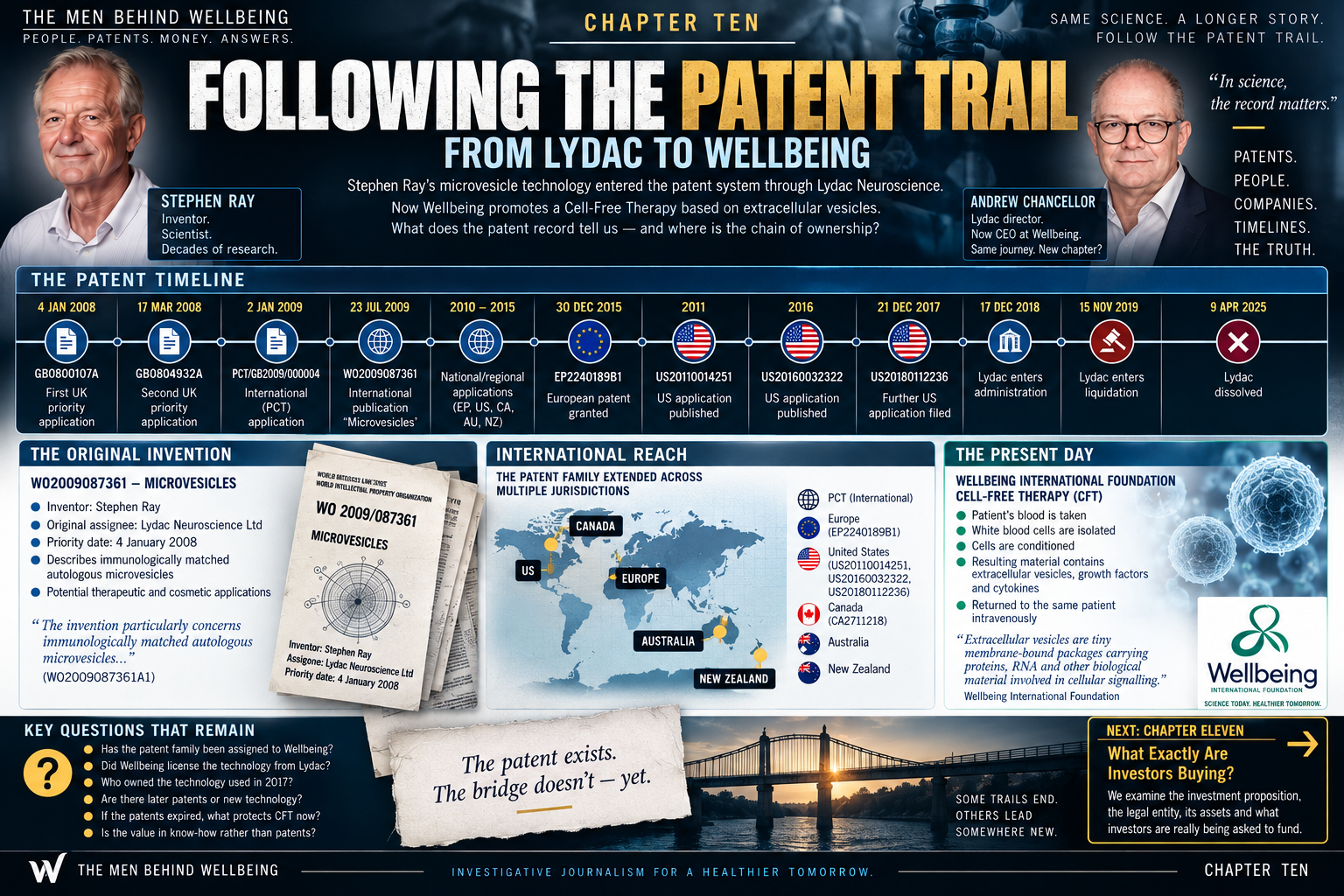
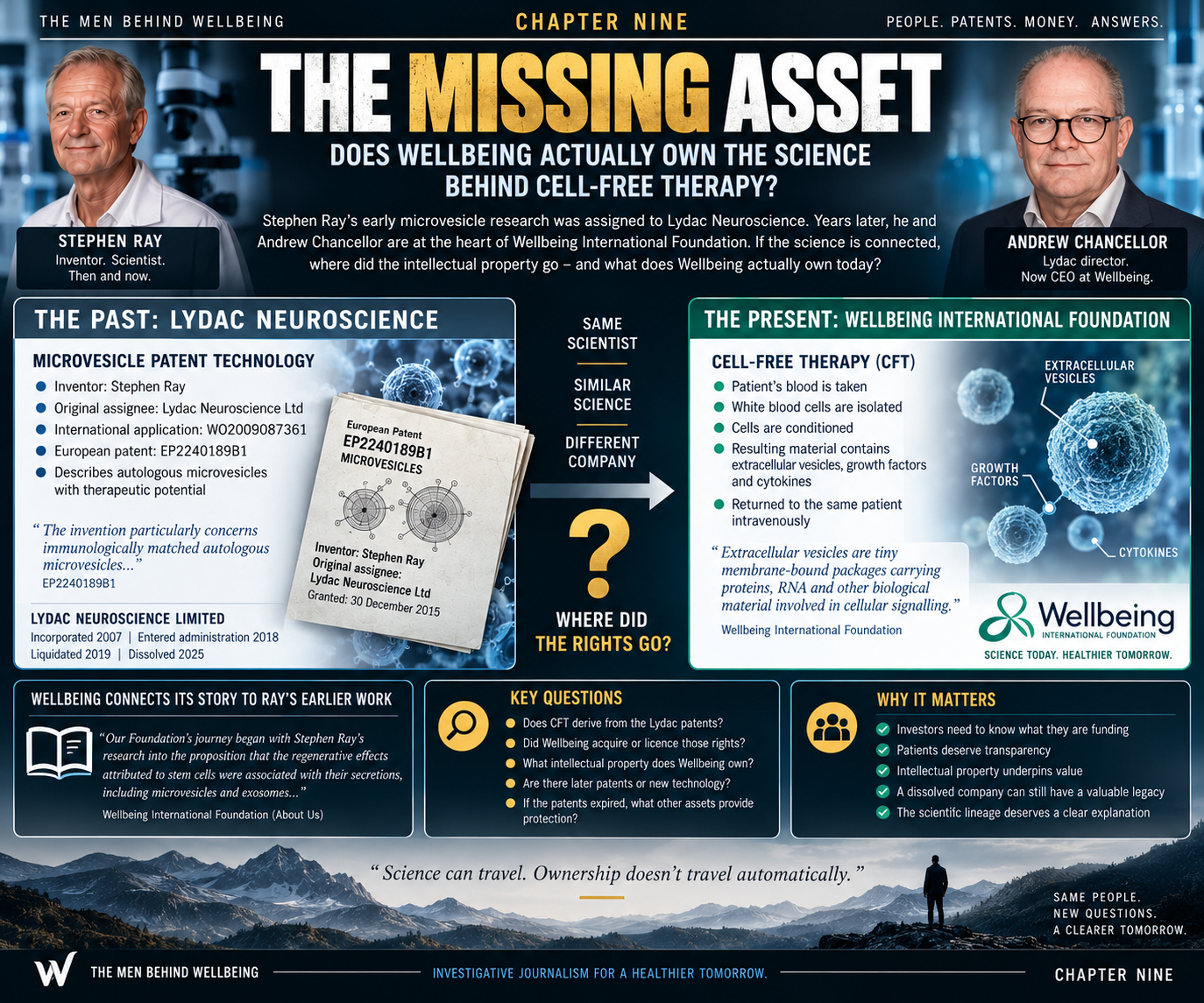
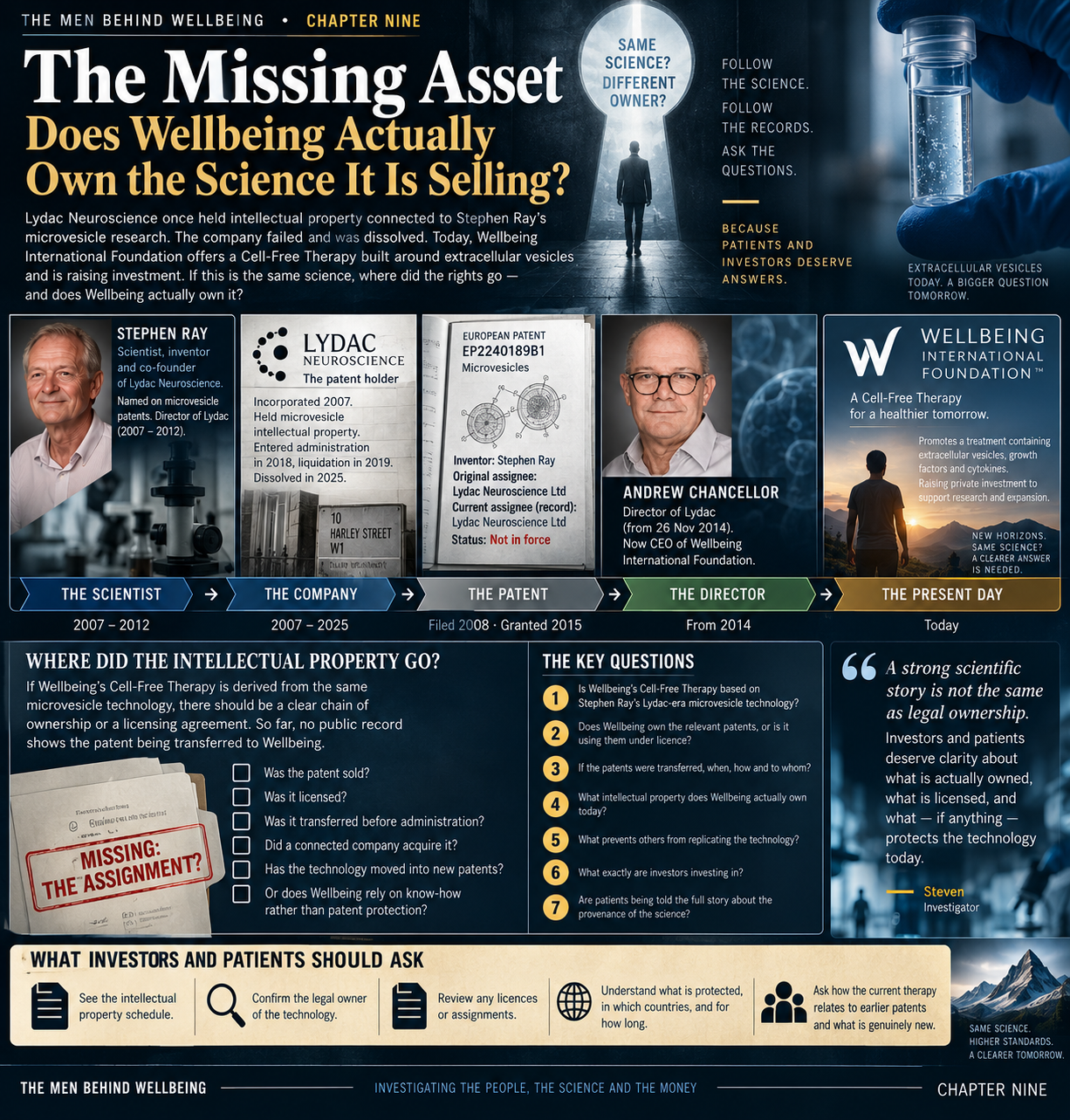
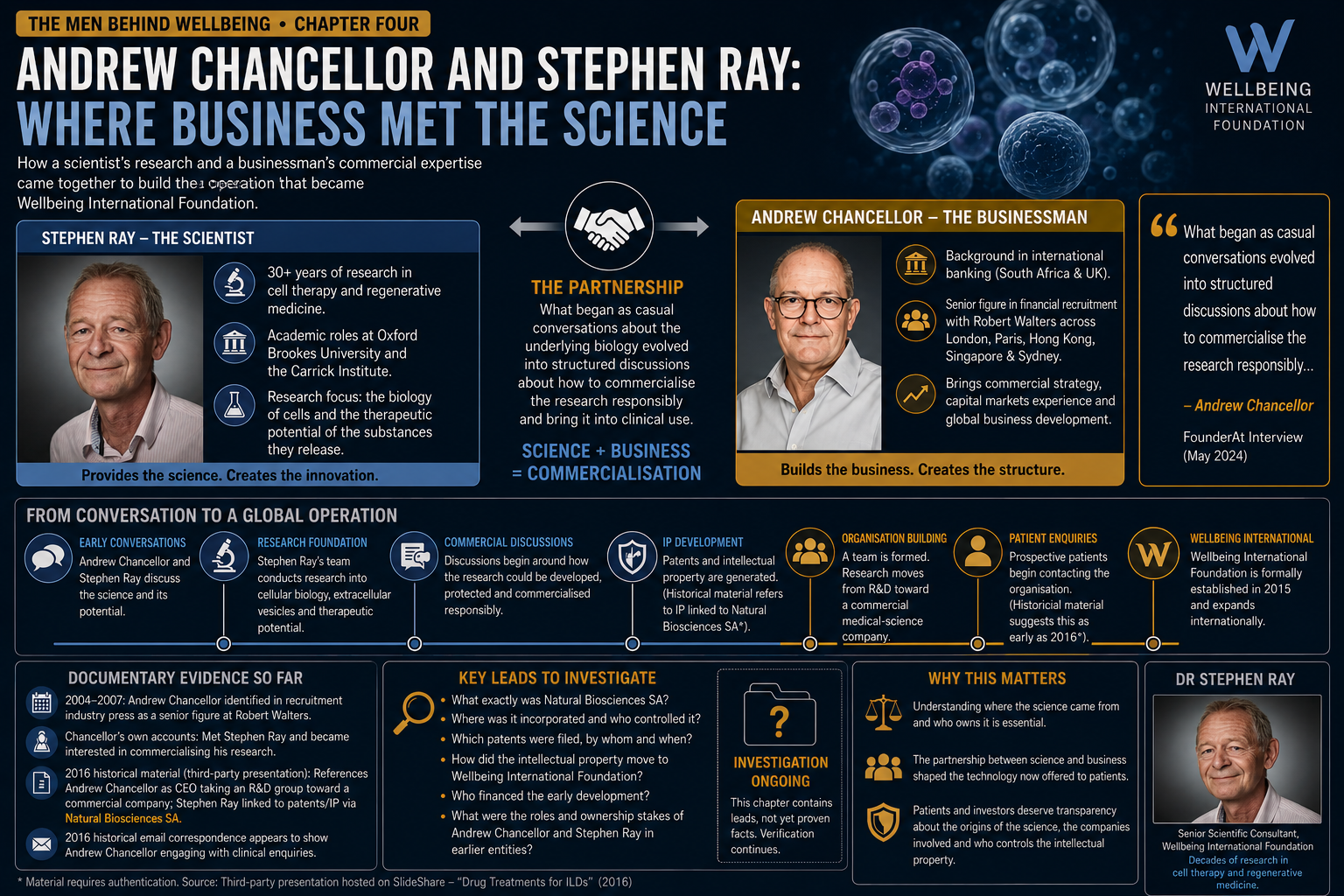
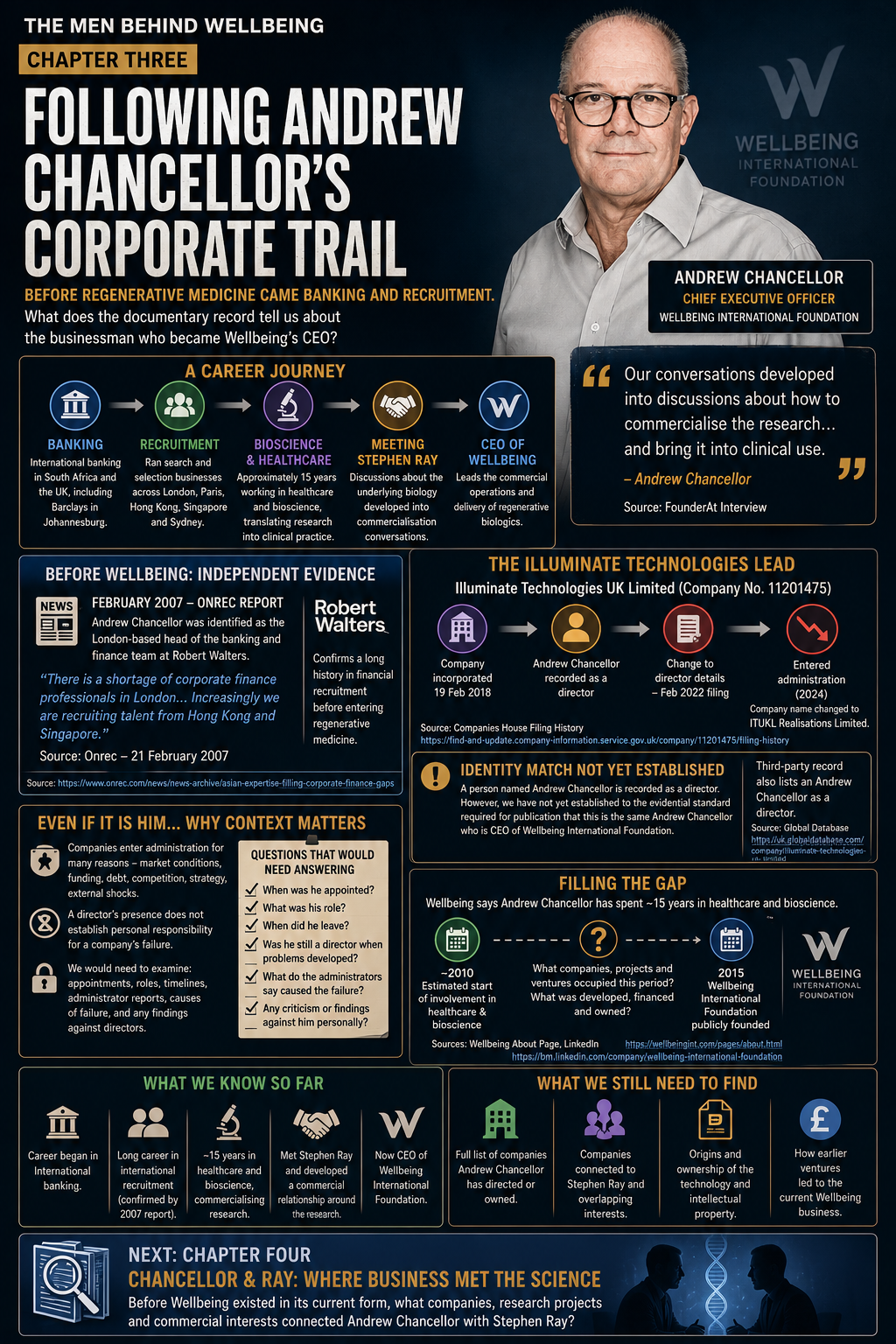
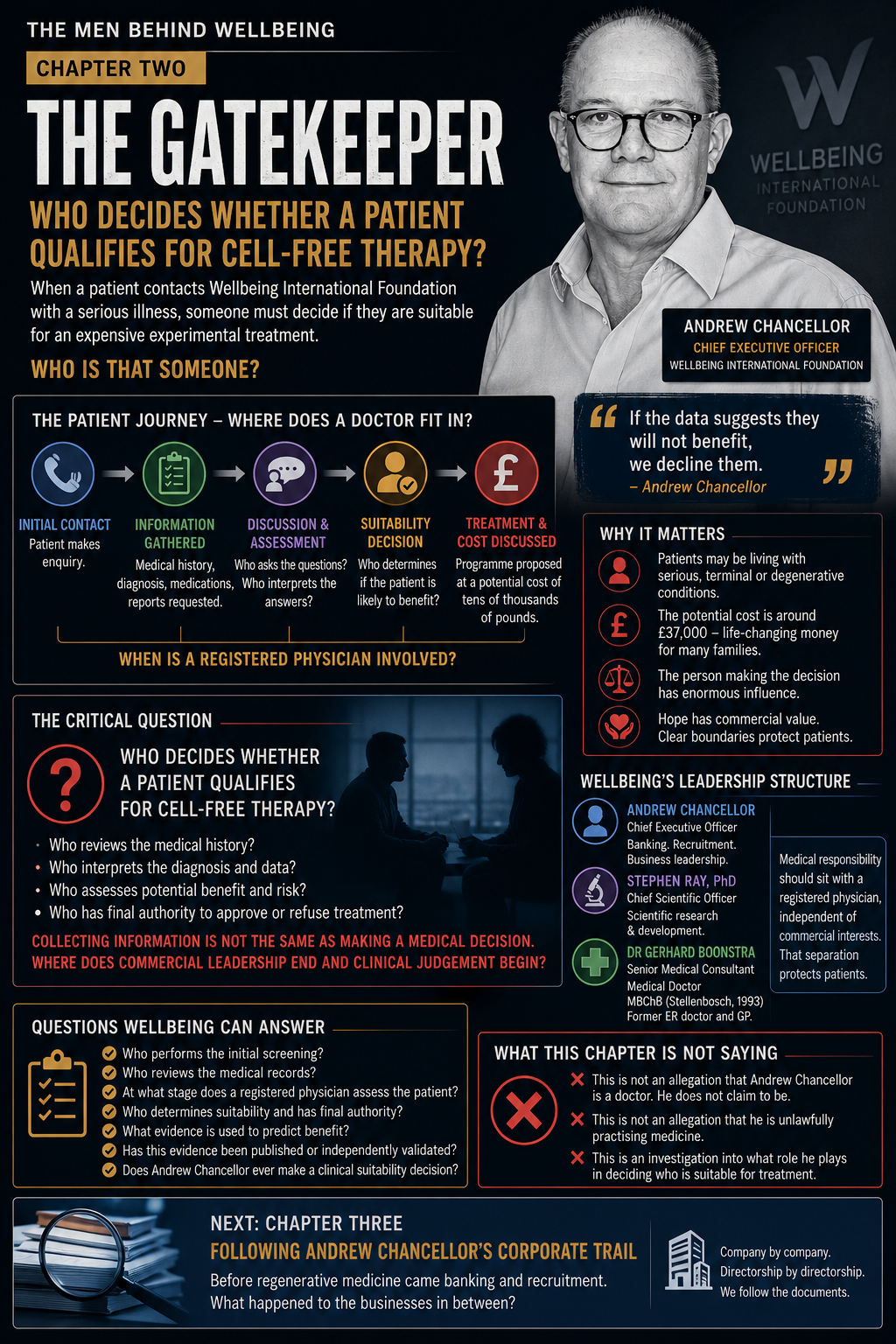
The earlier chapters established that Stephen Ray’s microvesicle research entered the patent system through Lydac Neuroscience. Today, Wellbeing International Foundation promotes an autologous Cell-Free Therapy built around extracellular-vesicle biology. This chapter follows the patents themselves and asks the question that now matters most: where is the legal and technical bridge between the old intellectual property and the treatment being commercialised today?
At some point, every investigation reaches the stage where biographies stop being useful.
People can describe their history in different ways.
Companies can change their branding.
Scientific terminology can evolve.
But patents are different.
They leave dates.
They identify inventors.
They identify applicants and assignees.
They show which jurisdictions were pursued.
And, crucially, they can reveal whether intellectual property moved from one legal owner to another.
That is why this chapter returns to Stephen Ray’s original microvesicle patent family.
Because if Wellbeing International Foundation’s present Cell-Free Therapy genuinely developed from that scientific lineage, the patent record may help us establish what happened between:
Stephen Ray’s early research
and:
the commercial treatment being promoted today.
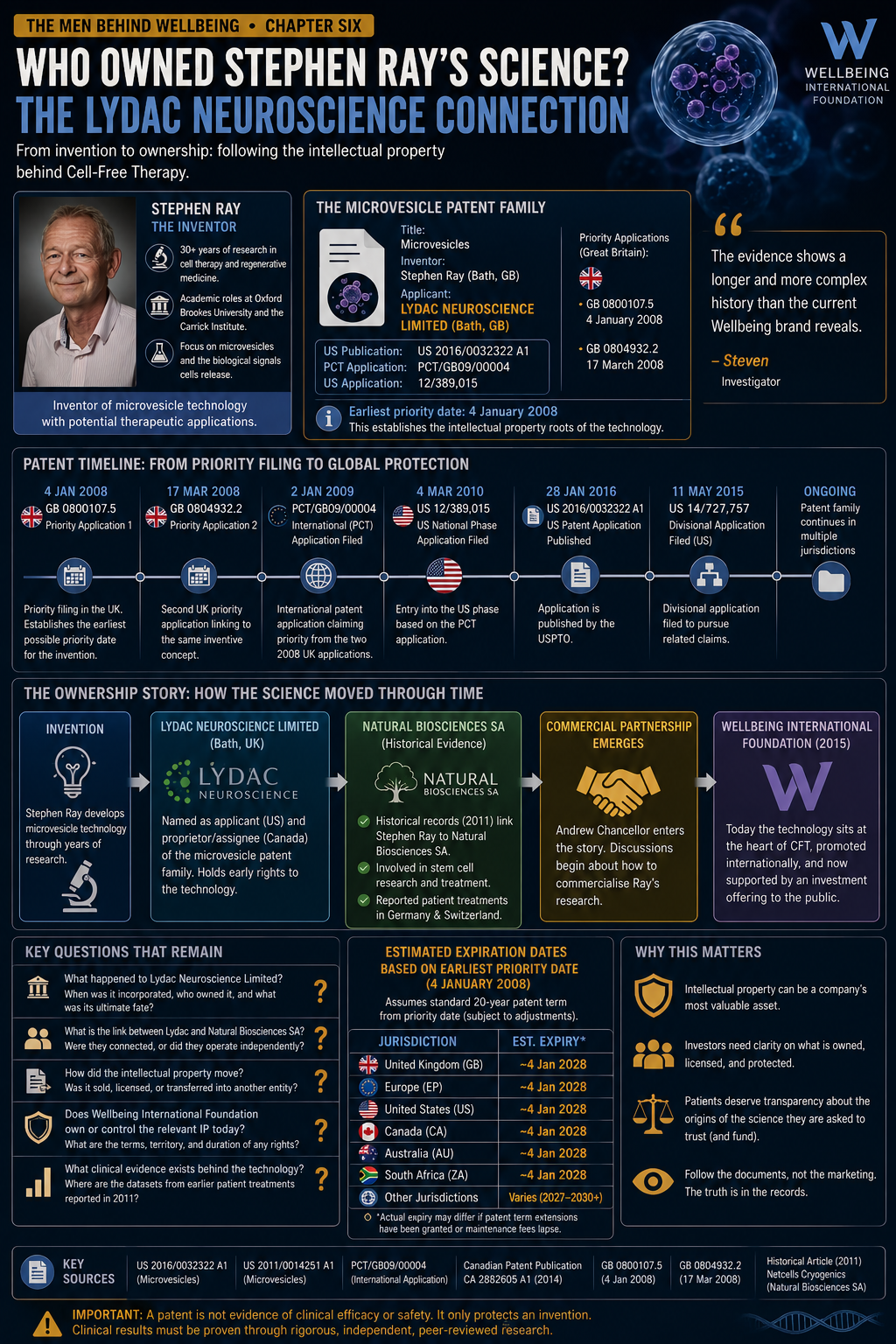
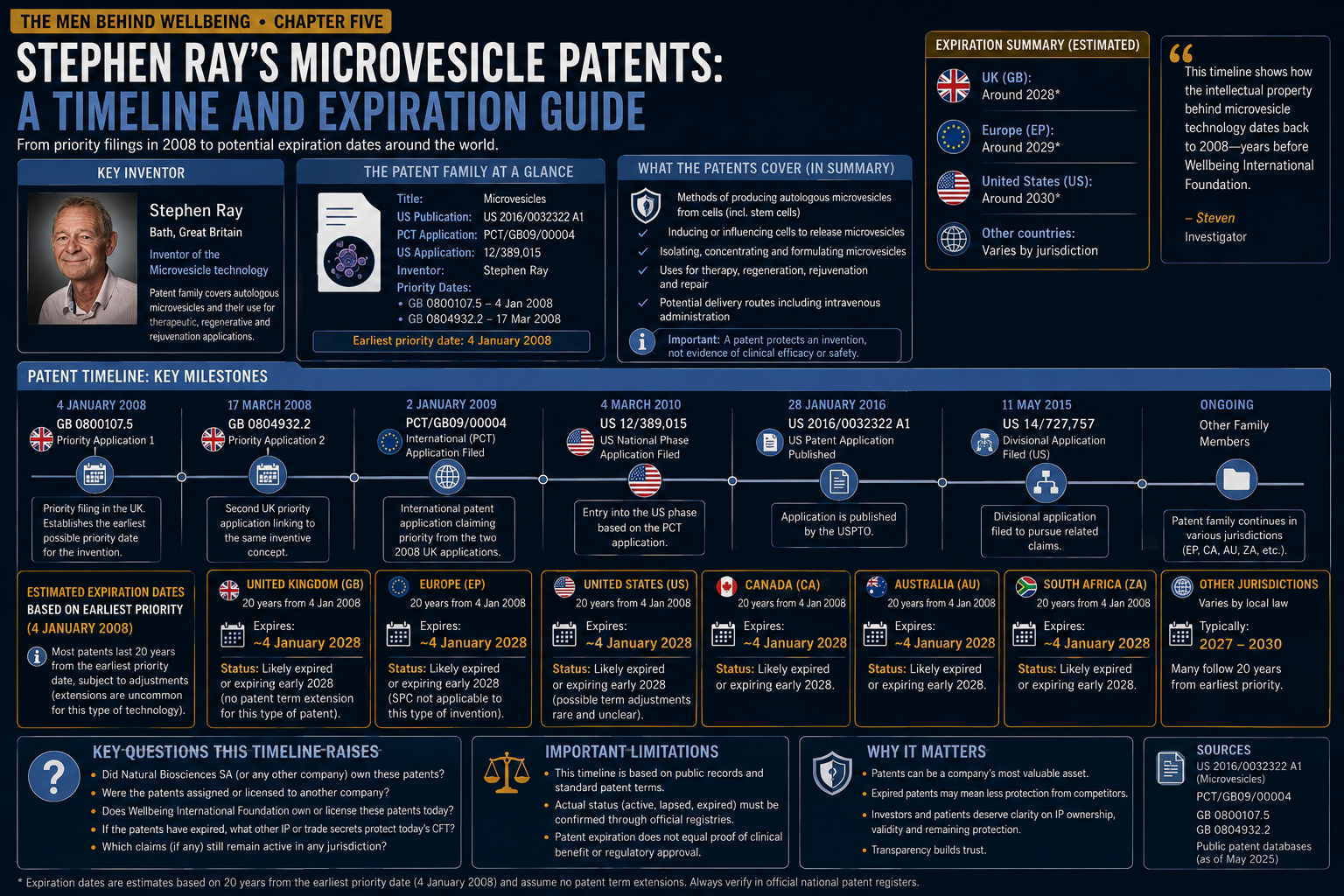
The Patent Story Begins in 2008
The earliest priority date I have identified for the microvesicle invention is:
4 January 2008.
A second British priority application followed on:
17 March 2008.
Then, on 2 January 2009, the invention entered the international patent system through:
PCT/GB2009/000004.
That application became:
WO2009087361 — Microvesicles.
The inventor is identified as:
Stephen Ray.
The original assignee is:
Lydac Neuroscience Limited.
Google Patents — WO2009087361 Microvesicles
This is the starting point.
Not Wellbeing.
Not a modern longevity programme.
Not an investment round.
A biotechnology company called Lydac Neuroscience, and a patent application concerning microvesicles.
What Did Stephen Ray’s Patent Actually Describe?
The patent is technical, but its central concept can be explained without oversimplifying it.
It describes the production and use of microvesicles released by cells.
The invention includes methods in which one population of cells is influenced or induced, microvesicles produced by those cells are harvested, and those vesicles or their contents may then be used in relation to another population of cells.
Importantly, the patent discusses:
autologous microvesicles.
In other words, biological material originating from the same individual.
The specification also discusses potential therapeutic applications.
European Patent EP2240189B1 — Microvesicles
That terminology matters because Wellbeing today also describes its Cell-Free Therapy as autologous.
But similarity in scientific language does not automatically establish legal identity.
What Wellbeing Describes Today
Wellbeing International Foundation now describes Cell-Free Therapy as a process in which blood is taken from the patient, white blood cells are isolated, and biological material produced under controlled conditions is subsequently returned to that same patient.
Wellbeing describes the resulting material as containing:
extracellular vesicles;
growth factors;
and:
cytokines.
Wellbeing International Foundation — Cell-Free Therapy
Its science material also describes extracellular vesicles as small membrane-bound structures involved in cell-to-cell signalling and capable of carrying proteins, RNA and other biological material.
Wellbeing International Foundation — The Science
So the comparison becomes obvious.
Historical patent:
autologous microvesicles.
Current CFT:
autologous biological material containing extracellular vesicles.
Same scientist.
Same broad scientific field.
But not necessarily the same legal invention.
Microvesicles and Extracellular Vesicles Are Related — But Not Identical Terms
This distinction deserves particular care.
Extracellular vesicles are a broad category of membrane-bound particles released by cells.
Microvesicles are generally considered one class within that broader field.
Wellbeing’s own research library includes scientific literature discussing exosomes, microvesicles and other extracellular-vesicle categories.
Wellbeing International Foundation — Research Library
That means it would be misleading to pretend the two scientific concepts have nothing to do with one another.
But it would be equally misleading to say that every modern extracellular-vesicle process is therefore covered by Ray’s original microvesicle patent.
Patent protection depends upon the actual claims.
And technologies can evolve significantly over time.
The Patent Family Went International
The invention did not remain confined to Britain.
The international filing generated patent activity across several jurisdictions, including:
Europe
the United States
Canada
Australia
and:
New Zealand.
International patent family — WO2009087361
This is important because patent rights are territorial.
There is no single worldwide patent that automatically applies everywhere.
A right may remain active in one jurisdiction while lapsing in another.
Ownership records may also differ.
That means any serious ownership investigation has to follow the patent family jurisdiction by jurisdiction.
Europe: The Lydac Patent Reaches Grant
The European application ultimately became:
EP2240189B1 — Microvesicles.
The record identifies:
Stephen Ray — Inventor
and:
Lydac Neuroscience Limited — Original Assignee.
The patent reached grant on:
30 December 2015.
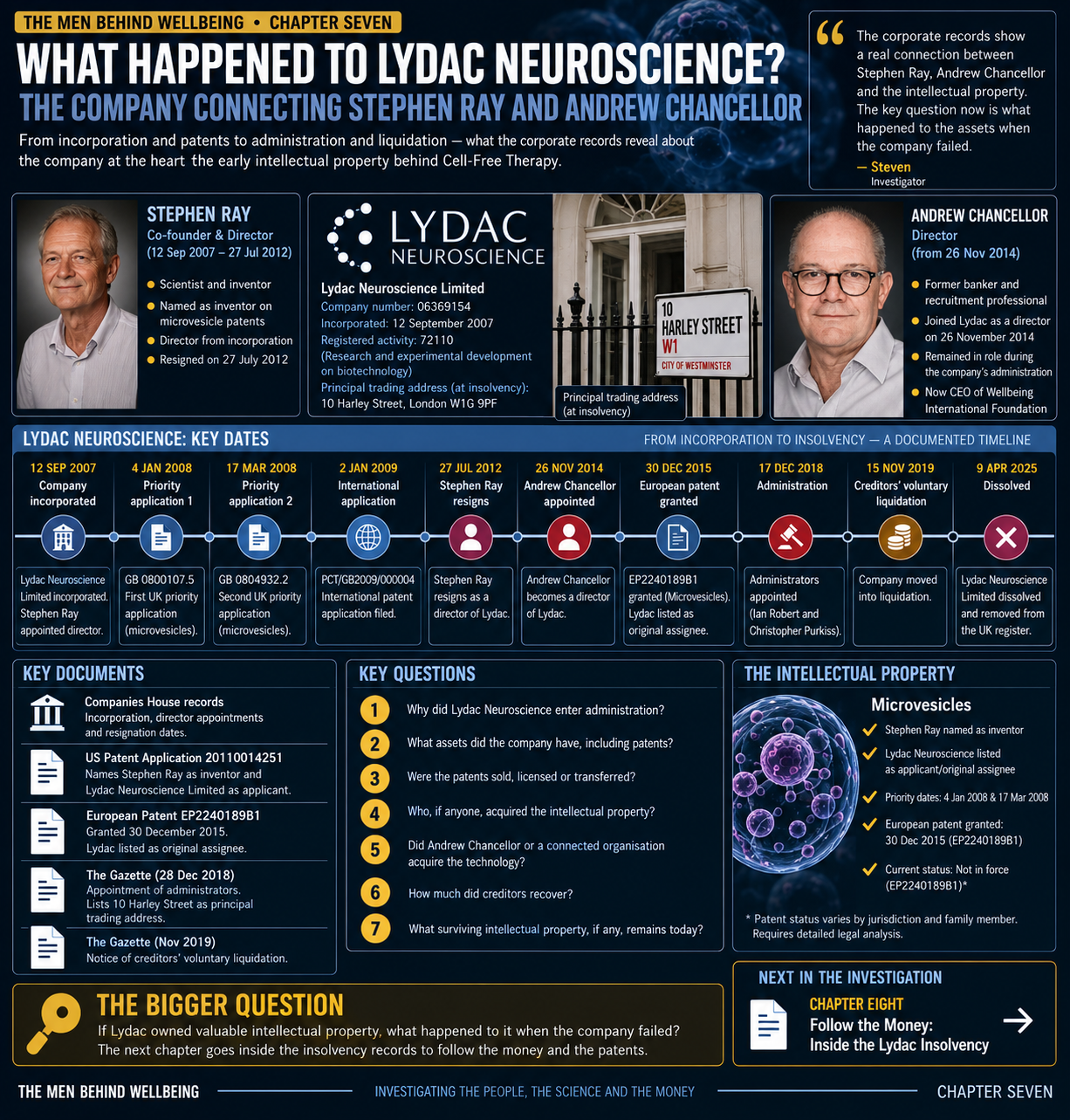
That date is particularly interesting in the corporate timeline.
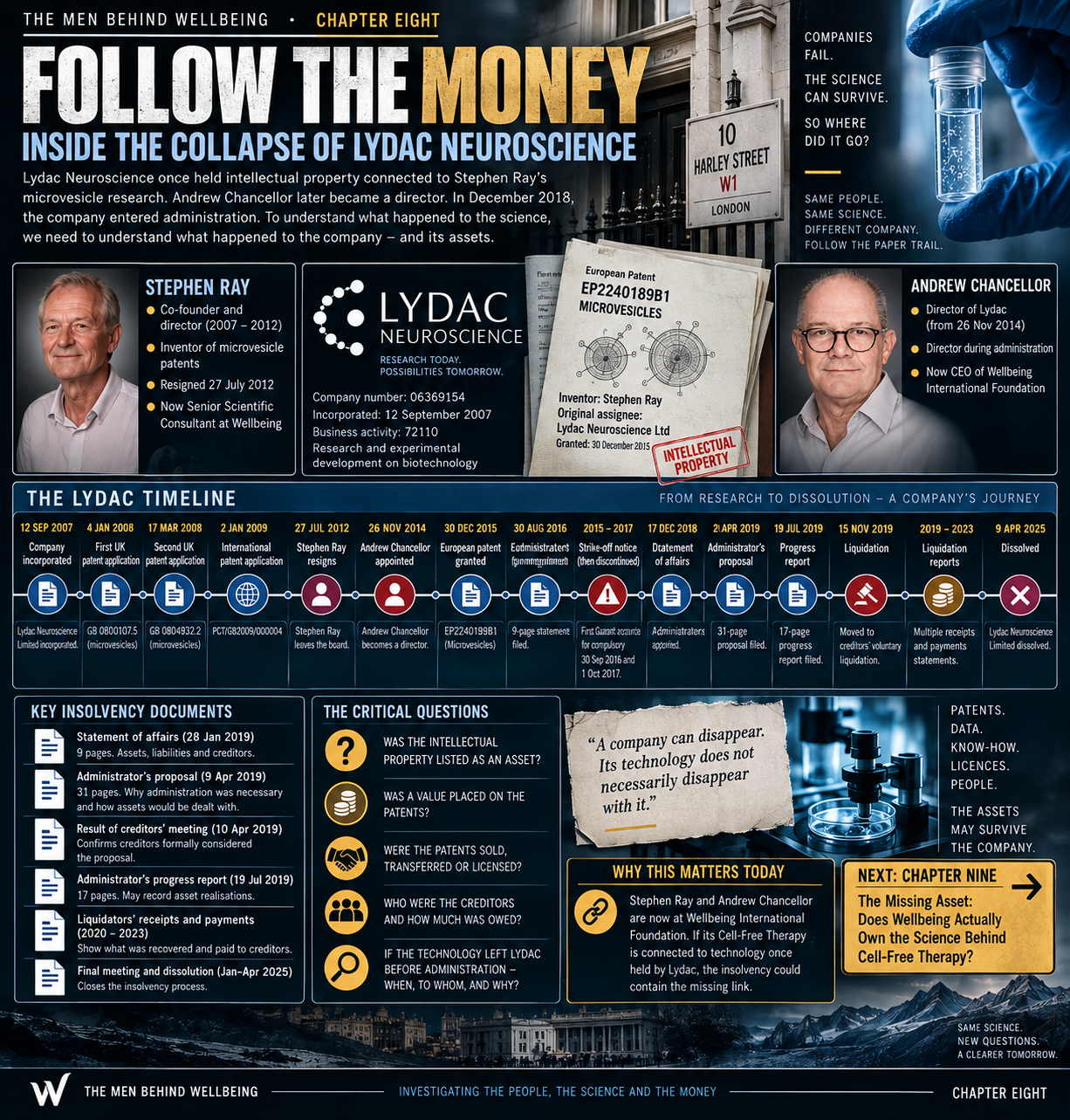
Andrew Chancellor had become a director of Lydac in November 2014.
So when the European patent reached grant, Chancellor was directing the company recorded as original assignee.
That does not make Chancellor the inventor.
It does not make him the personal owner.
But it places him inside the corporate structure during an important period in the patent’s life.
The European Patent Is Now Shown as Not in Force
The current Google Patents record lists EP2240189B1 as:
Not-in-force.
It also continues to display Lydac Neuroscience as both original and current assignee.
EP2240189B1 — Current database record
But caution is essential.
Google Patents itself warns that its legal-status and assignee information should not be treated as definitive legal advice.
National validations, renewals, lapses, assignments and other factors can complicate the true legal position.
So we cannot responsibly say:
“Lydac remained the legal owner of every European right until the end.”
But we can say something narrower.
I have not yet found a public European assignment record transferring this patent to Wellbeing International Foundation.
That is an important difference.
The United States Patent Trail Continues
The US side of the family is also worth examining.
A microvesicle application was published in 2011 as:
US20110014251.
Stephen Ray is named as inventor.
Lydac Neuroscience Limited is identified as applicant.
Justia Patents — US20110014251 Microvesicles
But the US history continues beyond that filing.
Later publications associated with Stephen Ray include:
US20160032322 — Microvesicles
and:
US20180112236 — Microvesicles.
Justia Patents — Stephen Ray inventor records
That suggests the patent prosecution continued through multiple generations of applications.
And one date becomes particularly interesting.
December 2017 Deserves Attention
The later US filing associated with the 2018 publication was filed on:
21 December 2017.
Now compare that with Wellbeing’s own historical account.
Its Paul Cook case study says Cook met Stephen Ray in November 2017 and subsequently began a cell-free treatment programme involving extracellular vesicles derived from his own cells.
Wellbeing International Foundation — Paul Cook Case Study
Those dates are close.
But we need to be very careful.
The timing does not prove that the December 2017 patent filing covered Cook’s treatment.
Continuation and divisional patent applications can arise from older filings for technical patent-prosecution reasons.
A later filing does not necessarily represent a newly invented treatment.
Still, the overlap makes 2017 a critical period for understanding the relationship between:
Ray’s historical patent activity;
the treatment programme later described by Wellbeing;
and:
the ownership of the technology at that time.
Who Owned the Rights in 2017?
This question has become increasingly important.
Lydac was still in existence.
It had not yet entered administration.
Stephen Ray was no longer one of its directors.
Andrew Chancellor was.
Wellbeing’s own account says Ray was involved in an autologous extracellular-vesicle treatment programme.
And related microvesicle patent activity was still occurring.
So:
Who owned the relevant commercial rights at that moment?
Was it Lydac?
Was the technology licensed?
Had an assignment occurred?
Was another organisation involved?
Or had Ray’s work progressed beyond the original patent claims?
Those possibilities are very different.
And we still need the evidence to distinguish between them.
Inventorship Is Not Ownership
This remains one of the most important principles in the investigation.
Stephen Ray being the inventor does not mean Stephen Ray personally owned all of the resulting patent rights.
The original patent records identify Lydac Neuroscience as assignee.
Likewise, Andrew Chancellor becoming a director of Lydac did not mean he personally owned Lydac’s patents.
A company is legally separate from its directors.
If a company owns intellectual property, that asset remains with the company until it is:
sold;
assigned;
licensed;
allowed to lapse;
or otherwise dealt with legally.
That is why the later Wellbeing connection requires documentation.
The Same Principle Applies to Wellbeing
Ray later joining or advising Wellbeing does not automatically take the historical patent rights with him.
Chancellor later becoming CEO of Wellbeing does not automatically transfer assets from a company he previously directed.
If Wellbeing acquired rights, there should be a legal basis.
Potentially:
an assignment;
a purchase;
a licence;
or:
later independent intellectual property.
So far, I have not found a public patent record reviewed for this chapter showing the original WO2009087361 / EP2240189 family assigned directly from Lydac Neuroscience to Wellbeing International Foundation.
Again, that does not mean no rights exist.
It means the public bridge has not yet been established.
Perhaps the Old Patent No Longer Matters
There is another possibility that could resolve much of this.
Perhaps Wellbeing simply does not depend upon Ray’s original patent family anymore.
The European patent is currently shown as not in force.
Modern CFT may rely on later discoveries.
Newer protocols.
Manufacturing know-how.
Trade secrets.
Subsequent inventions.
Or a process that falls outside the original patent claims entirely.
That would be commercially plausible.
But it changes the due-diligence question.
Instead of asking:
Which old patents does Wellbeing own?
we would need to ask:
What newer proprietary technology protects the business today?
Patent Protection and Know-How Are Different Assets
A company can possess valuable technology without a current patent.
Some manufacturing methods are deliberately kept secret.
A patent requires disclosure.
Trade secrets do not.
So Wellbeing could potentially rely upon proprietary know-how involving:
cell conditioning;
culture conditions;
timing;
concentration;
purification;
processing;
quality control;
or:
other laboratory techniques.
That might provide significant commercial value.
But then the ownership question simply moves elsewhere.
Who owns the know-how?
If Stephen Ray Is the Know-How, Investors Should Understand That
Suppose the real competitive advantage is largely Stephen Ray’s scientific expertise.
That creates a different type of business risk.
Is his knowledge contractually assigned to Wellbeing?
Is he an employee?
A consultant?
What happens to intellectual property created during his work?
Who owns improvements?
Does Wellbeing have exclusivity?
Can Ray work with another organisation?
What happens if he leaves?
These are not questions about Ray personally.
They are questions about whether Wellbeing’s scientific advantage is legally embedded within the company—or primarily dependent upon one individual.
For investors, that distinction could be substantial.
Wellbeing’s Website Copyright Does Not Answer the Question
Wellbeing’s Terms of Service contain a conventional intellectual-property clause relating to its website materials.
It covers things such as:
text;
logos;
graphics;
images;
and software.
Wellbeing International Foundation — Terms
That is normal.
But website copyright does not establish ownership of the underlying biotechnology.
It doesn't tell us who owns:
the CFT production method;
the relevant extracellular-vesicle technology;
the laboratory protocols;
or:
Ray’s historical inventions.
Those require separate documentation.
Scientific Papers Are Not Proprietary Rights Either
Wellbeing has assembled an extensive research library covering extracellular-vesicle science, secretome biology, ageing and other subjects.
That demonstrates that the wider field is real and scientifically active.
But those papers are independent research.
They do not belong to Wellbeing simply because Wellbeing links to them.
Wellbeing International Foundation — Research Library
This distinction is important for prospective investors.
The existence of a large scientific literature demonstrates a research field.
It does not create exclusive commercial rights for one company operating within that field.
The Real Investor Question Is Different
An investor should therefore not ask only:
“Is extracellular-vesicle science legitimate?”
The better question is:
“What part of this technology does Wellbeing uniquely control?”
That could mean:
patents;
exclusive licences;
trade secrets;
manufacturing protocols;
clinical data;
specialist know-how;
or proprietary methods.
Then comes the next question:
Which legal entity owns those assets?
And:
Are those assets inside the company or structure receiving my investment?
Those questions go directly to value.
What About the 2026 Investment Round?
This matters because Wellbeing has publicly announced the opening tranche of a 2026 capital round.
It says the funding is supporting research, operating capacity and expansion.
Wellbeing — 2026 Investment Round Announcement
That makes ownership of future intellectual property important as well.
If investors fund new research:
Who owns what the research produces?
Wellbeing International Foundation?
Stephen Ray?
A laboratory partner?
Another corporate entity?
Are inventions automatically assigned?
Will patents be filed?
Will investor capital finance technology that sits inside the investment vehicle—or outside it?
These are questions serious investors normally examine before investing.
The Patent Timeline We Can Establish
At this stage, the documentary sequence is becoming clear.
2008
British priority applications are filed.
2009
PCT/GB2009/000004 enters the international patent system.
Stephen Ray is inventor.
Lydac Neuroscience is assignee.
2009
WO2009087361 — Microvesicles is published.
2010–2015
The patent family progresses into national and regional jurisdictions.
2015
European patent EP2240189B1 is granted.
2016
A further US microvesicle publication appears.
November 2017
Wellbeing’s historical account places Ray in an autologous extracellular-vesicle treatment programme.
December 2017
Another US microvesicle application associated with Ray is filed.
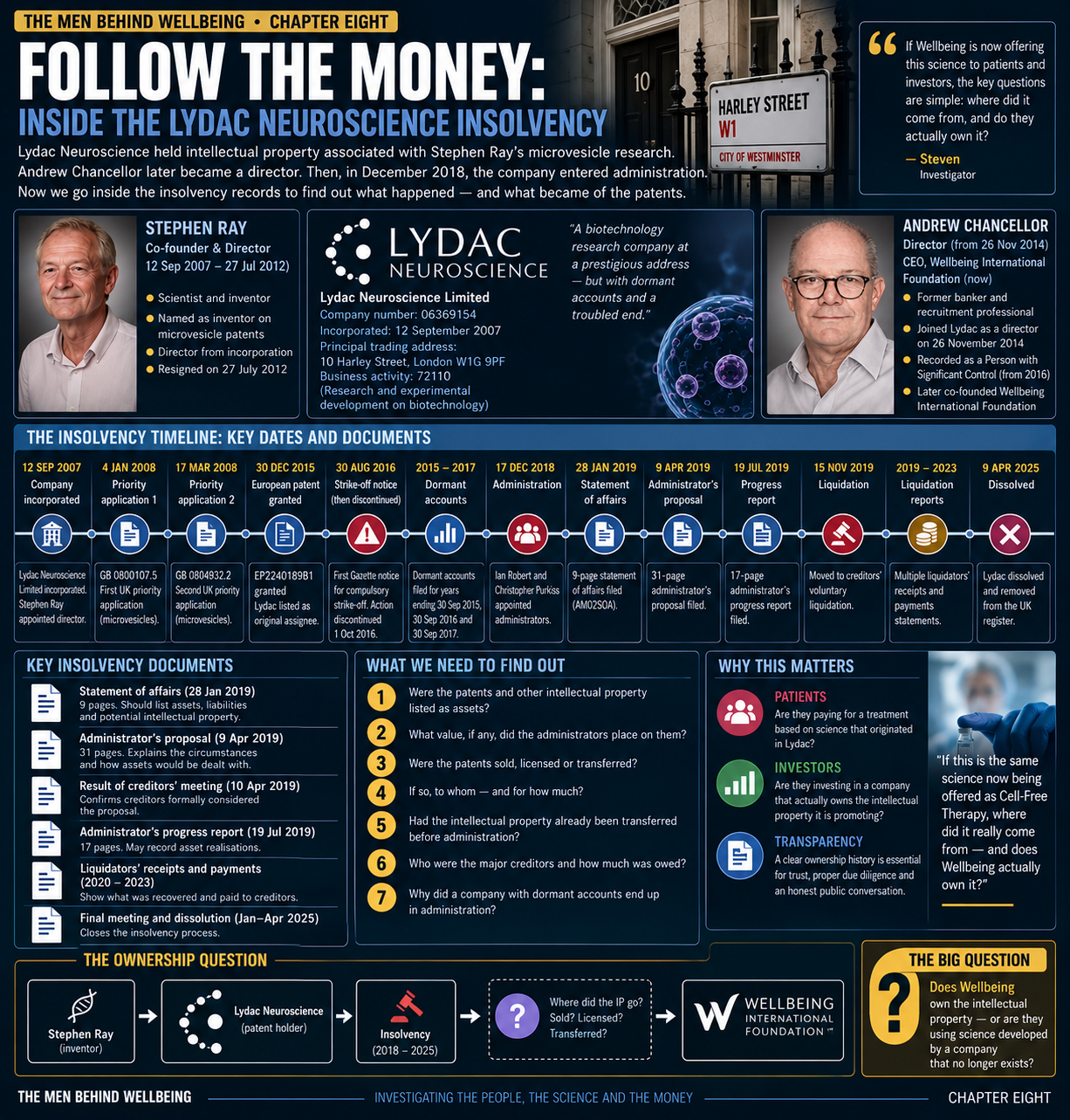
December 2018
Lydac Neuroscience enters administration.
November 2019
Lydac enters creditors’ voluntary liquidation.
April 2025
Lydac is dissolved.
Today
Wellbeing promotes an autologous Cell-Free Therapy involving extracellular vesicles.
What remains missing is the documentary bridge connecting those stages.
Four Possible Explanations
At this point, I see several realistic possibilities.
Wellbeing Acquired or Licensed the Relevant Rights
There may be a legitimate assignment or licence that is not apparent in the public records reviewed so far.
The Original Patents Became Irrelevant
Modern CFT may have evolved sufficiently far beyond the old claims that Wellbeing does not require those rights.
The Commercial Value Lies in Know-How
The old patents may be less important than confidential manufacturing methods, scientific expertise or trade secrets.
Another Entity Holds the Rights
A separate company may own patents, protocols or licences used by Wellbeing.
Any one of those explanations could be entirely lawful.
We simply need to establish which one is true.
What Would Resolve the Question?
The evidence we need is now very specific.
The full assignment history for the Ray microvesicle patent family.
USPTO assignment records.
European Patent Register ownership records.
Canadian and other national ownership records.
Lydac’s insolvency asset-sale documentation.
Any licensing agreements involving the relevant technology.
And Wellbeing’s present intellectual-property schedule.
Put those documents together and we should finally be able to see whether there is a legal chain connecting the early science with the present commercial operation.
Questions for Wellbeing International Foundation
At this stage, I would invite Wellbeing to answer several straightforward questions.
Does CFT use any technology covered by, derived from or substantially related to WO2009087361 or EP2240189B1?
Does Wellbeing own any member of that patent family?
Has it ever licensed those rights?
Did Wellbeing or any connected organisation acquire intellectual property from Lydac Neuroscience?
What intellectual property protected the 2017 treatment programme described by Wellbeing?
Which patents, if any, currently protect CFT?
If CFT is primarily protected by proprietary know-how rather than patents, which entity legally owns that know-how?
And:
which entity will own new intellectual property developed using current investment capital?
These should be answerable questions.
What We Are Not Claiming
This investigation has not established patent infringement.
It has not established unauthorised use of Lydac technology.
It has not established that Andrew Chancellor or Stephen Ray improperly transferred intellectual property.
It has not established that Wellbeing lacks valid commercial rights.
And it has not established that current CFT is identical to Ray’s 2008 invention.
Those would be much stronger conclusions than the evidence currently supports.
What we have established is enough to justify a serious ownership investigation.
There is a historical patent family.
There is a documented inventor.
There is a documented original assignee.
There is a later therapy involving related science.
There are overlapping people.
And there is no complete public ownership chain yet identified between those points.
Conclusion: The Patent Trail Is Real. The Ownership Trail Is Still Incomplete.
At the beginning of this investigation, one question was whether Stephen Ray genuinely had a historical scientific footprint in this field.
The patent record answers that.
He did.
His microvesicle intellectual property reaches back to 2008.
It entered multiple jurisdictions.
It described autologous microvesicles with potential therapeutic applications.
And Lydac Neuroscience appears as the original corporate assignee.
Today, Wellbeing promotes an autologous treatment involving extracellular vesicles and identifies Ray as a central scientific figure.
That does not prove the old patent became CFT.
But it does create a legitimate question of provenance.
How did we get from one to the other?
If there was an assignment, find it.
If there was a licence, identify it.
If the old technology became obsolete, establish when and why.
If later technology replaced it, identify the newer intellectual property.
And if Wellbeing’s real competitive advantage is know-how rather than patents, then investors deserve to understand exactly what that know-how is, who owns it, and how it is protected.
Because investors are not investing in the existence of extracellular-vesicle science.
That science belongs to an entire research field.
They are investing in whatever Wellbeing uniquely and legally controls within that field.
And until that asset is clearly identified, one fundamental question remains open:
What exactly does Wellbeing own that another organisation cannot legally or practically reproduce?
Next: Chapter Eleven — What Exactly Are Investors Buying?
The patent investigation has brought us directly back to the investment proposition. In Chapter Eleven, we examine the entity receiving investment, the assets inside it, what investors actually receive, how intellectual property is represented, and whether the scientific assets being used to support Wellbeing’s future valuation genuinely belong to the company being funded.
Recent Posts