Andrew Chancellor and Stephen Ray: Where Business Met the Science The Men Behind Wellbeing — Chapter Four
How the partnership between businessman Andrew Chancellor and scientist Stephen Ray helped transform biological research into the commercial operation that became Wellbeing International Foundation.
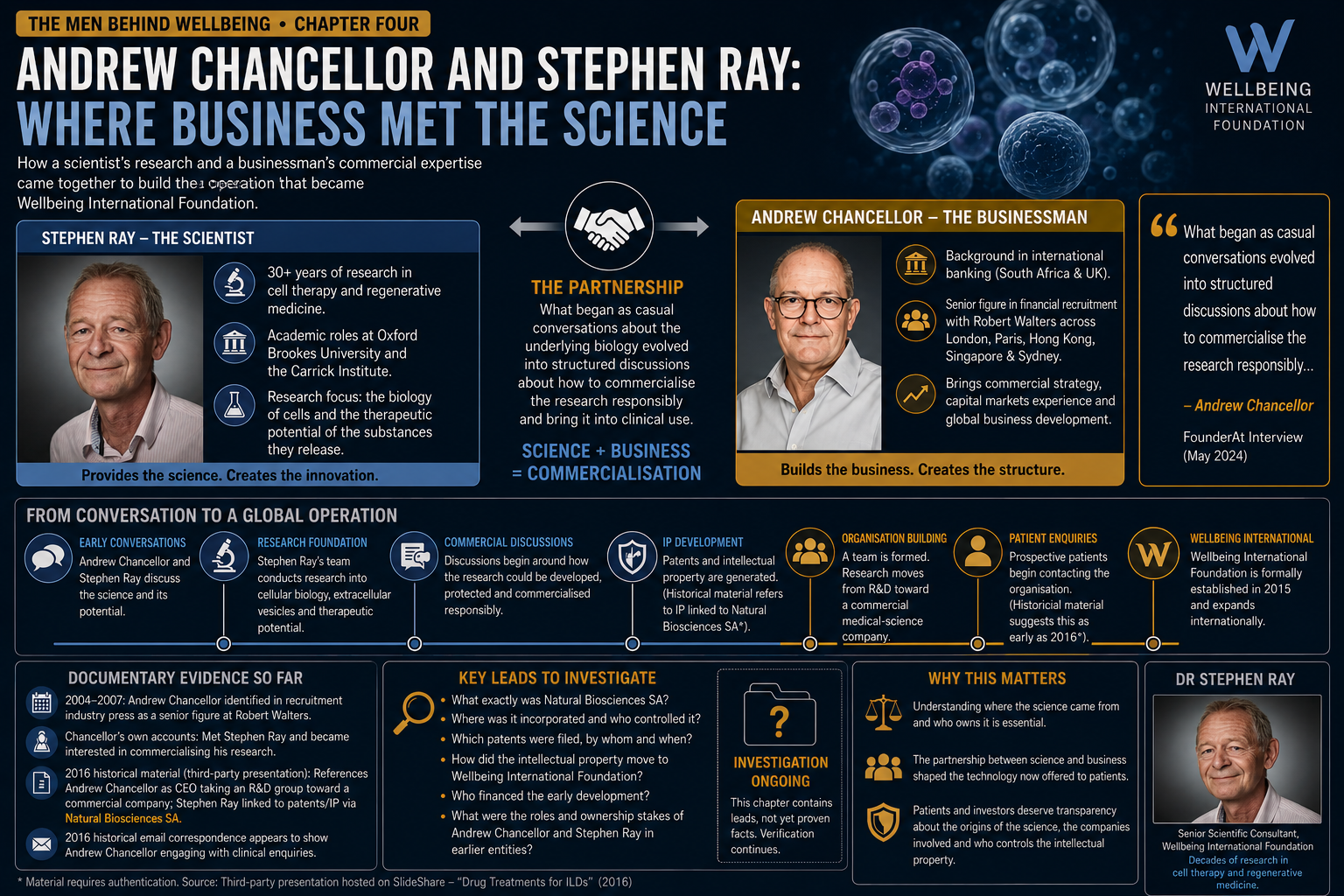
Every biotechnology company needs two things.
Science capable of producing something valuable.
And somebody capable of turning that science into a business.
In the history of Wellbeing International Foundation, those two roles appear to have been occupied by two very different men.
Stephen Ray brought the science.
Andrew Chancellor brought the business.
That isn't my interpretation alone.
It is remarkably close to the story Chancellor himself now tells.
After years in banking and international recruitment, Chancellor says he met Stephen Ray, became fascinated by his work and eventually began discussing something that would change the direction of both men's careers:
How could Ray's research be commercialised?
FounderAt — Andrew Chancellor discusses meeting Stephen Ray and commercialising the research
That word—commercialise—takes us to the heart of this chapter.
Because this investigation is no longer simply asking where Wellbeing's science came from.
We need to understand how that science became a product.
The Scientist and the Businessman
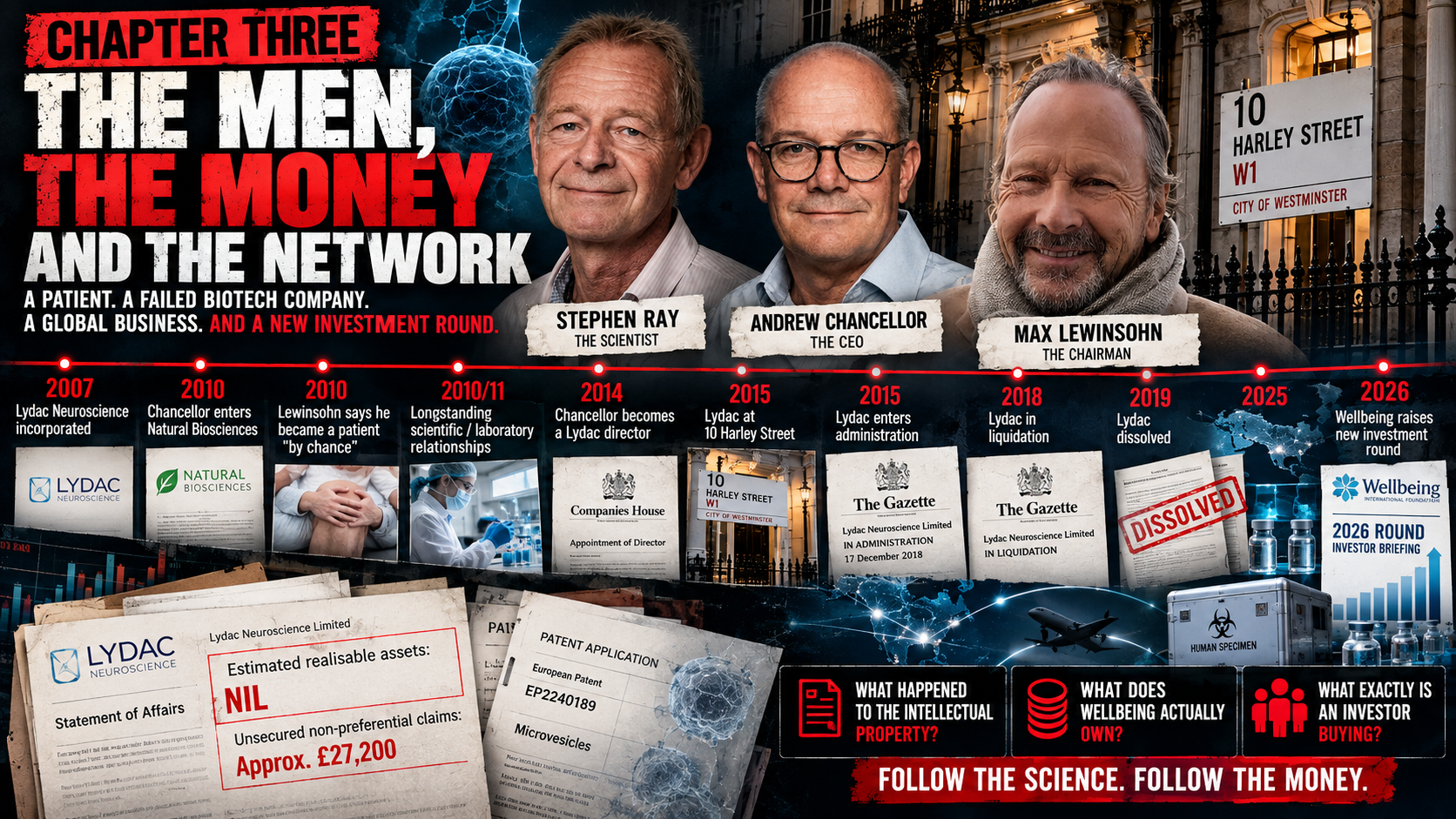
Wellbeing currently identifies Stephen Ray as its Senior Scientific Consultant.
Its biography credits him with more than thirty years of academic and commercial research experience in cell therapy and refers to previous academic positions at Oxford Brookes University and the Carrick Institute.
Andrew Chancellor, meanwhile, is identified as Chief Executive Officer, with a background beginning in international banking before moving through recruitment and ultimately healthcare and bioscience.
Wellbeing International Foundation — Leadership and research team
The distinction is striking.
Ray's stated expertise is scientific.
Chancellor's is commercial.
And according to Chancellor, those two worlds came together almost accidentally.
Andrew Chancellor Says He Entered a World He Knew Little About
Chancellor has now written publicly about this transition himself.
In an article titled “From Banking to Bioscience: The Unlikely Evolution of Andrew Chancellor,” he describes meeting Ray as the event that pushed him into a scientific world he initially knew little about.
Andrew Chancellor — “From Banking to Bioscience”
That is an important admission rather than necessarily a damaging one.
Biotechnology companies routinely combine scientific founders with commercially experienced executives.
Scientists may understand the technology but lack experience raising capital, building companies, negotiating partnerships or developing international markets.
Businesspeople can provide exactly those skills.
The interesting question isn't why Ray needed Chancellor.
It is:
What exactly did they build together?
From Conversation to Commercialisation
Chancellor gives us part of the answer.
In a recent interview he explained:
“What began as casual conversations evolved into structured discussions about how to commercialise the research responsibly…”
Read Chancellor's full FounderAt interview
That is one of the most important statements we have uncovered about the origins of Wellbeing.
The research apparently existed first.
Then came the commercial question.
How could it be turned into something capable of being delivered to patients?
How could an organisation be built around it?
How could it operate internationally?
How could clinicians become involved?
And ultimately, how could the science generate revenue?
There is nothing inherently improper about any of those questions.
That is how biotechnology businesses are created.
But it means the origins of Wellbeing should be examined not only as a scientific story.
They are also a commercial story.
What Exactly Was Stephen Ray's Research?
This is where the history becomes considerably more important.
Wellbeing attributes the scientific origins of its approach to work carried out by Stephen Ray over many years.
Its current materials describe Ray as having extensive experience in cell therapy and position his research as central to the development of what eventually became Cell-Free Therapy.
The basic concept is that cells release biological signalling substances—including extracellular vesicles, cytokines and growth factors—which may influence repair and cellular behaviour.
Rather than administering the living cells themselves, Wellbeing's approach involves producing and administering a preparation containing substances released by those cells.
This is scientifically interesting territory.
Extracellular vesicles and cellular secretomes are genuine areas of biomedical research.
But the existence of a scientific field does not automatically validate a particular commercial therapy.
That distinction has remained central throughout this investigation.
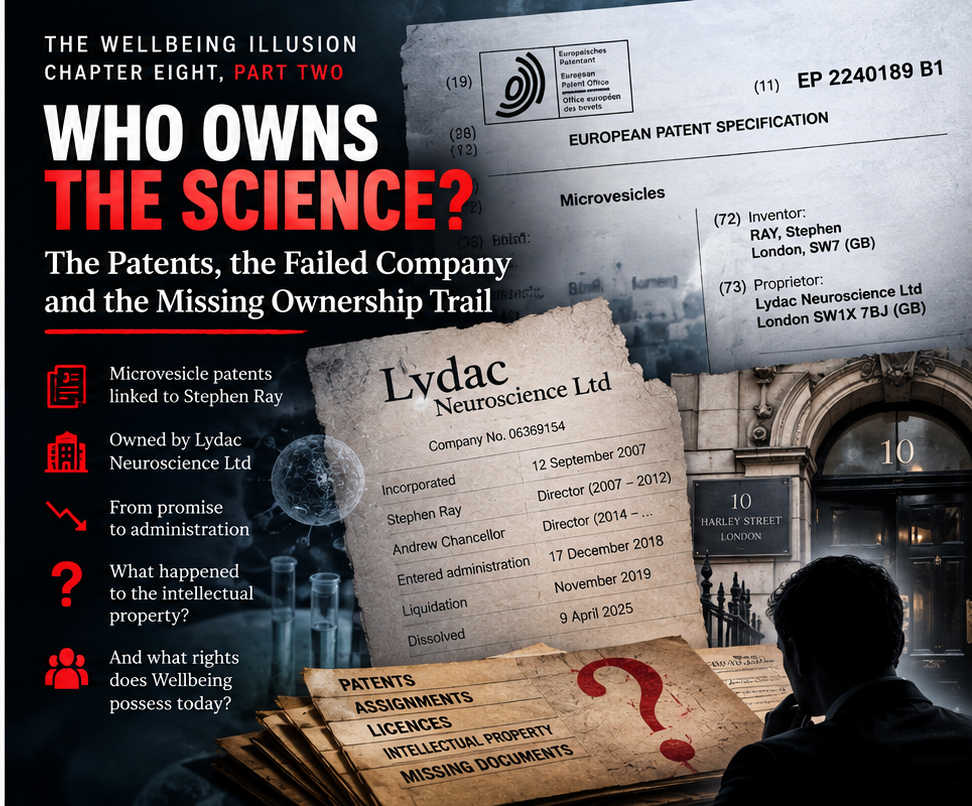
The Intellectual Property Question
Once Chancellor and Ray began discussing commercialisation, another question inevitably arose.
Who owned the science?
Scientific discoveries intended for commercial development are often protected through intellectual property.
Patents.
Patent applications.
Proprietary laboratory processes.
Trade secrets.
Licensing agreements.
Manufacturing protocols.
If Ray had developed processes capable of producing commercially valuable biological preparations, ownership of those processes could potentially become enormously valuable.
And this is where an older document uncovered during this investigation becomes particularly interesting.
A 2016 Document Points Toward Natural Biosciences SA
I located a presentation preserved online that appears to contain historical Wellbeing-related material dating from approximately 2016.
Within that material, Stephen Ray is described as having led a team responsible for generating:
“an extensive portfolio of patents and intellectual properties”
associated with a company called Natural Biosciences SA.
The same material describes Andrew Chancellor as Chief Executive Officer with responsibility for taking the organisation from a research-and-development group toward a commercial medical-science company.
If authentic, this could be extremely important.
Because suddenly we have another corporate name entering the story:
Natural Biosciences SA.
But I need to be very clear about the evidential status.
This Is a Lead, Not Yet a Finding
The document I found is not currently hosted on an official Wellbeing website.
It appears inside a third-party presentation preserved online.
That means I am not yet treating every statement contained within it as independently established fact.
Before relying upon it conclusively, we need to determine:
Who created the original material?
When was it produced?
Was it genuinely supplied by Wellbeing or its predecessors?
What was Natural Biosciences SA?
Where was it incorporated?
Who were its directors?
Who were its shareholders?
What patents did it own or apply for?
And what relationship did it have with Stephen Ray and Andrew Chancellor?
Until those questions are answered, Natural Biosciences remains an investigative lead.
But potentially a very important one.
Follow the Intellectual Property
This gives us another route into the history.
Rather than merely searching for companies associated with Chancellor, we can follow the technology itself.
If Ray generated patents, those patents should potentially leave records.
Patent applications identify inventors.
They identify applicants.
They contain dates.
They can identify companies.
They can show changes of ownership.
They may identify jurisdictions.
And sometimes they reveal precisely when scientific research became a commercial asset.
That trail could tell us considerably more than executive biographies.
Who Was the Inventor?
The first question is straightforward.
Which patents identify Stephen Ray as an inventor?
Who Owned Them?
Was the applicant Ray personally?
Natural Biosciences SA?
Another company?
Wellbeing?
A laboratory?
An investor-controlled entity?
Where Did the Intellectual Property Go?
If the technology was originally owned elsewhere, was it subsequently licensed or transferred to Wellbeing?
And if so:
When?
For how much?
Under what agreement?
Those are potentially crucial questions when trying to understand who owns the technology underlying a treatment being offered commercially today.
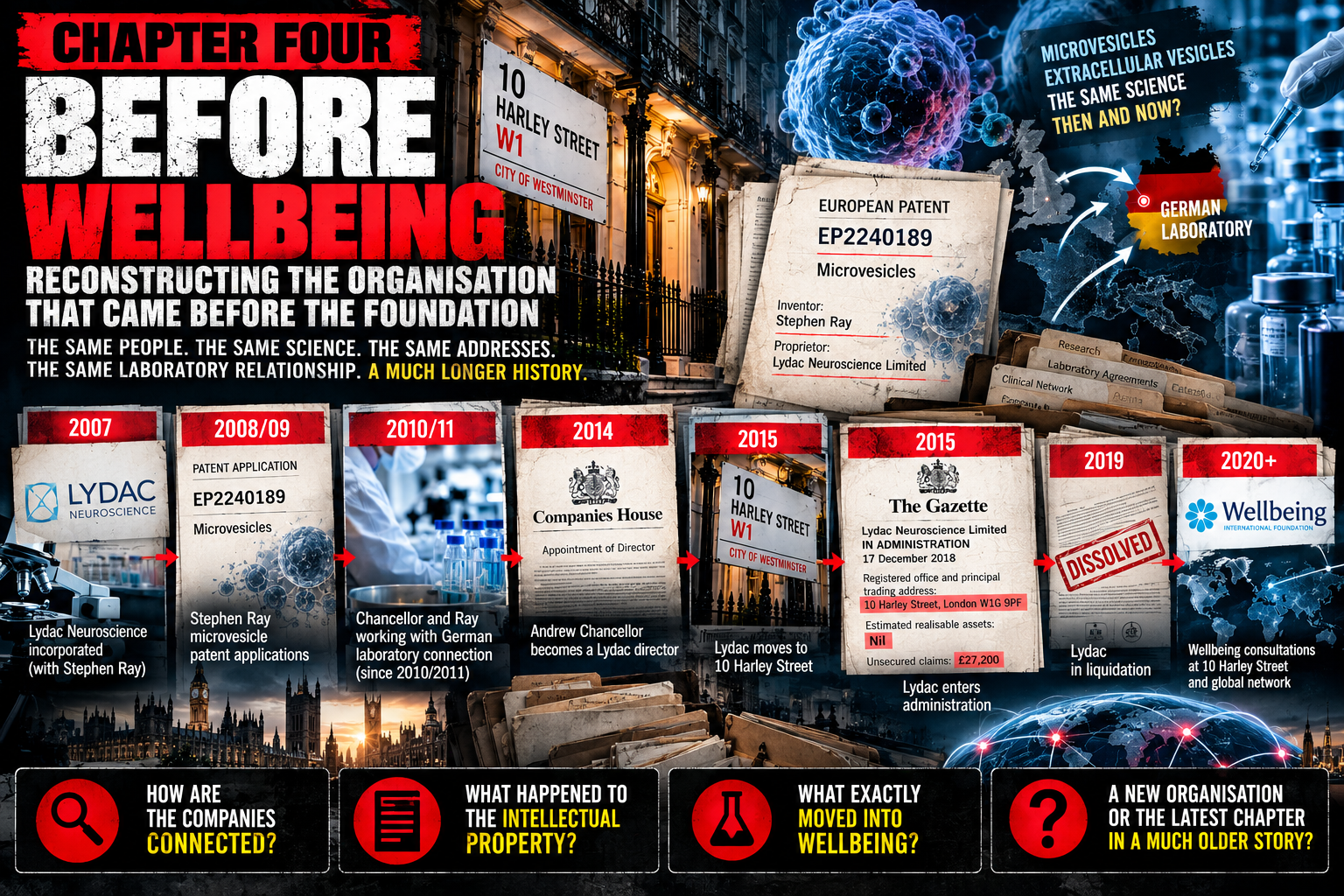
The Corporate History May Predate Wellbeing
This is becoming increasingly important.
Chancellor says he has led Wellbeing for approximately nine years.
Wellbeing's current biography says he has worked in healthcare and bioscience for approximately fifteen years.
That suggests the commercial relationship surrounding this science may predate the present Wellbeing operation.
If Natural Biosciences—or another predecessor organisation—was involved earlier, then the real history of Cell-Free Therapy may extend through several corporate structures.
That isn't necessarily unusual.
Biotechnology projects often migrate through companies as investment rounds change, intellectual property is transferred and new commercial structures are created.
But it means we need to identify those structures.
Then We Found Something Else From 2016
The same historical material contains something potentially even more significant.
It reproduces what appears to be an email exchange involving Andrew Chancellor and an NHS healthcare professional concerning a patient with idiopathic pulmonary fibrosis.
The healthcare professional asks for evidence concerning outcomes in patients with that condition.
The reproduced response from Chancellor says that first consultations were complimentary but appears reluctant to provide information before meeting the prospective patient.
Again, I am deliberately being cautious.
The material requires authentication before I would publish the correspondence as established fact.
But if authenticated, it could show Chancellor interacting with prospective patient enquiries as early as 2016.
That would make the questions raised in Chapter Two about patient assessment considerably more historically significant.
This would not simply be about what Chancellor does today.
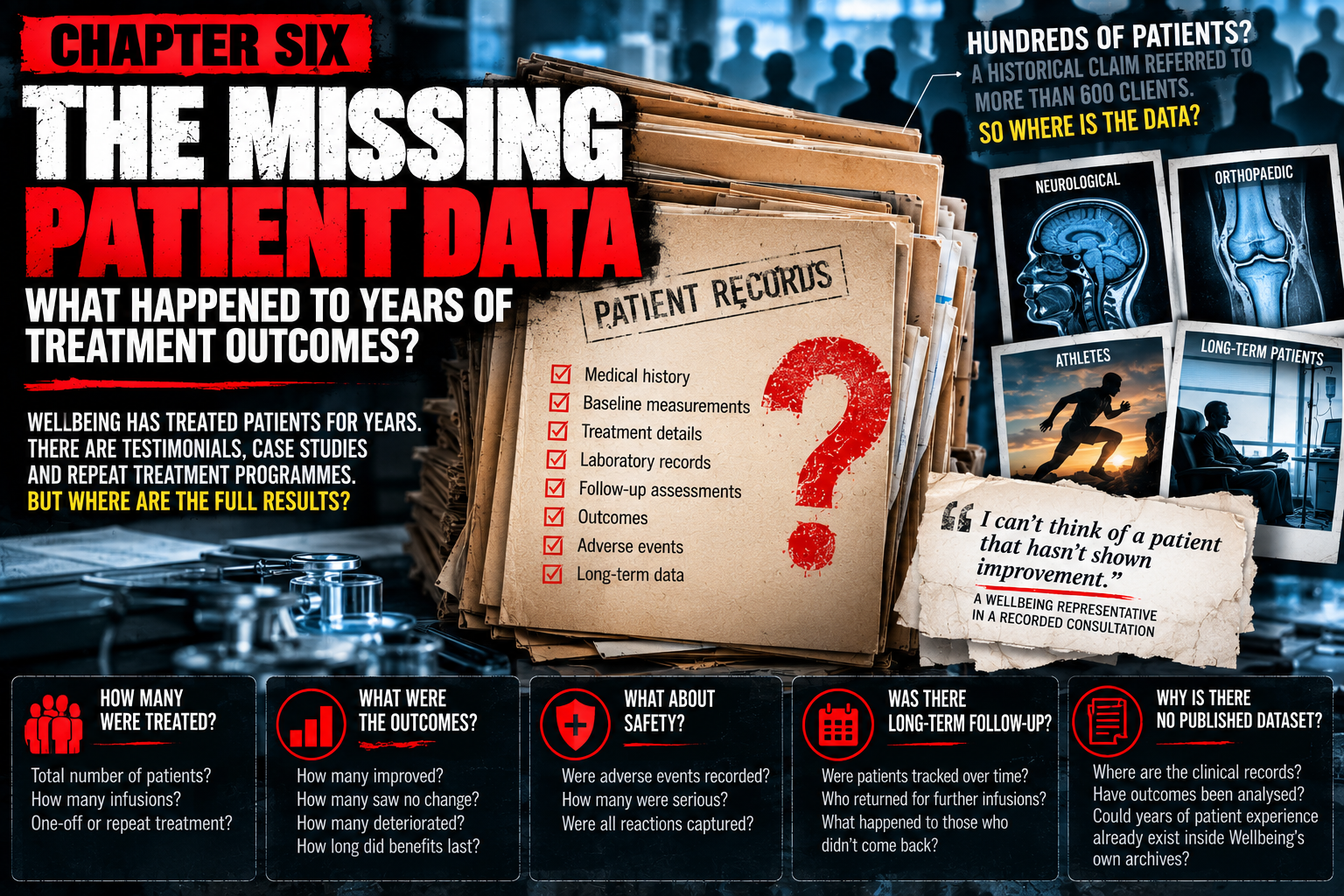
It could potentially establish a patient-facing role extending back a decade.
The Science Was Already Becoming a Business
What is beginning to emerge is a clearer picture of the transition.
Stephen Ray appears to have been developing biological research.
Andrew Chancellor entered the relationship from banking and recruitment.
Chancellor says they began discussing how to commercialise Ray's work.
An organisation developed around that objective.
Patients eventually entered the picture.
And today Wellbeing operates internationally, working with clinicians, laboratories and commercial partners to deliver Cell-Free Therapy.
That is the broad story.
But enormous gaps remain.
Who Funded the Early Development?
Research costs money.
Laboratories cost money.
Patent applications cost money.
Clinical development costs money.
Staff cost money.
International expansion costs money.
So who financed the Chancellor–Ray project during its early years?
Was it Chancellor?
Ray?
Private investors?
Corporate investors?
Patient revenue?
Philanthropic funding?
Another company?
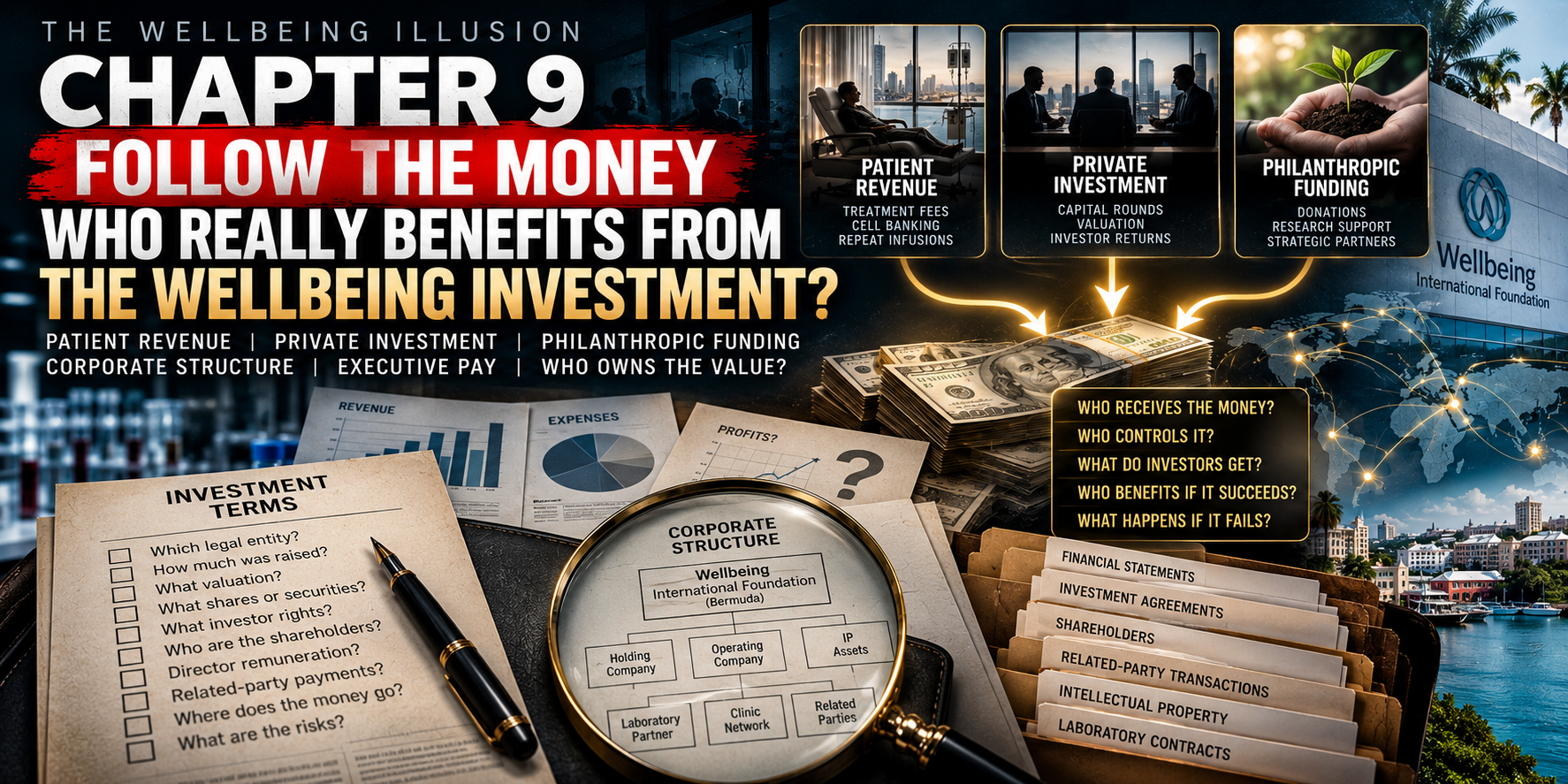
This becomes especially relevant given Wellbeing's recent move into raising investment capital.
If today's investors are being offered an opportunity based partly upon technology developed years earlier, understanding who financed and owns that technology becomes basic due diligence.
Where Does Stephen Ray's Ownership Begin and End?
Another question now needs answering.
Was Stephen Ray merely the scientist?
Or did he hold equity in the businesses commercialising his research?
Was he an inventor?
Shareholder?
Director?
Consultant?
Licensor?
Employee?
Those distinctions matter.
A scientist paid to advise a company occupies a very different commercial position from an inventor who owns the underlying intellectual property.
And if ownership changed over time, we need to understand how.
The Relationship Has Lasted for Years
Whatever the precise corporate arrangements, one thing is clear from Chancellor's own public account.
His relationship with Ray has lasted for years.
Chancellor describes their working relationship in unusually warm terms, saying they came from completely different professional worlds but formed an immediate and enduring partnership.
That makes Ray more than simply another consultant in the Wellbeing story.
He appears to be central to Chancellor's entire transition into bioscience.
Without Ray, there may have been no scientific proposition.
Without Chancellor, there may have been no commercial organisation built around it.
That makes understanding their relationship essential.
The Question Is No Longer “Who Is Andrew Chancellor?”
We now know considerably more about Chancellor.
He came from banking and recruitment.
He met Stephen Ray.
He became interested in Ray's science.
He began discussing its commercialisation.
He eventually became CEO of the organisation delivering the resulting intervention.
The question has changed.
It is now:
What exactly was commercialised?
Who developed it?
Who owned it?
Who financed it?
What companies controlled it?
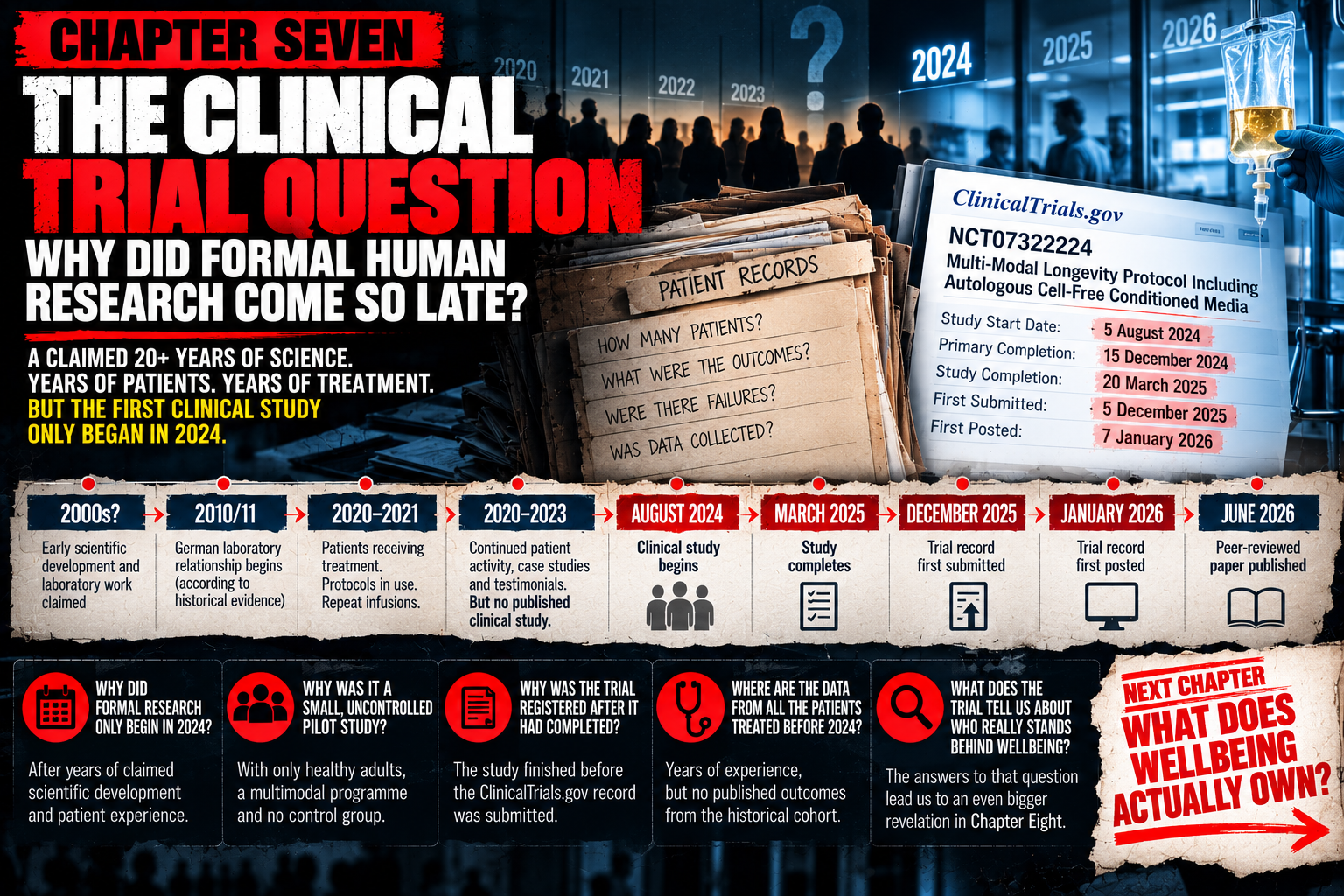
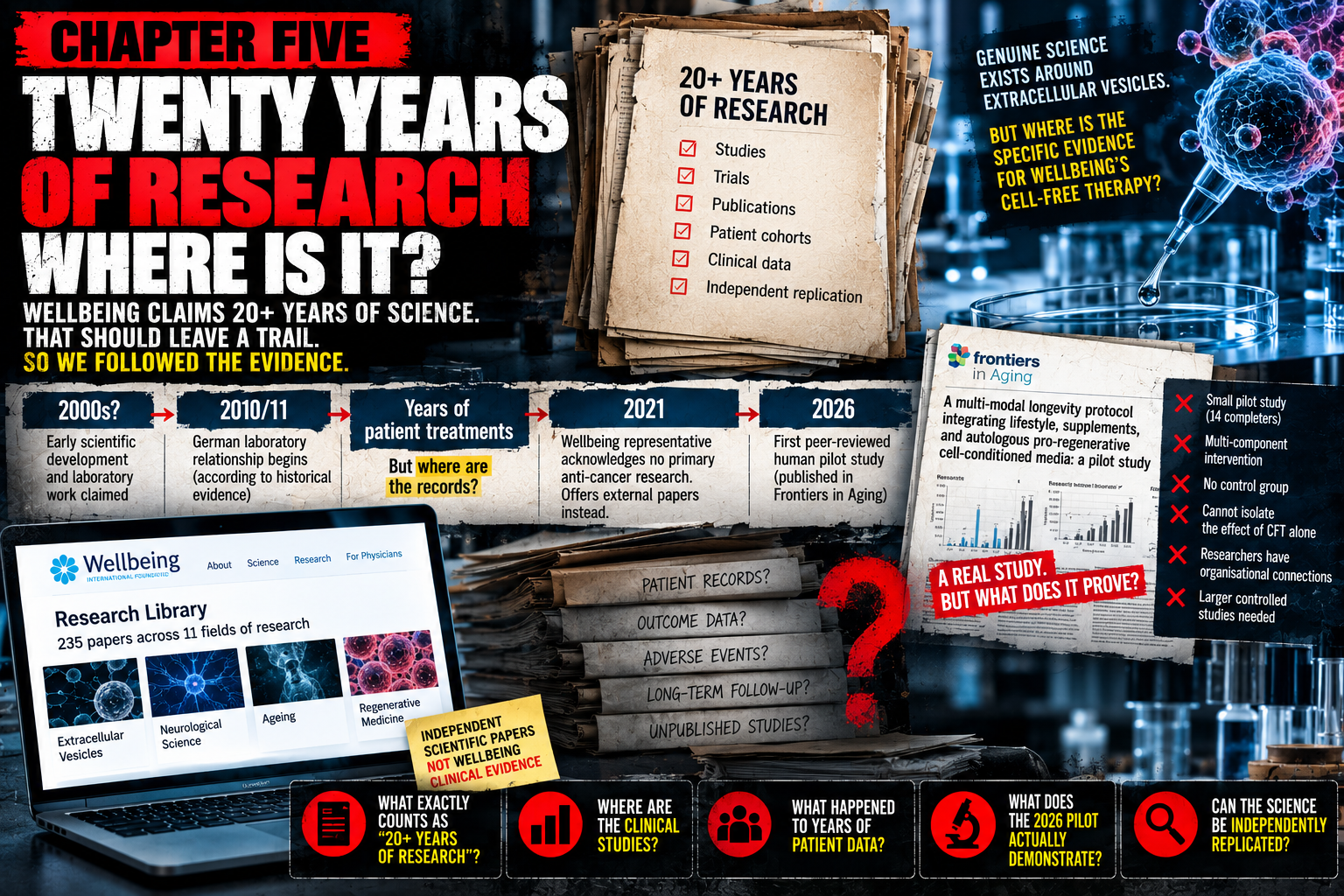
What evidence supported it at the point patients began paying for it?
And how did those early arrangements evolve into Wellbeing International Foundation?
Those questions take us beyond biographies.
They take us into corporate records, patent databases and historical documents.
Conclusion: Where Science Became a Commercial Proposition
There is nothing unusual about a scientist working with a businessman.
In fact, biotechnology depends upon exactly that partnership.
Scientific discoveries rarely reach patients without capital, management, regulatory expertise and commercial organisation.
But that relationship deserves scrutiny when the resulting intervention is sold to patients for substantial sums while its clinical evidence remains developing.
Stephen Ray appears to provide the scientific foundation of the Wellbeing story.
Andrew Chancellor appears to have provided much of the commercial machinery.
And Chancellor himself acknowledges that their early conversations became discussions about commercialising the research.
That gives us the next investigative target.
Not the marketing.
Not the testimonials.
Not even the treatment.
The intellectual property.
Because patents do something biographies cannot.
They leave dates.
They leave names.
They leave owners.
And they leave a documentary trail.
If the scientific technology behind Cell-Free Therapy passed through Natural Biosciences SA or other companies before reaching Wellbeing, that trail may allow us to reconstruct exactly how the science became the business.
And perhaps, finally, determine who actually owns what patients are being sold today.
Next: Chapter Five — Follow the Patents
Stephen Ray is credited with decades of cell-therapy research. Now we search the patent record: what did he actually invent, who owned the intellectual property, and how did it reach Wellbeing International Foundation?
Recent Posts