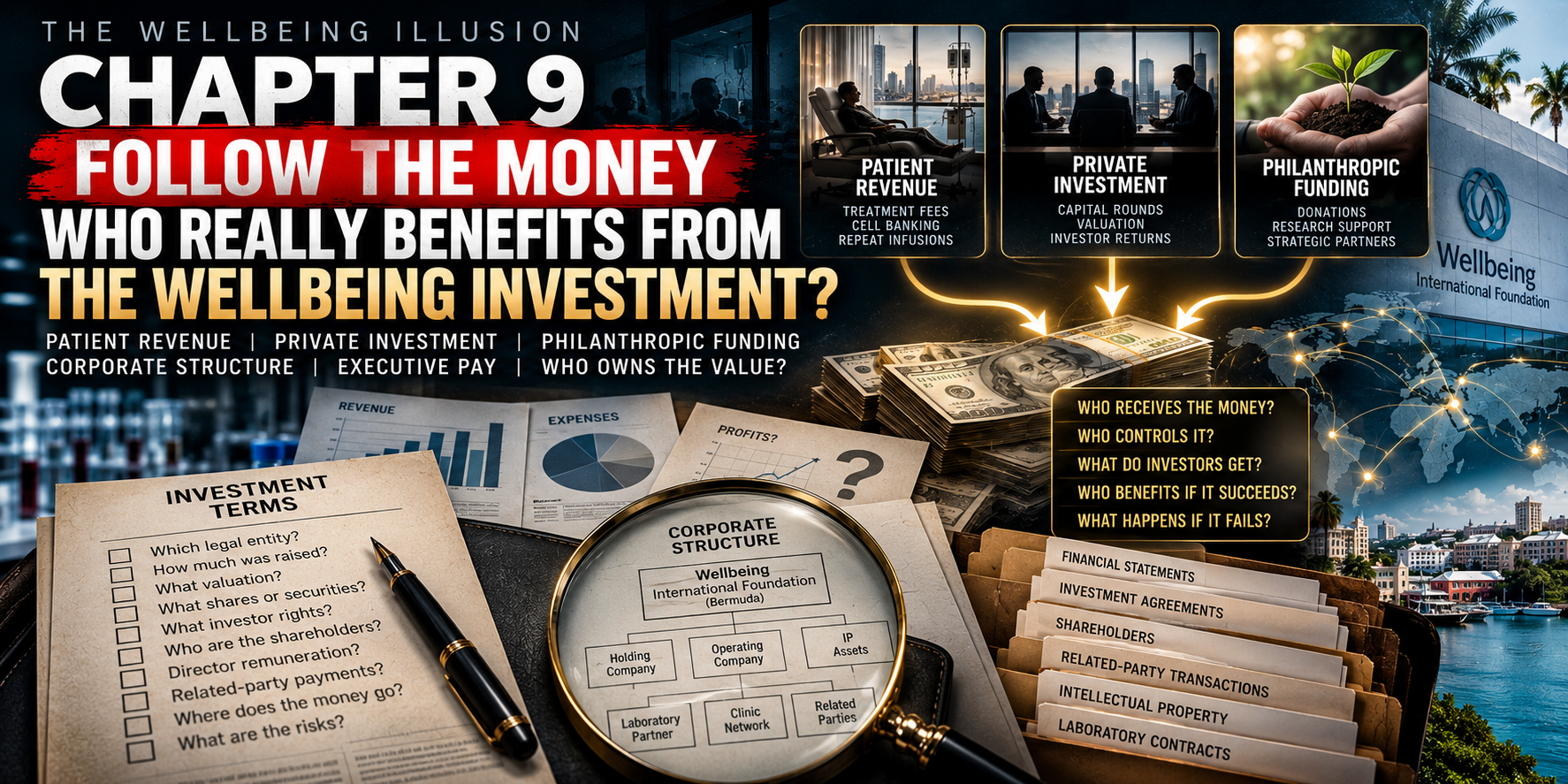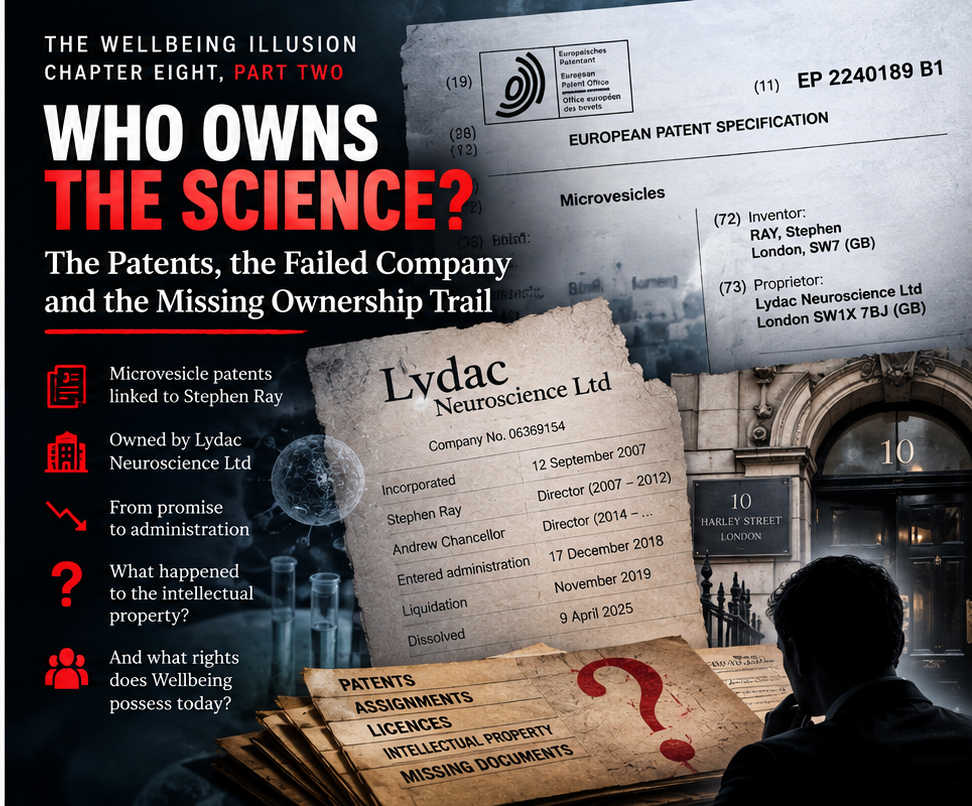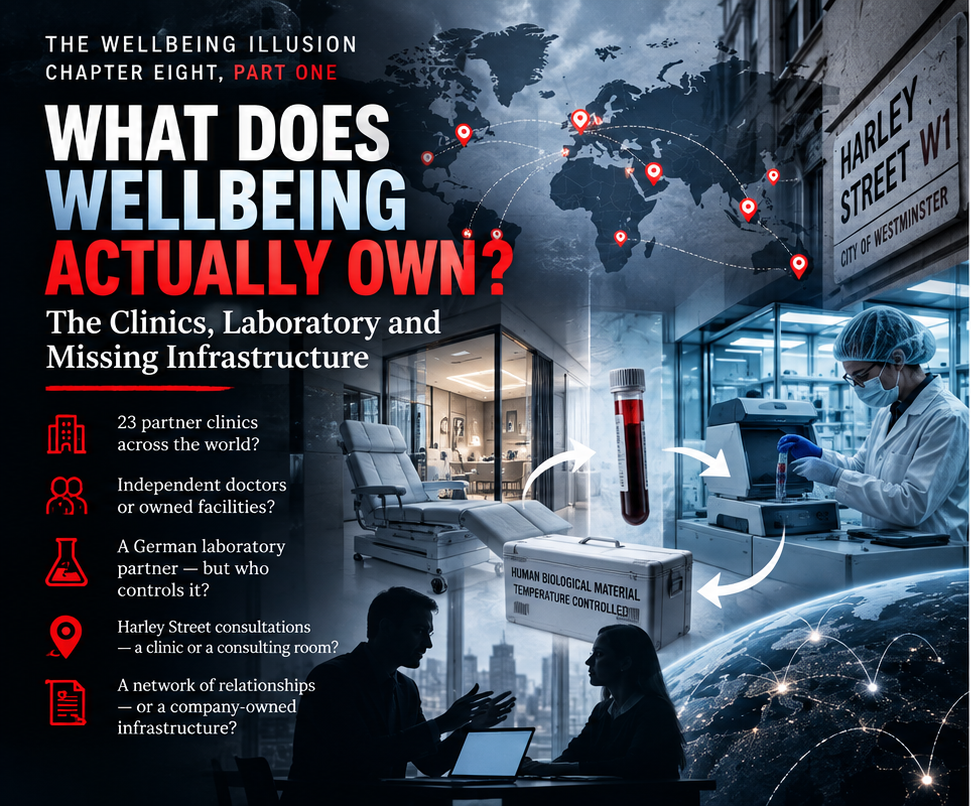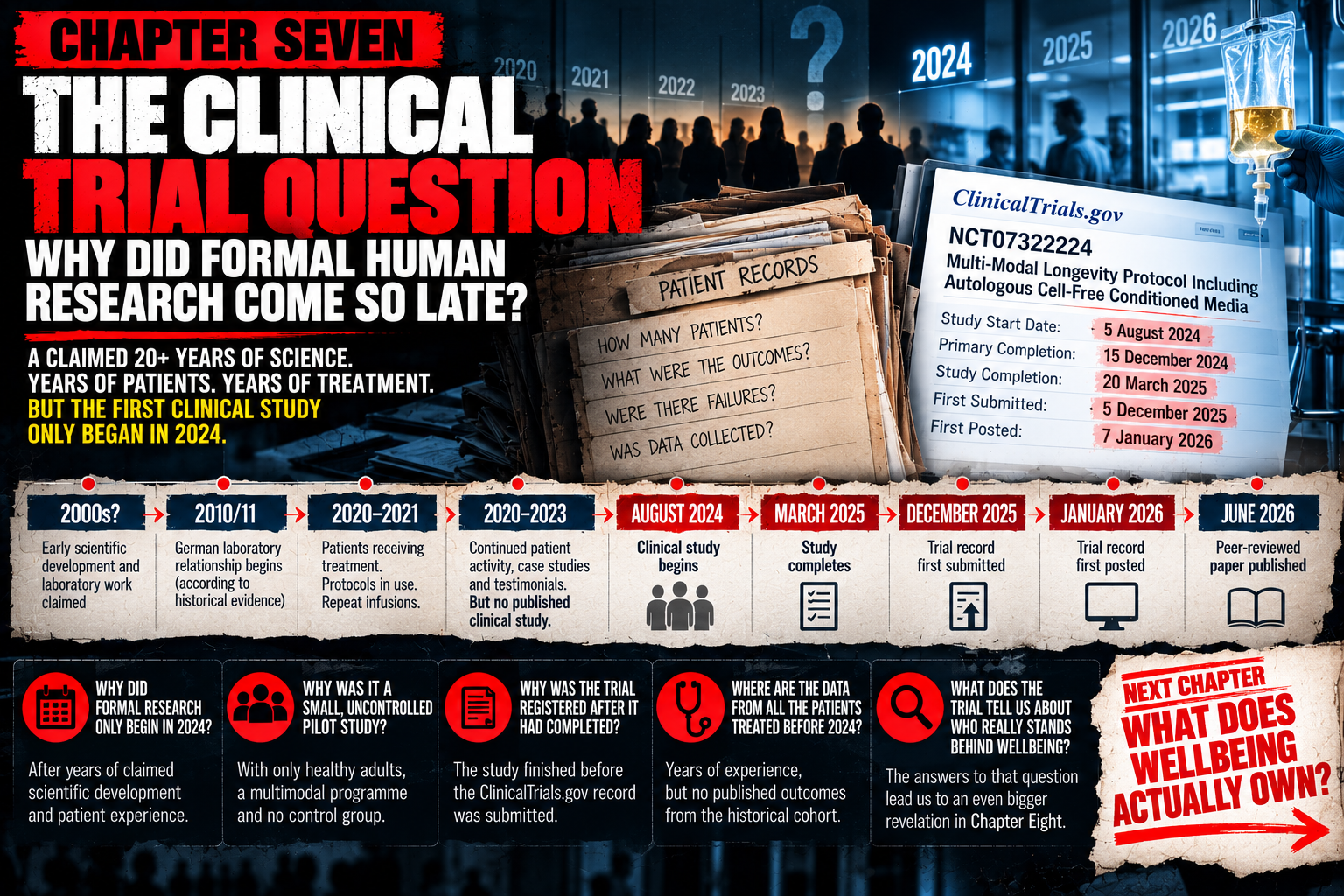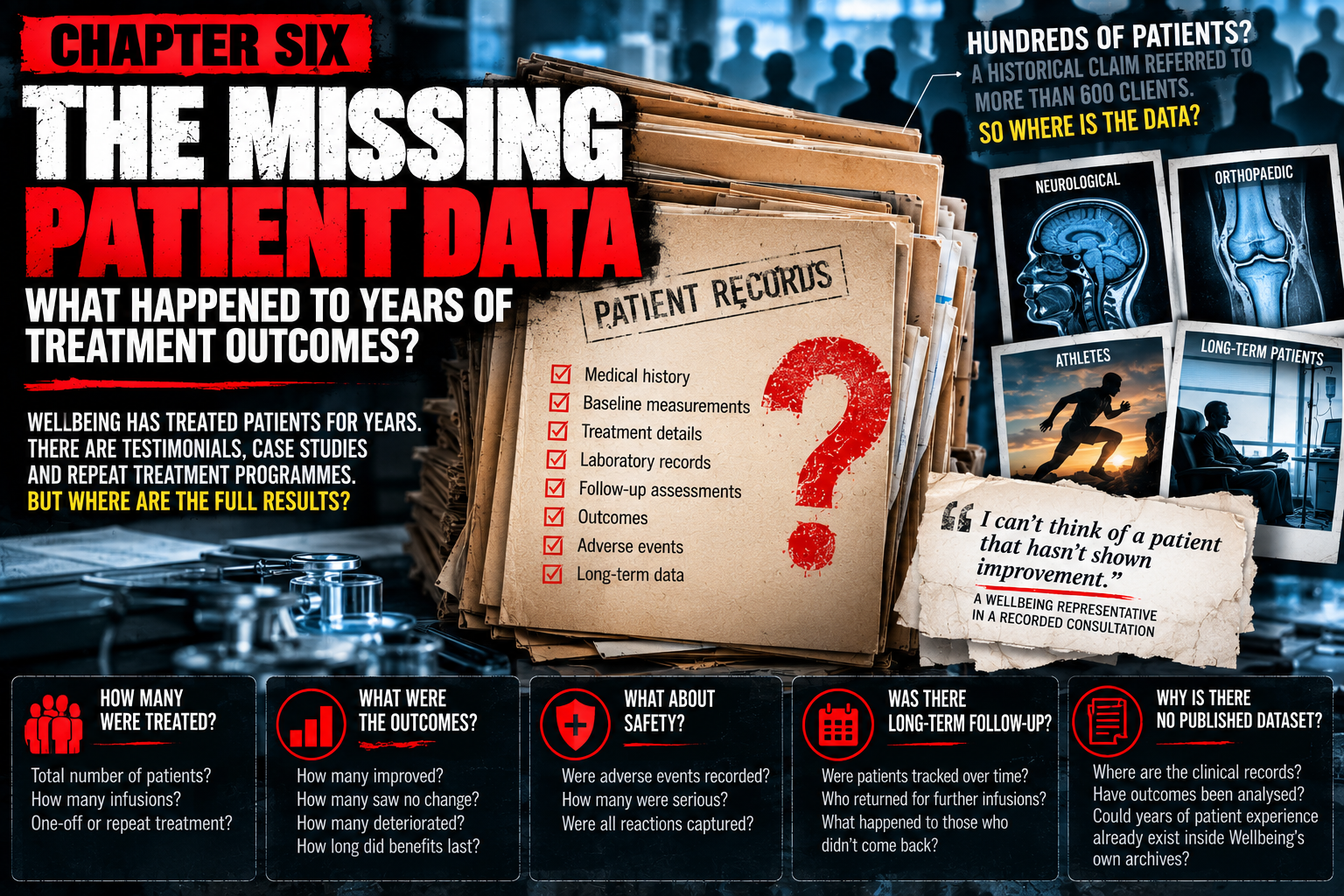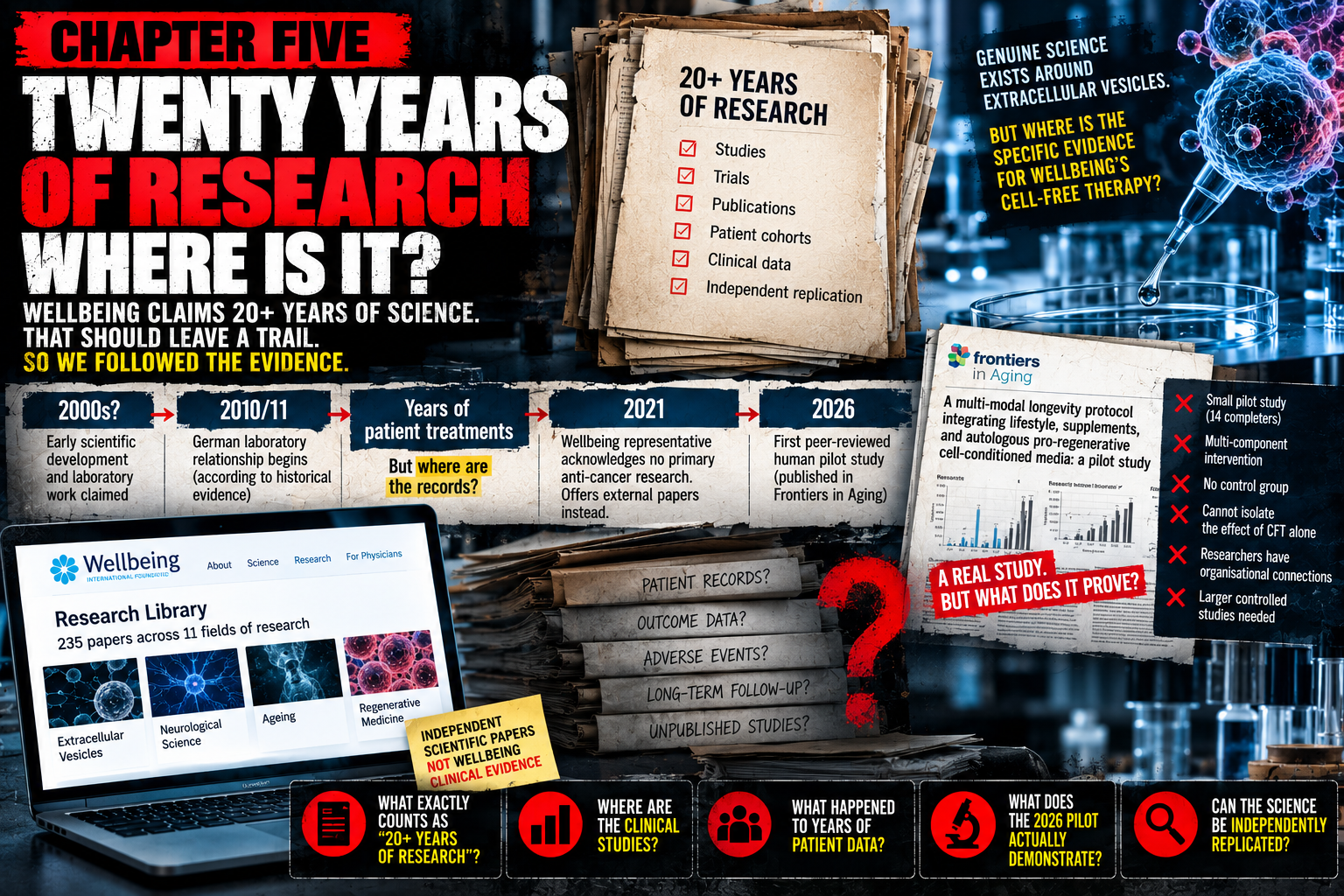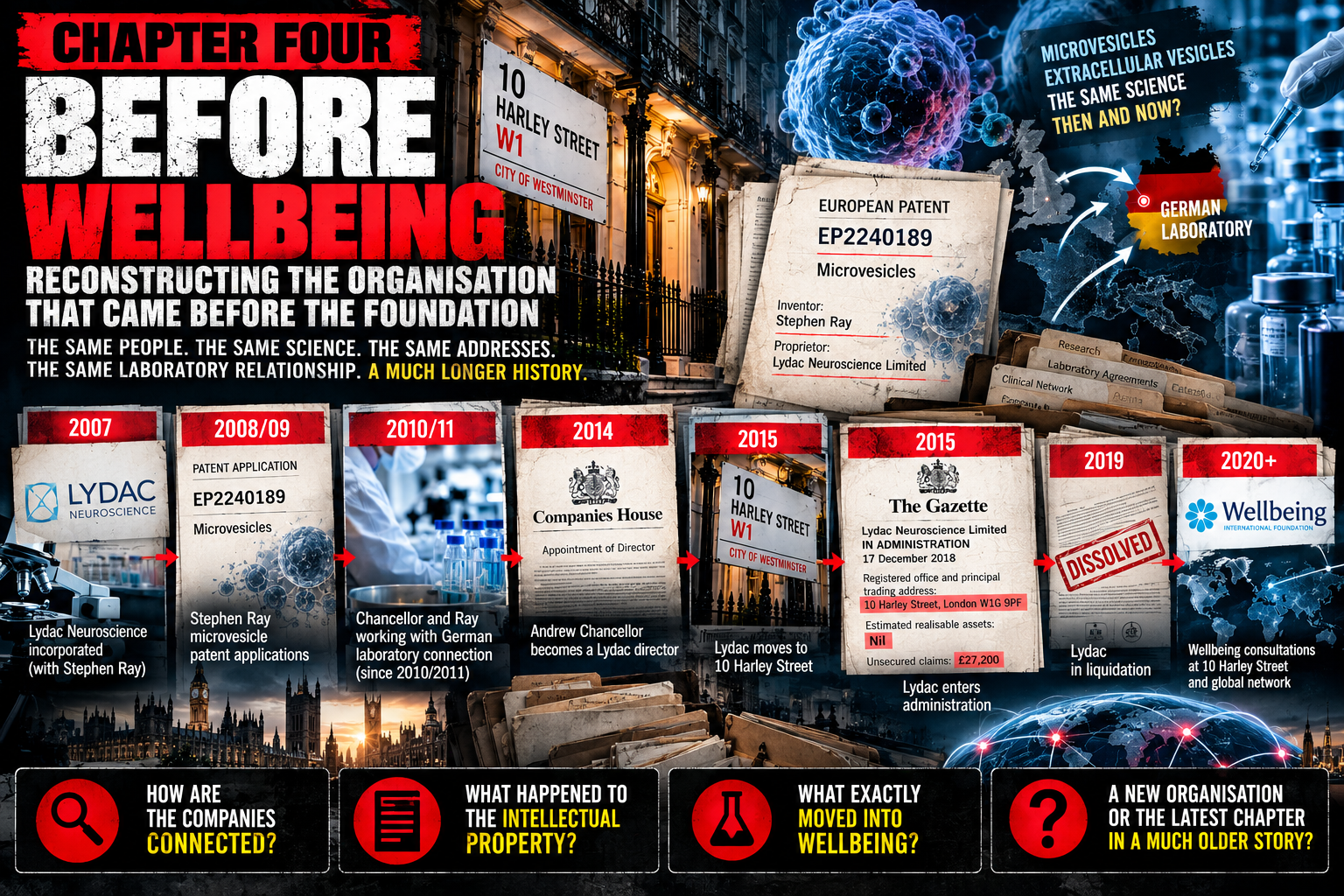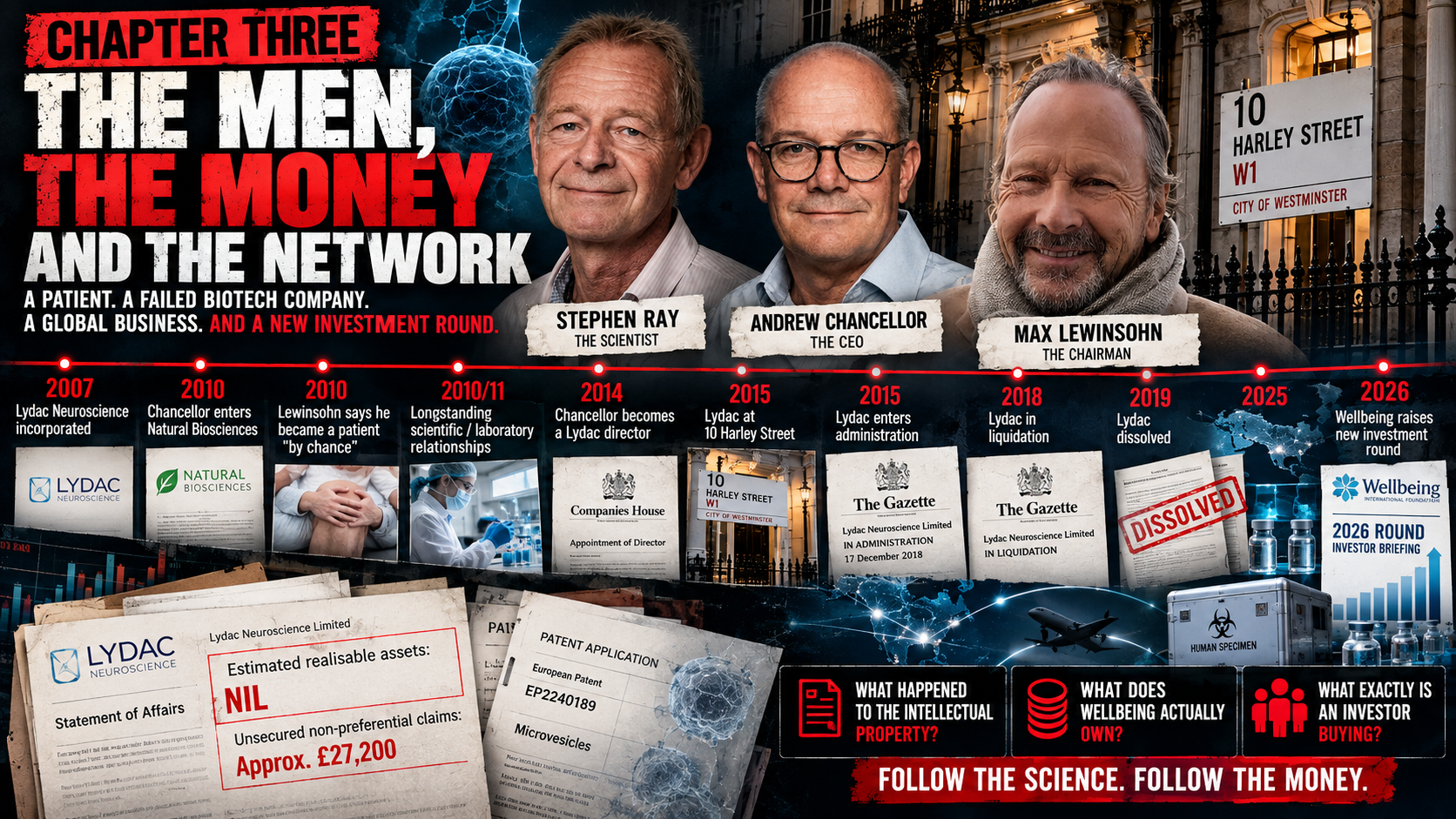
The Men Behind Wellbeing — Chapter Three
Following Andrew Chancellor’s Corporate Trail: From Recruitment to Regenerative Medicine
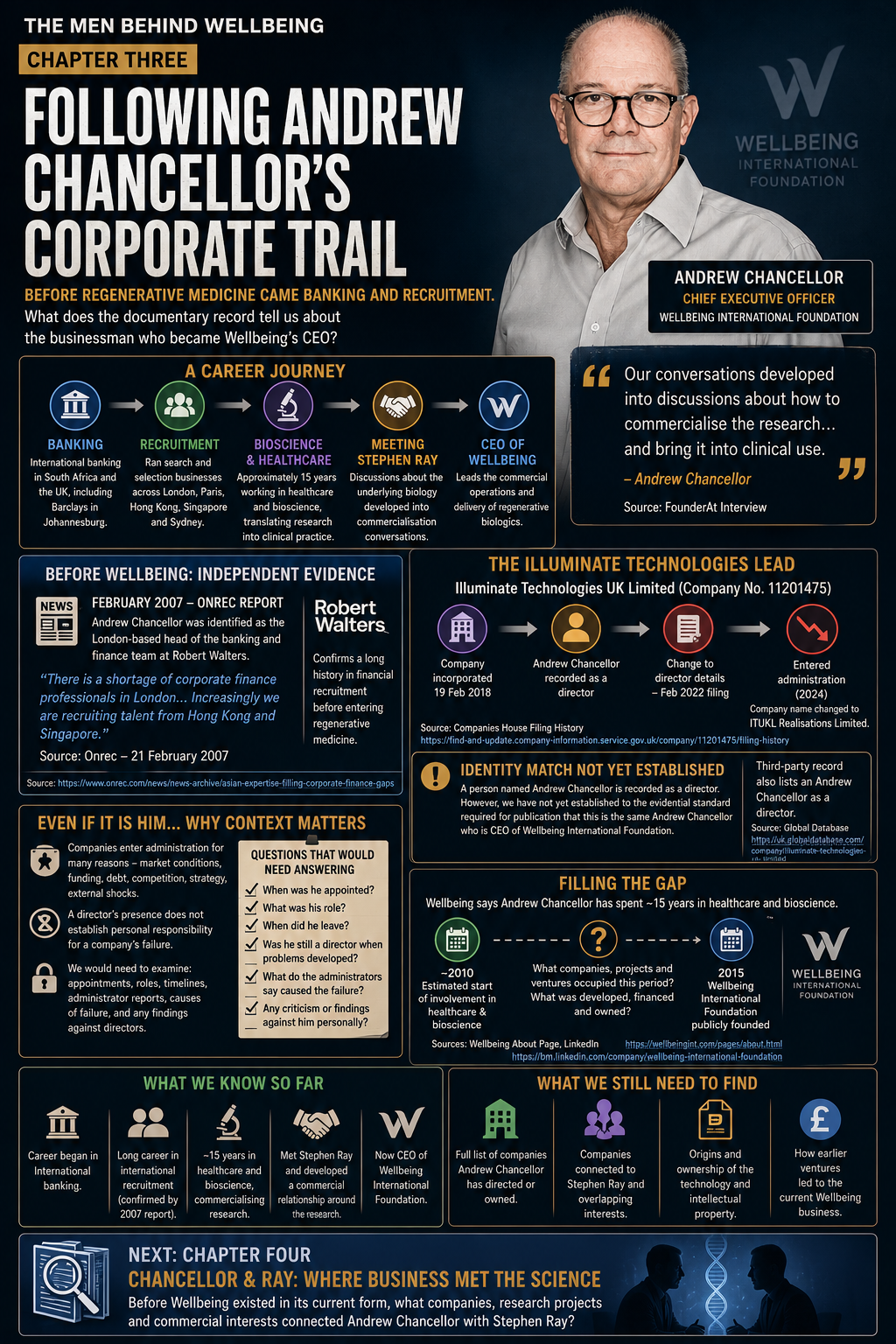
Andrew Chancellor’s public biography tells us where he started and where he is today. But what happened in between? This chapter begins following the corporate trail behind the CEO of Wellbeing International Foundation.
By Steven
When investigating the people behind an organisation, biographies can only take you so far.
They tell you what somebody wants the public to know.
They provide the highlights.
They simplify decades of professional history into a few paragraphs.
But they rarely tell you everything.
That is why, after examining Andrew Chancellor's involvement in the patient journey, I wanted to go backwards.
Before Cell-Free Therapy.
Before Wellbeing International Foundation.
Before regenerative medicine.
Who was Andrew Chancellor?
And what does the documentary record tell us about the businessman who eventually became CEO of an organisation operating in experimental and emerging biological medicine?
The answer begins somewhere considerably more conventional.
Financial recruitment.
Andrew Chancellor Before Wellbeing International Foundation
Wellbeing's current biography describes Chancellor as having built a career in banking and recruitment across Europe and Asia before moving into bioscience alongside Stephen Ray.
Today, Wellbeing identifies him simply as its Chief Executive Officer, responsible for the organisation's commercial strategy. (Wellbeing International Foundation)
Wellbeing International Foundation — About and Leadership
That account can be independently tested.
And when we go back almost a quarter of a century, Andrew Chancellor begins appearing in the financial recruitment press.
In 2004, eFinancialCareers identified an Andrew Chancellor as Managing Director of the Financial and Professional Services Division at Robert Walters, discussing recruitment within corporate finance. (eFinancialCareers)
By January 2005, the same publication described Chancellor as Managing Director of Financial Services at Robert Walters, commenting on salaries and bonuses within London's corporate-finance market. (eFinancialCareers)
Then, in February 2007, recruitment publication Onrec identified Andrew Chancellor as the London-based head of the banking and finance team at Robert Walters. (Onrec)
Onrec — Asian Expertise Filling Corporate Finance Gaps, February 2007
This gives us something valuable.
Independent contemporary evidence supports an important part of Chancellor's stated professional history.
Before regenerative medicine, he was a senior figure within financial recruitment.
A Career Built in Business, Not Medicine
There is nothing sinister about this history.
Quite the opposite.
The documentary evidence suggests Chancellor had achieved senior positions within a major international recruitment company.
But it reinforces the distinction established in the earlier chapters.
His professional foundations were in business and recruitment, not medicine.
The evidence I have found does not show an early career treating patients.
It doesn't show medical-school training.
It doesn't show a career in clinical research.
Instead, it shows somebody working at a senior level within the commercial world.
That distinction becomes important when we examine what happened next.
Because eventually Andrew Chancellor met Stephen Ray.
And Chancellor's professional direction changed dramatically.
The Meeting With Stephen Ray
Chancellor has publicly described meeting Stephen Ray as the moment that ultimately brought him into bioscience.
In a recent interview, he described Ray as the researcher behind Wellbeing's science and explained that the two came from very different professional backgrounds.
What began as discussions about the underlying biology eventually became discussions about how to commercialise the research and build an organisation capable of bringing it into clinical use. (Founder@)
FounderAt — Andrew Chancellor on the Origins of Wellbeing
This is one of the most important statements I have found in Chancellor's own account.
Because it provides the bridge.
Science met business.
Ray apparently brought the scientific research.
Chancellor brought commercial experience.
And the discussion became not simply:
Does this science work?
But:
How do we commercialise it?
There is nothing inherently improper about commercialising scientific research.
Virtually every pharmaceutical and biotechnology company ultimately has to answer exactly that question.
But once commercialisation begins, another series of questions follows.
Who owns the technology?
Who owns the intellectual property?
Which companies were established?
Who invested?
Who became directors?
Where was the research conducted?
And how did those early commercial arrangements eventually evolve into today's Wellbeing International Foundation?
That is the corporate trail we now need to reconstruct.
Wellbeing’s Own History Confirms the Transition
Interestingly, Wellbeing's own historical material describes Chancellor's arrival in remarkably similar terms.
The organisation says Chancellor joined the work following a career that had moved through banking and international recruitment.
According to Wellbeing, he became interested in whether the active biology associated with cells could be extracted and reliably reproduced as a therapeutic preparation. (Wellbeing International Foundation)
Wellbeing — Its Account of the Organisation's Research Heritage
That account is useful because it again places Chancellor's arrival after the underlying scientific work had begun.
He appears in the story as the businessman entering an existing scientific field.
This is consistent with his own description of meeting Ray.
When Did Andrew Chancellor Enter Bioscience?
This is where the timeline becomes interesting.
Wellbeing's public LinkedIn profile states that the organisation was founded in 2015. (LinkedIn)
Wellbeing International Foundation — LinkedIn Company Profile
However, recent public biographies of Chancellor describe him as having nearly a decade in bioscience leadership. (Acquisition International)
Other Wellbeing material describes his involvement in healthcare and bioscience over a longer period.
This does not necessarily represent a contradiction. Organisations evolve, corporate structures change, and scientific projects can exist for years before a particular company is created.
But it leaves an important period that needs to be reconstructed.
What exactly existed before Wellbeing?
The Missing Corporate Bridge
We know where Chancellor was in the mid-2000s.
Financial recruitment.
We know where he is today.
CEO of Wellbeing International Foundation.
And we know that somewhere between those points he met Stephen Ray and became involved in commercialising biological research.
What remains considerably less obvious is the corporate bridge between those worlds.
Which businesses was Chancellor involved with during that transition?
Which were biotechnology companies?
Which involved Stephen Ray?
Who owned them?
Who financed them?
Were investors brought in?
Did those companies own intellectual property?
Did that intellectual property subsequently move?
Were companies dissolved or replaced?
Were new corporate structures established in different jurisdictions?
Those questions matter because today's Wellbeing organisation did not simply appear from nowhere.
There must be a commercial history behind it.
Then a Companies House Record Appeared
During the investigation, one particular UK corporate record attracted my attention.
Companies House contains a company originally called Illuminate Technologies UK Limited, company number 11201475.
The company is now called ITUKL Realisations Limited.
Its filing history contains a February 2022 entry explicitly referring to:
“Director's details changed for Mr Andrew Chancellor.” (Company Information Service)
UK Companies House — ITUKL Realisations Limited Filing History
The company subsequently entered administration.
Its Companies House record contains administrator documentation and continuing insolvency-related filings. (Company Information Service)
At first sight, this looked potentially significant.
An Andrew Chancellor.
A directorship.
A technology company.
And a company that later entered administration.
But this is exactly where an investigation can go badly wrong.
The Andrew Chancellor Identity Problem
There are multiple people named Andrew Chancellor.
A search for the name produces businessmen, academics, doctors and scientists.
LinkedIn search results alone show numerous individuals with that name, including a medically qualified Andrew Chancellor in New Zealand and an Andrew Chancellor with a PhD associated with biomedical research. (LinkedIn)
That creates a serious evidential problem.
A matching name is not proof of identity.
I cannot responsibly state that the Andrew Chancellor recorded as a director of Illuminate Technologies UK Limited is Wellbeing's Andrew Chancellor unless that connection can be independently established.
A date of birth could establish it.
An address could establish it.
A CV could establish it.
Another corporate filing could establish it.
An archived biography could establish it.
But the name alone cannot.
For that reason, the Illuminate record currently remains:
IDENTITY MATCH NOT YET ESTABLISHED.
That distinction is important.
Why Publish an Unconfirmed Lead?
Because this investigation is also intended to demonstrate how evidence should be handled.
It would be extremely easy to write:
“Andrew Chancellor was director of a technology company that went into administration.”
It would certainly make a dramatic headline.
But without proving that the director is the same Andrew Chancellor, it could also be completely wrong.
Investigative journalism cannot work that way.
First find the evidence.
Then authenticate it.
Then attempt to disprove your own theory.
Only after that should you publish the conclusion.
So Illuminate remains a lead.
Not a finding.
Even a Confirmed Directorship Would Not Prove Responsibility
There is another equally important safeguard.
Suppose we eventually prove that Wellbeing's Andrew Chancellor was indeed a director of Illuminate.
That still would not establish that he caused the company's insolvency.
Businesses fail for countless reasons.
Funding disappears.
Customers leave.
Markets change.
Technology fails.
Investors withdraw.
Management strategies fail.
Economic circumstances intervene.
The correct questions would then become:
When was Chancellor appointed?
What position did he hold?
When did he leave?
Was he still involved when the financial problems developed?
What did the administrators identify as the causes of failure?
Were any directors criticised?
Were transactions challenged?
Did administrators allege misconduct?
Was Chancellor personally criticised?
Only those documents could establish the significance—if any—of his involvement.
The Public Andrew Chancellor Profile Is Growing
Something else has happened recently.
Chancellor's public media profile has expanded.
In 2026, articles carrying his byline have appeared in business publications discussing international expansion, leadership and healthcare management.
Acquisition International describes him as CEO of Wellbeing International Foundation and specifically references his career across banking, international executive recruitment and bioscience leadership. (Acquisition International)
Acquisition International — Andrew Chancellor on Global Expansion
EU Business News provides essentially the same career description. (EU Business News)
EU Business News — Andrew Chancellor on Human-Centred Growth
This consistency is useful.
It strengthens the broad outline of his professional history.
But it still doesn't fill the missing corporate years.
Chancellor Is Now Telling His Own Story
There is another development worth noting.
Chancellor now has his own author profile on Vocal.
The biography describes him primarily as a figure in international recruitment and executive search.
Among the pieces published under his name is one titled:
“From Banking to Bioscience: The Unlikely Evolution of Andrew Chancellor.”
Another discusses Wellbeing's history and sports-related treatment claims. (Vocal)
Andrew Chancellor's Vocal Author Profile
Again, this is useful material.
But it is important to distinguish self-published or promotional biography from independent evidence.
Chancellor's own account tells us how he describes his history.
Contemporary recruitment reports tell us what can independently be established.
Companies House tells us which corporate appointments can be proven.
Court and insolvency records tell us what happened when businesses encountered problems.
Those different types of evidence should never be treated as interchangeable.
The Corporate Investigation Now Changes Direction
At this stage, we have established something quite clearly.
Andrew Chancellor did not emerge from a traditional medical career.
He emerged from the commercial world.
Contemporary reporting places him in senior financial recruitment roles at Robert Walters during the 2000s. (eFinancialCareers)
His own account says that meeting Stephen Ray ultimately led to discussions about commercialising scientific research. (Founder@)
Wellbeing's own history broadly confirms that transition. (Wellbeing International Foundation)
And today Chancellor leads the organisation's commercial strategy. (Wellbeing International Foundation)
The beginning and the end of the story are therefore relatively clear.
The middle is not.
The Questions We Need to Answer Next
The next stage is no longer about Andrew Chancellor's CV.
It is about the businesses surrounding the science.
Which companies first connected Chancellor and Stephen Ray?
Who owned those companies?
Where did their money come from?
What intellectual property did they control?
Which laboratories were involved?
Which investors participated?
What happened to those businesses?
And most importantly:
How did the science being discussed between Chancellor and Ray become the commercial Cell-Free Therapy operation being promoted today?
That is where the corporate history becomes relevant to the medical investigation.
Conclusion: Follow the Companies, Not the Biography
Andrew Chancellor's move from recruitment into biotechnology is not evidence of wrongdoing.
Nor is commercialising scientific research inherently suspicious.
Biotechnology exists because scientists, entrepreneurs and investors work together to turn discoveries into products.
But when an organisation eventually asks patients to spend substantial sums on an emerging biological intervention, understanding the commercial history behind that organisation becomes legitimate due diligence.
Who developed the science?
Who financed it?
Who owned it?
Who commercialised it?
Which companies came before the current organisation?
And what happened to them?
Those questions cannot be answered by a polished executive biography.
They require documents.
Corporate filings.
Historical records.
Accounts.
Directorships.
Shareholdings.
And where appropriate, insolvency and court records.
That is precisely where this investigation now goes.
Because somewhere between Andrew Chancellor the financial recruiter and Andrew Chancellor the CEO of a regenerative-medicine organisation lies the story we still need to uncover.
And the next person standing directly in the middle of that story is:
Stephen Ray.
Next: Chapter Four — Chancellor & Ray: Where Business Met the Science
What happened when a businessman specialising in finance and recruitment met the scientist behind Wellbeing's biological research—and which companies, intellectual property and commercial relationships came out of that partnership?
Recent Posts