THE MEN BEHIND WELLBEING — Chapter Two
The Gatekeeper
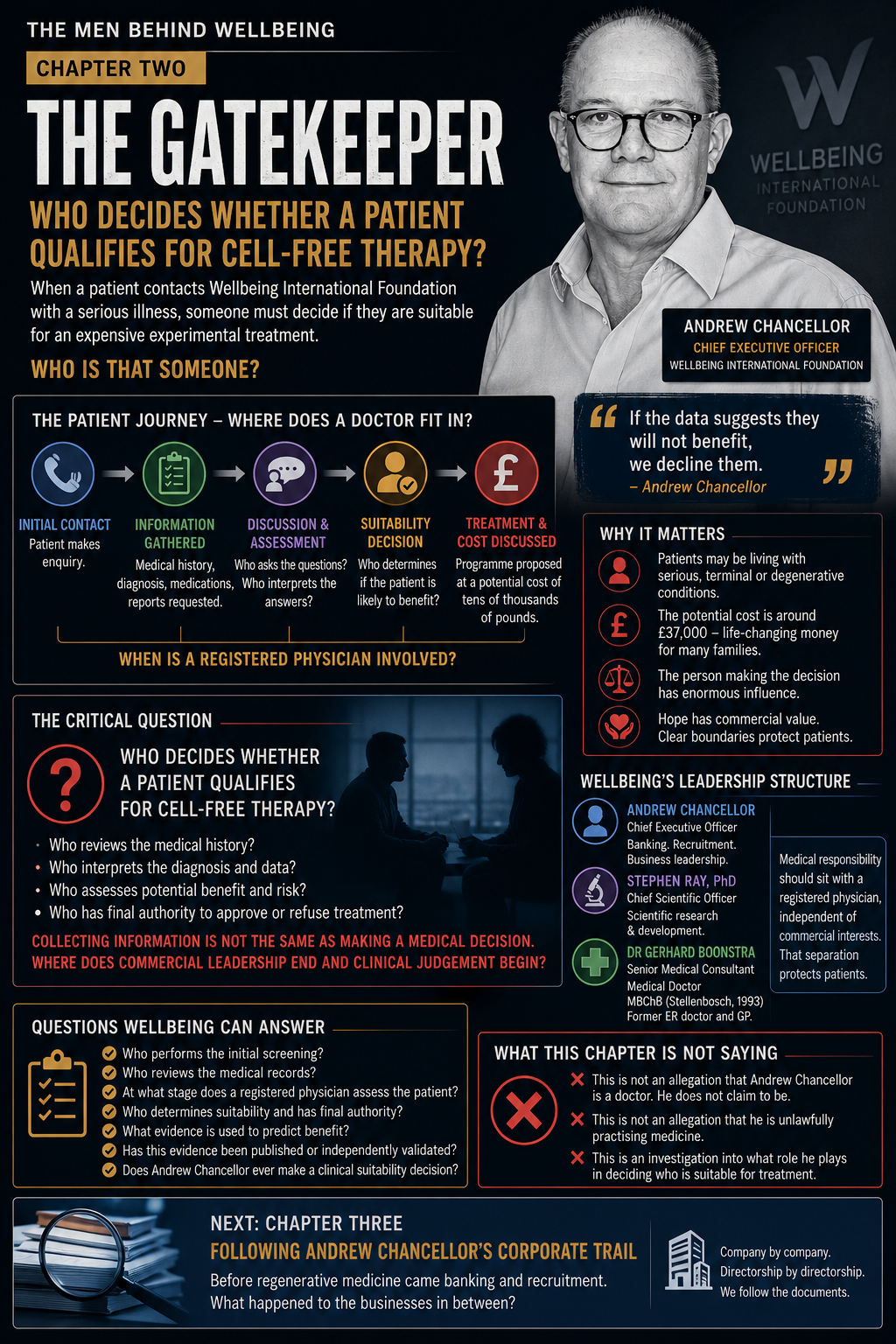
An investigation into Andrew Chancellor, Wellbeing International Foundation and the question of who actually determines whether a prospective patient is suitable for Cell-Free Therapy.
There is a moment when every discussion about regenerative medicine stops being theoretical.
A real patient makes contact.
They may be frightened. They may be living with a chronic or degenerative condition. They may have exhausted conventional treatment options. Or they may simply be searching for something that could improve their quality of life.
And they ask the question that matters most:
Can this treatment help me?
For an organisation such as Wellbeing International Foundation, the answer to that question carries considerable responsibility.
Cell-Free Therapy isn't simply an interesting scientific concept. It is something being offered to paying patients.
During the prospective-patient enquiry examined as part of this investigation, the potential cost reached approximately £37,000.
So before somebody commits that kind of money, another question becomes extremely important:
Who decides whether they are suitable for treatment?
That question takes us directly back to Wellbeing's Chief Executive Officer, Andrew Chancellor.
Wellbeing Says It Selects Its Patients
Andrew Chancellor has publicly explained that Wellbeing does not simply accept everyone who approaches the organisation.
In an interview discussing the company's philosophy and patient selection, Chancellor said:
“If the data suggests they will not benefit, we decline them.”
Read the Andrew Chancellor interview at FounderAt
At first glance, this sounds reassuring.
An organisation offering an expensive emerging biological intervention should not accept someone simply because they can afford it. If the treatment is unsuitable, the responsible answer should be no.
But Chancellor's statement immediately raises another question:
Who exactly is “we”?
Who Reviews the Patient Data?
If Wellbeing is capable of deciding that a prospective patient is unlikely to benefit, somebody must presumably evaluate information about that patient.
What information?
Medical records? Diagnosis? Blood tests? Medication? Previous treatments? Age? Disease progression? Biological markers?
And then somebody has to interpret that information.
That is where the distinction between administration and medicine becomes important.
A patient coordinator can collect medical records. An administrator can arrange an appointment. A commercial representative can explain prices and logistics. A CEO can explain the organisation's technology.
But determining whether a particular person is medically suitable for an intervention is something different.
So who makes that decision at Wellbeing?
Andrew Chancellor's Role at Wellbeing International Foundation
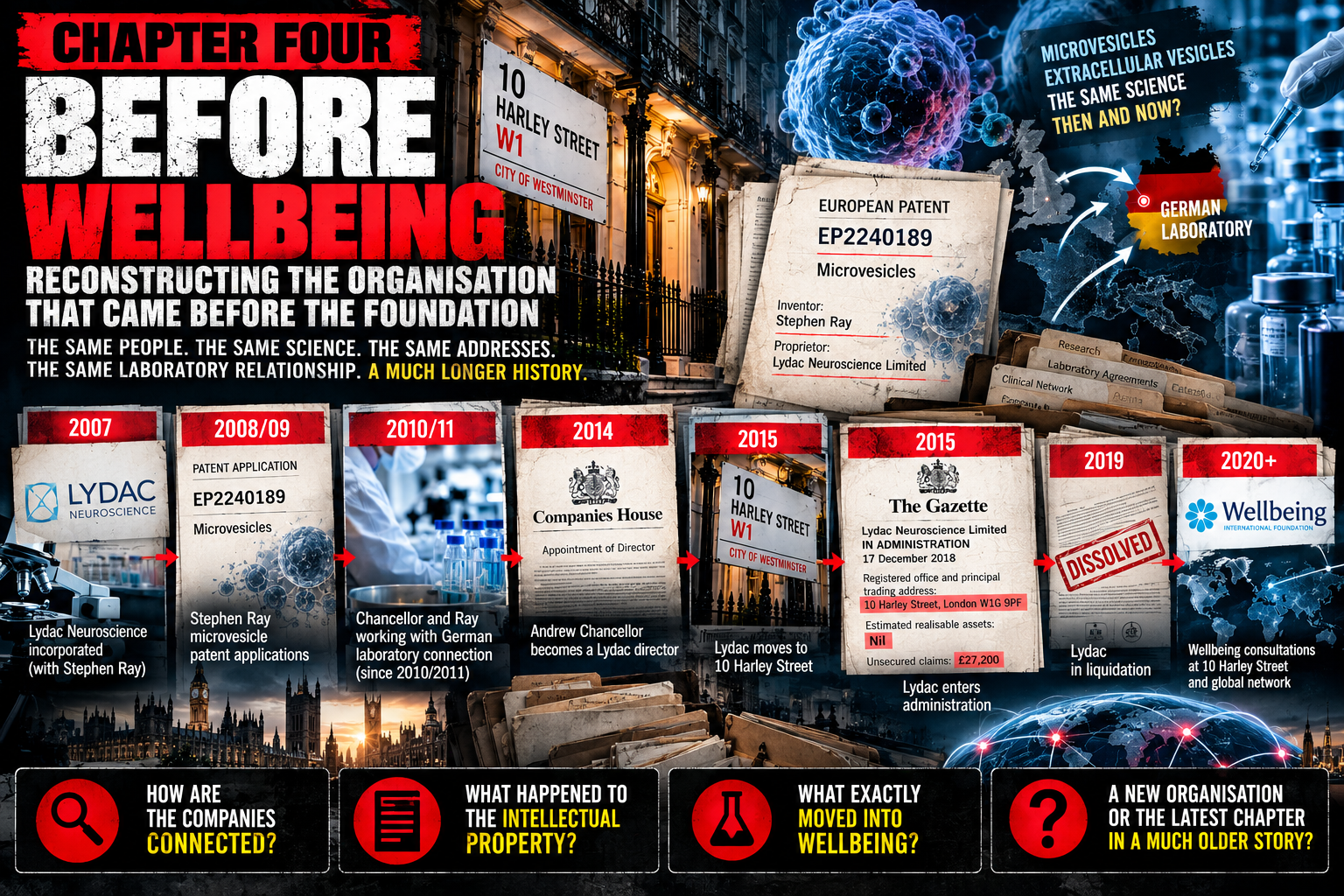
As established in Chapter One, Wellbeing does not publicly identify Andrew Chancellor as a physician.
Its own biography describes a career beginning in international banking before moving into recruitment and, considerably later, healthcare and bioscience.
Wellbeing International Foundation — Leadership biographies
Wellbeing identifies Chancellor as its Chief Executive Officer.
It separately identifies Stephen Ray as its senior scientific figure.
And importantly, it separately identifies Dr Gerhard Boonstra as its senior medical consultant.
Wellbeing states that Boonstra obtained his medical degree from Stellenbosch University before working in emergency medicine and general practice.
Wellbeing International Foundation — About the team
That appears to establish a sensible division of responsibility:
Chancellor — commercial leadership.
Ray — science.
Boonstra — medicine.
But the patient journey raises the question of how clearly those divisions operate in practice.
Patient Screening Is Not the Same as Clinical Assessment
This distinction is essential.
There is nothing unusual about a non-medically qualified employee speaking to patients. It happens throughout healthcare.
A receptionist may ask why you need an appointment. A patient coordinator may obtain your medical history. A private hospital employee may explain treatment costs. A clinical-trial coordinator may collect information before a physician becomes involved.
None of that makes those people doctors.
The important question is what happens next.
There is a significant difference between:
“Tell me about your medical condition so I can pass the information to our doctor.”
and:
“Based upon your medical condition, we believe this treatment could help you.”
The first is information gathering.
The second may amount to a clinical judgement depending upon exactly what is said, the context and the applicable law.
That distinction lies at the centre of this investigation.
What Happens During the Wellbeing Patient Assessment?
This investigation has examined prospective-patient communications involving Wellbeing.
Initially, I was primarily interested in what was being said about Cell-Free Therapy.
Now I am equally interested in who was saying it and at what stage of the process.
The chronology needs to be reconstructed carefully.
When the patient's medical conditions were discussed, who asked the questions?
Who received the medical information?
Who interpreted it?
Who discussed the possibility of improvement?
Who explained why Cell-Free Therapy might be appropriate?
Who determined that the patient could proceed?
And critically:
When did a registered physician first become involved?
Those questions matter considerably more than someone's job title.
Where Does Andrew Chancellor's Role End?
There is nothing inherently problematic about Chancellor speaking to prospective patients.
As CEO, he may know Wellbeing's technology extremely well.
He can explain how the organisation operates. He can discuss its research. He can explain the treatment process. He can discuss costs. He can collect information that will subsequently be assessed by a physician.
The crucial boundary is whether he personally goes further.
Does Chancellor assess an individual's medical condition?
Does he interpret their symptoms or diagnosis?
Does he express an opinion about their likelihood of benefiting?
Does he determine whether they qualify?
Does he recommend that they proceed?
If he does, on whose clinical authority is that judgement made?
Those are questions the evidence needs to answer.
Where Does the Doctor Enter the Process?
This brings us back to Dr Gerhard Boonstra.
Wellbeing's own description identifies Boonstra as a medically qualified member of its senior team.
That makes the timing of medical involvement particularly important.
Does Dr Boonstra—or another appropriately qualified physician—review every prospective patient's case?
If so, when?
Before the initial consultation?
Before suitability is discussed?
Before a price is presented?
Before money changes hands?
Or later in the treatment pathway?
These are not trivial procedural details.
They help establish whether clinical assessment drives the commercial process—or follows it.
Who Has Final Authority?
There is an extremely straightforward question Wellbeing could answer:
Who possesses final authority to approve a patient for Cell-Free Therapy?
Is it Chancellor?
Dr Boonstra?
Another physician?
A clinical committee?
A combination of scientific and medical personnel?
If Chancellor believes someone is suitable but the physician disagrees, who has the final say?
Conversely, if a physician believes the intervention is inappropriate, can anyone within the commercial organisation override that decision?
A clearly separated clinical process should make those answers straightforward.
What Does “Benefit” Actually Mean?
There is another important element within Chancellor's statement:
“If the data suggests they will not benefit, we decline them.”
What exactly does benefit mean?
Improvement in symptoms? Improved mobility? Reduced pain? Changes in blood biomarkers? Changes in biological-age algorithms? Improved quality of life?
Something else?
And what data allows Wellbeing to predict this?
If the organisation possesses a reliable method for determining which patients are likely to respond to Cell-Free Therapy, that could itself be scientifically important.
Which raises another question:
Has that predictive method been independently validated?
What Evidence Supports Patient Selection?
If patient selection is data-driven, there should presumably be evidence supporting the selection criteria.
How many previous patients contributed to the dataset?
What medical conditions were included?
How were outcomes measured?
What constituted success?
What constituted failure?
Were unsuccessful treatments included?
How accurately does the system predict response?
Has the methodology been published?
Has it been independently tested?
Without those answers, the phrase “the data suggests” sounds reassuring but tells prospective patients surprisingly little.
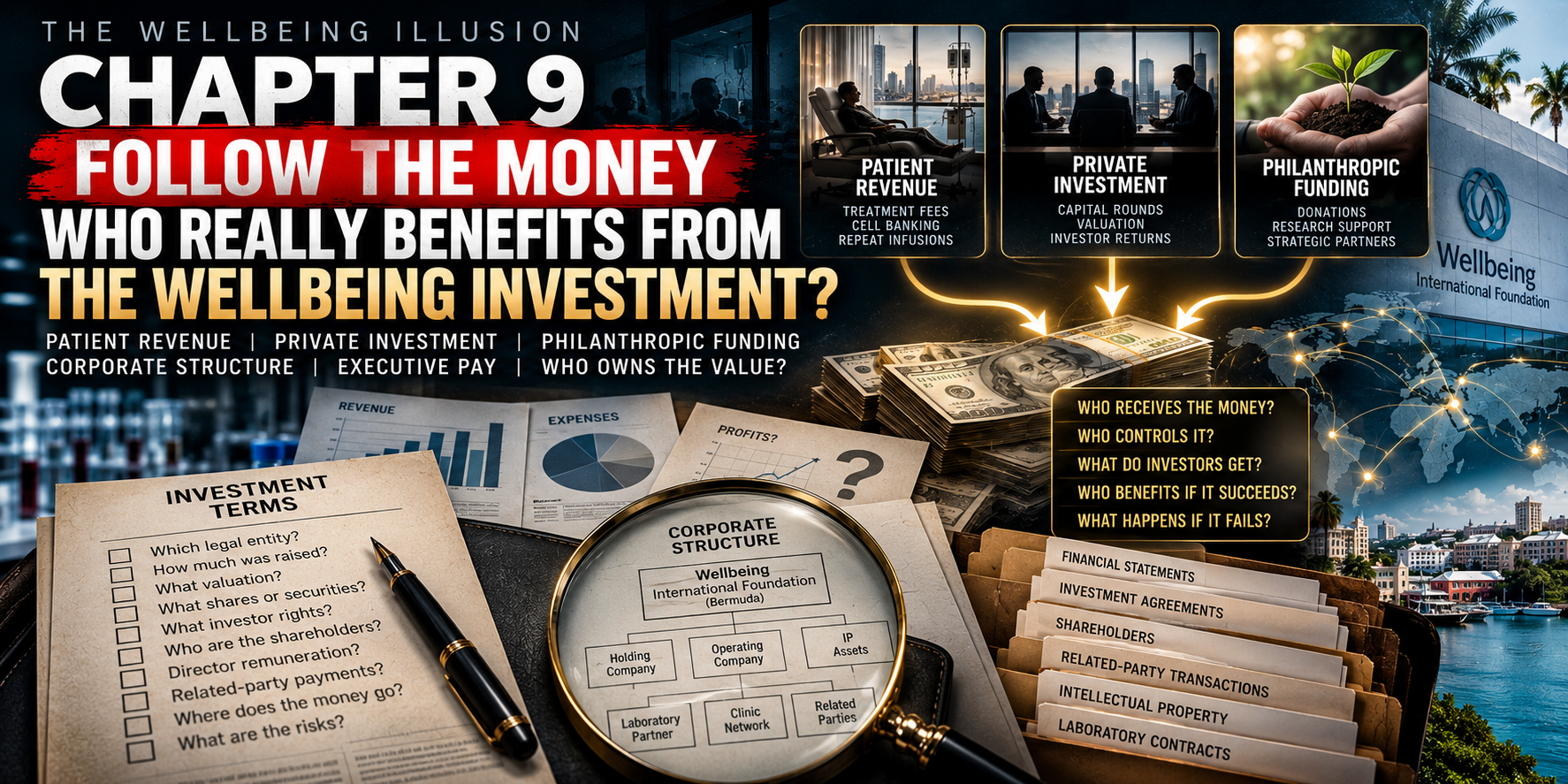
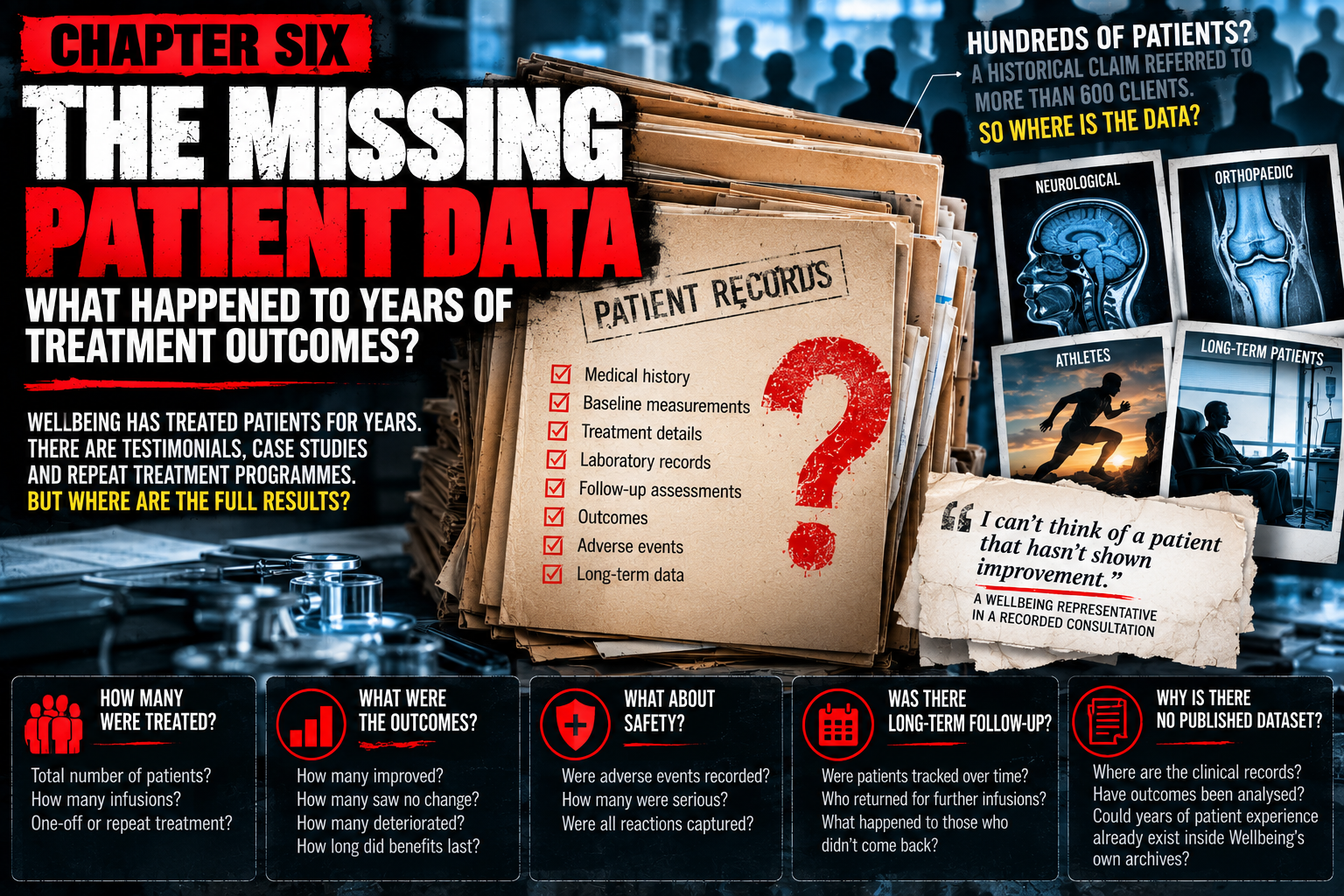
The £37,000 Cell-Free Therapy Question
The financial element makes all of this considerably more important.
During the prospective-patient enquiry examined in this investigation, a programme costing approximately £37,000 was discussed.
That requires an important qualification.
I am not claiming £37,000 is Wellbeing's universal current price. Wellbeing currently explains that programmes are personalised and pricing depends upon the treatment proposed.
The figure relates to the specific enquiry examined during this investigation.
But imagine the position of the patient.
Someone is potentially telling you that an emerging biological intervention may help you.
Then you are asked to consider spending tens of thousands of pounds.
At that moment, the authority and qualifications of the person discussing your potential benefit matter enormously.
Hope Is Not an Ordinary Product
Patients seeking emerging treatments are not necessarily ordinary consumers.
Some may be seriously ill. Some may have exhausted conventional medicine. Some may be living with chronic pain or disability. Others may simply fear the consequences of ageing.
Whatever their circumstances, they may be particularly receptive to hope.
That creates a responsibility for organisations operating in emerging medicine.
Scientific possibility must not become confused with established clinical probability.
“This mechanism is scientifically interesting” is not the same as:
“This is likely to help you.”
And the qualifications of the person explaining that difference matter.
The Commercial Conflict in Private Medicine
There is another uncomfortable reality.
The organisation deciding whether the patient is suitable may also financially benefit if that patient proceeds.
This issue is not unique to Wellbeing.
It exists throughout private medicine.
Private hospitals make money from procedures. Dentists make money from treatments. Cosmetic clinics make money from interventions. Fertility clinics make money from IVF.
One important safeguard is the separation between commercial incentives and professional clinical judgement.
A regulated clinician has professional responsibilities towards the patient.
That is why determining who actually makes Wellbeing's clinical decisions is so important.
Who Decides That the Patient Should Spend £37,000?
Earlier in this investigation I asked:
Where does the £37,000 go?
Now there is another question:
Who decides that the patient should spend it?
If that decision follows an independent assessment by an appropriately qualified physician, Wellbeing should be able to demonstrate that pathway clearly.
If the commercial discussion occurs first and the physician becomes involved considerably later, prospective patients deserve to understand that too.
Transparency would resolve much of this uncertainty.
Questions Wellbeing International Foundation Can Answer
There is a straightforward way to establish what actually happens.
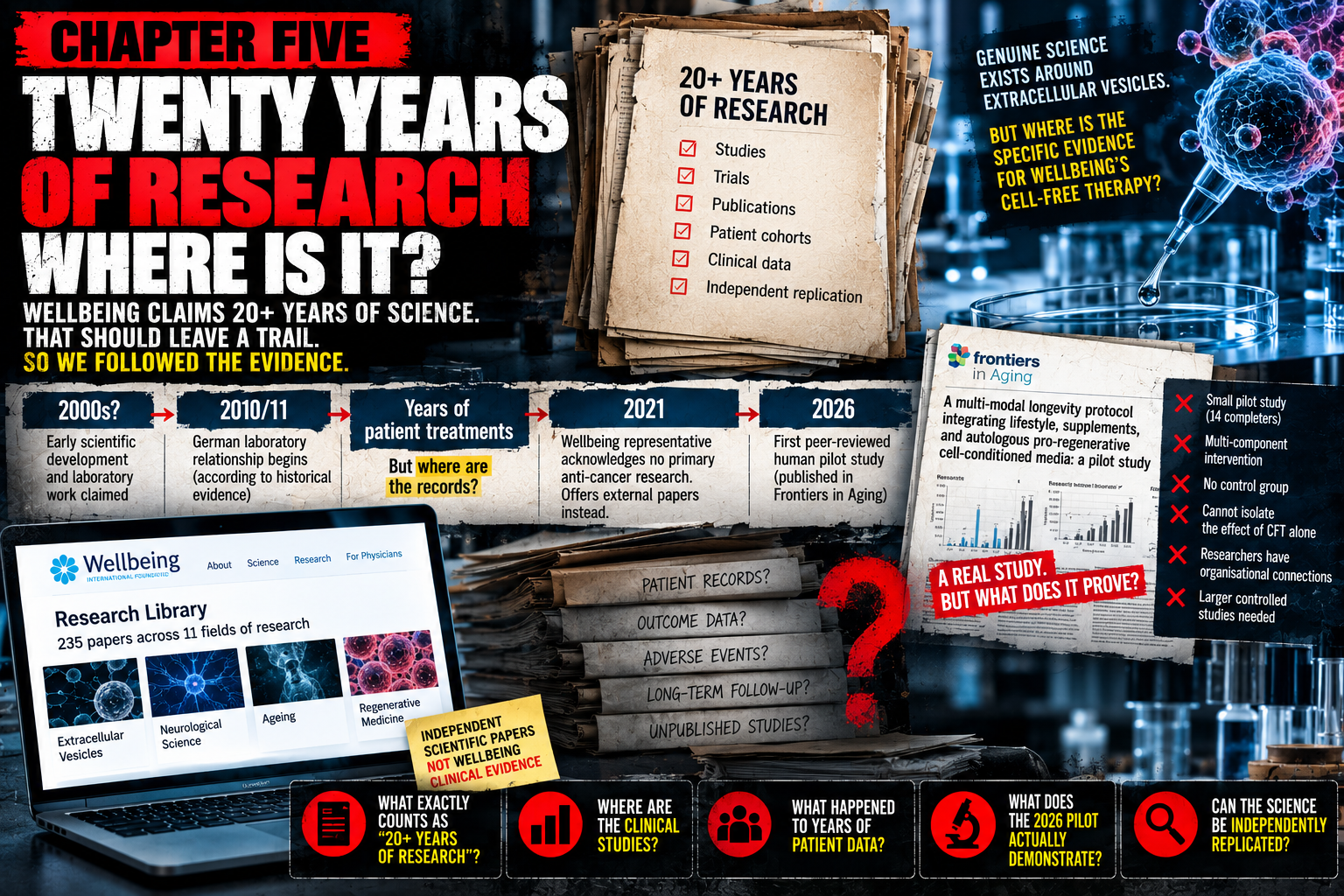
I would like Wellbeing International Foundation to explain who conducts its initial prospective-patient consultations; whether Andrew Chancellor personally collects or discusses individual medical histories; whether he expresses opinions about an individual's likelihood of benefiting from Cell-Free Therapy; whether he has authority to approve or reject patients; which registered physician performs the formal clinical assessment; and at what stage that assessment occurs.
There are further questions.
Does the medical assessment happen before treatment is recommended?
Does it happen before a price is quoted?
Who has final authority over clinical suitability?
What data is used to determine whether somebody is likely to benefit?
Has that selection methodology been independently validated?
And in which jurisdiction is the responsible physician registered?
Clear answers would substantially clarify the patient pathway.
What This Investigation Is — and Is Not — Alleging
Precision matters.
I am not alleging that Andrew Chancellor falsely represents himself as a doctor. I have found no evidence that he does.
I am not suggesting that a CEO cannot speak with patients.
And I am not presently claiming that Chancellor has unlawfully practised medicine.
That would be a legal conclusion requiring considerably more evidence. The applicable jurisdiction, precise words used, nature of any assessment and relevant regulatory definitions would all matter.
The question being investigated is narrower:
What role does Andrew Chancellor personally perform when Wellbeing determines whether an individual patient should receive Cell-Free Therapy?
Why the Patient Recording Matters
This is where evidence gathered during the investigation becomes potentially important.
A recollection can be disputed.
A summary can be interpreted differently.
A contemporaneous recording potentially provides something much more useful:
chronology and exact words.
What did the patient say?
What did Chancellor say?
Which medical conditions were discussed?
What questions were asked?
What potential benefits were discussed?
Was an opinion about suitability expressed?
When was treatment proposed?
When did price enter the conversation?
And was a physician involved before those things happened?
That evidence should be presented carefully, accurately and in context.
There is no need to tell readers what they should think.
Let the evidence show them what happened.
Conclusion: Who Is the Gatekeeper?
Andrew Chancellor does not need a medical degree to run Wellbeing International Foundation.
That has never been the issue.
The question is whether his role remains that of a chief executive when an individual patient's medical circumstances are being considered.
Because somebody inside Wellbeing acts as the gatekeeper.
Somebody ultimately decides:
Yes.
Or:
No.
Somebody determines whether the person on the other side of that conversation should proceed towards an expensive intravenous biological intervention.
Patients deserve to know who that person is.
They deserve to know that person's qualifications.
They deserve to understand the evidence being used.
And they deserve to understand any commercial interests surrounding the recommendation.
For someone contemplating spending tens of thousands of pounds in search of better health, those aren't technical questions.
They are fundamental ones.
And until the patient pathway is completely clear, one question remains at the centre of this investigation:
Who is actually making the medical decision?
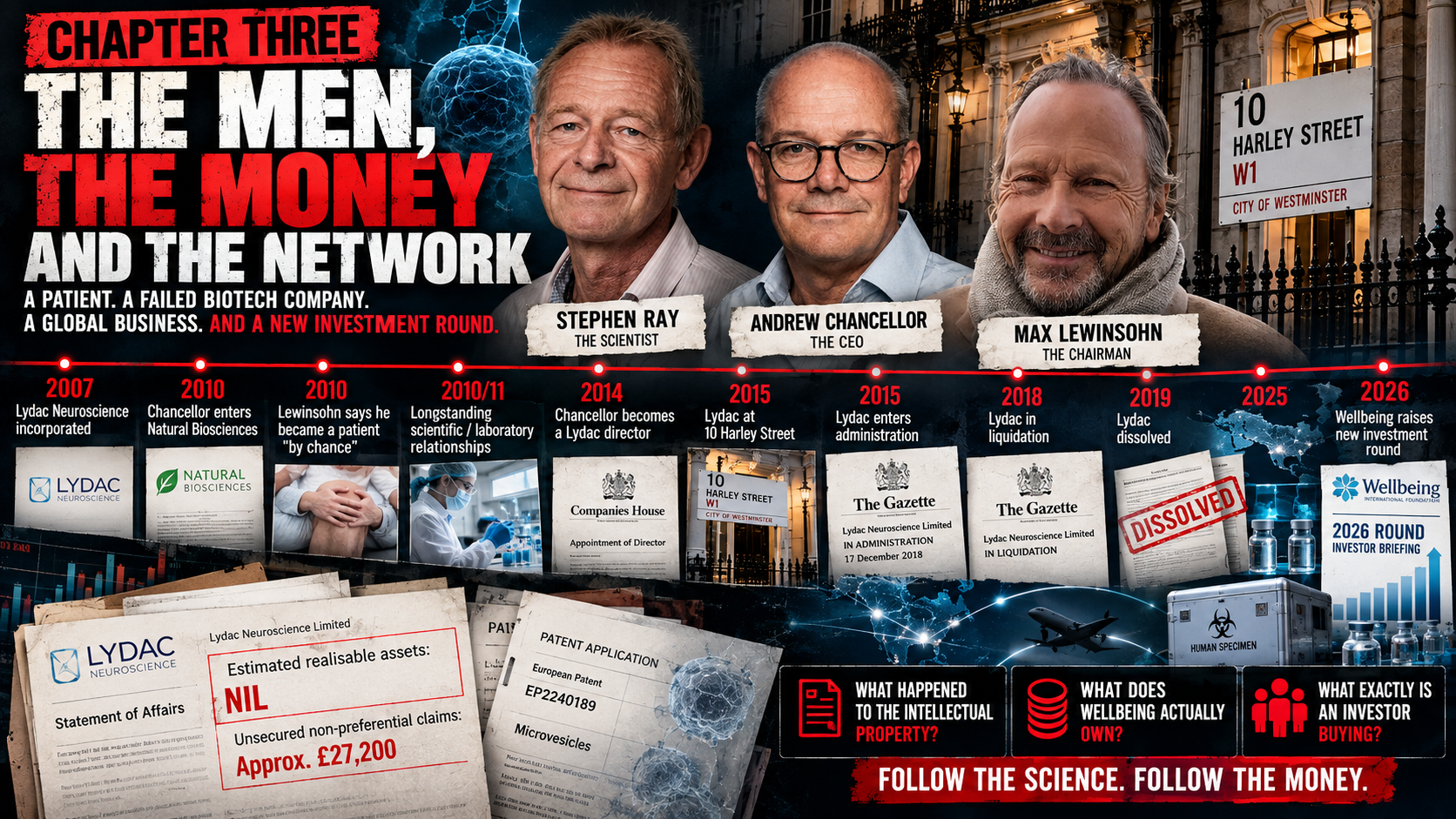
Next: Chapter Three — Following Andrew Chancellor's Corporate Trail
Before regenerative medicine came banking and recruitment. What does the documentary record tell us about the businessman who became Wellbeing's CEO?
For Chancellor's stated background and Wellbeing's leadership structure: Wellbeing International Foundation — About.
For Chancellor's comments about patient selection: FounderAt — Andrew Chancellor interview.
Recent Posts