The Patent Trail: The Failed Biotechnology Company Behind Wellbeing's Scientific History
The Wellbeing Illusion — Chapter Eight, Part Two | Alternative Edition
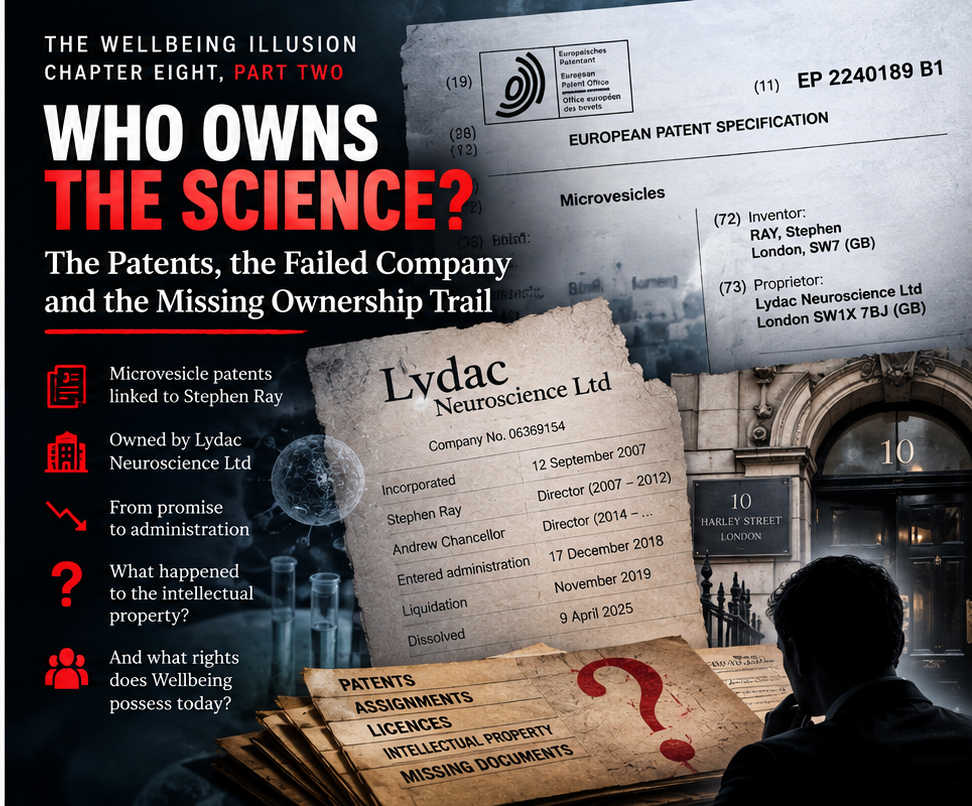
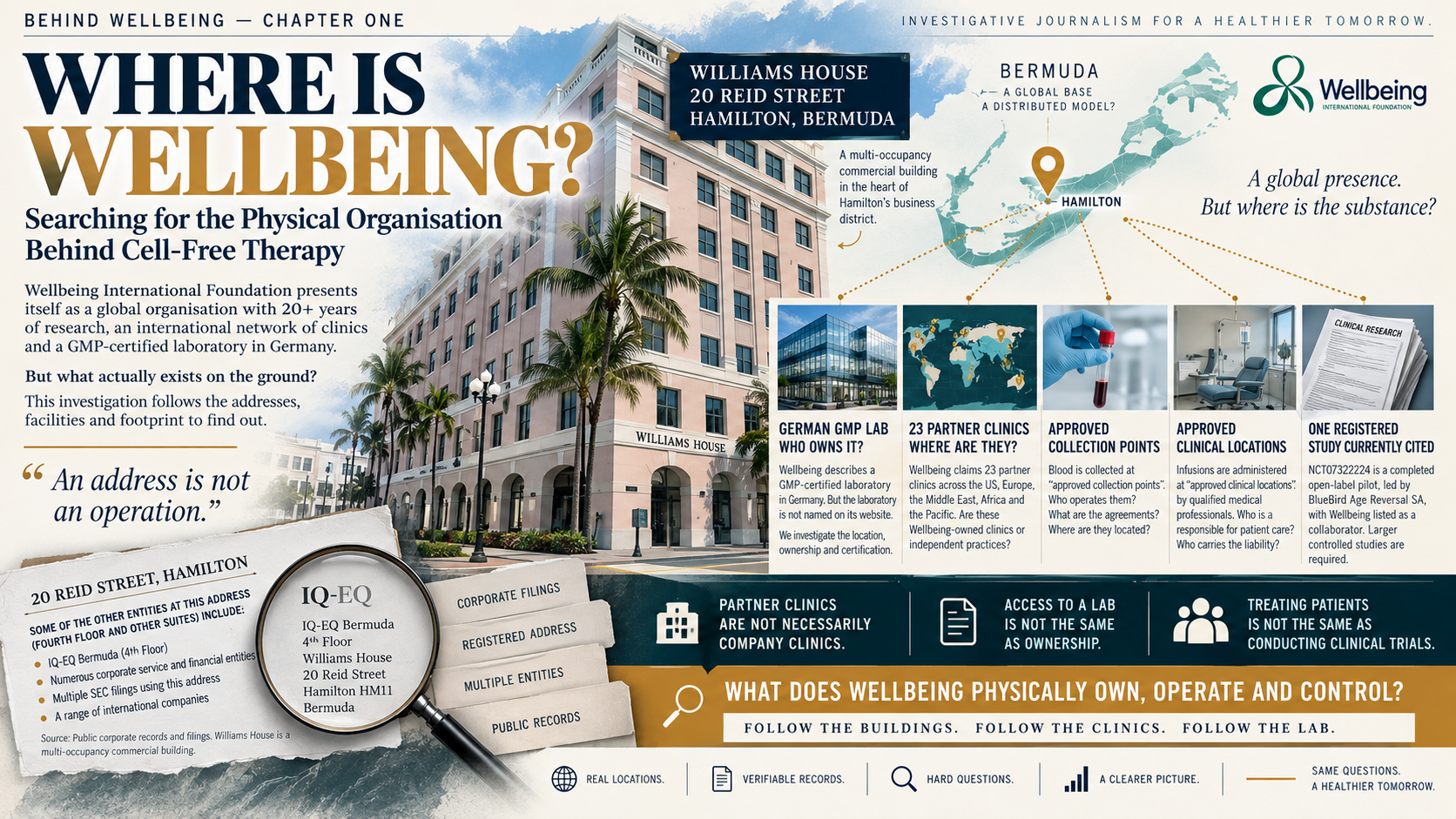
The search for Wellbeing International Foundation's physical assets led us to an unexpected conclusion.
The most important asset behind its international medical operation might not be a clinic, a laboratory or a building.
It might be something far less visible.
The legal ownership of the science.
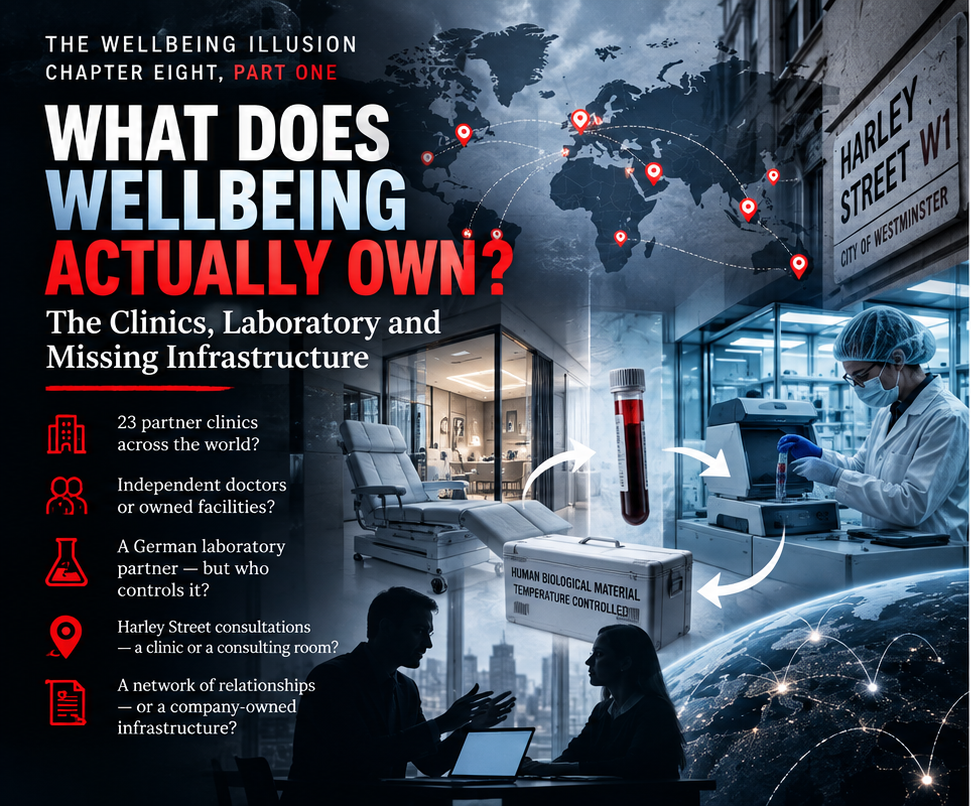
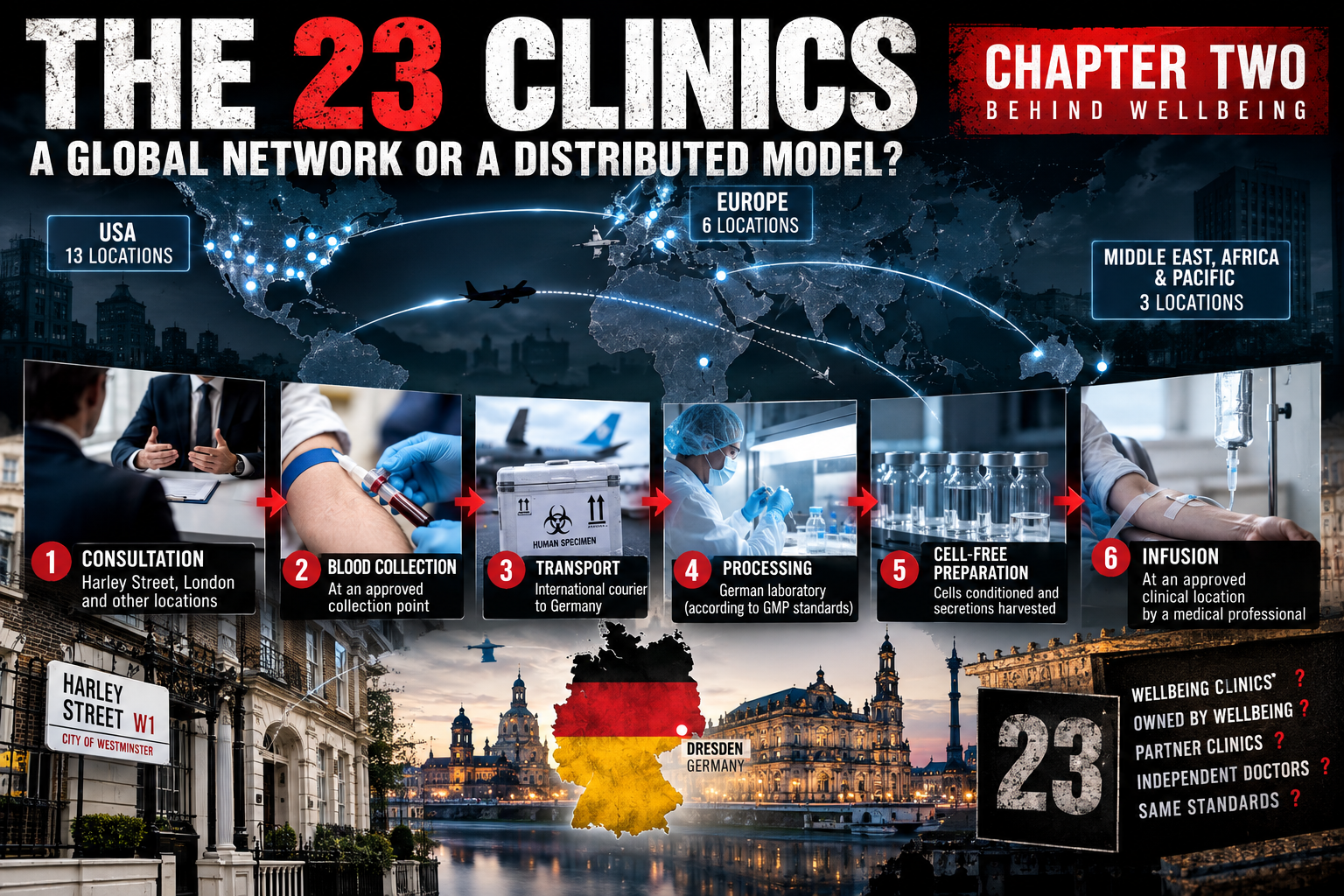
In Part One, we examined Wellbeing's international partner clinics, its German laboratory arrangements and its network of independent medical practitioners.
We found a business model that appears to depend substantially on relationships with external providers.
Such an arrangement can be entirely legitimate. Many biotechnology businesses outsource manufacturing and clinical services while retaining ownership of valuable scientific technology.
But that model creates an essential question.
If the clinics are partners and the laboratory is a partner, what proprietary technology does the central organisation actually control?
To investigate, we turned away from medical facilities and began examining patent records, company registrations, historical directorships and insolvency documents.
The records led us to a British biotechnology company whose name rarely features in the public story surrounding Wellbeing International Foundation.
Lydac Neuroscience Ltd.
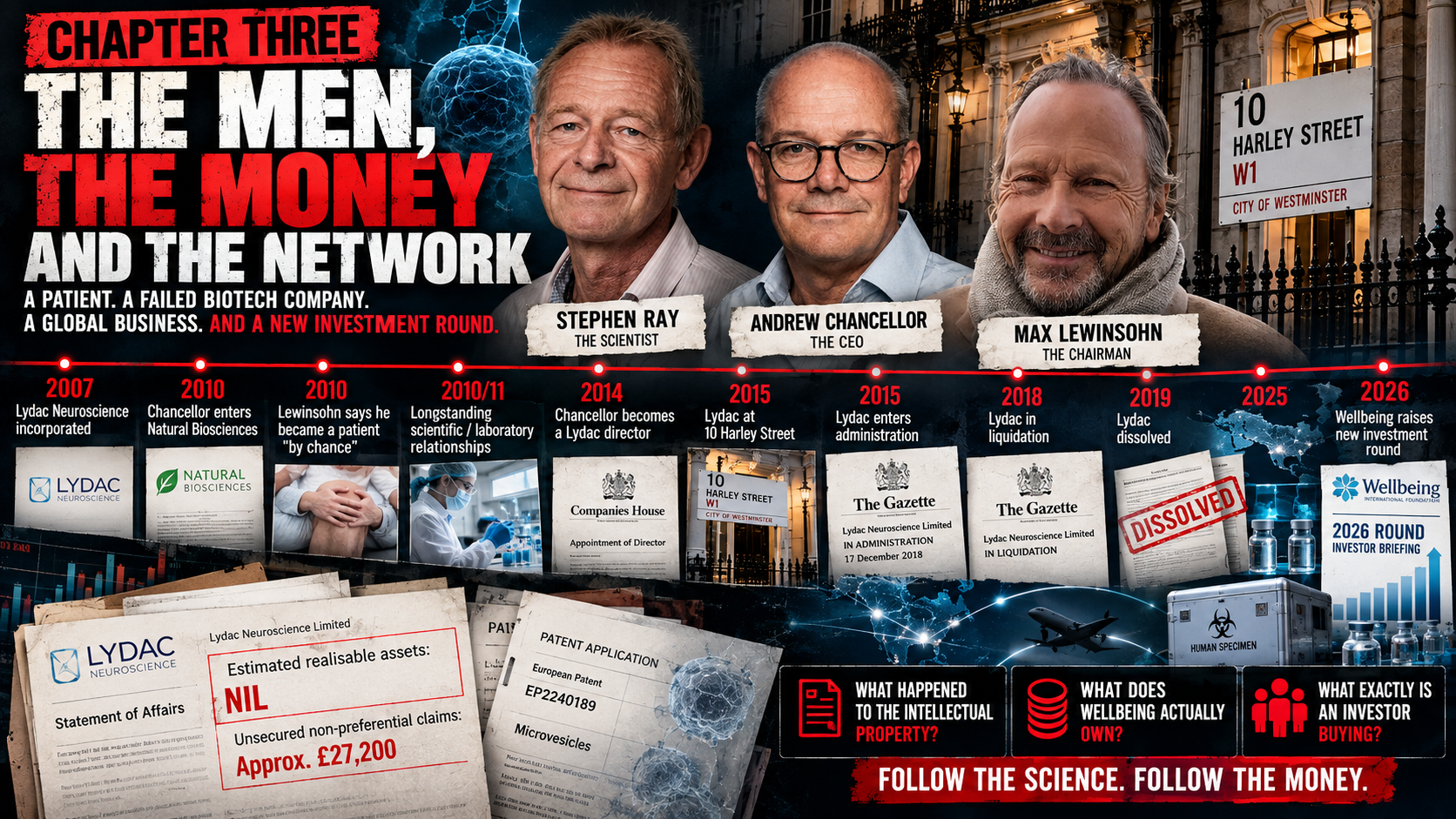
The company had a documented connection to Stephen Ray, a scientist associated with Wellbeing's research history.
It was also connected, at a later date, to Andrew Chancellor, Wellbeing's chief executive.
And its history included something that made the ownership question considerably more important.
Lydac entered administration, subsequently moved into liquidation and was eventually dissolved.
That does not establish that anything improper happened to its intellectual property.
But it does create a question that deserves a documented answer.
What happened to the scientific rights associated with the earlier company, and do any of those rights form part of Wellbeing's present commercial technology?
The Patent That Opened the Investigation
Our investigation began with a patent family relating to microvesicles.
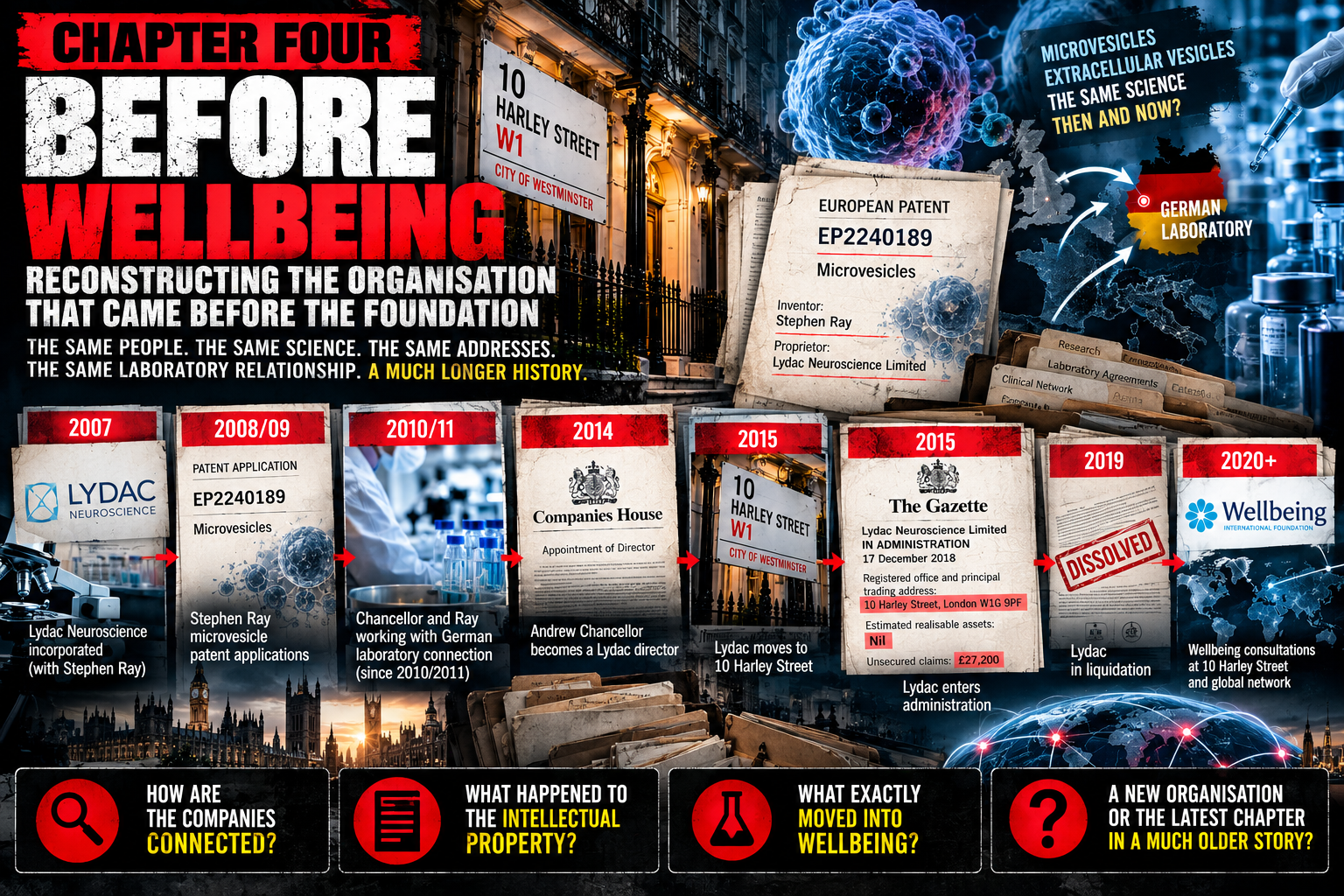
The European patent, identified as EP2240189B1 and titled Microvesicles, names Stephen Ray as an inventor.
The original applicant and assignee was Lydac Neuroscience Ltd.
The patent family traces its earliest priority to January 2008, with an international application published in 2009.
These are not claims taken from promotional material.
They are details recorded in publicly accessible patent documents.
The patent concerns biological methods involving microvesicles and related cellular processes.
Its subject matter is relevant to the broader scientific field in which Wellbeing describes its work.
But the existence of the patent does not establish that the invention became a clinically effective treatment.
Nor does it prove that Wellbeing's current Cell-Free Therapy, or CFT, uses the same patented process.
That distinction is essential.
A patent can establish that an invention was described and legally claimed. It does not establish that a medical intervention works in patients.
Nevertheless, the records provide a concrete historical link between Stephen Ray, microvesicle research and a separate biotechnology company.
And that link takes us into the question of ownership.
The Scientist Who Invented It Was Not Necessarily the Person Who Owned It
Patent law distinguishes between inventorship and ownership.
The inventor is the person credited with making the invention.
The owner is the person or legal entity holding the relevant patent rights.
Sometimes they are the same.
Often they are not.
A scientist may develop an invention while working for a company that owns the resulting intellectual property.
Alternatively, rights may be assigned through an agreement or transferred later.
The original patent records identify Lydac Neuroscience as the applicant and assignee.
They do not identify Wellbeing International Foundation as the original owner.
That matters because a scientist's expertise can continue from one commercial organisation to another without the underlying patent rights automatically moving with them.
An inventor can leave a company.
They can establish another business.
They can continue researching similar technology.
They can develop entirely new methods.
But none of those events, by itself, transfers ownership of an earlier company's intellectual property.
If the present Wellbeing treatment depends on technology once owned by Lydac, there would need to be a legal explanation for the rights involved.
That might be a patent assignment, a licence, an asset purchase or another enforceable arrangement.
Equally, the present treatment may have developed independently and may not require those historical patent rights at all.
The public record examined in this investigation does not resolve which explanation applies.
Who Was Lydac Neuroscience?
Lydac Neuroscience Ltd was incorporated in England and Wales on 12 September 2007.
Its company number was 06369154.
The company's history can be traced through Companies House, the United Kingdom's official corporate register.
Stephen Ray was appointed a director when Lydac was incorporated.
His directorship ended in July 2012.
Andrew Chancellor was appointed a director in November 2014.
This chronology is important.
The two men were associated with the same company at different times, but the recorded appointments do not establish that they served together as directors.
We should not exaggerate the connection.
Nevertheless, it is a documented corporate relationship between two individuals subsequently associated with the Wellbeing story.
And it connects them to an earlier biotechnology enterprise with an identifiable patent history.
The significance lies not simply in their names appearing on company records.
It lies in what those records may tell us about the commercial development of the scientific technology.
The Harley Street Connection
Lydac's corporate history contains another detail.
In June 2015, the company's registered office moved to 10 Harley Street in London.
The address later appeared in the company's insolvency documentation.
During our separate historical investigation, consultations connected with Wellbeing were recorded at 10 Harley Street during 2020 and 2021.
The overlap is noteworthy.
But it must be interpreted carefully.
Harley Street contains numerous medical and professional consulting facilities. Organisations can use the same address at different times without having the same ownership, directors or legal identity.
The address alone does not establish that Wellbeing was a successor to Lydac.
Nor does it demonstrate that intellectual property moved between the two organisations.
What it does establish is another historical connection worth examining alongside the corporate and scientific records.
The same medical address appears at different points in the histories of the earlier biotechnology company and the later Wellbeing-related activity.
It is a connection, not proof of legal succession.
When the Biotechnology Company Ran Into Financial Trouble
The next stage of Lydac's history is documented in formal insolvency records.
Administrators were appointed to Lydac Neuroscience in December 2018.
The company subsequently entered creditors' voluntary liquidation in November 2019.
It was dissolved on 9 April 2025.
That sequence is significant, but it should not be sensationalised.
Biotechnology companies face substantial financial risks.
Research can be expensive.
Scientific development may take years.
Commercialisation may require further investment.
And promising technologies do not always generate sufficient revenue to sustain a business.
A company entering administration is not, by itself, evidence of misconduct.
Nor does a failed biotechnology venture prove that its scientific work was invalid.
However, insolvency creates an important issue concerning company property.
What happened to the assets?
And, more specifically, what happened to any patents, licences, research rights or proprietary methods held by Lydac?
What Happens to Patents When a Company Fails?
Intellectual property can form part of a company's assets.
That may include patents, patent applications, registered trademarks, contractual rights and commercially valuable technical knowledge.
When a company enters administration or liquidation, those assets may be examined and dealt with as part of the insolvency process.
Depending on the circumstances, intellectual property can be sold, licensed, assigned, abandoned or allowed to expire.
Some assets may have little value.
Others may be worth substantial sums.
But ownership does not automatically pass to a former director or inventor simply because the company ceases trading.
This is why the Lydac history is relevant.
If the earlier microvesicle technology remained commercially important, what happened to the rights attached to it?
Were they sold during the insolvency proceedings?
Had they already been transferred?
Were they licensed to another organisation?
Did the patents cease to be commercially useful?
Or did later scientific developments make them unnecessary?
These are different possibilities.
We have not established which, if any, connects the historical patents to Wellbeing's present CFT programme.
The answer requires documentary evidence.
What the Patent Register Actually Shows
The publicly accessible European patent record identifies Lydac Neuroscience as the original assignee associated with the microvesicle invention.
Google Patents currently describes the European patent as not in force.
However, legal-status information in patent databases carries qualifications and should not be treated as a definitive determination of every legal right.
Patent protection can vary between jurisdictions.
Individual national validations may have different histories.
Assignments may require examination of official registers.
And an expired or lapsed patent does not necessarily eliminate the value of related know-how.
There is also another important distinction.
A patent becoming unenforceable may allow others to practise the disclosed invention, subject to any other applicable rights or restrictions.
That is not the same as acquiring ownership of the patent.
And neither situation establishes ownership of later improvements or confidential manufacturing processes.
Consequently, the historical patent record cannot be used on its own to determine the ownership of Wellbeing's current technology.
It establishes a starting point for investigation, not a completed chain of title.
The German Laboratory Adds Another Layer
In Part One, we examined Wellbeing's historical relationship with a German laboratory.
Recorded discussions from 2021 described a longstanding arrangement in which Stephen Ray was associated with the design of scientific protocols while the German laboratory carried out processing and quality-related work.
This historical evidence is important because it raises questions about the relationship between scientific development and manufacturing.
A protocol may be designed by one person.
It may be refined by another.
A laboratory may develop practical techniques that improve consistency or efficiency.
An organisation may finance further development.
And a separate business may commercialise the final product.
The resulting intellectual-property position can be complicated.
Who owns the original method?
Who owns subsequent improvements?
Who has the right to reproduce the process?
Who controls the manufacturing documentation?
Can the protocol be transferred to another laboratory?
Can the scientist use the same method for another organisation?
Could the laboratory offer similar services to other customers?
The answers depend on contracts and applicable law.
They cannot be established simply by knowing who designed the original protocols or who performed the processing.
This matters because Wellbeing's commercial proposition depends upon its ability to continue providing a distinctive biological intervention.
If that ability relies on intellectual property or know-how controlled by third parties, the relevant agreements become central to the organisation's value.
Does Current CFT Actually Use the Lydac Patents?
This is perhaps the most important scientific qualification in the investigation.
The earlier patent family concerns microvesicles and associated biological methods.
Wellbeing's present treatment materials describe an autologous, blood-derived biological preparation involving conditioned media.
There are broad scientific themes that warrant comparison.
But a resemblance between descriptions is not proof that one process practises the claims of a particular patent.
To determine whether the present CFT process uses the patented invention, investigators would need detailed technical information.
That would include the actual processing steps, biological materials, relevant cell populations, harvesting methods and composition of the finished preparation.
Those details would then need to be compared with the specific patent claims.
We have not established that comparison.
Therefore, we cannot conclude that Wellbeing uses the Lydac patent.
We cannot conclude that a licence to that patent is required.
And we cannot conclude that any intellectual property has been used without authorisation.
But this uncertainty cuts both ways.
If the present CFT process is genuinely different from the earlier invention, the question becomes who developed the new technology and who owns it.
That ownership history is just as important.
Twenty Years of Research Does Not Necessarily Mean Twenty Years of Company-Owned Research
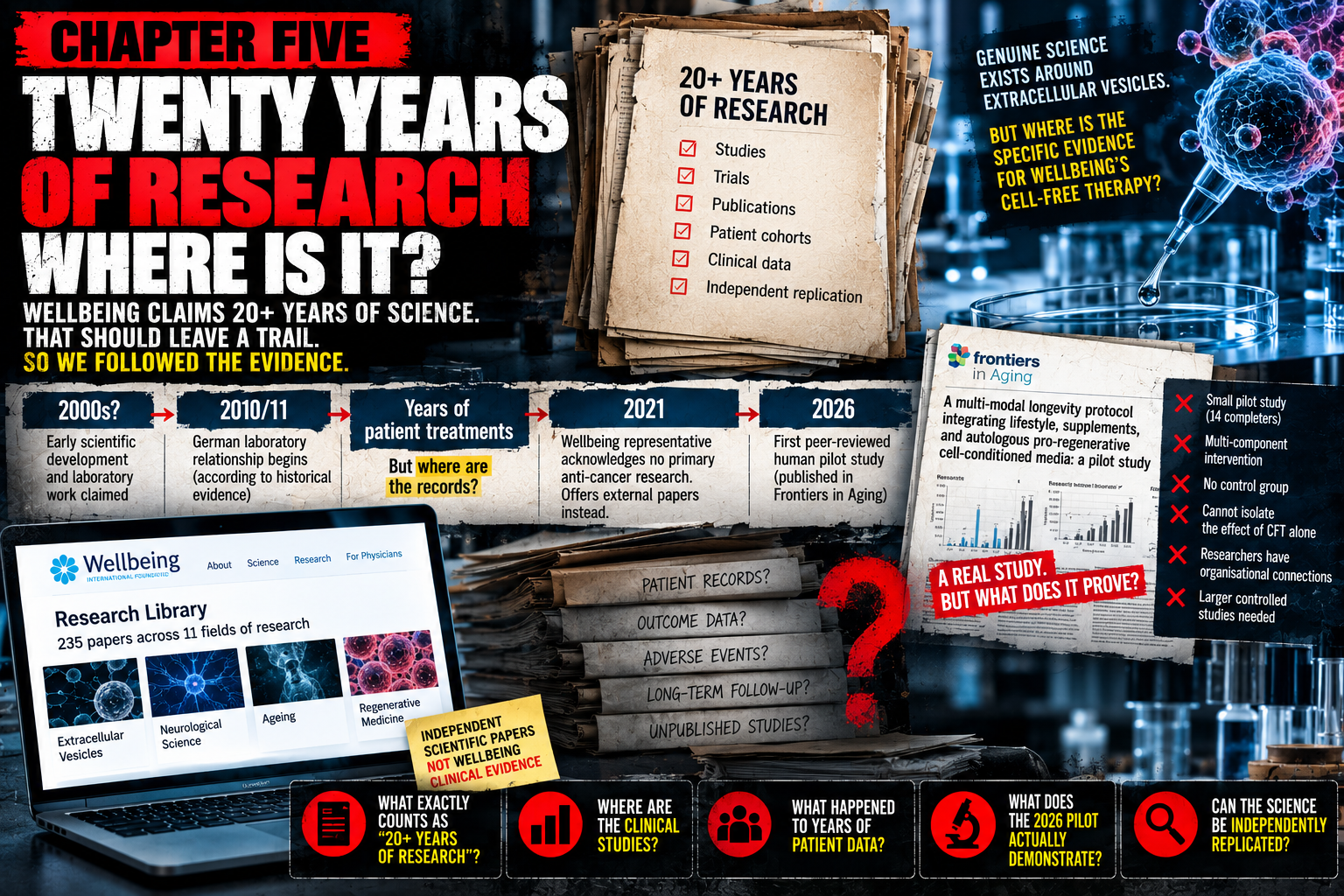
Wellbeing describes a scientific background extending more than twenty years.
The experience of an individual researcher can legitimately contribute to such a history.
A scientist may spend decades studying a particular field while working for different institutions, companies and research programmes.
That experience may be valuable.
But the research history of an individual is not necessarily the asset history of the organisation currently employing or consulting with that individual.
This distinction becomes particularly important when scientific history is used to support commercial credibility.
Consider three different statements.
A scientist has worked in a field for twenty years.
A treatment method has evolved through twenty years of scientific development.
A company owns twenty years' worth of proprietary research and intellectual property.
Those statements are not interchangeable.
Each requires different evidence.
The first may be supported by a professional biography.
The second requires a documented scientific development history.
The third requires evidence of legal ownership or control.
Without those distinctions, a long research narrative can create an impression of corporate assets that has not actually been demonstrated.
Why Ownership Matters to Investors
The intellectual-property question becomes more significant in light of Wellbeing's 2026 private capital round.
The organisation announced in March 2026 that it had closed an opening tranche of investment, with the wider round continuing.
Its stated objectives included further research, documentation, operational development and expansion of clinical relationships.
Those may be legitimate investment purposes.
But an investor must understand what the investment entity actually owns.
If the company owns valuable patents, those rights may support its valuation.
If it holds an exclusive licence, the duration and terms of that licence matter.
If its principal technology is protected by confidential know-how, investors need to understand how that knowledge is controlled.
If manufacturing depends on an external laboratory, contractual continuity matters.
And if the business relies heavily on a particular scientist, the arrangements governing that person's expertise and intellectual-property contributions may be commercially critical.
The existence of a scientific history is not enough.
The investment entity must have identifiable rights that allow it to benefit from the technology.
The Missing Documentary Bridge
Our investigation has established a series of historical facts.
There was an earlier British biotechnology company.
That company was associated with a microvesicle patent family.
Stephen Ray was named as an inventor.
Lydac Neuroscience was the original patent applicant and assignee.
Stephen Ray served as a director during the company's early history.
Andrew Chancellor became a director later.
Lydac subsequently entered insolvency proceedings and was dissolved.
Historical material also documents scientific and laboratory relationships involving personnel associated with Wellbeing.
But these facts do not, on their own, establish a legal transfer of intellectual property into Wellbeing's current commercial structure.
There may be agreements that answer the question.
They may be private.
They may involve later developments rather than the original patent family.
Or the current technology may not depend upon those earlier patents at all.
What remains unresolved is the documented relationship, if any, between the historical intellectual property and the present commercial process.
This is not evidence that Wellbeing lacks the necessary rights.
It is a gap in what can presently be independently verified.
The Documents That Would Settle the Ownership Question
A proper intellectual-property review would examine the relevant patent assignments and licences, together with the contracts governing scientific development and laboratory manufacturing.
It would also identify the legal entity that currently owns or controls the CFT protocols.
If the technology has evolved independently of the Lydac patents, the review would establish how and when that later technology was developed.
It would identify the ownership of subsequent improvements and the contractual rights held by Wellbeing.
It would also consider whether the business has sufficient rights to transfer manufacturing, license the process or prevent unauthorised commercial use.
These are ordinary questions in biotechnology due diligence.
They are not accusations.
They are the documents needed to distinguish scientific experience from legally owned technology.
A Failed Company Does Not Mean Failed Science
One conclusion must be avoided.
The dissolution of Lydac Neuroscience does not establish that the underlying science was worthless.
Nor does it establish that its former directors acted improperly.
Companies can fail for reasons unrelated to the scientific merit of their research.
And technologies can continue to develop after the original company disappears.
Scientific expertise can survive corporate failure.
New inventions can emerge.
Legitimate licensing and asset-transfer arrangements can preserve commercial rights.
But that does not eliminate the need to establish ownership.
In fact, it makes the ownership history more important.
When an earlier company has entered insolvency, assumptions about continuity are particularly unreliable.
The proper question is not whether the same individuals remain involved.
It is whether the relevant legal rights can be traced.
The Central Finding
The investigation into Wellbeing's intellectual-property history has not established unlawful conduct.
It has not demonstrated that the present CFT process infringes an earlier patent.
It has not proved that patents were improperly transferred.
And it has not shown that Wellbeing lacks legitimate rights to its technology.
What it has established is a documented historical patent and corporate trail that is relevant to understanding the scientific and commercial history presented by the organisation.
That trail leads to Lydac Neuroscience.
It connects to Stephen Ray.
It connects, at a later point, to Andrew Chancellor.
It includes a Harley Street address associated with later Wellbeing-related consultations.
And it ends with the earlier company's dissolution.
The current ownership of Wellbeing's CFT technology cannot be determined solely from that history.
But neither can it be assumed.
That is the distinction at the heart of this investigation.
What Is the Real Asset Behind Wellbeing?
After examining the clinics, laboratory, historical patents and scientific relationships, the central question becomes clearer.
Perhaps Wellbeing's greatest value lies in its international network.
Perhaps it lies in proprietary manufacturing know-how.
Perhaps it lies in exclusive commercial agreements.
Perhaps it lies in new technology developed independently of the earlier patents.
Or perhaps its value is distributed across several different rights and relationships.
Any of these possibilities could support a legitimate commercial enterprise.
But each produces a different financial picture.
An organisation that owns enforceable intellectual property is not economically identical to an organisation that licenses technology from another party.
A business with exclusive manufacturing rights is not the same as one dependent on a non-exclusive service provider.
And a company with a proprietary clinical process is not necessarily equivalent to a company coordinating treatments through independent practitioners.
Those distinctions determine how resilient the business is, how easily competitors can enter the market and what an investor might actually acquire.
The Question That Remains
The most revealing part of this investigation is not the existence of a failed biotechnology company.
It is the difference between a scientific story and a legal ownership story.
A scientist can have decades of experience.
A laboratory can possess sophisticated equipment.
A company can coordinate international medical services.
Patients can provide sincere testimonials.
And a business can raise investment to finance future development.
All of those things may be genuine.
But none of them independently establishes ownership of the scientific technology.
For that, we need documentary evidence.
The relevant patent rights.
The assignments.
The licences.
The contracts.
The identity of the entity that controls the technology today.
Until those matters are established, the historical patent trail remains an important but incomplete part of Wellbeing's commercial story.
And that brings us to the next stage of the investigation.
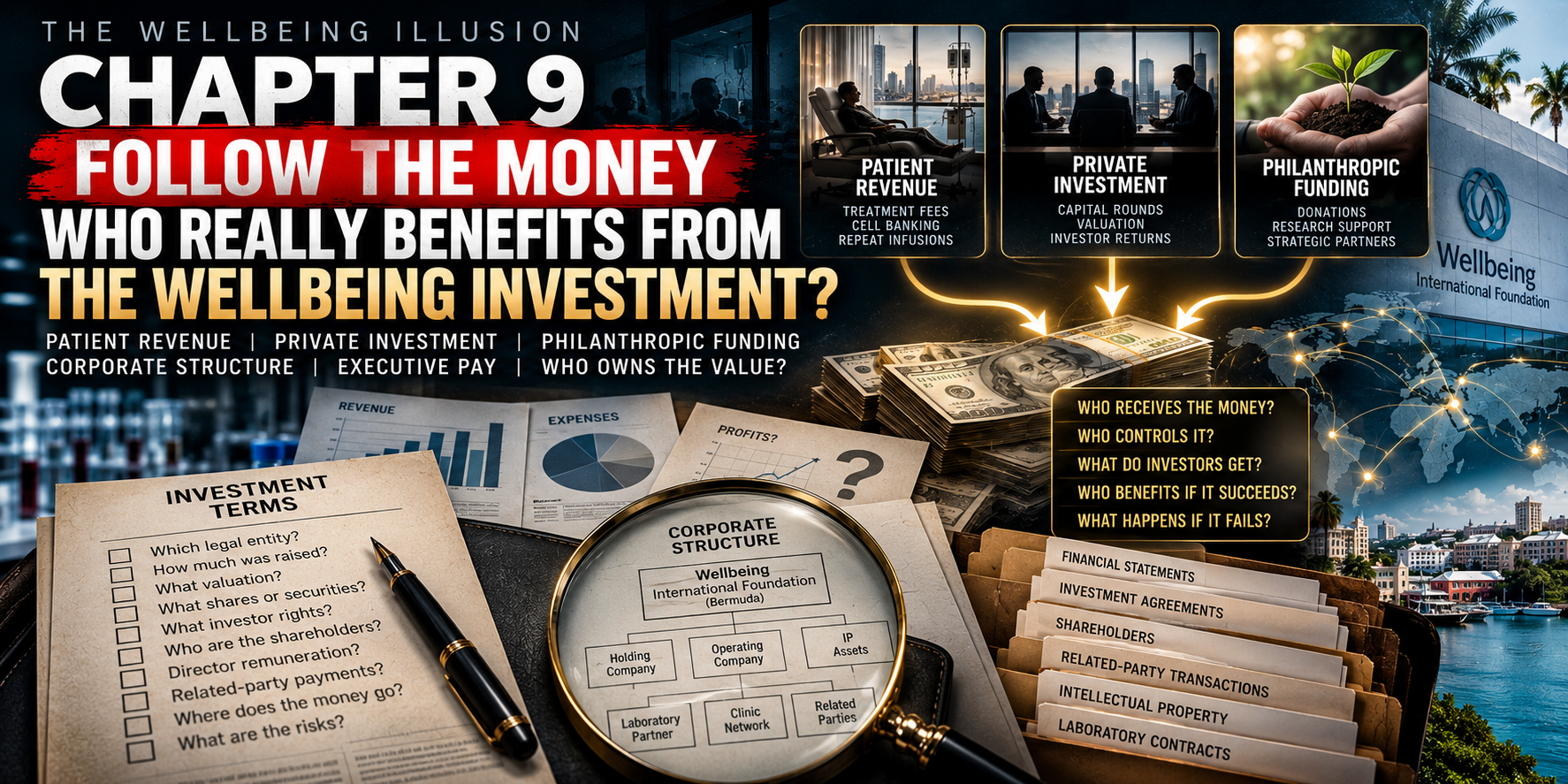
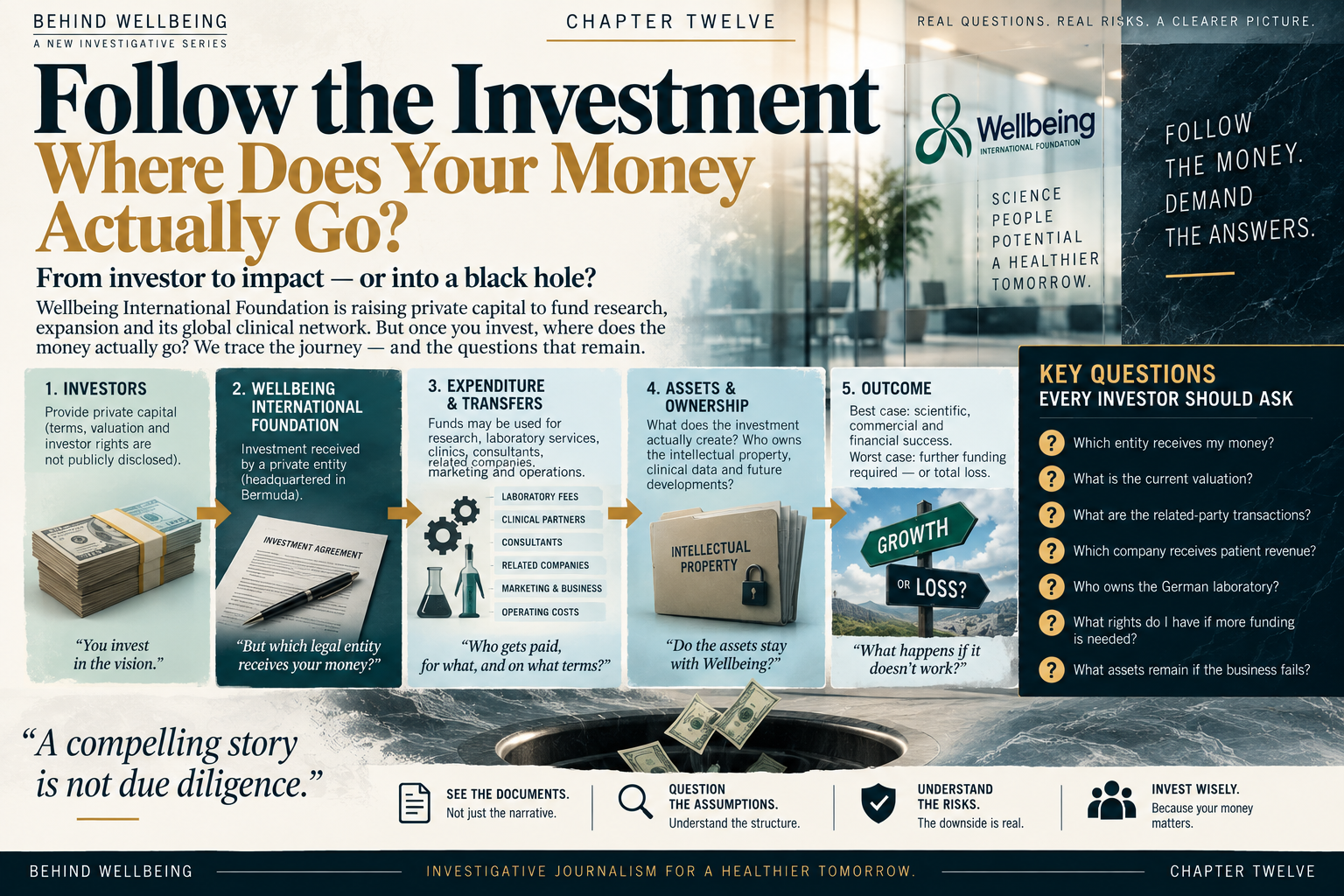
Because if the clinics operate through partnerships, the laboratory is an external relationship and the historical intellectual-property trail requires further examination, a prospective investor faces a much broader question.
What exactly is the company worth?
Not what the scientific story suggests.
Not what the international network appears to represent.
But what its actual assets, contracts, revenue and legal rights justify.
That question cannot be answered by examining patents alone.
It requires following the money.
Coming Next — Follow the Money: Who Really Benefits From the Wellbeing Investment?
Wellbeing has publicly announced a private capital round in 2026.
Its business model includes patient revenue, clinical partnerships and specialist laboratory processing.
But the financial position of the investment entity cannot be established simply from those descriptions.
In the next investigation, we examine the distinction between patient fees and company profit, the structure of private investment, the significance of related-party transactions, and the financial documents needed to understand what investors are actually buying.
Because the ultimate question is no longer just who developed the science.
It is who owns the commercial value — and who carries the financial risk.
Public reference material
- European Patent EP2240189B1 — Microvesicles
- International Patent WO2009087361A1
- Companies House — Lydac Neuroscience Ltd
- Companies House — Lydac Filing History
- The Gazette — Lydac Administration Notice
- Wellbeing — About
- Wellbeing — March 2026 Capital Round Announcement
Editorial note: The historical corporate and patent connections described in this article are distinguished from unverified questions about present-day intellectual-property ownership. No finding of misconduct, unlawful transfer or patent infringement is made.
Recent Posts