The Clinical Trial Question: Why Did Formal Human Research Come So Late?
The Wellbeing Illusion — Chapter Seven
For six chapters we have followed the trail backwards.
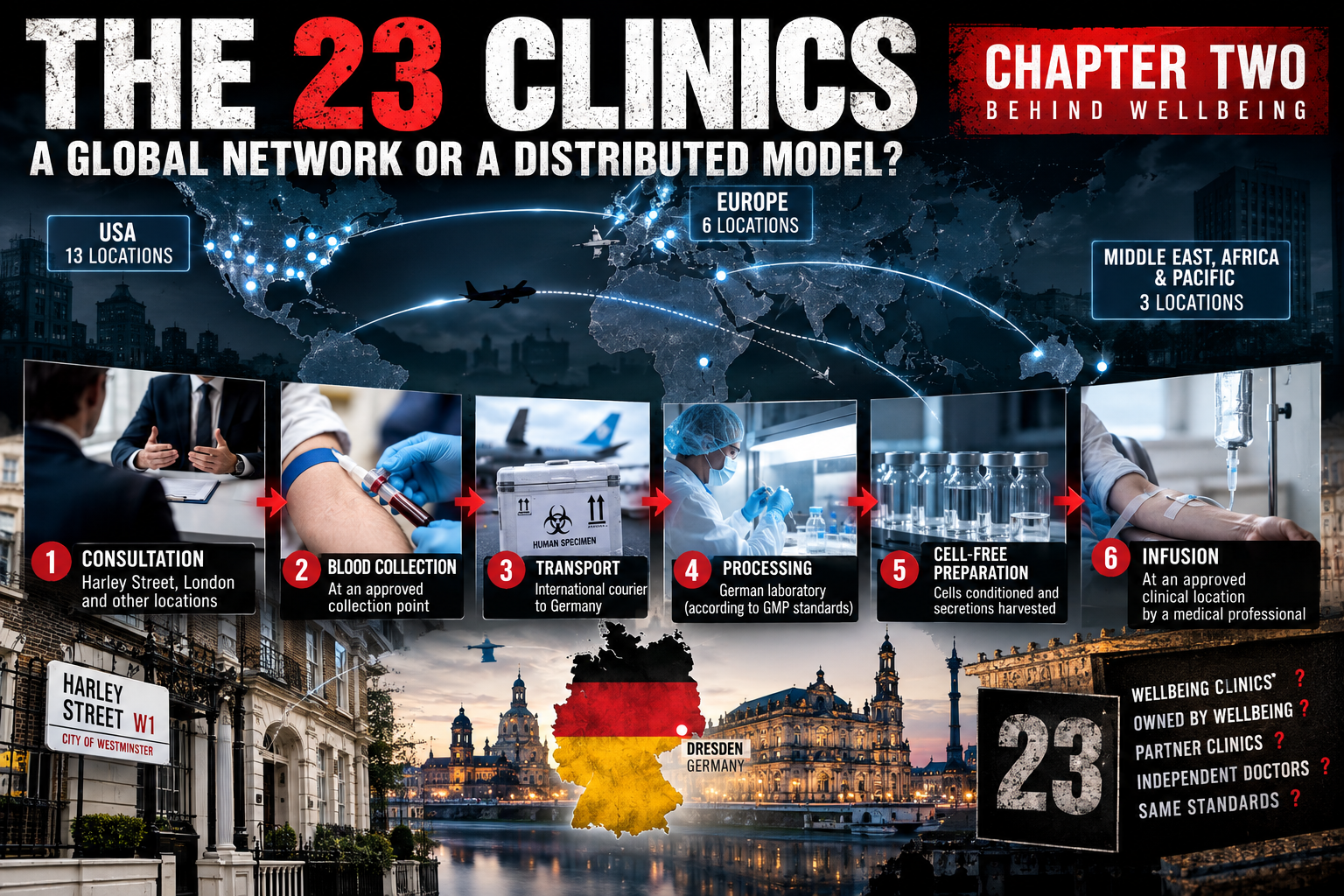
The clinics.
The doctors.
The German laboratory.
The protocols.
The scientific history.
The patients.
And finally the evidence those patients should have generated.
Now we can put dates against that story.
And the dates create perhaps the most uncomfortable question so far.
Wellbeing International Foundation presents a scientific history stretching over more than twenty years.
Our historical investigation found patients discussing treatment years ago.
We found longstanding laboratory relationships.
We found protocols already being used.
We found discussions of repeat infusions.
We found claims of extensive patient experience.
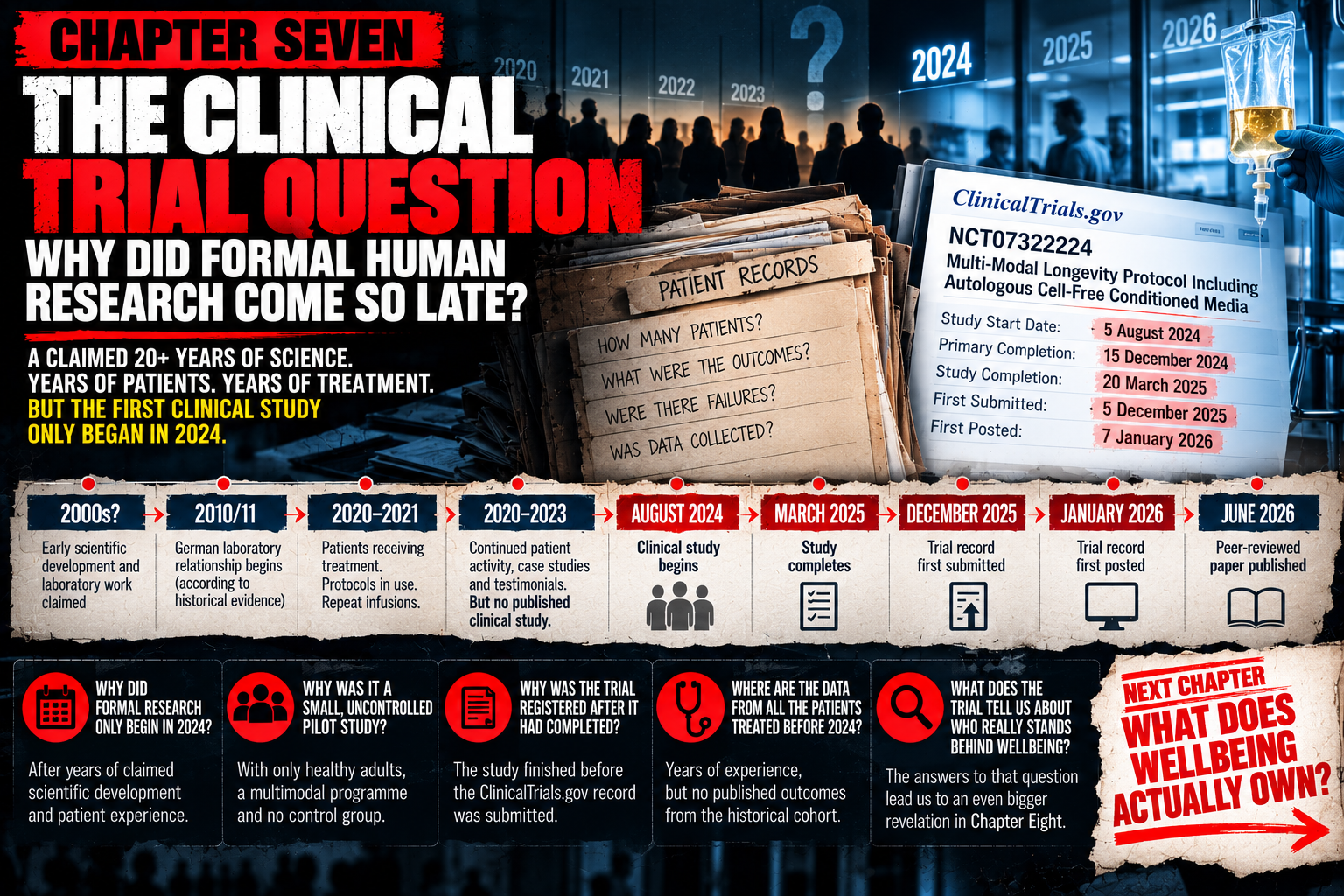
And yet the peer-reviewed human pilot study that Wellbeing now cites did not begin until August 2024.
The study completed in March 2025.
The ClinicalTrials.gov record associated with it was first submitted in December 2025 and publicly posted in January 2026.
The peer-reviewed paper appeared in June 2026.
Put those dates on a single line and something becomes immediately obvious.
The patients came first.
The formal published clinical research came much later.
And when we followed that chronology one step further, we found something that leads directly into the most important chapter of this investigation so far.
Start With What Wellbeing Says Today
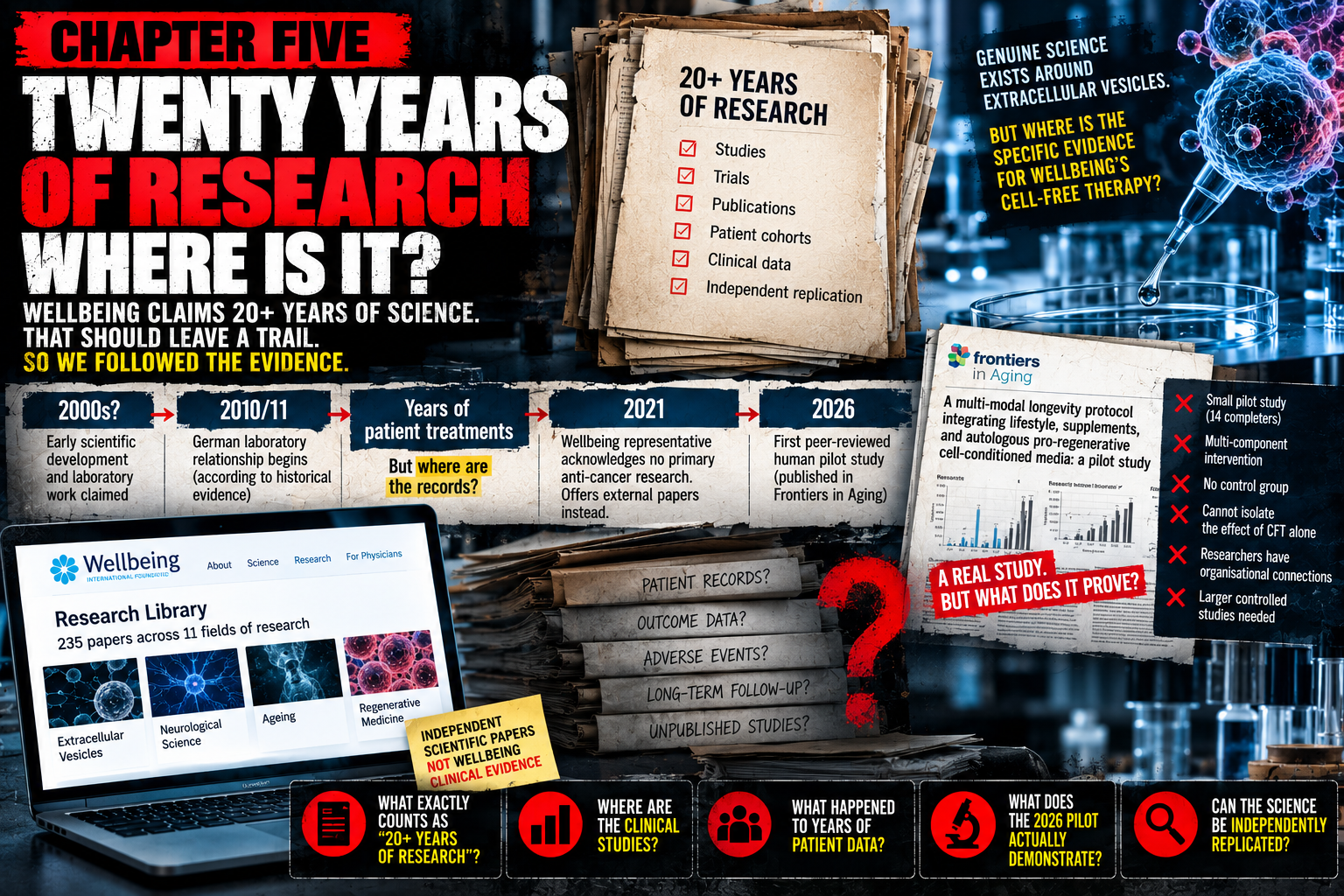
There is now a genuine peer-reviewed study associated with Wellbeing's intervention.
That fact needs to be stated clearly.
The study was published in Frontiers in Aging in June 2026 under the title:
“A multi-modal longevity protocol integrating lifestyle, supplements, and autologous pro-regenerative cell-conditioned media: a pilot study.”
It involved sixteen healthy adults, fourteen of whom completed the programme.
The study was small.
It was open-label.
It had no control group.
And Cell-Free Therapy was only one part of a much larger programme involving lifestyle changes and supplementation.
We examined those limitations in Chapter Five.
But the existence of the study itself matters.
Wellbeing now has published human research associated with its intervention.
The question is not whether it exists.
The question is:
Why did it arrive so late?
Because the Patients Were Already There
Our confidential historical material takes us back years before the pilot.
Recorded consultations from 2020 and 2021 describe a functioning patient pathway.
Prospective patients were discussing medical conditions.
Blood collection was discussed.
Sending blood to Germany was discussed.
Laboratory processing was explained.
Intravenous administration was discussed.
Repeat treatment was discussed.
Prices were discussed.
And previous patient experience was repeatedly referenced.
This was not a conversation about an intervention still waiting to be tried in humans.
People were already apparently receiving it.
Wellbeing's own historical case studies also describe patients receiving versions of the intervention years before the 2024 pilot.
So there is an unavoidable gap in the chronology.
Human treatment appears substantially earlier than the formal study Wellbeing now cites.
Treating Patients Is Not Clinical Research
This distinction is essential.
There is nothing inherently unusual about clinical experience preceding formal research.
Medical innovations can develop through laboratory work, physician experience, compassionate use and observational practice before becoming the subject of rigorous trials.
But those activities are not interchangeable.
Treating someone is not automatically conducting research.
Observing somebody after treatment is not automatically a clinical study.
Collecting a testimonial is not clinical research.
A scientist believing an intervention works is not clinical proof.
Formal human research introduces something different.
A protocol.
Defined participants.
Predefined outcomes.
Eligibility criteria.
Safety monitoring.
Research consent.
Structured data collection.
Statistical analysis.
And ideally, registration before researchers know what the results will be.
That framework exists for a reason.
It makes the evidence testable.
So When Did Formal Research Actually Begin?
The study associated with the 2026 publication began on:
5 August 2024.
Its primary completion date was:
15 December 2024.
The study itself completed on:
20 March 2025.
The associated ClinicalTrials.gov identifier is:
NCT07322224.
The study is titled:
Multi-Modal Longevity Protocol Including Autologous Cell-Free Conditioned Media.
Those dates give us something we haven't had before.
A point at which the formal human research programme becomes publicly traceable.
And that point is remarkably recent compared with the much longer history being described around the technology.
This Wasn't a Large Therapeutic Trial
It is also important to understand what kind of study this was.
It wasn't a Phase III clinical trial.
It wasn't a large randomized trial involving hundreds of patients.
It wasn't designed to demonstrate that CFT treated cancer, neurological disease, orthopaedic injury or another named medical condition.
The participants were generally healthy adults interested in longevity.
There was one intervention group.
No placebo group.
No untreated control group.
No randomisation between CFT and no CFT.
No masking.
And CFT was combined with multiple other interventions.
The registered study describes its primary purpose as Basic Science and its phase as Not Applicable.
That makes sense for exploratory research.
But after a scientific history said to extend beyond twenty years, it also tells us something important.
The formal public clinical evidence still appears to be at an exploratory stage.
Why Start With Healthy Adults?
This creates another interesting contrast.
The historical story contains discussions involving people with serious medical conditions.
There are neurological patients in Wellbeing's public history.
There are injured professional athletes.
There are people seeking regenerative benefits.
There are repeat patients.
There are years of claimed experience.
Yet the peer-reviewed pilot Wellbeing now cites involved generally healthy adults participating in a longevity programme.
That doesn't make the study inappropriate.
It simply means it doesn't answer many of the questions raised by the historical patient population.
It doesn't tell us whether CFT helped the historical knee patients.
It doesn't tell us whether it changed neurological disease progression.
It doesn't tell us whether injured athletes recovered faster because of CFT.
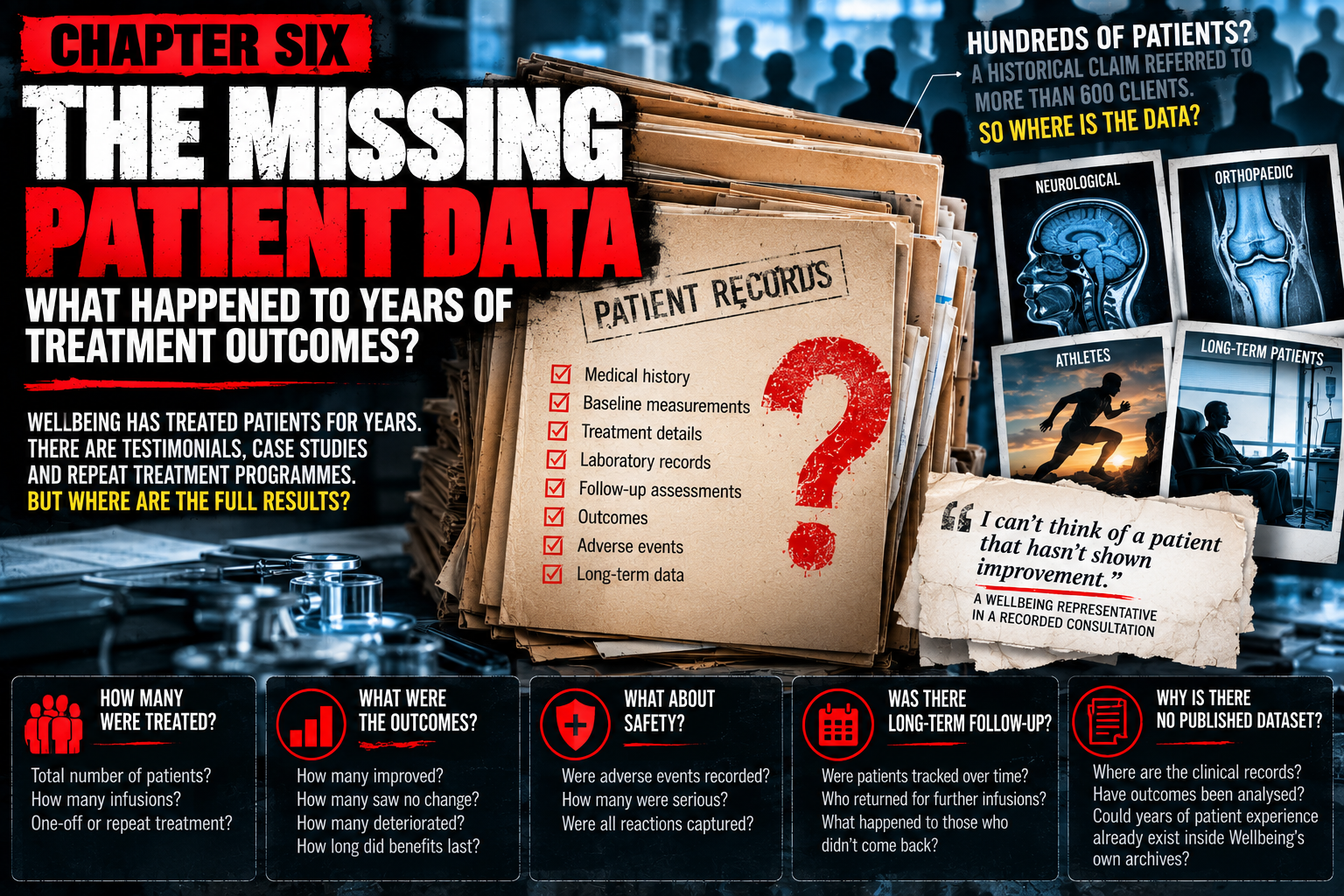
And it doesn't explain what happened to the hundreds of historical patients referred to in earlier material.
Those questions remain open.
Then We Looked at the Registration Timeline
This is where Chapter Seven becomes considerably more interesting.
The study began in August 2024.
It completed in March 2025.
But according to the public registration chronology associated with NCT07322224, the ClinicalTrials.gov submission came later — in December 2025 — with the record appearing publicly in January 2026.
In other words, according to that chronology:
the study had already been completed before its ClinicalTrials.gov registration was publicly submitted and posted.
That requires careful wording.
It does not mean the research didn't have a protocol before it began.
It does not prove that endpoints were altered.
It does not mean the study was fabricated.
And it does not automatically invalidate the eventual peer-reviewed publication.
But it does mean the public registry record appears to have been created retrospectively rather than prospectively.
And scientifically, that distinction matters.
Why Register a Study Before It Starts?
Clinical-trial registration isn't merely administrative bureaucracy.
It serves an important scientific purpose.
Before researchers know the outcome, they publicly state what they intend to investigate.
What is the intervention?
Who will participate?
How many participants?
What is the primary outcome?
What are the secondary outcomes?
When will measurements occur?
What is the study design?
That creates a timestamp.
Then, when the results are eventually published, researchers and readers can compare:
What did you say you were going to measure?
with:
What did you eventually report?
That helps protect against selective reporting.
Imagine Measuring Twenty Things
The reason is easy to understand.
Imagine a study measures twenty biological markers.
Seventeen show no meaningful change.
Three improve.
If the researchers subsequently publish only those three, the results can appear much more impressive than the experiment actually was.
Prospective registration helps outsiders see that twenty things were originally being measured.
The unsuccessful results remain visible in the research design.
That is one of the safeguards against researchers unconsciously — or deliberately — selecting the most attractive outcomes after seeing the data.
Retrospective registration cannot provide exactly the same protection.
Because by then the results may already be known.
Again, we are not alleging that happened here.
We have no evidence establishing that it did.
The point is simply that the chronology matters.
The Paper Was Still Peer Reviewed
This should not be overlooked.
The study was eventually published in a peer-reviewed journal.
Its methodology can be examined.
Its limitations are discussed.
Its affiliations are disclosed.
Its results are available for other researchers to scrutinise.
That is valuable.
And the authors themselves are cautious about what can be concluded.
They acknowledge the small sample.
They acknowledge the absence of a control group.
They acknowledge the open-label design.
They acknowledge that the multimodal intervention prevents the contribution of each individual component from being isolated.
And they call for larger controlled research.
That is how exploratory science should progress.
But peer review doesn't change the dates.
The Dates Are the Story
Put everything we have discovered so far into chronological order.
There is a scientific story said to extend over more than twenty years.
There are laboratory relationships extending back well over a decade.
There were protocols.
There were patients.
There were repeat treatments.
There were claims of extensive experience.
There were testimonials.
There were discussions about outcomes.
Then, much later:
August 2024 — the pilot begins.
March 2025 — the study completes.
December 2025 — the ClinicalTrials.gov record is first submitted.
January 2026 — the record becomes publicly available.
June 2026 — the peer-reviewed paper is published.
The gap between those two histories is striking.
The commercial and patient history appears old.
The public formal clinical-research history appears much younger.
Why Wasn't This Done Earlier?
That is the obvious question.
If hundreds of patients had already received versions of the intervention, why wasn't a structured prospective study undertaken earlier?
If there was extensive experience with knees, why not study knee patients?
If professional athletes repeatedly received treatment, why not construct a sports-injury cohort?
If neurological patients were receiving repeated infusions, why not systematically record progression?
If biological material was being processed through the same laboratory relationship for years, why not connect laboratory variables with patient outcomes?
If the intervention produced results as impressive as some historical conversations suggested, formal research could potentially have demonstrated that.
There may be perfectly reasonable explanations.
Perhaps funding wasn't available.
Perhaps research wasn't the organisation's original priority.
Perhaps earlier research exists but was never published.
Perhaps the technology changed so substantially that older data were no longer comparable.
Perhaps the necessary infrastructure wasn't in place.
We don't know.
And where the documents don't answer the question, we won't invent an answer.
But the chronology itself remains.
There Is Another Difference Between the Old Claims and the New Study
The historical consultations could be remarkably confident.
We have already examined the statement concerning knee patients:
“I can't think of a patient that hasn't shown improvement.”
Another representative responded:
“There hasn't been one.”
Now compare that with the language of the 2026 scientific paper.
The published researchers are much more cautious.
They describe signals.
Associations.
Limitations.
Subgroups.
Hypotheses.
The need for larger controlled trials.
That difference is revealing.
Not necessarily because one side was dishonest.
But because science forces certainty to shrink.
Once you start counting everybody, measuring everybody and analysing everybody, the story becomes more complicated.
And that is precisely why formal research matters.
Not Everyone in the Pilot Responded the Same Way
The pilot itself illustrates this perfectly.
Participant responses varied.
The paper describes larger responders and smaller or non-responders in relation to biological-age measurements.
That is normal.
Biology is messy.
People differ.
Responses vary.
And it demonstrates why a handful of spectacular patient stories can never tell us how an intervention performs across an entire population.
Clinical research introduces the denominator.
It forces us to count the people who didn't produce the headline.
The Study Wasn't Independent Replication Either
There is another limitation.
The paper's declarations identify organisational relationships between its authors and the groups involved with the programme, including Wellbeing and xLongevity.
Again, this does not invalidate the research.
Commercial organisations routinely investigate their own technologies.
What matters is transparency.
But it means the study is not yet independent replication.
That would require other researchers, independent of the organisations involved, to test the intervention and reproduce the findings.
That remains another important step.
What Would the Decisive Trial Look Like?
The next study could answer much more.
Take CFT itself.
Define the preparation precisely.
Prospectively register the protocol before the first participant is enrolled.
Select a meaningful population.
Randomise participants.
Create an appropriate comparator.
Blind outcome assessment wherever possible.
Predefine the primary endpoint.
Track adverse events.
Follow participants long enough to determine whether any effect persists.
And publish the results regardless of whether they are positive or negative.
If the biological effect is substantial, rigorous research should make it easier to demonstrate.
If there is no meaningful effect, rigorous research should reveal that too.
That is the bargain science makes.
But While Following the Trial, We Found Something Else
This is where our investigation changes direction.
Initially, we were interested in the trial because we wanted to understand the evidence.
When did it start?
How many people participated?
What did it measure?
When was it registered?
What did it find?
But the study record contains more than scientific information.
It contains organisations.
A sponsor.
Collaborators.
Researchers.
A study location.
Responsibilities.
And once we began examining those details alongside everything uncovered in the previous six chapters, a much larger question appeared.
Because Wellbeing is not operating in isolation.
Throughout this investigation we have repeatedly encountered other components.
Partner clinics.
Independent physicians.
A German laboratory partner.
External scientific literature.
A separate lead study sponsor.
Collaborating organisations.
A distributed clinical network.
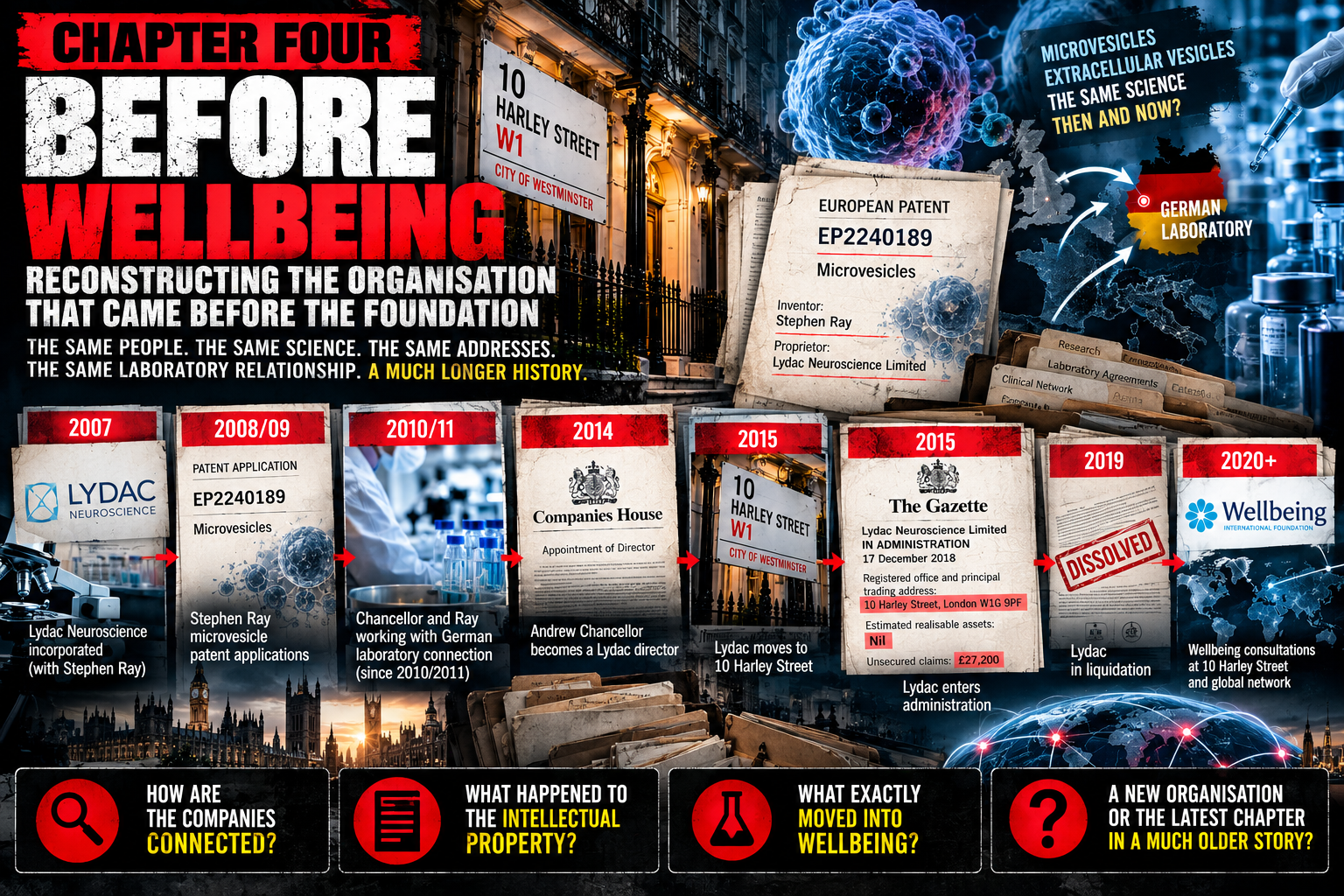
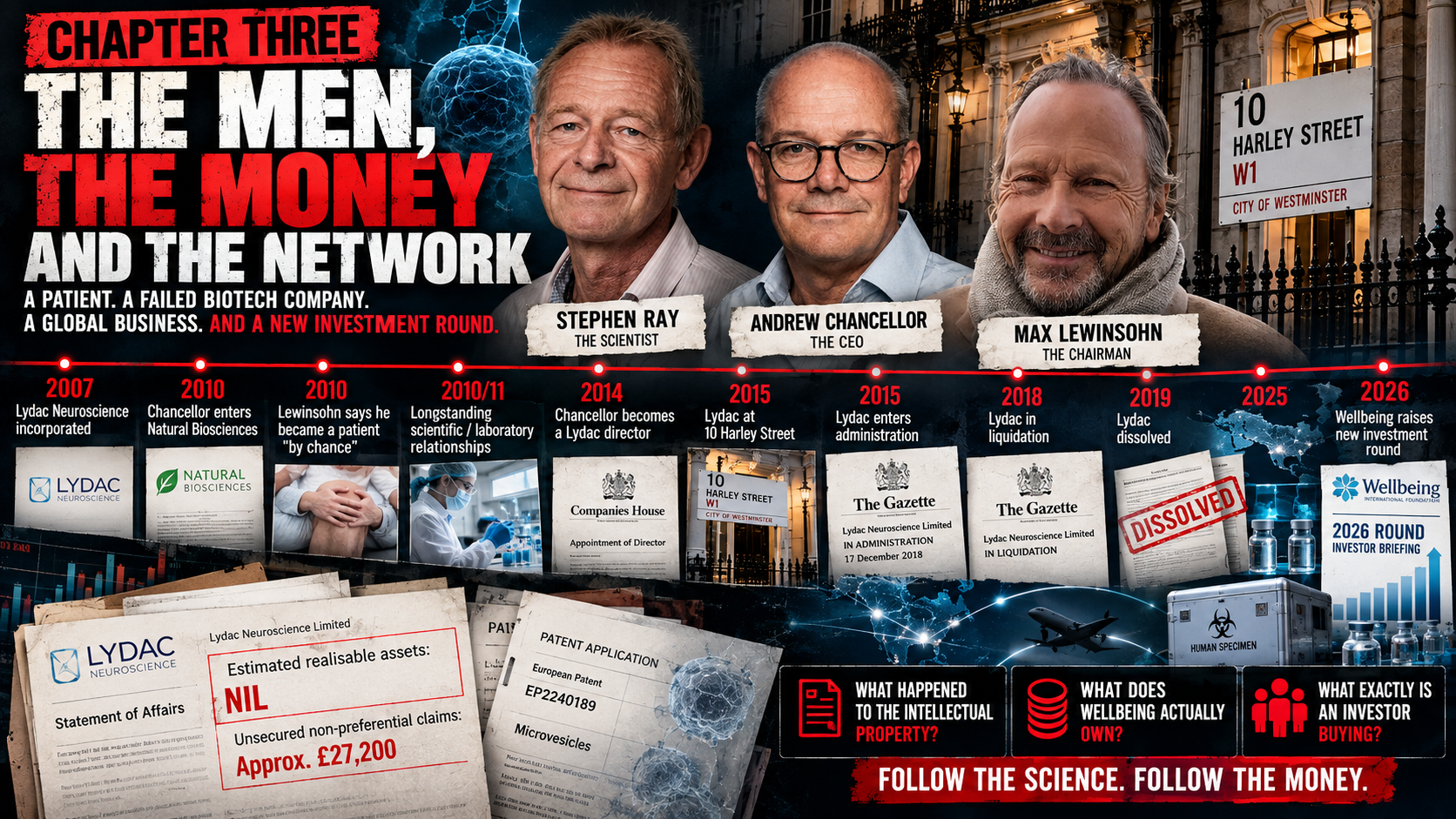
And historical companies connected to the people and science.
None of that is inherently improper.
Modern biotechnology frequently depends upon outsourcing and partnerships.
But it means we have been asking the wrong question.
Stop Asking What Wellbeing Has Access To
Having access to something is not the same as owning it.
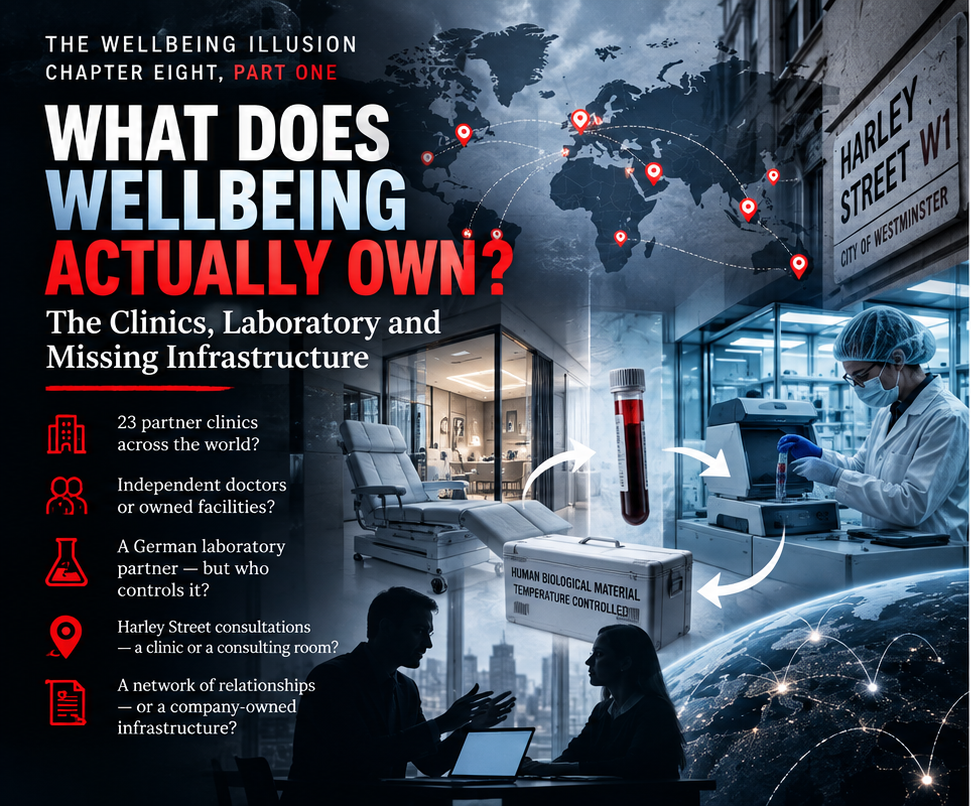
A company can use a laboratory without owning the laboratory.
It can refer patients to doctors without employing those doctors.
It can operate through clinics without owning those clinics.
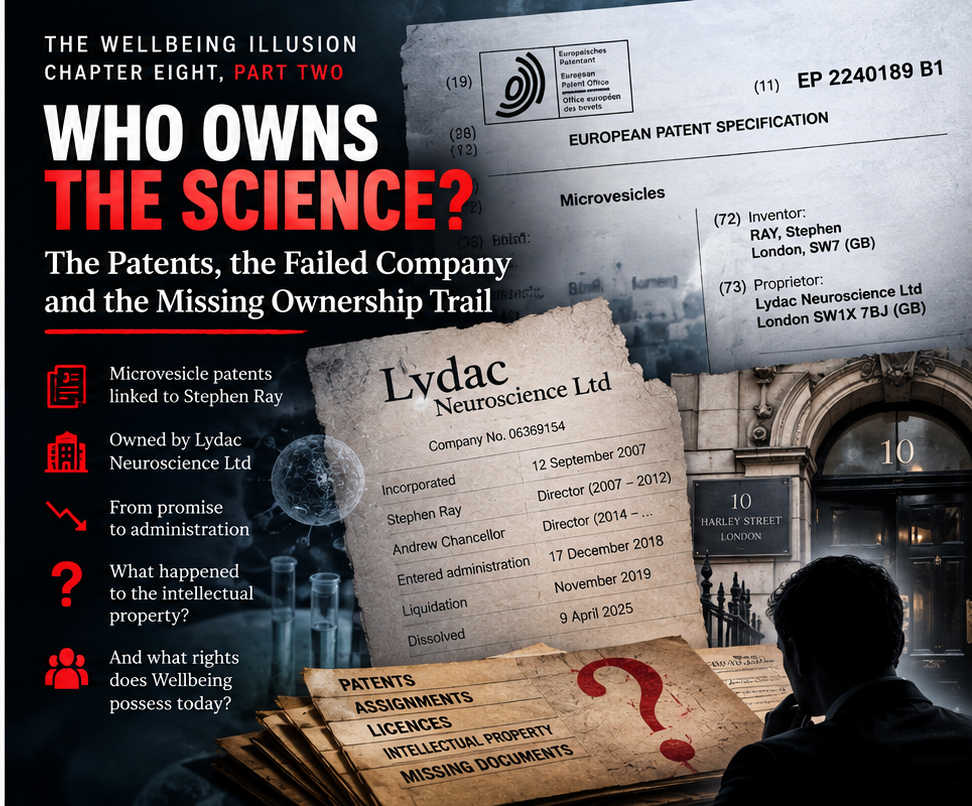
It can use scientific protocols without necessarily owning the underlying intellectual property.
It can cite scientific literature without having conducted that research.
It can collaborate on a clinical study without sponsoring it.
It can use a Harley Street location without owning a hospital.
It can maintain relationships across twenty countries without owning twenty international medical facilities.
Again:
None of those arrangements is inherently improper.
But they become extremely important when trying to understand what the organisation actually is.
And even more important when investors are being invited to put money into it.
Because Investors Are Not Buying “Access”
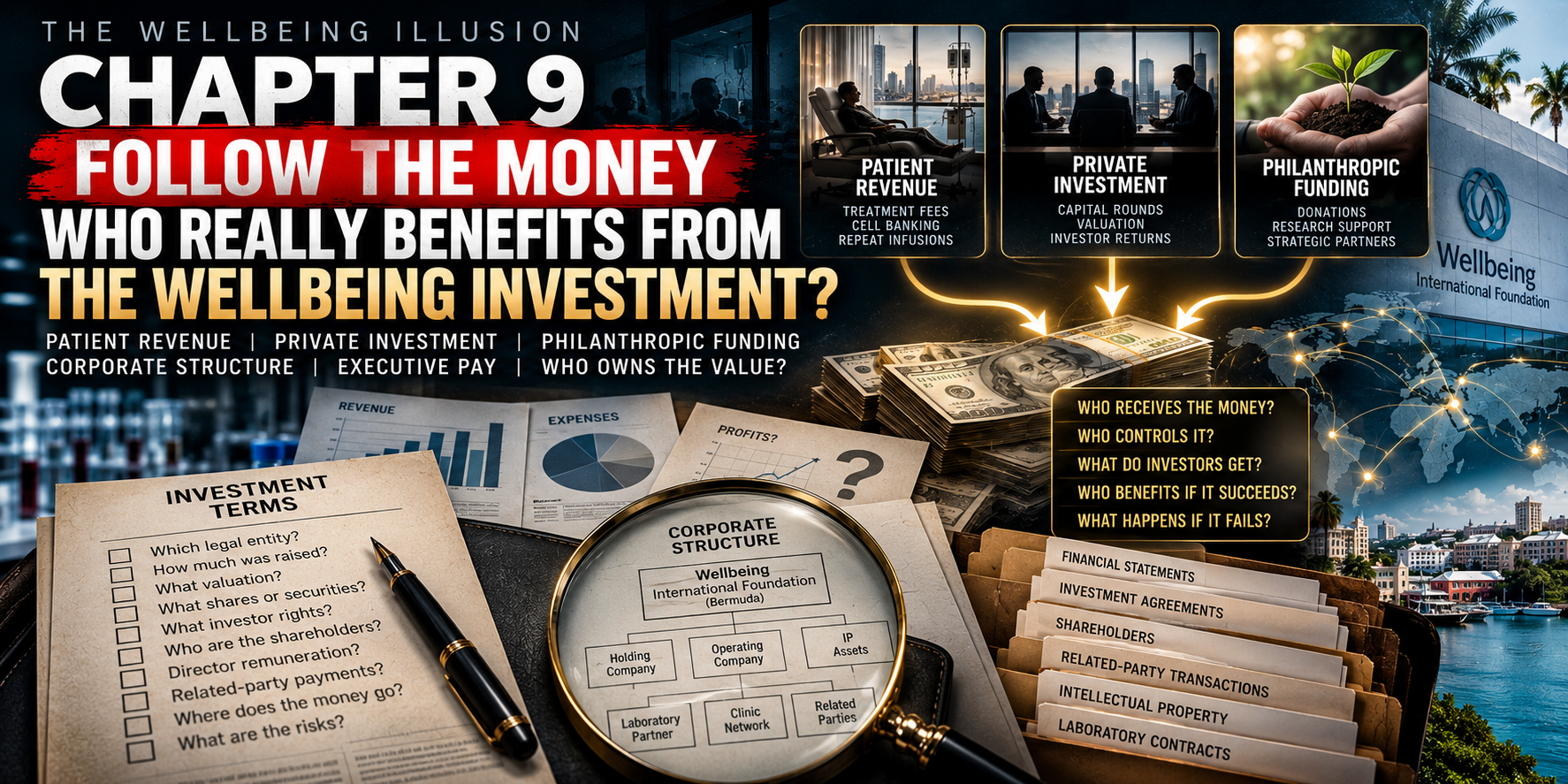
This is where Chapter Eight becomes unavoidable.
Wellbeing announced in 2026 that it had closed the opening tranche of a capital round.
Investment changes the question completely.
A patient may principally care whether the treatment is safe and effective.
An investor needs to understand something else as well.
What does the company actually own?
Not what can it access.
Not who does it know.
Not which scientists advise it.
Not which laboratories process material.
Not which doctors can administer infusions.
Not which independent research papers support the biological theory.
What assets belong to the organisation receiving the investment?
That is a very different question.
Follow the Assets
After seven chapters, we can now place almost every part of the Wellbeing proposition into a category.
The clinics.
Are they owned?
Or partners?
The physicians.
Employees?
Contractors?
Independent practitioners?
The German laboratory.
Owned?
Controlled?
Or contracted?
The protocols.
Who owns them?
The intellectual property.
Where is it?
The patents.
Who owns them?
The historical patient data.
Who controls it?
The banked biological material.
Who is its legal custodian?
The clinical study.
Who sponsored it?
The research.
Who paid for it?
The scientific know-how.
Does it belong to Wellbeing, individual scientists, the laboratory, or another entity?
The brand.
The website.
The patient relationships.
The clinical network.
The commercial agreements.
The revenue.
The investment capital.
For the first time, all of those questions can now be placed on the same table.
And once we do that, something becomes obvious.
We need to stop following the claims.
We need to follow the ownership.
Seven Chapters Have Brought Us to One Question
This investigation began by asking where Wellbeing actually was.
Then we followed its clinic network.
We followed the people treating the patients.
We followed the blood to Germany.
We followed the scientific history.
We searched for twenty years of research.
We searched for the historical patient outcomes.
And now we have followed the clinical trial.
Every road has brought us to the same place.
Ownership.
Because an organisation can appear enormous when everything surrounding it is placed together.
Twenty-three partner clinics.
A German laboratory.
Doctors.
Scientists.
Hundreds of scientific papers.
Patients around the world.
Professional athletes.
Clinical research.
Decades of experience.
But the critical due-diligence question is not how impressive that combined ecosystem appears.
It is much simpler.
Which parts of that ecosystem actually belong to Wellbeing International Foundation?
That question matters to patients.
It matters to doctors.
It matters to regulators.
But most of all, it matters to anybody being invited to invest.
Because Chapter Eight is no longer about whether Cell-Free Therapy sounds scientifically plausible.
It is about something considerably more concrete.
Assets.
Ownership.
Control.
Intellectual property.
Contracts.
Infrastructure.
And ultimately:
What is the investor actually buying?
Next: Chapter Eight — What Does Wellbeing Actually Own?
This is where the investigation changes.
We have followed the clinics, the physicians, the German laboratory, the scientific protocols, the research history, the patients and the clinical trial.
Now we strip the entire proposition down to its assets.
Which clinics does Wellbeing own? Does it own the German laboratory? Who owns the Cell-Free Therapy protocol? Where is the intellectual property? Who owns the patents behind the earlier science? Who controls the patient data and banked biological material? What contracts secure the clinical network? And what assets actually sit inside the organisation receiving investors' money?
Because access is not ownership.
Partnership is not ownership.
Scientific history is not ownership.
And when investment money enters the story, there is one question that matters above almost everything else:
What, exactly, are you buying?
Recent Posts