Inside the German Laboratory: Who Actually Makes Wellbeing’s Cell-Free Therapy?
The Wellbeing Illusion — Chapter Four
If there is one physical location that appears indispensable to Wellbeing International Foundation's Cell-Free Therapy, it is not Bermuda.
It is not Harley Street.
It is not one of the 23 partner clinics.
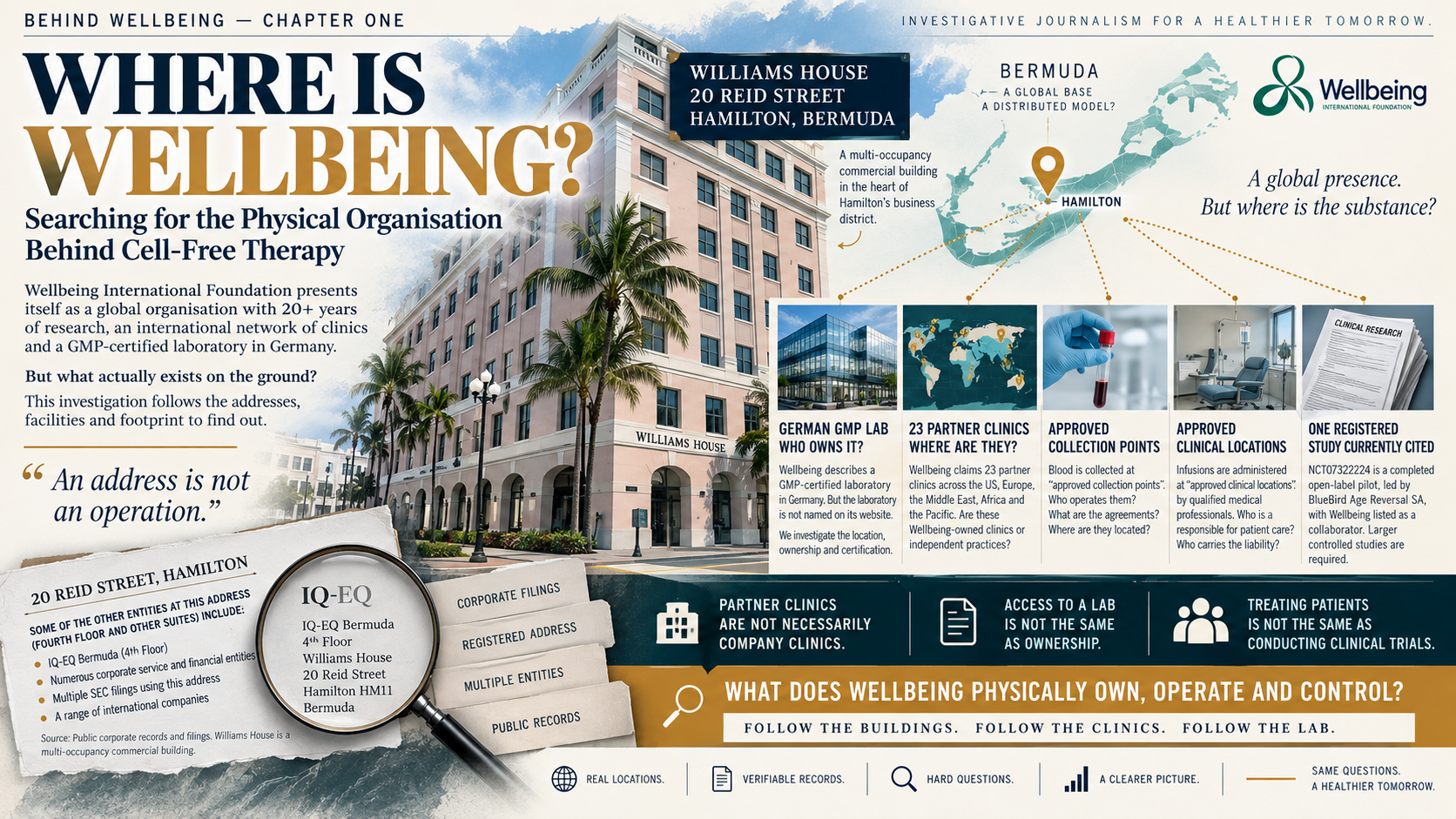
It is the laboratory in Germany.
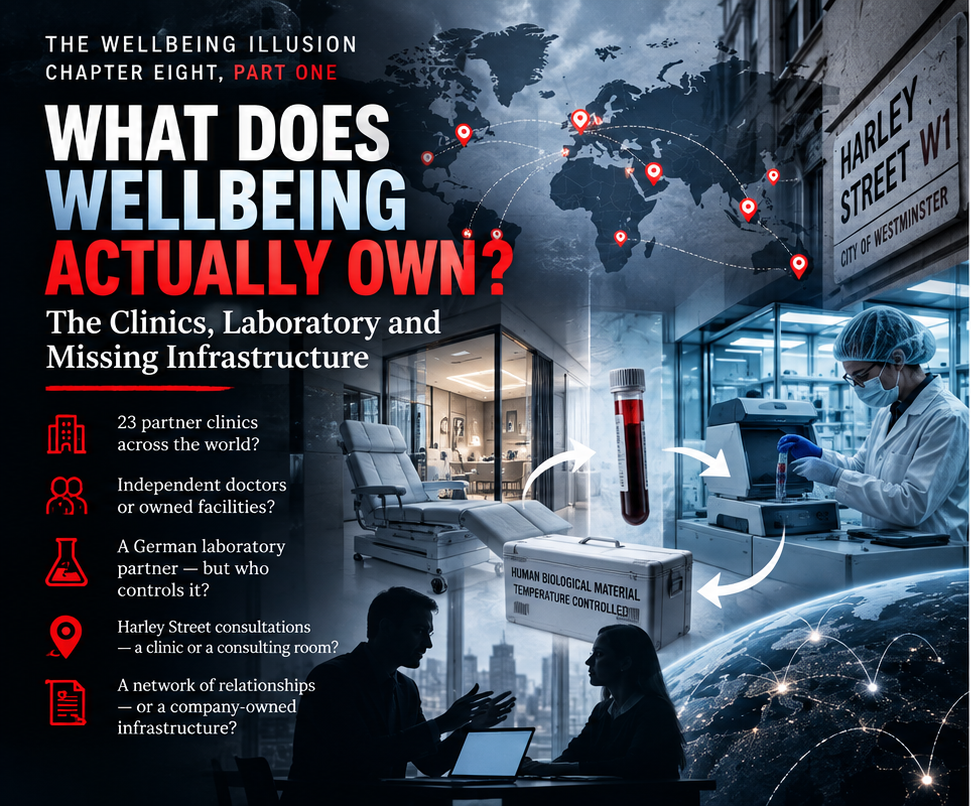
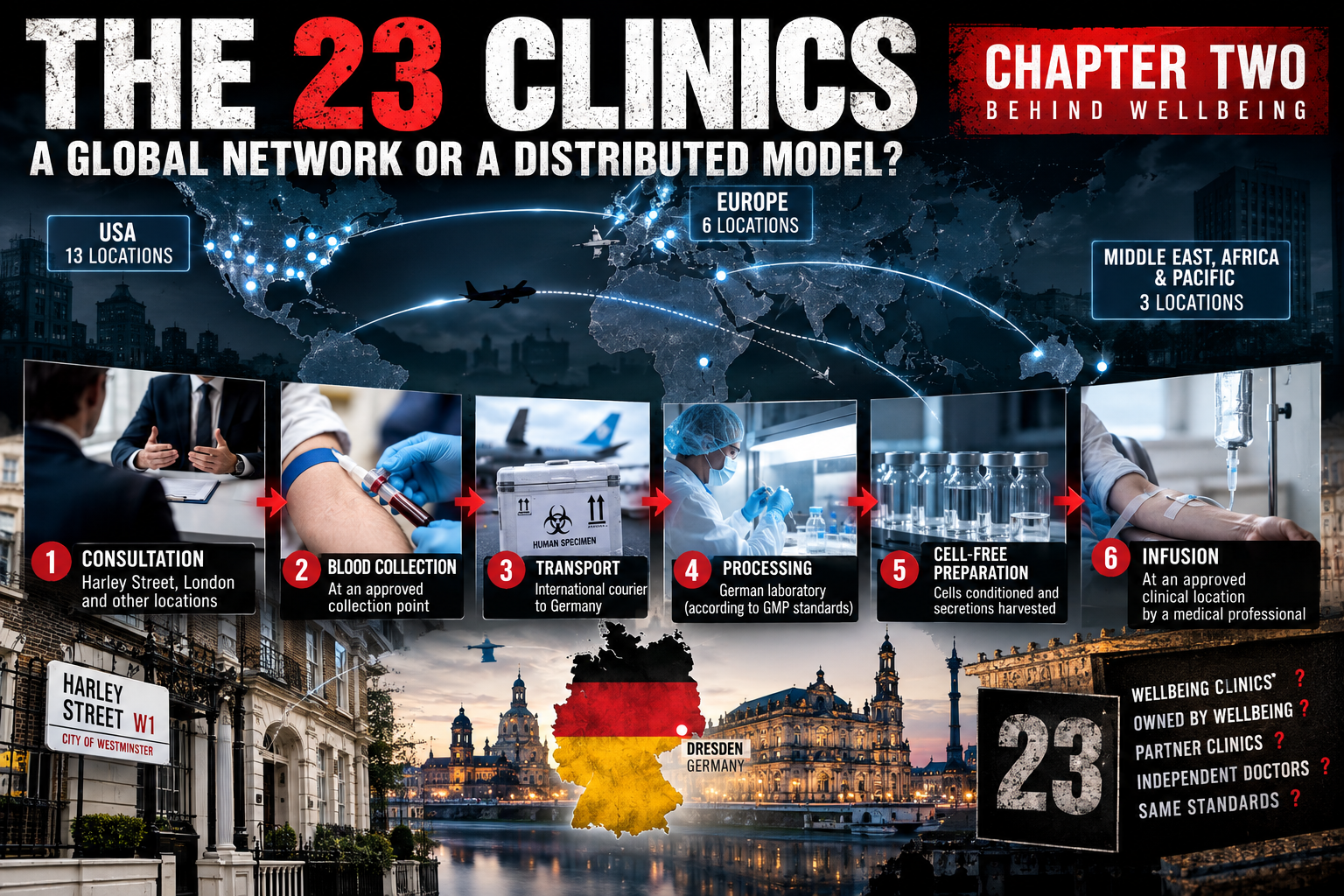
Wellbeing's current website describes it as a “GMP-certified laboratory” and says every Cell-Free Therapy preparation is processed there. The patient gives approximately 150ml of blood at an approved collection point; that sample is transported to Germany, where cells are isolated and conditioned, the cell-free output is harvested and tested, and the resulting preparation can later be returned for intravenous administration. Wellbeing International Foundation
Wellbeing's About page goes further, calling it the organisation's:
“German GMP-certified laboratory partner.” Wellbeing International Foundation
That final word is important.
Partner.
It indicates that the laboratory sits alongside Wellbeing rather than necessarily being a facility owned by Wellbeing itself.
So we started looking behind the phrase “German laboratory.”
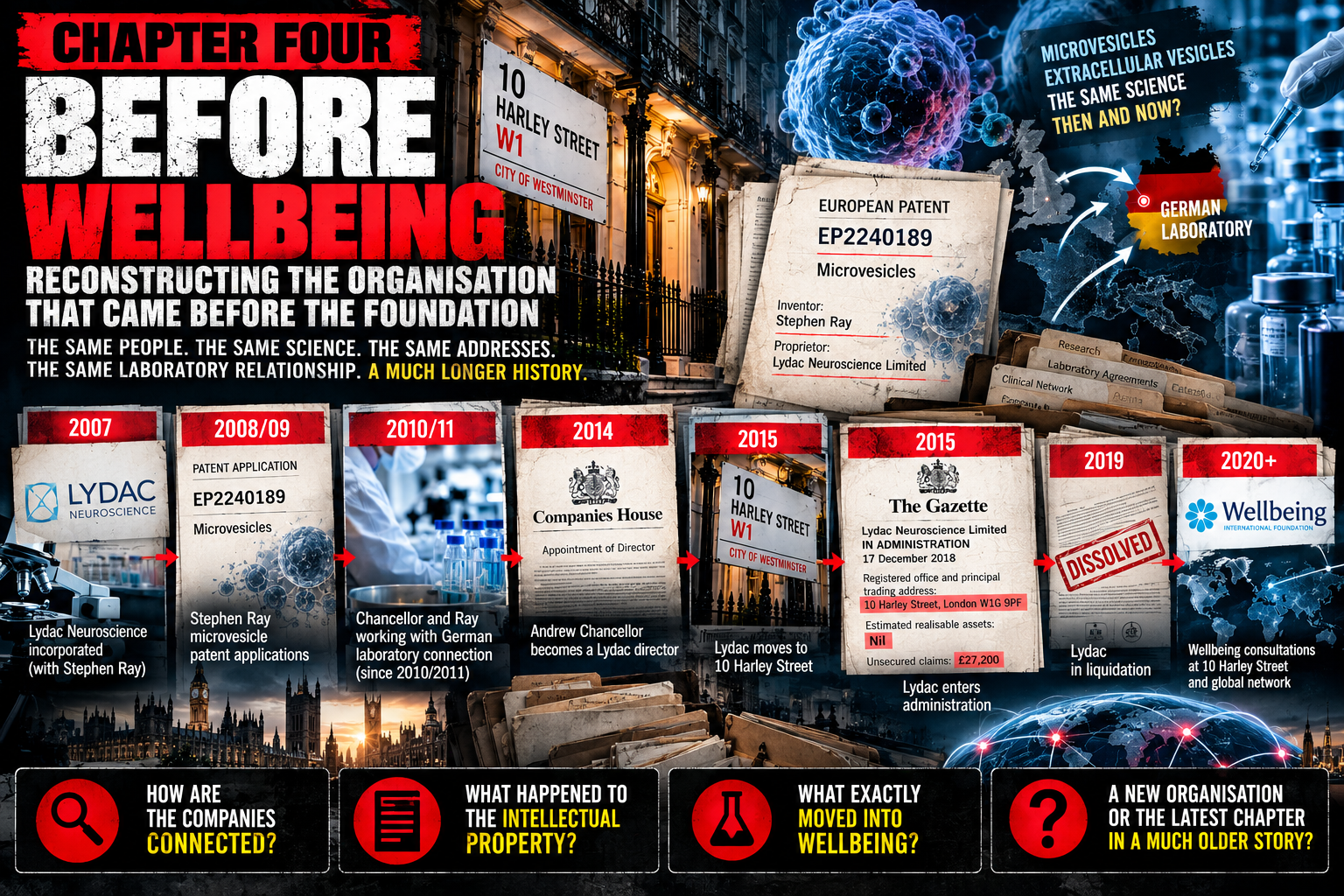
And what we found takes the Wellbeing story back more than a decade.
The Laboratory Is the Manufacturing Heart of the Process
Forget the marketing for a moment and follow the biology.
Without the German laboratory, there appears to be no CFT preparation.
Wellbeing's current process says the patient's blood is sent there under monitored conditions.
The cells are isolated.
They are placed under controlled conditions.
Wellbeing says those conditions stimulate the cells' natural signalling response.
The cell-free output is collected.
It undergoes quality testing.
Material may then be stored.
Eventually it is made available for infusion. Wellbeing International Foundation
Whatever view one takes of the claimed biological effects, the laboratory is therefore performing one of the most important physical functions in the entire Wellbeing system.
The clinic doesn't manufacture the preparation.
The CEO doesn't manufacture it.
The patient coordinator doesn't manufacture it.
Germany does.
So who exactly is Germany?
The Public Website Doesn't Name the Laboratory
This is where things become interesting.
Wellbeing's current Contact page identifies:
Germany (Laboratory)
and describes a:
“State-of-the-art GMP-certified laboratory for cell-free preparation processing.” Wellbeing International Foundation
But the page does not name the laboratory company.
It doesn't provide its address.
And it doesn't identify the certification number or certification scope on that page.
The Regulatory page similarly says Wellbeing uses an:
“EU-compliant, GMP-certified laboratory in Germany”
with full traceability, batch testing and quality assurance. Wellbeing International Foundation
Again, the laboratory isn't identified there by corporate name.
So we went back into the historical evidence.
And there, the picture becomes considerably clearer.
A Prospective Patient Was Introduced Directly to the Laboratory
In January, an investigator posing as a prospective patient asked Wellbeing to explain what happened to his blood in Germany.
Andrew Chancellor arranged a video meeting.
The people on that call included Chancellor and a representative of a German laboratory business called Ad Lentus.
At the beginning of the meeting Chancellor introduced the German participant as the person running Ad Lentus and described it as the laboratory Wellbeing worked with. 4. MR Stem Cell report.
This is significant.
This wasn't information inferred from a company directory.
The introduction came from Wellbeing's CEO during a discussion specifically arranged to explain the laboratory that would process the prospective patient's biological material.
The Relationship Went Back Years
The conversation then became even more interesting.
Chancellor explained that the German laboratory relationship was not new.
He recalled working with the laboratory connection from around 2010 or 2011.
The German representative remembered the relationship as potentially extending even further back.
Chancellor also described Stephen Ray as being central to the scientific side of the arrangement, saying:
“Steve designs all the protocols that we use.”
2. UC TL (1)
This is an extremely important piece of the Wellbeing structure.
Because it begins to separate three distinct functions.
Wellbeing — coordination and commercial organisation.
Stephen Ray — scientific protocol.
German laboratory — physical processing, quality and process control.
And according to the participants themselves, versions of that relationship existed long before the current Wellbeing website.
The Laboratory Representative Explained His Role
The German representative then described what his laboratory did.
He said:
“We carry out the protocols of Wellbeing International.”
He also described responsibility for:
“quality control”
and:
“process control.”
1. Ad lentus (1)
That distinction matters.
It suggests the laboratory was not necessarily inventing the entire Wellbeing process independently.
According to the recorded discussion, protocols were associated with Ray and Wellbeing, while the laboratory implemented the process and controlled its execution.
That raises an important question for today's CFT:
Who owns the current manufacturing protocol?
Is it Wellbeing?
Ray?
The laboratory?
Another legal entity?
Or is it governed through a licence or contractual arrangement?
Wellbeing's public pages reviewed for this article do not answer that question.
What Actually Happened to the Patient's Cells?
The 2021 conversation provides a rare historical description from inside the processing relationship.
The prospective patient asked whether drugs or other substances were being added.
The German representative said they were not.
He described cells being isolated and then subjected to the protocol.
The objective, as he explained it, was to stimulate them so biological signalling substances accumulated in the surrounding liquid.
Among the substances he specifically mentioned were:
cytokines;
microvesicles;
and:
growth factors.
He described the resulting material as coming from the patient's own biological starting material. 6. Max Robert Lewinsohn
This is broadly recognisable alongside the biological principles Wellbeing describes publicly today, although the organisation's current process and terminology should not simply be assumed to be identical to the 2021 method.
Processes evolve.
Protocols change.
Regulatory requirements change.
That distinction is important.
But the historical continuity is difficult to miss.
Then Comes the Word “GMP”
Today Wellbeing uses unequivocal language.
It says the laboratory is:
“GMP-certified.” Wellbeing International Foundation
But during the 2021 recorded conversation, the German representative used slightly different wording.
He said:
“we have a laboratory, according to GMP standards.”
2. UC TL (1)
Those statements are not necessarily contradictory.
A facility can change status over time.
The speaker may have been using informal English rather than regulatory terminology.
A different facility or corporate entity may now perform the work.
Or the laboratory may indeed have held relevant certification at the time and the speaker simply described it imprecisely.
We therefore cannot responsibly conclude from those words that the facility was not GMP-certified in 2021.
But neither should “according to GMP standards” and “GMP-certified” automatically be treated as interchangeable without examining the underlying documentation.
GMP Is Not Just a Marketing Term
This distinction matters because GMP — Good Manufacturing Practice — is not simply another way of saying a laboratory is clean or professionally run.
The meaningful questions concern the actual regulatory documentation.
Which legal entity holds the relevant authorisation or certificate?
Which physical premises does it cover?
Which regulatory authority issued or inspected it?
What activities are included within its scope?
What products or manufacturing processes are authorised?
When was the facility last inspected?
And does that scope encompass the specific processing being performed for Wellbeing's CFT preparations?
Those are documentary questions.
And Wellbeing itself says detailed regulatory documentation is available from its team. Wellbeing International Foundation
For this investigation, seeing that documentation would resolve a significant part of the uncertainty.
Ad Lentus Is a Real German Biotechnology Business
This is another important distinction.
Our investigation is not suggesting that Ad Lentus is an invented laboratory.
It isn't.
Ad Lentus GmbH has a public presence in Germany.
Its own website identifies the company as:
Ad Lentus GmbH
at:
Magirus-Deutz-Str. 18 D
89077 Ulm
Germany.
Its legal notice identifies the business in the Ulm commercial register under HRB 731330 and names Jörn Steiger and Cornelia Ludwig as managing directors. Ad Lentus GmbH
Its website describes specialist analytical laboratory services involving the isolation and analysis of human cell types and cytokines.
It also advertises expertise in process development, method transfer, automation, GMP compliance, quality-management systems and pharmaceutical production development. Ad Lentus GmbH
Those are substantial biotechnology activities.
But something else emerged from the public corporate record.
There Is More Than One Ad Lentus Company
Public German corporate information also identifies a separate company:
Ad Lentus Laboratories GmbH.
It was registered in 2019 and has an address in Laichingen.
Its publicly recorded business purpose includes pharmaceutical project development, biotechnology, cell-based products, regenerative medicine, quality assurance and GMP systems. Company House
This distinction becomes important.
Because saying simply “Ad Lentus” does not necessarily tell us which legal entity performed a particular activity at a particular time.
Was Wellbeing's historical laboratory relationship with Ad Lentus GmbH?
Ad Lentus Laboratories GmbH?
Did the relationship migrate between entities?
Which company actually received patient samples?
Which company invoiced for processing?
Which company employed the laboratory personnel?
And most importantly today:
Which legal entity holds the certification Wellbeing relies upon when it describes its current laboratory as GMP-certified?
We have not yet established those answers.
The Current Laboratory May Not Be the Historical Laboratory
This is another point where we need to be careful.
The 2021 evidence connects Wellbeing's historical processing arrangement with Ad Lentus.
The current Wellbeing website says it has a German GMP-certified laboratory partner. Wellbeing International Foundation
But from the current public Wellbeing pages reviewed for this chapter, we have not independently established that Ad Lentus remains the current CFT processing laboratory in September 2026.
That distinction matters enormously.
It would be tempting to simply write:
“Wellbeing's laboratory is Ad Lentus.”
The historical evidence supports that description for the arrangement discussed in 2021.
It does not, by itself, prove the current arrangement is unchanged.
So we asked the harder question instead.
Who processes CFT today?
There Is Another Geographic Puzzle
Our historical evidence contains another intriguing detail.
In a separate recorded conversation, Chancellor was asked whether an infusion could take place in Germany.
He replied that it could.
When asked where the laboratory was, he described it as being in eastern Germany and referred to Dresden.
He also said biological material was stored in the German laboratory in preservation tanks and claimed some stored material dated back to 2010 and was periodically checked. 7. SR meeting Part 1
But the public Ad Lentus businesses identified today are associated with Ulm and Laichingen, in Baden-Württemberg — not Dresden. Ad Lentus GmbH
That does not establish a contradiction.
Wellbeing may have had multiple facilities.
Storage and processing may have occurred in different places.
A partner facility may have existed in Dresden.
The arrangement may have changed.
Or Chancellor may simply have been referring to a clinical location rather than the same processing facility.
The evidence currently available does not resolve this.
But it gives us another question that deserves an answer:
Where, physically, was the patient's biological material being processed and stored?
The Storage Claim Is Particularly Important
Consider what Chancellor's historical statement implies.
If biological material derived from patients was being stored for years, there should be a substantial documentary framework surrounding that activity.
Patient consent.
Sample identification.
Storage conditions.
Traceability.
Retention periods.
Release procedures.
Quality checks.
Destruction procedures.
Data protection.
Chain of custody.
And a legal entity responsible for maintaining the material.
Wellbeing's current process continues to advertise optional cell banking, meaning material can be stored for future use. Wellbeing International Foundation
So this is not merely an historical curiosity.
Storage appears to remain part of the modern business model.
Which means another simple question emerges:
Who legally holds the patient's banked biological material?
Wellbeing Says Traceability Is Complete
Its current regulatory page makes strong quality-control claims.
Wellbeing says the German laboratory provides:
full traceability;
batch testing;
and:
quality assurance.
It says there is complete tracking from patient sample to final preparation. Wellbeing International Foundation
Those are exactly the systems we would expect to see around this type of process.
And they should create documentation.
A patient's blood doesn't simply become “CFT.”
There should be records showing what happened.
When the sample arrived.
Who received it.
What identifier it was given.
What process occurred.
Which protocol version was used.
What equipment was involved.
What quality tests were performed.
Whether the batch passed.
Who released it.
What was stored.
What was shipped.
And where it ultimately went.
That documentary trail may be one of the most important pieces of evidence in the entire Wellbeing system.
Then There Is Stephen Ray
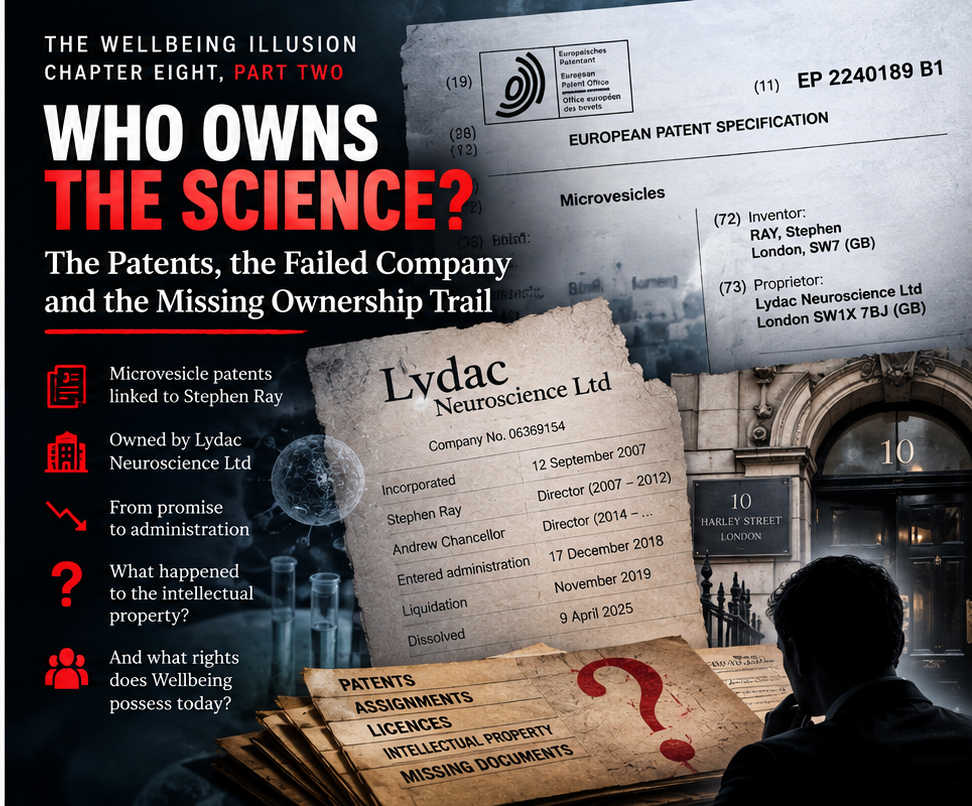
The laboratory investigation also brings us back to the scientific ownership question.
Chancellor's recorded statement was remarkably clear:
“Steve designs all the protocols that we use.”
2. UC TL (1)
That was 2021.
Wellbeing today identifies Stephen Ray as its Senior Scientific Consultant and describes more than 30 years of academic and commercial cell-therapy research. Wellbeing International Foundation
So what exactly is Ray's relationship to the present CFT manufacturing protocol?
Did he personally develop it?
Does Wellbeing own it?
Was it assigned to Wellbeing?
Is it licensed?
Does the German laboratory receive a controlled manufacturing protocol from Wellbeing?
Does the laboratory have discretion to modify it?
Who approves modifications?
Who owns improvements developed inside the laboratory?
Those may sound like corporate-law questions.
They are not.
They are central to understanding what Wellbeing actually possesses.
Because the Laboratory May Hold More Than the Buildings
Imagine that Wellbeing owns no laboratory.
That doesn't necessarily matter.
Many successful biotechnology companies outsource manufacturing.
But if manufacturing is outsourced, the organisation normally needs something else.
A proprietary protocol.
A patent.
A licence.
Protected know-how.
Validated processes.
Exclusive manufacturing rights.
Contracts.
Data.
Or some other defensible intellectual asset.
Otherwise, an investor needs to understand precisely what prevents another organisation from reproducing the commercial model.
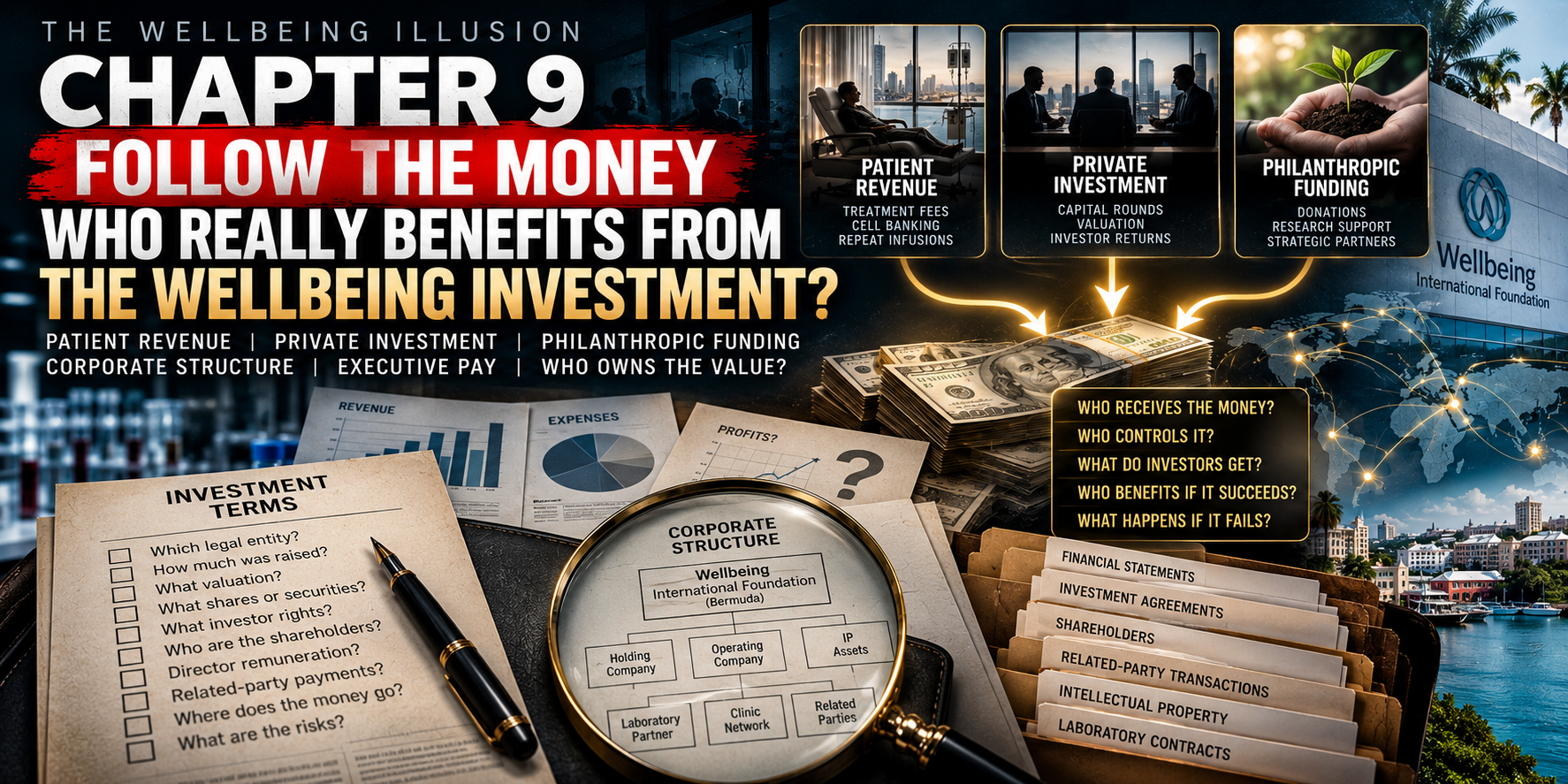
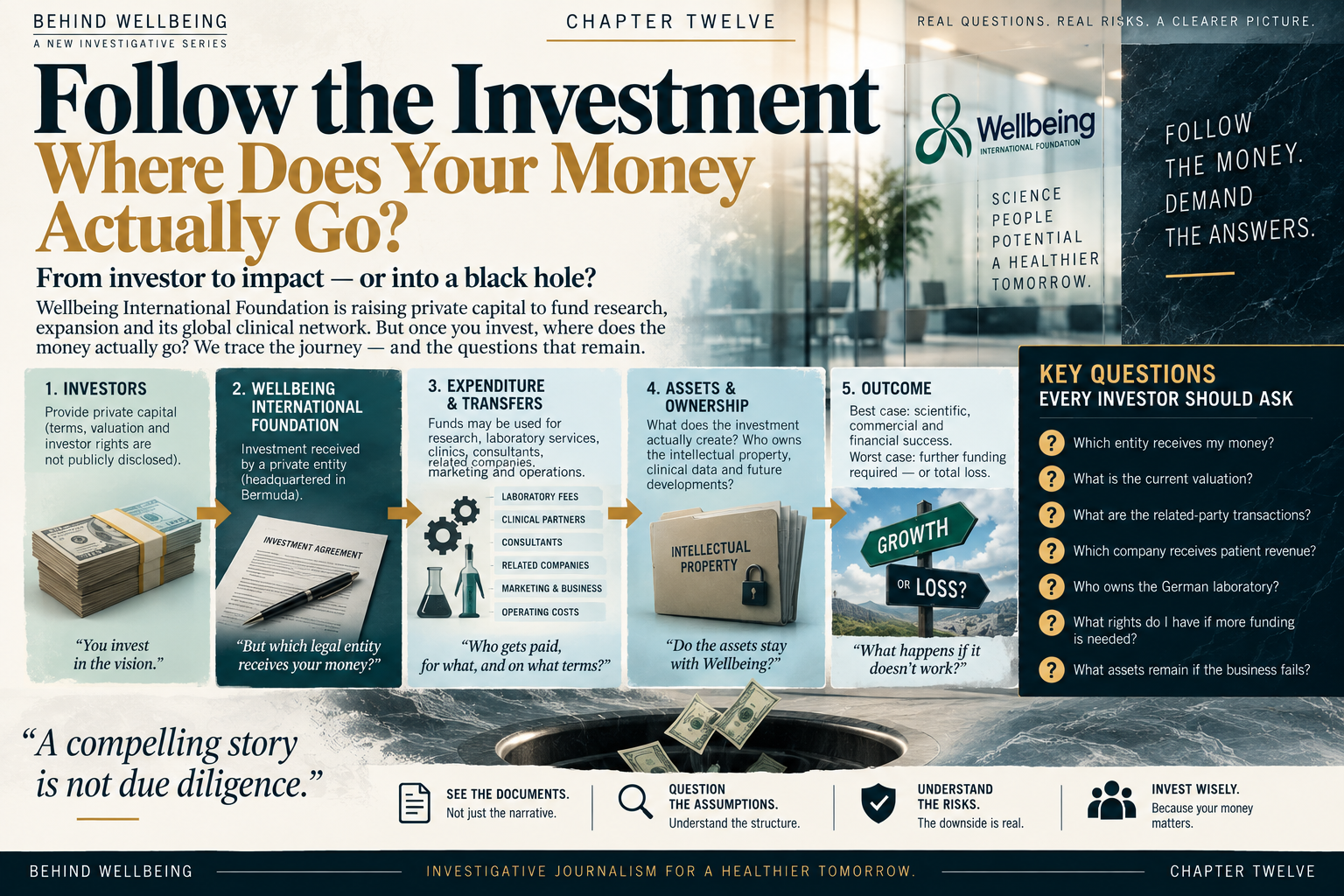
This becomes especially important because Wellbeing announced a new private capital round in 2026 and said the money would support research, documentation, operating capacity and expansion of its clinical-relationship network. (wellbeingint.com)
If investors are funding biotechnology, the ownership and control of the underlying biotechnology matter.
What We Have Established
At this stage, the evidence supports several conclusions.
Wellbeing currently says CFT preparations are processed at a GMP-certified laboratory in Germany. Wellbeing International Foundation
Wellbeing describes that facility as a laboratory partner, rather than publicly presenting it on the pages reviewed as a Wellbeing-owned laboratory. Wellbeing International Foundation
Historical evidence establishes that Wellbeing had a processing relationship with Ad Lentus in 2021. 4. MR Stem Cell report.
The German laboratory representative said the laboratory carried out Wellbeing protocols and handled quality and process control. 1. Ad lentus (1)
Chancellor said Stephen Ray designed the protocols used at the time. 2. UC TL (1)
And Ad Lentus is a real German biotechnology business publicly advertising analytical laboratory, cell, cytokine, process-development and GMP-compliance expertise. Ad Lentus GmbH
Those are facts we can document.
What We Have Not Established
There are equally important things we cannot yet say.
We have not independently established that Ad Lentus is Wellbeing's current 2026 CFT processing laboratory.
We have not obtained the current GMP certificate relied upon by Wellbeing.
We therefore have not independently verified its holder, physical site, issuing authority or precise scope.
We have not established whether the historical Dresden reference concerned processing, storage, infusion or another partner facility.
We have not established who legally owns Wellbeing's current CFT manufacturing protocol.
And we have not established the contractual relationship governing intellectual property between Wellbeing, Ray and the current laboratory partner.
Those are not reasons to declare the laboratory illegitimate.
They are reasons to obtain the documents.
The Laboratory Behind the Curtain
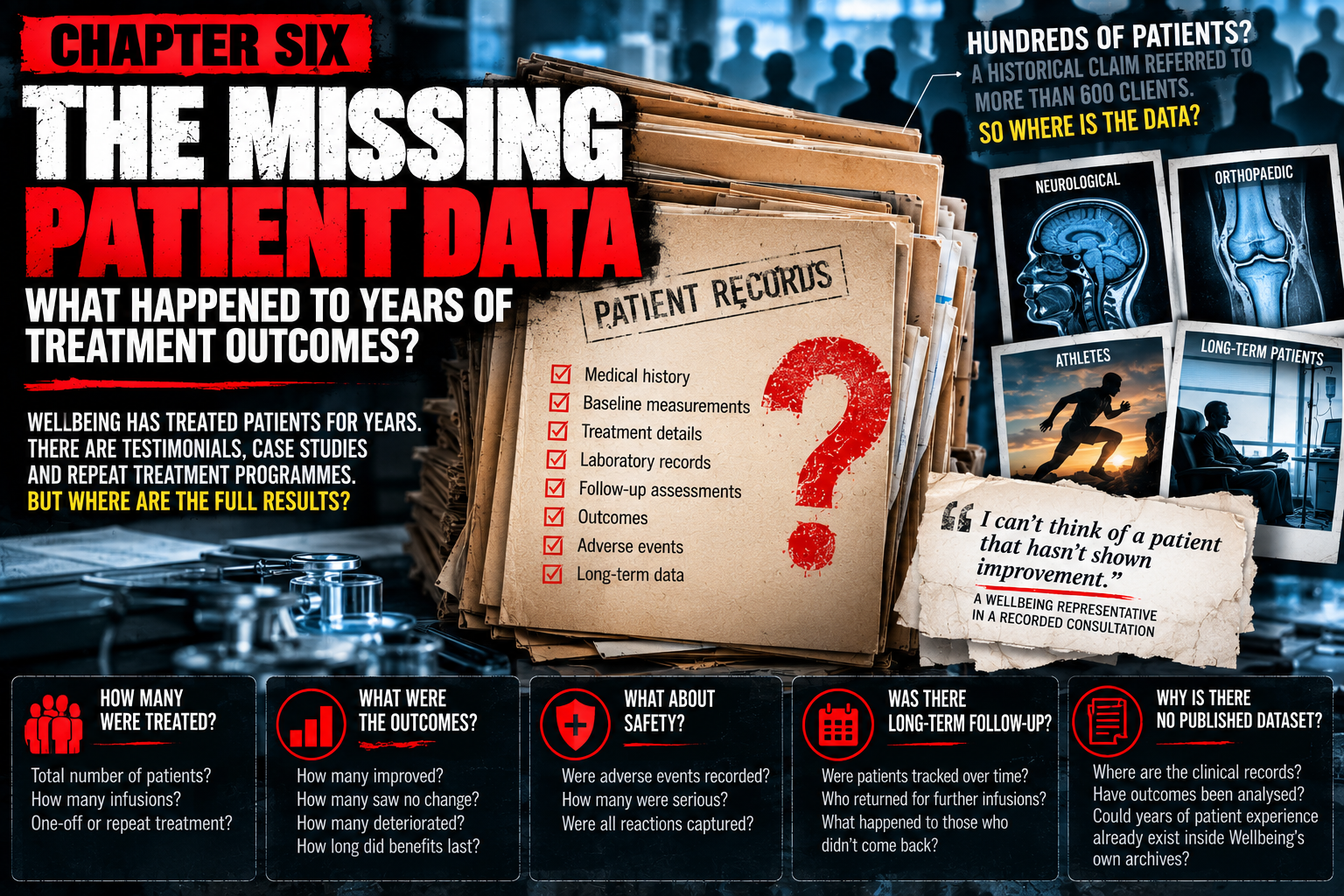
Chapter Two showed us that Wellbeing's international clinic network appears to operate largely through relationships.
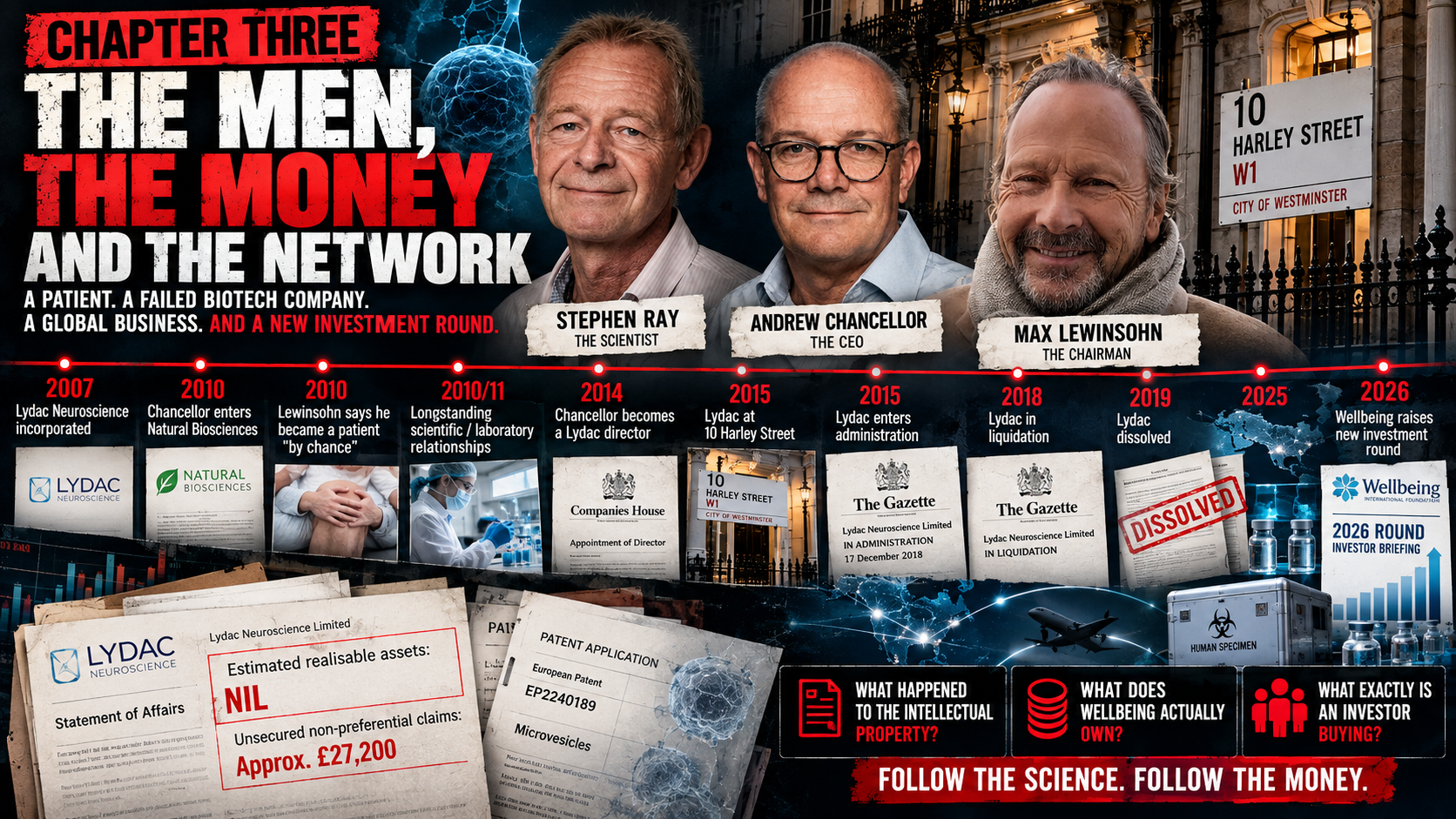
Chapter Three showed that clinical responsibility can involve different professionals and organisations.
Now Chapter Four reveals the same pattern at the scientific centre of the operation.
The laboratory appears to be a partner.
Historically, the protocol was described as being designed outside the laboratory and executed inside it.
The patients were elsewhere.
The doctors were elsewhere.
The commercial organisation was elsewhere.
The biological material moved between them.
That may be an entirely workable biotechnology model.
But it makes the contractual and documentary relationships between those components absolutely fundamental.
Because somewhere inside Germany is the place where a tube of blood stops being simply a patient's blood and becomes the preparation Wellbeing calls Cell-Free Therapy.
And if we want to understand Wellbeing International Foundation, that transformation may be the single most important part of the entire operation to investigate.
We therefore end with four questions:
Who owns the laboratory?
Who certifies the process?
Who owns the protocol?
And ultimately:
Who actually makes CFT?
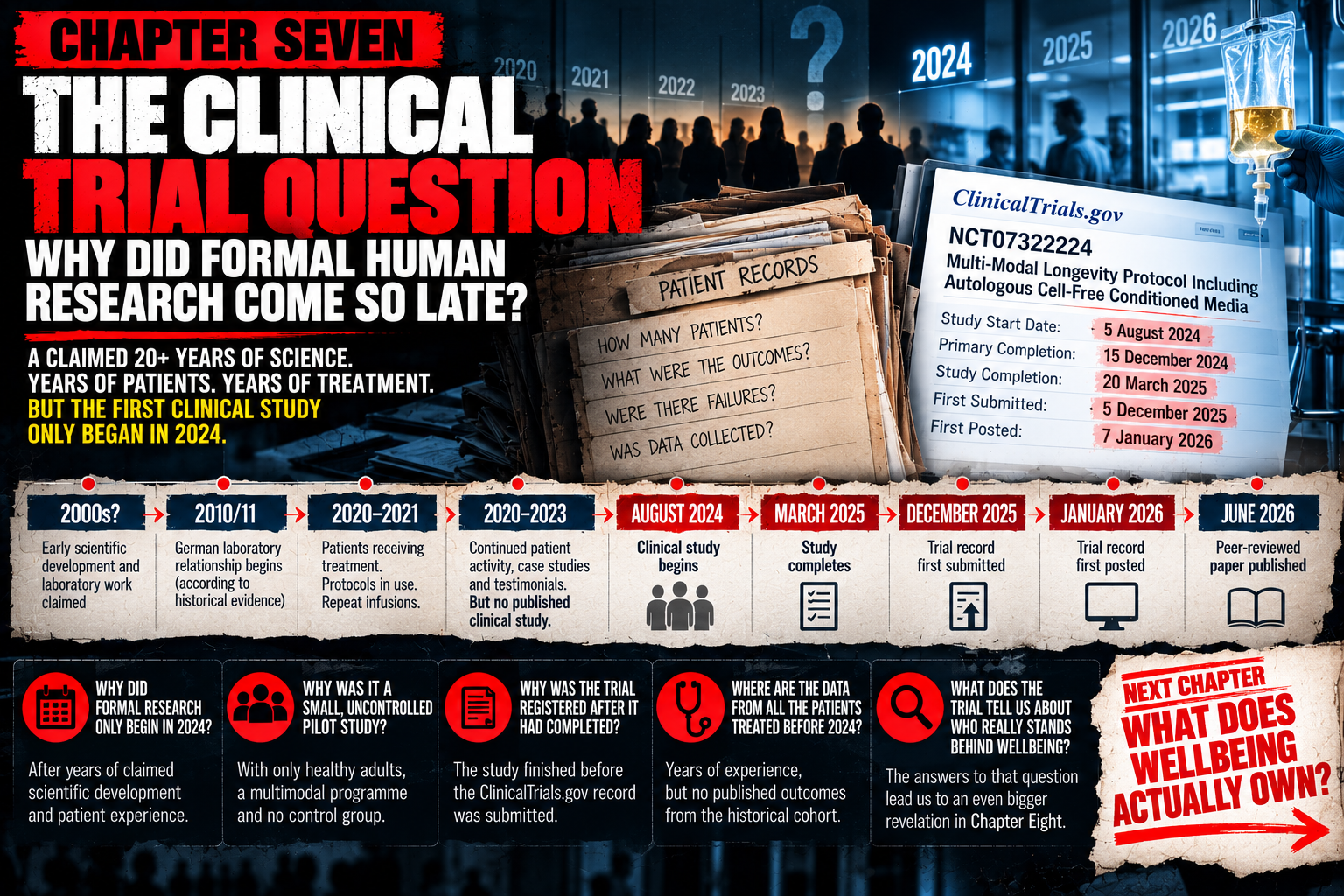
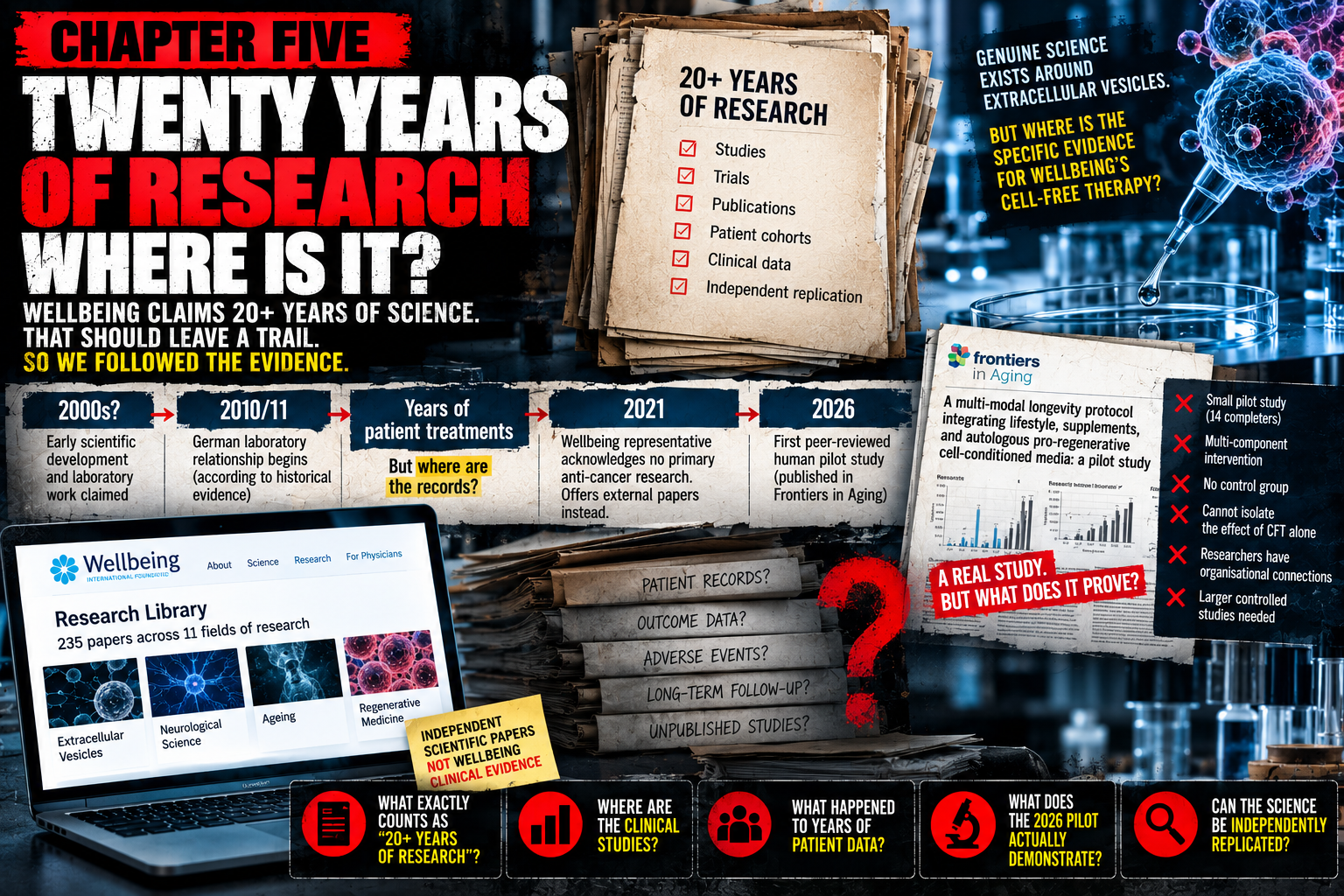
Next: Chapter Five — Twenty Years of Research: Where Is It?
Wellbeing describes a scientific programme extending over more than two decades. In Chapter Five we stop following the businesses and start following the science. We search the publications, clinical trials, patents, research institutions and named investigators behind those twenty years — and separate documented research from commercial history.
Recent Posts