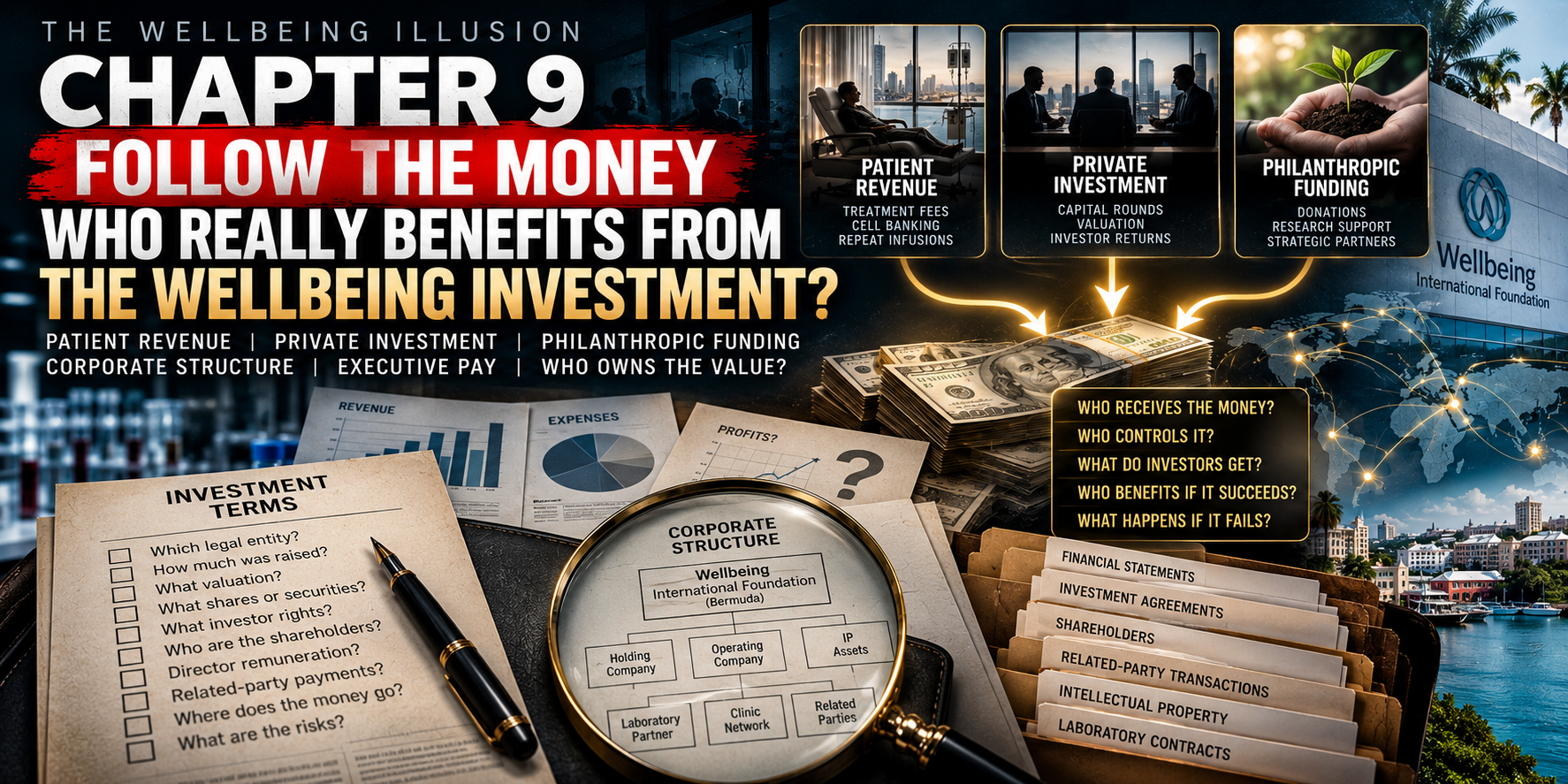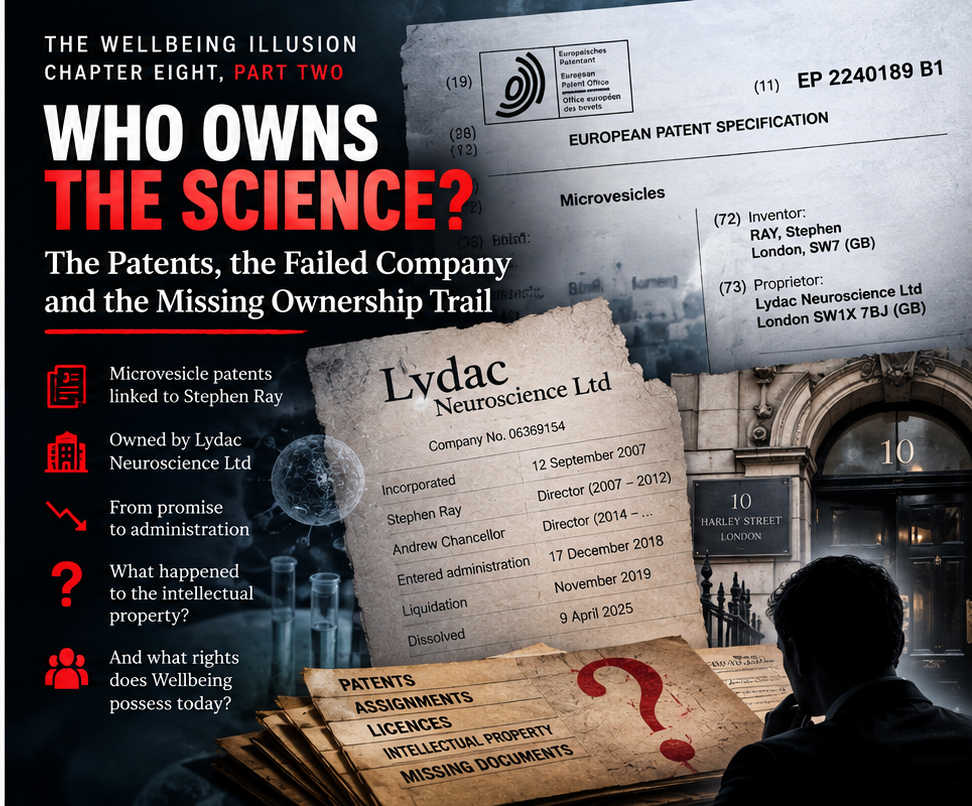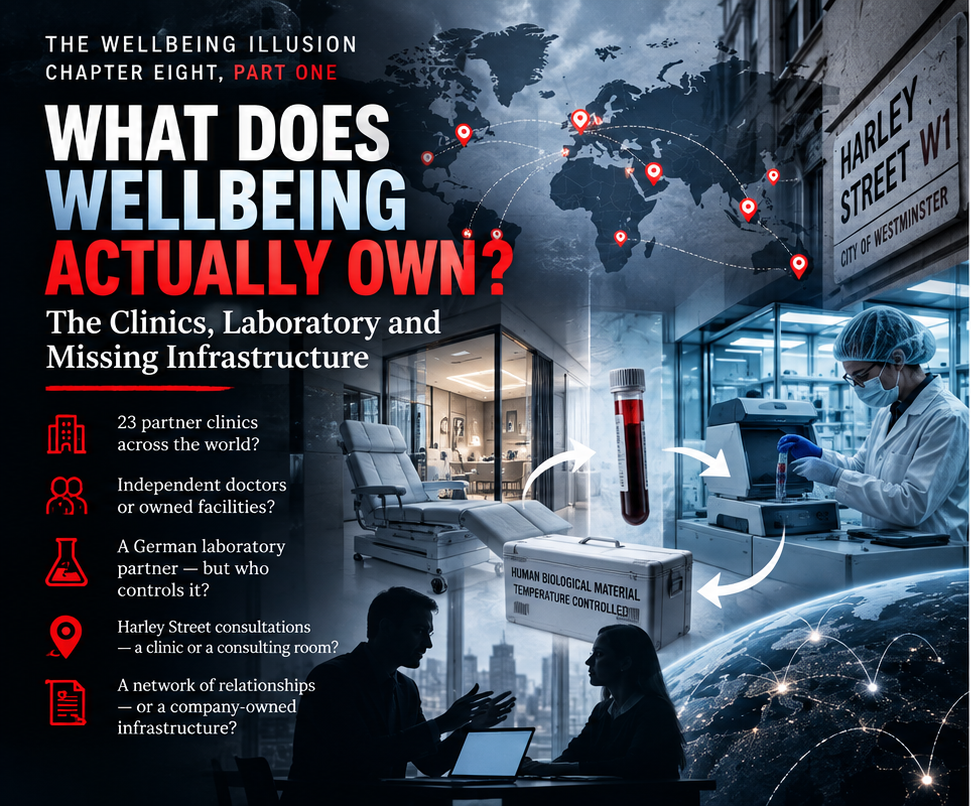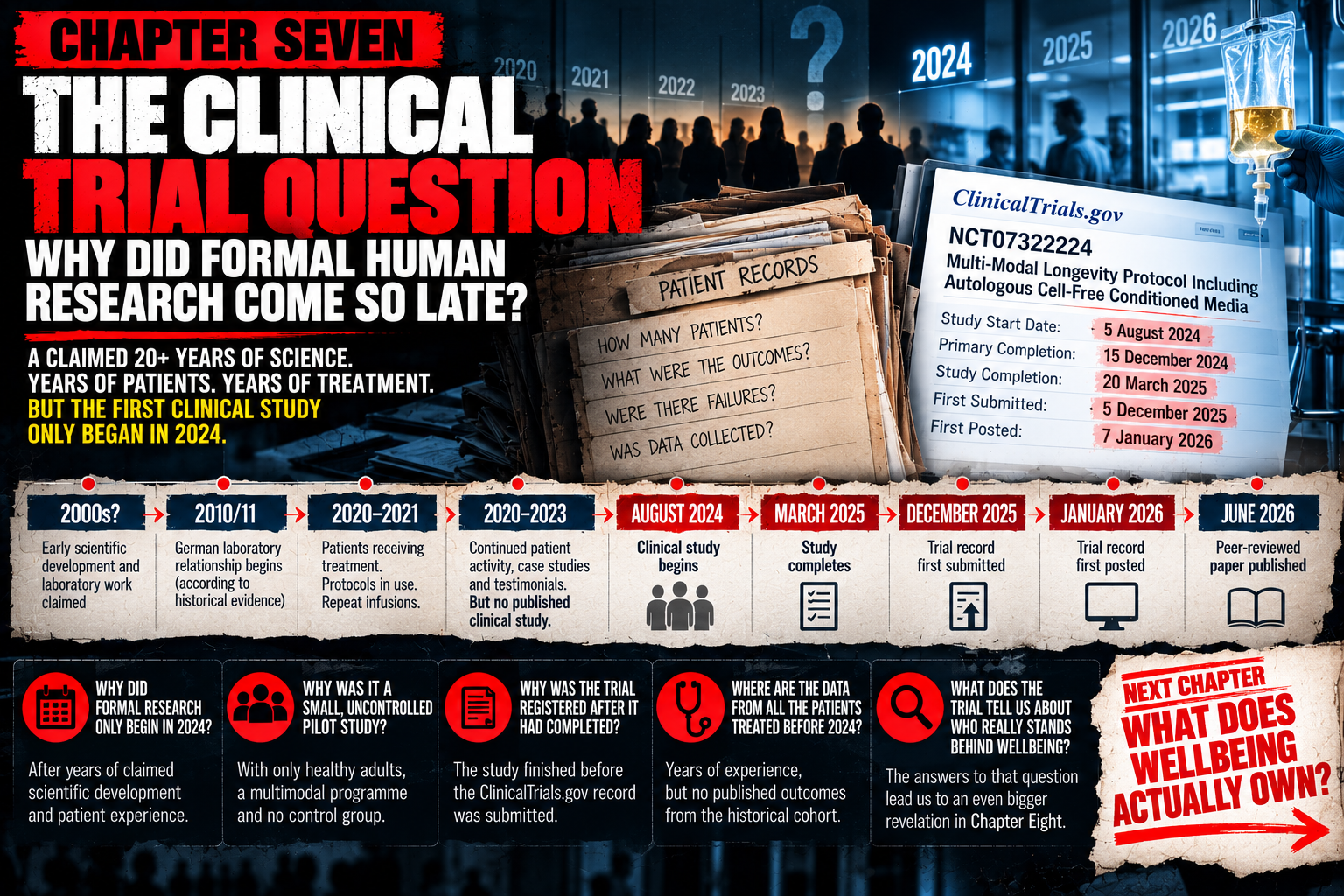
Who Is Actually Treating the Patient? Inside Wellbeing’s Clinical Chain
The Wellbeing Illusion — Chapter Three
There is a point in this investigation where company structures, clinic networks and biotechnology stop being abstract.
A patient sits down.
They discuss their health.
Someone considers whether Cell-Free Therapy is appropriate.
Blood is taken.
That blood crosses an international border.
A laboratory processes material derived from it.
Weeks later, a biological preparation is infused back into the patient's body.
At that point, one question matters more than almost anything else:
Who is actually treating the patient?
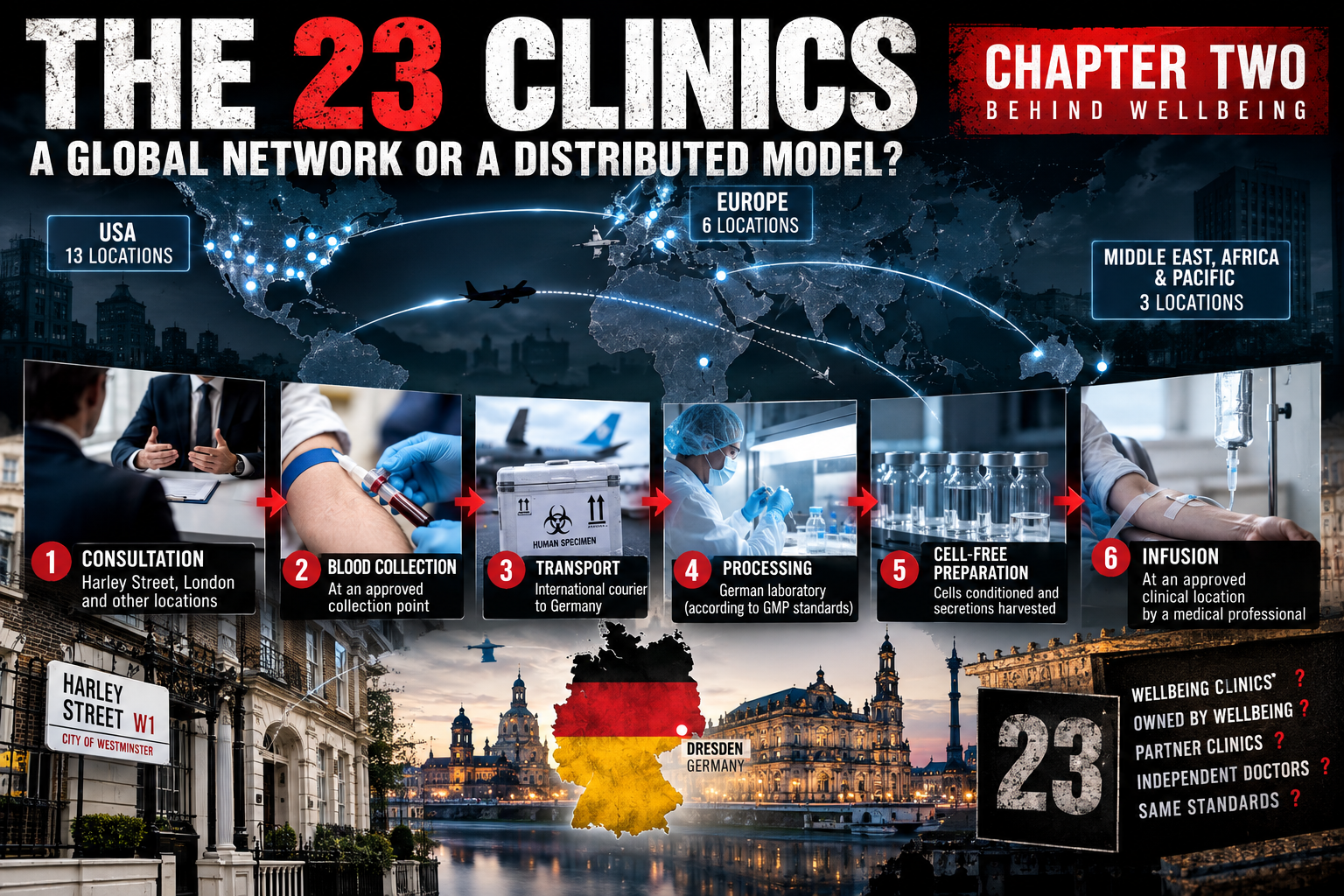
Chapter Two examined Wellbeing International Foundation's claim of a global network of partner clinics.
What emerged was not the conventional structure many readers might imagine.
Wellbeing's own current material describes a distributed system: an initial consultation with its clinical team, blood collection at an “approved collection point,” transportation to a laboratory in Germany, and eventual infusion at an “approved clinical location” by a qualified medical professional. Wellbeing International Foundation
There is nothing inherently improper about medicine being delivered through different specialist organisations.
But it creates a chain.
And when we began reconstructing that chain using Wellbeing's current disclosures alongside historical patient consultations obtained during this investigation, an important question emerged:
At what point does somebody become medically responsible for the patient?
Start With Wellbeing's Current Process
Today Wellbeing describes the beginning of the CFT journey as an:
“Initial Consultation.”
Its website says:
“Speak with the WIF clinical team about your goals and health history.”
Blood collection comes afterwards.
Approximately 150ml is taken at an approved collection point and transported under controlled temperature conditions to Germany.
After cell isolation, conditioning, collection of the cell-free biological output and quality testing, the preparation can eventually be administered intravenously at an approved clinical location. Wellbeing International Foundation
On paper, that appears straightforward.
But look more closely at the first stage.
Who is the “WIF clinical team”?
And what exactly happens during that initial consultation?
Is it an information session?
A sales conversation?
A scientific consultation?
A medical assessment?
A formal clinical evaluation?
And most importantly:
Who decides that this particular patient should proceed?
Someone Has to Make the Medical Decision
This distinction matters.
There is nothing unusual about non-doctors speaking to prospective patients.
Healthcare organisations employ patient coordinators, receptionists, scientists, nurses, commercial directors and administrators.
Each can legitimately play a role.
But their roles are different.
Explaining how a technology works is not the same as diagnosing somebody.
Collecting medical records is not the same as interpreting them.
Discussing price is not the same as determining medical suitability.
And explaining scientific research is not the same as accepting clinical responsibility for an individual patient.
So we went back to the historical evidence.
And one recorded consultation is particularly revealing.
Inside a Wellbeing Consultation
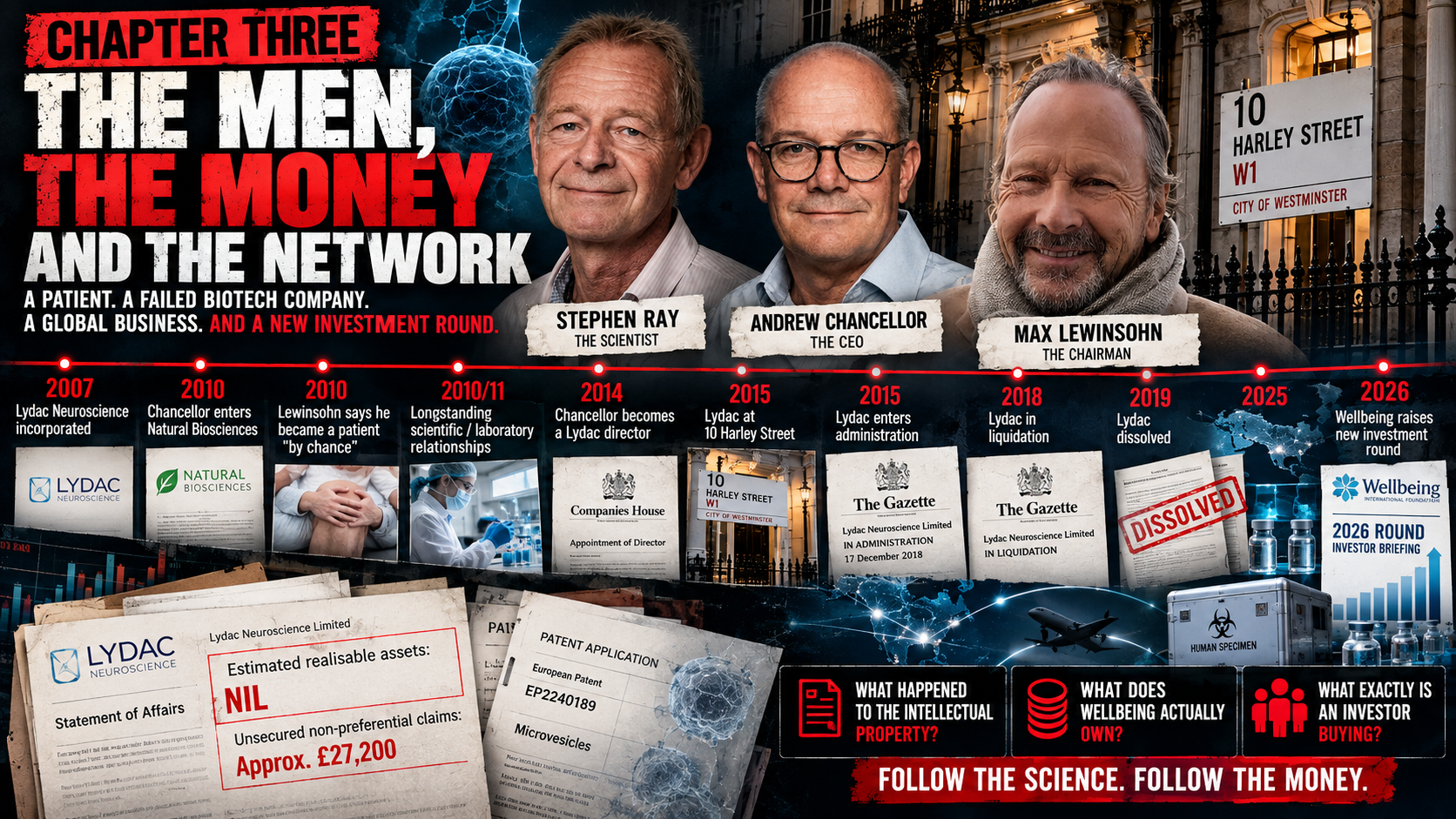
An investigator posing as a prospective patient attended a Wellbeing consultation at 10 Harley Street, London.
We are deliberately withholding the investigator's identity.
The investigator presented with a supposed knee injury.
According to the contemporaneous recording, Stephen Ray did much of the talking.
Medical history and the proposed treatment were discussed.
Ray asked questions including the prospective patient's age and occupation.
The proposed process was then explained: blood would be collected, sent to Germany, processed and later returned for intravenous administration. WIFL Claims (Covert) Dr. X notes…
The investigator's contemporaneous summary records that Ray anticipated the supposed patient might require two or three infusions and that approximately ten vials could potentially be produced, with material remaining available for future use. WIFL Claims (Covert) Dr. X notes…
The quoted overall cost at that historical consultation was approximately $40,000.
This was not simply someone reading a webpage.
It was an individual sitting in Harley Street discussing their supposed medical history and a proposed biological intervention.
So who was providing the medical assessment?
Stephen Ray Provides an Important Answer
This investigation subsequently obtained another recorded exchange with Stephen Ray.
Ray was directly asked whether he was a medical doctor.
His response was clear:
“No, I'm a PHD doctor.”
He described himself as a neuroscientist and Wellbeing's Chief Scientist. A:181220:1142 telephone call tr…
Later in the exchange he made the distinction even clearer:
“I don't do the medical treatment cause I'm not a doctor.”
Ray explained his role differently.
He said:
“My job is to advise patients for what these things can do and what they can't do.”
WIFL - USA
That distinction is important.
Ray himself was not claiming to be the treating physician in that exchange.
He was explicitly distinguishing his scientific role from medical treatment.
But that immediately produces the next question.
If Ray wasn't making the medical decision, who was?
Medical Records Were Not Always the Same
The exchange also gives us some insight into the information available during these consultations.
When challenged about medical records, Ray said:
“Sometimes they are extensive from their own doctors. Sometimes they are less so.”
He then explained:
“My job is really to explain the science to them and then it is up to them if they want to go ahead or not.”
WIFL - USA
That sentence deserves careful treatment.
It would be wrong to interpret it as proof that no doctor assessed Wellbeing patients.
The historical consultation itself involved another person described at the time as a medical doctor.
Nor does Ray saying the decision was “up to them” necessarily mean that patients could proceed without medical clearance.
But it does leave an important gap in the documented historical pathway.
Who gave the clinical approval?
That is what we need to establish.
The Current Wellbeing Team Is More Clearly Defined
Wellbeing's present website provides more information about its clinical personnel than was readily apparent from older material.
It identifies named clinical staff.
For example, Wellbeing describes Chris Icamina as Senior Clinical Consultant and says he performs both blood draws and infusions while working alongside partner physicians beginning to deliver CFT.
It describes Melanie Scaggs as Senior Nursing Consultant and says she performs blood draws and infusions and participates in follow-up afterwards. Wellbeing International Foundation
Those are meaningful clinical functions.
But Wellbeing's own wording also reinforces something important.
Icamina works:
“alongside partner physicians.” Wellbeing International Foundation
Which takes us directly back to the network uncovered in Chapter Two.
The physician may belong to the partner clinic.
The nurse may perform the infusion.
The laboratory may be a separate German organisation.
And Wellbeing may coordinate the system.
So where does medical responsibility sit?
The Doctor May Not Work for Wellbeing
This is perhaps the most important consequence of the partner-network model.
Wellbeing's physician programme actively recruits established practitioners, including high-volume PRP practices.
It promotes CFT as a premium addition to an existing regenerative-medicine practice and offers training, scientific access, commercial modelling, cell-banking revenue opportunities and marketing support. Wellbeing International Foundation
That strongly suggests that at least some physicians delivering CFT can be independent practitioners joining the Wellbeing network.
Again, there is nothing inherently unusual about this.
But consider what it means from the patient's perspective.
The organisation introducing CFT may be Wellbeing.
The scientific explanation may come from Wellbeing.
The laboratory protocol may be associated with Wellbeing.
The preparation may be produced through Wellbeing's German laboratory relationship.
But the person putting the IV into the patient's arm may work for an entirely different medical practice.
So:
Who is the physician of record?
Follow the Patient Instead of the Company
This is where the investigation becomes clearer if we stop following company names and follow one hypothetical patient.
They contact Wellbeing.
Stage One: Consultation
Someone discusses their health history and objectives.
Who conducts that consultation?
And is it clinical or informational?
Stage Two: Suitability
Someone must decide whether there is any medical reason why the patient should not proceed.
Who makes that decision?
Stage Three: Blood Collection
Approximately 150ml of blood is collected.
Who orders that procedure?
Who verifies the patient's identity?
Who records the collection?
Stage Four: Transportation
The sample leaves the collection point and travels to Germany.
Wellbeing says chain of custody and temperature monitoring are maintained. Wellbeing International Foundation
Who legally assumes custody?
Stage Five: Laboratory Processing
Cells are isolated and conditioned.
The cell-free biological output is collected and tested.
Who authorises the release of that preparation?
Stage Six: Return
The resulting material is made available for infusion.
Who receives it?
Stage Seven: Infusion
A qualified medical professional administers it intravenously. Wellbeing International Foundation
Who prescribed or authorised that administration?
Stage Eight: Follow-Up
If the patient develops an unexpected reaction hours or days later, who is responsible for investigating it?
One organisation?
The partner doctor?
The laboratory?
Wellbeing?
Or some combination of them?
These are basic clinical-governance questions.
The Laboratory Has Responsibility Too
There is another important participant in this chain.
Germany.
Wellbeing currently says every preparation is processed at a single GMP-certified laboratory in Germany. Wellbeing International Foundation
Its Contact page describes a:
“State-of-the-art GMP-certified laboratory for cell-free preparation processing.” Wellbeing International Foundation
And the treatment-process page says the biological output undergoes quality testing before release. Wellbeing International Foundation
But the laboratory isn't simply a courier destination.
It is where the patient's biological material is transformed into the preparation eventually infused.
That means laboratory responsibility is central to the patient journey.
Who operates it?
Who is the responsible scientific or medical officer?
What precisely does its certification cover?
What release criteria must a preparation satisfy?
What happens if a batch fails?
Who reports that to the patient?
Those questions become even more important when collection, processing and administration occur in different countries.
Wellbeing's Current Claims Have Become More Careful
There is another development worth acknowledging.
Wellbeing's current website now contains unusually explicit language about what it says CFT does not claim.
It says CFT:
“is not offered as a treatment for any named condition.”
It further states that CFT is:
“not intended to diagnose, treat, cure, or prevent any disease.” Wellbeing International Foundation
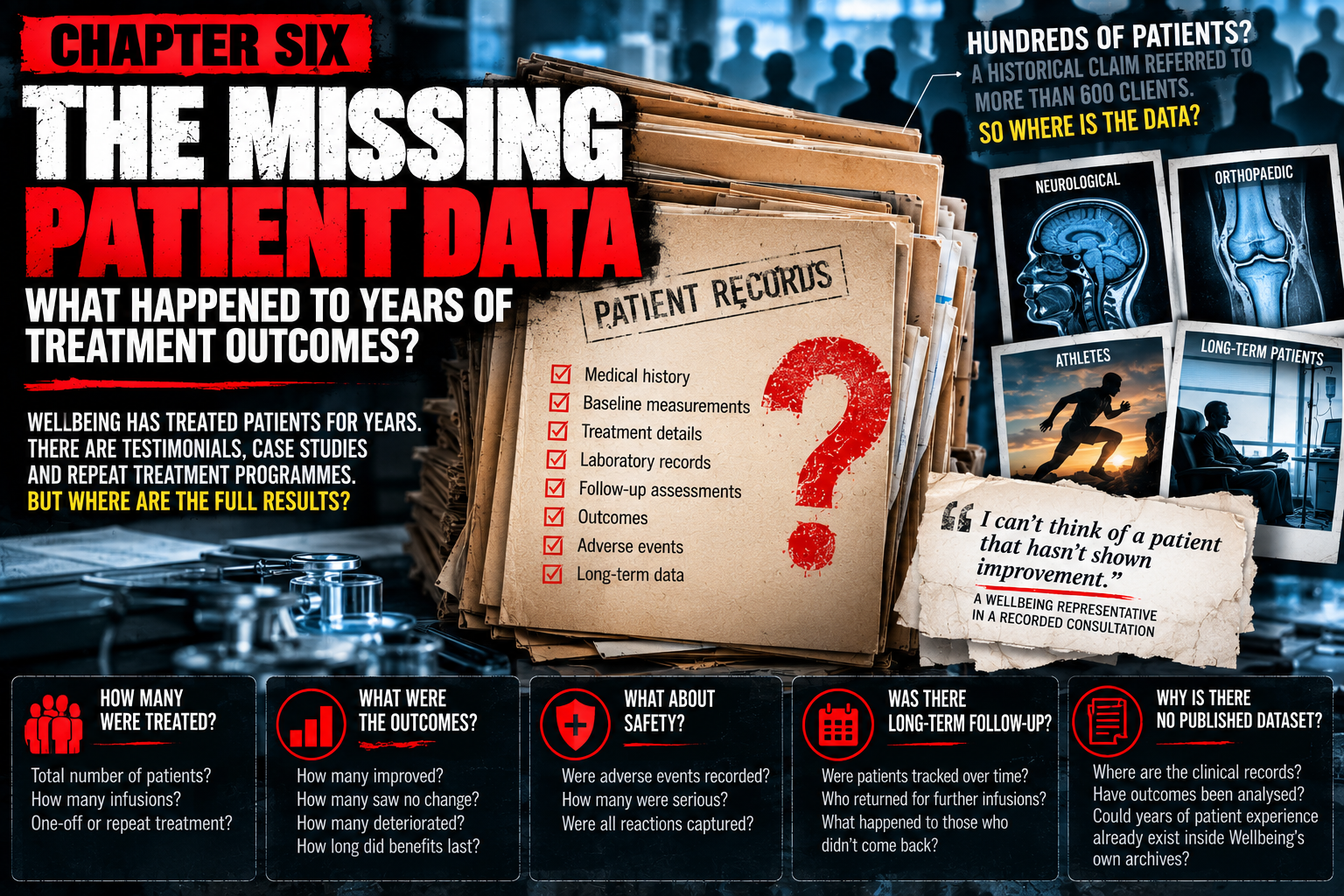
Wellbeing also says the peer-reviewed pilot published in 2026 is the only clinical study it cites and that testimonials and case studies are patient-reported accounts rather than evidence of efficacy. Wellbeing International Foundation
That is important context.
But it creates an interesting question for the patient consultation.
If CFT isn't offered as treatment for a named condition, what exactly determines whether a particular person is an appropriate candidate?
“Can It Help My Knee?” Is Still a Medical Question
Imagine somebody contacts Wellbeing because they have a damaged knee.
Or neurological symptoms.
Or chronic pain.
Or age-related decline.
They aren't interested in the abstract biology of extracellular vesicles.
They want to know:
Will this help me?
That is where marketing, science and medicine can begin to overlap.
A scientist can explain what extracellular vesicles are.
A CEO can explain how the company works.
A patient coordinator can explain logistics.
A nurse can explain what happens during an infusion.
But when discussion moves to whether a particular person's medical circumstances make an intervention appropriate, the question becomes clinical.
And somebody needs to own that decision.
The Historical Consultation Shows Why This Matters
Return to Harley Street in 2020.
The investigator's supposed knee injury was discussed.
Ray did much of the scientific explanation.
The process was explained.
Potential numbers of infusions were discussed.
The prospective patient was given an approximate price.
And at the end of the consultation, the division of responsibilities was summarised.
The investigator was told that clinical questions could be directed to those present at the consultation, while financial questions would go to Andrew Chancellor. WIFL Claims (Covert) Dr. X notes…
That suggests there was an intended distinction between clinical and commercial functions.
Good.
But it still leaves us needing to identify precisely who held the medical responsibility.
Not who explained the science.
Not who organised the payment.
Not who physically drew the blood.
The doctor responsible for deciding:
This patient is medically suitable to receive this preparation.
What We Have Not Established
Precision is essential here.
We have not established that Wellbeing patients receive treatment without medical supervision.
We have not established that the current partner physicians are unqualified.
We have not established that blood draws or infusions are being performed improperly.
We have not established that Stephen Ray represented himself as the treating medical physician in the exchange examined here. In fact, the recorded evidence contains Ray explicitly stating that he was not a medical doctor and that he did not perform the medical treatment. WIFL - USA
And we have not established that Wellbeing's current clinical-governance arrangements are identical to those operating in 2020.
The organisation has evolved.
Those distinctions matter.
Our question is narrower.
Can a patient clearly identify who holds medical responsibility at every stage?
Wellbeing Could Answer This Very Easily
There is a straightforward way to resolve the issue.
For every patient, identify:
the clinician conducting the formal medical assessment;
the physician responsible for approving CFT;
the legal medical provider;
the professional registration of that physician;
the organisation responsible for the blood collection;
the laboratory legal entity responsible for processing;
the clinician authorising administration;
the professional administering the infusion;
the organisation retaining the medical record;
and the organisation responsible for adverse-event reporting and follow-up.
That information need not undermine Wellbeing's distributed model.
It would strengthen it.
Because patients would know exactly who is responsible for them.
The Question Isn't Whether Wellbeing Has Doctors
That would be far too simplistic.
Wellbeing works with medical professionals.
Its current material identifies clinical personnel and explicitly refers to partner physicians. Wellbeing International Foundation
The real question is more sophisticated.
Where does medical responsibility sit inside a network where the consultation, blood collection, laboratory processing and infusion may involve different people, organisations and countries?
That is the question patients need answered.
It is also the question prospective physician partners should ask before joining the network.
And it is something investors examining the scalability of the model should understand.
Because a global medical network is not merely a collection of relationships.
It is a chain of responsibility.
From Harley Street to Germany and Back Again
Our investigation started with a patient sitting in Harley Street.
It then followed their hypothetical blood.
Out of their arm.
Into a collection system.
Across an international border.
Into a German laboratory.
Through a biological processing protocol.
Into storage and quality control.
Back into the clinical network.
And eventually into an IV line.
At every stage somebody is doing something.
At every stage somebody owns responsibility for that action.
But the patient shouldn't have to conduct an investigation to discover who those people are.
That information should be obvious.
Because when a person agrees to have a biological preparation manufactured from their own blood and subsequently infused back into their body, the most important person in the entire network isn't the CEO.
It isn't the scientist.
It isn't the investor.
It isn't the laboratory partner.
And it isn't the person who built the website.
It's the patient.
And that patient deserves a clear answer to one extraordinarily simple question:
Doctor — who is actually responsible for me?
Next: Chapter Four — Inside the German Laboratory: Who Actually Makes Cell-Free Therapy?
The patient may begin with Wellbeing, but their blood travels elsewhere. In Chapter Four we follow it to Germany. Who operates the laboratory? What does “GMP-certified” actually cover? Who designed the processing protocols, who performs the quality-control release, and what is the legal relationship between the laboratory and Wellbeing International Foundation?
Recent Posts