THE MEN BEHIND WELLBEING
Chapter One: Andrew Chancellor
The Businessman Behind the Biologics
From international banking and recruitment to the leadership of a regenerative-medicine organisation
When investigating an organisation selling an emerging medical intervention, there are two very different questions worth asking.
The first is obvious:
Does the science support the treatment?
The second receives considerably less attention:
Who are the people turning that science into a business?
That second question brought me to Andrew Chancellor, Chief Executive Officer of Wellbeing International Foundation.
Today, Chancellor sits at the head of an organisation promoting Cell-Free Therapy, an intervention involving biological material processed from a patient's own cells and subsequently administered intravenously.
He speaks publicly about regenerative medicine.
He discusses patients.
He discusses the potential of the technology.
And he represents an organisation operating at the intersection of biotechnology, private healthcare and investment.
Yet Chancellor's route into this world did not begin in medicine.
According to Wellbeing's own biography, it began in banking.
Wellbeing International Foundation — Leadership biographies
Before Regenerative Medicine
Wellbeing describes Chancellor as an experienced international businessman.
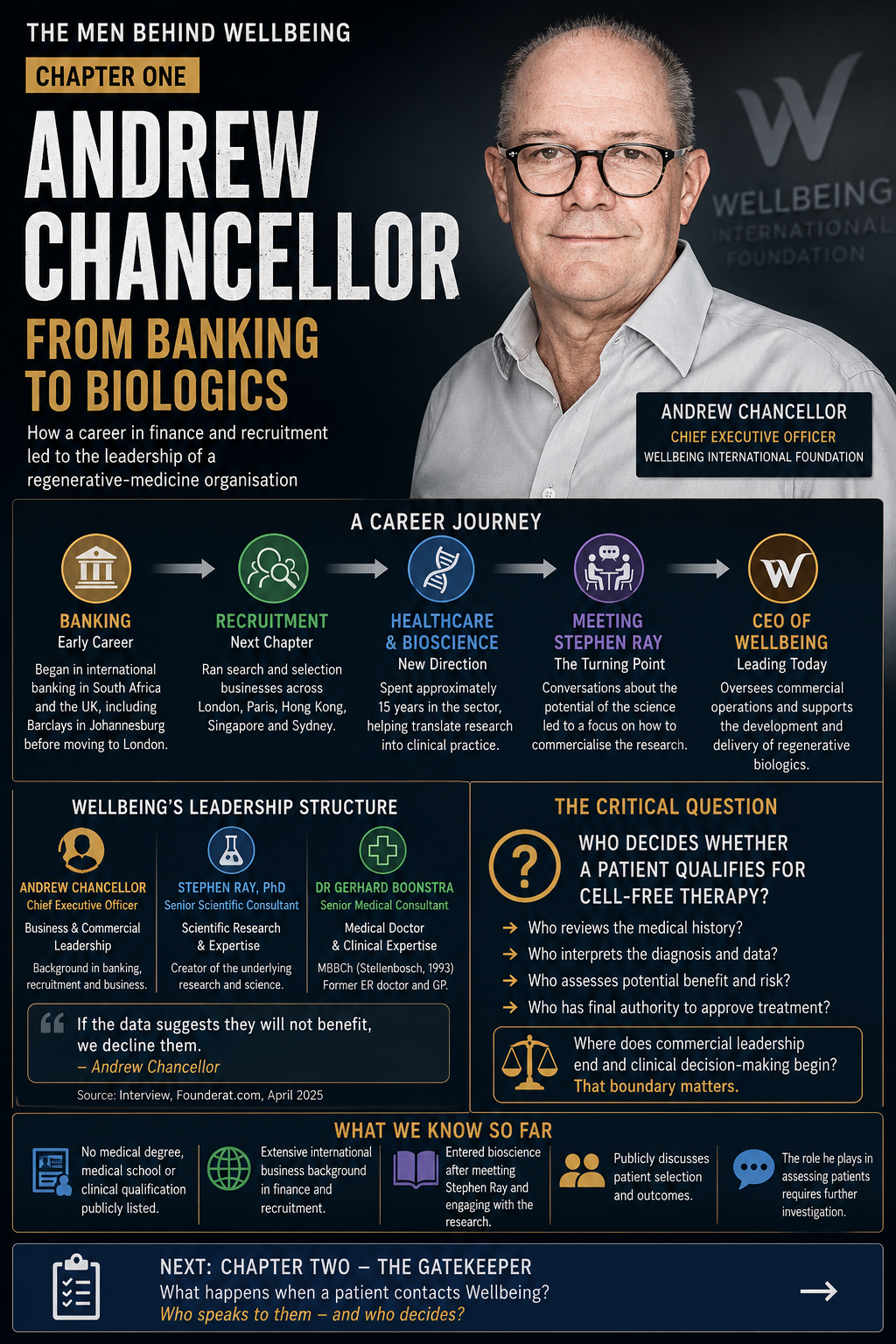
His early career was spent in international banking in South Africa and the United Kingdom.
He subsequently moved into recruitment and executive search, operating businesses across London, Paris, Hong Kong, Singapore and Sydney.
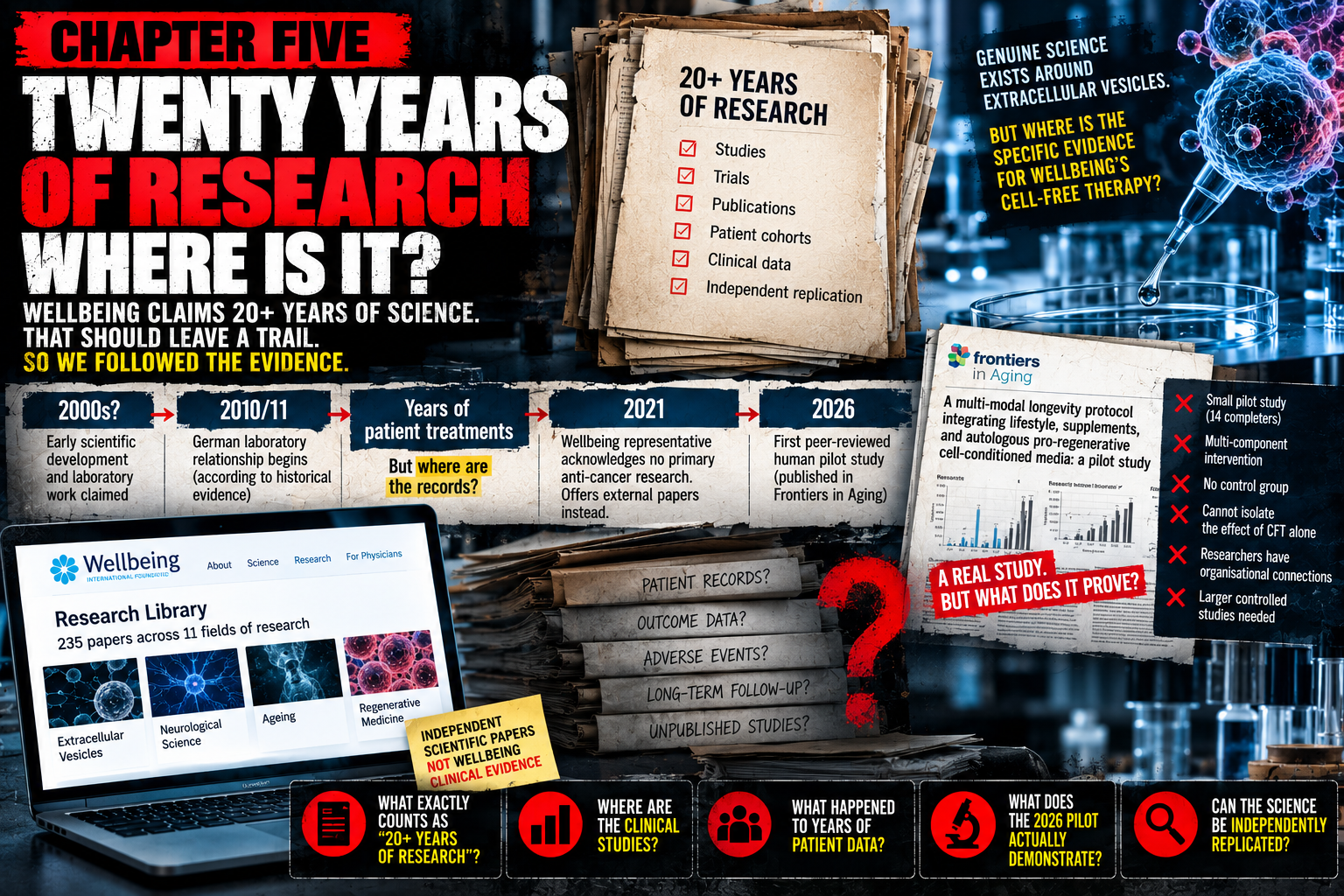
Historical recruitment-industry reporting supports at least part of that account.
In 2007, an Andrew Chancellor was identified by recruitment publication Onrec as the London-based head of banking and finance at Robert Walters, discussing the international recruitment of corporate-finance professionals.
Onrec — “Asian expertise filling corporate finance gaps”
It is a substantial commercial career.
But it is important to understand what it isn't.
It isn't a conventional medical career.
Where Are the Medical Qualifications?
This is where precision becomes essential.
I have found no evidence in Wellbeing's published biography identifying Andrew Chancellor as a medical doctor.
No medical degree is listed.
No medical school is identified.
No clinical speciality is provided.
And Wellbeing does not describe him as a physician.
That does not mean Chancellor should not be CEO of Wellbeing.
Chief executives of healthcare and biotechnology businesses do not have to be doctors.
Some of the world's largest healthcare companies are run by executives whose expertise lies in finance, management or business development.
The relevant question is therefore not:
Why is Wellbeing run by someone who isn't a doctor?
The more important question is:
What does Chancellor actually do when medicine and individual patients become involved?
That distinction will become increasingly important.
Wellbeing Separates the Roles
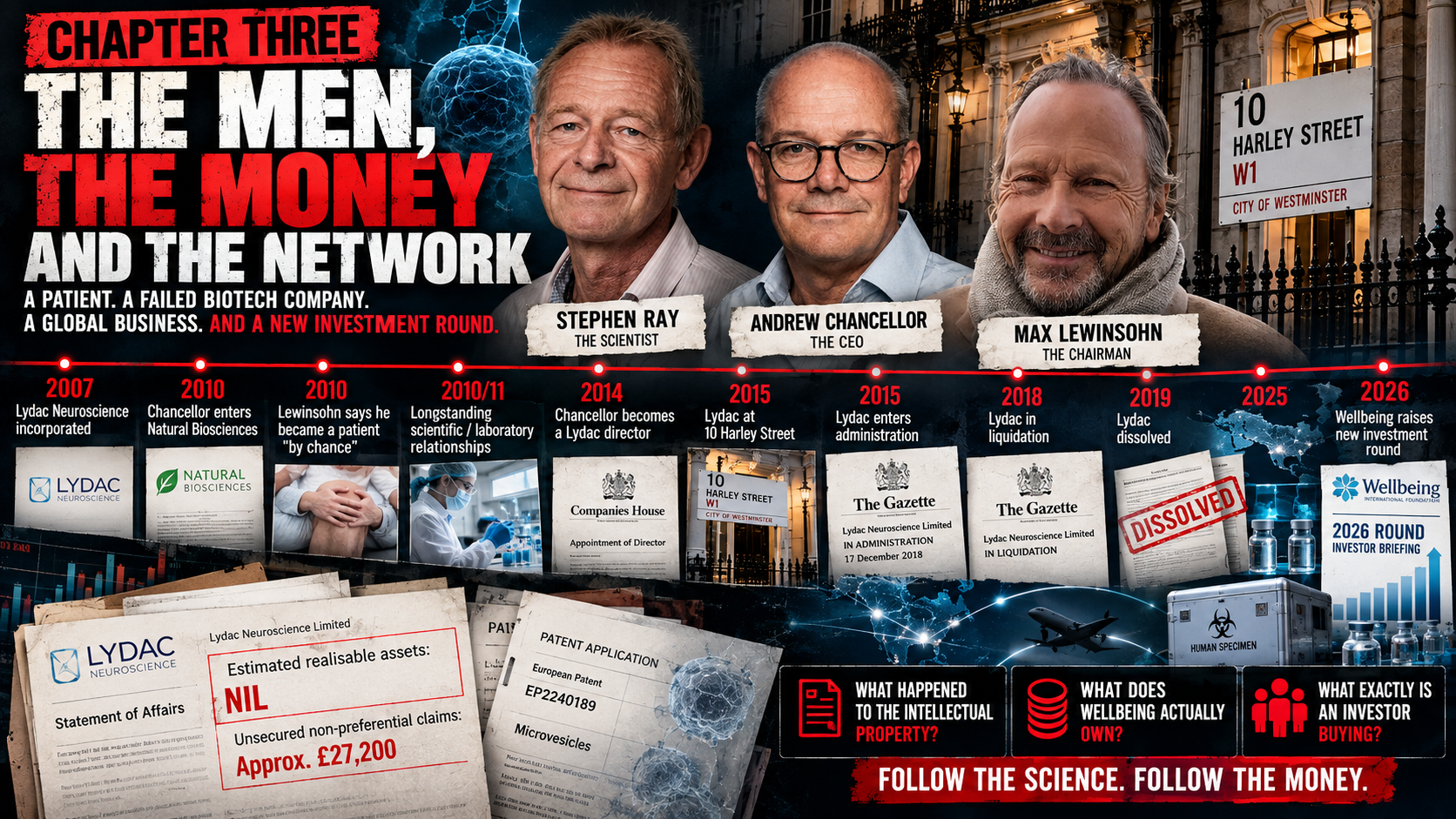
Interestingly, Wellbeing's own leadership structure appears to make the distinction between commercial, scientific and medical expertise.
Chancellor is identified as:
Chief Executive Officer.
Stephen Ray is identified separately as:
Senior Scientific Consultant.
And Dr Gerhard Boonstra is identified as:
Senior Medical Consultant.
Wellbeing's biography for Boonstra specifically identifies his medical education, stating that he obtained his medical degree from Stellenbosch University before working in emergency medicine and general practice.
Wellbeing International Foundation — About the team
On paper, the structure therefore appears straightforward.
Chancellor — business.
Ray — science.
Boonstra — medicine.
But how those boundaries operate in practice is another matter.
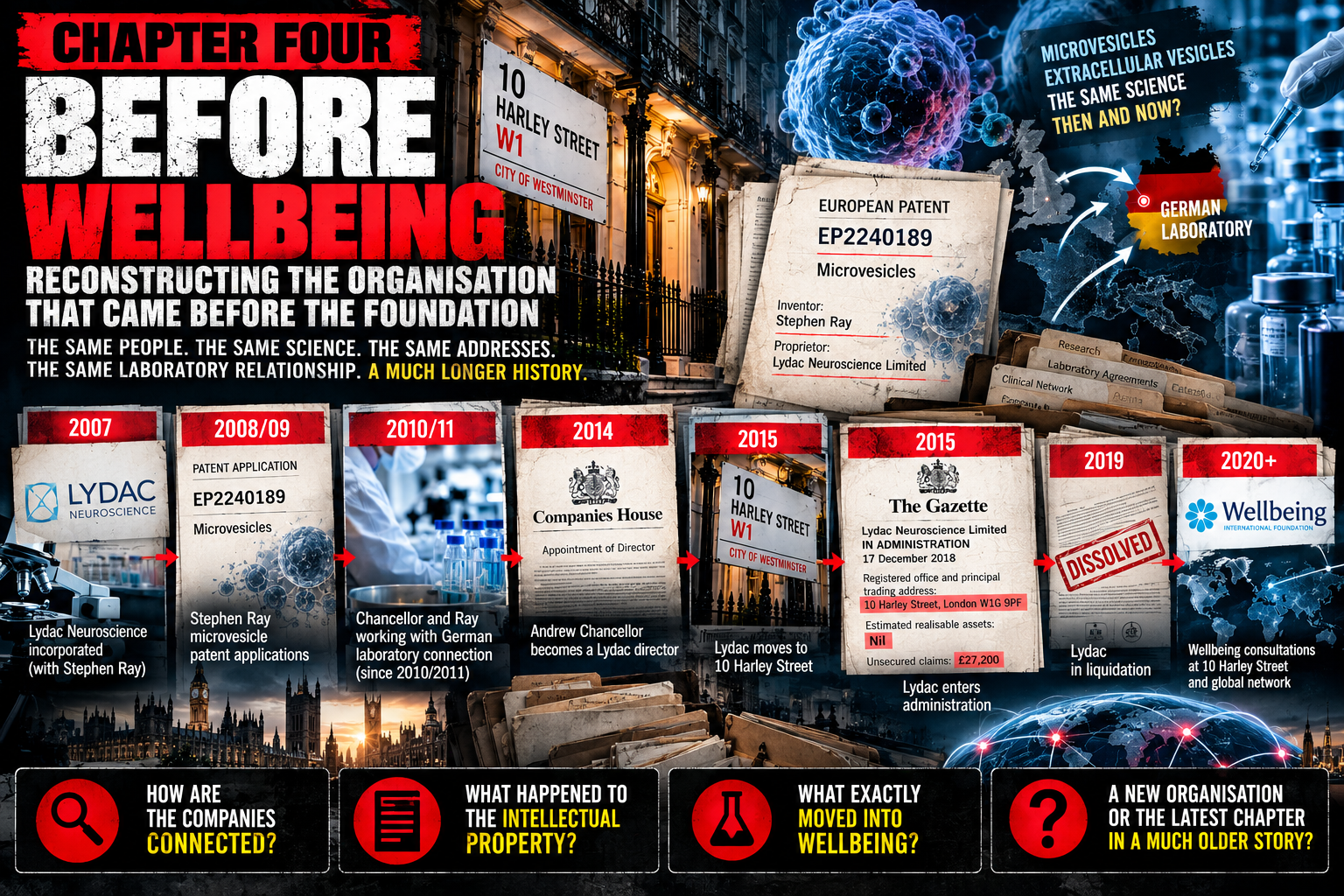
How Did a Banker Enter Regenerative Medicine?
The answer appears to begin with Stephen Ray.
Chancellor has spoken publicly about meeting Ray and becoming fascinated by the underlying science.
Their relationship eventually developed beyond scientific discussion.
Chancellor describes conversations about how the research could be commercialised and brought into clinical use.
FounderAt — Interview with Andrew Chancellor
That word matters.
Commercialised.
Because it helps explain what Chancellor appears to have brought to the relationship.
Ray brought scientific research.
Chancellor brought decades of business experience.
Together, the question became whether that research could be transformed into something capable of being delivered commercially.
That eventually contributed to the organisation we are investigating today.
Learning Medicine From the Outside
Chancellor has also discussed the difficulty of entering such a scientifically complex industry.
He describes having to understand the science and medicine sufficiently to lead the organisation responsibly, and speaks about learning through extensive reading, questioning and research.
There is nothing inherently wrong with that.
A chief executive running a biotechnology company should understand the science behind the product.
But it tells us something important about Chancellor's route to expertise.
Based upon the public information I have examined, his knowledge of regenerative medicine appears to have developed through his involvement in the industry and self-directed learning rather than through conventional medical education and clinical training.
Again, that is not inherently problematic for a CEO.
It becomes relevant only when we examine the extent of his involvement with patients.
From Commercialisation to Clinical Delivery
Wellbeing says Chancellor has now spent approximately fifteen years working within healthcare and bioscience.
During that time, his role appears to have evolved considerably.
He is no longer simply the businessman helping a scientist commercialise an idea.
He is now the CEO and one of the principal public representatives of the organisation.
He discusses Cell-Free Therapy.
He explains biological mechanisms.
He discusses patient outcomes.
He talks about clinical delivery.
And significantly, he has spoken publicly about Wellbeing's approach to deciding which prospective patients should receive treatment.
This is where the story changes.
“We Decline Them”
In a public interview, Chancellor explained that Wellbeing does not simply accept everybody willing to pay.
He said:
“If the data suggests they will not benefit, we decline them.”
Read the full Andrew Chancellor interview at FounderAt
On its face, that sounds responsible.
An organisation offering an expensive biological intervention should not accept someone it believes is unlikely to benefit simply because that person can afford the treatment.
But the statement raises an obvious question.
Who is “we”?
Who evaluates the data?
Who reviews the patient's medical condition?
Who determines whether that person is likely to benefit?
Who decides whether they qualify?
And who carries the medical responsibility for that decision?
The Difference Between Business and Medicine
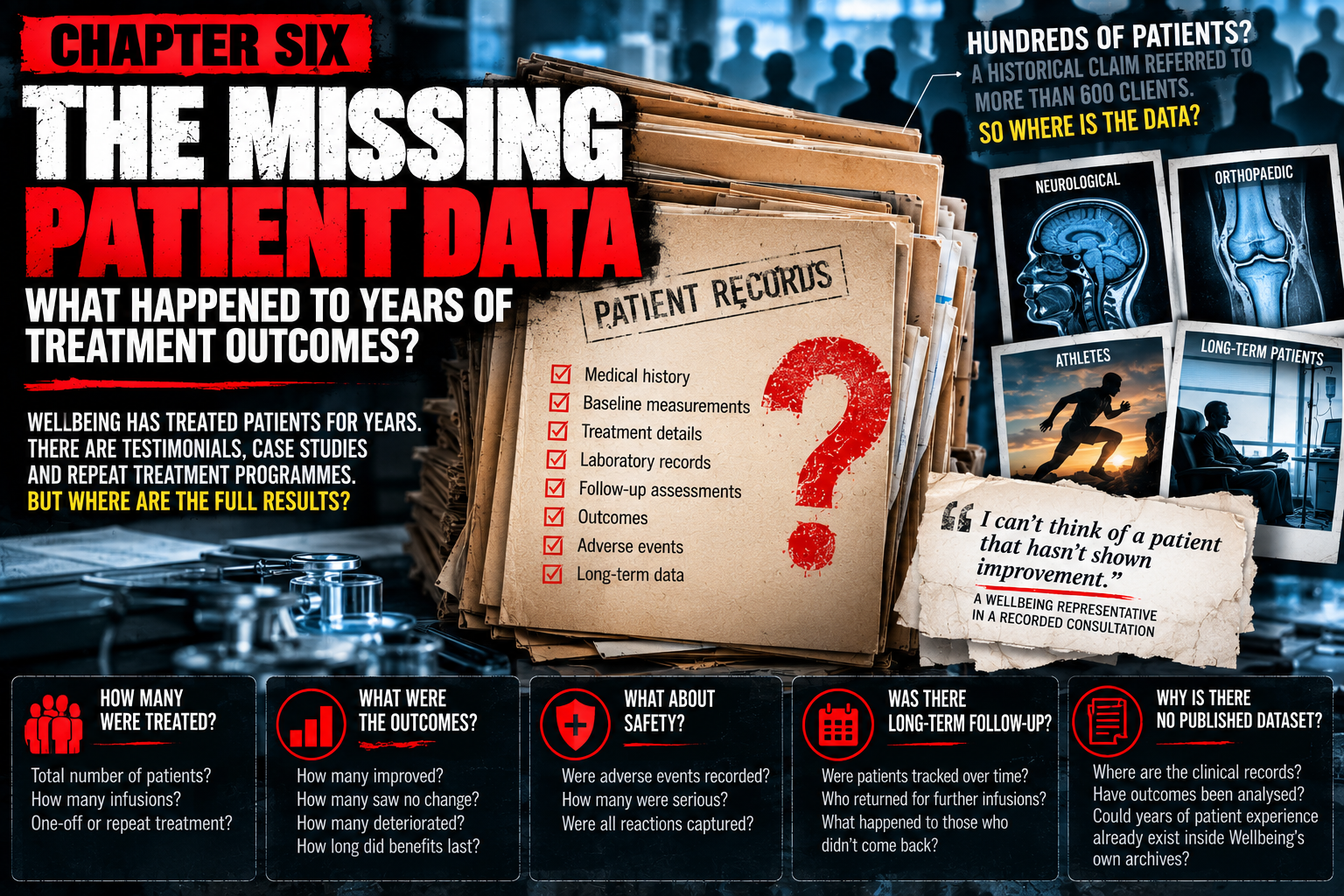
This is the boundary at the centre of my investigation into Andrew Chancellor.
A CEO can explain his company.
A CEO can discuss published scientific research.
A CEO can discuss strategy.
A CEO can talk about the theoretical potential of technology.
Administrative staff can also collect medical records and information from prospective patients.
But evaluating an individual's medical condition is different.
Assessing contraindications is different.
Predicting whether a particular patient is likely to benefit is different.
Determining whether an individual is clinically suitable for an intravenous biological intervention is different again.
Those functions require us to ask exactly where Wellbeing draws the line between commercial screening and clinical assessment.
Why This Matters
Cell-Free Therapy isn't being discussed in the same financial category as a vitamin supplement or wellness consultation.
During the prospective-patient enquiry examined as part of this wider investigation, a programme costing approximately £37,000 was discussed.
That figure should be understood carefully.
I am not suggesting that £37,000 is Wellbeing's universal current tariff. Wellbeing currently describes its programmes as individually priced.
It is the approximate price arising from the enquiry examined during this investigation.
Nevertheless, it changes the importance of the conversation.
Someone considering spending tens of thousands of pounds on an emerging biological intervention may place enormous weight upon what they are told about their chances of benefiting.
That makes the identity and qualifications of the person providing that assessment extremely important.
The Patient Changes Everything
Until this point, Chancellor's unusual career transition is merely interesting.
Banker becomes recruiter.
Recruiter meets scientist.
Businessman becomes involved in biotechnology.
Eventually businessman becomes CEO.
There is nothing inherently improper about any of that.
But once the CEO begins interacting directly with prospective patients, another level of scrutiny becomes appropriate.
What questions does he ask?
What medical information does he receive?
Does he interpret that information?
Does he discuss whether CFT could help a particular condition?
Does he express an opinion about whether the individual is suitable?
Does he recommend proceeding?
And most importantly:
Has a registered physician independently assessed the patient before any such conclusion is communicated?
Those are factual questions.
They should have factual answers.
Where Is the Doctor?
This is why Wellbeing's separate identification of Dr Gerhard Boonstra becomes so important.
If Boonstra—or another appropriately qualified and registered physician—reviews every patient's medical records, assesses suitability and makes the final clinical decision before treatment is recommended, that is significant context.
It should be reported.
But we need to establish when that happens.
Before Chancellor speaks with the patient?
Afterwards?
Before suitability is discussed?
Before the treatment price is presented?
Before payment?
Immediately before treatment?
The sequence matters.
Because a doctor approving treatment after a commercial decision has effectively already been made is very different from a doctor independently deciding at the beginning that the intervention is clinically appropriate.
What This Investigation Is Not Claiming
There is an important line I will not cross without evidence.
I am not claiming Andrew Chancellor is pretending to be a doctor.
I have found no evidence that he describes himself as one.
I am not claiming merely being a non-medically qualified CEO of a biotechnology organisation is improper.
It isn't.
And I am not presently alleging that Chancellor is unlawfully practising medicine.
That would require analysis of exactly what he did, what was said, where it occurred and the applicable regulatory law.
The question at this stage is considerably simpler:
What role does Andrew Chancellor personally play in determining whether individual patients receive Cell-Free Therapy?
The Evidence Will Decide
That question cannot be answered by speculation.
Fortunately, this investigation does not have to rely solely upon corporate biographies.
I have examined prospective-patient communications involving Wellbeing.
Those interactions potentially allow us to reconstruct what happens when someone approaches the organisation seeking help.
That evidence needs to be treated carefully.
Exact words matter.
Chronology matters.
Context matters.
If Chancellor merely gathers information before referring a patient to a doctor, that needs to be made clear.
If the evidence demonstrates something more substantial, that needs to be made equally clear.
The objective is not to make the evidence fit the story.
The evidence must determine the story.
A Simple Question
Andrew Chancellor's career is certainly unusual.
International banking.
Executive recruitment.
Bioscience.
Regenerative medicine.
CEO.
But unusual does not mean improper.
The question that matters is what happened when the businessman crossed from building the business into interacting with the people purchasing its medical services.
Because ultimately, a prospective patient doesn't care whether the person speaking to them once worked in banking.
They care whether the person telling them that an expensive biological intervention might help them is qualified to make that judgement.
And that brings us to the next part of this investigation.
Not Andrew Chancellor the banker.
Not Andrew Chancellor the recruiter.
Not even Andrew Chancellor the CEO.
But Andrew Chancellor sitting opposite a prospective patient.
And one question:
Who is actually making the medical decision?
NEXT — CHAPTER TWO
The Gatekeeper
Inside the patient-selection process: who decides whether someone qualifies for Cell-Free Therapy?
Recent Posts