The Men Behind Wellbeing — Chapter Five
Stephen Ray’s Microvesicle Patents: Following the Intellectual Property Behind Cell-Free Therapy
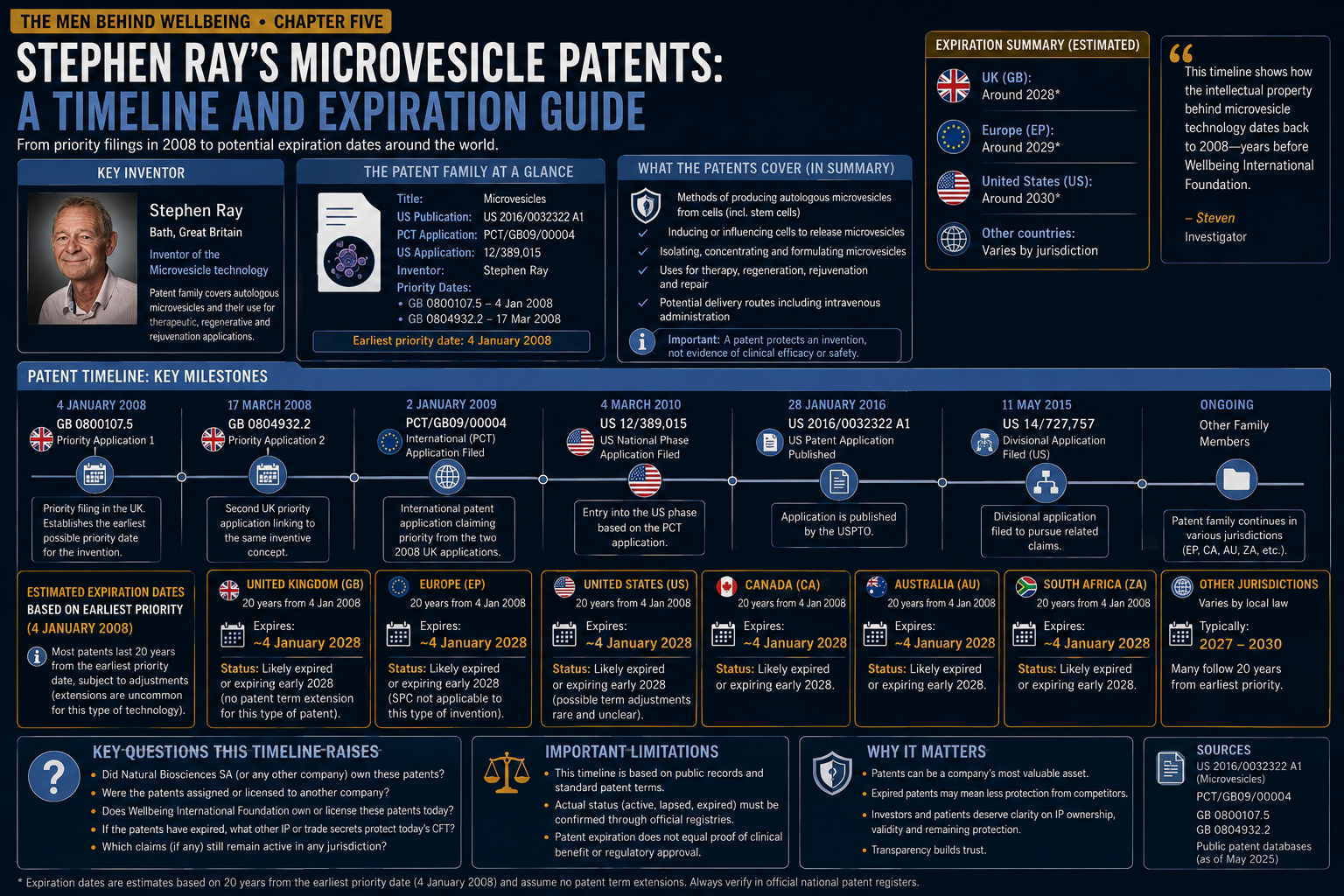
Wellbeing International Foundation credits Stephen Ray with decades of research behind its Cell-Free Therapy. This investigation has now located a patent trail stretching back to 2008. What does it actually prove—and what doesn't it prove?
In the previous chapter, I said the next stage of this investigation would be different.
Instead of following biographies, promotional articles and interviews, I wanted to follow something considerably harder to rewrite.
Patents.
Patent records leave dates.
They identify inventors.
They describe technologies.
They establish priority claims.
And sometimes they allow us to reconstruct the origins of a commercial technology long before the company currently selling it existed.
That search has now produced something important.
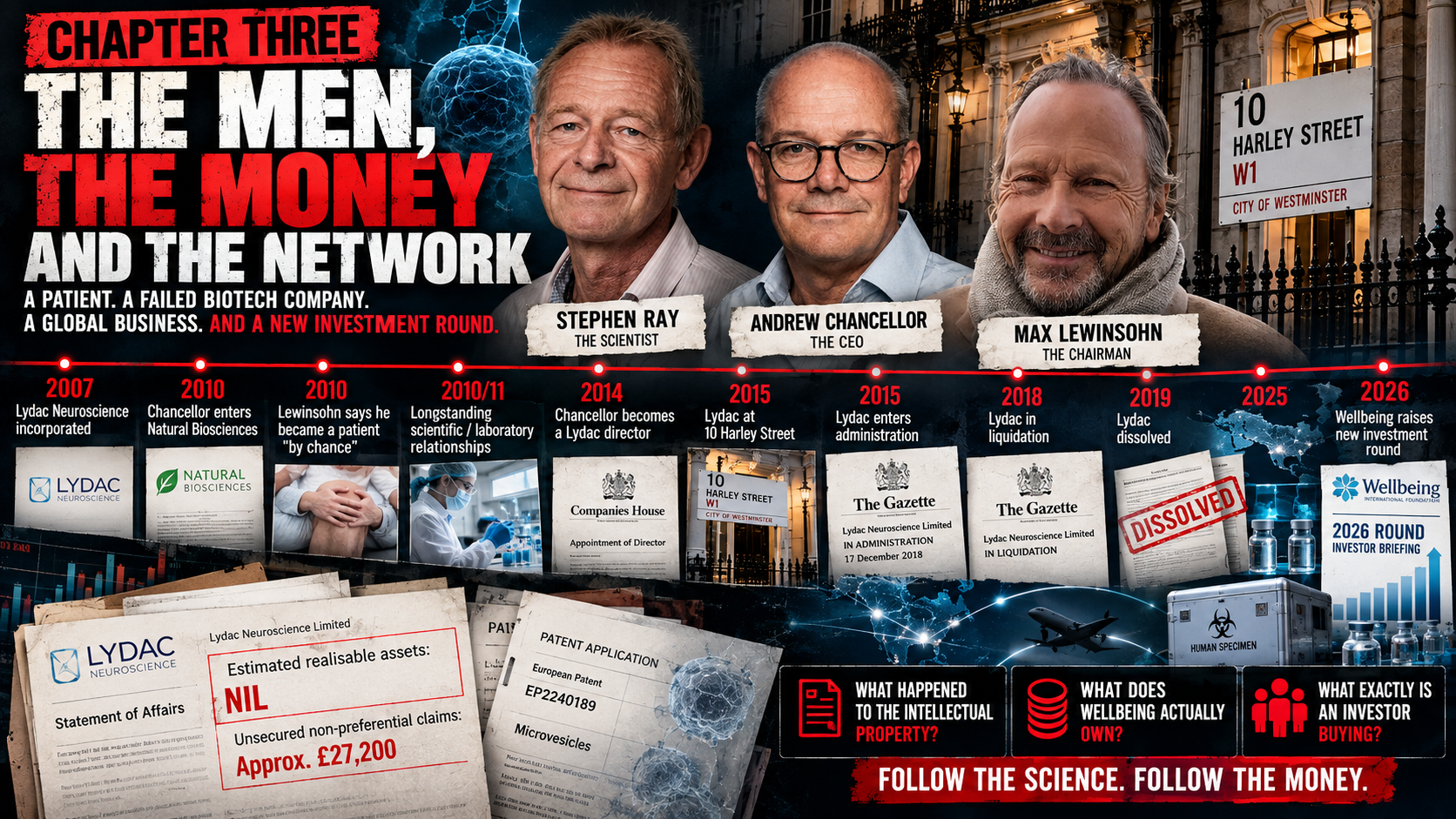
There really is a patent trail connected to a Stephen Ray of Bath, Great Britain, involving microvesicles, stem cells, autologous biological material and potential therapeutic applications.
And the history appears to begin much earlier than Wellbeing International Foundation.
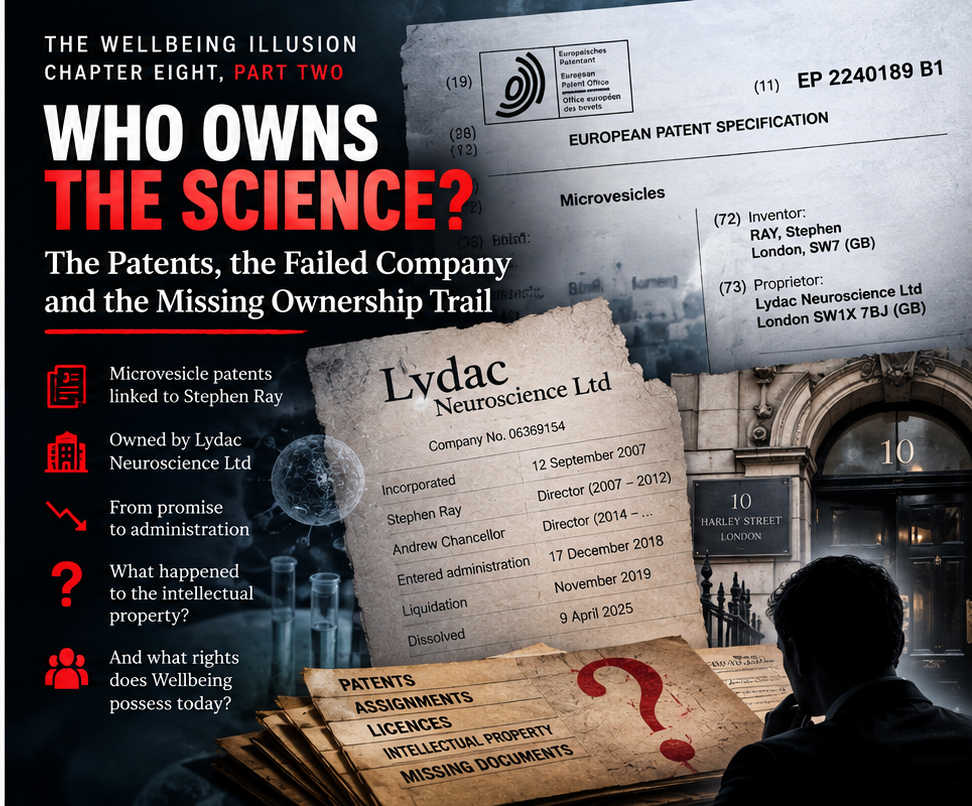
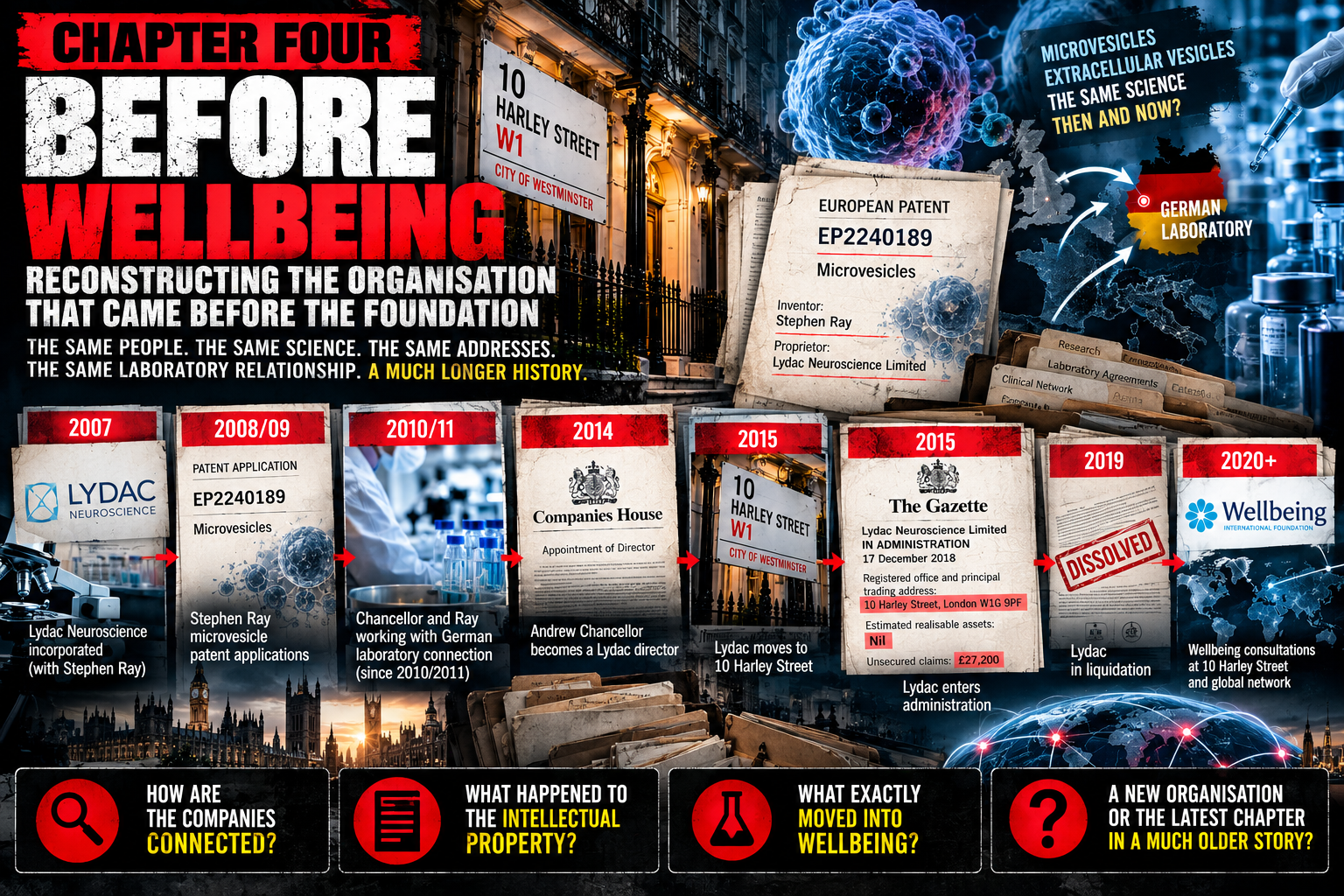
US Patent Application 20160032322 — Microvesicles
The Patent Is Real
The US patent record identifies an application titled simply:
“Microvesicles.”
The named inventor is:
Stephen Ray — Bath, Great Britain.
The US publication number is US 2016/0032322.
But 2016 is misleading if we are trying to establish when the underlying intellectual property originated.
The application explains that it is part of a much older patent family.
It traces backwards through a US application filed in 2010 to an international application:
PCT/GB09/00004
filed on 2 January 2009.
That application, in turn, claimed priority from two British applications:
GB 0800107.5 — filed 4 January 2008
and
GB 0804932.2 — filed 17 March 2008.
Read the patent history and specification
This is significant.
Because whatever eventually became Wellbeing's present commercial operation, the documented intellectual-property story surrounding Ray's microvesicle work appears to reach back approximately 18 years.
What Did Stephen Ray Claim to Have Invented?
The patent is technically complex, but the central idea can be simplified.
It concerns producing autologous microvesicles.
Autologous means biological material originating from the same individual who ultimately receives it.
The patent describes taking cells, influencing or inducing them in particular ways, harvesting microvesicles produced by those cells and potentially using those microvesicles—or derivatives of them—to affect other cells or for therapeutic purposes. (Patents Encyclopedia)
That should sound familiar to anyone who has followed this investigation.
Because there are obvious conceptual similarities with the language now surrounding Wellbeing's Cell-Free Therapy.
But similarity is not enough.
We need to be careful about claiming that today's commercial CFT product is identical to what this patent describes.
That connection needs to be established separately.
The Patent Talks About Regeneration and Rejuvenation
The language becomes particularly interesting deeper inside the patent.
The specification discusses potential applications involving:
tissue repair
regeneration
rejuvenation
and various therapeutic uses.
It also contemplates administration of biological products through routes including intravenous administration. (Patents Encyclopedia)
Again, the resemblance to some of the terminology used today in regenerative medicine is striking.
But there is an essential distinction.
A patent is not clinical proof.
That point cannot be overstated.
A Patent Does Not Prove That a Treatment Works
Patients can easily misunderstand what a patent represents.
A patent is fundamentally an intellectual-property instrument.
It can protect an invention.
It can establish priority.
It can prevent competitors from exploiting protected claims.
It can become a valuable corporate asset.
But obtaining or applying for a patent does not establish that a medical treatment has been demonstrated to be safe and effective in humans.
Patent examination is not the same thing as a randomised controlled clinical trial.
It is not regulatory approval.
It is not independent clinical validation.
It is not evidence that a treatment cures disease.
This distinction becomes extremely important if patents are ever presented to patients or investors as evidence that the underlying therapy is medically proven.
The Patent Goes Much Further Than Today's Marketing
The specification is extraordinarily broad.
It discusses potential applications involving disorders associated with cell deficiency and differentiation.
It refers to traumatic injury.
Brain injury.
Age-related degeneration.
Infertility.
Cancer-related applications.
Cosmetic applications.
Physical enhancement.
Cognitive enhancement.
And tissue repair and rejuvenation. (Patents Encyclopedia)
But patent documents frequently describe broad possible embodiments and applications.
That does not mean every proposed application has subsequently been demonstrated in human clinical trials.
This is precisely why patents and clinical evidence must remain separate.
An Experiment Raises Another Question
The patent specification also describes experimental work involving animals.
One example discusses age-related cognitive decline and reports an experiment involving microvesicles and laboratory animals.
The patent characterises the results positively and then refers to other work from the laboratory as unpublished. (Patents Encyclopedia)
That immediately raises another investigative question.
Where is the subsequent scientific publication?
If these experiments formed part of the scientific foundation for a technology eventually administered to paying humans, we need to determine whether the underlying experiments were ever:
peer reviewed;
independently replicated;
published in full;
or followed by controlled human clinical trials.
A patent can tell us an experiment was described.
It cannot substitute for the scientific scrutiny of publishing the underlying research.
The Timeline Has Now Changed
This discovery changes our understanding of the chronology.
We previously knew that Wellbeing's present commercial organisation developed later.
We knew Chancellor says he met Ray and eventually began discussing commercialisation.
But the patent priority record takes Ray's microvesicle work back to 2008.
That means the science—or at least the intellectual-property claims surrounding it—predates the present Wellbeing operation by years. (Patents Encyclopedia)
The chronology now looks something like this:
2008 — British priority applications
2009 — international PCT application
2010 — US national-phase application
2015 — later US divisional filing
2016 — US publication
and subsequently further patent-family activity appears in the records. (Patents Encyclopedia)
This is much more useful than a company biography.
We now have documentary dates.
Natural Biosciences Appears Again
Then something particularly interesting happens.
In Chapter Four, I identified historical material referring to a company called Natural Biosciences SA.
That material described Stephen Ray as leading a team responsible for generating an extensive portfolio of patents and intellectual property associated with Natural Biosciences.
At the time, I deliberately treated that claim cautiously because the material survives through a third-party-hosted presentation rather than a primary corporate archive.
Historical presentation referencing Stephen Ray and Natural Biosciences SA
But we have now found something else.
A separate historical publication from South Africa describes:
“Dr Stephen Ray, chief scientist at Natural Biosciences SA”
and also identifies him at the time as a senior lecturer in Clinical Physiology at Oxford Brookes University.
That publication discusses adipose-derived stem cells and regenerative therapies. (Netcells)
Historical article identifying Stephen Ray with Natural Biosciences SA
That gives the Natural Biosciences connection considerably more weight.
We now have more than one historical source connecting a Stephen Ray working in this scientific area with Natural Biosciences SA.
But the next question is the important one.
Did Natural Biosciences Own the Patents?
This is where I am not yet prepared to jump ahead of the evidence.
The patent record establishes Stephen Ray as inventor.
Historical material connects Ray with Natural Biosciences SA.
Another historical document claims Natural Biosciences applied for intellectual property developed by Ray's team. (Patents Encyclopedia)
But those facts do not automatically establish the entire ownership chain.
We now need the assignment records.
Who was the original applicant?
Were the rights assigned?
To whom?
Was Natural Biosciences the owner?
Did another company acquire the intellectual property?
Did Wellbeing subsequently acquire or license it?
Does Ray personally retain any rights?
These are now answerable questions.
Inventor and Owner Are Not the Same Thing
This distinction matters enormously.
A patent can identify Stephen Ray as inventor while the commercial rights belong to somebody else.
Scientists frequently assign inventions to employers.
Universities own patents generated by researchers.
Biotechnology companies acquire patents.
Investors finance companies that own intellectual property.
Licences can grant commercial rights without transferring ownership.
Therefore:
Stephen Ray being named as inventor does not necessarily mean Stephen Ray owns the patent.
We need the ownership trail.
Does Wellbeing Own the Technology?
This is perhaps the most commercially important question raised by the discovery.
Wellbeing's business depends upon technology it presents as proprietary and developed from years of research.
If that technology is protected by patents originating from Ray's earlier work, investors and patients deserve to understand the relationship.
Does Wellbeing International Foundation own those patents?
Does it license them?
Does another company own them?
Are the relevant patents still active?
Which jurisdictions are protected?
Do the claims actually cover the current manufacturing process?
Those are due-diligence questions—not accusations.
And they become particularly important now that Wellbeing is actively presenting itself as an investment opportunity.
The Investment Story Changes
This is where our two investigations begin to intersect.
Earlier, we examined Wellbeing's announcement that it had closed the first tranche of its 2026 investment round.
Investors considering a biotechnology business are not simply investing in a charismatic management team.
One of the most valuable assets in biotechnology can be intellectual property.
If the company's competitive advantage depends upon technology developed by Stephen Ray, then an investor would reasonably want to know:
Who owns it?
How long is it protected?
Where is it protected?
What exactly do the claims cover?
Are there competing patents?
Have rights expired?
Are licences exclusive?
Can the intellectual property be transferred?
And does the company raising the investment actually control the technology upon which its valuation depends?
Those are fundamental investment questions.
Another Important Distinction: Patent Claims Versus Today's CFT
We also need to establish whether the patent technology is actually the technology currently being used.
The patent focuses heavily on microvesicles.
Wellbeing's current terminology discusses Cell-Free Therapy, conditioned media, extracellular vesicles and biological signalling factors.
There may be substantial overlap.
There may also be important differences.
Manufacturing processes evolve.
Scientific terminology changes.
Patent claims may cover only particular methods.
A commercial product may use additional processes developed later.
So I am not yet saying:
“This patent is Wellbeing's Cell-Free Therapy.”
What we can say is:
Stephen Ray is named as inventor on a patent family concerning autologous microvesicles and their potential therapeutic use, with priority dating to 2008.
That is established.
Whether and how those claims map onto today's CFT needs further investigation. (Patents Encyclopedia)
Something Else Has Become Clear
This discovery also corrects an important weakness in earlier investigations of Stephen Ray.
Ray's scientific footprint is not nonexistent.
There is a genuine intellectual-property record carrying his name in an area directly relevant to microvesicles and regenerative medicine.
That should be acknowledged.
An investigation should correct itself when better evidence appears.
The question is no longer:
Did Stephen Ray ever work on this technology?
The patent evidence strongly supports that he did.
The better questions are:
How scientifically validated was that work?
Who owned it?
What happened to it?
And how did it become today's commercial therapy?
Those are much stronger investigative questions.
Patents Are Evidence of Invention, Not Evidence of Efficacy
This distinction should remain at the centre of everything that follows.
The patent trail strengthens Ray's claim to have been working with microvesicle technology many years ago.
It does not prove Wellbeing's current treatment works.
Those are completely different evidential questions.
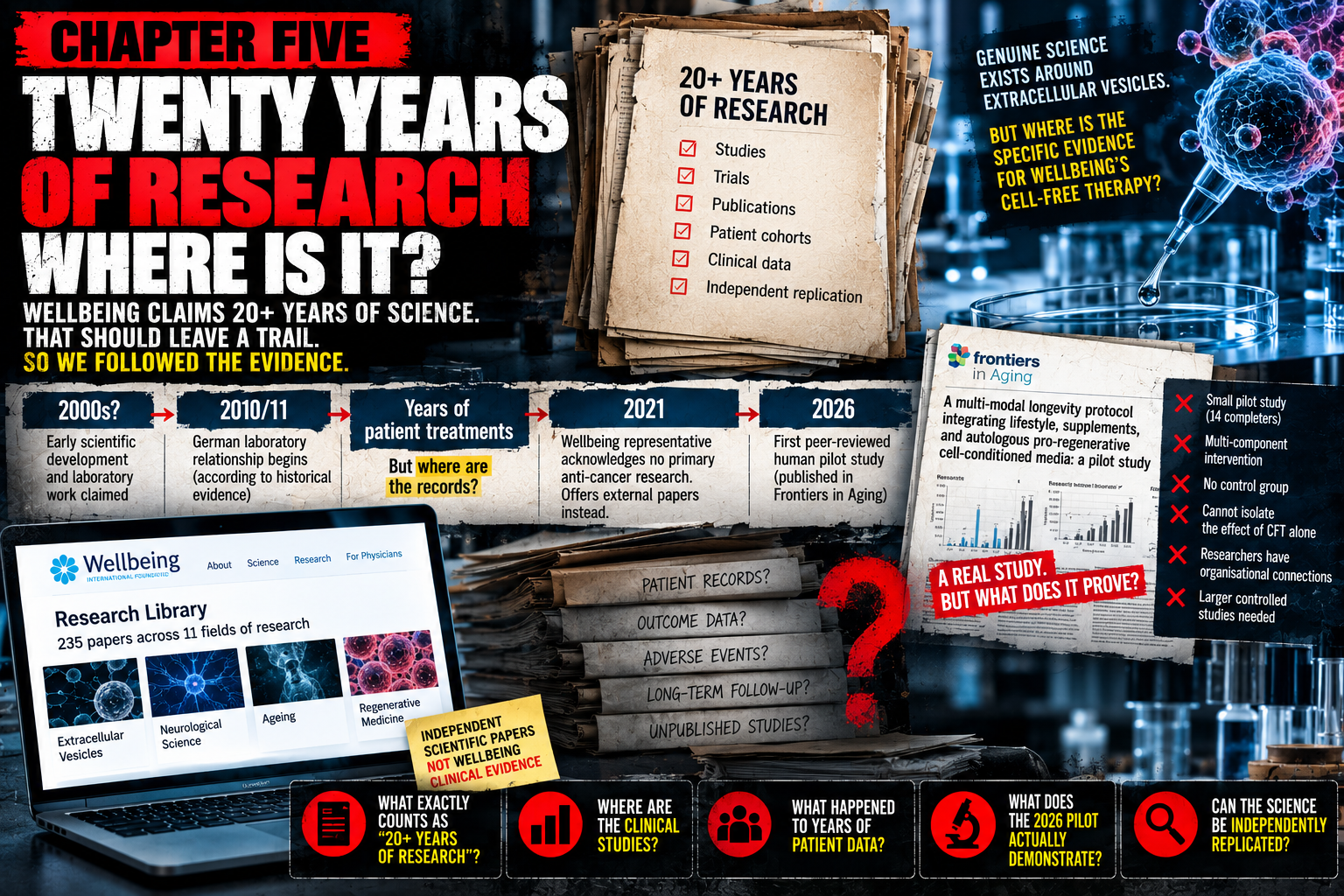
To establish efficacy, we still need clinical evidence.
Controlled trials.
Adequate patient numbers.
Appropriate endpoints.
Independent replication.
Transparent adverse-event reporting.
Peer-reviewed results.
Regulatory scrutiny.
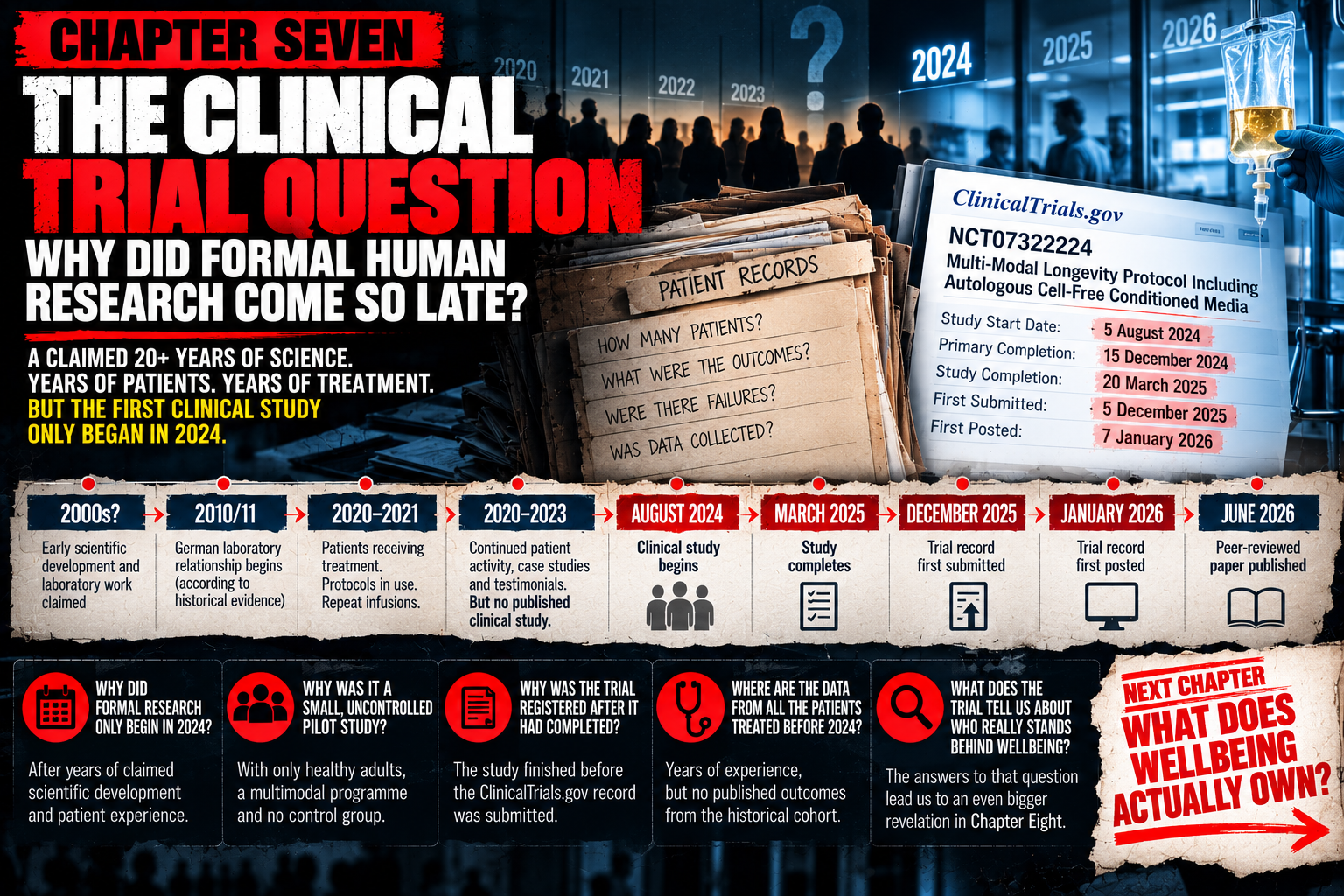
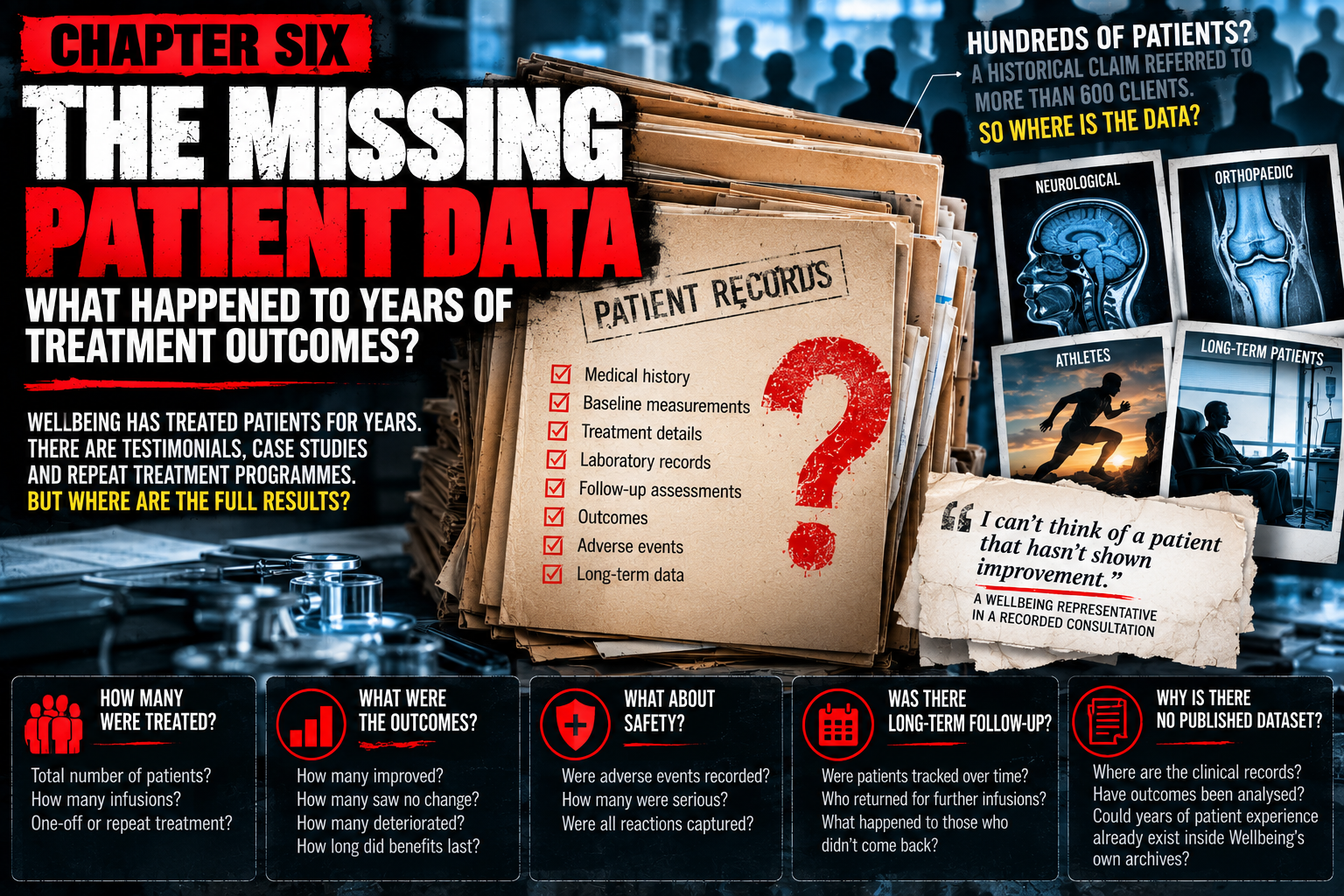
The longevity pilot we previously investigated contained only fourteen completing participants and combined multiple interventions, making attribution to Cell-Free Therapy impossible.
A patent from 2008 does not solve that problem.
The Questions Chapter Five Leaves Behind
We now have several concrete investigative targets.
Who originally owned the Ray patent family?
What was Natural Biosciences SA's legal identity?
Who owned Natural Biosciences?
Was Andrew Chancellor involved?
When did Chancellor and Ray begin working together?
Were the patents assigned or licensed?
Where are those rights today?
Does Wellbeing control them?
Are they included among the assets supporting Wellbeing's current investment proposition?
And perhaps most importantly:
What human clinical evidence exists connecting the technology described in these patents with the treatment being sold to patients today?
Those questions can now be investigated using documents rather than promotional claims.
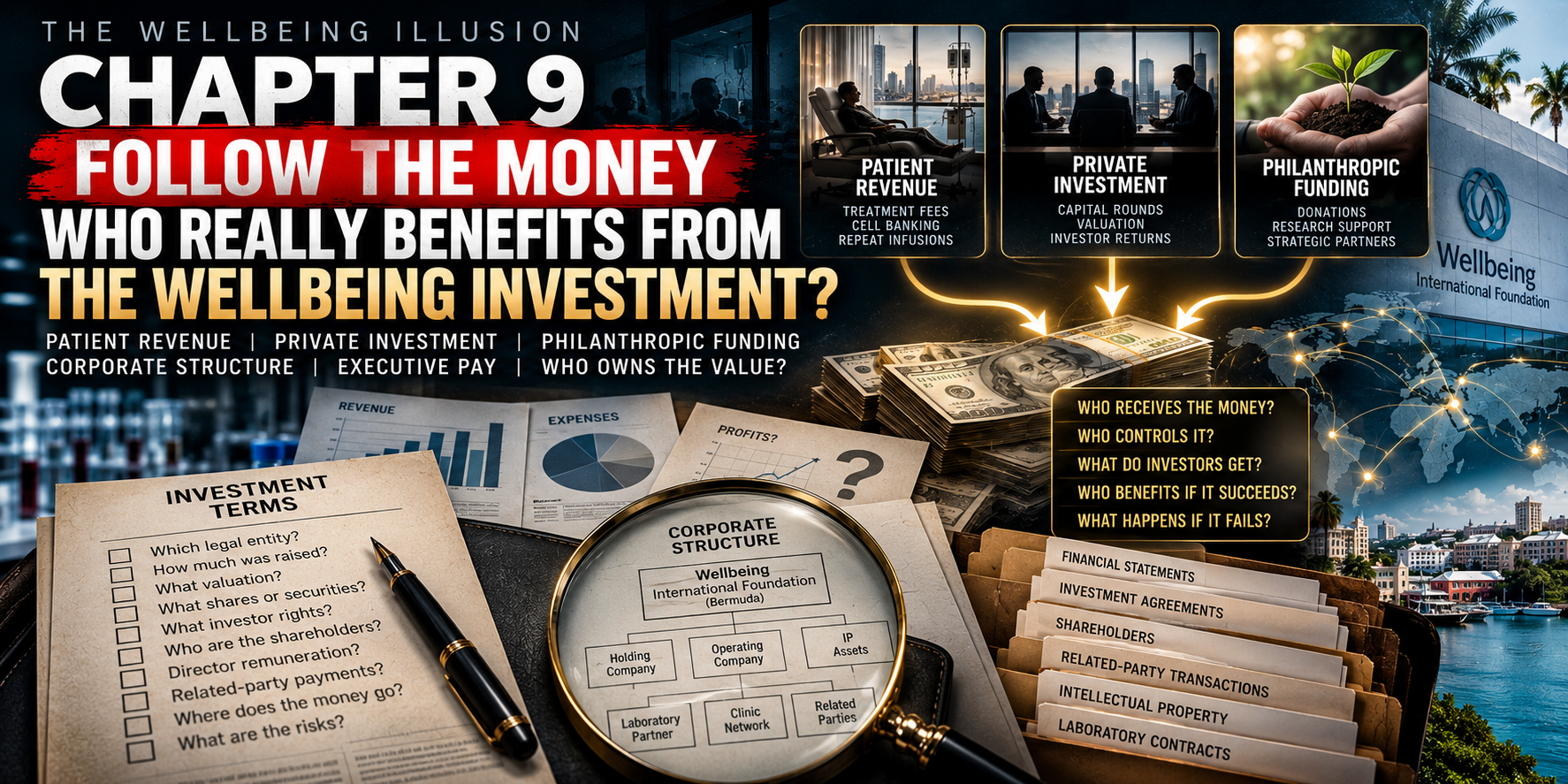
Conclusion: We Found the Patent Trail
For the first time in this part of the investigation, we have reached something concrete.
A Stephen Ray in Bath is named as inventor of a microvesicle patent family.
The priority trail reaches back to 2008.
The invention discusses autologous microvesicles.
It discusses therapeutic applications.
It discusses regeneration and rejuvenation.
It contemplates intravenous administration.
And historical material independently connects Stephen Ray with Natural Biosciences SA and stem-cell research. (Patents Encyclopedia)
That is significant.
It means there is genuine historical intellectual property behind at least part of the scientific story being told.
But it also opens a much bigger door.
Because now that we have found the invention, we can start asking:
Who owned it?
Who financed it?
Who acquired it?
Who controls it today?
And what evidence transformed an interesting patented biological concept into a treatment being offered to human patients?
Those questions matter not only to patients.
They matter enormously to investors.
Because if Wellbeing is now asking people to invest in the future of its regenerative-medicine business, one of the first things any serious investor should establish is remarkably simple:
Does the company actually own—or securely control—the intellectual property its future depends upon?
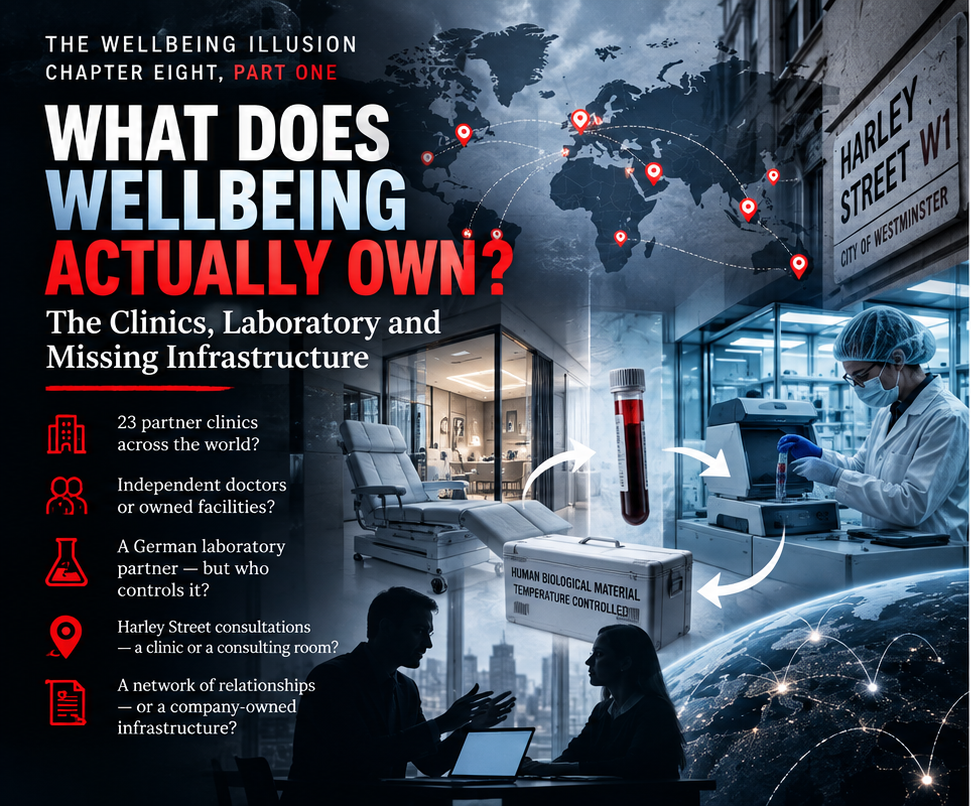
Next: Chapter Six — Who Owns the Science?
The patent exists and Stephen Ray is named as inventor. Now we follow the ownership trail through Natural Biosciences and any subsequent companies to determine who controlled the intellectual property—and whether Wellbeing controls it today.
Recent Posts