The Missing Asset: Does Wellbeing Actually Own the Science Behind Cell-Free Therapy?
The Men Behind Wellbeing — Chapter Nine
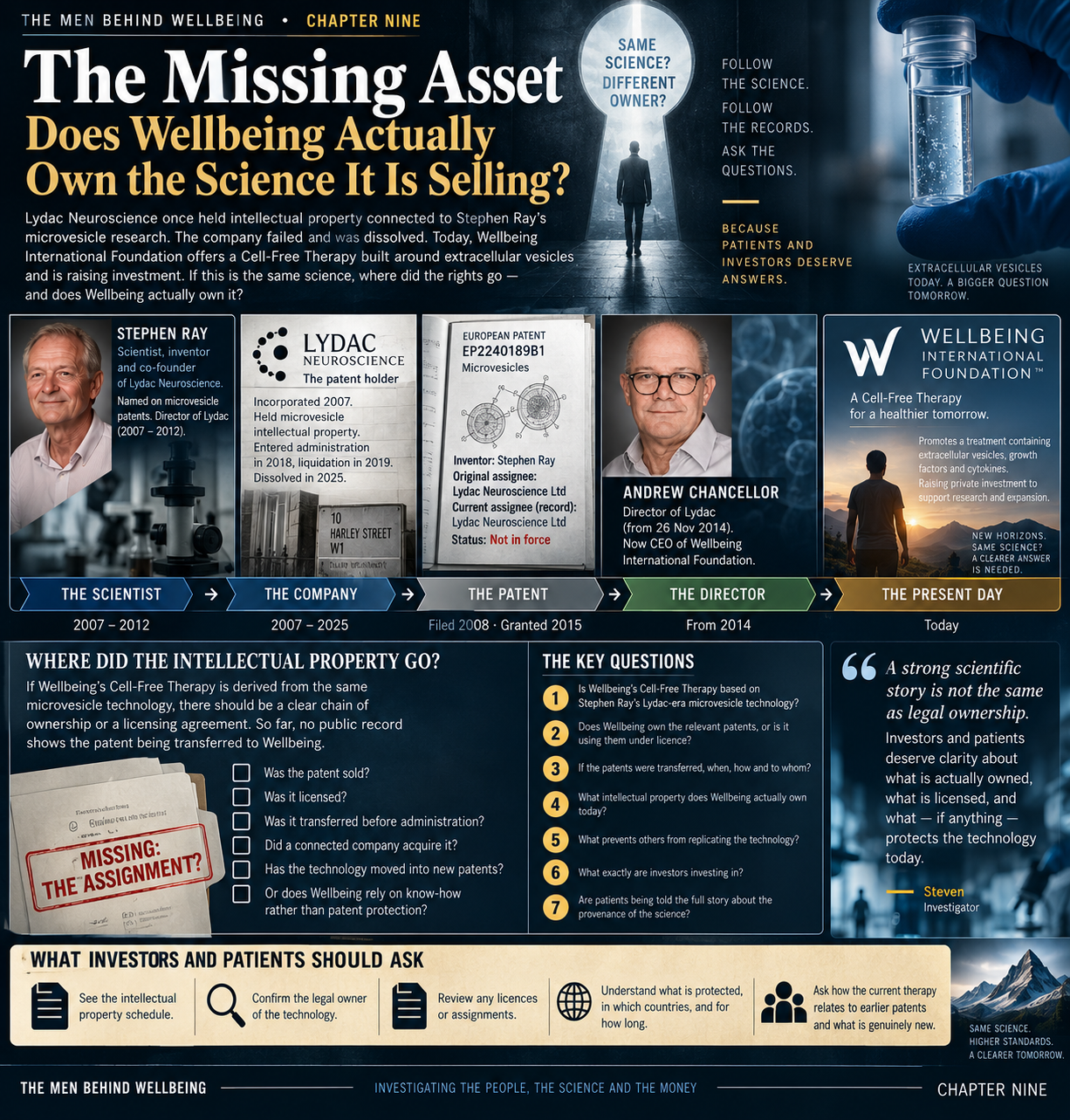
We followed Stephen Ray’s science backwards through patents, Lydac Neuroscience and ultimately the company’s insolvency. Now the investigation must return to where it started: Wellbeing International Foundation. If the Cell-Free Therapy being promoted today developed from the same microvesicle science once held by Lydac, where did Wellbeing obtain it — and what intellectual property does it actually own?
For the last several chapters, this investigation has travelled backwards.
We started with Wellbeing International Foundation and its Cell-Free Therapy.
We followed the scientist behind much of its scientific narrative, Stephen Ray.
That led us to patents.
The patents led us to a biotechnology company called Lydac Neuroscience Limited.
Lydac led us to Andrew Chancellor.
And Lydac's eventual collapse led us into administration, liquidation and a company that was finally dissolved in April 2025.
But there is a danger in following corporate records too far backwards.
We can forget why we started looking.
This investigation was never really about Lydac Neuroscience.
It is about Wellbeing International Foundation today.
It is about the scientific provenance of the treatment being offered to patients.
It is about the scientific story being presented around that treatment.
And it is increasingly about what prospective investors are actually being invited to invest in.
Because Wellbeing announced in 2026 that it had closed the opening tranche of a new capital round, with money intended to support research, clinical relationships, documentation and expansion.
That brings us to perhaps the most important question we have asked so far:
If Wellbeing's present Cell-Free Therapy originates from, incorporates, or substantially develops Stephen Ray's earlier microvesicle technology, who owns that technology today?
And specifically:
Does Wellbeing own it?
Start With What Wellbeing Says It Is Doing
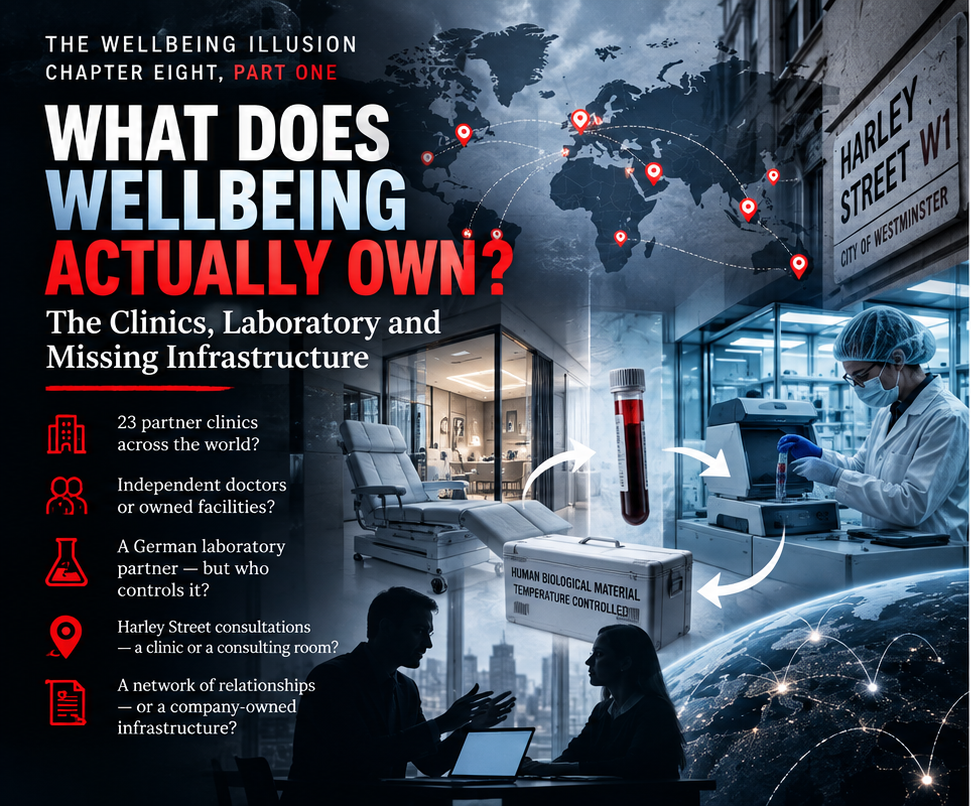
Wellbeing describes Cell-Free Therapy as an autologous treatment.
In simplified terms, blood is taken from the patient, white blood cells are isolated and processed under controlled conditions, and biological material is produced containing signalling components including extracellular vesicles, growth factors and cytokines.
Wellbeing places particular importance on extracellular vesicles in explaining the science behind its treatment.
That terminology matters.
Because it brings us directly back to the intellectual property uncovered earlier in this investigation.
Stephen Ray's Earlier Technology Was About Microvesicles
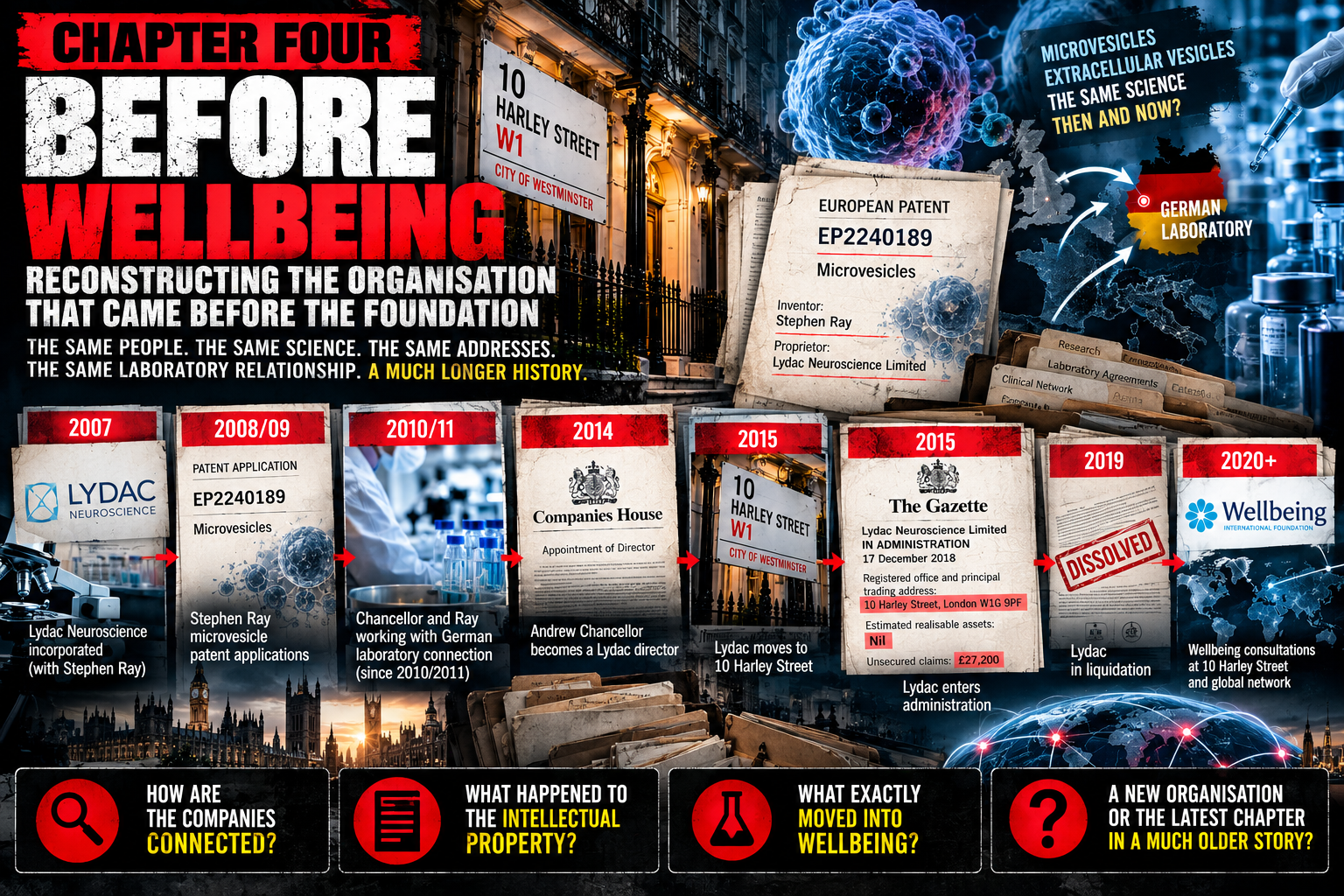
Years before the present Wellbeing organisation was promoting Cell-Free Therapy, Stephen Ray was named as inventor on patent applications dealing specifically with microvesicles.
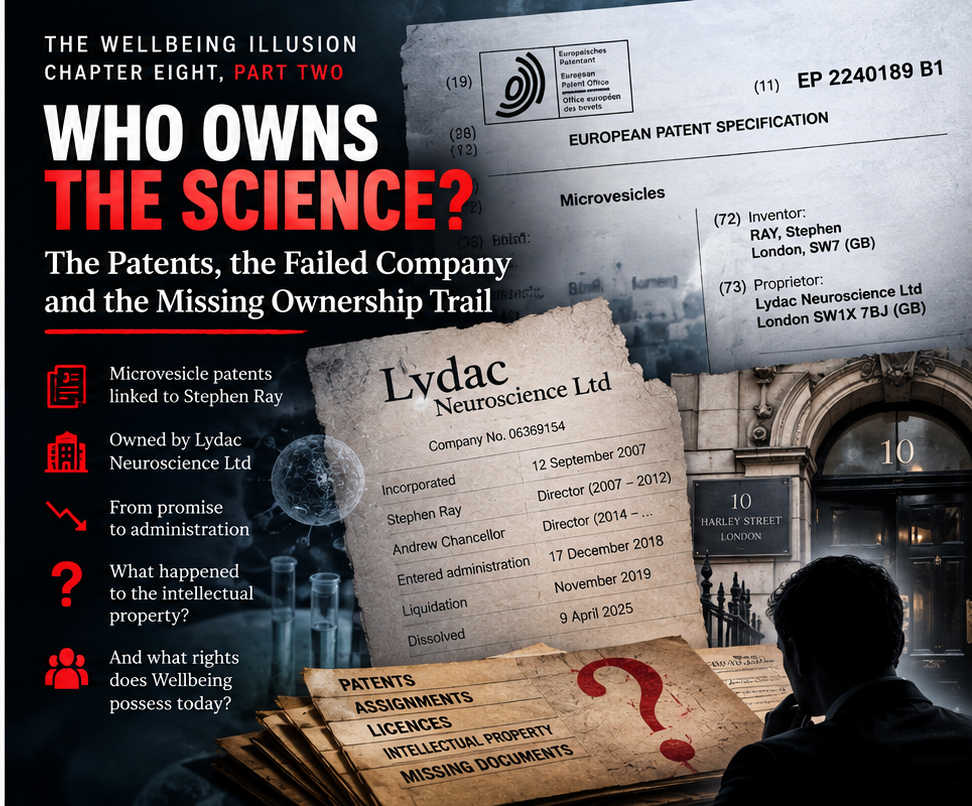
One of the clearest examples is European patent EP2240189B1, titled simply:
“Microvesicles.”
The patent record identifies:
Inventor: Stephen Ray
and:
Original Assignee: Lydac Neuroscience Ltd.
The patent concerns methods involving microvesicles, including the production of immunologically matched autologous microvesicles and their potential therapeutic and cosmetic applications.
This is not something we have inferred from Wellbeing's marketing.
It exists in the patent record.
And the underlying priority dates take the technology back to 2008.
Now Compare the Two Scientific Stories
This is where things become interesting.
The historical patent describes:
autologous microvesicles.
Wellbeing today describes:
autologous biological material containing extracellular vesicles.
Stephen Ray is the inventor associated with the earlier technology.
Stephen Ray is now Wellbeing's Senior Scientific Consultant.
There is therefore an obvious scientific lineage worth investigating.
But there is an equally important warning.
Similarity does not establish legal or technical identity.
We cannot simply declare that the old Lydac patent is Wellbeing's present CFT.
That has not been established.
The terminology surrounding extracellular vesicles has evolved.
The manufacturing process may have changed.
Ray may have made substantial subsequent discoveries.
Wellbeing may possess additional know-how.
There may be newer intellectual property we have not yet identified.
And the claims contained in the old patents may not cover Wellbeing's present process.
Those possibilities have to remain open.
But the similarities are sufficient to ask something Wellbeing should be capable of answering:
What is the relationship between Stephen Ray's Lydac-era microvesicle technology and the Cell-Free Therapy being promoted today?
The Science Has a History
This matters because Wellbeing itself relies upon scientific history.
Its biography of Stephen Ray describes him as having more than 30 years of academic and commercial experience in cell therapy.
That experience is presented as part of the scientific foundation behind the organisation.
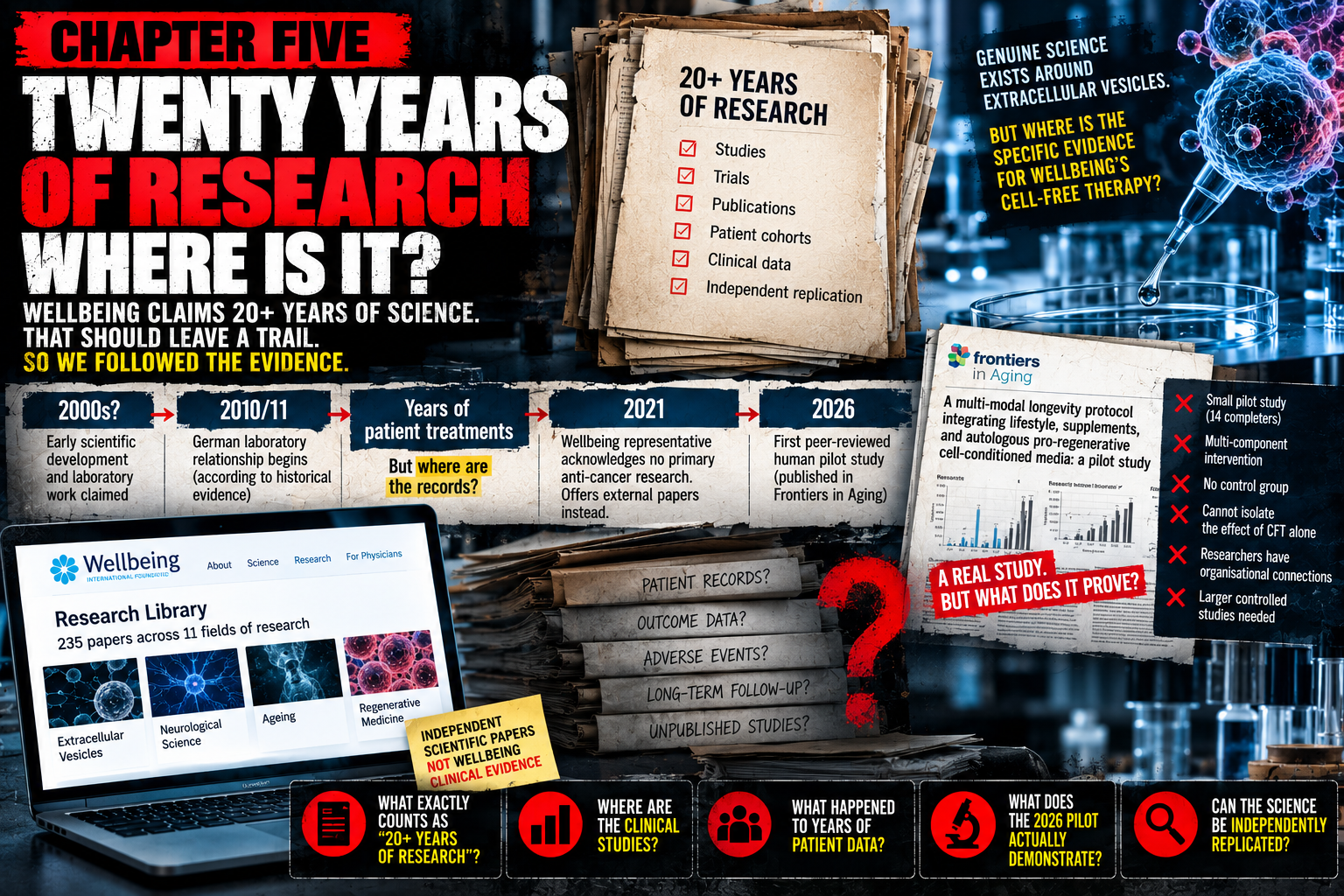
And our investigation has actually found documentary evidence supporting the existence of a substantial historical research footprint.
Ray was not suddenly introduced to this area when Wellbeing appeared.
His involvement goes back considerably further.
But that creates another distinction that patients and investors should understand.
Thirty years of a scientist's research experience is not necessarily thirty years of research on the exact commercial therapy being offered today.
Those are different claims.
If present-day CFT evolved from Ray's earlier microvesicle research, that history should be capable of being mapped.
Where did the process begin?
What did the original technology involve?
What changed?
When did it change?
What was patented?
What remained proprietary know-how?
And when did the version currently described as Cell-Free Therapy emerge?
That history could potentially strengthen Wellbeing's scientific narrative.
But it also creates an ownership question.
The Original Patent Holder Wasn't Wellbeing
This is one of the most important facts in the story.
The European patent record does not identify Wellbeing International Foundation as the original owner of Ray's microvesicle patent.
It identifies:
Lydac Neuroscience Limited.
That matters because we now know considerably more about Lydac than we did when this investigation began.
Stephen Ray was a director of Lydac from its incorporation in September 2007 until July 2012.
Andrew Chancellor became a director in November 2014.
The European patent was granted in December 2015.
Lydac subsequently entered administration in December 2018.
It moved into creditors' voluntary liquidation in November 2019.
And after years of winding up, the company was finally dissolved on 9 April 2025.
The company disappeared.
The science apparently did not.
Two Men Reappear in the Same Story
This is another reason the Lydac investigation matters.
Stephen Ray and Andrew Chancellor were not simultaneously directors of Lydac according to the dates we have established.
Ray had resigned more than two years before Chancellor joined the board.
We should therefore not describe Chancellor as directly “taking over from Ray” without evidence supporting that conclusion.
But both men undeniably appear in the corporate history of the same biotechnology company.
Ray was there when the early microvesicle intellectual property was being developed.
Chancellor subsequently became a director.
Today, the two men are again connected through Wellbeing International Foundation.
Ray is presented as the scientific specialist.
Chancellor is the Chief Executive.
And Wellbeing is promoting Cell-Free Therapy.
That makes the corporate history relevant.
Where Is the Bridge Between Lydac and Wellbeing?
This is where our investigation currently reaches a gap.
If technology belonging to Lydac subsequently became technology used by Wellbeing, there should logically be some mechanism explaining how that happened.
It might have been:
an assignment;
a sale;
a licence;
an acquisition;
a transfer of intellectual property;
a successor patent;
a separate agreement involving Ray;
or an entirely new body of technology developed later.
Any one of those explanations could be legitimate.
But they are not interchangeable.
And so far, we have not established the documentary bridge connecting Lydac's intellectual property with Wellbeing.
That is the missing asset in this story.
Who Owned the Patent When Lydac Failed?
The patent record adds another complication.
Google Patents currently displays Lydac Neuroscience Ltd as both the original assignee and the current assignee for EP2240189B1, while also describing the patent's status as “Not-in-force.”
That must be treated cautiously.
Google Patents itself warns that its legal-status information is not a legal conclusion, and patent ownership can vary between national members of an international patent family.
So this does not prove that Lydac legally owned every relevant patent right when it entered administration.
But neither have we yet identified a public assignment showing this particular European patent moving from Lydac to Wellbeing.
That is precisely why the insolvency documents examined in Chapter Eight matter.
If Lydac still possessed valuable intellectual property when administrators were appointed, we need to know what happened to it.
Was the Technology Sold During the Insolvency?
There are several possibilities.
The administrators may have sold intellectual property.
They may have sold licences.
The patents may have been considered commercially worthless.
Rights may already have expired or lapsed in particular jurisdictions.
The technology may have been transferred before administration.
Or the commercially important knowledge may never have depended entirely upon the patents.
Until the administrator's detailed asset records and patent assignment records are reconciled, we should not claim to know which occurred.
But if an intellectual-property sale took place, there should potentially be a purchaser.
If a licence existed, there should be a licensor and licensee.
And if the technology moved before administration, there should potentially be an assignment or agreement explaining how.
Intellectual property does not simply migrate because the same scientist later works somewhere else.
Inventing Something Is Not the Same as Owning It
This distinction is essential.
Stephen Ray may have invented the underlying technology.
That does not automatically mean Stephen Ray personally owned the patents.
The patent records identify Lydac as an assignee.
Ray may later have worked with Wellbeing.
That does not automatically transfer Lydac's intellectual property to Wellbeing.
Andrew Chancellor may have been a director of Lydac and subsequently CEO of Wellbeing.
That does not transfer intellectual property either.
These are legally distinct concepts:
inventorship;
patent ownership;
licensing;
commercial exploitation;
and:
scientific know-how.
A compelling scientific history does not establish a chain of legal ownership.
Perhaps Wellbeing Doesn't Need the Old Patent
There is another possibility that deserves serious consideration.
Perhaps the Lydac patent is no longer commercially important.
The European record currently describes EP2240189B1 as not in force.
Technology can also develop far beyond an original patent.
Wellbeing could therefore potentially be relying upon:
later discoveries;
trade secrets;
manufacturing protocols;
laboratory know-how;
newer intellectual property;
proprietary processing techniques;
clinical data;
or scientific expertise that is not itself protected by the original patent.
There is nothing inherently suspicious about that.
Many biotechnology businesses rely upon combinations of patents, know-how and confidential manufacturing processes.
But if that is the situation, it changes the question investors should be asking.
What Exactly Is Proprietary?
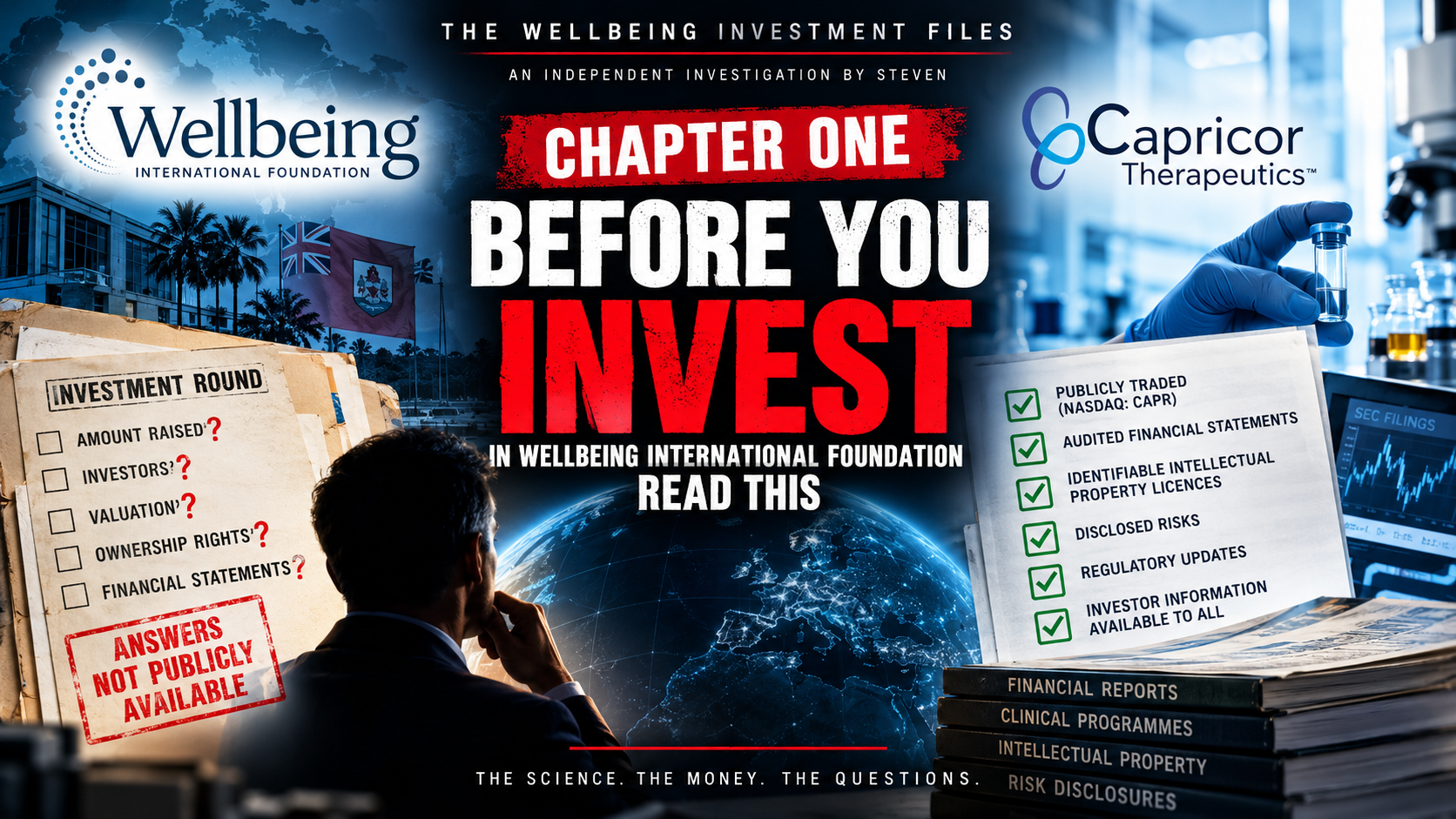
If an investor is being presented with a biotechnology opportunity, understanding the company's intellectual-property position is fundamental.
What stops another organisation from reproducing the technology?
Is the process protected by patents?
If so, which patents?
Who owns them?
How long do they remain enforceable?
In which jurisdictions?
If Wellbeing doesn't own them, does it hold exclusive licences?
If there are no relevant enforceable patents, what proprietary know-how protects the business?
And which legal entity actually owns that know-how?
These are not hostile questions.
They are basic due-diligence questions.
And That Matters Because Wellbeing Is Raising Investment
This is where our investigation reconnects directly with Wellbeing's current activities.
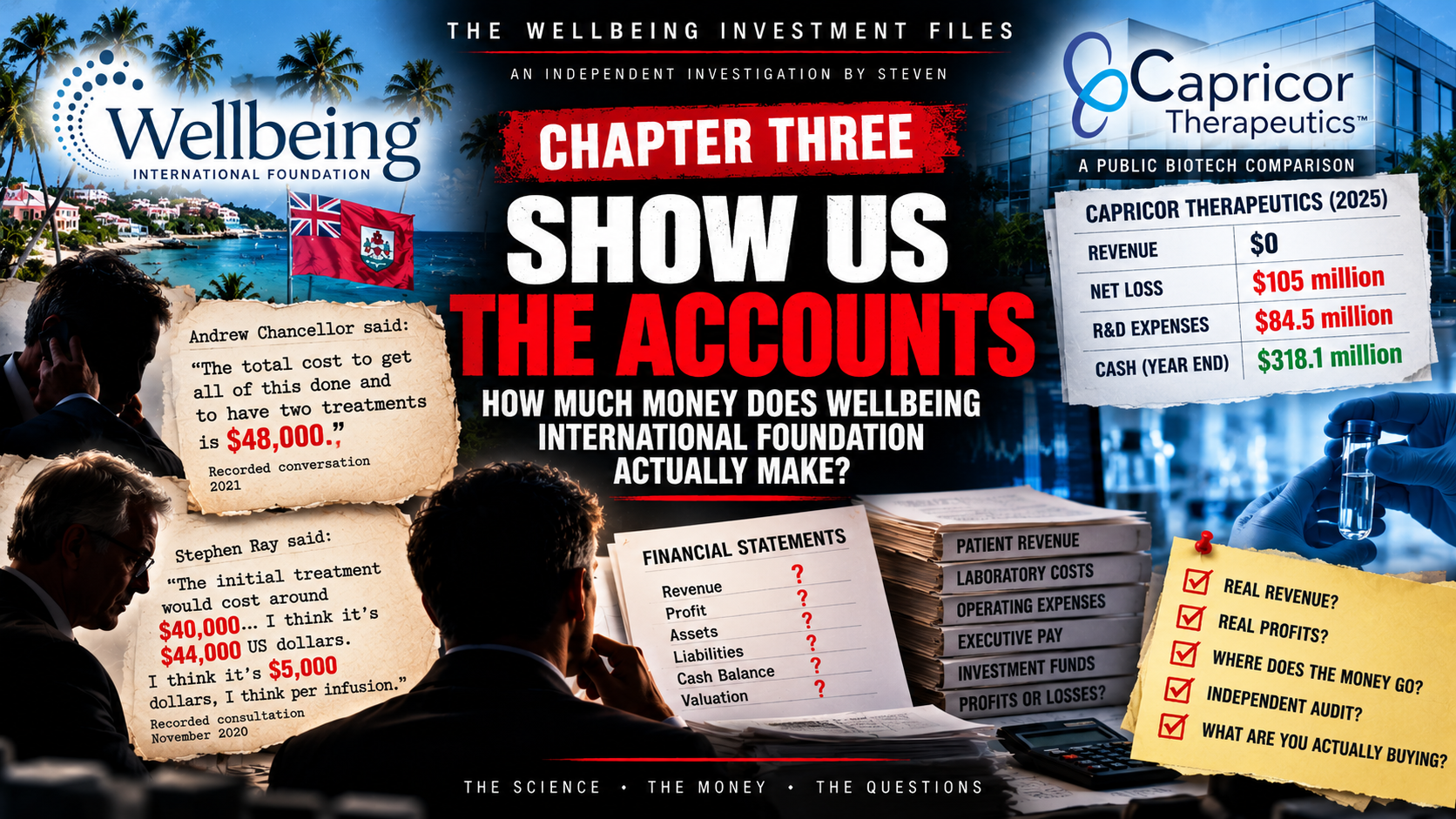
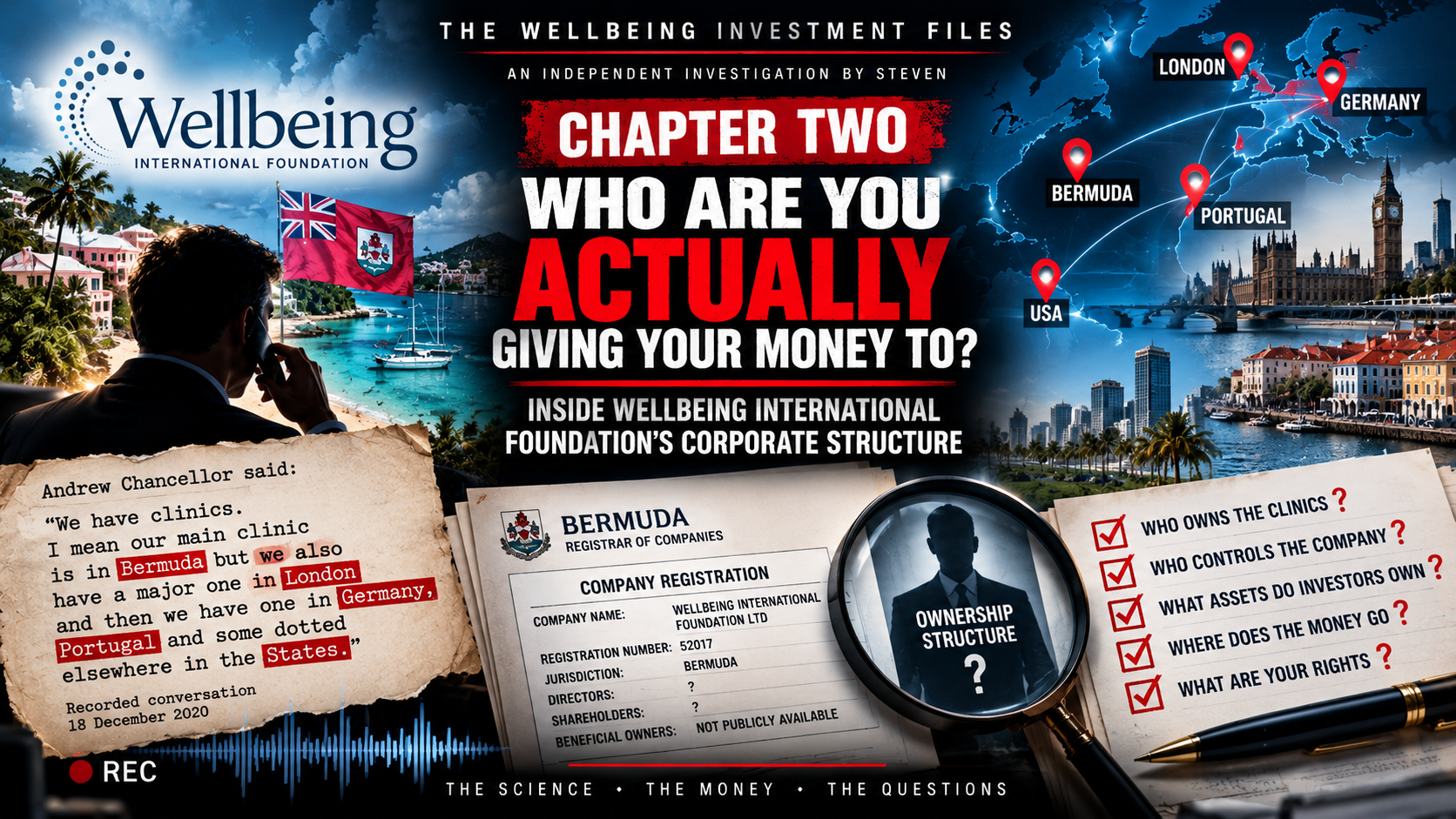
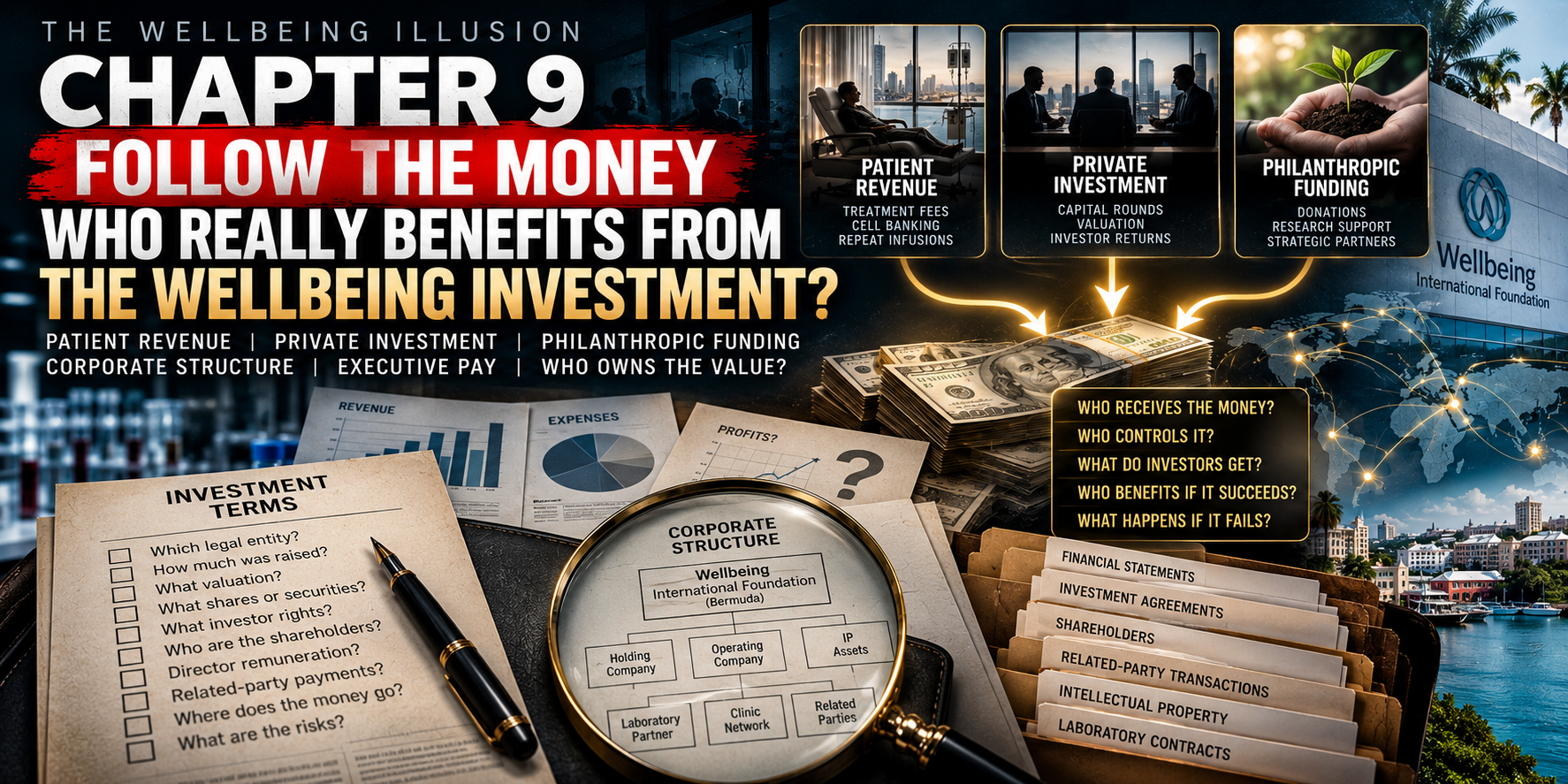
In March 2026, Wellbeing announced that it had closed the opening tranche of its 2026 capital round.
It said the round remained open.
According to Wellbeing, investment supports research, expansion of its clinical relationship network in Europe and the United States, documentation work and operating capacity.
Wellbeing also says its historical funding has included:
private investment, patient revenue and selective philanthropy.
When outside capital enters a biotechnology organisation, intellectual-property ownership becomes potentially significant.
Because investors are not merely investing in scientific enthusiasm.
They need to understand what the company actually controls.
What Is an Investor Actually Buying Into?
Imagine being shown a biotechnology company built around a treatment described as emerging from decades of research.
The organisation has a scientist with a long research history.
It has a therapy involving extracellular vesicles.
It has international ambitions.
It has patients.
It has research programmes.
And it is raising capital.
A reasonable investor might ask:
What scientific asset gives this organisation commercial exclusivity?
That question becomes particularly important if the historical patents associated with the scientist were originally owned by another company.
A company that subsequently became insolvent.
A company that has now been dissolved.
Ask for the Intellectual-Property Schedule
There is a straightforward way for a serious investor to resolve much of this uncertainty.
Ask Wellbeing for its intellectual-property schedule.
That should identify, where applicable:
patents;
patent applications;
registered proprietors;
licences;
exclusive rights;
territories;
expiry dates;
royalty obligations;
trade secrets;
proprietary processes;
and agreements governing intellectual property created by consultants or employees.
Then ask:
Which legal entity owns the technology underlying Cell-Free Therapy?
And after that:
What relationship, if any, does that technology have to Stephen Ray's earlier Lydac patents?
Those two answers could resolve a substantial part of this investigation.
If There Is No Connection, Say So
There is an important point here.
Our hypothesis could be wrong.
Perhaps modern CFT has no legally significant relationship with the old Lydac patent.
Perhaps the similarities reflect the continuation of Ray's scientific interests rather than continuation of the patented invention.
If that is the case, Wellbeing should be able to explain where the modern process begins and how it differs from the earlier technology.
That would be useful information.
Likewise, if Wellbeing possesses newer intellectual property, identify it.
If the organisation operates under licence, explain that.
If it relies upon proprietary know-how rather than patents, say so.
The answer does not have to be dramatic.
It simply has to be clear.
Patients Have a Stake in This Too
This investigation should not become solely about investors.
Patients matter.
When patients encounter claims about decades of research, scientific heritage and advanced biological technology, they deserve to understand the provenance of the treatment they are purchasing.
If modern CFT developed from Ray's earlier work, when did the current treatment emerge?
How closely does it resemble the patented process?
What additional development occurred?
What clinical evidence relates specifically to the current formulation or process rather than earlier generations of research?
That final distinction is particularly important.
A long history of research in a scientific field does not automatically amount to a long clinical evidence history for the exact treatment currently being administered.
The Question Is Becoming More Precise
At the beginning of this investigation, we were asking broad questions about Wellbeing.
Now we can ask much narrower ones.
We know Stephen Ray has a documented history involving microvesicle technology.
We know Lydac Neuroscience appears in that patent history.
We know Ray was a director of Lydac.
We know Andrew Chancellor subsequently became a director of the same company.
We know Lydac entered administration and ultimately disappeared.
We know Ray and Chancellor later appear together at Wellbeing.
We know Wellbeing's present treatment narrative prominently involves extracellular vesicles.
And we know Wellbeing is raising private investment.
What we do not yet know is whether one continuous chain of intellectual property connects those facts.
That is what we now need to establish.
Three Documents Could Change This Investigation
There are three categories of evidence I particularly want to see.
First:
the complete patent assignment history.
Second:
the Lydac insolvency records showing the treatment and disposal of intellectual property.
Third:
Wellbeing's current intellectual-property schedule or licensing documentation.
Put those three together and the ownership story should become considerably clearer.
Without them, there is a gap.
What We Are Not Alleging
For clarity, this investigation has not established that Wellbeing is using intellectual property it does not own.
We have not established that intellectual property was improperly transferred from Lydac.
We have not established that Andrew Chancellor acquired Lydac's patents.
We have not established that Stephen Ray transferred technology improperly.
And we have not established that Wellbeing's current CFT falls within the claims of the historic Lydac patent.
Those would be serious conclusions.
The evidence does not presently justify them.
What the evidence does justify is asking how the technology travelled from its documented historical origins to the commercial proposition being presented today.
The Right of Reply
There is a very straightforward opportunity for Wellbeing International Foundation to clarify this.
We would welcome answers to the following questions:
- Does Wellbeing consider its present Cell-Free Therapy to derive technically or scientifically from Stephen Ray's earlier microvesicle research?
- Does EP2240189B1, or any member of that patent family, relate to the present CFT process?
- Does Wellbeing own any patents covering CFT?
- If not, does it license relevant intellectual property from another entity?
- What happened to the microvesicle intellectual property previously owned by Lydac Neuroscience?
- Did Wellbeing, Andrew Chancellor, Stephen Ray or any connected organisation acquire intellectual property from Lydac before, during or after its insolvency?
- What intellectual property or proprietary rights are included in the commercial proposition currently being presented to investors?
If there is a straightforward ownership history, publishing it would answer many of the questions raised here.
Conclusion: Follow the Science — Then Follow the Ownership
We started with a treatment.
The treatment led us to a scientist.
The scientist led us to patents.
The patents led us to Lydac Neuroscience.
Lydac led us to Andrew Chancellor.
The company then entered insolvency and disappeared.
But years later, Ray and Chancellor are together again within an organisation promoting Cell-Free Therapy and raising investment.
That does not prove that Wellbeing inherited Lydac's technology.
It does not prove that the old patents protect modern CFT.
And it certainly does not prove wrongdoing.
But it creates a documentary question that can no longer be ignored:
If this is substantially the same scientific lineage, where is the chain of ownership?
Because the answer matters.
It matters to patients being told about the scientific heritage behind the treatment.
It matters to investors evaluating what proprietary assets underpin the business.
And it matters to anyone trying to understand whether Wellbeing is commercialising technology it owns, technology it licenses, technology that is no longer protected—or genuinely new technology developed after Lydac.
The science has a history.
The companies have a history.
The people have a history.
Now we need the ownership history.
And until that chain is established, the central question remains:
Does Wellbeing International Foundation actually own the science behind Cell-Free Therapy — and if it does, where is the documentary trail showing how it got there?
Next: Chapter Ten — Following the Patent Trail
In Chapter Ten, we leave the corporate biographies behind and follow the intellectual property itself: patent by patent, jurisdiction by jurisdiction and assignment by assignment. We will compare Stephen Ray's original claims with Wellbeing's description of modern Cell-Free Therapy and look for the missing legal bridge between Lydac Neuroscience and the technology being promoted today.
Recent Posts