THE BUSINESS OF LONGEVITY – Chapter Eight The Investor Pitch
When Emerging Science Becomes an Investment Opportunity
There is a moment in the development of almost every biotechnology company when the conversation changes.
Scientists talk about evidence.
Doctors talk about patients.
But investors talk about the future.
That difference is important.
Scientific research asks whether something works.
Investment asks what something could eventually become worth.
Between those two questions exists an enormous commercial opportunity—and an equally important area of risk.
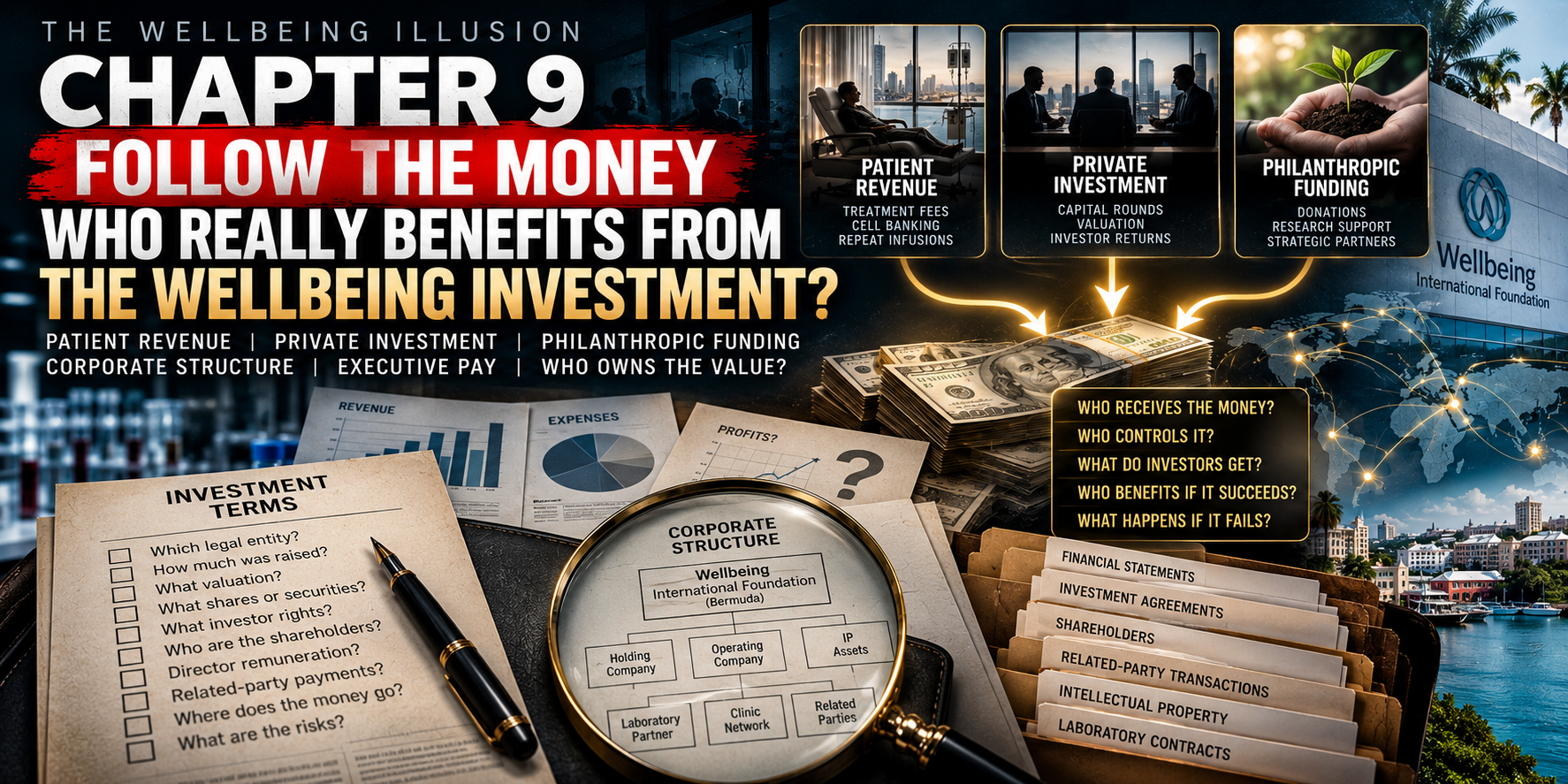
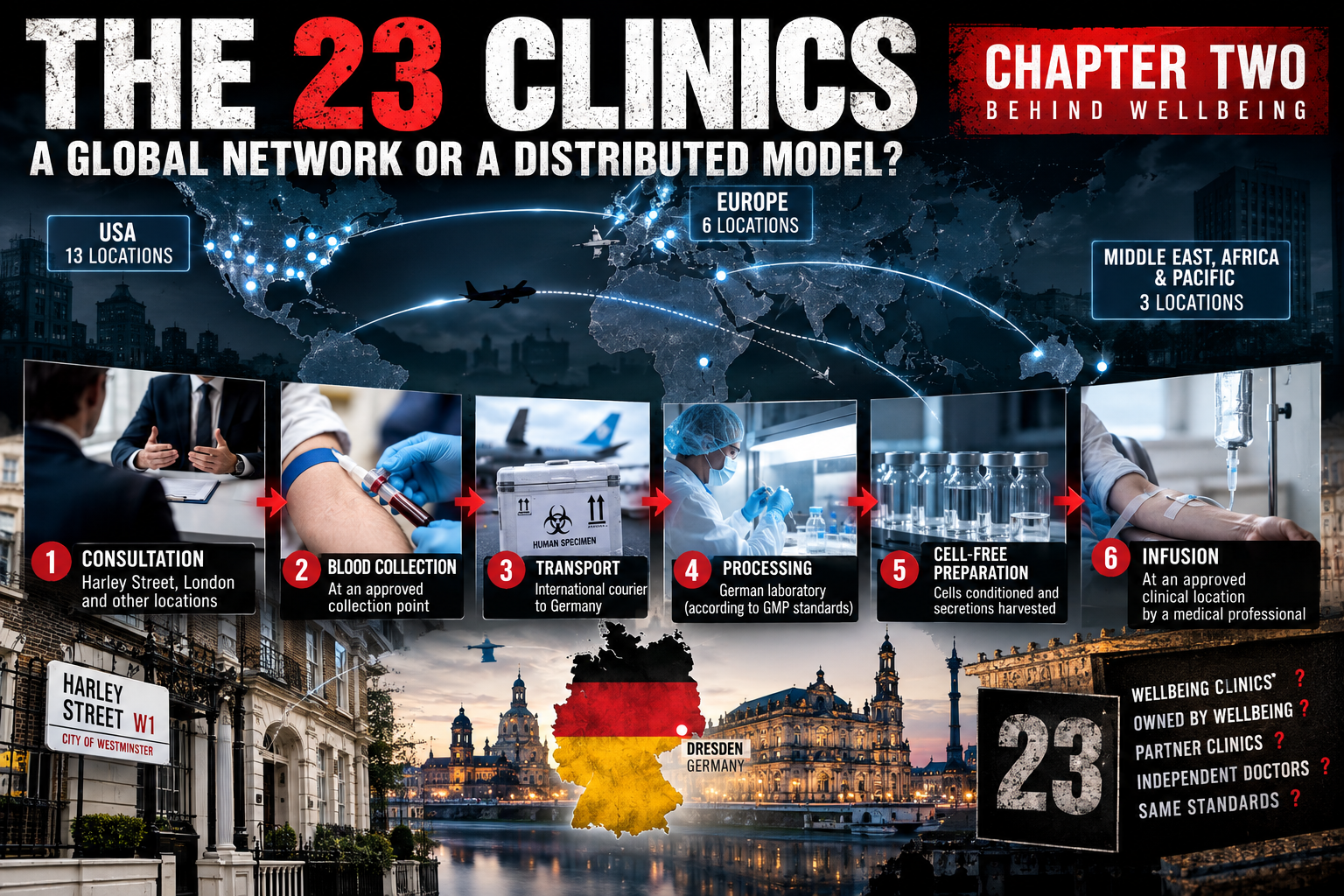
During this investigation into Wellbeing International Foundation, I discovered that the organisation had moved beyond simply offering Cell-Free Therapy and conducting research.
It was also raising private capital.
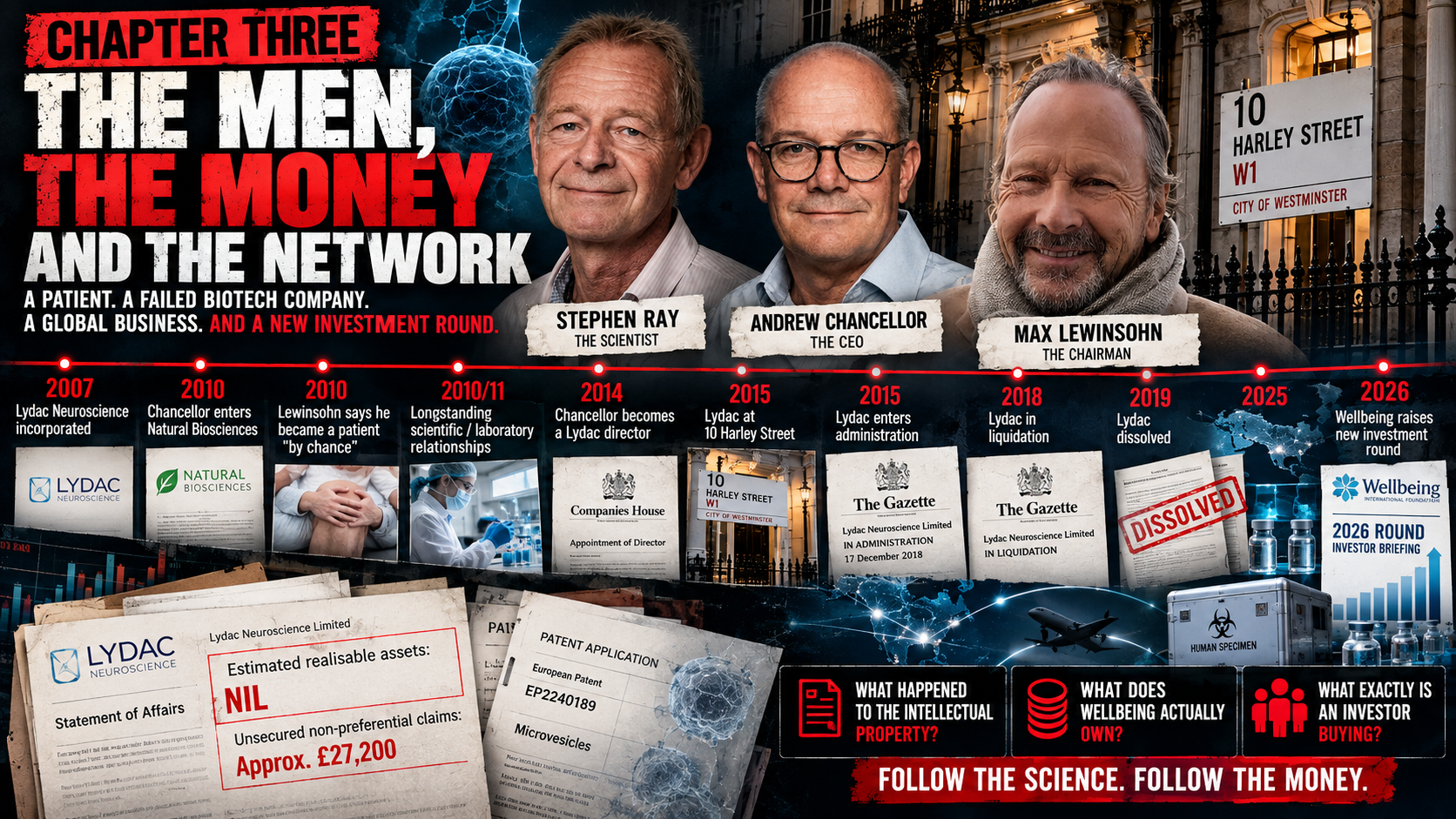
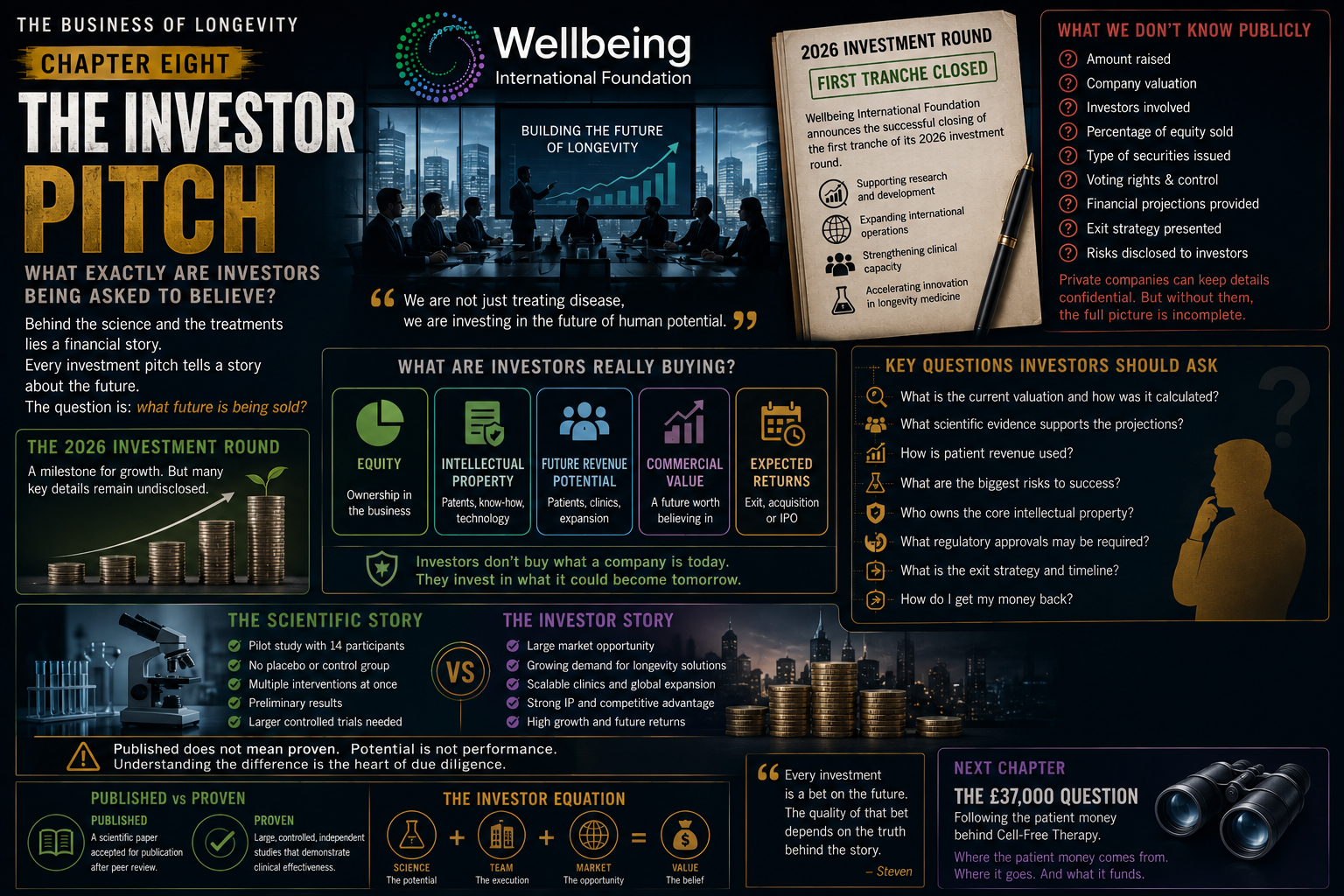
Wellbeing announced that it had successfully closed the first tranche of its 2026 investment round.
That announcement changed the direction of my investigation.
Because once emerging medical science becomes an investment proposition, another question becomes unavoidable:
What exactly are investors being asked to believe?
Why Biotechnology Needs Investors
There is nothing unusual about a biotechnology company raising money.
Quite the opposite.
Developing new medical technologies can require enormous amounts of capital.
Laboratories cost money.
Researchers cost money.
Clinical studies cost money.
Manufacturing costs money.
Regulatory approval costs money.
International expansion costs money.
Without investors willing to accept considerable risk, many important medical innovations would never progress beyond the laboratory.
Investment itself is therefore not the issue.
The issue is understanding the proposition being presented to those investors.
The Public Announcement
Wellbeing's announcement confirmed that the first tranche of its 2026 fundraising had been completed.
According to the organisation, capital would support areas including research, development, international expansion and operational capacity.
What the public announcement did not reveal was the detailed financial proposition behind the transaction.
From the information publicly available, we cannot independently determine:
- how much was raised;
- the valuation placed upon the company;
- who invested;
- what percentage of ownership changed hands;
- which securities were issued;
- what financial projections were presented;
- what returns were discussed;
- what exit strategy investors were shown.
For a privately held business, there is nothing inherently unusual about keeping such information confidential.
But it means the public announcement tells us that an investment has occurred without allowing us to independently evaluate the investment itself.
What Is Being Purchased?
This is perhaps the most basic question an investor should ask.
What am I actually buying?
Shares in Wellbeing International Foundation?
Shares in another company?
Preference shares?
Convertible debt?
An interest in intellectual property?
A holding company sitting above the operating businesses?
Without the investment documents, there is no responsible basis upon which to assume the answer.
And the answer matters enormously.
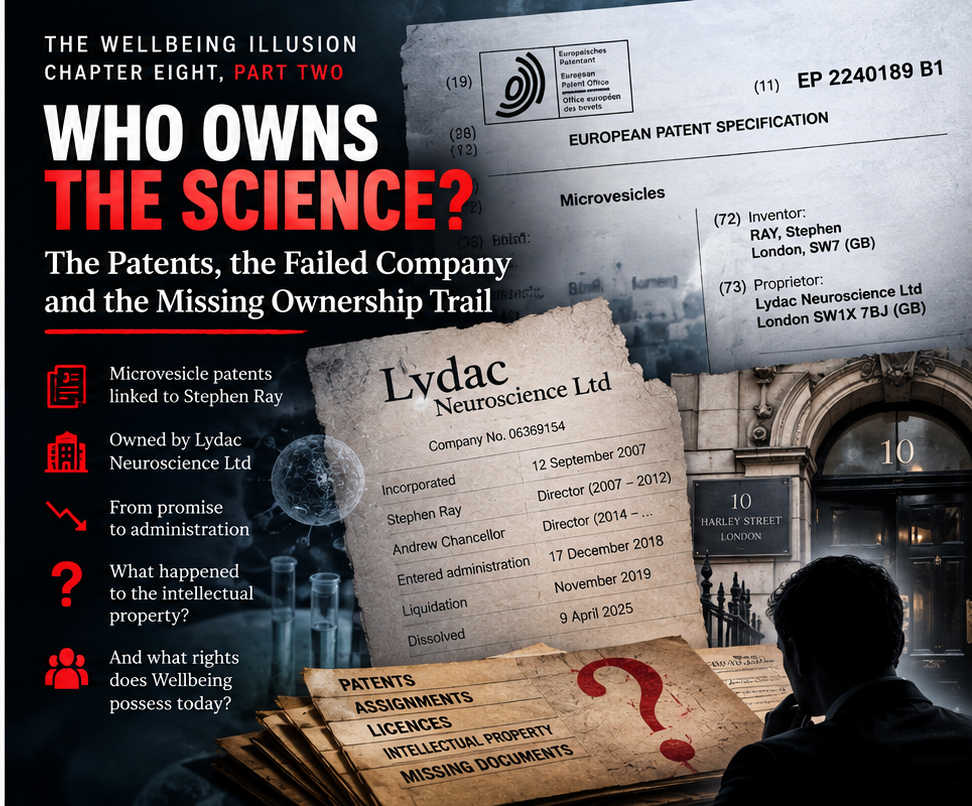
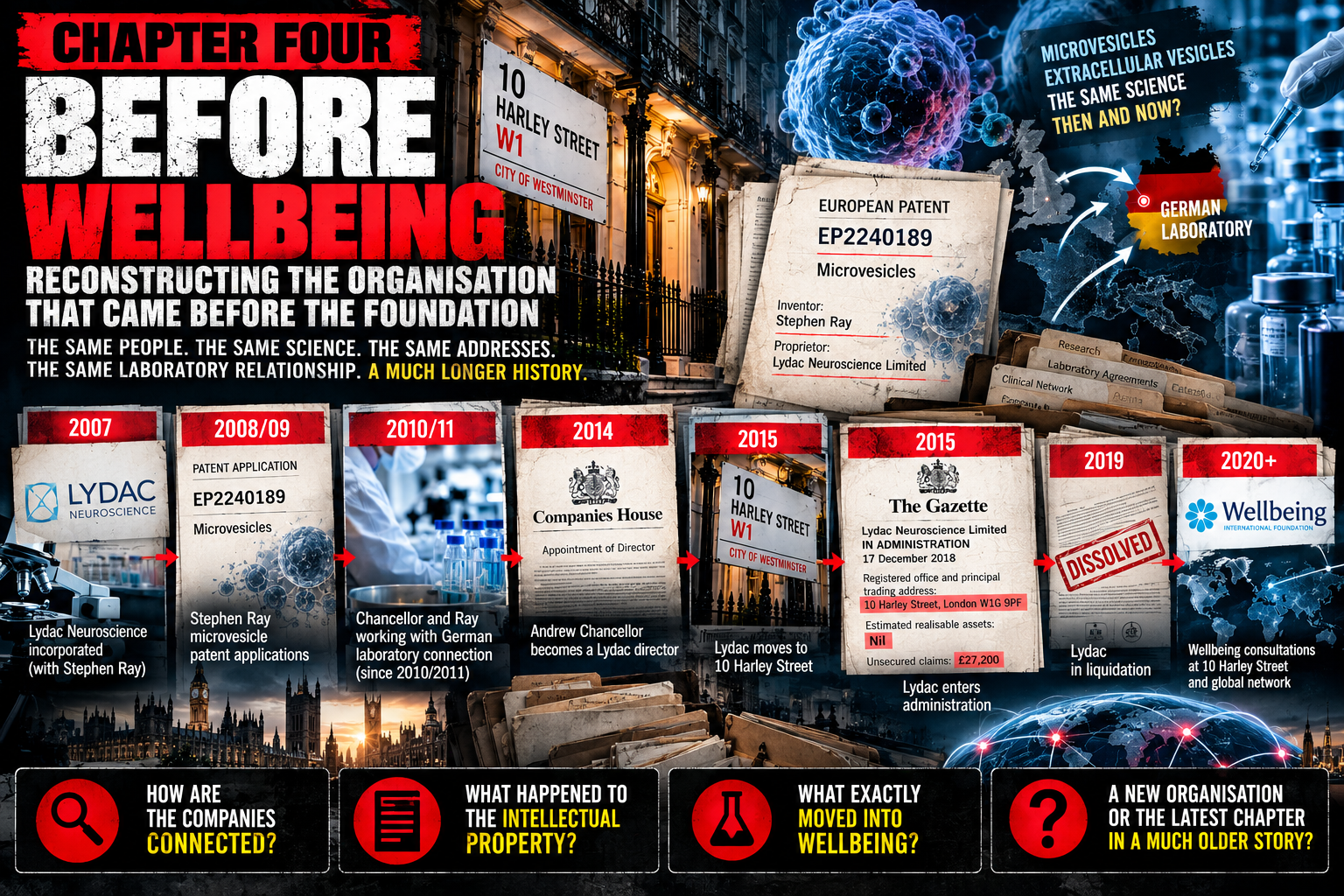
The value of a biotechnology investment may ultimately depend upon ownership of patents, technology, manufacturing processes and licensing rights.
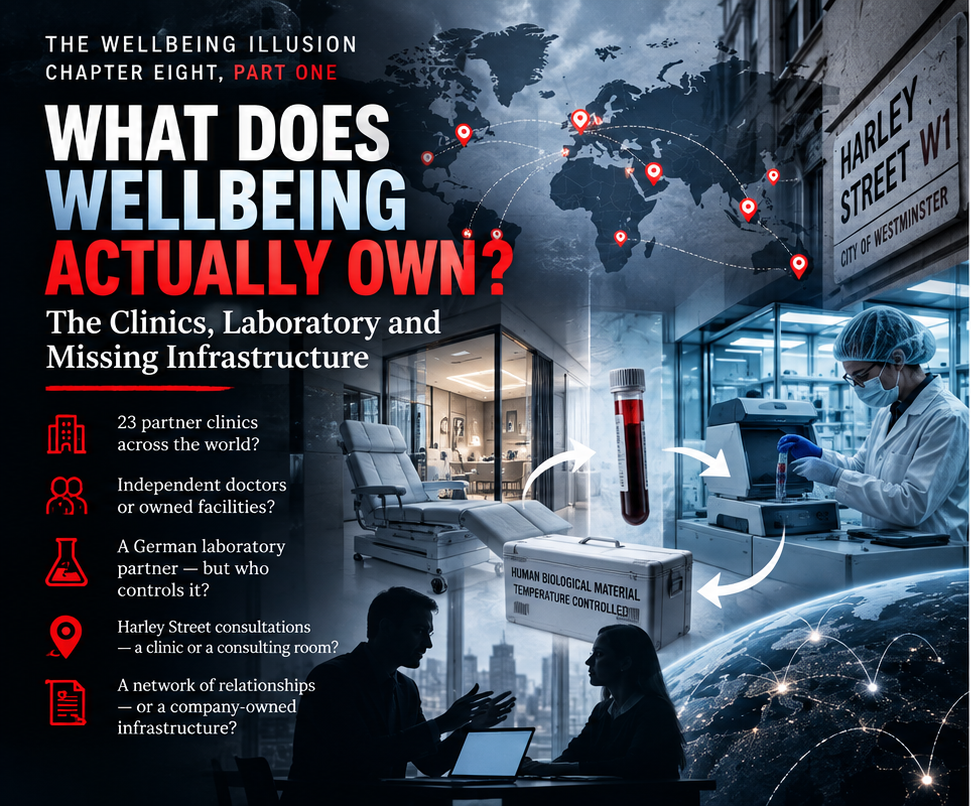
If the company receiving investment does not directly own those assets, the investor needs to understand exactly what contractual rights connect them.
This is why professional investors conduct detailed legal due diligence before investing.
The brand name alone tells them very little.
Then Came Peer Review
The investment story becomes particularly interesting when viewed alongside another development.
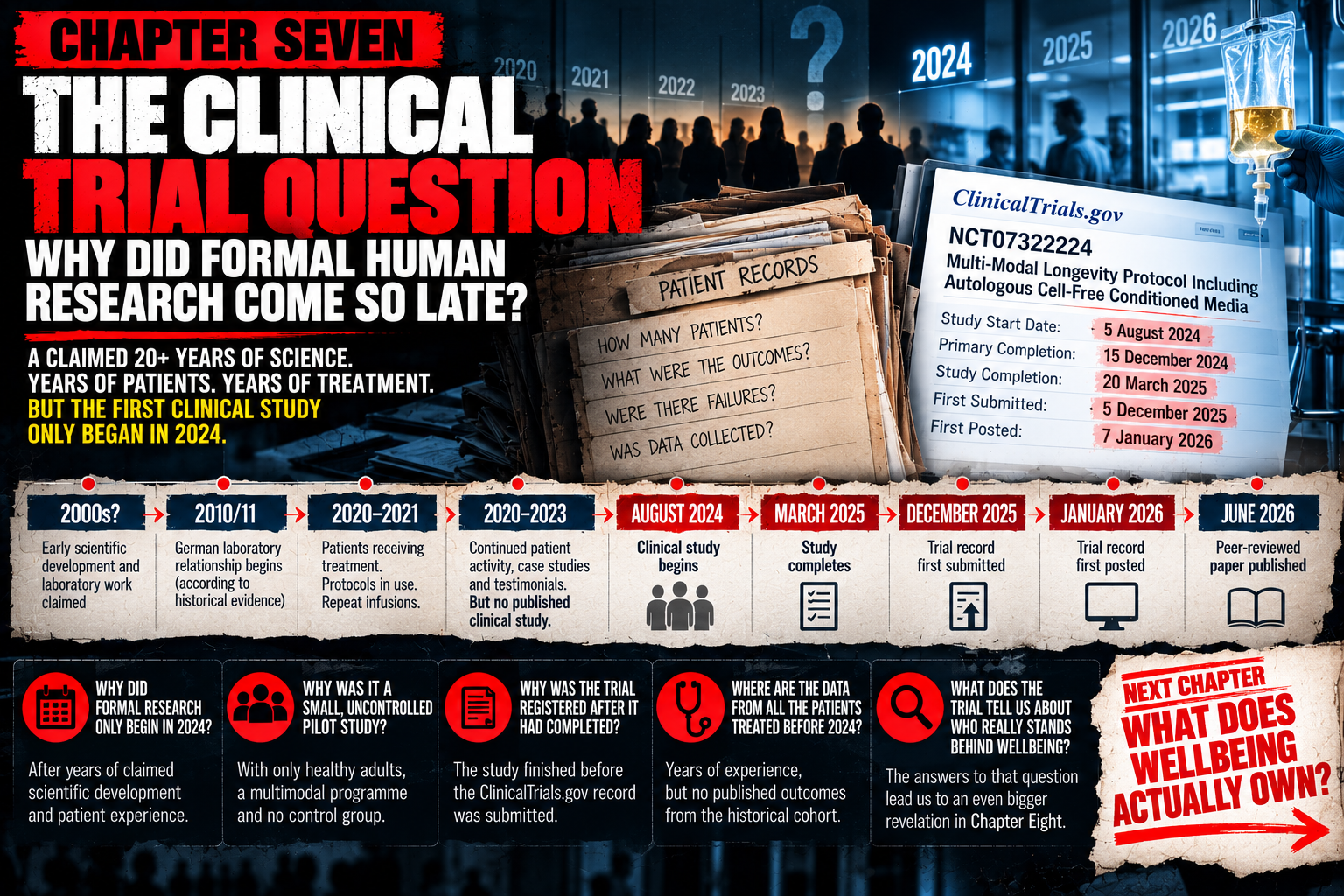
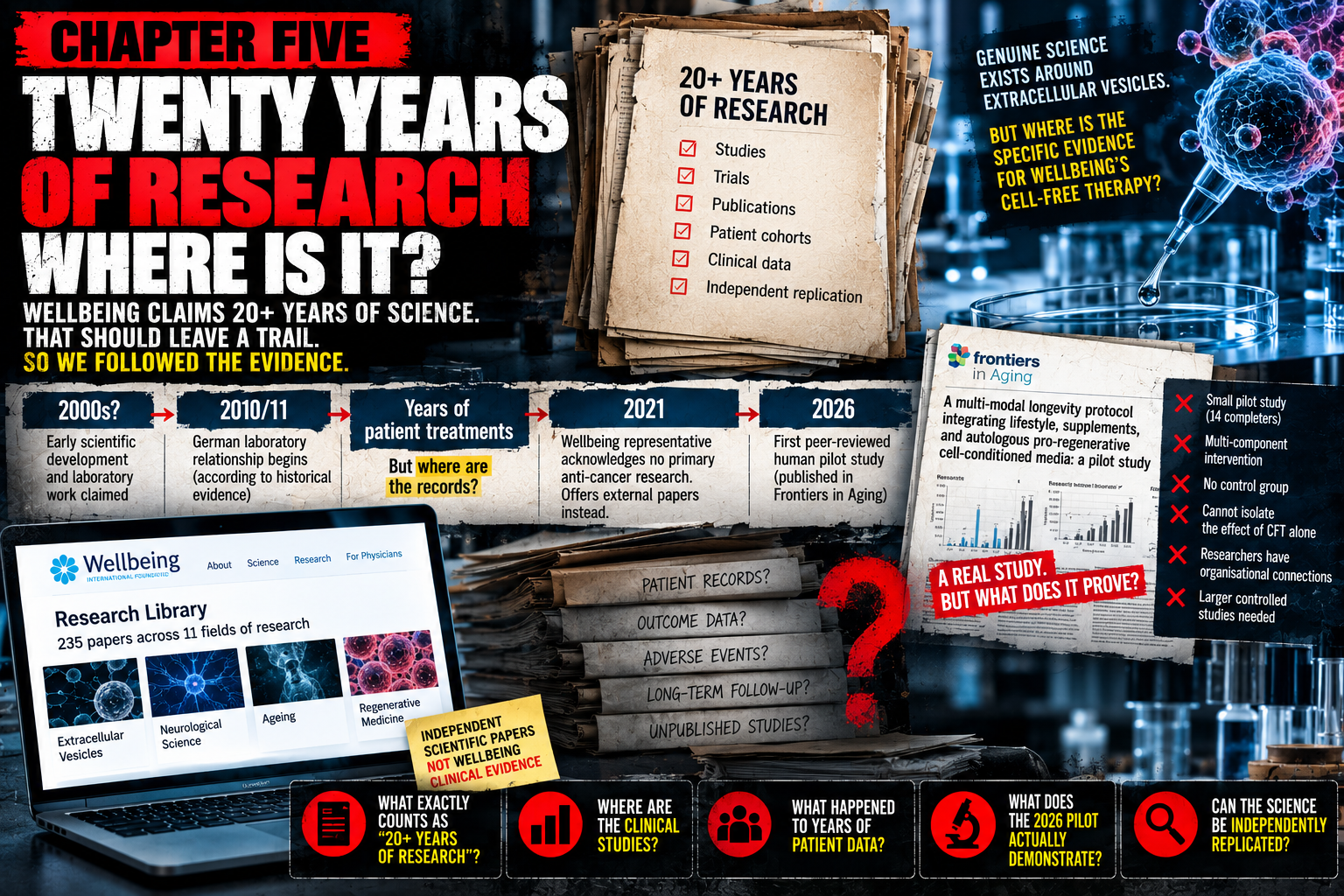
Wellbeing's longevity programme has now appeared in the peer-reviewed scientific journal Frontiers in Aging.
That is a genuine scientific achievement.
The study exists.
It was peer reviewed.
It was published.
But as examined earlier in this investigation, the study remains preliminary.
Only fourteen participants completed the programme.
There was no untreated control group.
There was no placebo group.
Participants underwent multiple interventions simultaneously.
The research involved individuals commercially connected with organisations delivering the programme.
And the authors themselves acknowledged that larger controlled studies would be required.
Scientifically, those limitations matter.
Financially, however, two words can become extraordinarily powerful:
Peer reviewed.
Published Does Not Mean Proven
This distinction is essential.
Peer review means that research has undergone scholarly evaluation before publication.
It does not mean that a commercial medical intervention has been definitively proven effective.
Clinical confidence generally develops through a much larger body of evidence.
Independent replication.
Randomised controlled trials.
Larger patient populations.
Appropriate control groups.
Long-term follow-up.
Clinically meaningful endpoints.
Reproducible results.
A small pilot study may justify further investigation.
It cannot, by itself, provide the same level of evidence as a mature clinical-development programme.
That distinction becomes particularly important when scientific credibility contributes to commercial valuation.
The Commercial Power of Two Words
Imagine two presentations to an investor.
The first says:
We are developing an experimental longevity programme.
The second says:
Our longevity programme has been published in a peer-reviewed scientific journal.
Both statements could be completely accurate.
But they create very different impressions.
The second immediately sounds more established.
More credible.
More scientifically mature.
Potentially more investable.
That is why the precise language contained within investment materials matters.
Are investors clearly told that the research involves fourteen participants?
Are they told there was no placebo or untreated control group?
Are they told that multiple interventions were administered simultaneously?
Are the commercial connections of the researchers explained?
Are they told that independent replication remains necessary?
Or is "peer reviewed" presented without that wider context?
At present, I cannot answer those questions.
I have not seen Wellbeing's private investment memorandum or investor presentation.
That limitation must be made absolutely clear.
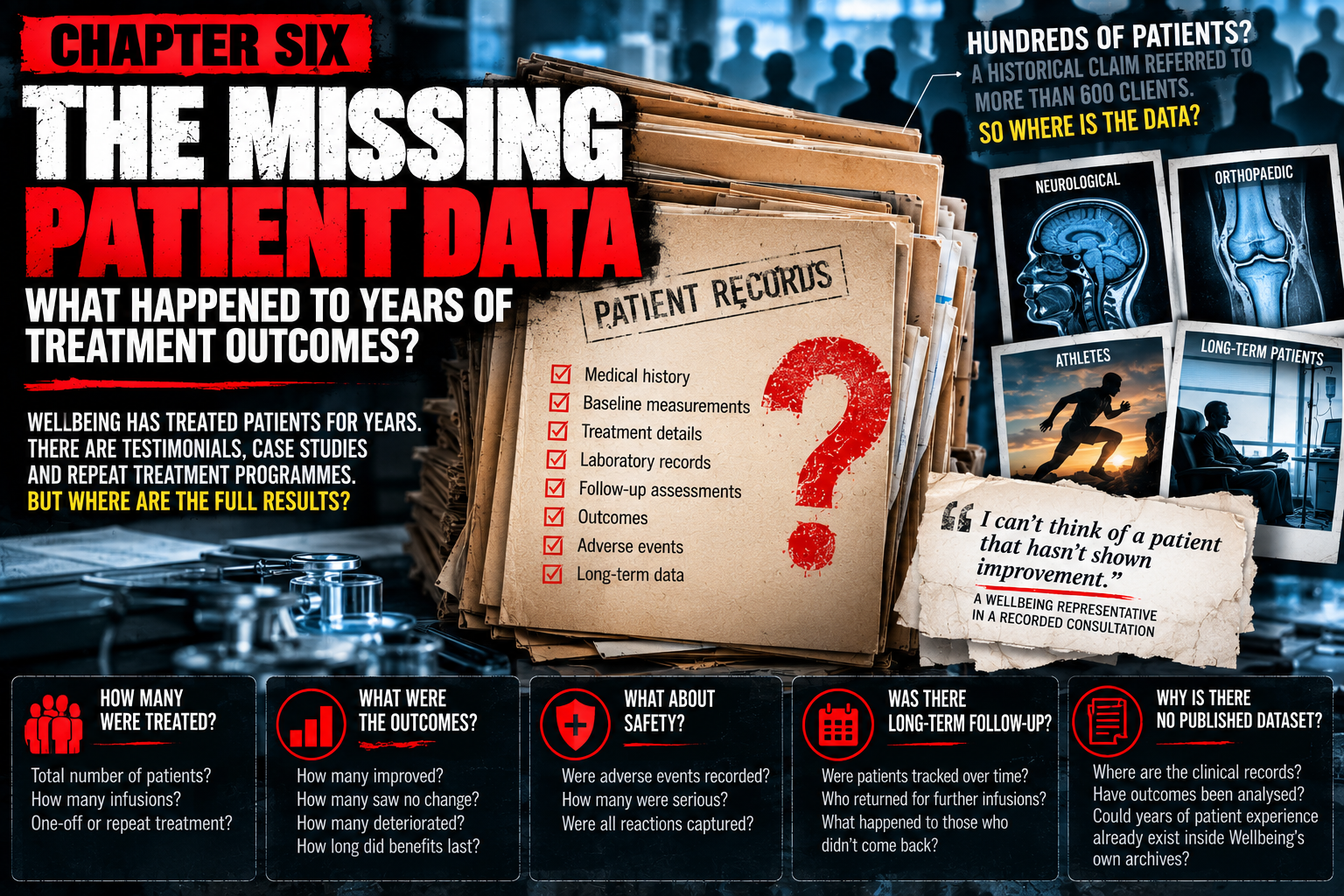
What We Do Not Have
Several documents would transform this investigation.
The investor deck.
The information memorandum.
The term sheet.
Subscription documents.
Financial forecasts.
The capitalisation table.
Risk disclosures.
Shareholder agreements.
Those documents would allow us to compare three different narratives.
What patients are told.
What the scientific paper actually says.
What investors are told.
If those three narratives are consistent, that would provide important reassurance.
If materially different claims are being made to different audiences, understanding those differences would become extremely important.
Until the documents are available, however, no such conclusion should be drawn.
The Longevity Investment Story
There is another reason this deserves scrutiny.
Longevity has become an extraordinarily attractive commercial concept.
People are living longer.
Wealthy consumers increasingly spend significant amounts attempting to remain healthier for longer.
Researchers are studying cellular senescence, epigenetic ageing, gene therapy, regenerative medicine and biological-age measurement.
Investors naturally see opportunity.
If even a small proportion of the promises surrounding longevity science eventually translate into effective therapies, the commercial market could become enormous.
That creates legitimate excitement.
It can also create a dangerous temptation.
Valuing tomorrow's possibility as though it were today's reality.
The Difference Between Potential and Performance
Investors do not normally buy companies because of what they are today.
They invest because of what they believe those companies may become tomorrow.
That means valuations frequently depend upon assumptions.
Future patients.
Future clinics.
Future countries.
Future intellectual property.
Future revenues.
Future clinical evidence.
Future regulatory approvals.
There is nothing inherently wrong with that.
Every early-stage investment contains uncertainty.
But the more a valuation depends upon future events, the more carefully those assumptions should be tested.
Scientific uncertainty therefore becomes financial uncertainty.
Science Risk Is Investment Risk
This is one of the most important connections in the entire investigation.
Imagine that future independent clinical trials fail to reproduce the encouraging findings reported in the pilot study.
What happens to the investment case?
What happens if regulators classify the therapy differently?
What happens if manufacturing requirements become more demanding?
What happens if the intellectual property proves difficult to protect?
What happens if competitors develop stronger clinical evidence?
What happens if patient demand falls?
These are not simply scientific questions.
They are investment risks.
When a biotechnology company's value is connected to its science, weaknesses in the evidence become potential weaknesses in the valuation.
Questions I Would Ask Before Investing
If I were considering investing my own money, I would want straightforward answers.
What is the company worth today?
How was that valuation calculated?
What revenue does the company currently generate?
How much comes from patients?
Is the business profitable?
How much cash does it hold?
How quickly is that cash being spent?
How much additional funding will be required?
Which company owns the intellectual property?
What exactly am I buying?
What percentage will I own?
Who controls the company after I invest?
What clinical evidence supports the growth projections?
What regulatory risks exist?
What happens if the science fails?
And finally:
How do I eventually get my money back?
These are not hostile questions.
They are the basic questions upon which serious investment decisions are made.
The Exit Question
Every investment ultimately requires an exit.
Perhaps the company is sold.
Perhaps another investor buys the shares.
Perhaps it eventually lists on a stock exchange.
Perhaps dividends are paid.
Perhaps the technology is licensed.
Whatever the strategy, investors normally need to understand how today's investment could eventually produce tomorrow's return.
That makes the absence of publicly available information concerning valuation, ownership and investment terms particularly significant for an outside observer.
It does not mean investors themselves lack that information.
They may have received extensive documentation privately.
It simply means we cannot independently evaluate it.
What Can Be Said Today
At this stage, there is no evidence available to this investigation demonstrating that Wellbeing has misled its investors.
That point matters.
Without seeing the private investor materials, it would be irresponsible to suggest otherwise.
What can be established is considerably narrower.
Wellbeing is raising private capital.
It is developing and commercialising a longevity programme.
Its programme now has a peer-reviewed scientific publication.
That publication remains preliminary and contains significant methodological limitations.
The detailed investment proposition is not publicly available.
Those are the facts.
What they mean depends upon information we have not yet obtained.
Two Products
Perhaps the most interesting conclusion is that Wellbeing may now effectively have two propositions.
One is offered to patients.
A longevity programme.
The other is offered to investors.
The future commercial value of that programme.
Those are fundamentally different products.
Patients are buying what exists today.
Investors are buying what they believe might exist tomorrow.
The credibility of both ultimately depends upon the same thing.
Evidence.
Conclusion
This investigation began by asking whether Cell-Free Therapy works.
That question led to the scientific paper.
The scientific paper led to the company.
The company led to its directors.
The directors led to corporate history.
The corporate history led to ownership.
And ownership eventually led to investment.
Each step has revealed another layer.
The investment round itself is not evidence of anything improper.
It is evidence that Wellbeing's story has moved beyond medicine.
It is now also a financial story.
And whenever scientific possibility becomes financial opportunity, due diligence becomes essential.
Because investors are not simply investing in today's company.
They are investing in a version of the future.
The question is whether the evidence available today supports the future they are being asked to believe in.
Recent Posts