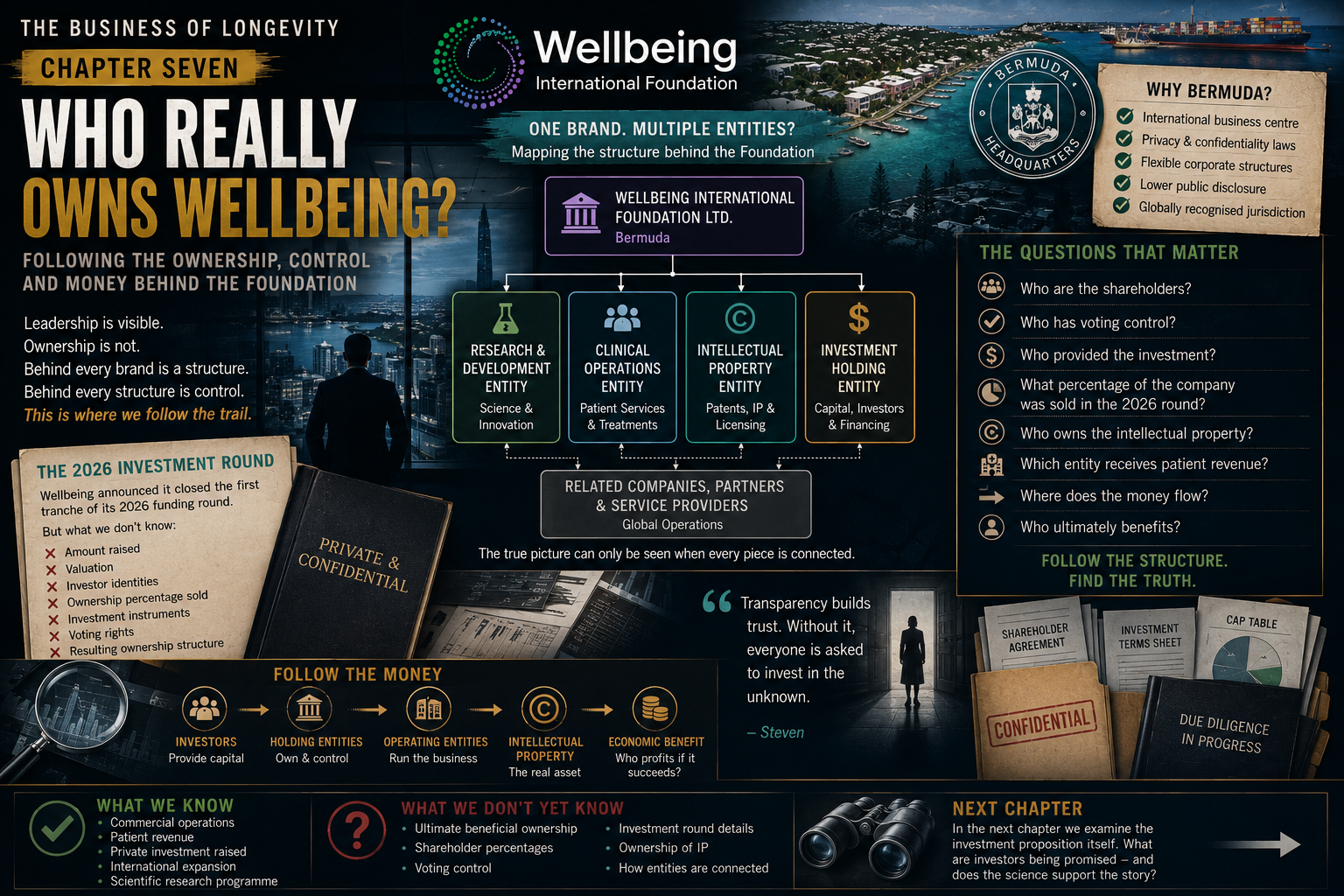
THE BUSINESS OF LONGEVITY – Chapter Seven Who Really Owns Wellbeing?
Following the Ownership, Control and Money Behind the Foundation
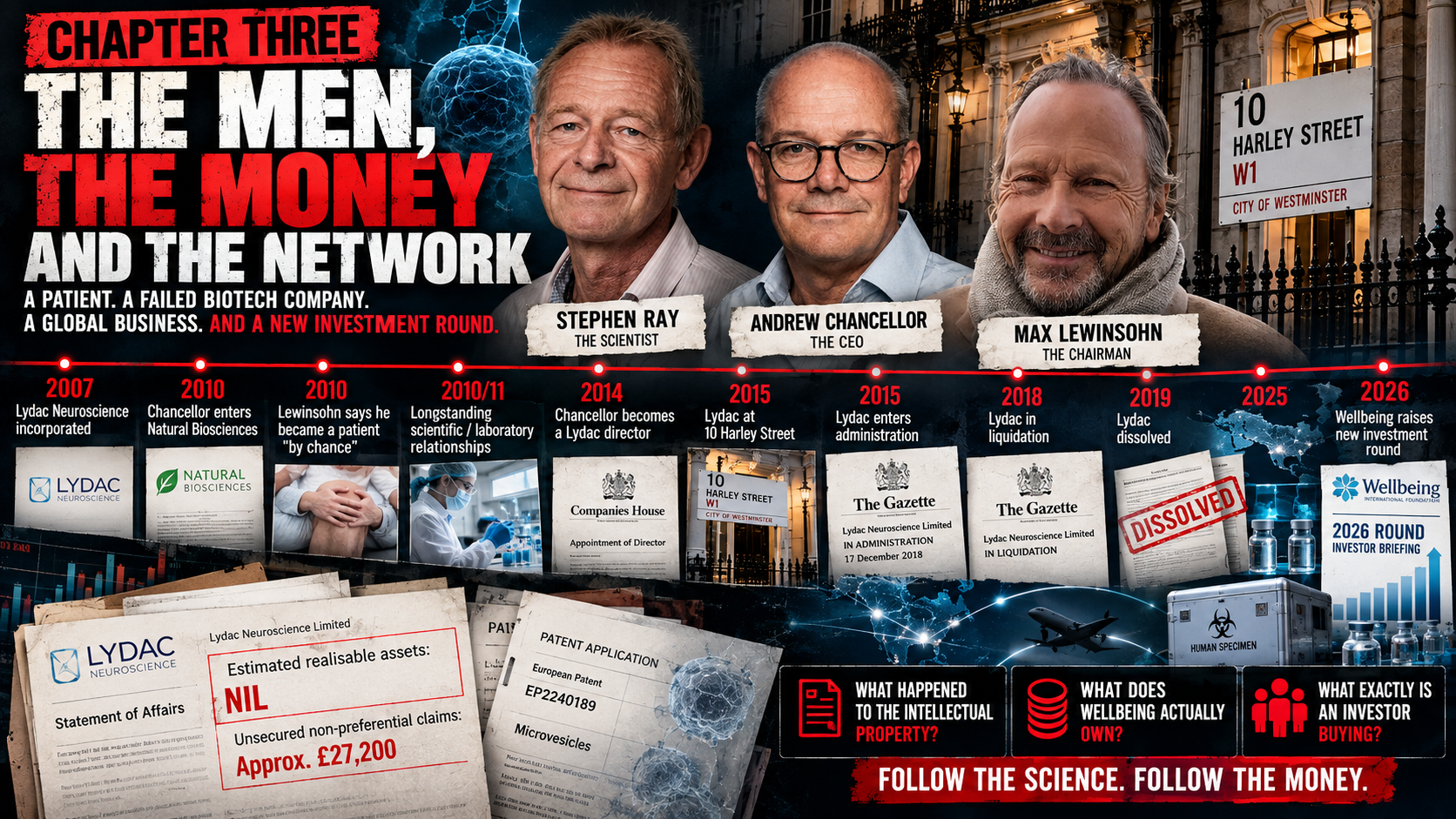
When investigating a company, identifying the people running it is relatively straightforward.
Chairmen have biographies.
Chief executives give interviews.
Scientists publish papers.
Directors appear on websites.
Ownership is different.
Behind almost every private business sits another layer consisting of shareholders, holding companies, investment agreements, intellectual property and voting rights.
Those relationships determine something far more important than who appears on the company website.
They determine who ultimately controls and benefits from the business.
As this investigation into Wellbeing International Foundation moved from science into corporate finance, that distinction became increasingly important.
We know considerably more about who represents Wellbeing publicly than we do about who ultimately owns its economic value.
And that leads to a very simple question.
Who really owns Wellbeing?
Management Is Not Ownership
One of the easiest mistakes to make when researching a private company is assuming that the people running it are necessarily the people who own it.
They may be.
But they do not have to be.
Directors manage companies.
Executives operate them.
Shareholders own economic interests in them.
Investors provide capital.
Intellectual property may belong to yet another company entirely.
That distinction becomes particularly important when an organisation begins raising outside investment.
New capital can change ownership.
It can change voting rights.
It can change control.
And sometimes it can change who ultimately receives the greatest financial benefit if the company succeeds.
The Wellbeing Question
Wellbeing International Foundation publicly identifies its leadership team and provides information about its scientific and commercial activities.
What is considerably harder to establish from public information is the complete ownership structure behind the organisation.
Who are the shareholders?
What percentage does each hold?
Who possesses voting control?
What happened to those percentages following the 2026 investment round?
Are there different classes of shares?
Do investors have preferential economic rights?
These are routine questions during professional investment due diligence.
From the public information presently available, however, the complete answers are not obvious.
That distinction matters.
It would be incorrect to say ownership has been deliberately concealed merely because information is not publicly accessible.
The accurate position is simpler:
A complete picture of ultimate ownership cannot currently be established from the public material examined during this investigation.
The Word "Foundation"
The organisation's name continues to deserve attention.
Wellbeing International Foundation.
For many readers, the word Foundation naturally suggests charitable, philanthropic, educational or scientific activity.
But a name does not tell us who owns an organisation or how its economic interests are structured.
Wellbeing itself has publicly discussed private investment, patient revenue, international expansion and commercial growth.
Those activities immediately make ownership relevant.
If investors have provided capital, what did they receive in return?
Equity?
Preference shares?
Convertible instruments?
Debt?
An economic interest in another company?
Without the underlying investment documentation, it would be irresponsible to assume the answer.
But it remains an important question.
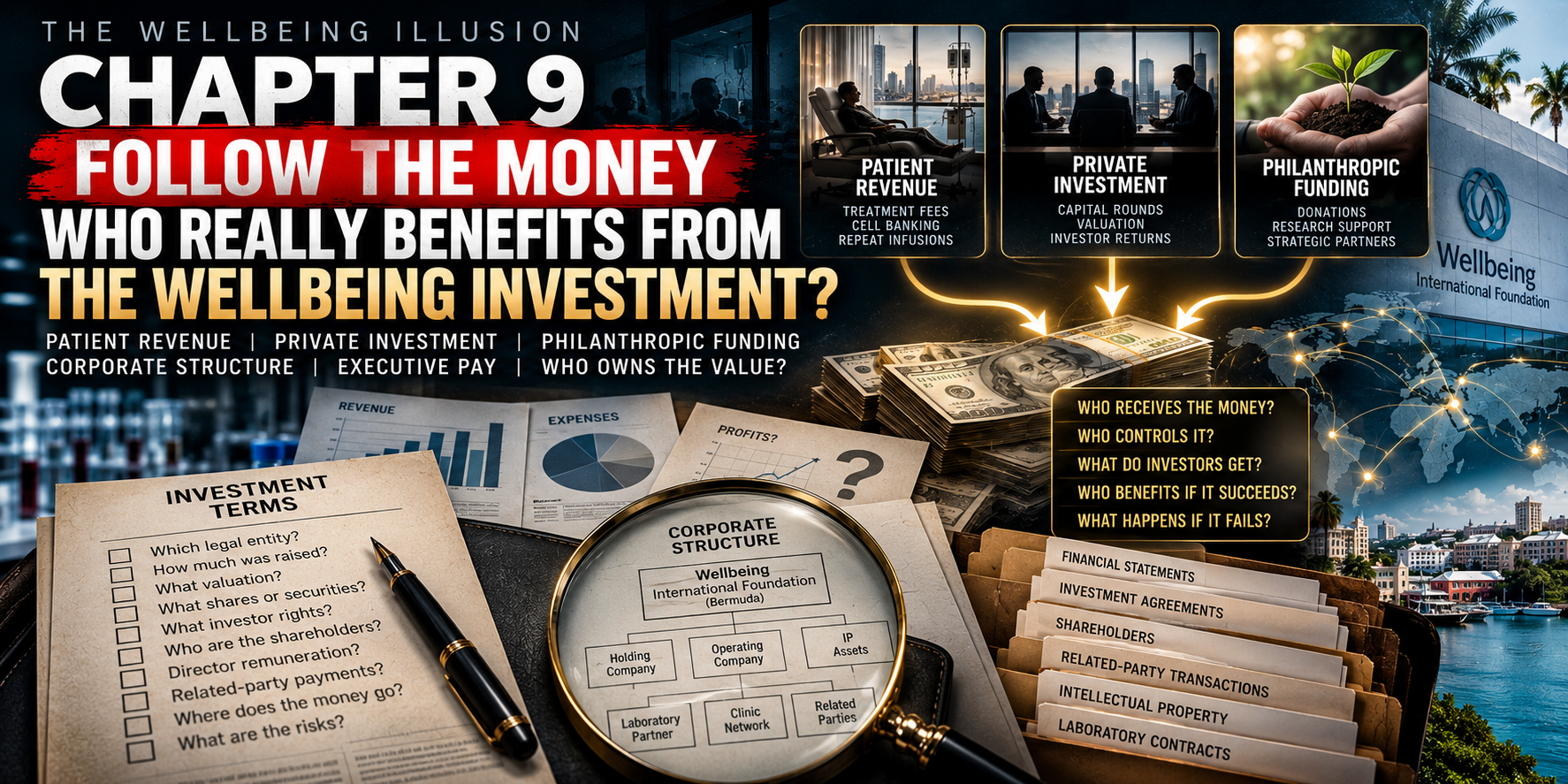
The 2026 Investment Round
Wellbeing announced that it had successfully closed the first tranche of its 2026 investment round.
The announcement presented the fundraising as another step in the organisation's development.
What was not publicly disclosed was the detailed financial structure behind that transaction.
We do not currently have public confirmation of:
- the amount invested;
- the company valuation;
- the identities of participating investors;
- the percentage of equity issued;
- the securities investors received;
- voting rights attached to those securities;
- the resulting ownership percentages.
None of this is necessarily unusual for a privately held company.
Private transactions are frequently confidential.
However, confidentiality creates an unavoidable limitation for anyone attempting to independently understand who owns and controls the organisation.
Ownership Is More Than Shares
There is another complication.
Finding the shareholders does not necessarily answer the entire ownership question.
Economic control can exist through many different arrangements.
Ordinary shares.
Preference shares.
Voting agreements.
Convertible debt.
Holding companies.
Licensing agreements.
Intellectual-property ownership.
Contractual rights.
An organisation may operate the business while another entity owns the technology upon which that business depends.
That is why sophisticated investors examine the entire structure rather than simply looking at a shareholder list.
They follow the economic value.
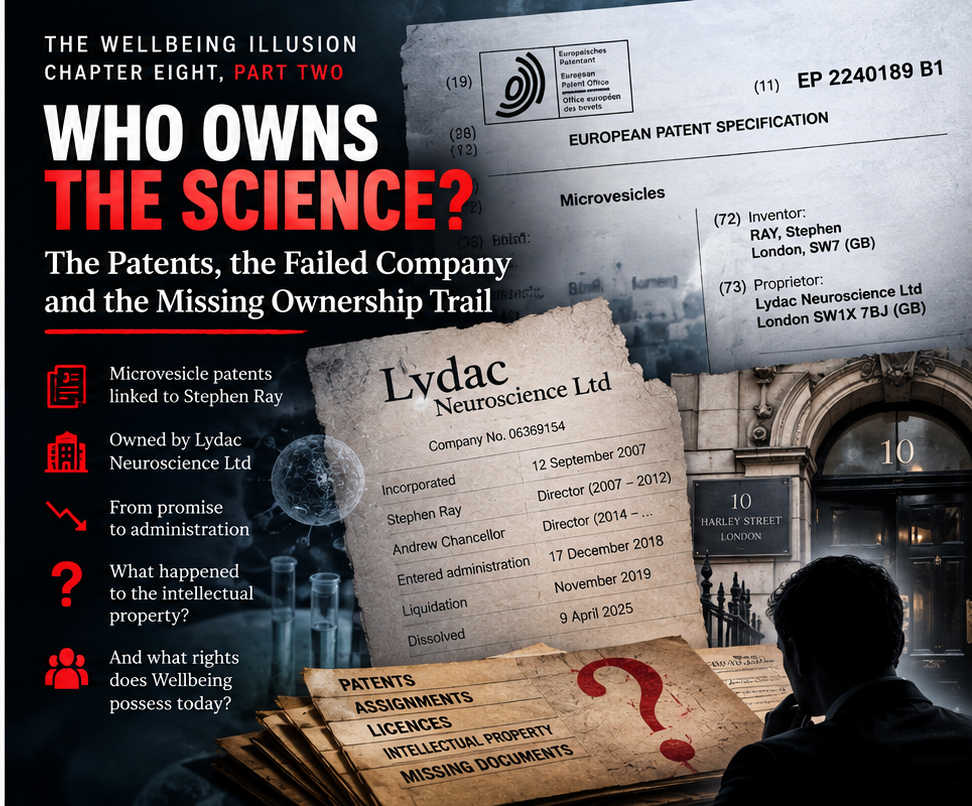
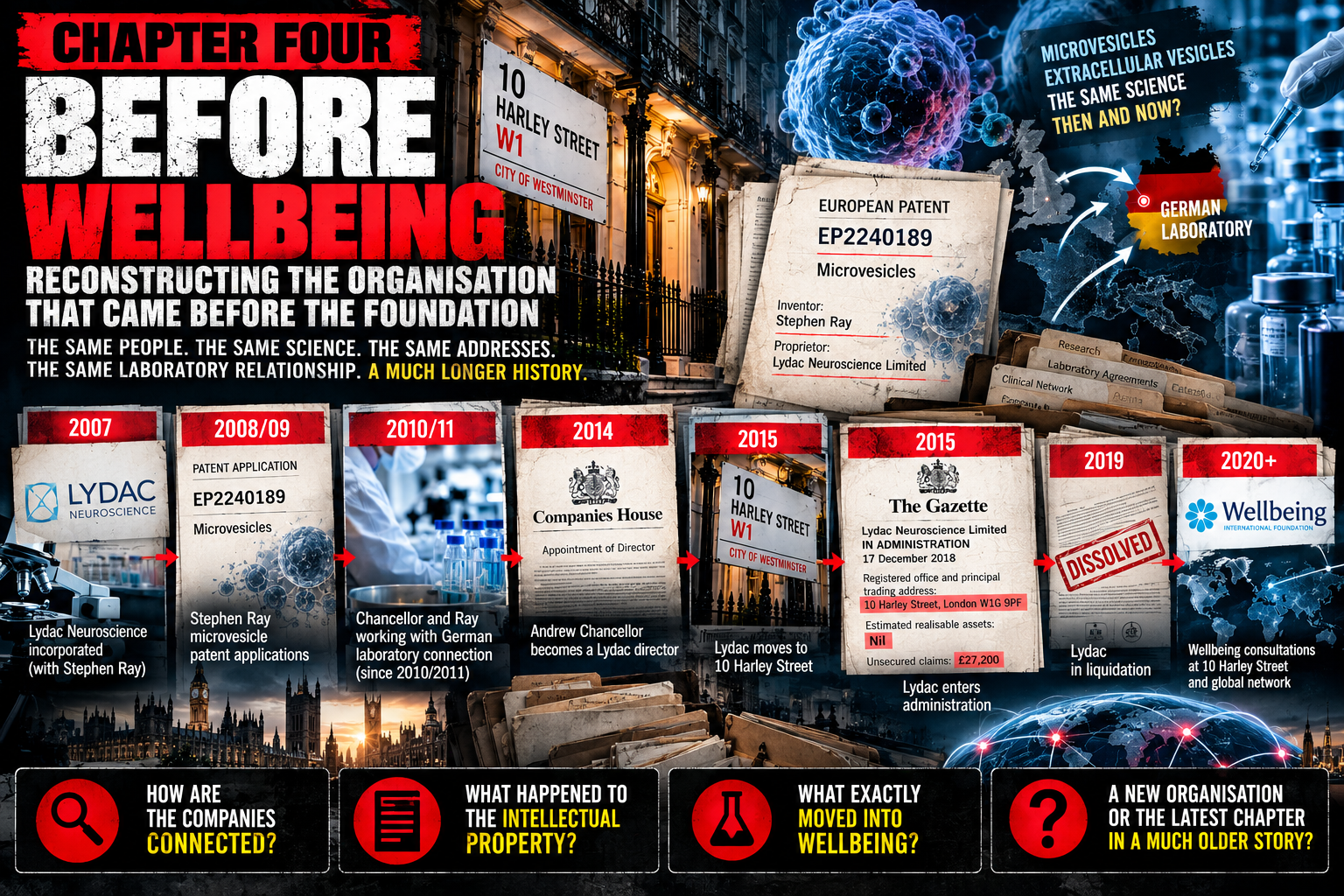
Follow the Intellectual Property
For an emerging biotechnology company, this may be the most important question of all.
Who owns the science?
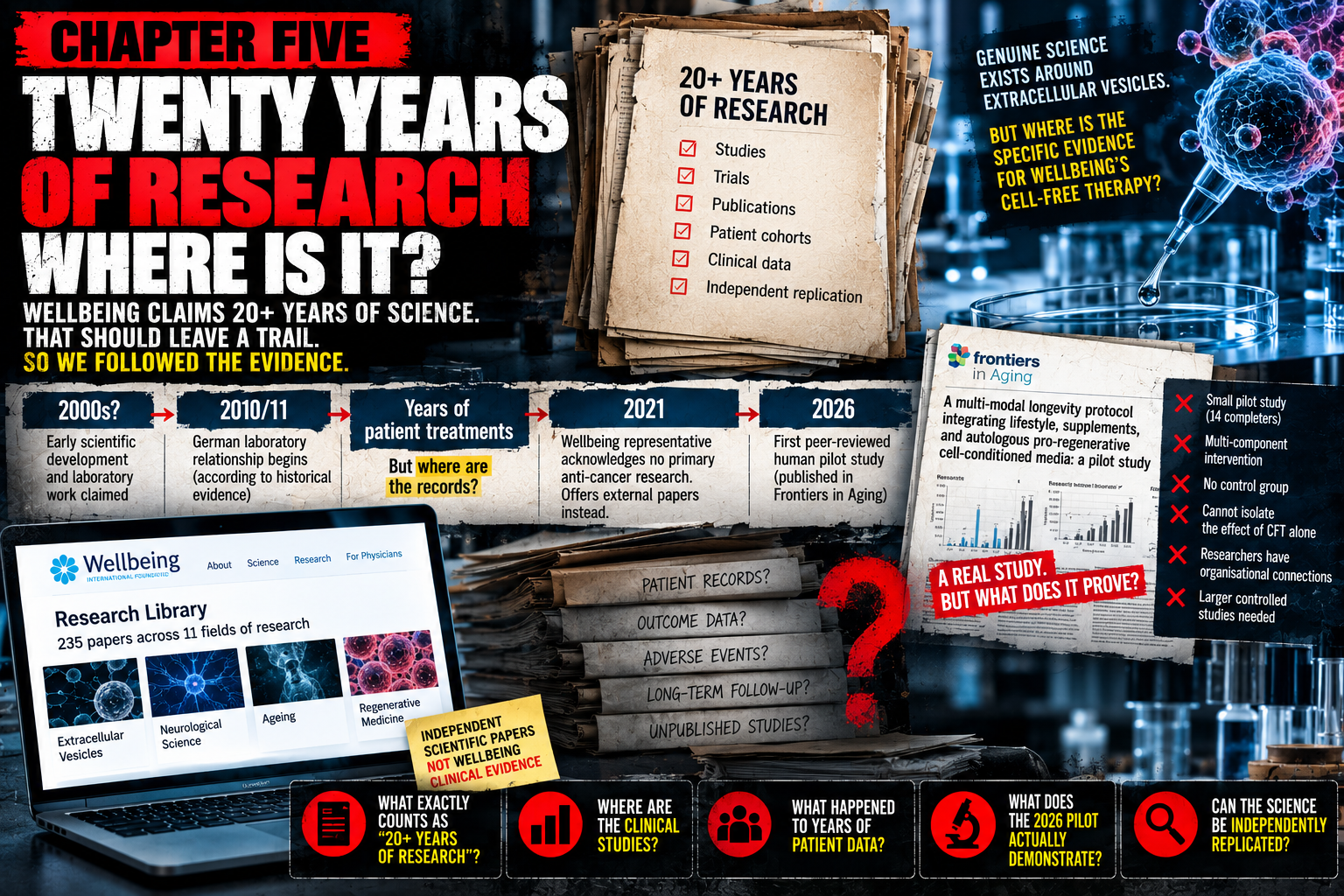
Wellbeing's commercial potential appears closely connected to Cell-Free Therapy and the biological processes surrounding it.
If those technologies ultimately prove successful, the intellectual property could potentially become extremely valuable.
That makes ownership crucial.
Are the relevant rights owned directly by Wellbeing International Foundation?
By a research company?
By individual scientists?
By a separate intellectual-property company?
Are they licensed?
Are investors buying into the entity that actually owns those rights?
These questions should not be answered through speculation.
They require patents, licensing agreements, corporate filings and investment documents.
Until those records are available, the correct position is simply that the complete intellectual-property ownership structure has not yet been independently established.
Patient Revenue Adds Another Layer
There is another financial relationship that makes this structure particularly interesting.
Wellbeing has acknowledged that patient revenue has historically contributed to funding its activities.
That means money potentially enters the organisation from several directions.
Patients.
Investors.
Selective philanthropic engagement.
Each group provides money for a fundamentally different reason.
Patients expect a service.
Investors expect financial returns.
Philanthropic supporters generally expect their contribution to advance a particular mission.
Understanding where those funds enter the corporate structure—and where they ultimately go—is therefore important.
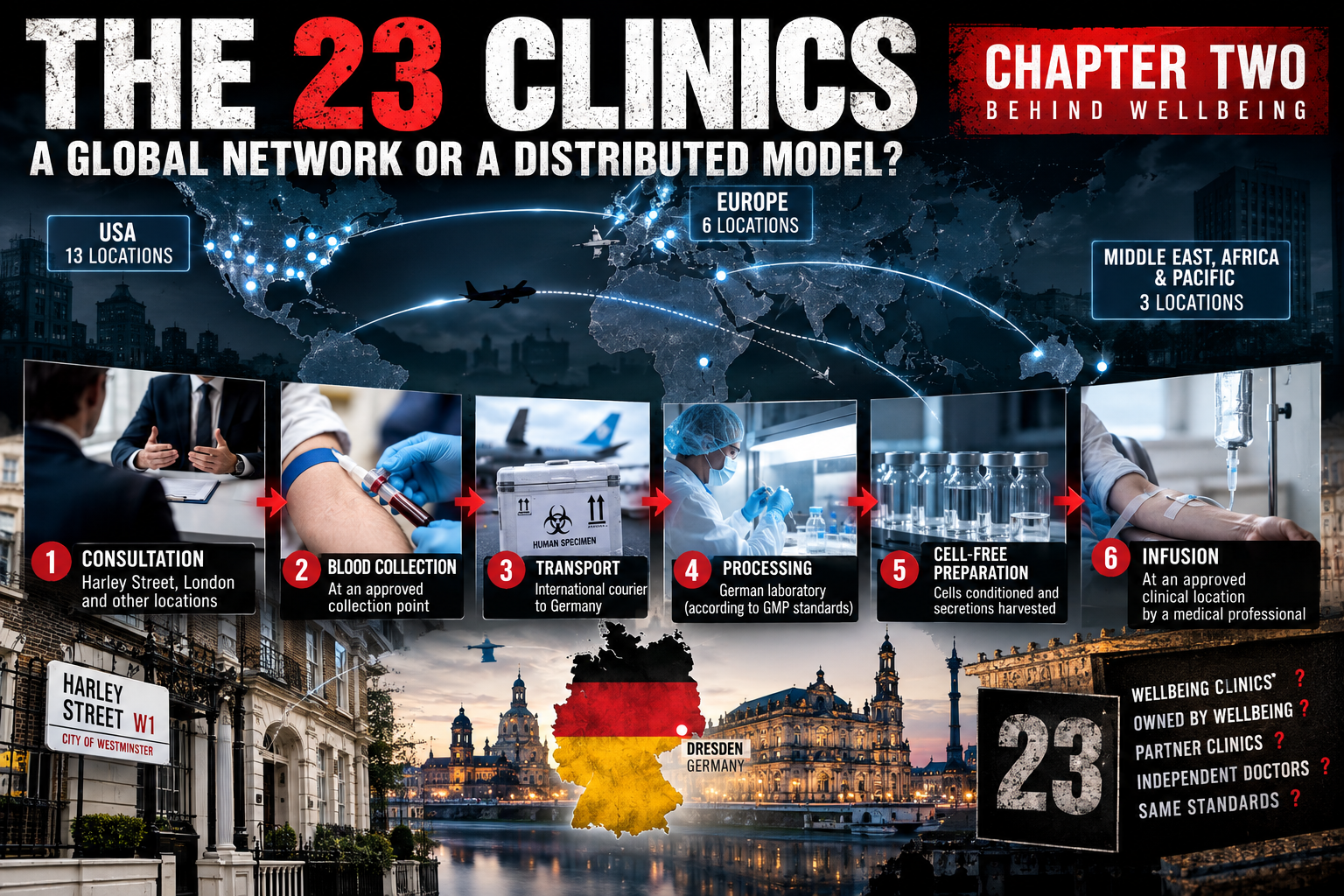
Which entity receives patient payments?
Which pays for research?
Which owns the intellectual property?
Which received investment capital?
Which retains profits?
Those relationships would reveal considerably more about the business than a corporate biography ever could.
Why Bermuda Matters
This investigation inevitably returns to Bermuda.
Not because incorporating there demonstrates anything improper.
It does not.
Bermuda is a long-established international business jurisdiction used by many legitimate global organisations.
The importance of Bermuda is practical.
Public disclosure requirements differ between jurisdictions.
A researcher examining a UK company may be able to access incorporation documents, director histories, accounts, confirmation statements, charges and certain ownership information relatively easily.
An offshore private structure may provide considerably less information to an ordinary member of the public.
That makes reconstructing ultimate beneficial ownership more difficult.
Again, difficulty obtaining information is not evidence that something is being hidden.
But it does place greater importance on voluntary transparency.
What Investors Would Normally Want to Know
Imagine being invited to invest substantial money in a biotechnology company.
Before transferring funds, most experienced investors would ask:
Who currently owns the business?
What percentage am I buying?
What valuation am I investing at?
Who controls the voting rights?
What happens if more shares are issued?
Who owns the intellectual property?
Does the company I am investing in actually own the assets upon which its valuation depends?
What happens if another company in the group fails?
How do I eventually exit?
These are not aggressive questions.
They are fundamental investment questions.
Presumably, Wellbeing's investors receive significantly more private information than is available publicly.
If that investment documentation can eventually be obtained, it could answer many of the questions raised by this investigation.
What We Can Establish
It is important to separate facts from unknowns.
From Wellbeing's own public communications, we can establish that the organisation operates commercially, generates patient revenue, has attracted private investment and intends to expand its international activities.
Its scientific programme is also becoming increasingly important to the organisation's public identity.
What remains much harder to independently establish from public material is:
- ultimate beneficial ownership;
- individual shareholder percentages;
- voting control;
- the post-investment ownership structure;
- the valuation attached to the 2026 fundraising;
- ownership of the core intellectual property;
- financial relationships between the relevant entities.
Those gaps do not establish misconduct.
They establish the limits of what can currently be independently verified.
And those limits themselves are relevant when evaluating transparency.
Why Patients Should Care Too
Ownership may initially appear to be an issue solely for investors.
It isn't.
Corporate ownership influences incentives.
A philanthropically funded research organisation operates under different financial pressures from a venture-backed biotechnology company.
A founder-controlled company may make different decisions from one controlled by outside investors.
A business dependent upon patient revenue faces different incentives from one funded predominantly through research grants.
None of those structures is automatically better or worse.
But understanding which model applies helps patients understand the organisation they are trusting.
Follow the Economic Interest
Throughout this investigation, one principle has repeatedly proved useful.
Do not stop at the brand.
Do not stop at the biography.
Do not even stop at the company.
Follow the economic interest.
Who provides the money?
Who owns the assets?
Who controls the decisions?
Who carries the risk?
And who benefits if the company succeeds?
Those questions lie at the heart of understanding almost every commercial enterprise.
They become even more important when the business operates at the intersection of experimental science, private healthcare and investment.
Conclusion
This investigation began with a medical treatment.
Then came the scientific paper.
Then the corporate history.
Then the investment round.
Each discovery revealed another layer.
We can identify many of the people publicly associated with Wellbeing International Foundation.
What we cannot yet independently reconstruct is the complete economic ownership sitting behind the organisation.
That does not justify assumptions.
It justifies further investigation.
Because ultimately, knowing who runs a company tells us only part of the story.
Knowing who owns the value tells us considerably more.
And that is where the money trail becomes impossible to ignore.
Recent Posts