Follow the Money: Inside the Lydac Neuroscience Insolvency
The Men Behind Wellbeing — Chapter Eight
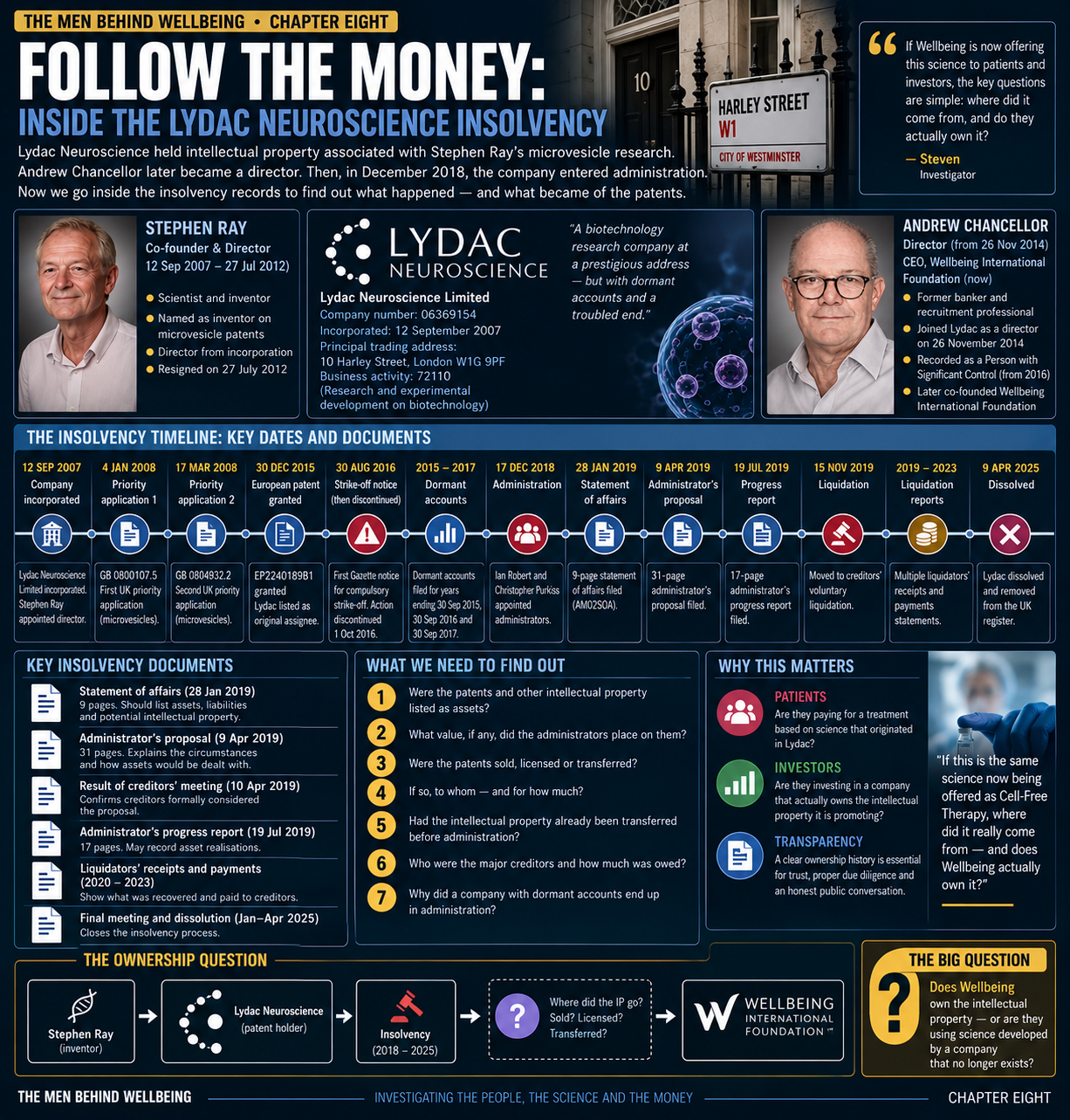
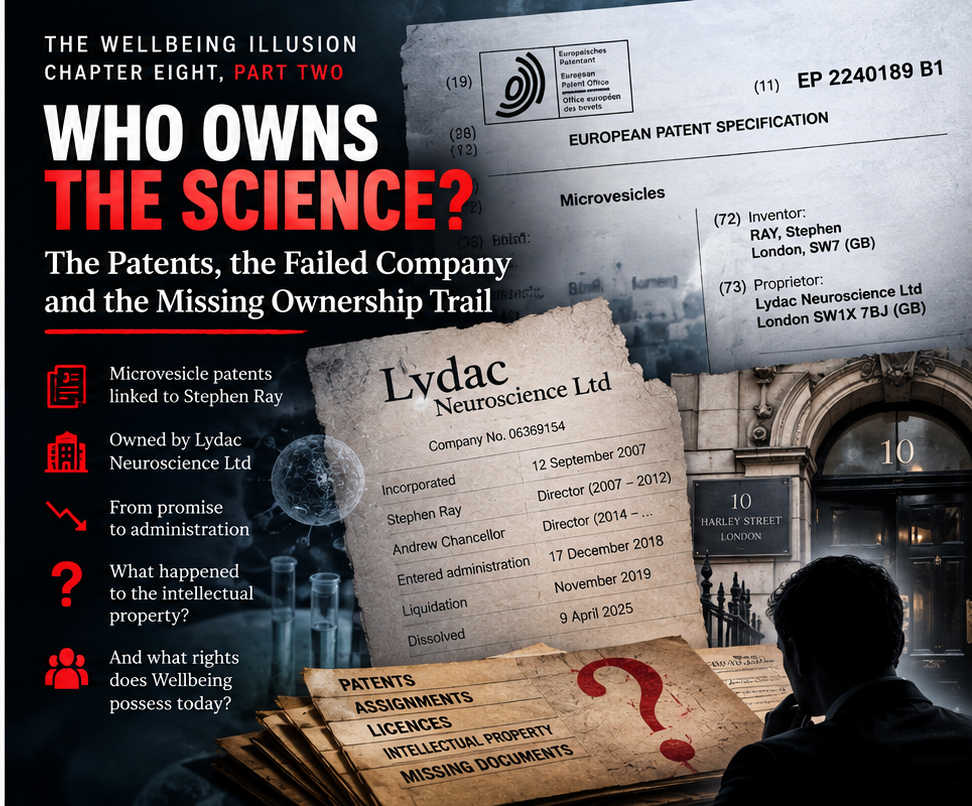
Lydac Neuroscience once held intellectual property connected to Stephen Ray's microvesicle research. Andrew Chancellor later became a director. Then the company entered administration. If this science forms part of the lineage behind the Cell-Free Therapy promoted by Wellbeing International Foundation today, understanding what happened when Lydac failed becomes far more than a piece of corporate history.
In Chapter Seven, we established something important.
The connection between Stephen Ray, Andrew Chancellor and Lydac Neuroscience Limited is not simply a collection of similar names or an assumption based on their later involvement with Wellbeing International Foundation.
It exists in the corporate record.
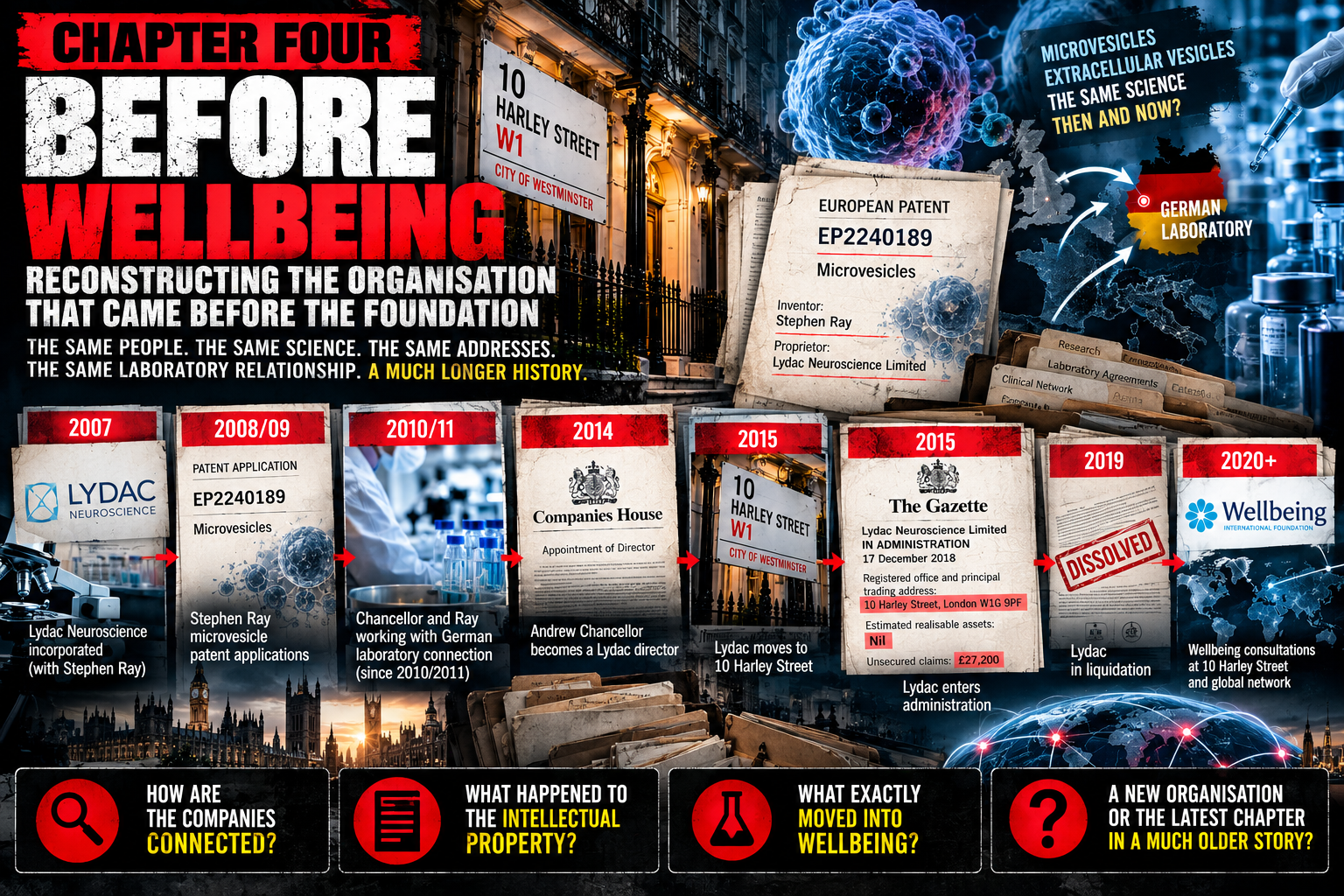
Stephen Ray was a director of Lydac Neuroscience from its incorporation in September 2007 until July 2012.
Andrew Chancellor subsequently became a director in November 2014.
Between those dates, intellectual property associated with Ray's microvesicle research was being pursued through Lydac.
Then something happened.
Lydac entered administration.
It moved into liquidation.
And eventually it disappeared altogether.
That could simply have been the end of an unsuccessful biotechnology company.
Except the scientific story did not disappear with it.
Years later, Stephen Ray and Andrew Chancellor are together again at Wellbeing International Foundation.
Ray is presented as a senior scientific figure.
Chancellor is CEO.
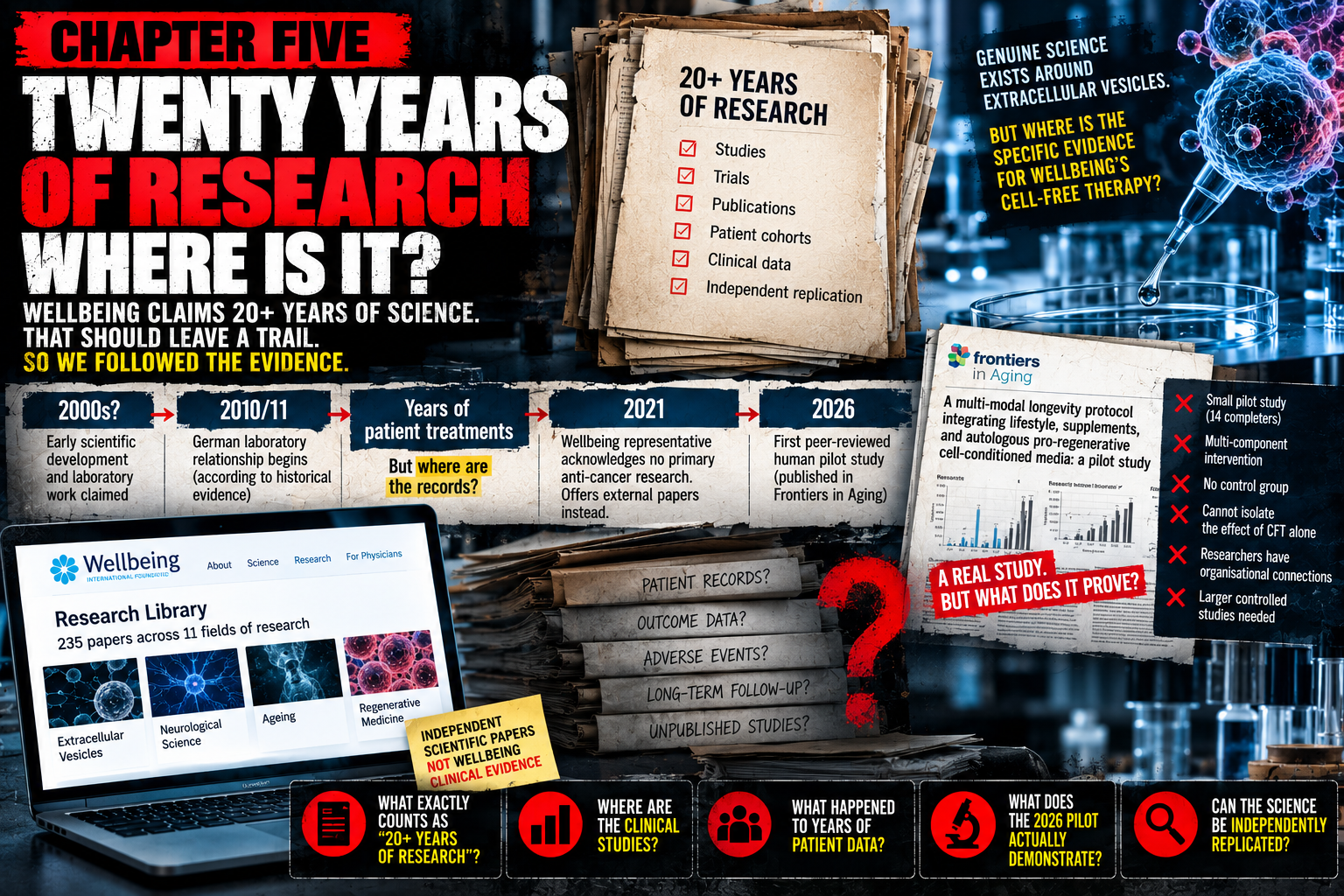
And Wellbeing now promotes a Cell-Free Therapy in which extracellular vesicles form an important part of the scientific explanation.
That is why Lydac's insolvency matters.
We are not investigating the collapse of an obscure company for historical curiosity.
We are trying to understand what happened to the science, the intellectual property and the commercial rights when that company failed.
Because if those rights are connected to what Wellbeing is offering today, the insolvency could contain a missing part of the Wellbeing story.
Lydac Neuroscience Wasn't Just Another Company
Lydac Neuroscience Limited was incorporated on 12 September 2007.
Its registered business activity was:
Research and experimental development on biotechnology.
Stephen Ray became a director on the day the company was incorporated and remained until 27 July 2012.
That period overlaps directly with the earliest priority dates of the microvesicle intellectual property we have already examined.
The first UK priority application dates from 4 January 2008.
A second followed on 17 March 2008.
An international application followed in January 2009.
The resulting patent family included European patent EP2240189B1 — “Microvesicles.”
Stephen Ray is named as inventor.
Lydac Neuroscience Limited is identified as the original assignee.
That means Lydac wasn't merely a company Ray happened to direct.
It sat directly within the documented corporate history of his microvesicle technology.
Then Stephen Ray Left
Ray resigned as a director on 27 July 2012.
This is an important date because it prevents us from oversimplifying the story.
More than two years passed before Andrew Chancellor became a director.
We therefore should not say that Chancellor simply took over from Ray.
The records do not establish that.
But they do establish that both men occupied directorships in the same biotechnology company at different stages of its existence.
And on 26 November 2014, Andrew William Chancellor was formally appointed as a director of Lydac Neuroscience Limited.
From this point onward, Chancellor becomes directly relevant to the company's later history.
The Patent Was Granted After Chancellor Arrived
The chronology becomes particularly interesting here.
Chancellor became a director in November 2014.
Then, on 30 December 2015, European patent EP2240189B1 was granted.
The patent names Stephen Ray as inventor and Lydac Neuroscience as the original assignee.
So by the time this important European patent reached grant, Ray was no longer a director.
Chancellor was.
Again, this does not establish that Chancellor personally owned the patent.
Directors and companies are legally distinct.
But it does establish that Chancellor was involved in Lydac during a period when intellectual property originating from Ray's earlier research remained part of the company's documented history.
That becomes significant when we examine what happened next.
The Company Was Filing Dormant Accounts
One of the more puzzling aspects of Lydac's corporate history is its accounting status.
Companies House records dormant accounts for the financial years ending:
30 September 2015
30 September 2016
and:
30 September 2017.
The last accounts filed before administration were therefore dormant accounts.
That deserves attention.
A company can legitimately be dormant while holding intellectual property.
It may have little or no accounting activity.
It may act principally as an IP-holding vehicle.
Commercial activity may occur elsewhere.
So dormant accounts are not evidence of misconduct.
But they create an obvious question.
How does a company filing dormant accounts subsequently end up in formal administration?
There Had Already Been a Strike-Off Attempt
There is another event in the Companies House history.
On 30 August 2016, a First Gazette notice for compulsory strike-off was issued.
That action was subsequently discontinued on 1 October 2016.
Compulsory strike-off proceedings can occur for administrative reasons, including failures to make required filings.
The discontinued action does not establish insolvency or wrongdoing.
But it belongs in the chronology.
By 2016, the company had already attracted regulatory action concerning its status on the register.
Two years later, its problems became considerably more serious.
December 2018: Lydac Enters Administration
On 17 December 2018, administrators were appointed to Lydac Neuroscience Limited.
The official Gazette identifies:
Ian Robert
and:
Christopher Purkiss
of Kingston Smith & Partners LLP.
The notice describes Lydac's business as:
“Research and experimental development on biotechnology.”
And its principal trading address at the time was:
10 Harley Street, London W1G 9PF.
This is a significant distinction.
Lydac wasn't simply struck off because nobody bothered maintaining the company.
It entered a formal insolvency procedure.
Administrators were appointed.
Creditors existed.
Assets and liabilities had to be considered.
And professional insolvency practitioners took control.
That is where the story changes.
Why Did Lydac Fail?
This is the first major question Chapter Eight needs to answer.
The public chronology tells us that Lydac failed.
It doesn't, by itself, tell us why.
And that distinction is important.
We should not invent an explanation.
We should not assume poor management.
We should not assume investor losses.
We should not assume that the patents were worthless.
And we certainly should not assume misconduct.
Fortunately, insolvency creates paperwork.
And Lydac generated a considerable amount of it.
January 2019: The Statement of Affairs
On 28 January 2019, Companies House records the filing of a nine-page:
Statement of Affairs.
This is potentially one of the most important documents in the entire investigation.
A statement of affairs can reveal the financial anatomy of an insolvent company.
Assets.
Liabilities.
Creditors.
Estimated realisable values.
Secured claims.
Unsecured claims.
And potentially the shortfall facing creditors.
For most companies, investigators might immediately look for cash, property, vehicles or equipment.
For Lydac, there is another asset category that interests us far more.
Intellectual property.
Where Are the Patents?
This is the question at the heart of Chapter Eight.
We know Lydac had historically been associated with intellectual property.
We have patent records.
We have Stephen Ray named as inventor.
We have Lydac identified as assignee.
So when administrators arrived in December 2018, what happened to those rights?
Were patents listed as company assets?
Were they valued?
Were they still legally owned by Lydac?
Had particular rights expired or lapsed?
Had they been licensed?
Had they already been transferred?
Were they considered commercially valuable?
Or were they effectively worthless by the time administrators arrived?
Those questions cannot responsibly be answered by guessing.
But the insolvency documents give us somewhere concrete to look.
April 2019: A 31-Page Administrator's Proposal
On 9 April 2019, Companies House records another substantial document:
Statement of Administrator's Proposal.
Thirty-one pages.
This may ultimately prove more important than any corporate biography we have examined.
Because an administrator's proposal can provide the contemporary professional explanation of what happened to a company.
Why administration became necessary.
What assets existed.
Who the creditors were.
What administrators intended to do.
What recoveries might be possible.
And how creditors were expected to fare.
For an investigation like ours, this is potentially the financial autopsy of Lydac Neuroscience.
The Creditors Then Considered the Proposal
The following day, 10 April 2019, Companies House records the result of a creditors' meeting.
That tells us something else.
This was not merely an internal restructuring exercise.
There were creditors whose financial interests were affected by what happened to Lydac.
Who were they?
How much were they owed?
Were any connected with investment?
Were there director loans?
Professional creditors?
Research costs?
Patent expenses?
Other companies?
We should not answer those questions until the underlying documents establish the facts.
But these are precisely the details we now need to extract.
July 2019: The Administrator Reports Back
On 19 July 2019, another important filing appeared:
Administrator's Progress Report.
Seventeen pages.
By then, administrators had controlled Lydac for approximately seven months.
That is enough time for something extremely important potentially to have happened.
Assets may have been realised.
And for this investigation, one category matters above everything else.
The intellectual property.
If patents were sold, this is where we might start seeing the transaction.
If intellectual property was assigned, we need the recipient.
If licences were disposed of, we need the counterparty.
If nothing was sold because the rights had no realisable value, that matters too.
Whatever happened, the answer potentially changes the Wellbeing story.
November 2019: Administration Ends
Lydac was not rescued.
On 15 November 2019, the company left administration and moved into creditors' voluntary liquidation.
The Gazette confirms the appointment of Ian Robert and Christopher Purkiss as liquidators following the company's exit from administration.
That tells us that whatever administrators attempted during the preceding eleven months did not result in Lydac continuing as an independent biotechnology company.
The company was now being wound up.
But Lydac Took Years to Finally Disappear
The liquidation did not conclude quickly.
Companies House records successive liquidators' statements of receipts and payments covering periods ending in:
2020
2021
2022
and:
2023.
The winding-up process therefore continued for years.
A final meeting return was eventually filed in January 2025.
Then:
9 April 2025 — Lydac Neuroscience Limited was dissolved.
Almost seventeen and a half years after it was incorporated, the company ceased to exist.
But that still doesn't tell us what happened to its science.
A Company Can Die While Its Intellectual Property Survives
This is the key point.
A biotechnology company disappearing does not necessarily mean its technology disappears.
Patents can be sold.
Patent applications can be assigned.
Licences can survive.
Know-how can move.
Research data can be acquired.
Manufacturing processes can be transferred.
Scientists can continue developing ideas elsewhere.
In fact, intellectual property can sometimes be among the most valuable assets remaining when the operating company itself fails.
That is why we cannot simply close the Lydac file in April 2025.
We have to follow what survived.
And This Is Where Wellbeing Comes Back Into the Story
This investigation began with Wellbeing International Foundation.
Today, Wellbeing identifies Andrew Chancellor as its CEO.
Stephen Ray is presented as its Senior Scientific Consultant.
Wellbeing describes Cell-Free Therapy using language involving extracellular vesicles, growth factors and cytokines.
And in 2026, Wellbeing announced that it had closed the first tranche of a capital round intended to support its research programme, clinical network and expansion.
That means the historical intellectual-property question is no longer merely academic.
If the science being promoted today is descended from Ray's earlier microvesicle work, then the ownership history potentially matters to:
patients;
commercial partners;
and especially:
investors.
What Happened Between Lydac and Wellbeing?
There is a danger here of making an assumption.
We must not automatically draw this line:
Lydac → Wellbeing.
We haven't established that.
The science may have changed substantially.
New intellectual property may have been created.
Ray may have developed subsequent technology independently.
Wellbeing may operate under licences.
The older patents may no longer matter.
Or another company may sit somewhere in the ownership chain.
Any of those explanations could be legitimate.
But the existence of possible explanations does not remove the need to identify the actual one.
The Insolvency Could Contain the Missing Link
Suppose the administrators' records show that Lydac still owned microvesicle patents in December 2018.
Then we need to know what happened to them.
Suppose instead the records show that Lydac no longer owned them.
Then we need to move backwards.
When did they leave?
Who acquired them?
For what consideration?
Suppose the administrators valued the intellectual property but couldn't sell it.
That would tell us something else.
And suppose the patents weren't mentioned at all.
That would create another question:
Why wasn't intellectual property historically associated with the company appearing among the assets of a biotechnology business?
Each answer sends the investigation in a different direction.
Follow the Money — But Follow the Ownership
This chapter is called Follow the Money.
But perhaps that title only describes half the investigation.
With biotechnology, we have to follow two things simultaneously.
The money.
And:
the intellectual property.
Where did the money come from?
Who was owed money?
What did creditors recover?
What assets were sold?
But alongside those questions:
Who owned the patents?
Who owned the know-how?
Who acquired the rights?
What survived liquidation?
And where did it go?
Because those questions lead directly back to Wellbeing.
The Andrew Chancellor Question
Andrew Chancellor was a director of Lydac when administrators were appointed.
That is an established corporate fact.
It does not establish that Chancellor caused Lydac's insolvency.
It does not establish that he transferred its intellectual property.
It does not establish that he personally benefited from the insolvency.
And it does not establish that insolvency practitioners criticised his conduct.
We should be absolutely clear about that.
But his position does make the records relevant to our investigation.
Because Chancellor later appears as CEO of Wellbeing International Foundation.
And Wellbeing is now commercially involved in regenerative biotechnology alongside the scientist whose earlier intellectual property was associated with Lydac.
The question is therefore not:
“Did Chancellor do something wrong?”
The correct question is:
“What happened to Lydac's technology while Chancellor was directing the company, and what relationship—if any—does that technology have to Wellbeing today?”
That is a much more important question.
The Stephen Ray Question
The same discipline applies to Stephen Ray.
Ray resigned from Lydac in 2012.
He was no longer a director when the company entered administration six years later.
Nothing we have established suggests that he was responsible for Lydac's subsequent insolvency.
But his intellectual-property history remains central.
If Ray continued developing the technology after leaving Lydac, we need to understand which parts belonged to Lydac and which parts were subsequently created elsewhere.
Inventorship and ownership are not the same thing.
A scientist can invent technology whose legal rights belong to a company.
That distinction could become crucial.
The Investor Question
And now we arrive at the reason this historical investigation matters today.
Wellbeing is raising investment.
If prospective investors are being presented with a business built around proprietary regenerative biotechnology, they need to understand what intellectual property supports that proposition.
Does Wellbeing own patents?
Does it own later patents derived from Ray's work?
Does it hold licences?
Does another entity own the technology?
Does Wellbeing rely primarily on proprietary know-how?
What stops competitors reproducing the process?
And if part of its scientific lineage originated inside Lydac, how did the relevant rights travel from that now-dissolved company to their present owner?
Those are basic due-diligence questions.
What We Can Establish
At this point, several facts are documented.
Lydac Neuroscience was incorporated in September 2007.
Stephen Ray became a director on incorporation.
Ray is named as inventor on microvesicle intellectual property associated with Lydac.
Ray resigned in July 2012.
Andrew Chancellor became a director in November 2014.
European patent EP2240189B1 was granted in December 2015 with Lydac identified as original assignee.
Lydac subsequently filed dormant accounts.
Administrators were appointed in December 2018.
A statement of affairs was filed.
An administrator's proposal followed.
A progress report followed.
The company moved into creditors' voluntary liquidation in November 2019.
And Lydac was finally dissolved in April 2025.
Those facts establish a corporate and intellectual-property chronology.
What We Have Not Established
Equally importantly, we have not established:
that Wellbeing owns the Lydac patents;
that Wellbeing's present CFT is covered by those patents;
that Chancellor acquired Lydac's intellectual property;
that Ray transferred Lydac's technology;
that assets were improperly disposed of;
that creditors were unfairly treated;
or that either Ray or Chancellor committed misconduct in connection with the insolvency.
Those would require substantially more evidence.
But we have established enough to ask where the assets went.
And that is precisely what an investigation should now do.
The Documents We Need Next
The next stage should focus on the documents rather than biographies.
We need the detailed Statement of Affairs.
We need the complete Administrator's Proposal.
We need the Administrator's Progress Report.
We need the administration-to-liquidation documentation.
We need the liquidators' receipts and payments accounts.
And we need to place those records beside the complete assignment history of Ray's microvesicle patent family.
Then we need to compare what those documents tell us with the intellectual-property position presented by Wellbeing today.
That is where the story may finally join together.
Conclusion: Lydac Failed — But Did the Science Move On?
Lydac Neuroscience is gone.
The company that appeared alongside Stephen Ray's early microvesicle patents no longer exists.
But the people continued.
The science continued.
And today, an organisation led by Andrew Chancellor and scientifically associated with Stephen Ray is promoting Cell-Free Therapy and raising investment.
That does not establish a direct ownership chain.
That is precisely the problem.
We can see the beginning of the scientific story.
We can see Lydac in the middle.
We can see Wellbeing today.
What we cannot yet see is the documentary bridge connecting them.
If the technologies are unrelated, that needs establishing.
If the Lydac patents became obsolete, that needs establishing.
If new technology replaced them, we need to identify it.
If the intellectual property was sold or licensed, we need to follow the transaction.
And if today's Cell-Free Therapy substantially descends from the same technology once owned by Lydac, then patients and prospective investors are entitled to ask a very straightforward question:
Who owns the science now?
That is where this investigation goes next.
Next: Chapter Nine — The Missing Asset: Does Wellbeing Actually Own the Science Behind Cell-Free Therapy?
Lydac disappeared, but Stephen Ray's scientific work did not. In Chapter Nine, we return directly to Wellbeing International Foundation and ask whether its present Cell-Free Therapy shares the scientific lineage of Lydac's microvesicle technology. If it does, where is the assignment, licence or ownership trail—and what intellectual property are investors actually being asked to put their money behind?
Recent Posts