The Missing Asset: Does Wellbeing Actually Own the Science Behind Cell-Free Therapy?
The Men Behind Wellbeing — Chapter Nine
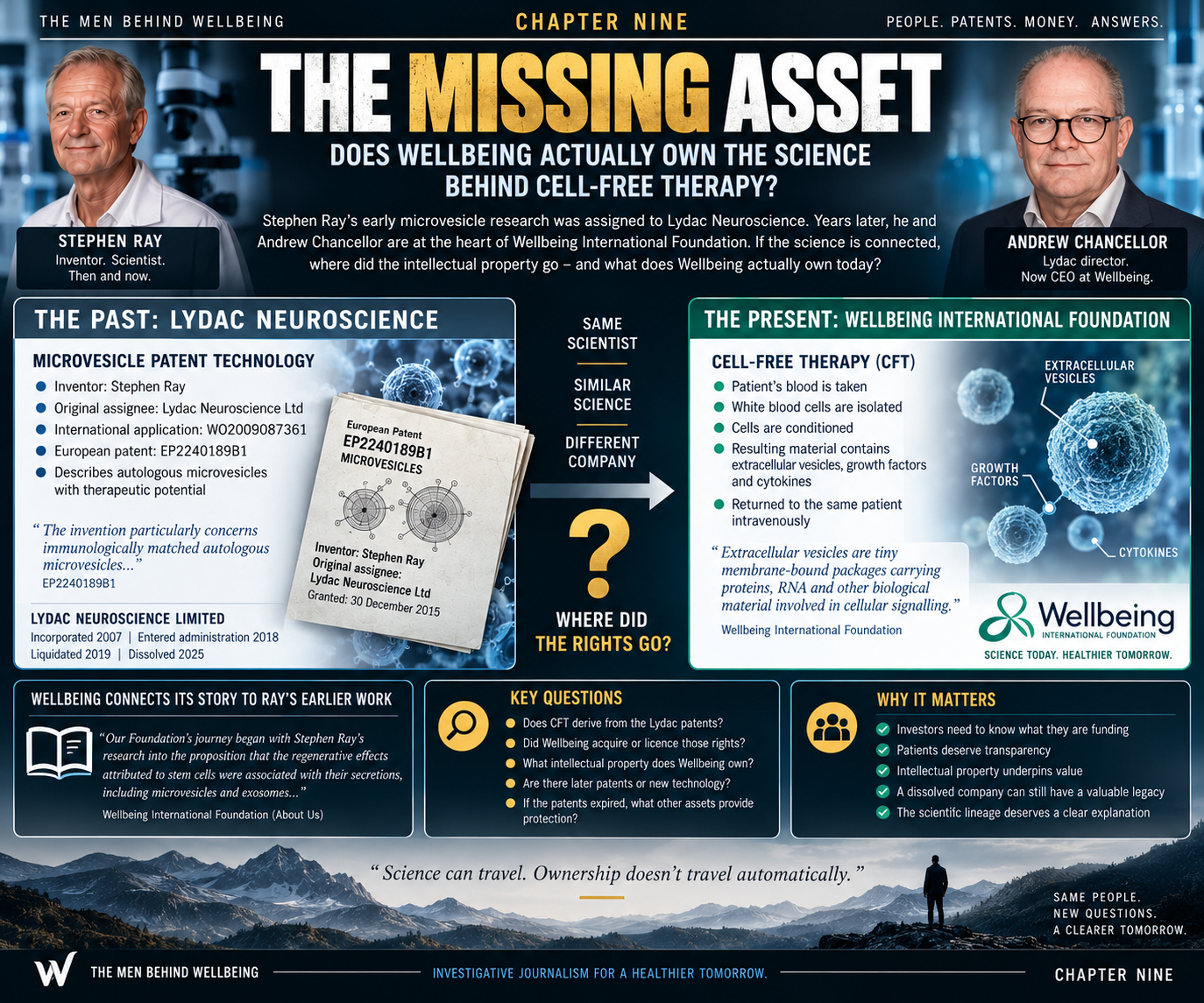
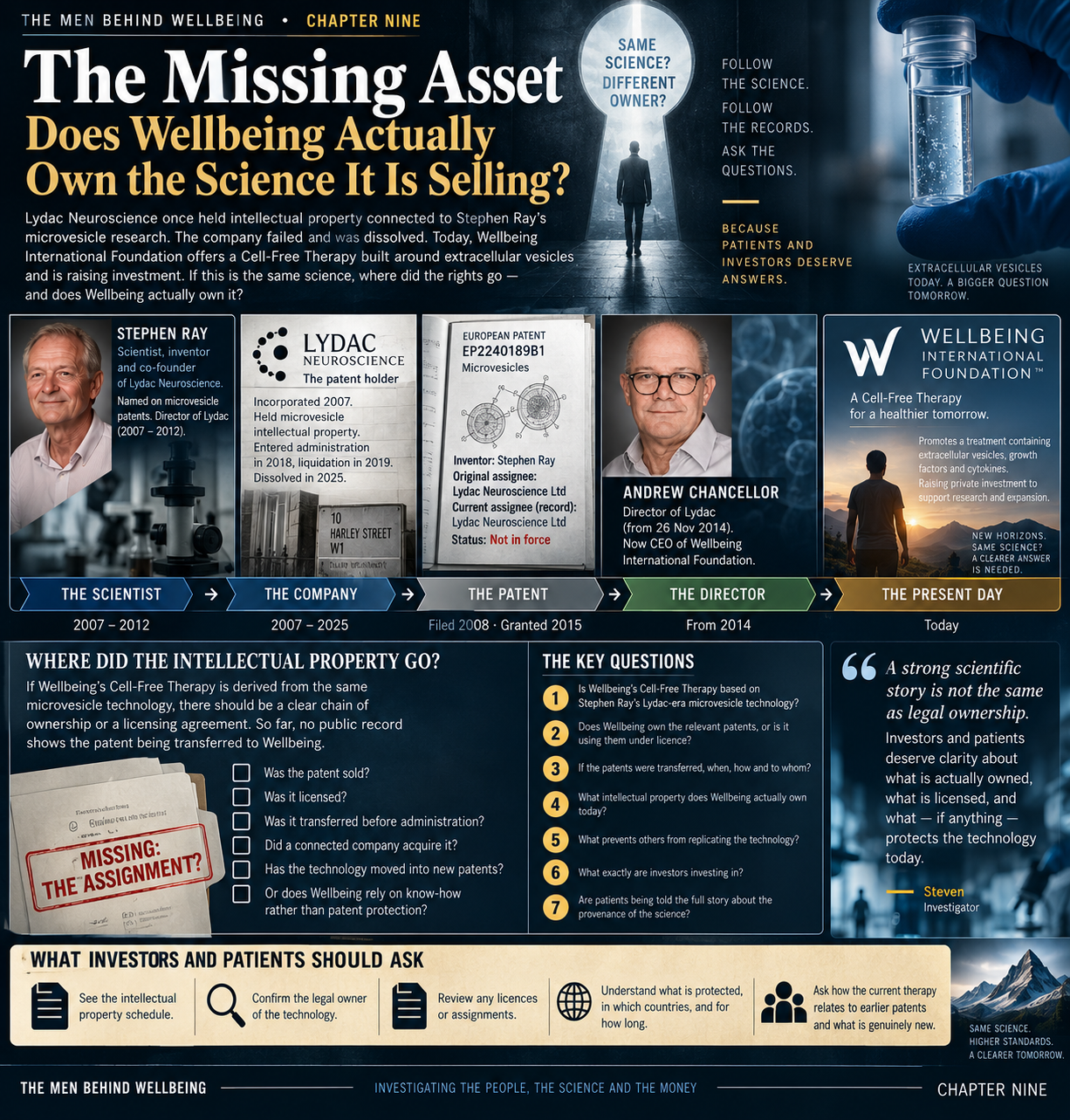
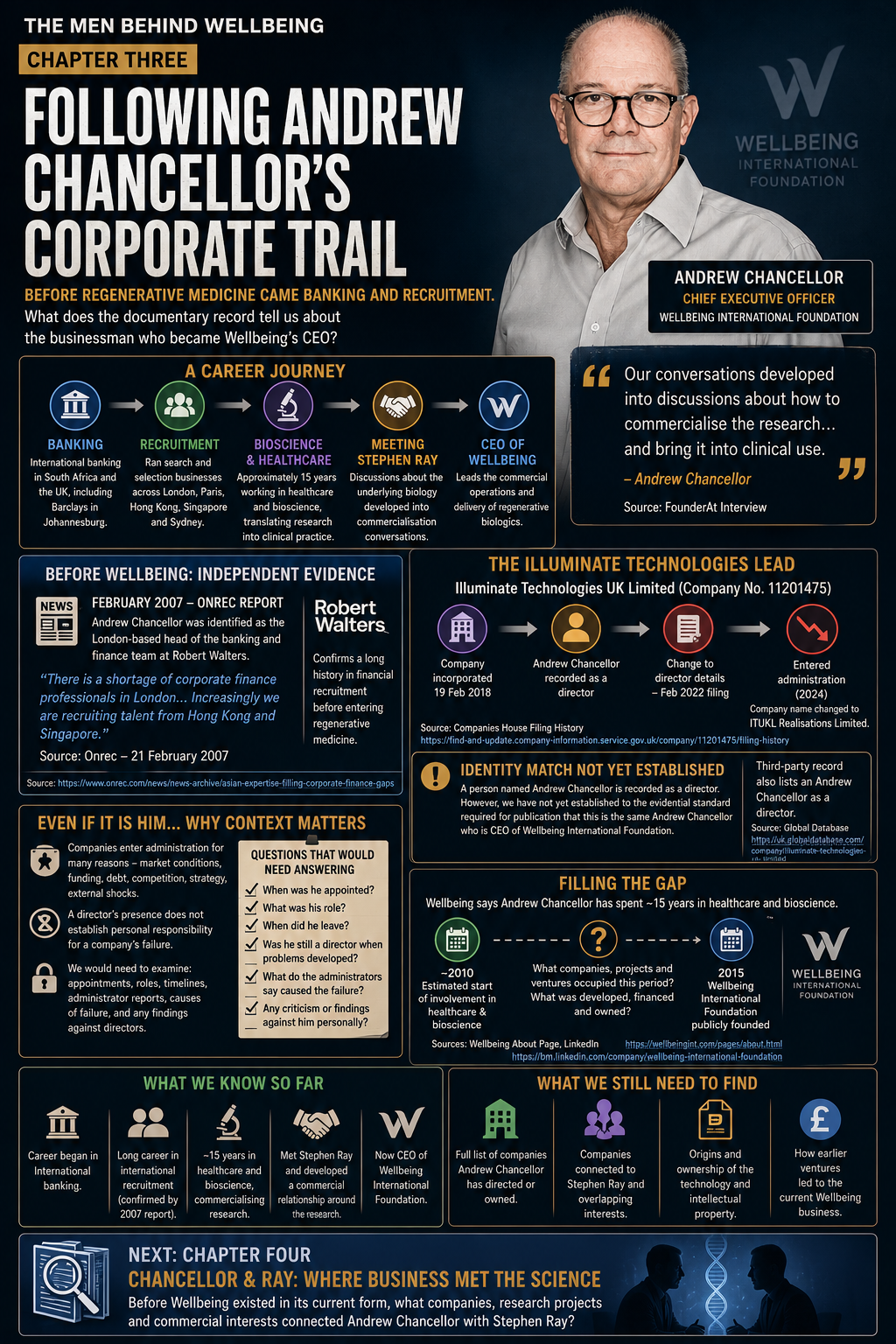
Lydac Neuroscience is gone. Stephen Ray’s science continued. Today, Ray and former Lydac director Andrew Chancellor are together again at Wellbeing International Foundation, where Cell-Free Therapy is promoted around extracellular-vesicle science. That creates a question that matters enormously to patients and prospective investors: where is the documented bridge between the old science and the technology being commercialised today?
By Steven
For the last three chapters, this investigation has followed a trail that began almost twenty years ago.
Stephen Ray.
Microvesicles.
Patents.
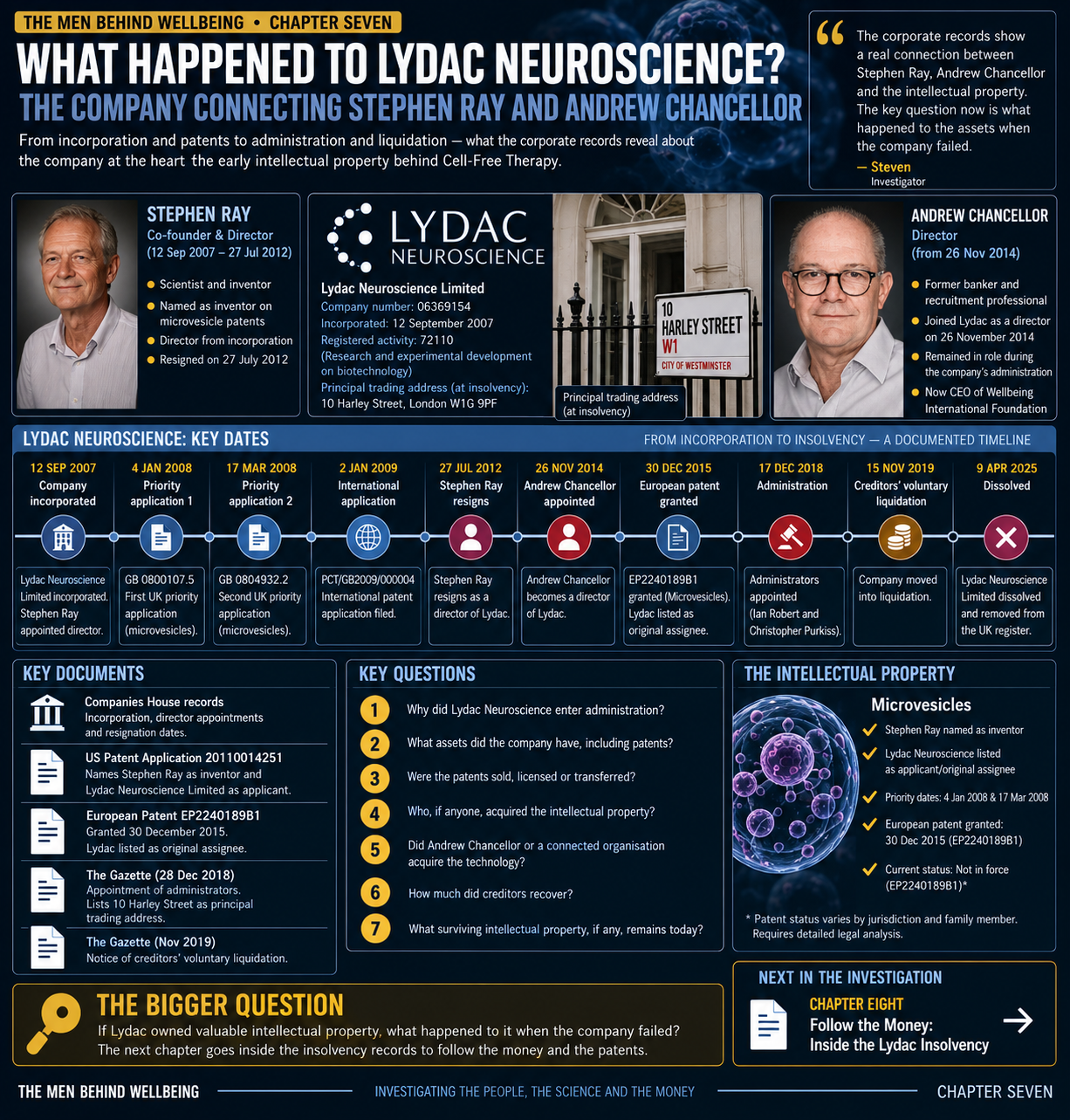
Lydac Neuroscience.
Andrew Chancellor.
Administration.
Liquidation.
Dissolution.
But it is important not to become lost in the history.
We started investigating all of this for one reason:
Wellbeing International Foundation.
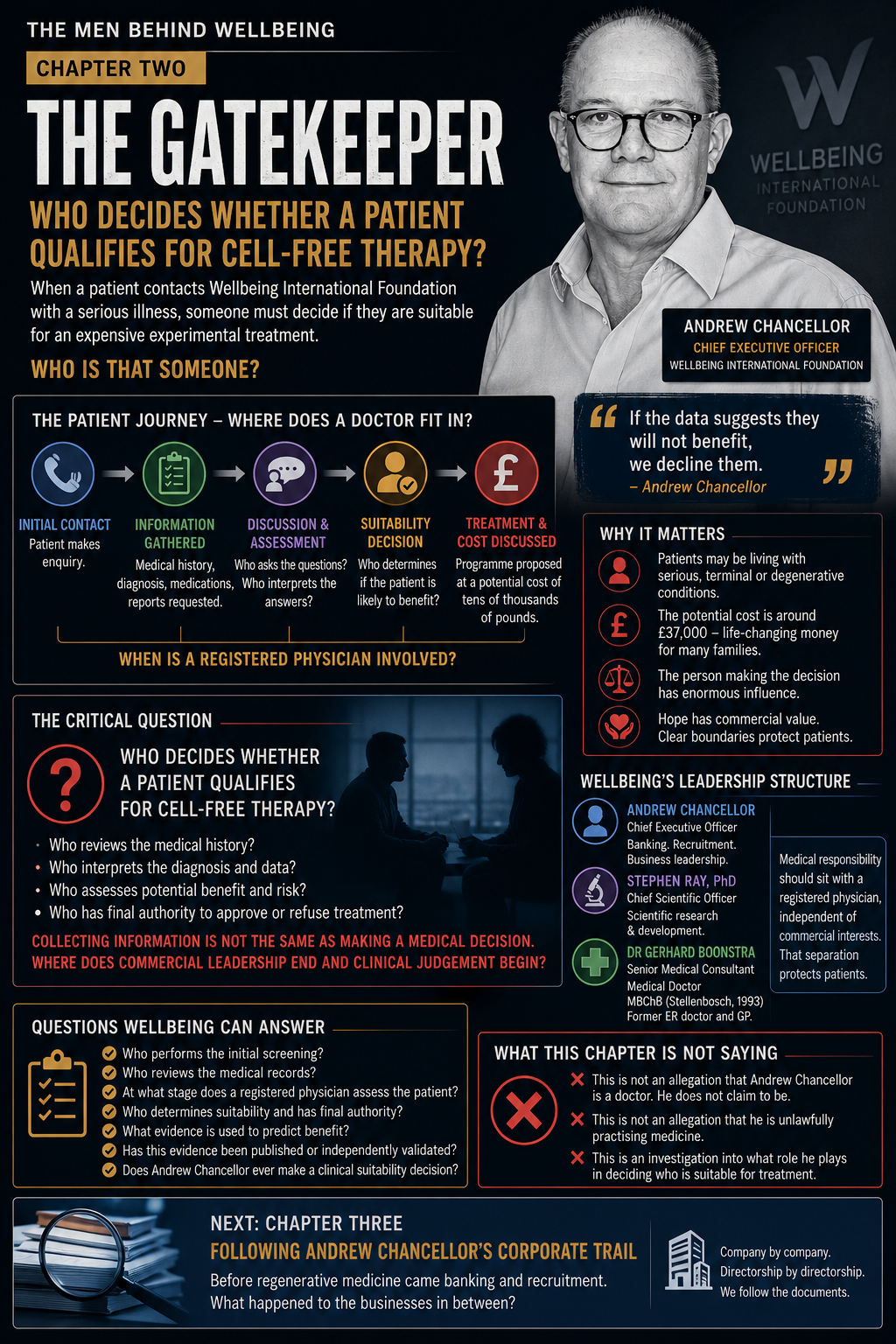
Today, Wellbeing presents Cell-Free Therapy as an advanced biological treatment involving material produced from a patient's own cells.
Its scientific explanation places extracellular vesicles, growth factors and cytokines at the centre of that process.
And one of the principal scientific figures behind the organisation is Stephen Ray.
That is the same Stephen Ray whose earlier microvesicle research led us to patents originally assigned to Lydac Neuroscience.
The same Lydac that Andrew Chancellor subsequently directed.
The same Lydac that later became insolvent and disappeared.
So Chapter Nine asks the question we have been moving towards:
What exactly does Wellbeing own?
Start With What Wellbeing Says CFT Is
To understand the question, we first need to understand the treatment.
Wellbeing describes Cell-Free Therapy as an autologous process.
In broad terms, blood is taken from the patient.
White blood cells are isolated.
Those cells are placed under controlled conditions.
The resulting biological material contains components including extracellular vesicles, growth factors and cytokines.
That material is then administered back to the same patient.
The important words for our investigation are:
autologous
and:
extracellular vesicles.
Because those words take us straight back into Stephen Ray's earlier patent history.
Go Back to 2008
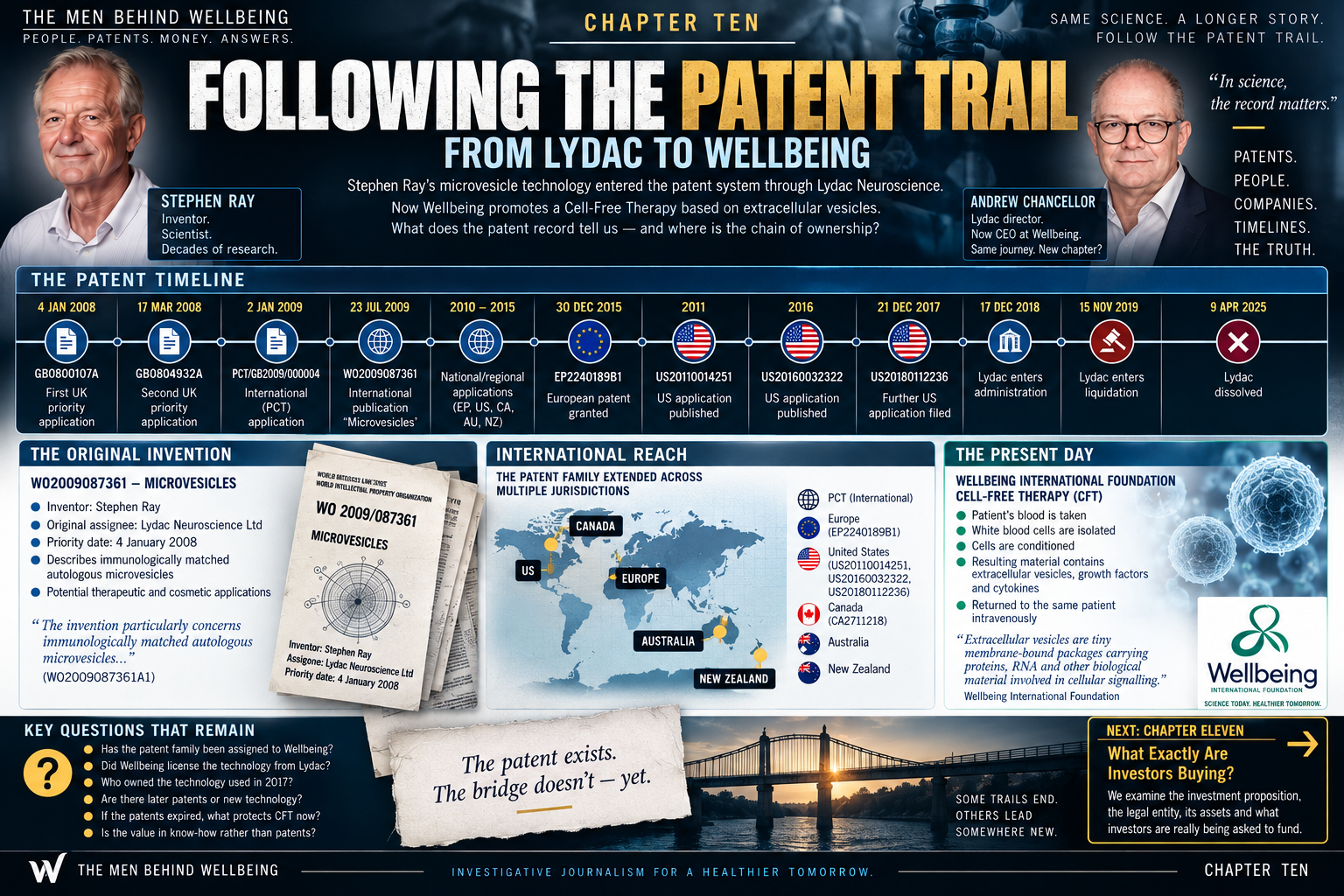
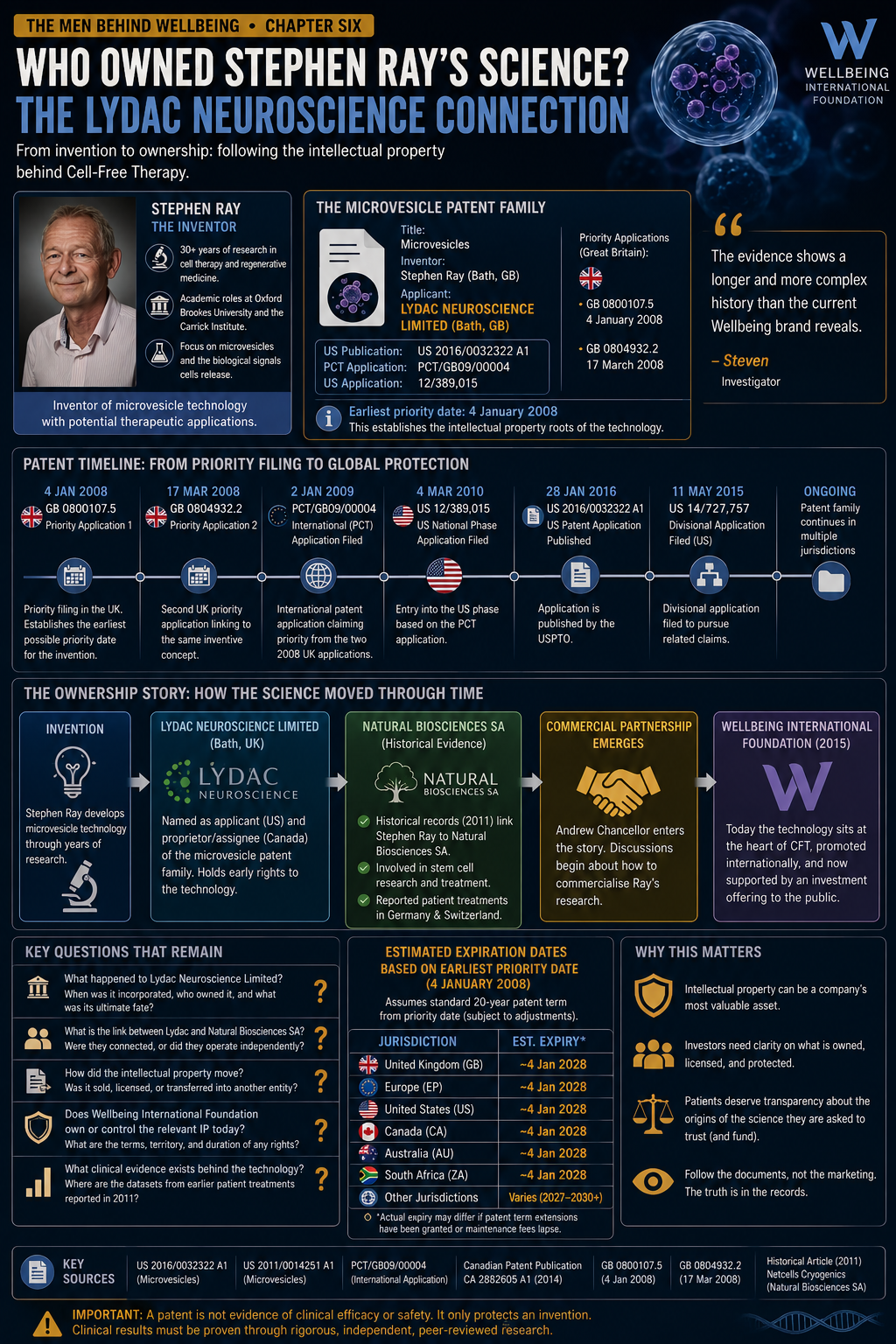
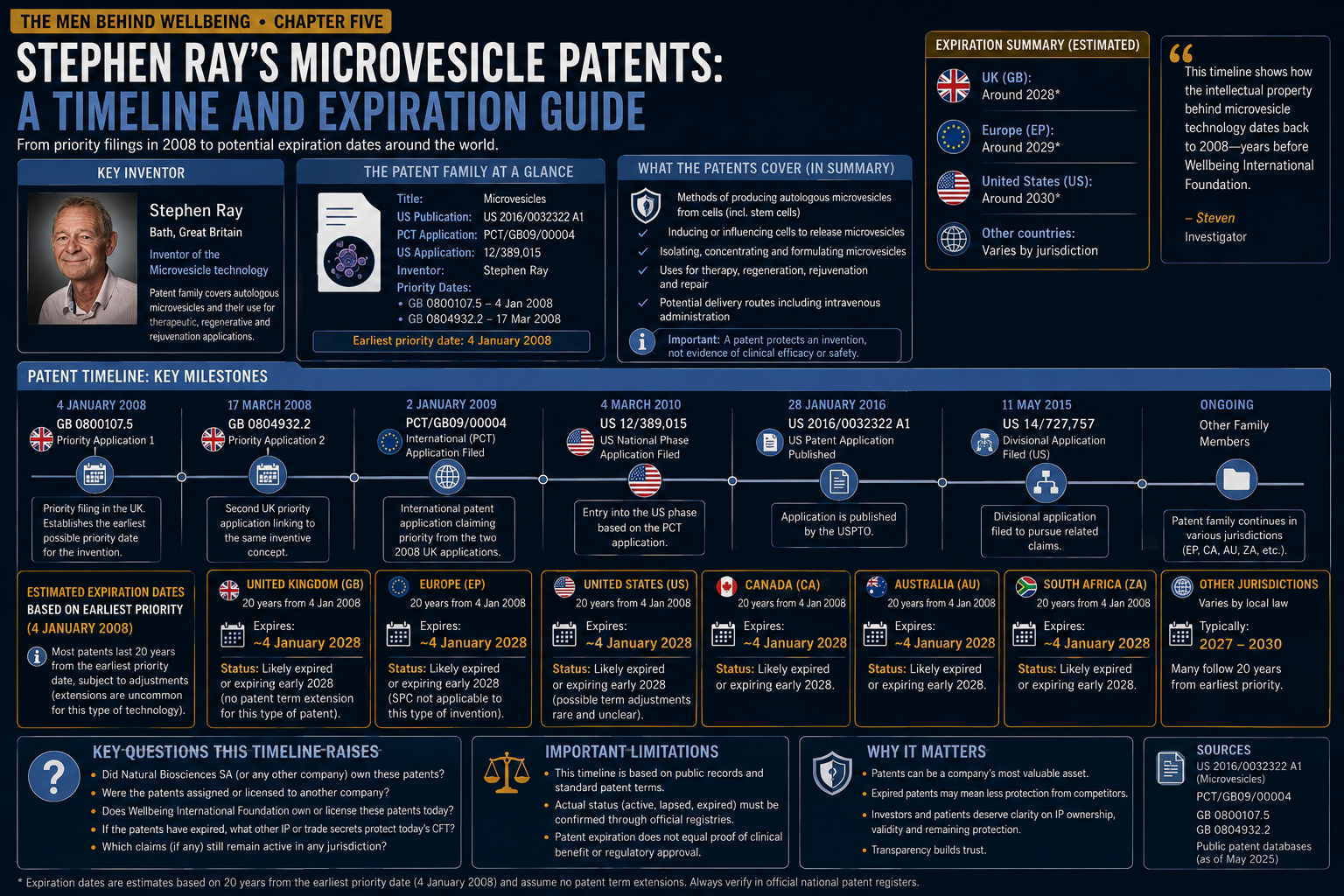
The patent family we have been examining begins with priority applications filed in 2008.
The international application became:
WO2009087361 — Microvesicles.
Stephen Ray is named as inventor.
Lydac Neuroscience Limited is identified as the original assignee.
The patent describes methods involving microvesicles and specifically discusses immunologically matched autologous microvesicles and their potential therapeutic applications.
Now compare that with Wellbeing's present description.
Historical technology:
autologous microvesicles.
Present-day CFT:
autologous biological material containing extracellular vesicles.
Same scientist.
Related biological mechanisms.
Related terminology.
But potentially different technology.
And that final distinction is crucial.
Similarity Is Not Proof
It would be irresponsible to look at those descriptions and simply declare:
“CFT is the old Lydac patent.”
We have not established that.
Extracellular-vesicle science has developed considerably since 2008.
Microvesicles form part of the wider extracellular-vesicle field.
Processes can evolve.
Manufacturing techniques can change.
Later discoveries can create new intellectual property.
And an old patent can become irrelevant even though the scientist behind it continues working in the same field.
Therefore, the question is not whether the words look similar.
The proper question is:
What scientific relationship exists between Ray's Lydac-era microvesicle technology and the CFT process being used today?
And once that relationship is established:
Who owns the relevant rights?
Wellbeing Itself Points Back to Ray's Earlier Science
This question isn't being created solely by outside investigators.
Wellbeing itself presents Stephen Ray's long research history as part of the scientific foundation behind the organisation.
Ray is presented as a senior scientific figure with decades of experience in cell therapy and related research.
That history gives Wellbeing's scientific narrative credibility.
But it also creates a responsibility to distinguish between several different things:
Ray's historical research;
the Lydac-era patented invention;
later scientific development;
and:
the exact CFT process being offered today.
Those are not automatically the same thing.
If Wellbeing wants to rely upon the history, then understanding the transition between those stages becomes important.
The 2017 Date Changes Everything
One date has become particularly interesting.
According to Wellbeing's own published account concerning patient Paul Cook, Cook was introduced to Stephen Ray in November 2017 and subsequently began a cell-free treatment programme involving extracellular vesicles derived from his own cells.
That date deserves attention.
November 2017.
Because Lydac Neuroscience still existed.
It would not enter administration until:
17 December 2018.
That means, according to Wellbeing's own historical account, Ray-associated autologous extracellular-vesicle treatment was already taking place while the company historically associated with Ray's microvesicle intellectual property remained alive.
That does not establish that Lydac owned the 2017 treatment.
But it creates a much more precise question.
Who Owned the Technology Being Used in 2017?
This may prove to be one of the key questions in the entire investigation.
If the 2017 programme substantially relied upon Lydac's patented technology:
what was the commercial arrangement?
Was Lydac involved?
Was the technology licensed?
Had the relevant rights already been assigned elsewhere?
Was another company operating the programme?
Or had Ray's research progressed sufficiently far beyond the old patent that Lydac's intellectual property was no longer relevant?
There may be a perfectly legitimate explanation.
But identifying that explanation could finally establish the bridge we have been looking for.
Science Can Travel. Ownership Doesn't Travel Automatically.
This distinction is fundamental.
Stephen Ray invented the earlier technology.
But the patent records identify Lydac Neuroscience as the original corporate assignee.
Inventorship and ownership are different.
A scientist leaving a company does not automatically take the company's patents with him.
Likewise, Andrew Chancellor subsequently becoming a Lydac director did not make Lydac's patents Chancellor's personal property.
And Ray and Chancellor later appearing together at Wellbeing does not automatically make historical Lydac intellectual property Wellbeing property.
There must be a legal basis for ownership or use where protected rights are involved.
Potentially:
assignment;
purchase;
licence;
new intellectual property;
or:
the expiry or abandonment of earlier rights.
Which applies here?
That is what we need to establish.
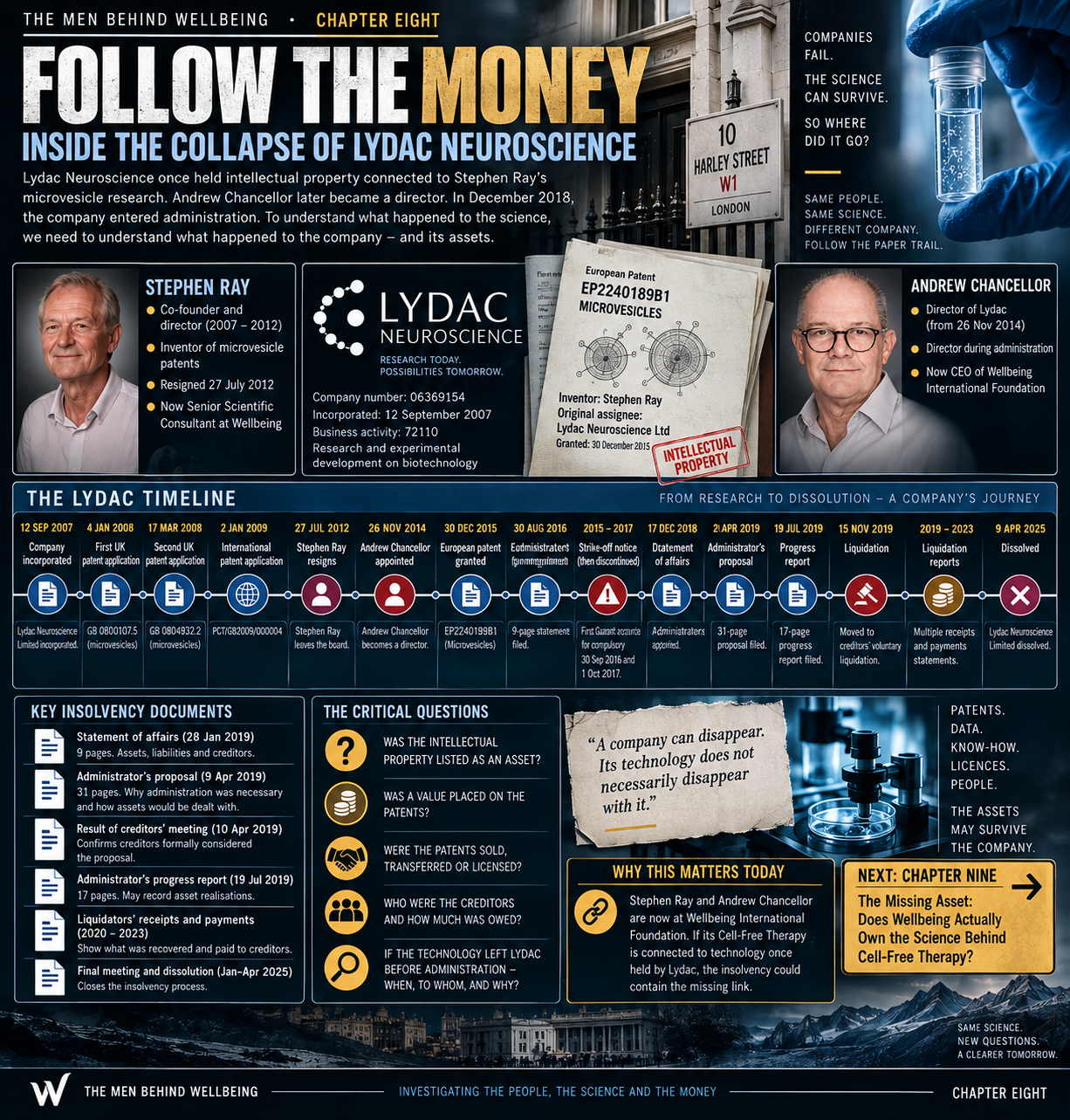
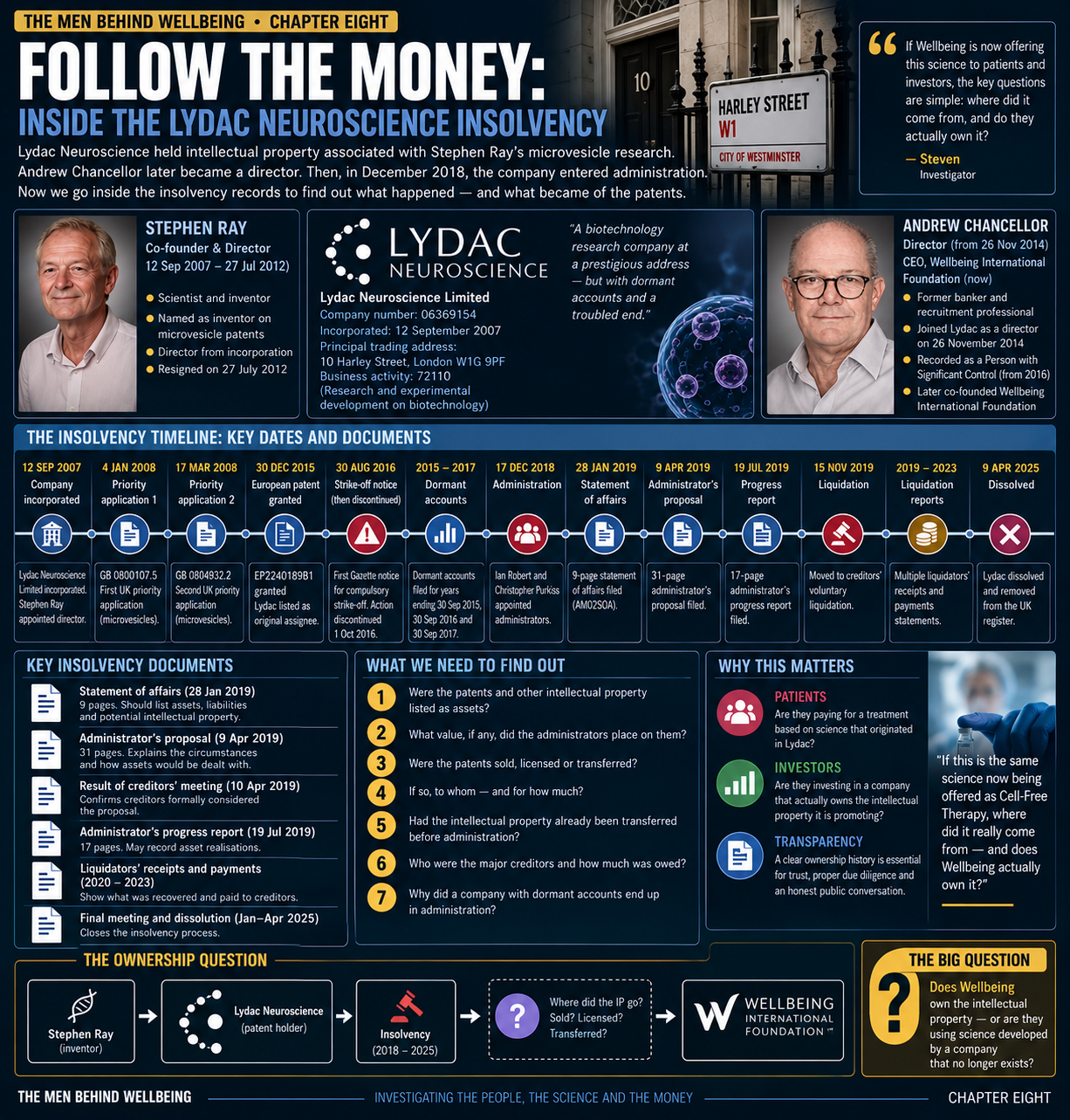
What Happened When Lydac Failed?
Chapter Eight brought us directly to this point.
When administrators entered Lydac in December 2018, they were dealing with a biotechnology company historically associated with Ray's intellectual property.
If Lydac still owned commercially valuable patent rights, those rights were potentially company assets.
If it didn't own them anymore, then we need to establish when they had left.
If they had been licensed, those agreements could potentially have value.
If they had become commercially irrelevant, that is also important.
And if the real value was not in patents at all but in scientific know-how, then we need to establish who owned or controlled that know-how.
The insolvency records and patent records therefore need to be examined together.
The European Patent Record Creates Another Question
The European patent EP2240189B1 identifies Stephen Ray as inventor and Lydac Neuroscience as original assignee.
Public patent databases currently display the patent as not in force.
That could mean the patent itself no longer provides meaningful protection today.
But that doesn't erase its historical significance.
For this investigation, we need to know what happened during the period when it was potentially relevant.
Was it assigned?
Was it licensed?
Did later patents replace it?
Did its claims cease to matter to the developing CFT process?
Those are different possibilities with very different implications.
Perhaps Wellbeing Doesn't Need the Lydac Patent at All
This possibility deserves serious consideration.
The answer to this investigation could ultimately be:
the old Lydac patent doesn't matter anymore.
Perhaps Ray continued developing the science.
Perhaps CFT represents a later generation of the technology.
Perhaps modern production methods are materially different.
Perhaps Wellbeing's competitive advantage comes from laboratory protocols rather than patents.
Perhaps the organisation relies upon proprietary know-how developed after the original applications.
There would be nothing inherently suspicious about that.
In fact, biotechnology businesses frequently rely upon combinations of patents, confidential processes, manufacturing expertise and trade secrets.
But if that is Wellbeing's position, another question immediately replaces the patent question.
Who Owns the Know-How?
Suppose the real value behind CFT isn't EP2240189B1.
Suppose it is:
a proprietary cell-conditioning process;
specific laboratory conditions;
timing;
concentrations;
purification;
processing;
quality-control procedures;
or accumulated scientific knowledge developed by Stephen Ray.
That could potentially be commercially valuable.
But who owns it?
Is that knowledge contractually assigned to Wellbeing?
Does Wellbeing possess exclusive rights?
Is Ray an employee or consultant?
What does his agreement say about intellectual property?
Who owns improvements he develops?
Can the technology be used elsewhere?
What happens if Ray leaves?
For investors, these questions can be every bit as important as patents.
A Scientist Is Not an Intellectual-Property Portfolio
This distinction matters particularly when an organisation's scientific identity is strongly associated with one person.
Stephen Ray's presence may provide expertise.
His research history may provide scientific credibility.
His knowledge may be extremely valuable.
But the presence of a scientist inside an organisation does not automatically mean the organisation owns everything that scientist previously invented—or everything he knows.
Ownership depends upon contracts.
Assignments.
Employment terms.
Licences.
And the circumstances under which new intellectual property is created.
This is why investors need documentation rather than assumptions.
Now Bring the Investors Back Into the Story
Wellbeing is not simply discussing experimental science.
It has been raising capital.
That makes intellectual-property ownership commercially important.
A prospective investor should be able to ask:
What am I actually investing in?
A scientific team?
A treatment business?
A research programme?
A proprietary manufacturing process?
Patents?
Licences?
Trade secrets?
Clinical relationships?
Patient revenue?
Or some combination of those things?
There is nothing inherently wrong with any of those business models.
But they have very different values and risks.
Owning the Organisation Doesn't Necessarily Mean Owning the Science
Imagine an investor acquires shares or some other economic interest connected with Wellbeing.
What assets sit inside the entity receiving that investment?
Does that entity own CFT intellectual property?
Does another company own it?
Does Stephen Ray own part of it?
Does Wellbeing operate under licence?
Does a laboratory own aspects of the manufacturing process?
Are rights held elsewhere within a corporate structure?
Those questions matter because investment into one legal entity does not automatically provide economic exposure to assets owned by another.
For biotechnology investors, that distinction can be fundamental.
The Research Library Is Not the Intellectual Property
Wellbeing maintains a substantial research library covering extracellular vesicles, secretome biology, ageing, neurological research and other areas.
That can be useful.
It demonstrates that extracellular-vesicle biology is a serious international field of scientific research.
But independent academic research is not proprietary technology belonging to Wellbeing.
A published scientific paper belongs to the wider evidence base.
It may support biological plausibility.
It may support a scientific hypothesis.
It may inform product development.
But it does not give Wellbeing exclusive commercial ownership of the underlying scientific field.
So investors need to distinguish between:
science supporting the field
and:
intellectual property belonging to the business.
They are not the same thing.
The Question Investors Should Ask
Rather than asking:
“How much research exists around extracellular vesicles?”
an investor should ask:
“What does Wellbeing uniquely control?”
That might include:
patents;
patent applications;
exclusive licences;
trade secrets;
proprietary manufacturing processes;
clinical data;
software;
protocols;
contractual rights;
or specialist know-how.
Then comes the second question:
Which legal entity owns those assets?
And the third:
Are those assets actually included in the company or structure I am investing in?
Those are the questions that determine whether the science has commercial defensibility.
Ask for the Intellectual-Property Schedule
There is a straightforward way to answer much of this.
Prospective investors should request Wellbeing's intellectual-property schedule and supporting documentation.
That should allow them to identify:
which patents are relevant to CFT;
who owns those patents;
which patents remain in force;
whether licences exist;
whether licences are exclusive;
which territories are covered;
who owns proprietary manufacturing protocols;
who owns new inventions created through ongoing research;
and:
whether any relevant rights originated with Lydac Neuroscience.
If the intellectual-property position is straightforward, this documentation should make it straightforward.
Then Ask About Lydac Specifically
The historical connection deserves its own questions.
Did Wellbeing acquire any Lydac intellectual property?
Did Stephen Ray reacquire any rights?
Did Andrew Chancellor or another connected entity acquire rights?
Were any Lydac patents licensed?
Were relevant rights sold during the administration?
Did the CFT process develop independently from the old patent family?
Or did the old patents simply become obsolete?
Any of those answers could resolve the apparent gap.
But without an answer, the gap remains.
Why Patients Should Care Too
This isn't only an investor issue.
Patients are also entitled to understand the scientific provenance of a treatment.
If a therapy is presented alongside decades of scientific history, patients should be able to distinguish between:
decades of research in a field;
decades of work by a particular scientist;
and:
clinical evidence relating specifically to the exact treatment being offered today.
Those are different things.
If CFT evolved through multiple generations of Ray's work, that history could be scientifically interesting.
But the evidence supporting earlier technology should not automatically be treated as evidence supporting every later version.
The exact process being administered matters.
So does the evidence generated specifically around it.
There May Be a Completely Innocent Explanation
This investigation needs to remain open to that possibility.
Perhaps the entire intellectual-property history is straightforward.
Perhaps Lydac's patents ceased to matter years ago.
Perhaps modern CFT is technically distinct.
Perhaps Wellbeing has properly documented rights to later technology.
Perhaps there are licences that aren't visible in public databases.
Perhaps the organisation relies primarily upon confidential know-how.
If so, publishing that explanation would answer many of the questions raised in these chapters.
The objective is not to force the evidence into a predetermined conclusion.
The objective is to establish what actually happened.
What We Can Establish
At this point, we have a documented historical sequence.
Stephen Ray developed microvesicle technology.
Patent records identify him as inventor.
Lydac Neuroscience appears as the original corporate assignee.
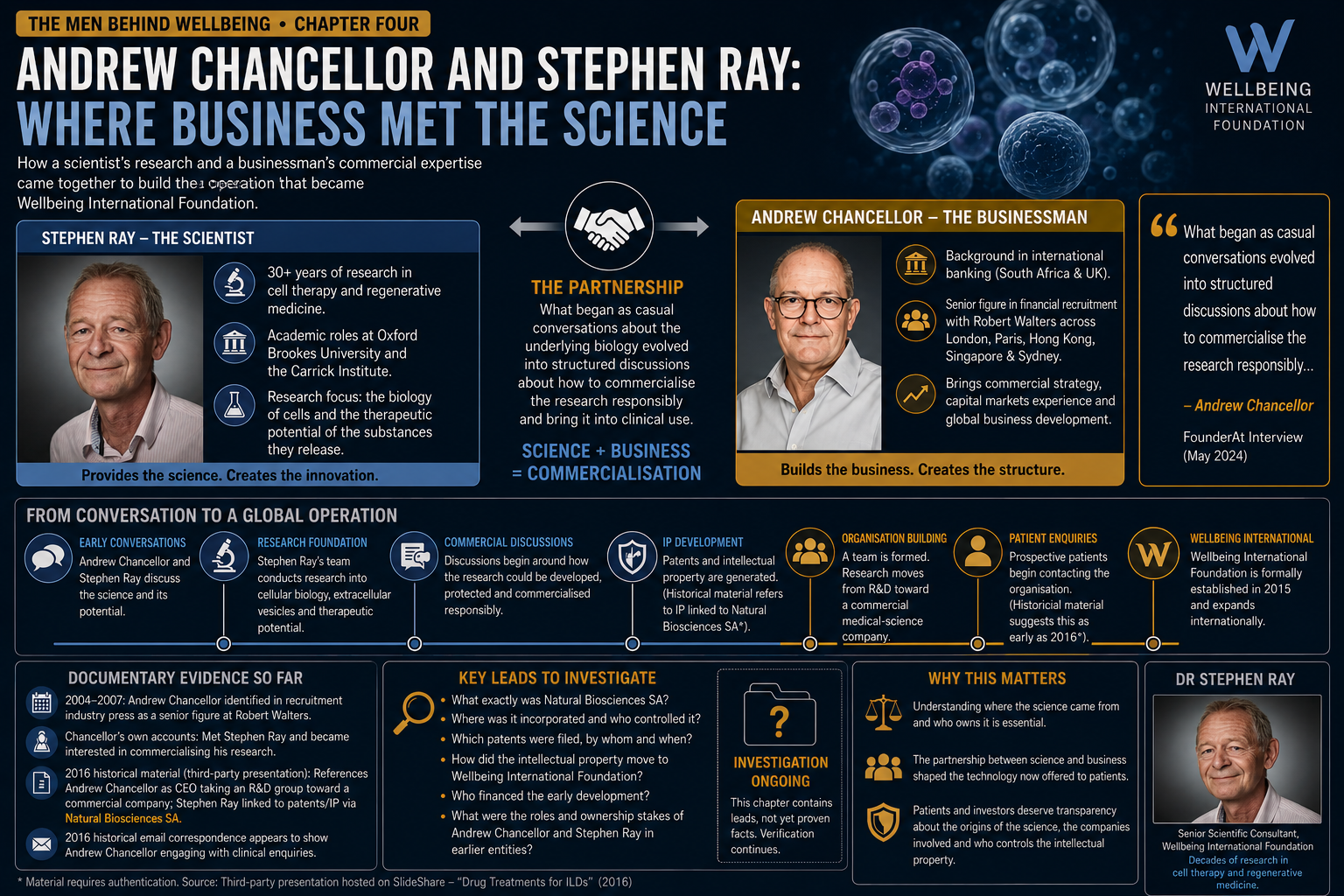
Andrew Chancellor subsequently became a director of Lydac.
Wellbeing's own historical account places Ray in an autologous extracellular-vesicle treatment programme by 2017.
Lydac entered administration in 2018.
It subsequently entered liquidation.
Today, Ray and Chancellor are associated with Wellbeing International Foundation.
And Wellbeing promotes Cell-Free Therapy involving autologous extracellular-vesicle-related biological material.
Those facts justify investigating the relationship.
What We Have Not Established
We have not established that CFT is the Lydac invention.
We have not established that Wellbeing uses intellectual property without permission.
We have not established that Lydac intellectual property was improperly transferred.
We have not established that Andrew Chancellor personally acquired Lydac assets.
We have not established that Stephen Ray improperly removed technology from Lydac.
We have not established that Lydac's creditors lost an asset that should have been realised for their benefit.
And we have not established that Wellbeing lacks legitimate intellectual-property rights.
Those would require evidence we do not presently have.
But we have established the question.
And it is now a very specific one.
Conclusion: The Missing Asset May Be the Missing Explanation
We began this part of the investigation looking for an asset.
A patent.
An assignment.
A transaction.
Something showing how Stephen Ray's earlier microvesicle science travelled from Lydac Neuroscience into the world surrounding Wellbeing International Foundation.
But perhaps what is missing isn't necessarily an asset.
Perhaps what is missing is simply the explanation.
There may be a legitimate chain.
There may be no chain because CFT is genuinely different technology.
There may be later intellectual property.
There may be licences.
There may be proprietary know-how.
There may be a perfectly ordinary commercial structure behind everything we have uncovered.
But until that structure is identified, an important question remains unanswered.
Wellbeing uses Stephen Ray's long scientific history as part of its story.
That history leads us directly to Lydac Neuroscience and its microvesicle patents.
Wellbeing today promotes Cell-Free Therapy involving extracellular vesicles.
And Wellbeing is seeking investment to expand its work.
So patients and investors deserve something more precise than a scientific biography.
They deserve the bridge between the history and the product.
Where did the present CFT technology come from?
Who owns it?
And what exactly does Wellbeing control that another organisation cannot simply reproduce?
Until those questions are answered, the missing asset remains at the centre of the story.
Next: Chapter Ten — Following the Patent Trail: From Lydac to Wellbeing
In Chapter Ten, we stop looking at companies and follow the intellectual property itself. We trace Stephen Ray's microvesicle patent family across Britain, Europe, the United States and other jurisdictions, examine later filings and begin looking for assignments, successor rights and the documentary bridge—if one exists—between Lydac Neuroscience and Wellbeing International Foundation.
Recent Posts