Inside the Collapse of Lydac Neuroscience: What Happened to the Company — and Its Science?
The Men Behind Wellbeing — Chapter Eight
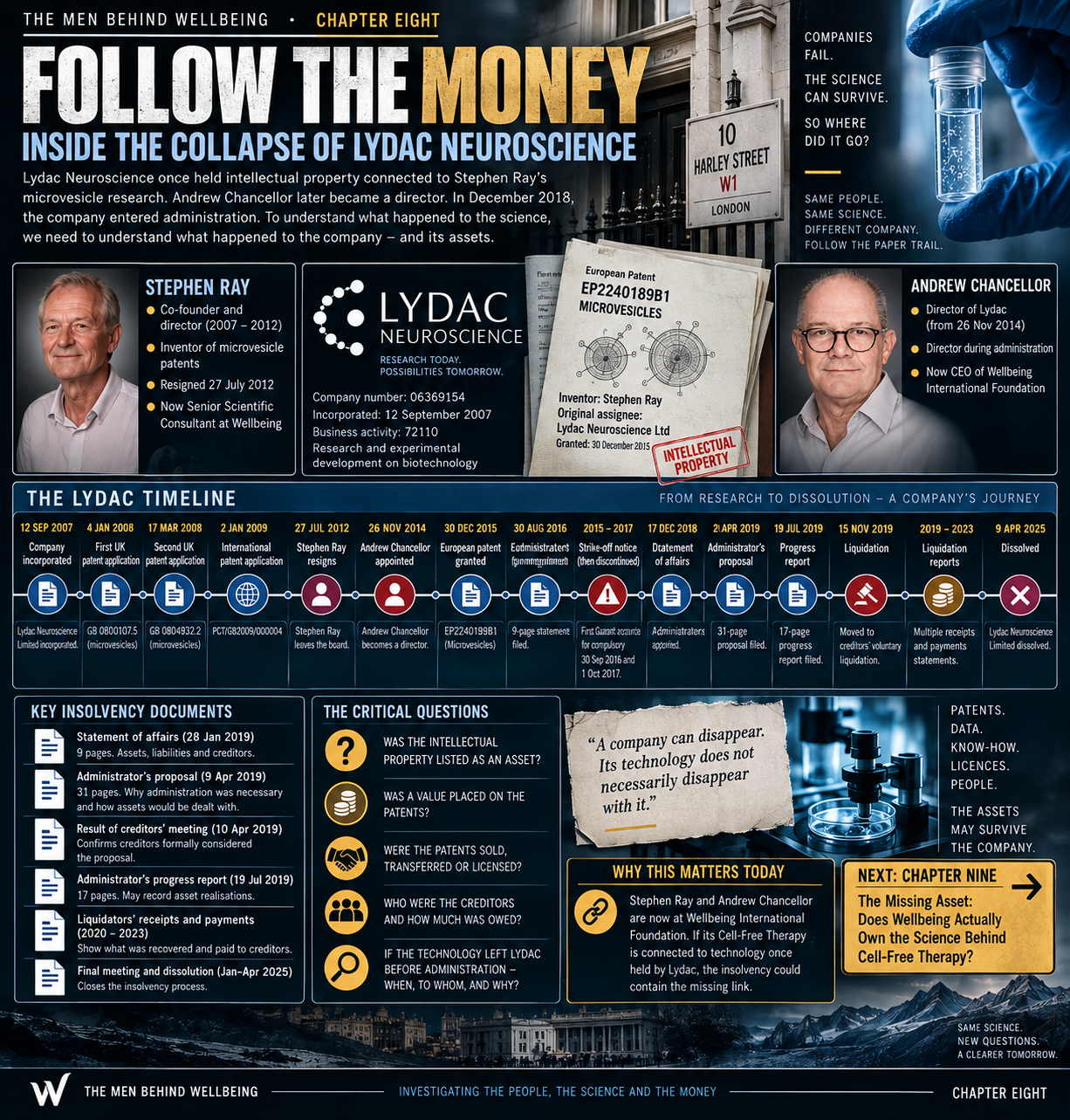
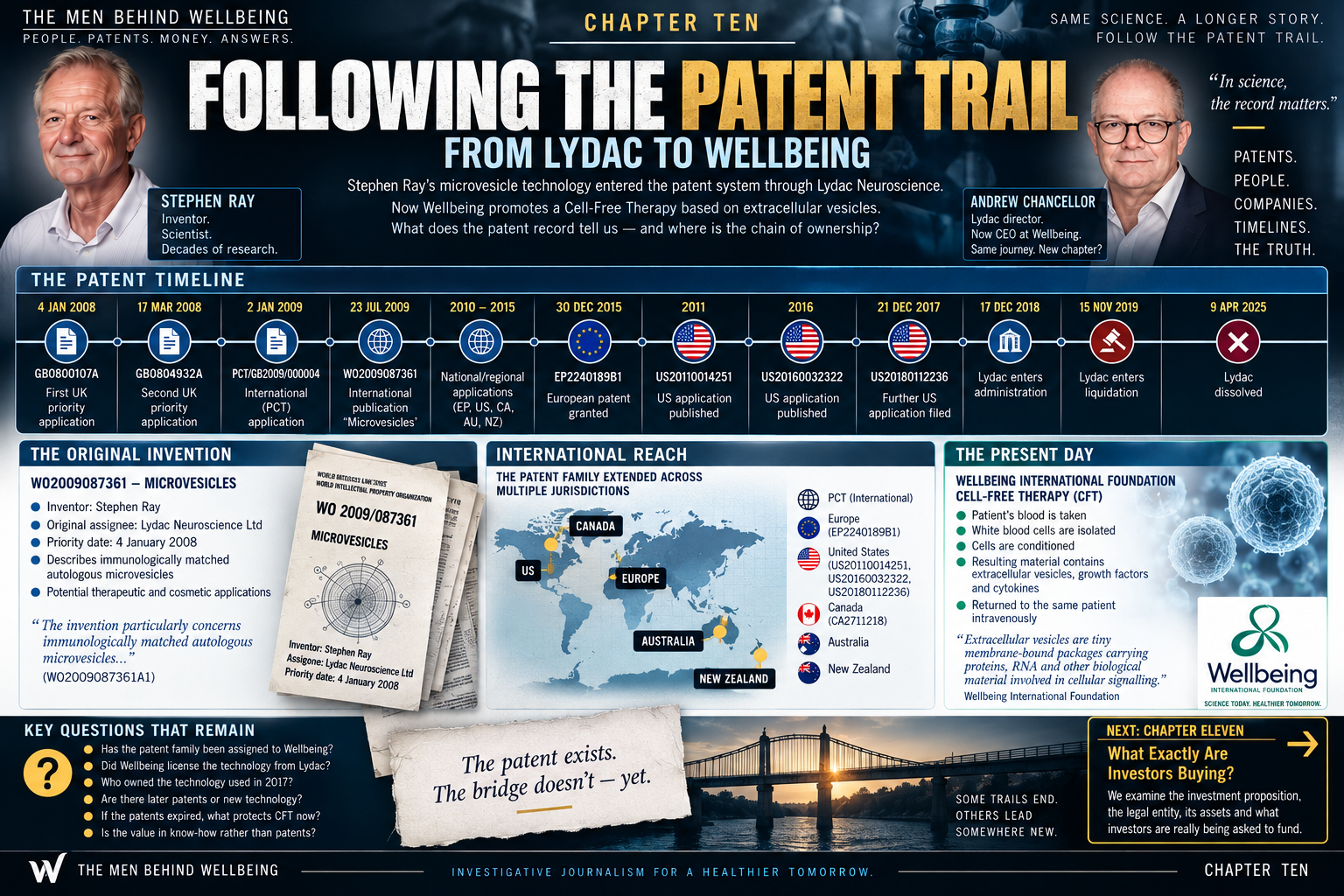
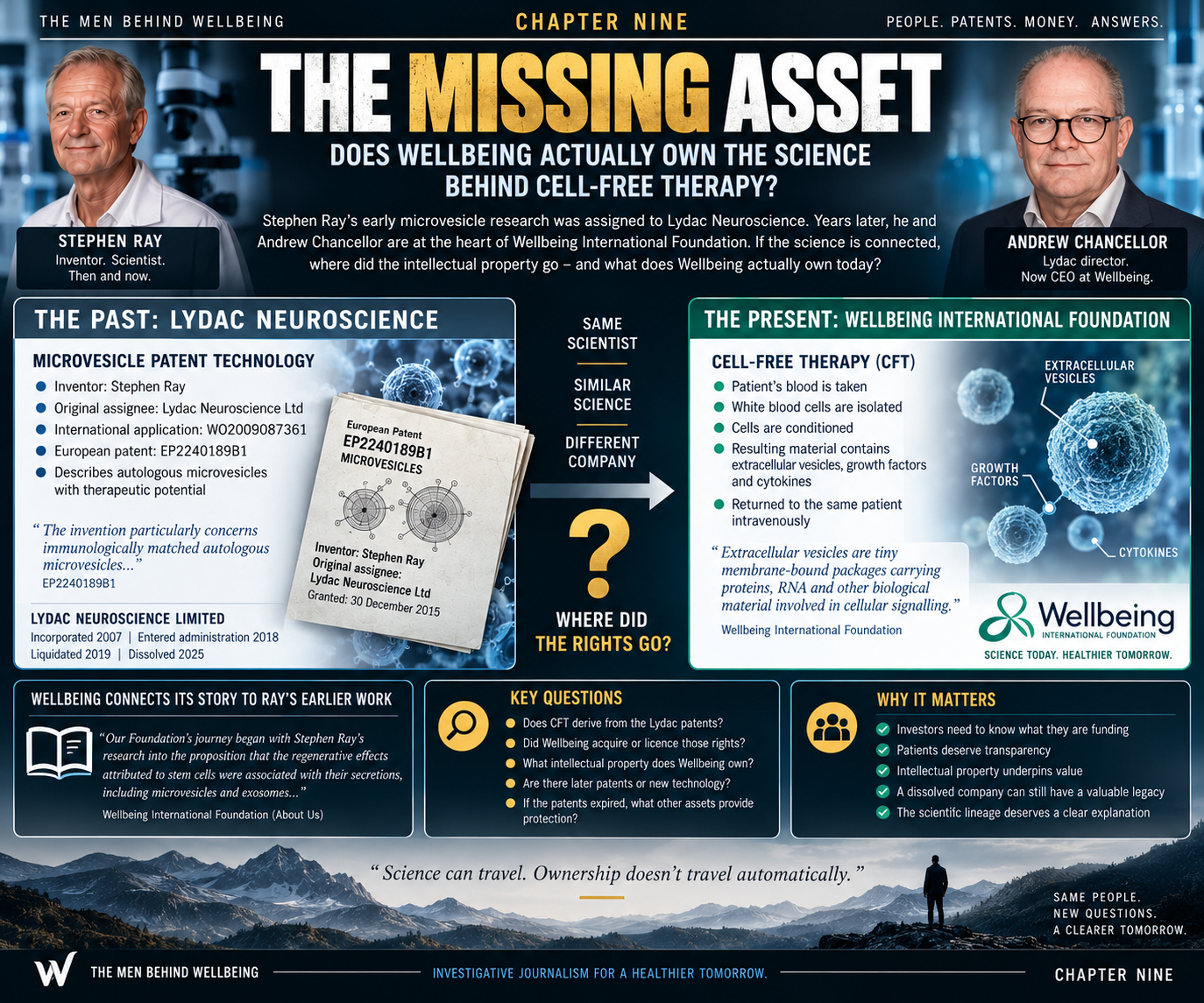
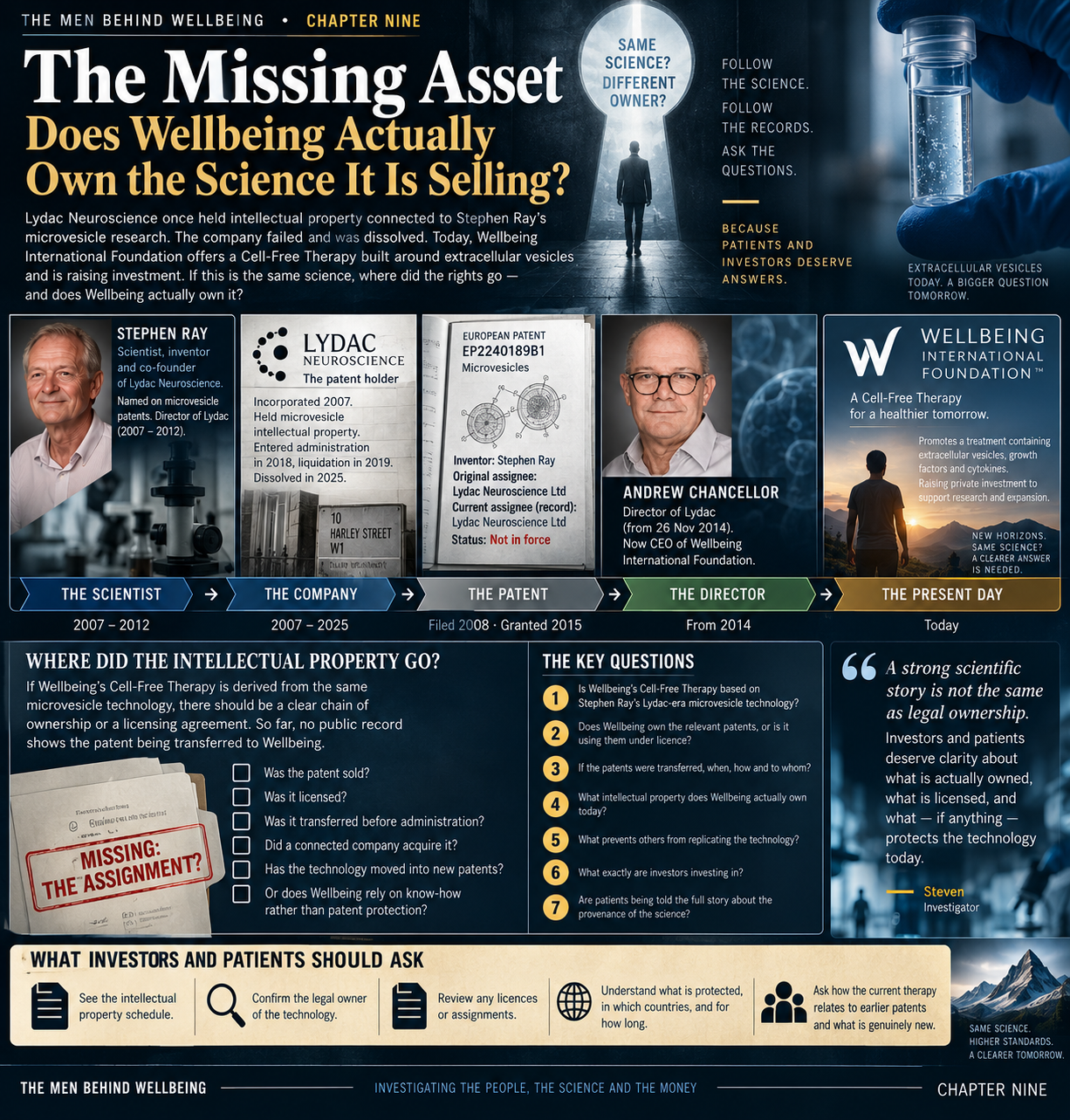
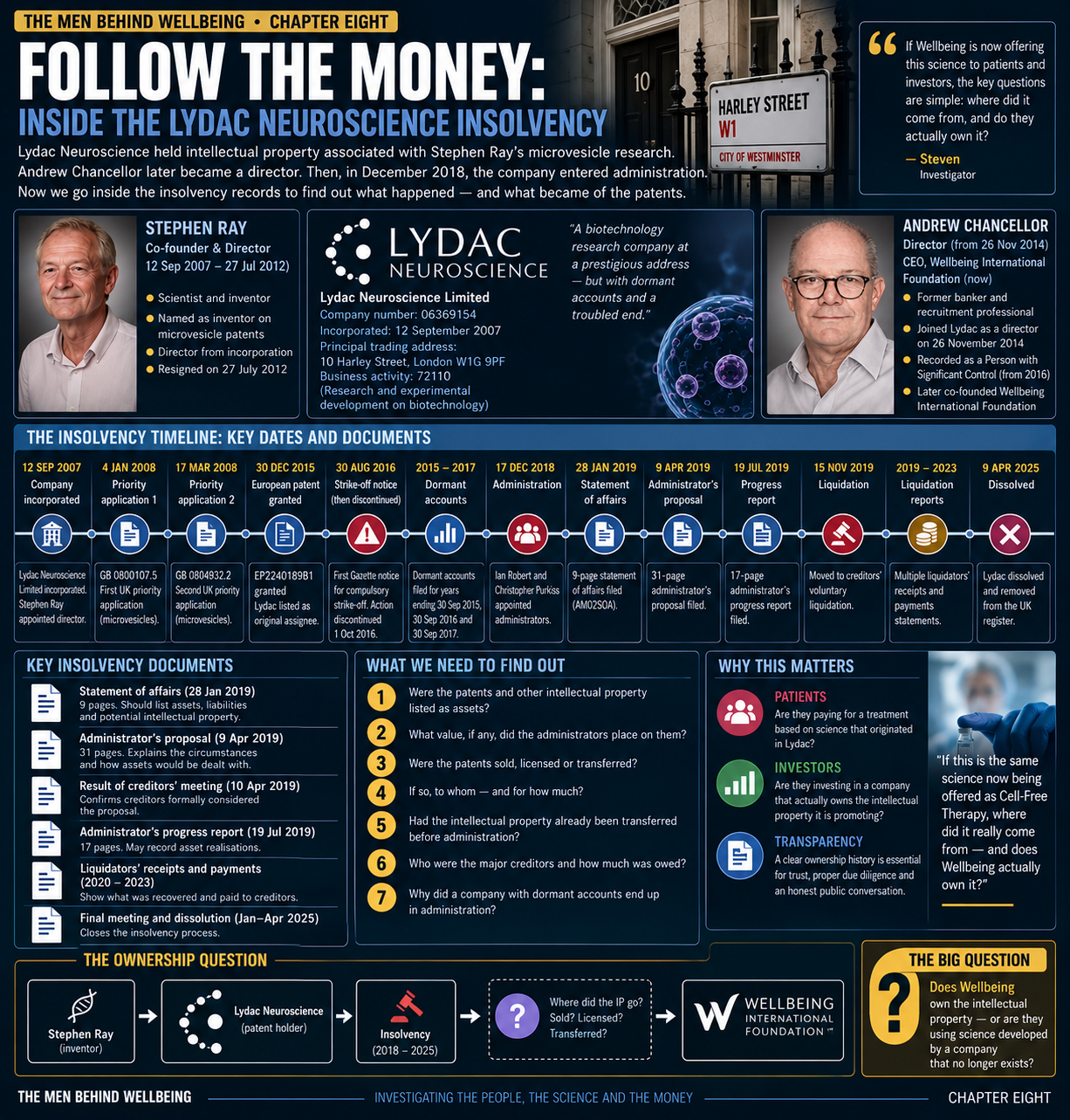
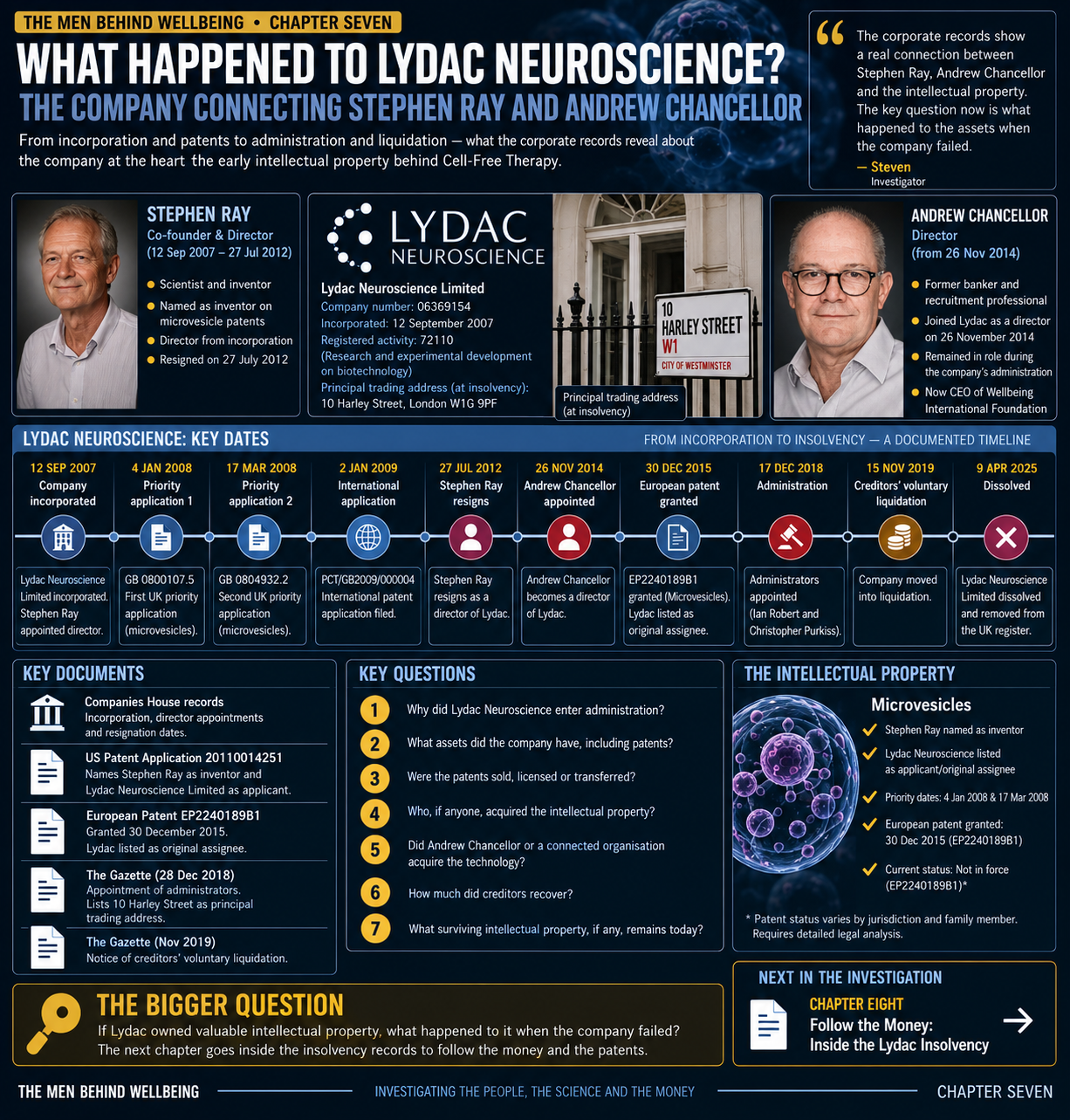
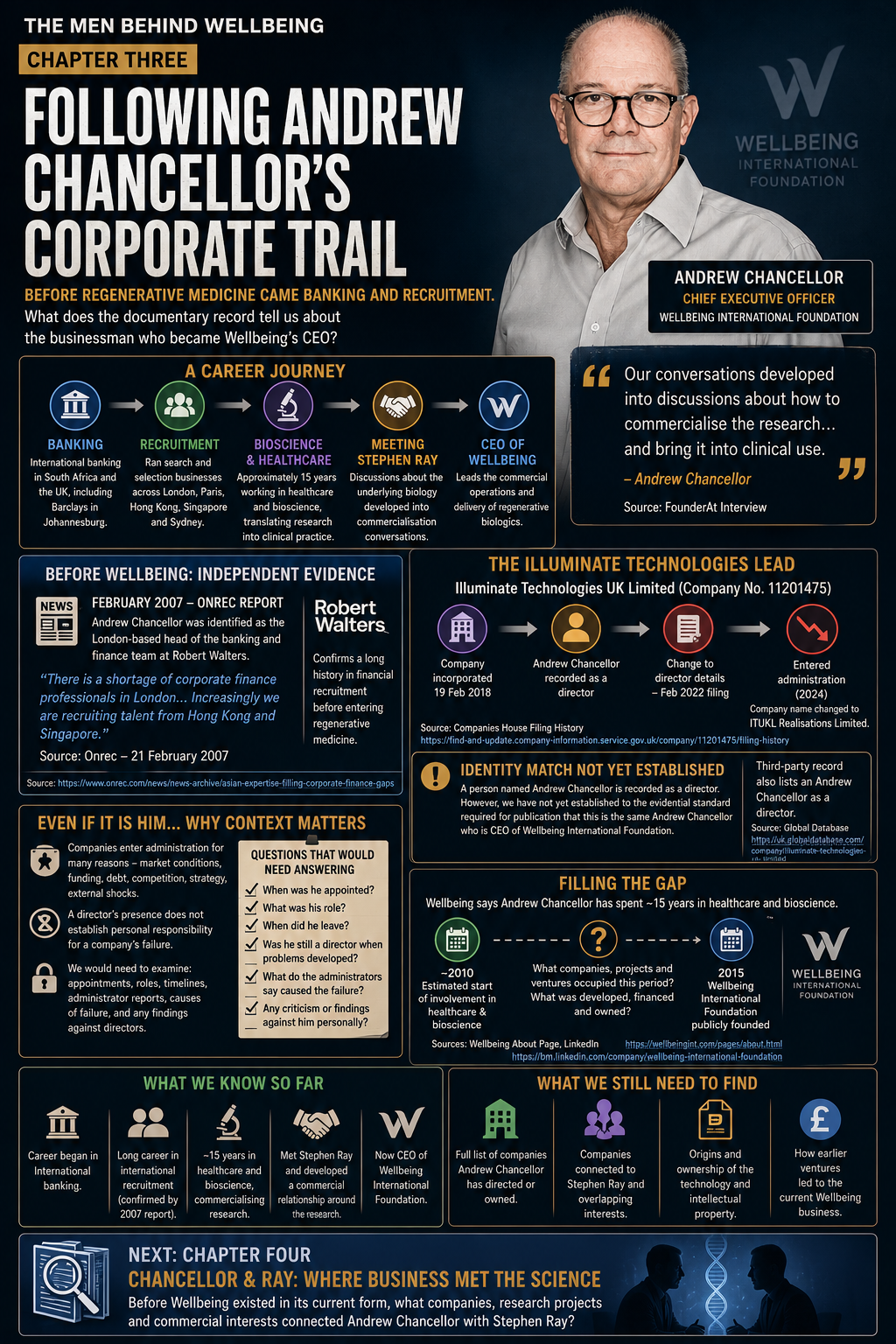
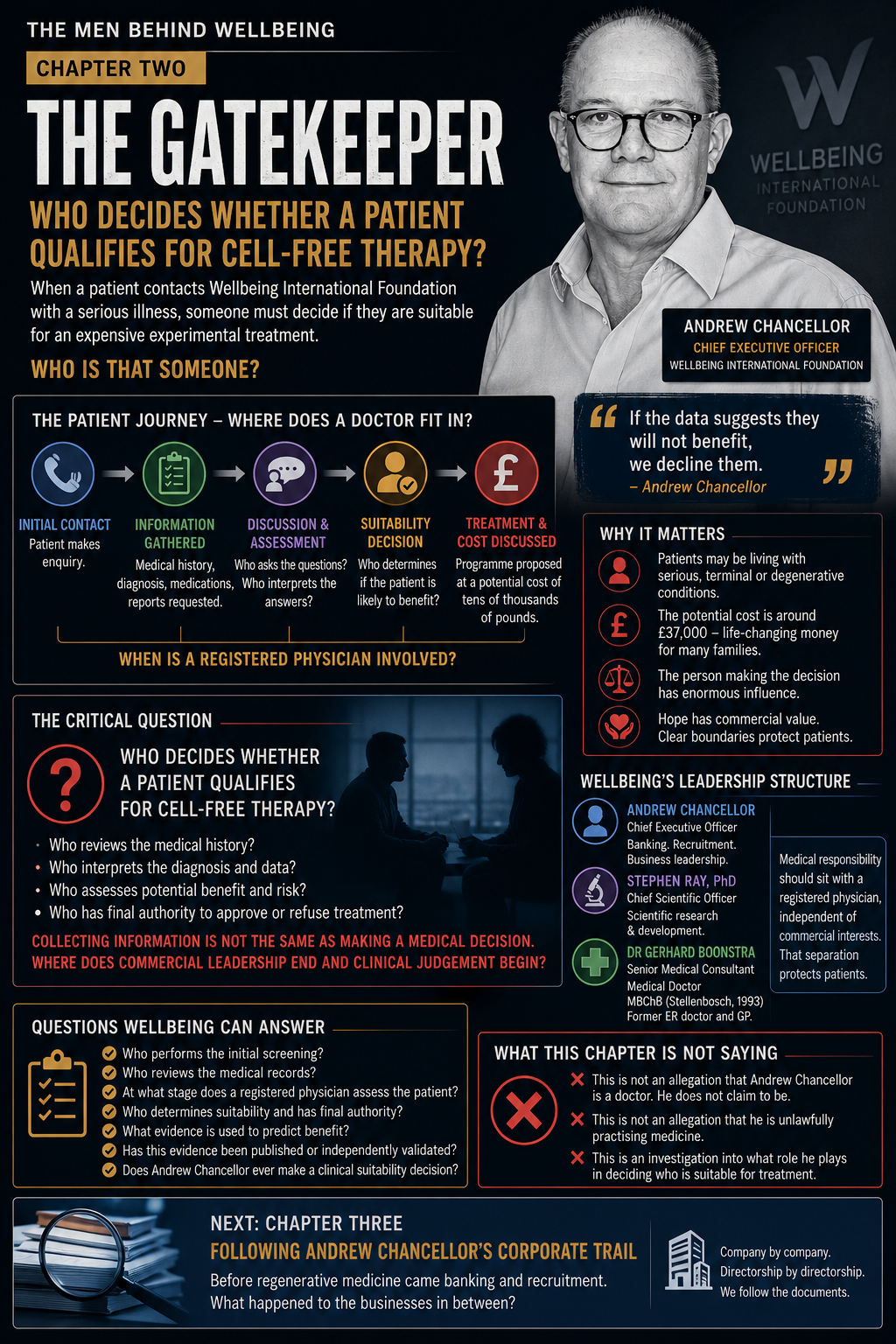
Lydac Neuroscience once sat at the centre of Stephen Ray’s microvesicle research. Andrew Chancellor later became a director. Then the company entered administration, moved into liquidation and ultimately disappeared. The failure of a biotechnology company is not, by itself, evidence of wrongdoing. But when the people and apparently related science later reappear around Wellbeing International Foundation, one question becomes unavoidable: what happened to Lydac’s intellectual property when the company failed?
Chapter Seven introduced a company that has become increasingly important to this investigation.
Lydac Neuroscience Limited.
It was incorporated in 2007.
Stephen Ray was one of its early directors.
Patent records connect Lydac directly with Ray's work involving microvesicles.
Ray subsequently left the board.
Andrew Chancellor later became a director.
Then, in December 2018, Lydac entered administration.
The company never recovered.
It moved into creditors' voluntary liquidation in 2019 and, after a lengthy winding-up process, was finally dissolved in April 2025.
On its own, that story isn't particularly remarkable.
Biotechnology companies fail.
Research programmes run out of money.
Investments don't always produce commercial products.
Patents don't always become profitable businesses.
None of those things demonstrates misconduct.
But Lydac is different for one reason.
The story appears to continue after the company disappears.
Today, Stephen Ray and Andrew Chancellor are both associated with Wellbeing International Foundation.
And Wellbeing promotes Cell-Free Therapy using a scientific narrative involving extracellular vesicles.
That is why Lydac's insolvency matters.
We need to determine what happened to the company's assets—particularly the intellectual property historically associated with Stephen Ray.
December 2018: Lydac Enters Administration
The critical date is:
17 December 2018.
Official insolvency notices record the appointment of administrators to Lydac Neuroscience Limited.
The administrators were Ian Robert and Christopher Purkiss of Kingston Smith & Partners LLP.
Lydac's business was described as:
“Research and experimental development on biotechnology.”
Its principal trading address was recorded as:
10 Harley Street, London W1G 9PF.
This is an important distinction.
Lydac wasn't simply struck from the Companies House register after being abandoned.
It entered a formal insolvency procedure.
Administrators took control of the company.
That means its financial affairs had to be examined.
Its creditors had to be identified.
Its assets had to be considered.
And for a biotechnology company, those assets potentially included something much more important than office furniture or bank balances.
Intellectual property.
The Strange Position Before Administration
The company's history immediately raises an interesting question.
Before administration, Lydac had filed dormant accounts for financial years ending in 2015, 2016 and 2017.
A dormant company is not necessarily an inactive company in every practical sense.
A company can exist primarily to hold intellectual property.
It can have very limited accounting transactions.
Research or commercial operations can potentially be conducted through other structures.
So dormant accounts are not evidence of anything improper.
But they make the subsequent administration particularly interesting.
A company reporting itself as dormant does not normally require administrators unless liabilities or financial obligations have arisen somewhere.
So what happened?
What did Lydac owe?
Who did it owe money to?
What assets remained?
And:
What value was placed on its intellectual property?
Those questions take us into the insolvency documents.
January 2019: The Statement of Affairs
On 28 January 2019, a Statement of Affairs was filed.
This is one of the documents I consider particularly important to the next stage of this investigation.
A statement of affairs provides a snapshot of an insolvent company's financial position.
Depending upon the circumstances, it can reveal:
assets;
estimated realisable values;
secured creditors;
preferential creditors;
unsecured creditors;
and the estimated deficiency facing those creditors.
But when the company concerned is a biotechnology business, there is another line we need to look for.
Patents and intellectual property.
Because we already know Lydac had a documented connection with intellectual property.
The Patent Didn't Belong to Stephen Ray Personally
This distinction becomes critical here.
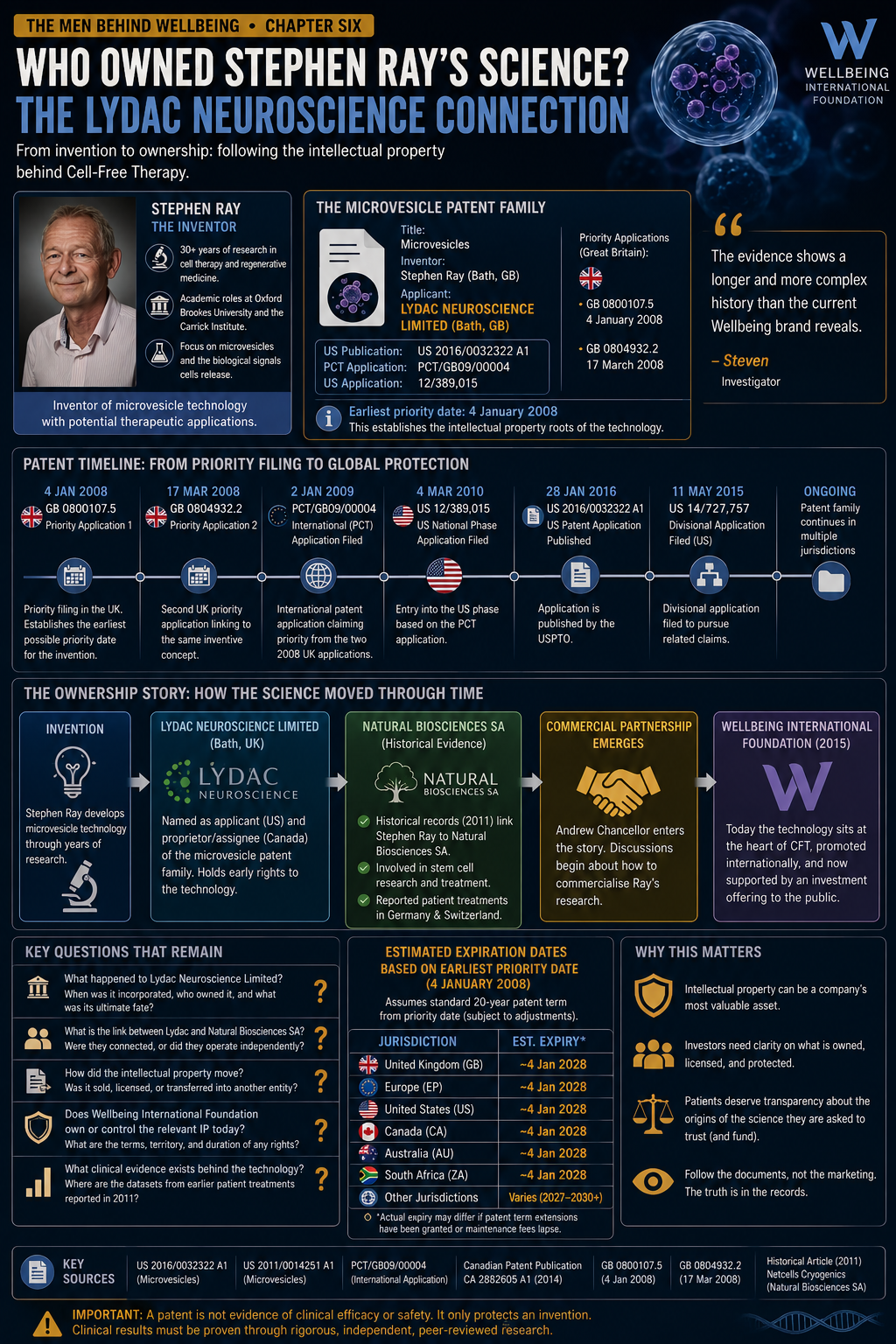
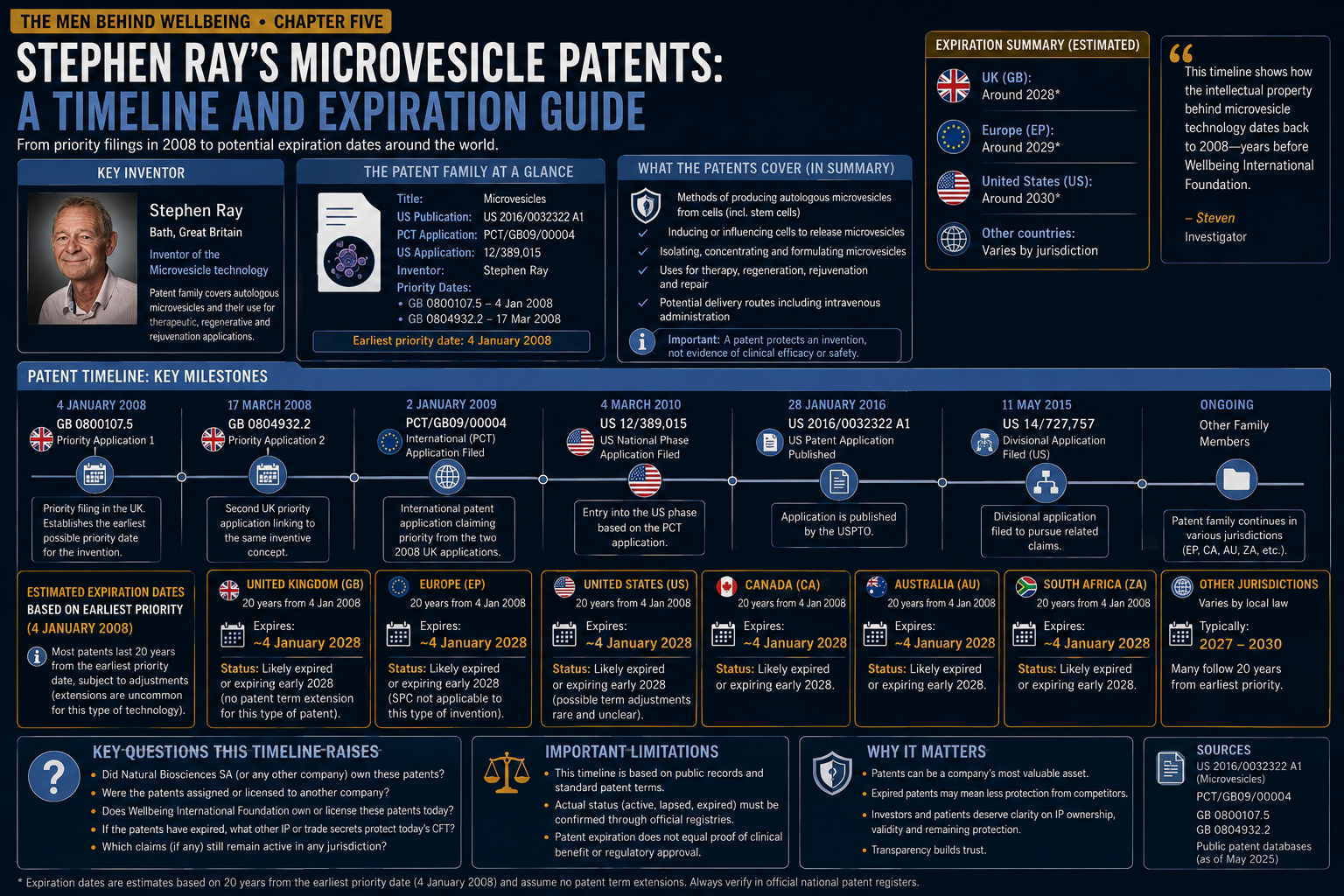
Stephen Ray is named as the inventor of the microvesicle technology we examined in earlier chapters.
But inventor and owner are not the same thing.
The international patent record for WO2009087361 — Microvesicles identifies:
Inventor: Stephen Ray
and:
Original Assignee: Lydac Neuroscience Ltd.
The corresponding European patent, EP2240189B1, similarly identifies Lydac in the ownership history.
That means the intellectual-property question cannot simply be answered by saying:
“Stephen Ray invented it, so Stephen Ray could take it somewhere else.”
Patent ownership doesn't work like that.
If rights had been assigned to a company, those rights were corporate assets unless subsequently assigned, licensed, expired, abandoned or otherwise dealt with.
And once a company becomes insolvent, that distinction becomes extremely important.
What Did the Administrators Find?
This is where we have to be disciplined.
At present, the existence of the insolvency filings is established.
But we should not pretend that filing titles alone tell us what happened to every Lydac asset.
They don't.
We need the underlying documents.
What we are looking for is very specific.
Did the administrators identify patents?
Were they given a valuation?
Were licences identified?
Was scientific know-how treated as an asset?
Were there research agreements?
Was intellectual property sold?
Was there a purchaser?
Or had the relevant intellectual property already left Lydac before administration?
Each answer would take this investigation in a different direction.
April 2019: A 31-Page Administrator's Proposal
On 9 April 2019, a much more substantial document was filed:
Statement of Administrator's Proposal.
Thirty-one pages.
This document could be central to reconstructing what happened.
Administrators are required to explain what they intend to achieve and how they propose dealing with the insolvent company's affairs.
For an investigator, this can provide something far more useful than retrospective interviews or company marketing.
It is a professional account created during the insolvency itself.
The questions for us are therefore straightforward:
What caused Lydac's financial failure?
What assets did the administrators identify?
What was recoverable?
What were creditors owed?
And what did they intend to do with any remaining intellectual property?
Then Come the Creditors
On 10 April 2019, the result of the creditors' decision process was filed.
That matters because administration is ultimately about creditors and assets.
But we need to avoid turning the existence of creditors into something it isn't.
An insolvent company having creditors does not prove that investors were deceived.
It does not prove directors behaved improperly.
It does not prove patient money was lost.
Those would require evidence.
The correct investigative approach is much simpler.
Who were the creditors?
How much were they owed?
What was the estimated deficiency?
Were any creditors connected parties?
Were directors owed money?
Were investors or lenders among them?
Were patent attorneys or scientific suppliers among them?
Those answers could help us understand what Lydac actually was commercially by the time it failed.
July 2019: The Administrators Report Back
On 19 July 2019, an Administrator's Progress Report was filed.
This is potentially even more revealing.
By then, the administrators had been in control for around seven months.
They had had time to examine records.
Investigate assets.
Deal with creditors.
And potentially attempt to realise whatever value remained.
For this investigation, one question dominates:
Had anything happened to the intellectual property?
If patents were sold, there should potentially be a purchaser.
If rights were licensed, there should potentially be an agreement.
If the intellectual property was regarded as worthless, that too may be documented.
And if Lydac no longer owned relevant rights when the administrators arrived, we then need to move backwards and establish when they left.
November 2019: Lydac Is Not Rescued
Administration did not save Lydac Neuroscience as an operating company.
On 15 November 2019, Lydac moved from administration into:
creditors' voluntary liquidation.
That tells us something important.
The company itself was not going to continue.
From this point, the objective was winding it up.
But a company disappearing and its intellectual property disappearing are two completely different things.
Intellectual Property Can Outlive the Company
This is perhaps the most important principle in this entire chapter.
Imagine a conventional business failing.
Its assets might include:
vehicles;
machinery;
property;
stock;
cash.
A biotechnology company's valuable assets can be much less visible.
They might include:
patents;
patent applications;
licences;
research data;
laboratory protocols;
manufacturing methods;
trade secrets;
and:
scientific know-how.
Those assets can survive the corporate entity that originally developed or owned them.
They can be purchased from administrators.
They can be assigned before insolvency.
They can be licensed.
They can become part of another business.
Or patents can simply lapse while the underlying scientific knowledge continues to be developed.
That is why the dissolution of Lydac doesn't end this investigation.
It actually creates the next part of it.
Lydac Remained in Liquidation for Years
Lydac's liquidation was not completed quickly.
Further liquidators' statements of receipts and payments were filed over subsequent years.
The process continued until a final winding-up return was filed in 2025.
Then:
9 April 2025 — Lydac Neuroscience Limited was dissolved.
The corporate entity was gone.
But by then, something interesting had already happened elsewhere.
Stephen Ray's science had continued.
And Andrew Chancellor's involvement in biotechnology had continued.
The Same Two Men Appear Again
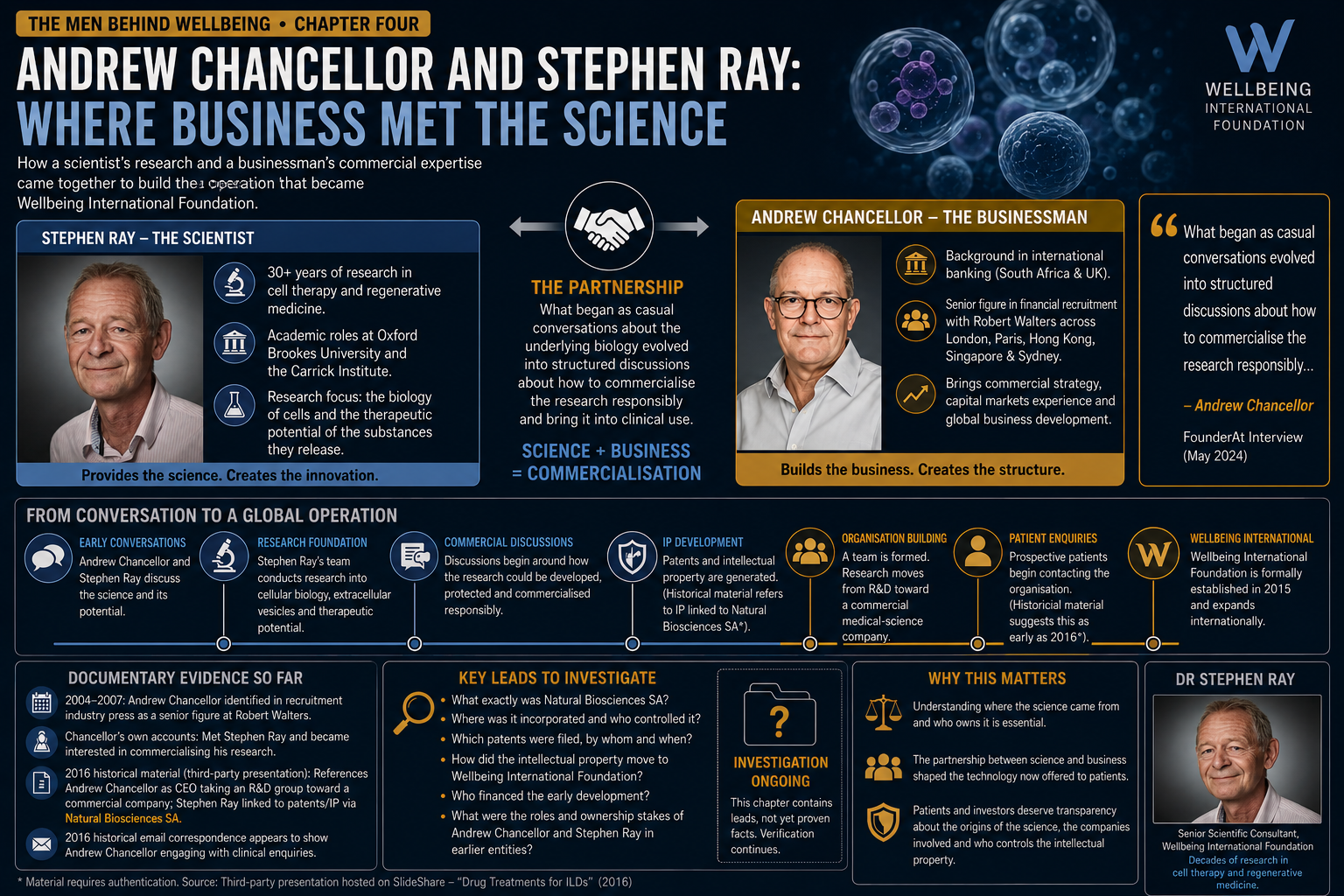
Today, Stephen Ray is presented by Wellbeing International Foundation as a senior scientific figure.
Andrew Chancellor is its Chief Executive.
That alone proves nothing about Lydac's assets.
People who worked with one company can perfectly legitimately work together again.
But when we combine the people with the science, the historical connection becomes much more relevant.
Lydac's patent history involved:
microvesicles.
Wellbeing's present Cell-Free Therapy involves:
extracellular vesicles.
Lydac's patent history involved:
Stephen Ray.
Wellbeing's scientific narrative involves:
Stephen Ray.
Lydac's later corporate history involved:
Andrew Chancellor.
Wellbeing is now led by:
Andrew Chancellor.
These are documented points of continuity.
What they do not establish is the legal connection between the technology.
And that is precisely what we need to find.
An Even More Important Date: 2017
There is another piece of the chronology that makes the insolvency particularly interesting.
Wellbeing's own account of patient Paul Cook places Stephen Ray in a cell-free treatment programme involving extracellular vesicles derived from Cook's own cells in 2017.
That date matters.
Because Lydac did not enter administration until December 2018.
So according to Wellbeing's own historical narrative, Ray-associated autologous extracellular-vesicle treatment activity was taking place while Lydac still existed.
This does not establish that the treatment used Lydac intellectual property.
It does not establish patent infringement.
It does not establish that Lydac owned the treatment.
But it does sharpen the question.
Who owned the relevant technology in 2017?
If It Was Lydac's Technology, What Was the Commercial Arrangement?
Suppose, purely for the purpose of investigation, that the 2017 treatment substantially relied upon technology covered by or derived from Lydac's intellectual property.
Then we would need to know:
Was Lydac conducting the programme?
Was the technology licensed?
Was another company authorised to use it?
Had ownership already been transferred?
Or was the process sufficiently different from the patented invention that Lydac's rights were irrelevant?
Those are all possible explanations.
But we need the evidence to distinguish between them.
If It Wasn't Lydac's Technology, That Matters Too
The alternative is equally important.
Perhaps Stephen Ray's science had moved substantially beyond the original microvesicle patents by 2017.
Perhaps CFT represented later work.
Perhaps new techniques had been developed.
Perhaps the relevant competitive advantage lay in know-how rather than patents.
If so, that would help separate Wellbeing's present technology from the old Lydac intellectual property.
That would be a significant finding.
An investigation should be equally prepared to establish separation as connection.
Andrew Chancellor's Role Must Be Treated Fairly
Andrew Chancellor was a director of Lydac when administrators were appointed.
That is relevant.
But it needs to be reported responsibly.
His position as director does not establish that he caused Lydac's insolvency.
It does not establish that he improperly transferred intellectual property.
It does not establish that he acquired company assets.
And it does not establish misconduct.
I have not established any of those things.
The legitimate question is narrower:
What happened to Lydac's assets during the period surrounding its insolvency, and did any of those assets later become connected with Wellbeing?
That is the question the documents should answer.
Stephen Ray's Position Is Different
Ray had left Lydac's board years before administration.
We should therefore not associate him with management of the company when it failed without evidence.
But Ray remains essential to the intellectual-property story because he is the named inventor.
And that creates a fascinating distinction.
The company could fail.
The patent could lapse.
But the scientist still retains his knowledge.
He knows what he discovered.
He knows how the research developed.
He may continue making further discoveries.
He may develop later techniques that are entirely outside the original patent claims.
That makes the boundary between old corporate intellectual property and new scientific know-how particularly important.
Why This Matters to Wellbeing's Investors
And now we return to the present.
Wellbeing is raising investment.
If investors are being asked to fund a biotechnology organisation whose value depends partly upon proprietary science, they need to understand what that proprietary science actually consists of.
Does Wellbeing own patents?
Does it license them?
Does another entity own them?
Does the company instead rely upon trade secrets?
Does its commercial advantage depend heavily upon Stephen Ray personally?
Who owns improvements developed during current research?
What happens if Ray leaves?
And most importantly for our historical investigation:
Did any intellectual property currently used by Wellbeing originate inside Lydac Neuroscience?
These are standard due-diligence questions.
The Insolvency Could Answer the Ownership Question
This is why Chapter Eight matters.
The Lydac insolvency records potentially provide a fixed point in the history.
December 2018.
At that moment, professional insolvency practitioners entered the company.
What did they find?
If Lydac still owned the relevant patents, we should investigate what happened to them.
If it didn't, we need to establish when ownership changed.
If the patents had no value, that matters.
If another company acquired them, that matters.
If the commercially valuable technology wasn't patented at all, that matters.
Whatever the answer, it helps reconstruct the journey from Ray's early science to the technology being promoted today.
What We Know
At this stage, the established chronology is significant.
Lydac Neuroscience was incorporated in 2007 as a biotechnology research company.
Stephen Ray was an early director.
Ray became named inventor on microvesicle intellectual property originally assigned to Lydac.
Andrew Chancellor later became a director.
Lydac subsequently entered administration in December 2018.
A Statement of Affairs was filed.
An Administrator's Proposal followed.
A Progress Report followed.
The company entered creditors' voluntary liquidation in November 2019.
And Lydac was finally dissolved in April 2025.
Those facts provide the framework.
What We Do Not Yet Know
We have not established that Wellbeing acquired Lydac's intellectual property.
We have not established that Andrew Chancellor acquired it.
We have not established that Stephen Ray reacquired it.
We have not established that any asset was improperly transferred.
We have not established that creditors were deprived of intellectual property.
And we have not established that Wellbeing's present Cell-Free Therapy is the same invention described in Lydac's historical patents.
Those distinctions matter.
But so does what remains unanswered.
Where did the intellectual property go?
The Documents That Could Resolve It
The next phase needs to combine two separate documentary trails.
First, the insolvency trail:
the Statement of Affairs;
the Administrator's Proposal;
the Administrator's Progress Reports;
the liquidators' receipts-and-payments statements;
and any asset-sale documentation.
Second, the intellectual-property trail:
the international patent records;
the European Patent Register;
USPTO assignment records;
and the corresponding records in Canada, Australia and New Zealand.
Then we place the two timelines together.
If an intellectual-property transaction occurred, that is where we should begin to see it.
Questions for Andrew Chancellor, Stephen Ray and Wellbeing
There are several straightforward questions that could shorten this investigation considerably.
What intellectual property did Lydac own when it entered administration?
Were any patents, licences, research assets or proprietary processes sold during the administration or liquidation?
Who acquired them?
Did Andrew Chancellor, Stephen Ray, Wellbeing International Foundation or any connected organisation subsequently acquire or license any Lydac intellectual property?
Was the Cell-Free Therapy programme described by Wellbeing in 2017 technically connected to Lydac's microvesicle technology?
And if not:
When and where was the distinct CFT technology developed?
There may be perfectly ordinary answers.
We would welcome them.
Conclusion: The Company Failed. The Question Survived.
Lydac Neuroscience disappeared in April 2025.
But the story surrounding its science did not disappear with it.
Stephen Ray remains involved in extracellular-vesicle-related regenerative medicine.
Andrew Chancellor now leads Wellbeing International Foundation.
And Wellbeing promotes a Cell-Free Therapy that raises legitimate questions about its scientific lineage.
That does not establish wrongdoing.
It establishes something more useful:
a trail worth following.
Because companies disappear.
Patents expire.
Brands change.
Directors move.
Scientists continue their work.
But intellectual-property ownership leaves records.
And if the science now being promoted through Wellbeing genuinely evolved from technology once assigned to Lydac Neuroscience, somewhere between those two organisations there should be an explanation.
A sale.
An assignment.
A licence.
A new invention.
Or a clear technical break between the old science and the new.
Until we establish which one occurred, the collapse of Lydac leaves behind one asset we still cannot account for:
the scientific and legal bridge to what came next.
Next: Chapter Nine — The Missing Asset: Does Wellbeing Actually Own the Science Behind Cell-Free Therapy?
The company disappeared, but apparently related science continued. In Chapter Nine, we return directly to Wellbeing International Foundation and compare its present Cell-Free Therapy with Stephen Ray's earlier microvesicle work. Then we ask the question that matters to patients and investors alike: what does Wellbeing actually own?
Recent Posts