$48,000 Upfront: Following the Money Behind Wellbeing International Foundation
THE WELLBEING INVESTMENT FILES — CHAPTER THREE
An investigation into treatment payments, historical patient claims, private fundraising and the financial records investors need to see
On 3 March 2021, an email arrived from Andrew Chancellor, the chief executive associated with Wellbeing International Foundation.
It was addressed to someone he believed was a prospective American patient.
The email described an advanced biological treatment, the collection of blood, specialist laboratory processing and two intravenous infusions.
It also contained a price.
$48,000.
And, importantly, it explained when the money was expected.
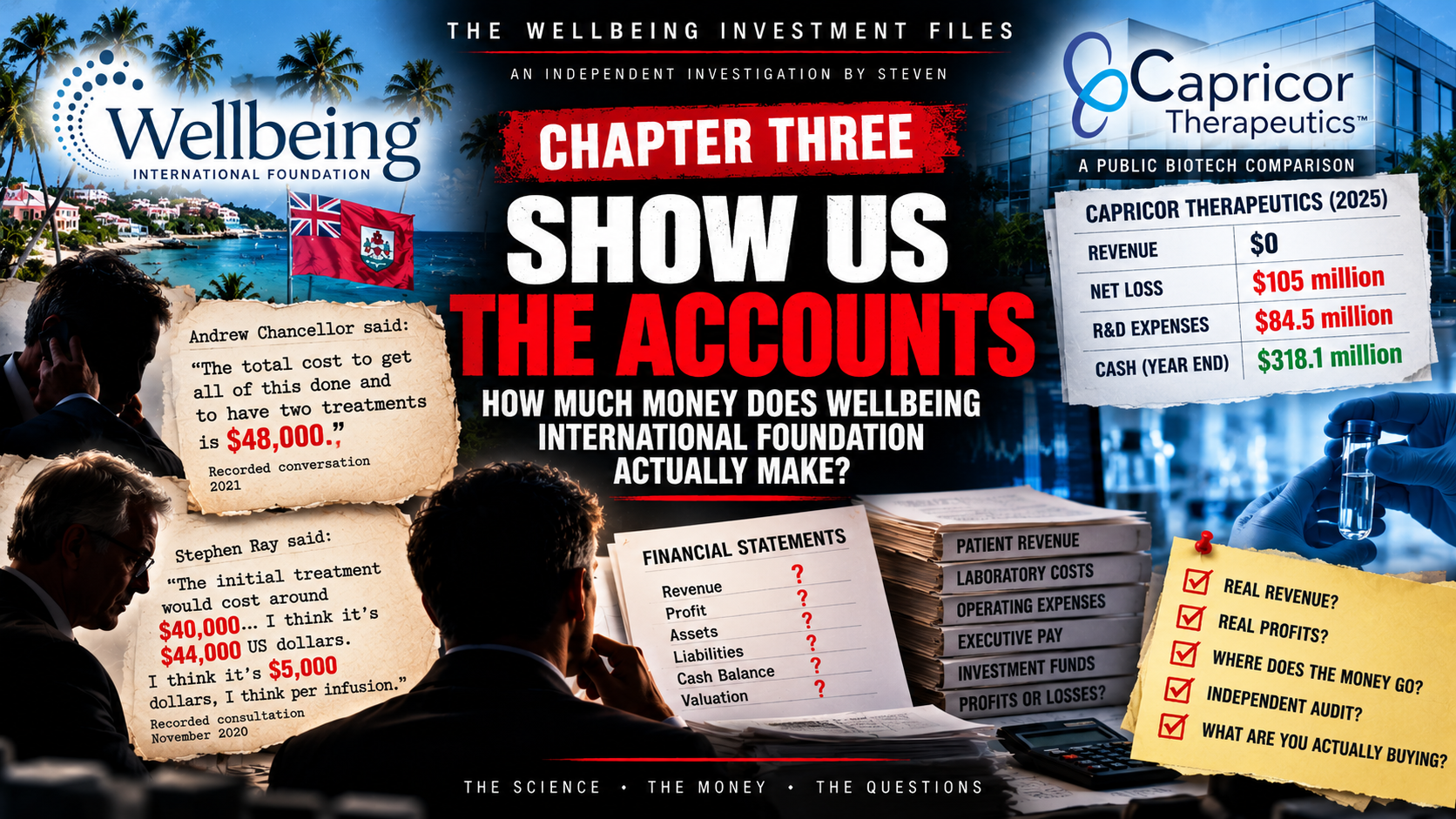
"The cost of the treatment is US$48,000 and is paid in advance of the blood draw."
This was not a figure reconstructed from a sales presentation.
It was a written quotation obtained during an undercover investigation.
The email also stated that further treatment infusions would cost $5,000 each.
For someone considering treatment, these were substantial sums.
But five years later, the same historical correspondence raises an entirely different question.
Wellbeing International Foundation has announced a new private investment round.
It describes patient revenue as one of the sources that historically supported its operations.
Yet the public information examined for this investigation does not establish how much money the organisation earned from its treatment programme, how much it spent or whether the business has been profitable.
The difference between charging $48,000 and making a profit from $48,000 is fundamental.
And for anyone considering investing their life savings, it could be the difference between buying into a sustainable business and financing one that remains dependent upon outside capital.
The Email That Put the Price in Writing
The March 2021 correspondence followed a telephone conversation between Chancellor and the prospective patient.
The caller had enquired about treatment following a serious injury.
Chancellor described a process involving medical assessment, blood collection, laboratory processing in Europe and subsequent administration of the biological preparation.
The email set out the proposed arrangements.
It described a blood draw, transportation to the laboratory and several weeks of processing before the first infusion.
A second infusion would follow later, depending upon the treatment plan.
The quoted $48,000 included consultations during the first year, preparatory assessments, diagnostic testing, laboratory work, biological-material banking and two infusions.
The email also established the payment condition.
The full amount was to be paid before the blood was collected.
That detail is significant.
It shows that the proposed commercial arrangement required substantial payment before the principal treatment process began.
The correspondence does not establish that the prospective patient actually transferred the money.
It does not establish that the treatment was performed.
But it does establish the price and payment terms being offered by Wellbeing's chief executive at that time.
This is more substantial evidence than a general recollection of what someone may have said.
It is a written commercial proposal.
The Follow-Up: Payment Documentation
The undercover correspondence did not end with the initial quotation.
During the following weeks, further communications took place concerning treatment arrangements.
On 6 April 2021, the prospective patient received an email containing several attachments.
Among them was a wire-transfer form.
The correspondence also included treatment consent and preclinical assessment documentation.
This provides another important piece of the historical commercial picture.
The discussions had progressed beyond an initial enquiry.
The organisation had supplied documents associated with payment and preparation for treatment.
But there is a distinction we must preserve.
A wire-transfer form is not proof that a bank transfer took place.
It is not a bank statement.
It is not a receipt.
And it is not evidence that the company ultimately recognised $48,000 in revenue.
The undercover material establishes the proposed transaction and the steps taken towards arranging it.
It does not establish a completed sale.
That is precisely why we need to examine the financial records.
The Question Behind the $48,000
Imagine a business charging $48,000 for a specialist medical service.
A prospective investor might reasonably assume that a relatively small number of patients could generate substantial annual revenue.
Ten treatments at that price would represent $480,000 in gross charges.
Fifty would represent $2.4 million.
One hundred would represent $4.8 million.
These figures are straightforward arithmetic.
They are not evidence of Wellbeing's actual sales.
They assume that every treatment was charged at the same price and that the money was collected.
But they illustrate why a high-value treatment programme can sound commercially attractive.
The critical question is what happens to the money after payment.
How much is retained by the organisation coordinating the programme?
How much is paid to medical practitioners?
How much goes to the German laboratory?
What are the costs of biological processing, testing, transportation and storage?
What are the company's administrative expenses?
And how much remains after those costs?
A business can generate substantial gross sales while producing very little profit.
It can even lose money.
Without accounts, the treatment price alone cannot tell us which situation applies.
The Historical Claim of Hundreds of Patients
The $48,000 quotation becomes more interesting when considered alongside another statement obtained during the undercover investigation.
In a recorded London consultation in November 2020, Stephen Ray discussed the organisation's treatment history.
He referred to more than 600 patients over approximately ten years.
During that consultation, he also made claims concerning the treatment's safety and patient experience.
Those were statements made by Ray.
They were not independently audited patient statistics.
The recordings do not establish how many individuals paid for treatment.
Nor do they establish whether all patients received the same service or paid comparable amounts.
But the claimed patient numbers raise an obvious commercial question.
If hundreds of patients had received an expensive treatment programme, what financial results had the organisation produced?
Historical investigators considered that issue and calculated that 600 treatments at approximately $44,000 would represent $26.4 million.
That calculation appeared in the earlier investigative material.
However, it was an estimate based upon representations about patient numbers and pricing.
It was not a figure taken from audited company accounts.
It would therefore be wrong to present $26.4 million as established historical revenue.
The correct question is more important.
If the organisation treated the number of patients described, what do its financial records show about the income generated?
Where Would the Money Have Gone?
Wellbeing's historical treatment process involved several distinct activities.
A patient would undergo medical assessment.
Blood would be collected.
The biological material would be transported to a specialist laboratory.
The laboratory would perform processing.
The resulting preparation would be returned for administration.
Further consultations and treatment could follow.
Each stage potentially involved costs.
And some of those services were associated with separate medical or laboratory providers.
Our earlier investigation documented a recorded meeting in January 2021 involving Chancellor and a representative of the German laboratory.
During that discussion, the laboratory was described as a separately operated business carrying out Wellbeing's protocols.
That historical arrangement matters to the financial investigation.
If the laboratory was independently operated, payments associated with laboratory processing may have represented an expense to Wellbeing or may have been handled through another commercial arrangement.
Similarly, medical practitioners administering treatment may have received fees.
The full amount charged to the patient would not necessarily have been retained by the organisation raising investment.
An investor therefore needs more than a headline treatment price.
They need to understand the revenue model.
Who Actually Invoiced the Patient?
This is one of the questions that could reveal the financial structure of the business.
A treatment programme involving several countries and independent providers may have more than one commercial entity.
One organisation may coordinate the patient.
Another may process the biological material.
A medical practice may administer the treatment.
And a separate company may hold the intellectual-property rights.
The financial arrangements between those businesses determine how revenue and profit are distributed.
An investor should establish which entity issued the treatment invoices.
Which company received payment?
Which company paid the laboratory?
Which company was responsible for clinical costs?
And which company ultimately recorded the income?
These distinctions become particularly important when a business is seeking private investment.
A prospective shareholder needs to know whether the company issuing shares is the same company that receives the treatment revenue.
If not, the contractual arrangements connecting those businesses must be examined.
The existence of commercial activity somewhere within an international network does not automatically establish revenue for every company associated with that network.
The Financial Picture Investors Cannot Establish From the Announcement
In March 2026, Wellbeing announced that the opening tranche of its new private capital round had closed.
The announcement described plans involving scientific documentation, clinical relationships and operational development.
It also referred to historical funding from patient revenue, private investment and selective philanthropic engagement.
But the public statement did not disclose the company's annual revenue.
It did not identify its current profitability.
It did not provide a balance sheet.
It did not state how much cash the investment entity held.
It did not disclose the amount raised in the opening tranche.
And it did not publish the valuation used for the investment.
Wellbeing stated that specific financial details were handled privately through its legal and finance team.
That distinction matters.
A private company is not necessarily required to publish the same information as a publicly listed business.
The absence of public financial statements does not prove that accounts do not exist.
Nor does it prove that prospective investors have not received financial documents privately.
But it does mean that an ordinary member of the public cannot establish the financial merits of the offering from the fundraising announcement alone.
For someone considering investment, the missing public figures must be replaced by verified private documentation.
Patient Revenue and Investor Capital Are Different Things
A company can obtain money in several ways.
It can earn revenue by selling products or services.
It can borrow money.
It can issue shares to investors.
It can receive grants or donations.
Each source of funds has different financial implications.
Revenue from commercial operations may indicate customer demand.
But it does not automatically establish profitability.
Borrowed money creates repayment obligations.
Investment capital can strengthen the company's cash position but may dilute existing shareholders.
Donations or philanthropic support may not create repayment obligations, depending upon their terms.
These categories should not be confused.
If a company raises $5 million in investment, that does not mean it has earned $5 million from customers.
If it receives $5 million in patient payments, that does not mean it has made $5 million in profit.
And if it holds $5 million in cash, that does not necessarily mean it has sufficient funds to complete its scientific development programme.
A proper financial review must distinguish the sources and uses of funds.
That is particularly important in biotechnology, where research and development can consume substantial amounts of capital.
A Public Biotechnology Company That Shows Investors the Numbers
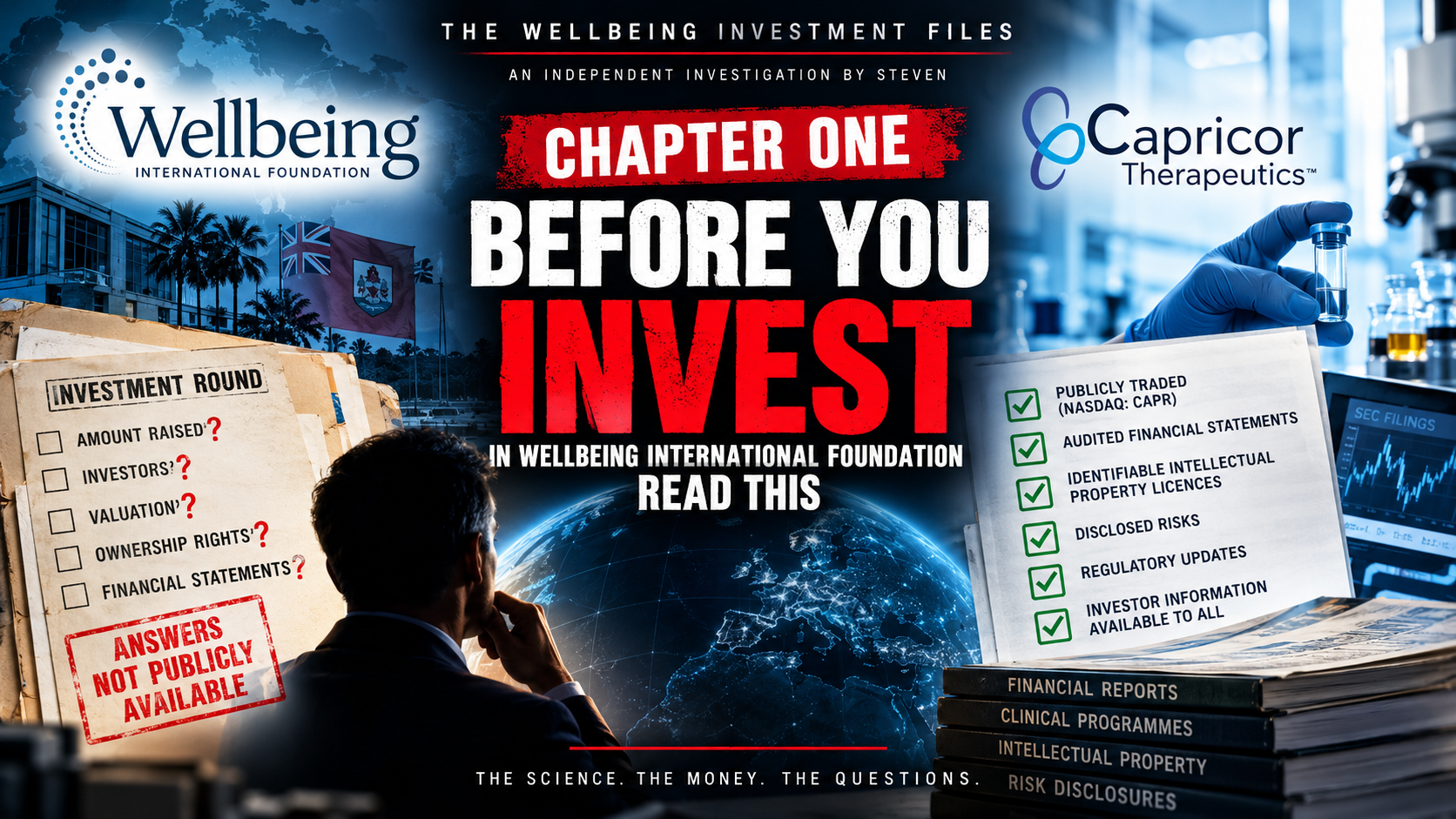
For comparison, we examined Capricor Therapeutics.
Capricor is a Nasdaq-listed American biotechnology company developing cell-based therapies and engineered exosome technology.
Its activities are not identical to Wellbeing's.
The two businesses operate under different corporate and regulatory circumstances.
But Capricor provides a useful example of financial disclosure in a scientific industry where commercial outcomes can be uncertain.
Its annual report for the year ending 31 December 2025 is publicly available through the United States Securities and Exchange Commission.
The figures are revealing.
Capricor reported no revenue during 2025.
It spent approximately $84.5 million on research and development.
It recorded a net loss of approximately $105 million.
At the end of the year, it held approximately $318.1 million in cash, cash equivalents and marketable securities.
These figures demonstrate that a biotechnology company can have substantial scientific operations and financial resources while remaining loss-making.
Capricor's report also identifies the risks associated with its development programmes and the possibility of needing further capital.
The company is not presented here as a safe investment or a recommended share purchase.
Its shares can lose value, its programmes can encounter setbacks and investors can suffer losses.
The important point is that investors can examine the financial evidence.
They can see the company's spending.
They can assess its cash resources.
They can examine its liabilities.
And they can consider the risks associated with future development.
Transparency does not make biotechnology investment safe. It makes the financial risks more visible.
The Difference Between a Medical Business and a Research Business
There is another important distinction.
Some biotechnology companies are primarily research organisations.
They spend money developing products that may not yet generate commercial revenue.
Other businesses provide existing medical services while also conducting research.
Wellbeing's historical treatment quotations indicate that it was commercially offering a treatment programme years before the 2026 fundraising announcement.
That raises questions about the relationship between its treatment activity and its scientific development.
How much revenue came from patients?
How much was spent on research?
Was the treatment business profitable?
Did patient revenue finance scientific work?
Or did the organisation remain dependent upon private investment to fund its operations?
The answers could materially affect how the company should be valued.
A business with stable, profitable service revenue presents a different financial profile from one dependent upon external funding.
Both may have legitimate commercial strategies.
But they carry different risks.
And an investor should not be expected to guess which situation applies.
The Cost of Scientific Development
Biotechnology research can be expensive.
Laboratory work requires specialist personnel and equipment.
Clinical studies require planning, documentation and professional oversight.
Regulatory processes can be lengthy.
Scientific results may require replication.
And promising early findings do not guarantee that a treatment will prove effective in larger controlled studies.
Wellbeing has published research associated with its treatment programme, including a 2026 peer-reviewed pilot study.
That study provides material for scientific examination.
But publication does not, by itself, establish the company's commercial value.
A scientific paper is not a financial statement.
It does not establish the company's cash balance.
It does not show whether the organisation is profitable.
And it does not determine what investors should pay for its shares.
The relationship between scientific progress and financial value must be examined separately.
What About the Company's Valuation?
Suppose an investor is offered shares in a private biotechnology company.
The company may describe its technology as commercially promising.
It may highlight historical treatment experience.
It may refer to scientific publications and international partnerships.
But how is the share price calculated?
Does the valuation reflect current revenue?
Does it reflect profits?
Does it rely upon projected future sales?
Does it assign substantial value to patents or intellectual-property licences?
Does it assume that the treatment will achieve wider clinical acceptance?
And how much additional capital will be required before those projections become realistic?
These questions are central to the investment decision.
A company can have a promising scientific programme and still be overpriced.
It can generate revenue and still carry excessive liabilities.
And it can raise capital at a valuation that later proves impossible to justify.
The investment price must be examined independently of the enthusiasm surrounding the technology.
Wellbeing's public March 2026 announcement did not disclose the valuation used in its fundraising round.
We therefore cannot independently assess that valuation from the announcement.
That does not establish that the valuation is unreasonable.
It establishes that the necessary information must be obtained before reaching a conclusion.
Where Is the Evidence of Profit?
The historical undercover material gives us evidence of treatment prices.
It gives us evidence of payment terms.
It includes statements about patient numbers.
And it documents commercial arrangements associated with the treatment programme.
But none of those materials establishes the company's actual profit.
Profit requires revenue to be measured against costs.
Those costs may include laboratory services, medical fees, administration, insurance, marketing, research and management expenditure.
There may also be debts, contractual liabilities and other financial obligations.
Without the relevant accounts, we cannot determine whether Wellbeing's commercial activities generated profits or losses.
Nor can we determine how much of the company's historical income was retained for future development.
For investors, this is not a minor omission from the public picture.
It is one of the most important financial questions.
Executive Payments and Related Businesses
A thorough financial review should also examine how money moves between the company and the people or businesses associated with it.
Directors and executives may receive salaries.
Consultants may be paid fees.
Laboratories may invoice for specialist services.
Companies under common ownership may enter into commercial agreements.
These arrangements can be entirely legitimate.
But investors need to understand material transactions that could affect the company's financial position.
How much is spent on management?
What are the principal operating costs?
Are there loans involving directors or shareholders?
Are significant payments made to related businesses?
Who approves those transactions?
And what controls exist to protect the interests of minority shareholders?
We have not established improper payments by Wellbeing or its leadership.
We have not obtained evidence supporting an allegation of financial misconduct.
But the absence of such a finding does not remove the need for due diligence.
These are normal questions to ask before investing in a privately held company.
The Risks of Investing Without Accounts
Private biotechnology investments can be difficult to evaluate.
They can also be difficult to sell.
An investor may purchase shares in a company that has no public market.
There may be restrictions on transferring those shares.
Future fundraising may dilute existing shareholders.
And if the company fails, investors may recover little or nothing.
These risks exist even when the organisation is genuine and its management acts in good faith.
The problem becomes more serious when investors do not understand the company's financial position before committing money.
Someone investing retirement savings may assume that years of commercial activity have created a profitable business.
They may believe that high treatment prices indicate strong margins.
They may interpret a successful fundraising announcement as evidence of financial stability.
But those assumptions cannot replace the accounts.
A company may be scientifically ambitious and financially vulnerable at the same time.
That is not unusual in biotechnology.
It is one of the reasons investors must be particularly careful.
What We Would Ask Wellbeing to Provide
Before considering an investment, we would want to examine the financial statements of the precise legal entity issuing the securities.
Those records should establish revenue, expenditure, assets, liabilities and cash flow.
We would want to understand the income generated from patient treatments and the costs associated with delivering them.
We would examine the amount spent on scientific development.
We would seek information about significant management and consultancy expenditure.
We would review material debts and contractual commitments.
We would examine the proposed use of the new investment capital.
And we would want to understand how the company's valuation had been calculated.
Where independently audited accounts exist, those would be particularly valuable.
Where financial projections are provided, their assumptions should be tested.
The investor should also establish whether the business expects to require further capital and what that could mean for existing shareholders.
These documents can be supplied confidentially.
They do not all have to appear on a public website.
But investors should have sufficient information to make an informed decision.
What Our Investigation Has Actually Established
The historical evidence examined for this chapter supports several specific findings.
In March 2021, Andrew Chancellor provided a written quotation of $48,000 for a treatment programme involving two infusions.
The correspondence specified payment in advance of the blood draw.
Additional infusions were priced at $5,000.
Subsequent correspondence included a wire-transfer form and treatment-related documentation.
Earlier recorded statements referred to hundreds of historical patients.
These facts establish how the programme was being presented commercially at that time.
They do not establish that the undercover patient paid.
They do not establish the company's actual historical revenue.
They do not prove that the quoted prices were charged to every patient.
And they do not establish profitability.
Separately, Wellbeing publicly announced a private fundraising milestone in March 2026.
The announcement did not disclose the amount raised or the valuation applied.
The organisation stated that detailed financial information was handled privately.
We have not examined those private investor documents.
We therefore cannot conclude that they are absent or inadequate.
But the publicly available information does not allow us to establish the company's financial position independently.
That is the present limit of the evidence.
Why This Investigation Matters
For someone investing a modest amount of speculative capital, the loss of an investment may be disappointing.
For someone investing their retirement savings, the consequences can be much more serious.
A private biotechnology investment may remain illiquid for years.
The company may need repeated fundraising.
Scientific development may take longer than expected.
Commercial revenue may fail to cover operating costs.
And the investment may ultimately become worthless.
Those are risks that should be understood before money changes hands.
The fact that an organisation has been active for many years does not guarantee financial stability.
The fact that representatives have quoted substantial treatment prices does not establish profitability.
And the fact that a fundraising round has attracted capital does not prove that the investment is appropriately valued.
The only responsible approach is to examine the evidence.
Our Conclusion: The Price Is Known. The Profit Is Not.
The most revealing document in this chapter is not a scientific publication.
It is a commercial email.
A written quotation for $48,000, payable before treatment began.
That document shows how Wellbeing's treatment programme was being offered to a prospective customer in March 2021.
It is supported by subsequent payment-related correspondence.
It is evidence of a proposed commercial transaction.
But it does not tell us how much money the company actually received.
It does not tell us how much the laboratory was paid.
It does not tell us what the business earned after expenses.
And it does not tell us what financial value a shareholder would acquire through the 2026 investment round.
Those questions require financial records.
Until the relevant documents have been examined, the investment proposition cannot be properly assessed from public statements alone.
This is not a finding that Wellbeing is fraudulent.
It is not a finding that the organisation is insolvent.
And it is not a claim that its treatment revenue has been misused.
It is a warning about the difference between a commercially attractive story and a financially verified business.
A $48,000 treatment quotation is not $48,000 in profit.
A claimed history of hundreds of patients is not an audited revenue statement.
And a successful fundraising announcement is not proof that investors will make money.
Before committing capital, investors should establish what the company has earned, what it has spent, what it owes and how much further funding it may require.
Because once the investment has been made, the opportunity to ask those questions may come too late.
Show the revenue. Show the costs. Show the liabilities. Show the accounts.
Only then can an investor begin to decide whether the opportunity is worth the risk.
NEXT INVESTIGATION — CHAPTER FOUR
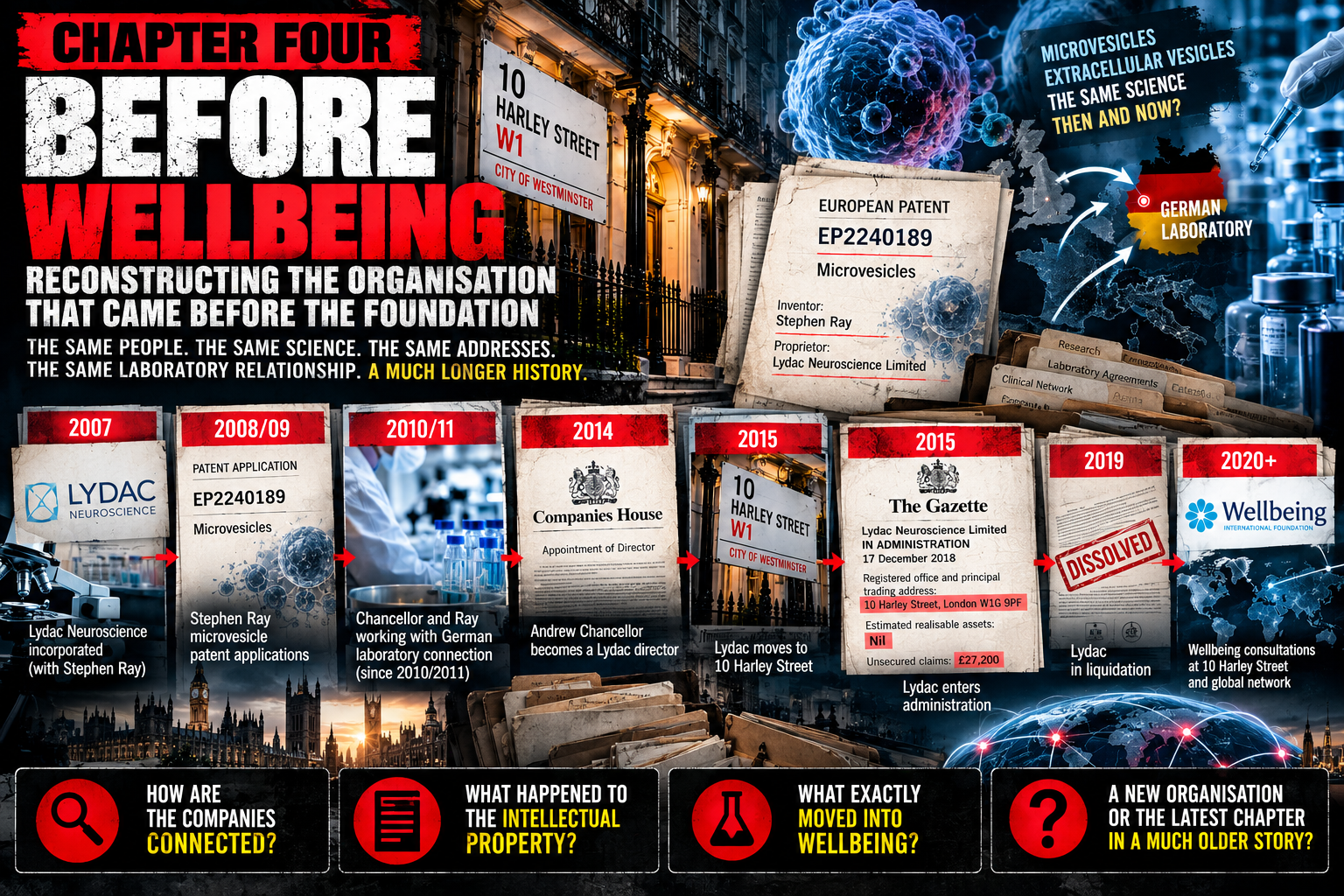
Who Owns the Science? Inside Wellbeing's German Laboratory and Intellectual-Property Claims
We examine the historical relationship between Wellbeing and its German laboratory, the development of its treatment protocols and the legal rights that could underpin the company's valuation.
We will revisit the recorded January 2021 laboratory meeting and compare the statements made with the documentary evidence available today.
Because access to scientific expertise is not the same as ownership of valuable technology.
And investors need to know precisely what belongs to the company in which they are purchasing shares.
Public sources and further reading
- Wellbeing International Foundation — March 2026 Fundraising Announcement
- Wellbeing — Treatment Process
- Wellbeing — Research Library
- Capricor Therapeutics — SEC Filings
- US SEC — Investor Information on Private Placements
Editorial note: The March 2021 quotation and subsequent correspondence were obtained during historical undercover investigative work. The quotation, payment terms and associated documents establish what was proposed to a prospective patient, not that payment or treatment occurred. Historical patient numbers and projected revenue figures have not been independently verified against company accounts. The article makes no allegation of proven fraud or financial misconduct. The Capricor comparison concerns financial transparency and recognises the different reporting requirements applying to publicly traded and private businesses.
Recent Posts