The Biotechnology Investment That Raises More Questions Than Answers
THE WELLBEING INVESTMENT FILES — CHAPTER ONE
Inside Wellbeing International Foundation's fundraising announcement, its historical treatment claims and the financial evidence every investor should demand
There is something particularly powerful about an investment opportunity promising to participate in the future of medicine.
It offers more than the possibility of financial returns.
It offers the chance to be involved in a scientific breakthrough, perhaps even a technology capable of changing lives.
For investors approaching retirement, people with substantial savings or those seeking an opportunity outside conventional financial markets, the proposition can be enormously attractive.
But scientific ambition and financial security are two entirely different things.
And when a biotechnology organisation begins raising private investment, there is one question that should overshadow every presentation, testimonial and scientific explanation.
Where is the independently verifiable evidence that the business is worth what investors are being asked to pay?
That question lies at the centre of our investigation into Wellbeing International Foundation.
The organisation promotes a biological intervention known as Cell-Free Therapy, or CFT, involving extracellular vesicles and other biological signalling components.
It describes international clinical relationships, specialist laboratory processing in Germany and a scientific programme developed over many years.
It also announced in March 2026 that it had completed the first tranche of a new private investment round.
The announcement suggested progress.
But it left some important financial questions unanswered in the public record.
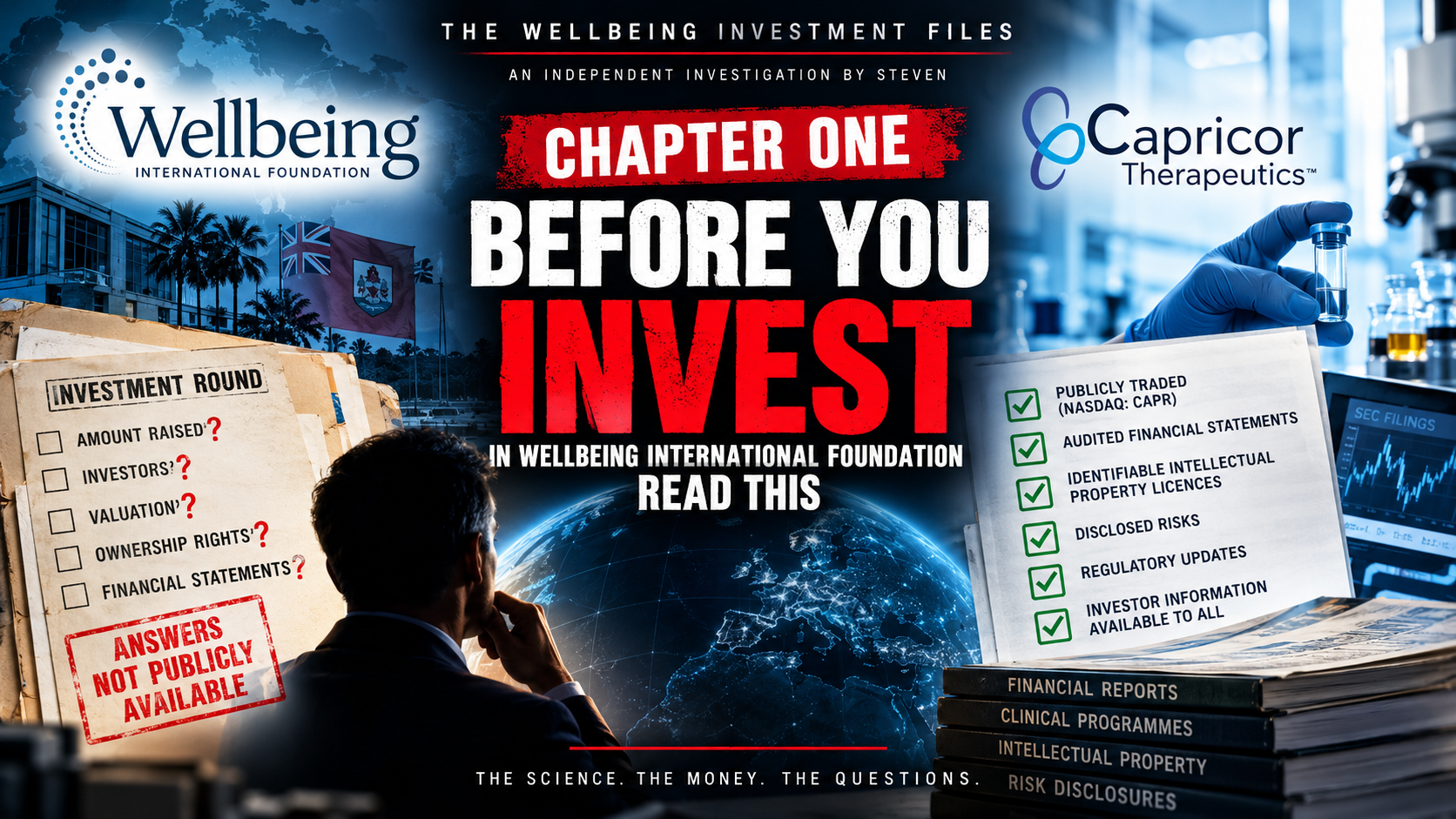
How much money had been raised?
What was the company's valuation?
Who had invested?
What ownership rights had been issued?
And what evidence could an ordinary prospective investor examine before deciding whether the opportunity was financially sound?
These are not hostile questions.
They are the questions upon which responsible investment decisions depend.
The Recorded Conversations That Started Our Questions
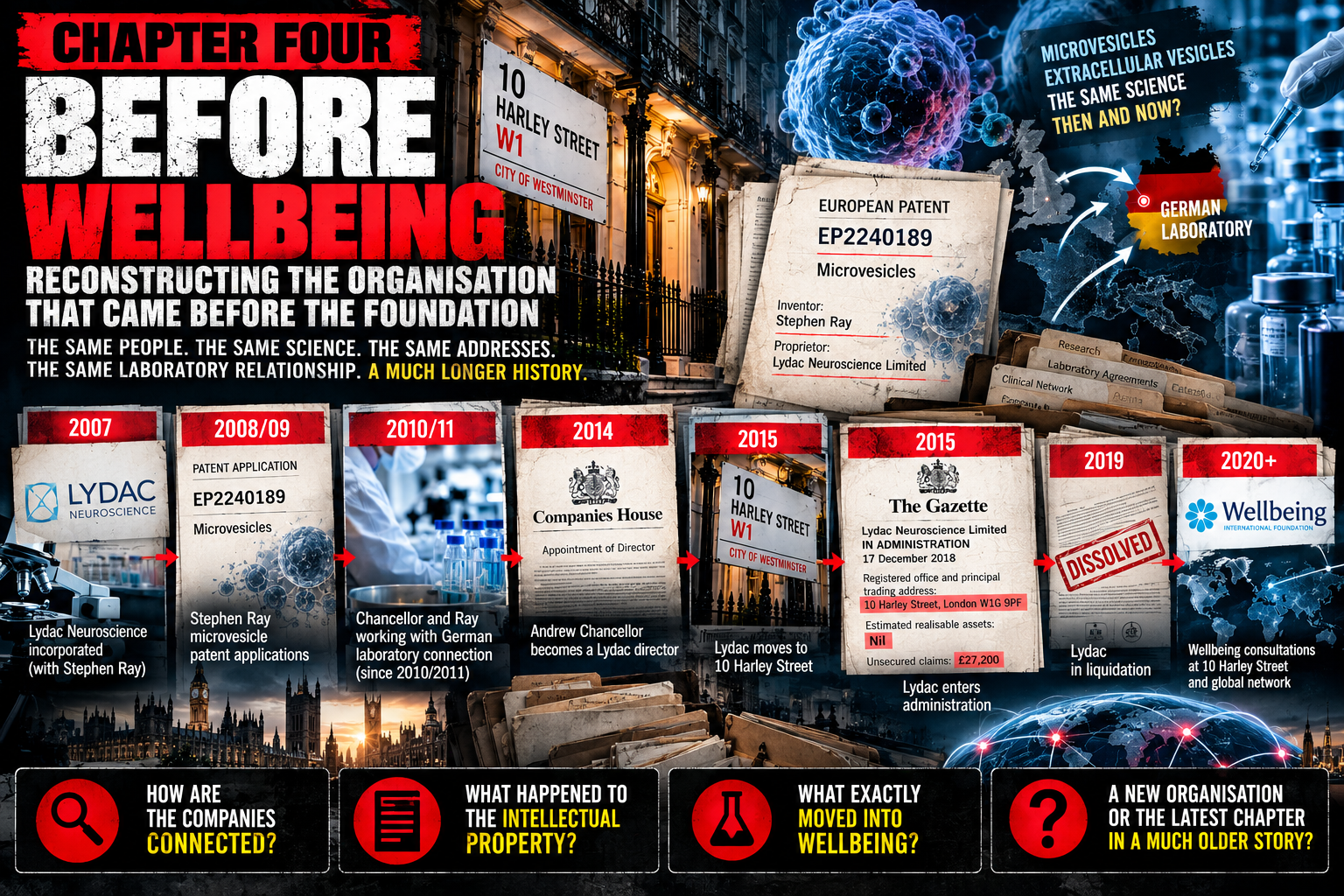
Our investigation into Wellbeing did not begin with its 2026 fundraising announcement.
Years earlier, undercover enquiries had obtained direct statements from individuals associated with the organisation.
The conversations concerned its medical programme, its commercial arrangements and the prices being quoted to prospective patients.
One particularly revealing exchange occurred during a consultation in London in November 2020.
The prospective patient asked about the cost of treatment.
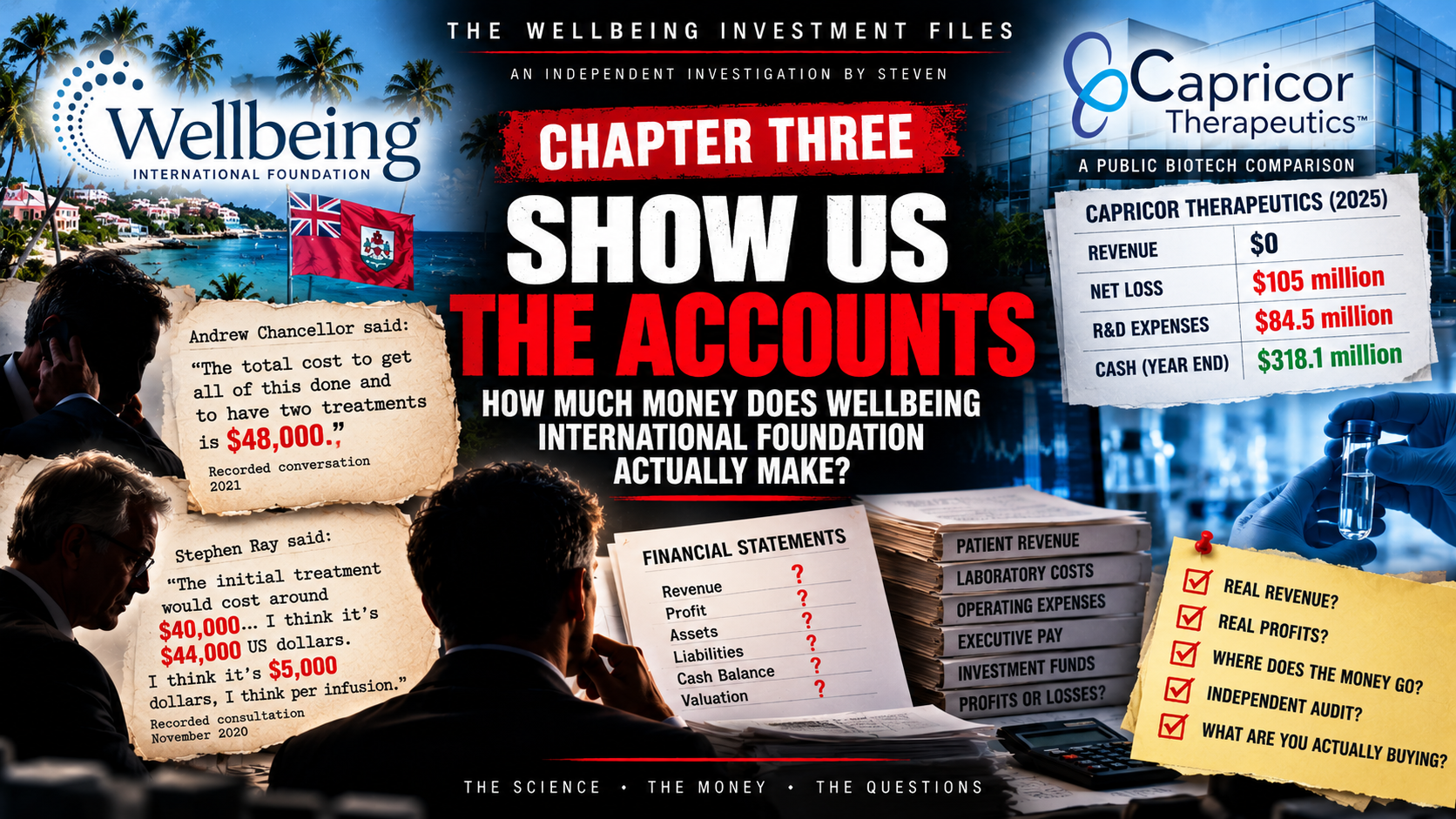
Stephen Ray, discussing the proposed programme, indicated that the initial process would cost approximately $40,000.
Another representative suggested around £33,000, equivalent at the time to approximately $44,000.
Ray subsequently said:
"I think it's ($) 44,000 US dollars."
Additional infusions, he explained, might cost around $5,000 each.
These were not hypothetical figures invented by our investigation.
They were recorded statements made during a consultation.
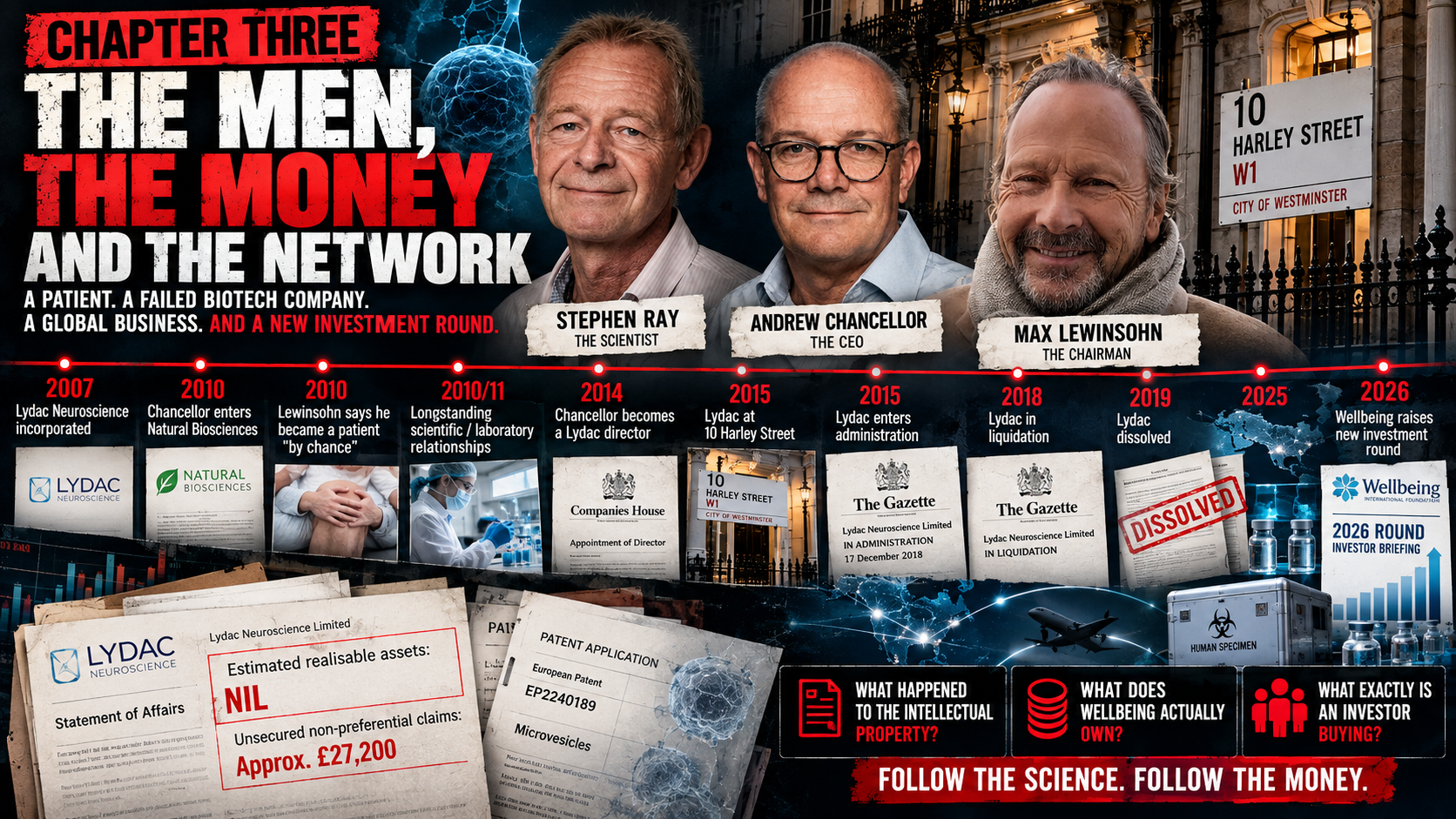
In another recorded conversation in 2021, Andrew Chancellor discussed a treatment arrangement with a prospective American patient.
Asked about the cost, he replied:
"The total cost to get all of this done and to have two treatments is $48,000."
The conversations establish what was being offered and the amounts being discussed at those times.
They do not establish that the prospective patients purchased the treatments.
They do not prove that every customer was charged the same amount.
And they do not establish the organisation's total revenue.
Nevertheless, they demonstrate that Wellbeing representatives were describing a commercially substantial treatment programme years before the latest investment round.
That history is relevant when the organisation seeks capital from investors.
Because a company with years of commercial activity should be capable of explaining the financial results of that activity to people considering acquiring an ownership interest.
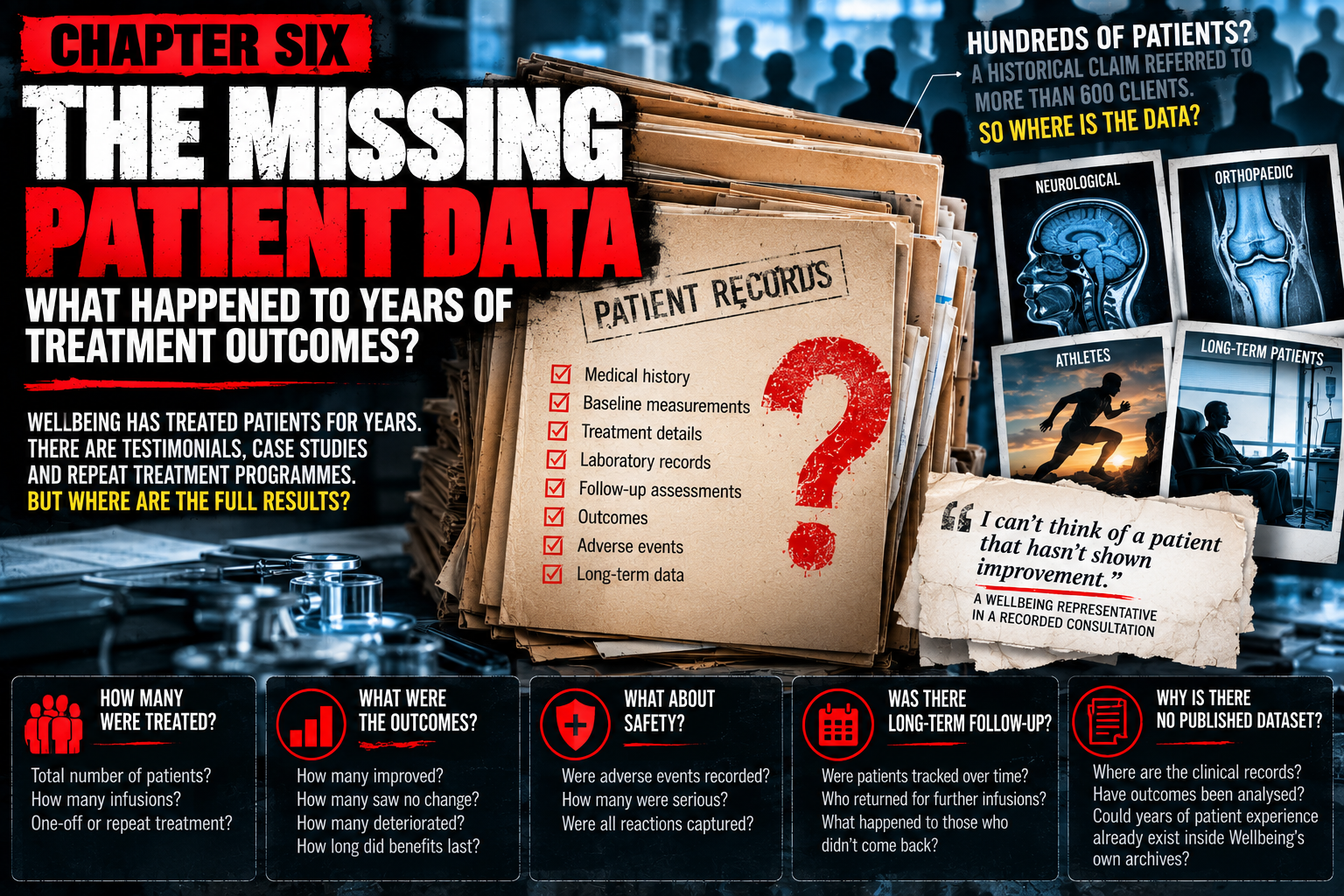
Hundreds of Patients — But What Does That Mean Financially?
During the November 2020 consultation, Stephen Ray also referred to the organisation's historical treatment experience.
He spoke of more than 600 patients treated over approximately ten years.
That was his statement.
It was not an independently audited patient count.
Nor did the conversation establish how many of those individuals paid for treatment, what amounts they paid or which legal entities received the money.
But the statement raises an important issue.
If hundreds of patients received a service for which representatives were quoting tens of thousands of dollars, the potential commercial activity could have been considerable.
At a purely illustrative level, 600 treatments charged at $44,000 each would represent $26.4 million.
But that calculation is not evidence that Wellbeing actually received $26.4 million.
The real figure could differ substantially.
Patients may have paid different prices.
Some may have received different treatment arrangements.
Some may not have paid at all.
Revenue may have been divided among clinicians, laboratories and other service providers.
And operating expenses may have consumed a significant proportion of the money collected.
This is precisely why financial statements matter.
A company's commercial history cannot be accurately reconstructed by multiplying a claimed patient count by a quoted price.
The accounts, not the sales presentation, must establish what the business actually earned.
Then Came the Investment Announcement
In March 2026, Wellbeing International Foundation published a statement confirming that the opening tranche of its latest capital round had closed.
The organisation explained that the funds would support further scientific documentation, clinical relationships and operational development.
It also said the wider investment round remained open at the time of publication.
But the announcement contained an important qualification.
The amounts raised, investment terms and participating investors were described as private information held by the organisation's legal and finance team.
In other words, the public announcement confirmed that a fundraising milestone had been reached without revealing the financial details necessary to evaluate it.
There may be legitimate reasons for keeping such information confidential.
Wellbeing is not a publicly listed company, and private offerings can operate under different disclosure rules.
It would therefore be misleading to suggest that every private business must publish the same financial information as a company trading on a major stock exchange.
But confidentiality creates a responsibility for prospective investors.
They must obtain and independently examine the information that is not publicly available.
Because the fact that a fundraising tranche has closed tells us nothing, by itself, about whether the investment represents good value.
A Successful Fundraising Round Is Not Proof of a Successful Business
This distinction is frequently misunderstood.
When a company announces that it has raised capital, the announcement may create confidence.
People naturally assume that other investors have examined the opportunity and decided that it is worthwhile.
But raising investment is not the same as earning profit.
A company may raise money because it has an attractive growth opportunity.
It may need capital to finance expensive research.
It may be funding expansion.
Or it may need additional money to sustain operations.
All of these possibilities exist within legitimate biotechnology businesses.
The announcement alone cannot tell an outsider which circumstances apply.
Nor does the presence of existing investors guarantee that a valuation is reasonable.
Experienced investors make mistakes.
Early-stage companies fail.
And even scientifically promising projects can consume substantial amounts of capital without achieving commercial success.
Before investing, a person needs to know what the business has already accomplished financially and what must happen before it can deliver a return.
We Examined a Biotechnology Company That Publishes the Evidence
To demonstrate what detailed investment scrutiny can look like, we examined Capricor Therapeutics.
Capricor is a publicly traded biotechnology company listed on Nasdaq under the ticker CAPR.
Its activities include cell-based therapies and an engineered exosome technology platform.
That makes it a useful comparison because extracellular vesicles and related biological technologies are relevant to the scientific field promoted by Wellbeing.
The companies are not identical.
Their products, research programmes, corporate structures and regulatory positions differ.
Capricor is also subject to the public-reporting requirements applicable to a Nasdaq-listed company.
Wellbeing's private offering may be governed by different rules.
Our comparison is therefore not intended to suggest that the two businesses are legally required to publish identical information.
It asks a more fundamental question.
What does it look like when an investor can independently examine a biotechnology company's finances, assets, risks and scientific development?
With Capricor, much of that information is publicly available.
Its annual report is filed with the United States Securities and Exchange Commission.
The document identifies the legal company, its directors and management arrangements, its financial results, its scientific programmes and its material risks.
It also discusses intellectual-property licences and commercial relationships.
An investor can read the filing without first attending a sales presentation or requesting permission from the company's representatives.
That matters.
The Most Revealing Part of Capricor's Records Is Not Its Success
The most useful feature of Capricor's annual report is not that it presents a biotechnology company in a flattering light.
It is that the report discloses substantial financial risks.
For the year ending 31 December 2025, Capricor reported no revenue.
It recorded approximately $84.5 million in research and development expenditure.
It also reported a net loss of approximately $105 million.
At the same year-end, the company held approximately $318.1 million in cash, cash equivalents and marketable securities.
Those figures illustrate the financial realities of biotechnology development.
A company can have substantial capital, scientific programmes and established institutional relationships while still making very large losses.
Its future may depend on regulatory decisions, clinical results, manufacturing progress and the availability of additional funding.
Capricor's public filings allow investors to examine those risks.
The company does not have to be profitable to be a genuine biotechnology enterprise.
And it does not have to be a safe investment to be transparent.
The importance lies in the evidence.
Investors can examine the numbers for themselves.
Who Owns the Technology?
Capricor's public records also provide information about intellectual-property arrangements.
Its 2025 annual report describes exclusive licensing agreements involving institutions including Cedars-Sinai Medical Center.
The agreements concern certain cell-therapy and exosome-related intellectual-property rights.
The filing discusses contractual obligations and the limitations associated with those rights.
This is significant because scientific expertise and ownership of technology are not the same thing.
A scientist may have developed a process during an earlier career.
A laboratory may perform specialised work.
A university may own relevant patents.
A commercial organisation may use technology under licence.
Each arrangement has different financial implications.
An investor must know which rights actually belong to the company issuing the investment.
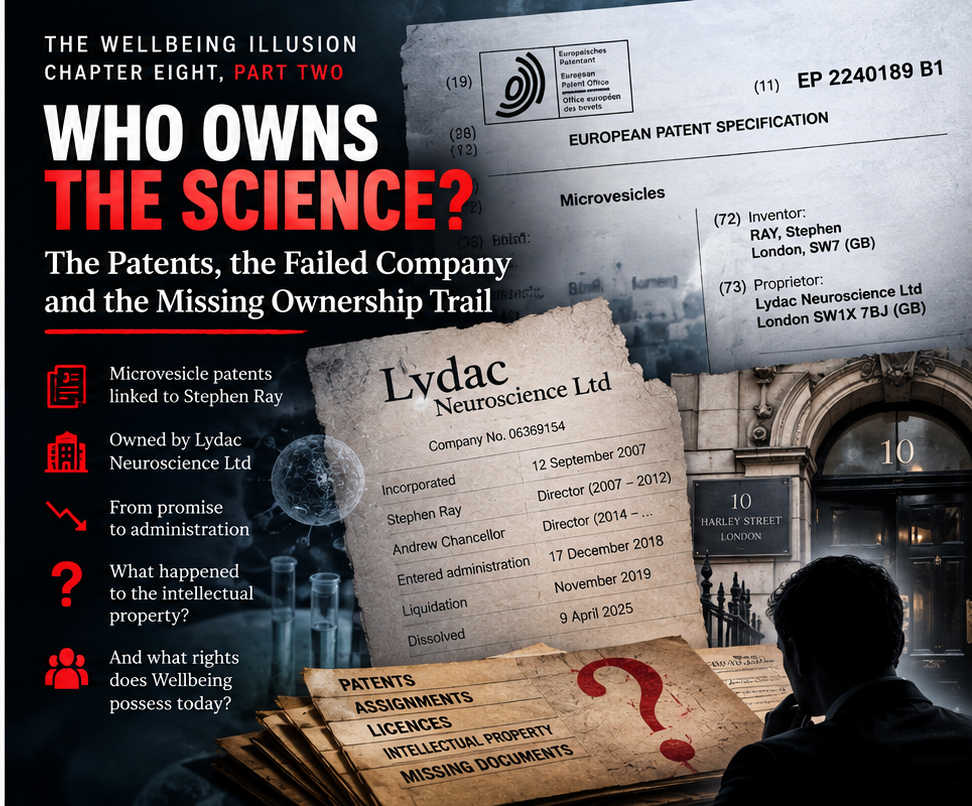
If Wellbeing's valuation depends substantially upon its scientific programme, prospective investors should establish the legal ownership or licensing arrangements supporting that programme.
They should also understand what happens if a key laboratory or technology relationship ends.
A description of scientific capability is not a substitute for the contracts establishing commercial control.
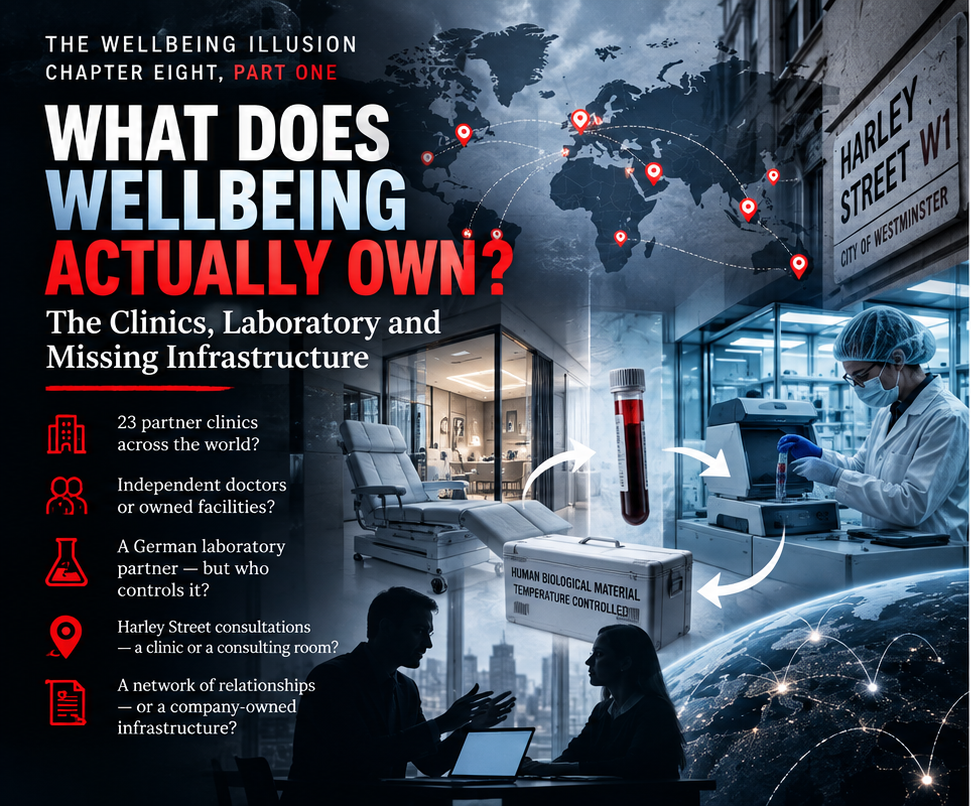
An International Network Does Not Automatically Mean Owned Assets
Wellbeing describes international clinical relationships and German laboratory processing.
These arrangements may be commercially important.
But an investor must distinguish between a company's own facilities and those operated by independent providers.
A clinical network may consist of partnerships rather than subsidiaries.
A laboratory may be a contractor rather than a company-owned facility.
A medical practitioner may work independently while offering services associated with the programme.
None of these arrangements is inherently improper.
Indeed, partnerships can be a sensible way to operate an international medical business.
But the financial implications differ considerably.
Owning a laboratory may provide valuable physical assets and direct operational control.
Using an independent laboratory may reduce fixed costs but create contractual dependencies.
Owning clinics may provide revenue and property or equipment interests.
Working with independent clinics may provide access to patients without ownership of those facilities.
An investor should understand which model applies before assigning value to the organisation's international presence.
The Questions That Must Be Answered Before Investment
The public information reviewed does not establish the complete financial and legal position of Wellbeing's 2026 offering.
A prospective investor should therefore insist on documents that resolve the following matters.
First, the exact legal entity issuing the investment must be identified.
Second, the company's current financial statements should be examined, including revenue, expenses, liabilities and cash flow.
Third, the investor must understand the valuation and how it was calculated.
Fourth, the company's ownership or licensing rights over its principal technology should be verified.
Fifth, the agreements with laboratories and clinical providers should be understood.
Sixth, the investor must know how the new capital will be spent.
Finally, the investor should establish the legal rights attached to the investment and the circumstances in which those rights may be diluted, restricted or lost.
These are not extraordinary demands.
They are basic financial due diligence.
A private company may provide this information confidentially rather than publishing it online.
That is not inherently a problem.
The problem arises when someone commits substantial capital without having the opportunity to verify the material facts.
What the SEC Warns About Private Investments
The United States Securities and Exchange Commission has published investor guidance explaining the risks associated with private placements.
The guidance is directed at offerings governed by US securities rules; it does not establish which regulatory framework applies to Wellbeing's investment round.
Nevertheless, it identifies risks that can arise in private investments more generally.
Private securities can be difficult to sell.
Investors may need to hold them for an indefinite period.
Disclosure may be more limited than in publicly traded companies.
And an investor can lose the entire amount committed.
The SEC also encourages investors to examine financial statements, the background of management, the intended use of funds and the restrictions attached to their securities.
These warnings are particularly relevant when an investment is presented as an opportunity to participate in emerging technology.
The prospect of future scientific progress does not eliminate the possibility of financial loss.
The Retirement Savings Problem
Consider the position of someone with £100,000 available to invest.
Perhaps the money represents a lifetime of savings.
Perhaps it is part of a retirement fund.
Perhaps the person has sold a business or inherited capital and wants to support a promising scientific project.
An investment presentation may describe enormous future markets.
It may highlight years of research.
It may emphasise international relationships and impressive scientific credentials.
But the investor's practical concerns are different.
What happens if the treatment fails to achieve the expected commercial success?
What happens if additional fundraising is required?
What happens if the company issues more shares?
What happens if the business becomes insolvent?
And what happens if the investor needs their money back?
In a private company, there may be no ready market for the shares.
The investor may be unable to sell.
Even if the company continues operating, the investment may remain illiquid for years.
A minority shareholder may have little influence over the decisions that determine the company's future.
These risks exist even where the business is entirely legitimate.
That is why no investor should confuse an attractive scientific proposition with a secure financial asset.
The Difference Between Evidence and Reassurance
The historical undercover conversations obtained during our investigation are relevant because they provide firsthand evidence of what Wellbeing representatives said about treatment pricing and patient experience.
But those conversations also demonstrate the limits of relying on statements alone.
A quoted treatment price is not verified revenue.
A claimed patient count is not an audited sales record.
A description of an international medical network is not proof of ownership of the facilities involved.
And a fundraising announcement is not evidence of profitability.
Each claim requires the appropriate supporting documentation.
Financial statements.
Corporate records.
Contracts.
Intellectual-property agreements.
Research publications.
Regulatory information.
And properly documented investment terms.
The more substantial the proposed investment, the more important this verification becomes.
What We Can Establish — And What Remains Unknown
Our investigation has established that Wellbeing publicly announced the closing of the opening tranche of its 2026 capital round.
It has established that the organisation describes a treatment programme involving international clinical relationships and laboratory processing.
Historical recordings establish that representatives quoted treatment prices of approximately $44,000 and $48,000 in separate conversations.
The historical record also contains a statement referring to more than 600 patients.
However, the public material reviewed does not independently establish the actual revenue generated from those patients.
It does not establish the company's current profitability.
It does not disclose the valuation applied to the 2026 investment round.
And it does not provide a complete public account of the legal rights and assets supporting that valuation.
These are gaps in the information independently verified for this investigation.
They are not proof that the documents do not exist.
Nor are they proof of fraud.
Wellbeing may have supplied relevant financial and legal information privately to prospective investors.
We have not examined those investor-specific materials.
That distinction is important.
Our findings should not be exaggerated.
But neither should investors assume that documents exist, are complete or have been independently verified merely because the organisation says its financial arrangements are handled privately.
What This Investigation Will Examine Next
This is the beginning of a new investigation into Wellbeing International Foundation's investment proposition.
Our focus will be the financial and corporate evidence supporting the organisation's commercial claims.
We will examine the legal entity receiving investment funds.
We will investigate the financial records and the historical commercial activity described by its representatives.
We will examine the ownership and licensing arrangements surrounding the scientific programme.
We will consider the roles of the laboratory, clinical partners and company leadership.
And we will continue comparing the available evidence with the disclosures of established biotechnology companies.
Our purpose is not to reach a predetermined conclusion.
It is to establish what prospective investors can independently verify before committing their money.
Where the evidence supports a claim, we will explain it.
Where the evidence is incomplete, we will identify the limitation.
And where historical statements differ from the present public record, we will examine the distinction carefully.
The Investment Decision That Could Save Your Savings
There is a fundamental rule that applies to every private investment, whether the company develops biotechnology, property, software or financial services.
Never allow the promise of future success to replace evidence of the business you are buying into today.
A legitimate company can fail.
An experienced management team can make mistakes.
A promising scientific programme can encounter years of delays.
And a private investment can become impossible to sell.
Those risks do not disappear because the organisation operates in an exciting scientific field.
If anything, they make careful examination more important.
Capricor Therapeutics provides an example of a biotechnology company whose financial position, scientific programmes, intellectual-property arrangements and material risks can be examined through public records.
Wellbeing's private investment proposition must be assessed through the documents available for its particular offering.
If those documents establish a sound investment case, they should withstand independent professional scrutiny.
If the essential evidence cannot be obtained or verified, a prospective investor has every reason to decline.
There is no requirement to invest.
There is no obligation to believe a projection.
And there is no reason to place retirement savings at risk simply because an opportunity sounds exclusive.
Before committing your money, establish what the company owns, what it earns, what it owes and what legal rights you will receive.
Then ask yourself one final question.
If this investment fails, can I afford to lose everything I have put into it?
If the answer is no, the decision should be straightforward.
Because the greatest investment opportunity in the world is worthless if losing it destroys your financial future.
The science may be fascinating. The investment still has to make sense.
COMING NEXT — CHAPTER TWO
The Company Behind the Name: Who Really Receives a Wellbeing Investor's Money?
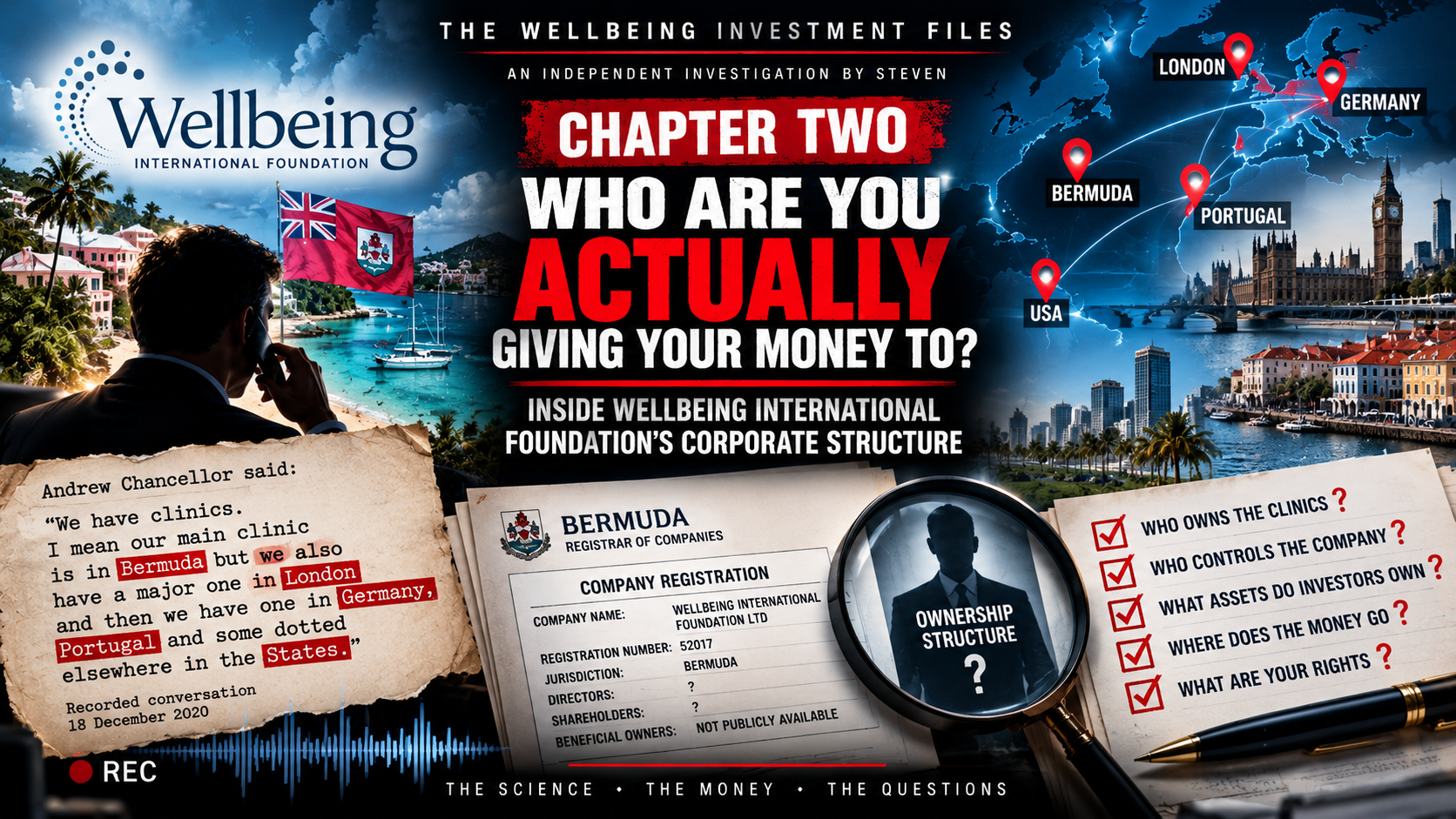
We investigate Wellbeing's corporate identity, Bermuda registration, international structure and the distinction between the organisation promoting the treatment and the legal entity in which investors may acquire an interest.
Public documents and further reading
- Wellbeing International Foundation — March 2026 Fundraising Announcement
- Capricor Therapeutics — 2025 Annual Report, SEC Form 10-K
- Capricor Therapeutics — Annual Reports
- SEC Investor Bulletin — Private Placements
Editorial note: The historical statements quoted in this article were obtained in recorded investigative conversations from 2020 and 2021. They are presented as statements made at those times, not as independently verified current prices, patient numbers or financial results. This article does not allege proven fraud or recommend purchasing shares in Capricor Therapeutics. The comparison concerns the availability of financial and corporate evidence, recognising the different disclosure obligations applicable to public and private companies.
Recent Posts