The Company Behind the Name: Who Really Receives a Wellbeing Investor's Money?
THE WELLBEING INVESTMENT FILES — CHAPTER TWO
An investigation into offshore registration, international medical operations, laboratory ownership and the legal identity behind Wellbeing International Foundation
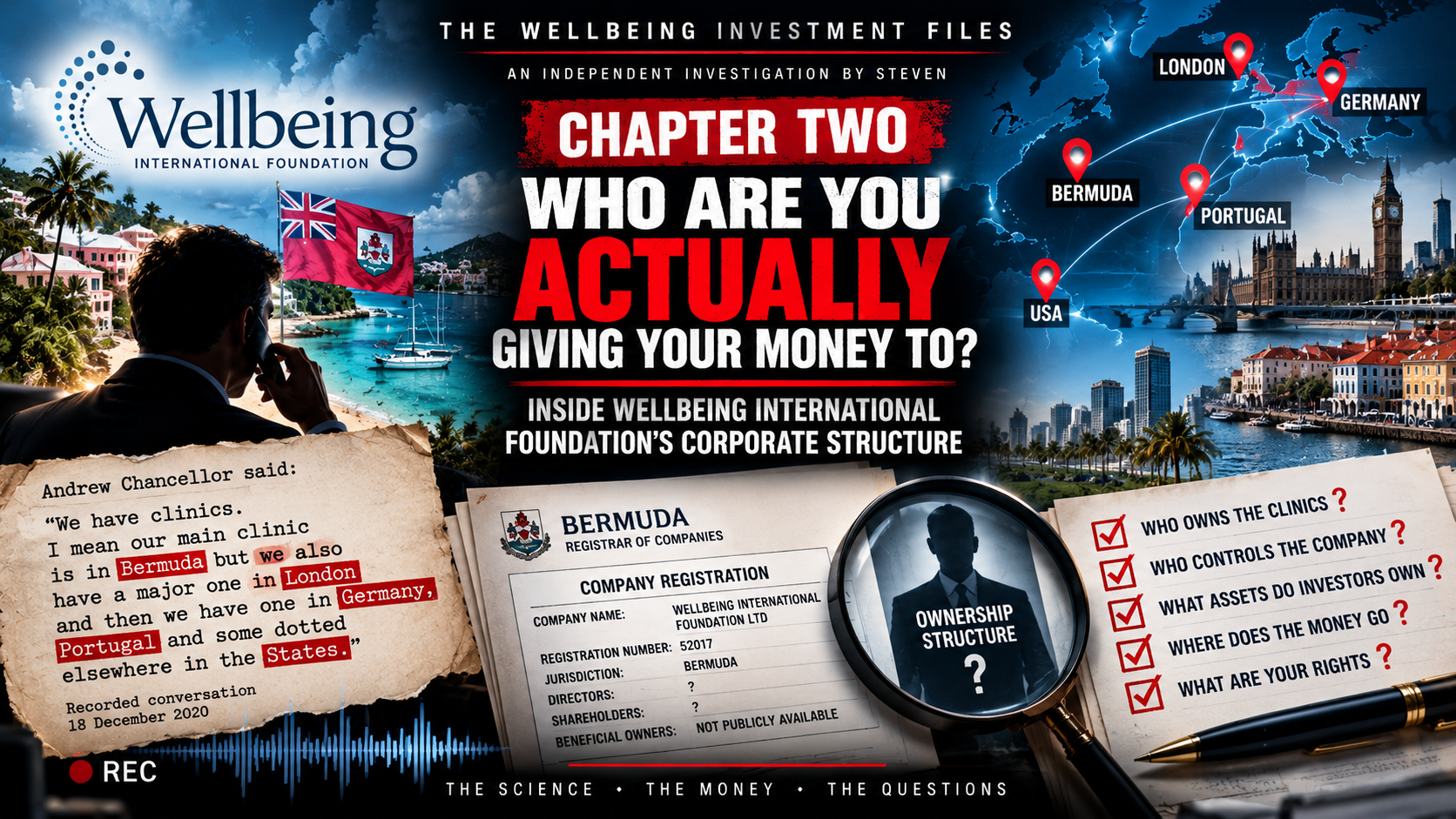
In December 2020, Andrew Chancellor was speaking to someone he believed was a prospective customer of Wellbeing International Foundation.
The caller wanted to arrange a consultation. The conversation turned to where the organisation operated and whether Chancellor was based in the United Kingdom.
His answer was revealing.
"We have clinics. I mean our main clinic is in Bermuda but we also have a major one in London and then we have one in Germany, Portugal and some dotted elsewhere in the States."
Chancellor went on to explain that he was in London and that the organisation's principal people were there at the time.
The conversation was recorded as part of an undercover investigation.
It offers a glimpse into how Wellbeing's international operations were being described to prospective customers more than five years ago.
Bermuda. London. Germany. Portugal. The United States.
To someone hearing that description, Wellbeing could sound like a substantial multinational medical organisation.
But there is a fundamental difference between operating an international medical network and owning an international medical business.
And for anyone considering investing their savings, that difference could determine what their shares are actually worth.
In March 2026, Wellbeing announced that it had completed the opening tranche of a new private investment round.
The organisation described the fundraising as a means of supporting scientific development, clinical relationships and operational expansion.
But its public announcement did not reveal the full financial terms or identify the precise assets supporting the investment valuation.
That raises a question we believe every prospective investor should ask.
What exactly belongs to the company in which you are being invited to invest?
The International Business Described on the Telephone
Chancellor's December 2020 statement is significant because it was made during an ordinary commercial conversation.
He was not addressing shareholders at an annual meeting.
He was not presenting a formal corporate prospectus.
He was explaining the organisation's operations to someone interested in its treatment programme.
The description was expansive.
A main clinic in Bermuda.
A major clinic in London.
Further facilities or arrangements in Germany, Portugal and the United States.
But the recording does not tell us whether those clinics were owned by Wellbeing.
It does not establish whether they were subsidiaries, leased premises, independent medical practices or facilities accessed through commercial agreements.
That is not a minor distinction.
Consider two hypothetical biotechnology businesses.
The first owns medical facilities in several countries, employs clinical teams, controls a specialist laboratory and holds the intellectual property supporting its treatment.
The second coordinates an international network of independent clinicians and contracts with a separately owned laboratory.
Both businesses may legitimately describe themselves as operating internationally.
Both may provide services to patients in multiple countries.
But their assets, liabilities, operating costs and financial valuations could be very different.
An investor needs to know which model applies.
And the answer must come from contracts, financial statements and corporate records — not merely from descriptions of geographical reach.
The Bermuda Company
Wellbeing International Foundation identifies Bermuda as its headquarters.
Historical investigative records also identify a Bermuda company under the name Wellbeing International Foundation Ltd, associated with registration number 52017.
That information provides a starting point for independent verification.
But it should not be confused with a current certified corporate record.
A historical company reference cannot establish who owns the business today.
Nor can it confirm whether the same entity is issuing securities in the 2026 investment round.
Companies can change directors, shareholders and constitutional arrangements.
They can create subsidiaries or holding companies.
They can transfer assets or enter into new commercial agreements.
And the company that originally developed a business may not necessarily be the company later used to raise investment.
Before transferring money, a prospective investor should obtain the current official registration details of the precise entity named in the investment agreement.
That includes its full legal name, company number, legal status and governing documents.
If the company receiving investment is different from the organisation appearing on the website, the relationship between them must be explained.
Why Bermuda Matters
Bermuda is a recognised international corporate jurisdiction.
Its use by a biotechnology business does not, by itself, suggest anything improper.
Many legitimate international companies use offshore corporate structures for commercial, administrative and financial reasons.
However, the jurisdiction of incorporation affects investors' legal rights.
A British or European investor may be familiar with the protections and reporting requirements associated with companies registered in their own country.
Those protections cannot simply be assumed to apply to a Bermuda investment.
A shareholder may need to rely upon Bermuda company law.
Disputes may be subject to contractual jurisdiction clauses.
Information rights may differ from those available to shareholders in a publicly listed company.
And insolvency proceedings may operate under a different legal framework.
The investor must therefore establish where the company is registered and which laws govern the securities being offered.
That information should be clearly documented before any investment is made.
What Bermuda's Official Records Can Reveal
Bermuda maintains a Registrar of Companies.
Official government guidance explains that company information can be searched through its online system.
The available records can include incorporation information, registered offices, company names, constitutional documents and registered charges.
Director information can also be inspected through the applicable procedures.
The system may require registration, verification and payment of fees.
This means there is an official route for investigating a Bermuda company's legal identity.
For a prospective investor, obtaining the relevant company records is a basic due-diligence step.
The company number should correspond with the investment documents.
The registered entity should be active and legally capable of issuing the securities described.
The constitutional documents should permit the relevant transaction.
And the authorised signatories should be properly identified.
None of this requires an allegation of wrongdoing.
It is simply the process of establishing that an investor understands the company with which they are entering into a legal agreement.
The Laboratory Conversation That Raises Another Important Question
A second undercover recording provides an even more revealing insight into Wellbeing's historical operating arrangements.
On 22 January 2021, a prospective patient participated in a recorded video meeting involving Andrew Chancellor and a representative of the German laboratory associated with the treatment programme.
The discussion concerned the relationship between Wellbeing and the laboratory responsible for processing biological material.
During the meeting, Chancellor introduced the laboratory representative and described their history of working together.
He then made a particularly important statement about the laboratory business.
Chancellor explained that the laboratory representative had established his own company with a colleague.
The significance of that statement is not the name of the laboratory.
It is the distinction between Wellbeing and the company carrying out the laboratory work.
The discussion presented the laboratory as a separately operated business with a longstanding commercial relationship with Wellbeing.
The laboratory representative described carrying out Wellbeing's protocols and managing aspects of process control and quality control.
This is useful firsthand evidence of how the relationship was represented in January 2021.
But it does not establish the present ownership of the laboratory.
Nor does it establish the current contractual rights held by Wellbeing.
Those matters require contemporary documents.
Nevertheless, the historical conversation raises a question that becomes critical when assessing an investment.
If the laboratory is independently owned, what enforceable rights does Wellbeing hold over the process on which its commercial programme depends?
A Partnership Is Not the Same as Ownership
There is nothing inherently wrong with a biotechnology company using an external laboratory.
Indeed, specialist outsourcing is common throughout the pharmaceutical and biotechnology industries.
A company may develop a treatment protocol while contracting with a separate organisation to perform manufacturing or processing.
This can reduce the need for expensive buildings, equipment and permanent laboratory staff.
But it also creates dependencies.
What happens if the laboratory terminates the relationship?
Can the company transfer production elsewhere?
Does it have exclusive rights to the process?
Who owns improvements made during laboratory development?
Who is responsible for regulatory compliance and quality assurance?
And can the company continue operating if the laboratory becomes unavailable?
These questions have financial consequences.
A company with legally protected manufacturing rights may possess a valuable commercial asset.
A company dependent upon an informal or easily terminated relationship may face greater operational uncertainty.
The difference can be substantial.
That is why a laboratory partnership should be examined through the relevant agreements.
An investor should not assume ownership merely because the organisation describes the laboratory as part of its treatment process.
What About Harley Street?
The historical undercover investigation also involved consultations at 10 Harley Street in London.
Harley Street is internationally associated with private medicine.
An address there can create an impression of established clinical operations.
But the use of a prestigious medical address does not automatically establish ownership of a clinic.
Medical practitioners may rent consulting rooms.
Companies may use serviced clinical facilities.
Independent professionals may provide services from the same building.
And several unrelated organisations may operate from a single address.
The recorded consultations establish that Wellbeing-related activities took place at 10 Harley Street during the period investigated.
They do not establish that Wellbeing owned the premises.
Nor do they establish the value of any property or equipment associated with the address.
For an investor, that distinction matters.
A company-owned medical facility may represent a tangible asset.
Access to consultation rooms through a commercial arrangement is a different proposition.
Neither is inherently superior.
But they should not be confused when assessing a company's value.
The Word Foundation Does Not Answer the Ownership Question
The organisation's name creates another issue worth examining.
Wellbeing International Foundation sounds, to some readers, like a charitable or nonprofit institution.
But the word Foundation does not, by itself, establish that an organisation is a registered charity.
Nor does it establish whether the entity has shareholders, whether profits can be distributed or how its assets are legally controlled.
Those matters depend upon its actual corporate structure and governing documents.
Wellbeing has publicly described private investment as one source of its funding.
That makes the legal form of the investment entity particularly important.
Is the investor purchasing ordinary shares?
Preferred shares?
A convertible instrument?
An interest in a holding company?
Or some other form of security?
The answer determines the investor's rights.
A shareholder may have voting rights, dividend rights or rights to a proportion of residual assets in a winding-up.
But those rights may be limited by the company's constitution, shareholder agreements and the terms of other securities.
A prospective investor should never infer their legal position from the organisation's name.
Who Controls Wellbeing?
Wellbeing's public materials identify senior figures associated with its leadership and scientific programme.
Andrew Chancellor has been presented as chief executive.
Max Lewinsohn has been identified as chairman.
Stephen Ray has been associated with the organisation's scientific development.
These roles are relevant to understanding management.
But management is not the same as ownership.
A chief executive may run a company without owning a controlling shareholding.
A chairman may oversee the board without possessing majority voting rights.
And an investor may hold substantial economic rights without participating in day-to-day management.
The critical questions concern the company's ownership structure.
Who holds the issued shares?
Are there different classes of shares?
Do some investors have preferential rights?
Who can appoint or remove directors?
Can management issue additional shares?
Are there agreements that give particular shareholders control over major decisions?
Bermuda's beneficial ownership framework requires certain ownership information to be maintained and reported, but the central beneficial ownership register is not generally available for unrestricted public inspection.
That makes direct disclosure to prospective investors especially important.
A capitalisation table, together with the relevant constitutional and investment documents, should help establish the ownership and control position.
Without those records, the public identities of senior executives tell us only part of the story.
The Most Important Difference: The Company and the Brand
An international business can operate under a single recognisable brand while using multiple legal entities.
One company may own the intellectual property.
Another may receive patient payments.
A third may contract with the laboratory.
A fourth may raise investment.
These arrangements can be entirely legitimate.
But they create important distinctions for shareholders.
Imagine an investor purchases shares in a company that coordinates treatment bookings.
The scientific intellectual property may belong to another company.
The laboratory may be independently owned.
The clinics may be independent medical practices.
And the investment entity may have contractual rights to certain fees rather than ownership of the underlying facilities.
The investor does not automatically acquire an interest in every business associated with the brand.
Their rights attach to the company whose securities they purchase.
That is why the exact issuing entity must be established before any payment.
The investor should understand the relationships between the relevant companies.
They should know which assets belong to the issuer.
They should understand whether those assets are owned outright or used under licence.
And they should establish what happens if important commercial relationships end.
Where Does the Investment Money Go?
Wellbeing's March 2026 announcement confirmed that the opening tranche of its capital round had closed.
It described the fundraising as supporting scientific documentation, clinical development and operational expansion.
But the public announcement did not disclose the amount raised or the detailed terms of the offering.
It stated that those matters were handled privately by the organisation's legal and finance team.
Private companies are not necessarily obliged to disclose the same information as publicly traded businesses.
It would therefore be wrong to suggest that the absence of public figures proves that investors have not received the relevant documents.
Nevertheless, the public announcement alone does not establish which legal entity issued the investment or the full financial rights received by investors.
That information must be obtained from the offering documents.
The receiving bank account must also be verified.
If money is being transferred to an entity other than the issuer, the legal basis for that arrangement should be clear.
A payment to a company with a similar name is not automatically equivalent to an investment in the intended business.
An investor should verify the beneficiary, the contractual purpose of the payment and the rights created by the transaction.
Once the funds have been transferred, resolving mistakes or disputes may become significantly more difficult.
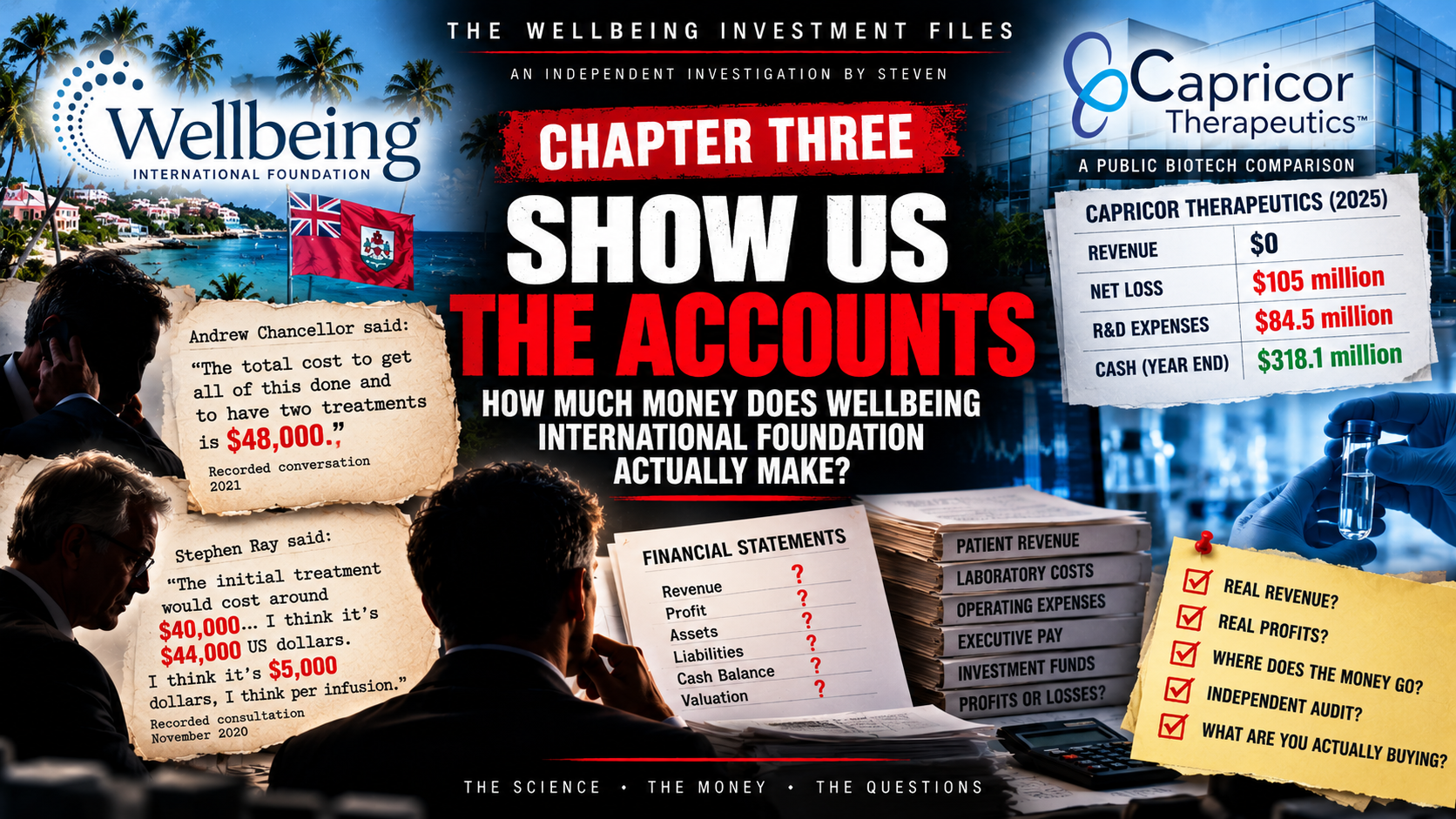
The Comparison With a Public Biotechnology Company
Our investigation has also examined Capricor Therapeutics, a Nasdaq-listed biotechnology company developing cell-based therapies and exosome-related technology.
Capricor provides a useful comparison because its corporate structure and material commercial arrangements are documented in public securities filings.
Its annual report identifies the legal entity, its securities, financial position and material risks.
The company also describes intellectual-property licensing agreements with scientific institutions.
Those disclosures help investors understand which rights the company controls and which depend upon external agreements.
Capricor is not necessarily a safer investment.
Its clinical programmes can fail.
Its share price can fall.
Its business may require further capital.
And investors can lose money.
The important distinction is that substantial information about the company can be independently examined.
Wellbeing's private offering is subject to a different disclosure environment.
But investors still need to establish the same underlying facts.
What company are they buying into?
What does it own?
What does it license?
What revenue does it receive?
And what legal rights will shareholders possess?
The answers should be supported by documents, regardless of whether those documents are publicly available or provided confidentially.
What the Historical Record Actually Establishes
The undercover material examined for this chapter provides valuable firsthand evidence.
In December 2020, Andrew Chancellor described Wellbeing's operations across several countries.
In January 2021, a recorded discussion described a separately operated German laboratory carrying out Wellbeing's protocols.
The investigation also documented consultations at 10 Harley Street in London.
These historical statements help explain how the organisation operated and presented itself during that period.
But they do not establish the complete corporate structure of the 2026 investment offering.
They do not prove that Wellbeing currently owns or does not own particular clinics.
They do not establish the present ownership of the German laboratory.
And they do not establish the company's current intellectual-property rights.
Those matters require updated corporate and contractual records.
The historical evidence is therefore a starting point for further investigation, not a substitute for present-day verification.
The Documents That Could Resolve the Questions
For a prospective investor, the essential evidence should include the current company registration documents for the precise issuing entity.
The company's constitutional documents should be examined.
Its directors and authorised signatories should be identified.
The investor should understand the ownership structure and any preferential rights held by existing shareholders.
The investment agreement should clearly explain the securities being issued.
The corporate structure should identify relevant subsidiaries, affiliates and contractual relationships.
The intellectual-property position should be documented.
And the agreements supporting the laboratory and clinical network should be sufficiently clear to assess their commercial importance.
The investor should also establish whether the company has significant debts, contractual obligations or other claims that could affect shareholder value.
These documents do not guarantee that an investment will succeed.
But without them, an investor may be unable to understand what they are purchasing.
The Risk of Investing in an International Story
International operations can be impressive.
They can demonstrate ambition, commercial reach and the ability to coordinate complex services.
But geographical presence should never be confused with asset ownership.
A company may have patients in several countries without owning clinics in those countries.
It may use a specialist laboratory without owning the laboratory.
It may have access to scientific expertise without owning every relevant patent.
And it may coordinate valuable commercial relationships without holding permanent or exclusive rights to them.
These distinctions become particularly important when a business is valued for investment purposes.
The investor must understand what remains if an important partner leaves.
What happens if a contract is terminated?
What happens if a licence expires?
What happens if a laboratory stops processing the company's material?
What happens if a key individual leaves the organisation?
A company's resilience depends not only upon the relationships it has developed but also upon the legal rights protecting those relationships.
What We Can Conclude
Wellbeing International Foundation presents itself as an international organisation involved in Cell-Free Therapy.
Its historical representatives described clinical activities in several countries.
Recorded material also indicates that the treatment programme relied upon a relationship with a separately operated German laboratory.
The organisation subsequently announced a private fundraising milestone in March 2026.
These matters are relevant to understanding its business.
But they do not, by themselves, establish the value of the company issuing the investment.
We have not examined the complete current investment documentation.
We have not obtained a current certified corporate extract establishing the full present-day ownership structure.
And we have not independently verified all of the contractual and intellectual-property rights supporting the commercial programme.
Those are limits of the evidence presently available to this investigation.
They are not proof of fraud or improper conduct.
But they are important matters for prospective investors to resolve.
Before You Invest, Follow the Ownership
There is a simple principle that should guide every private investment decision.
Do not confuse the business you are shown with the legal entity you are buying.
A website may describe an international network.
A representative may discuss clinics in several countries.
A scientist may explain an advanced laboratory process.
And a fundraising announcement may describe ambitious plans for the future.
But the investor's rights depend upon the actual legal documents.
The company issuing the securities must be identified.
Its ownership structure must be understood.
Its assets and contractual rights must be examined.
And the investor must know what happens if the business fails.
This is particularly important for people investing retirement savings or other capital they cannot easily replace.
A private shareholding may be difficult or impossible to sell.
It may be diluted by future fundraising.
And it may become worthless if the company becomes insolvent.
Even a legitimate biotechnology business can fail.
The existence of an international network does not eliminate those risks.
For Wellbeing, the historical recordings provide a valuable insight into how the organisation described its operations.
But they also raise the central question of this chapter.
Are prospective investors purchasing shares in a business that owns substantial medical and scientific assets, or are they purchasing an interest in a company whose value depends upon contracts and relationships with other organisations?
Either model can be legitimate.
Either could potentially support a viable business.
But they are not the same investment.
And no responsible investor should proceed without understanding the difference.
Before you follow the science, follow the ownership.
Before you transfer the money, identify the company.
And before you accept the valuation, establish what legally belongs to the shareholders.
Because when an investment fails, the value of a company's name may offer little protection.
What matters is what the company actually owns — and what rights its investors can enforce.
NEXT INVESTIGATION — CHAPTER THREE
The Price of Treatment, the Promise of Revenue and the Missing Financial Picture
Our investigation returns to the historical undercover recordings, including treatment quotations of tens of thousands of dollars and statements about hundreds of patients.
We examine what those claims can tell us about Wellbeing's commercial history — and, more importantly, what they cannot tell us without financial records.
Because charging a substantial amount for treatment is not the same as making a profit.
And raising investment is not the same as creating shareholder value.
Public sources and further reading
- Wellbeing International Foundation — Contact and Headquarters
- Wellbeing — March 2026 Capital Round Announcement
- Bermuda Government — Registrar of Companies
- Capricor Therapeutics — Investor Relations
- Capricor Therapeutics — SEC Filings
Editorial note: This article incorporates statements from historical recorded conversations obtained during undercover investigative work in 2020 and 2021. Those statements are presented in their historical context and do not establish the organisation's current corporate or operational arrangements. The investigation distinguishes verified evidence from unanswered questions and makes no finding of fraud or unlawful conduct.
Recent Posts