Every long corporate career leaves behind a paper trail.
Sometimes that trail tells the story of success.
Sometimes it tells the story of failure.
More often, it tells a far more complicated story than any corporate biography ever can.
As I continued investigating the business behind Wellbeing International Foundation, I found myself moving further away from regenerative medicine and deeper into corporate history.
That search led to one company that appears repeatedly in the early career of Wellbeing's Chairman, Max Lewinsohn.
Dominion International.
It is not a household name today. Yet it represents the first significant chapter in the public corporate record that ultimately leads to the leadership of Wellbeing International Foundation.
This article is not about assigning blame for events that occurred decades ago.
It is about understanding the documented history behind one of the individuals now responsible for guiding a company operating within one of the world's fastest-growing healthcare sectors.
Why Look Back?
Whenever investors examine a business, they begin with the management team.
Before analysing products or financial forecasts, they ask a simple question:
Who is running the company?
The answer rarely begins with the present.
It begins with the past.
Corporate history provides context.
It shows how leaders have navigated success, failure, growth and crisis throughout their careers.
That process is not unusual.
Banks perform it.
Institutional investors perform it.
Private equity firms perform it.
Investigative journalists should do exactly the same.
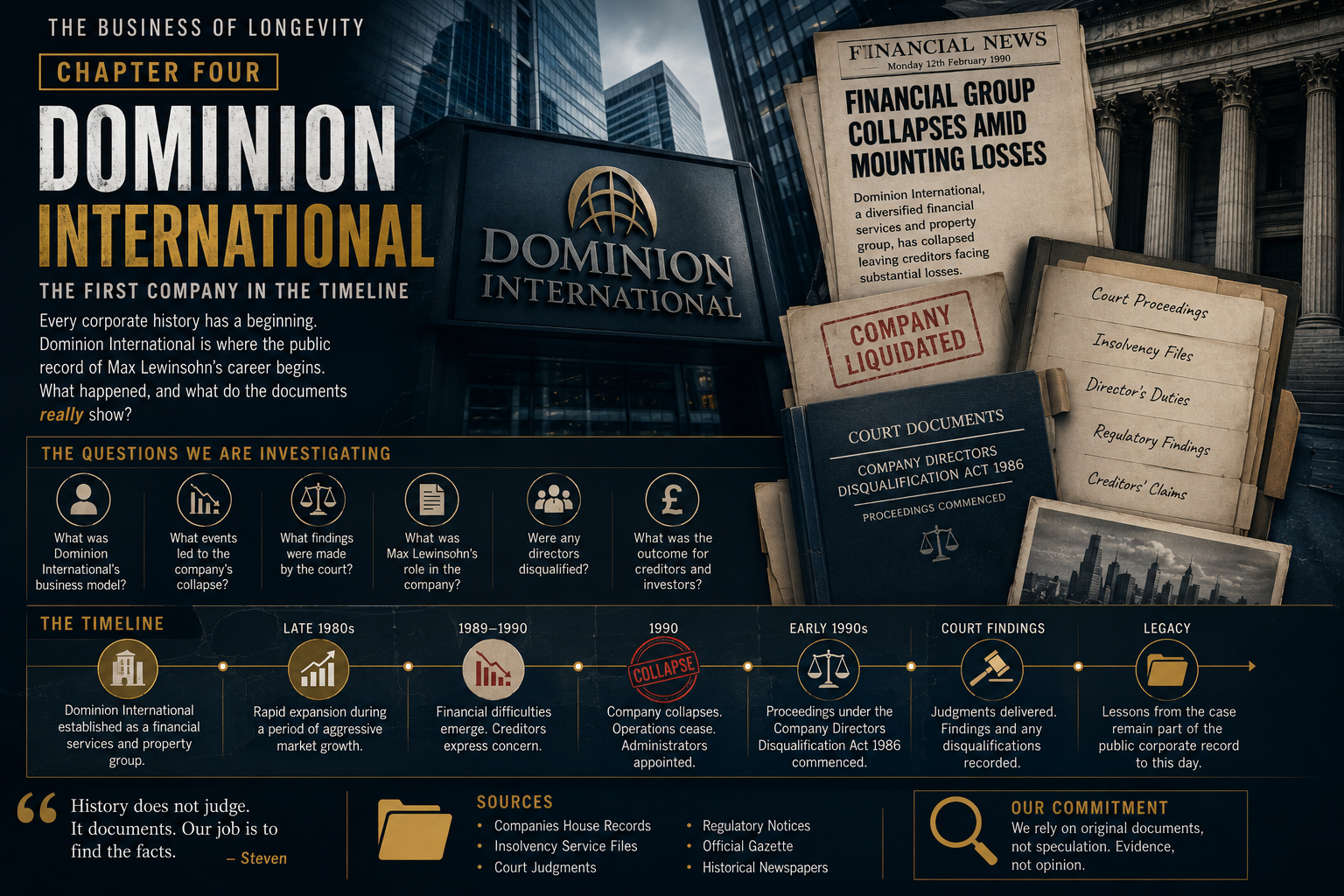
Dominion International
Public records identify Dominion International as a financial services and property group operating during the late twentieth century.
Like many businesses of its era, the company expanded during a period of significant economic optimism.
Expansion, however, was followed by financial difficulty.
Eventually, Dominion International collapsed.
Its failure resulted in insolvency proceedings and references within the public record to proceedings under the
Company Directors Disqualification Act 1986.
Those references immediately raised several important questions.
What happened?
What findings were made?
What role did the directors play?
At this stage of the investigation, those questions remain more important than any conclusions.
Separating Fact from Reputation
One of the challenges in investigating historic corporate failures is distinguishing between documented fact and decades of repeated commentary.
Newspaper articles often summarise events.
Online discussions repeat fragments of information.
Corporate biographies naturally focus on achievements rather than setbacks.
None of those sources should be accepted without verification.
For that reason, this investigation is being built around primary evidence wherever possible.
The objective is to obtain and review:
- Companies House records;
- court judgments;
- Insolvency Service documents;
- regulatory notices;
- official filings;
- historical corporate records.
These documents provide a far more reliable account than retrospective opinion.
Why This Matters
It would be easy to assume that events from the late twentieth century have little relevance today.
That would be a mistake.
Corporate history does not exist to predict future conduct.
It exists to provide context.
Many respected business leaders have experienced failed ventures before later building successful organisations.
Equally, previous insolvencies, restructurings and regulatory proceedings form part of the experience that directors bring to future roles.
Understanding that experience is a normal part of due diligence.
It should not be controversial.
The Questions Still to Be Answered
As this investigation continues, the focus is now shifting from general history to specific evidence.
Among the questions still being examined are:
- What business model was Dominion International pursuing?
- What events led to its collapse?
- What conclusions did the courts ultimately reach?
- What role did individual directors play?
- What lessons can be drawn from the official record?
These are questions of fact, not opinion.
They deserve answers supported by documents rather than speculation.
Looking Ahead
Dominion International represents the earliest significant chapter in this investigation.
It establishes the beginning of a corporate timeline.
The next chapter moves forward into the early 2000s with
Eneco Inc., where the documentary record becomes substantially more detailed.
Unlike Dominion, Eneco generated years of bankruptcy proceedings, court judgments and intellectual property litigation.
Those records provide a rare opportunity to examine a corporate story almost entirely through original legal documents.
As always, this investigation will follow one simple principle.
No assumptions.
No sensationalism.
No conclusions beyond the evidence.
Because in the end, the documents tell the story far better than anyone else can.