When we visit a company's website, we are presented with a carefully prepared introduction to its leadership team.
These biographies are designed to inspire confidence. They summarise careers, achievements and experience, presenting the individuals entrusted with guiding the organisation.
There is nothing unusual about that.
Every successful business does it.
But good investigative journalism asks a different question.
What does the public record tell us beyond the biography?
That question led me to the Chairman of Wellbeing International Foundation,
Max Lewinsohn.
As my investigation into the business of longevity expanded beyond science and into investment, one thing became increasingly clear.
Patients may be interested in treatments.
Investors are interested in leadership.
When private capital is being raised to support an emerging medical business, the experience and corporate history of those leading that business become just as important as the science itself.
This article is not an accusation.
Nor is it an attempt to rewrite history.
It is an examination of the public record and an effort to understand the career of one of the key figures behind Wellbeing International Foundation.
The Public Biography
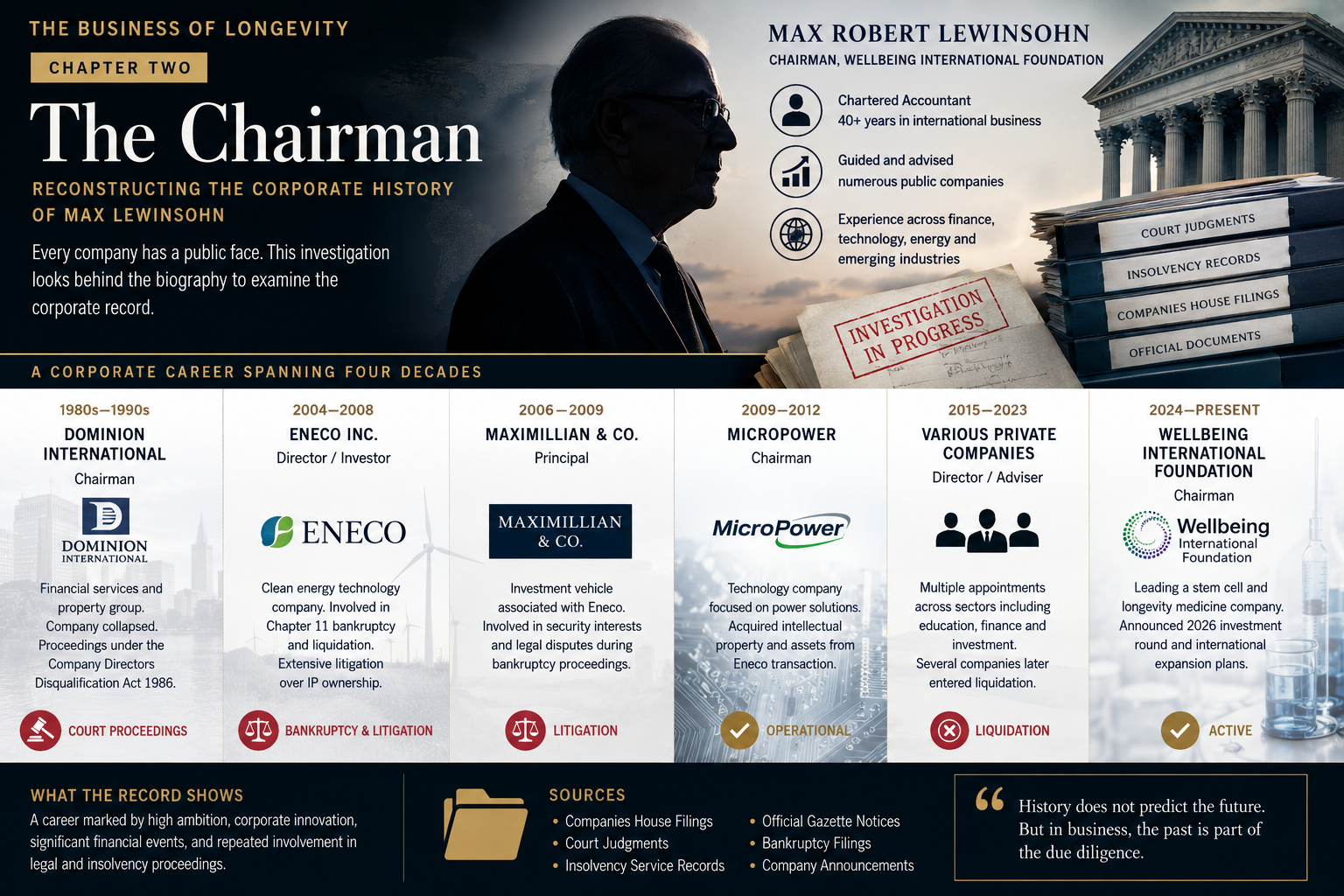
Wellbeing International Foundation describes Max Lewinsohn as a Chartered Accountant with more than forty years of international business experience.
According to the company's published biography, he has advised and guided numerous public companies and has held senior positions across finance, technology and investment.
It is an impressive résumé and undoubtedly reflects extensive experience in corporate finance.
Experience, however, is only one part of any business story.
Every long corporate career contains successes, setbacks and difficult decisions.
The question is whether the publicly available biography reflects the complete picture.
Why Corporate History Matters
Business history is not about assigning blame.
Companies fail.
Markets change.
Technology evolves.
Economic conditions deteriorate.
Many respected entrepreneurs have experienced failed businesses before later creating successful ones.
Failure alone tells us very little.
However, corporate history provides valuable context.
When investors evaluate a company, they routinely examine the track record of its directors.
Banks perform due diligence.
Institutional investors commission background reports.
Prospective shareholders ask difficult questions.
Patients rarely do.
Perhaps they should.
When a healthcare organisation asks people to place their trust in innovative therapies, understanding the experience of those leading the company is entirely reasonable.
Dominion International
One of the earliest significant companies associated with Max Lewinsohn was Dominion International.
Contemporary reports describe Dominion as a financial-services and property group that ultimately collapsed during the 1990s.
Public reports also refer to proceedings brought under the Company Directors Disqualification Act following the company's failure.
At the time of writing, I am obtaining the original court papers, Insolvency Service records and regulatory documents relating to those proceedings.
The objective is simple.
To establish, from the original evidence:
- Mr Lewinsohn's exact role;
- the findings made by the court;
- the reasons for any reported disqualification;
- and the wider circumstances surrounding the company's collapse.
Those documents—not newspaper headlines—will determine the conclusions reached in this investigation.
Eneco
More than a decade later, Max Lewinsohn's name again appears within extensive legal proceedings involving Eneco Inc., an American technology company attempting to commercialise energy-related intellectual property.
Court records show that Eneco entered Chapter 11 bankruptcy protection before later being converted into Chapter 7 liquidation.
The subsequent sale of intellectual property resulted in years of litigation involving investors, creditors and competing claims over valuable technology.
Mr Lewinsohn appears within those proceedings through his involvement with Maximillian & Co., and the court papers provide a detailed account of the commercial disputes that followed.
The existence of litigation should never be interpreted as evidence of wrongdoing.
Complex commercial disputes frequently arise following corporate insolvencies.
What matters is understanding the documented facts rather than relying upon speculation.
That is precisely what this investigation seeks to do.
A Career Across Many Businesses
Public records indicate that Mr Lewinsohn has been associated with numerous businesses spanning finance, technology, investment and education.
Some were successful.
Some ceased trading.
Others entered insolvency procedures.
That is not unusual over a career lasting more than four decades.
The significance lies not in the existence of corporate failures, but in understanding the complete corporate history rather than only the highlights presented within a biography.
Experience should always be viewed in its entirety.
Why This Matters Today
Today, Max Lewinsohn chairs an organisation operating within one of the fastest-growing sectors of modern healthcare.
Longevity medicine is attracting global attention, increasing patient demand and significant private investment.
That naturally places greater importance on transparency.
Prospective investors may reasonably wish to understand the experience of those entrusted with managing their capital.
Patients considering innovative treatments may equally wish to understand the corporate leadership behind the organisation providing those services.
These are not unreasonable questions.
They are part of responsible due diligence.
The Investigation Continues
This chapter is not intended to reach final conclusions.
It is intended to identify the questions that now require documentary answers.
Over the coming weeks, this investigation will examine:
- Companies House filings;
- court judgments;
- insolvency records;
- bankruptcy proceedings;
- director appointments;
- regulatory documents;
- historical corporate filings.
Only after those original documents have been reviewed will it be possible to build a complete picture of Mr Lewinsohn's corporate career.
Good investigations do not begin with conclusions.
They begin with evidence.
And as this series has already demonstrated, the deeper one looks into the business of longevity, the more important the documents become.
The science brought me here.
The business persuaded me to keep digging.
In the next chapter, we move beyond the biographies and begin analysing the documentary evidence itself—company by company, filing by filing and judgment by judgment.