For years, the regenerative medicine industry has been driven by hope, innovation and compelling patient testimonials. Scientific research has often followed behind the marketing, leaving patients to decide whom to trust in an increasingly complex field.
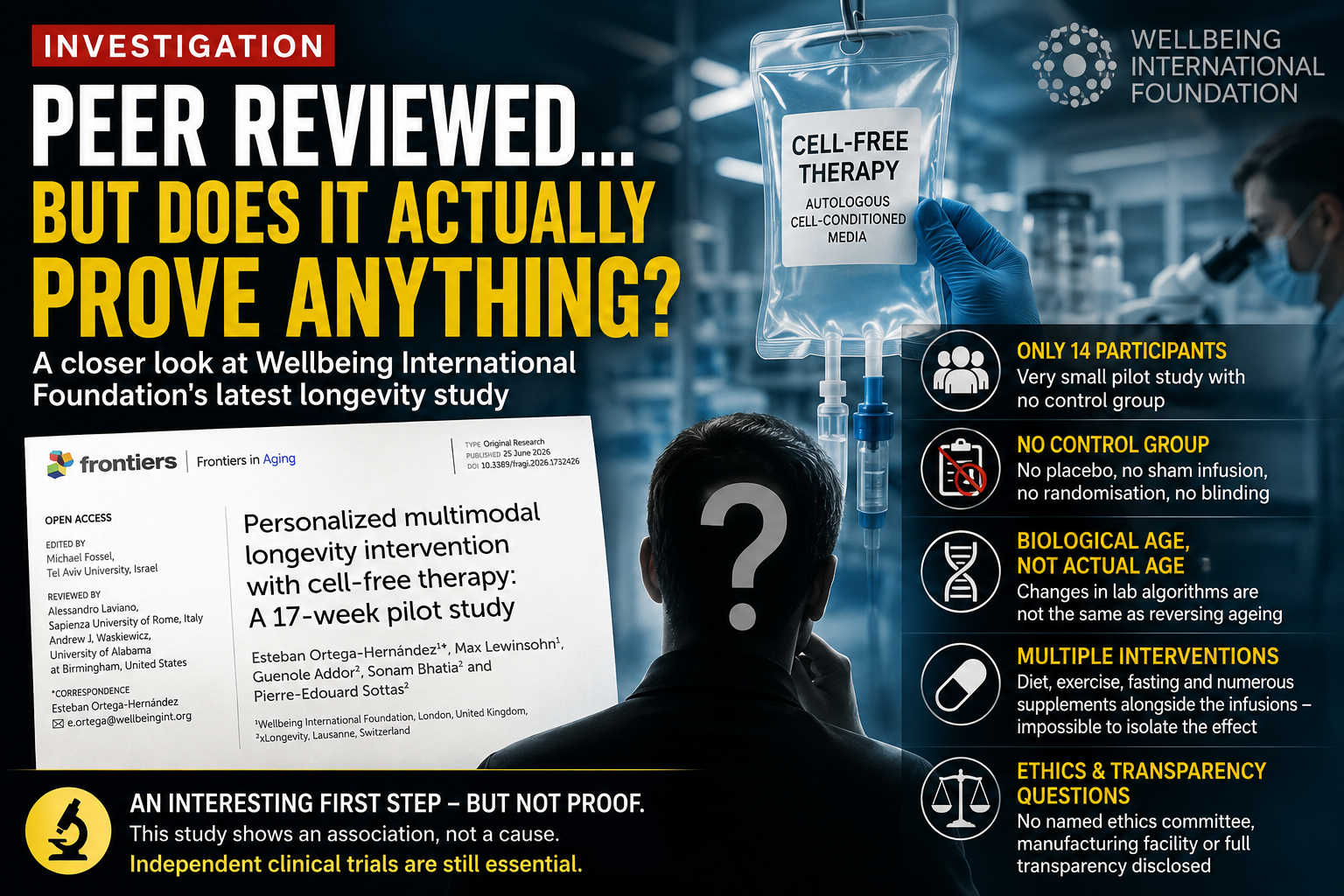
So when Wellbeing International Foundation announced that its longevity programme had been published in the peer-reviewed journal Frontiers in Aging, it appeared to represent a significant milestone. To many readers, "peer reviewed" carries an understandable implication: that the treatment has now been scientifically proven.
But does it?
After carefully reviewing both the published paper and Wellbeing's accompanying announcement, the answer is more nuanced than the headlines might suggest.
The study is genuine.
The journal is genuine.
The peer-review process is genuine.
However, that does not necessarily mean the treatment itself has been proven effective.
A Genuine Scientific Publication
Unlike many promotional claims found throughout the regenerative medicine sector, this research genuinely exists within the scientific literature.
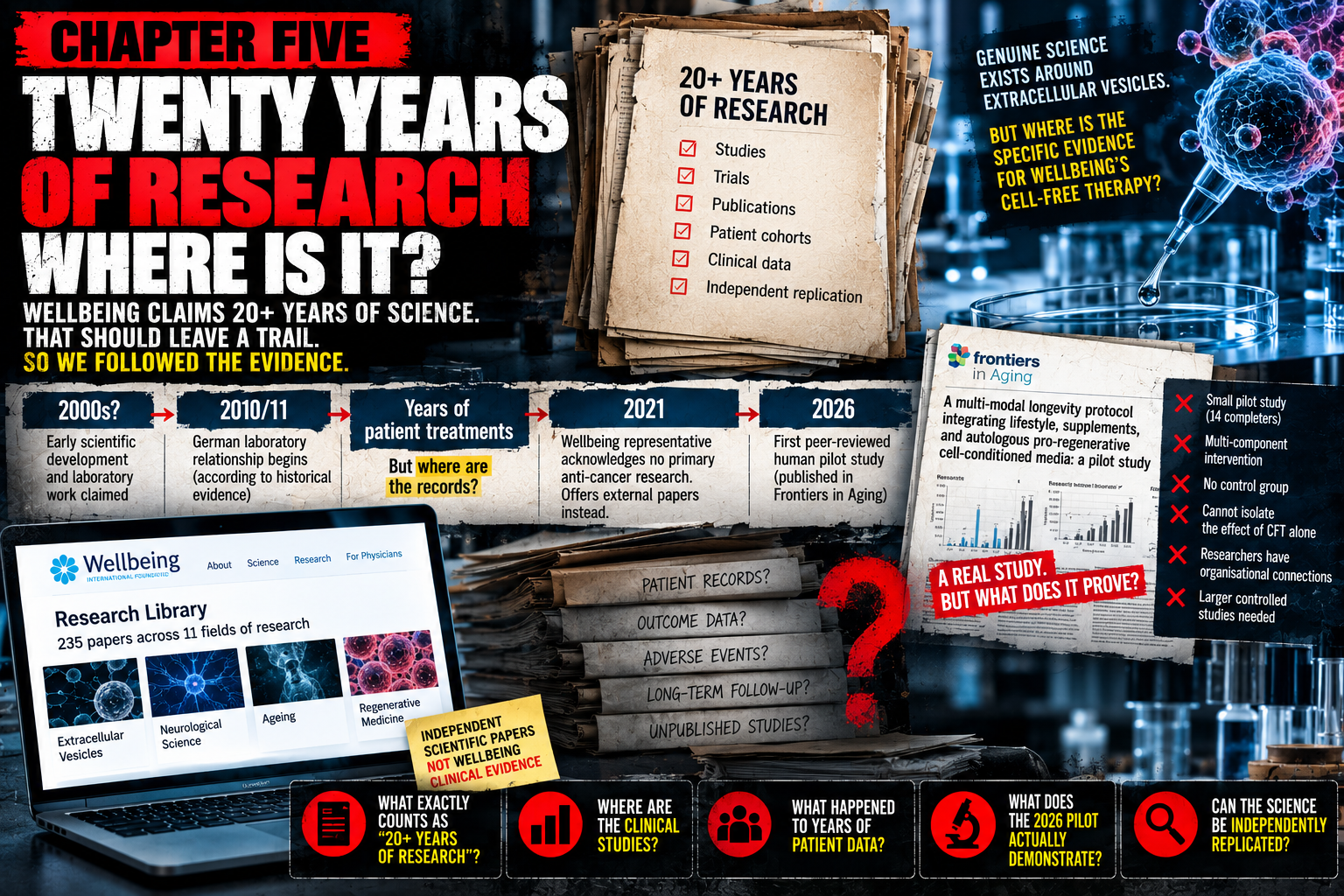
Published in Frontiers in Aging in June 2026, the paper underwent formal peer review before publication. That immediately places it on a higher scientific footing than organisations relying solely on testimonials or marketing material.
Publication, however, is only the beginning of scientific scrutiny—not its conclusion.
Throughout medical history, many promising early studies have later failed to withstand larger, independent clinical trials. Peer review establishes that research is worthy of discussion; it does not establish that a treatment has been conclusively proven.
Who Conducted the Research?
Whenever evaluating a scientific paper, one of the first questions investigators should ask is straightforward:
Who carried out the research?
In this case, the study was authored by researchers employed by Wellbeing International Foundation together with employees of xLongevity.
In other words, the organisations responsible for delivering and promoting the programme also designed, conducted and published the research.
That is not unusual within pharmaceutical or biotechnology research, nor does it invalidate the findings.
However, it does mean the study should not be viewed as independent confirmation.
The authors openly declared these commercial relationships within the publication, allowing readers to assess the findings with appropriate context.
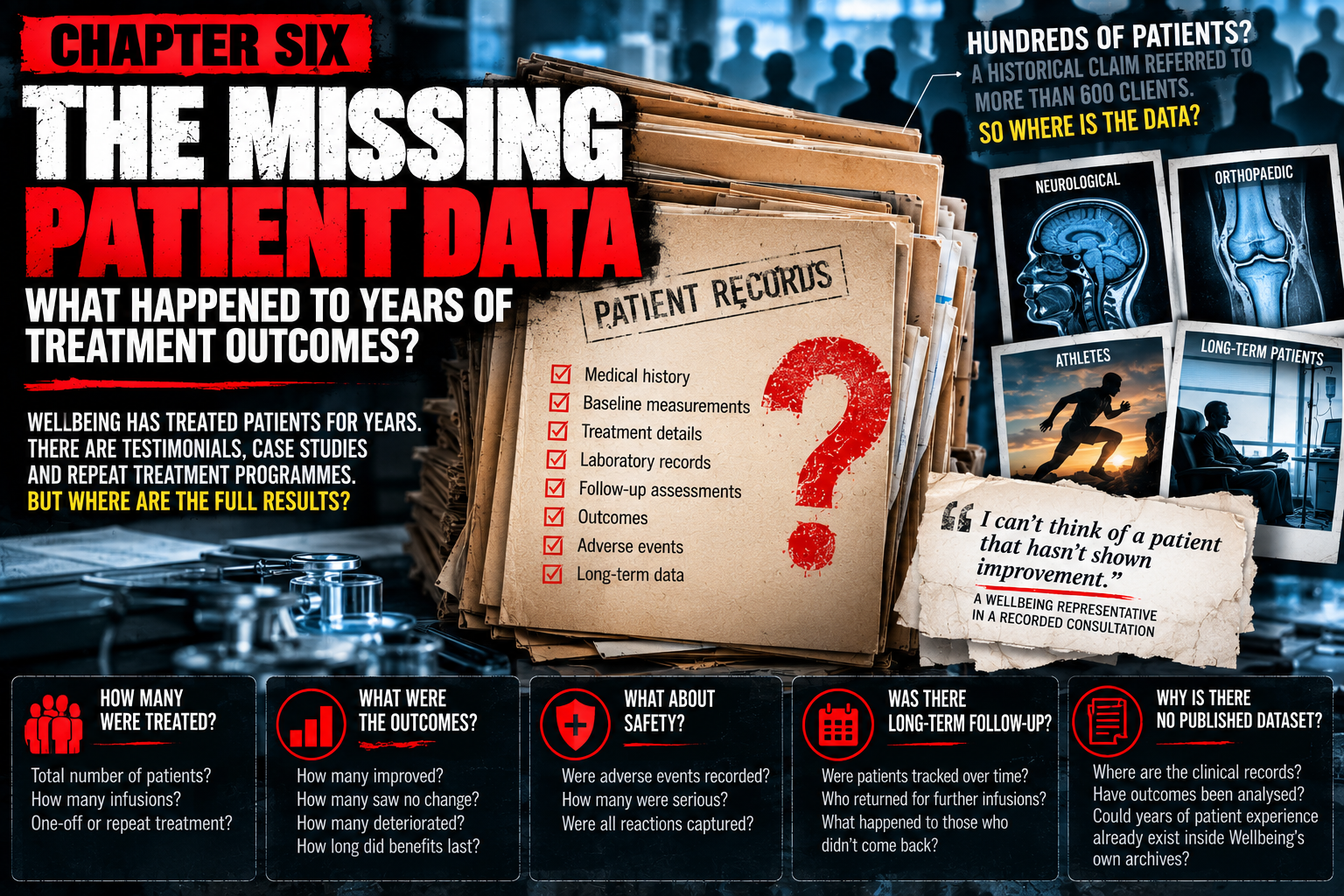
Fourteen Participants
Only fourteen volunteers completed the seventeen-week programme.
That is an exceptionally small sample from which to draw broad conclusions.
Pilot studies are designed to explore possibilities and generate future research questions.
They are not intended to provide definitive clinical proof.
The Fundamental Scientific Limitation
The most significant limitation of the study is surprisingly simple.
It is impossible to determine which part of the programme produced the reported improvements.
Participants did not receive Cell-Free Therapy alone.
Instead, they completed a comprehensive programme including:
- dietary modification;
- structured exercise guidance;
- intermittent fasting;
- sleep optimisation;
- nutritional supplementation, including NMN, GlyNAC, taurine, creatine, curcumin and CoQ10;
- two infusions of autologous cell-conditioned media.
Every participant received every intervention.
There was:
- no placebo group;
- no untreated control group;
- no group receiving lifestyle changes without the infusions;
- no randomisation;
- no blinding.
As a result, even if genuine improvements occurred, the study cannot identify which intervention—or combination of interventions—was responsible.
Biological Age Versus Chronological Age
Perhaps the most eye-catching claim promoted after publication was that participants finished the programme several years "biologically younger."
This is an attractive headline.
However, it is important to understand what was actually measured.
The researchers did not demonstrate that participants physically became younger.
Instead, they used biological-age algorithms based upon laboratory biomarkers.
These so-called ageing clocks estimate biological age using mathematical models.
They are valuable research tools, but they are not direct measures of rejuvenation.
The study did not demonstrate:
- increased lifespan;
- reduced mortality;
- disease prevention;
- tissue regeneration;
- improved physical performance;
- improved cognitive function.
It demonstrated changes in laboratory markers over a relatively short period.
Those findings are scientifically interesting.
They are not proof that ageing has been reversed.
Understanding the Numbers
Wellbeing's accompanying announcement highlights participants finishing approximately:
- 5.8 years younger according to one biological-age clock;
- 4.1 years younger according to another.
These figures are technically accurate within the context presented.
However, they describe the participants' final estimated biological age relative to their chronological age.
The actual change observed during the study was considerably smaller.
That distinction is important.
Without careful explanation, readers could reasonably assume that participants reversed more than five years of ageing in just seventeen weeks.
That is not what the published paper demonstrates.
Ethics and Transparency
Another aspect of the study deserves discussion.
The paper explains that two registered physicians concluded, using UK Health Research Authority guidance, that NHS Research Ethics Committee approval was not required.
However, the publication does not clearly identify:
- an independent ethics committee overseeing the study;
- the physicians who reached that conclusion;
- the country in which the infusions were administered;
- the laboratory manufacturing the investigational product;
- the accreditation of that manufacturing facility.
None of these omissions necessarily imply any wrongdoing.
Nevertheless, when healthy volunteers receive an investigational intravenous biological product, greater transparency would strengthen confidence in the research.
Commercial Connections
One of the strongest aspects of the paper is also one of its most important disclosures.
The authors openly state that they were employed by organisations involved in delivering the programme.
That openness should be recognised.
At the same time, it reinforces why independent replication is essential.
Medical history contains countless examples of encouraging pilot studies that could not be reproduced by independent researchers.
Replication—not publication alone—is ultimately what establishes scientific confidence.
What the Study Actually Demonstrates
To the authors' credit, the paper itself is measured in its conclusions.
It does not claim to have cured ageing.
It does not claim definitive proof.
Instead, it presents preliminary findings and openly acknowledges that larger, properly controlled clinical trials are required.
That is precisely how early-stage scientific research should be presented.
The published paper is, in many respects, more cautious than some of the marketing that has surrounded regenerative medicine in recent years.
Conclusion
This study represents an important milestone for Wellbeing International Foundation.
It demonstrates that a complex, multi-component health programme was associated with improvements in several biological markers among fourteen participants.
What it does
not demonstrate is that Wellbeing's Cell-Free Therapy alone produced those improvements.
Nor does it prove biological rejuvenation or establish clinical effectiveness.
Ultimately, scientific credibility is built through repeated, independent verification conducted by researchers with no commercial involvement in the treatment being evaluated.
Until those studies are completed, this publication should be regarded for what it is: an interesting and encouraging pilot study that raises important questions—but does not yet provide definitive answers.
Good science rarely deals in certainty.
It progresses by asking better questions.
This paper is an important contribution to that process, but it should be viewed as the beginning of the conversation rather than the end of it.