Every emerging technology industry shares one thing in common.
It attracts investors.
Whether the technology is artificial intelligence, renewable energy or regenerative medicine, the promise of future innovation often attracts substantial financial backing long before commercial success has been proven.
Sometimes those investments change the world.
Sometimes they disappear without trace.
Sometimes they become trapped in years of legal disputes that reveal just how complicated the business of innovation can become.
That is exactly what happened with
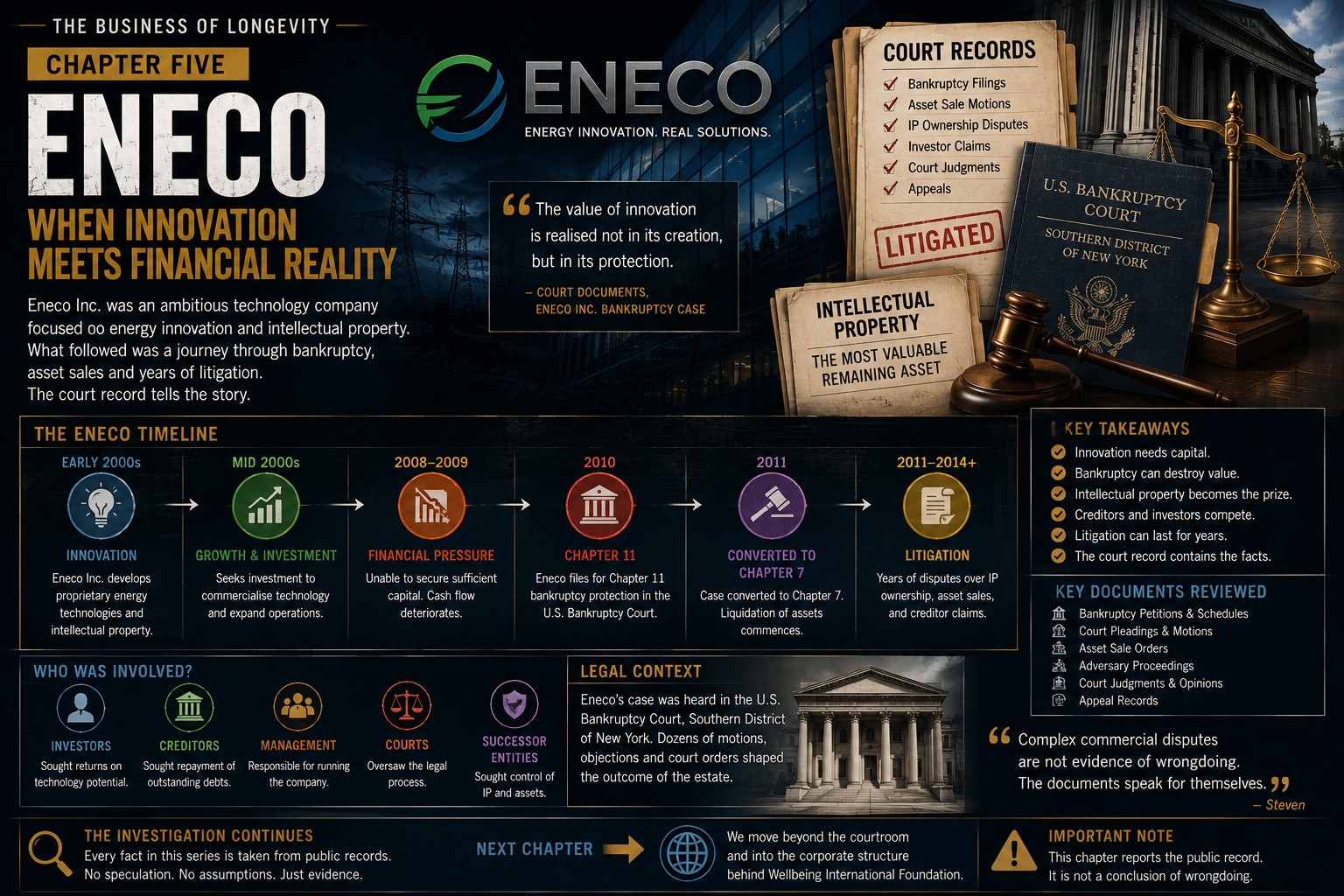
Eneco Inc.
As I continued tracing the corporate history of Wellbeing International Foundation's Chairman, Max Lewinsohn, I discovered that one chapter stood out from all the others.
Unlike earlier companies, the story of Eneco is preserved in extraordinary detail.
Bankruptcy filings.
Federal court proceedings.
Asset sale orders.
Intellectual property disputes.
Years of litigation.
For an investigator, it is one of the richest documentary records in this entire series.
A Business Built on Ideas
Eneco was not a conventional manufacturing company.
Its value lay largely in intellectual property.
Its commercial future depended on innovative energy technologies and the expectation that those ideas could eventually become profitable products.
That business model is familiar.
Across emerging industries, investors routinely provide capital years before a product reaches full commercial maturity.
The investment is not based solely on current performance.
It is based on future potential.
That potential can be extremely valuable.
It can also be extremely risky.
When the Money Runs Out
Like many ambitious technology companies, Eneco eventually faced financial pressure.
According to publicly available court records, the business required additional funding to continue developing and commercialising its technology.
That funding never arrived in sufficient quantity.
The company entered Chapter 11 bankruptcy protection in the United States before later being converted into Chapter 7 liquidation.
For shareholders, that marked the end of the company.
For the courts, it marked the beginning of a much longer story.
The Real Asset
When a technology company collapses, the buildings are rarely its greatest asset.
The intellectual property is.
Patents.
Research.
Trade secrets.
Licensing rights.
Those assets often become the focus of intense legal disputes because they may still hold significant commercial value even after the company itself has failed.
The Eneco court record demonstrates exactly how complex those disputes can become.
Ownership.
Priority.
Creditors.
Investors.
Competing commercial interests.
Years after the company ceased trading, the intellectual property continued to generate litigation.
Where Max Lewinsohn Appears
Public court documents identify Max Lewinsohn in connection with Eneco and with Maximillian & Co., an investment vehicle involved during the bankruptcy proceedings.
His name appears throughout parts of the documentary record because of that involvement.
That fact alone should not be interpreted as evidence of wrongdoing.
Large corporate insolvencies frequently involve directors, investors, advisers, creditors and competing commercial interests.
Participation in litigation does not determine liability.
The importance lies in understanding the documented role each party played rather than drawing assumptions from their presence within court proceedings.
That is precisely why this investigation relies on original legal documents rather than internet commentary.
Innovation Carries Risk
One of the most valuable lessons from the Eneco story has little to do with the individuals involved.
It is about innovation itself.
Emerging technologies are expensive.
Research takes time.
Commercial success is uncertain.
Even promising ideas can fail if funding disappears before the business becomes financially sustainable.
That lesson applies far beyond the energy sector.
It is equally relevant to biotechnology, regenerative medicine and longevity research.
Scientific promise does not automatically translate into commercial success.
Why This Matters
Readers may reasonably ask why a bankruptcy involving an energy technology company is relevant to an investigation into longevity medicine.
The answer lies not in the industries themselves.
It lies in corporate experience.
When investors evaluate a management team, they rarely look only at today's company.
They examine previous ventures.
Corporate restructurings.
Bankruptcies.
Litigation.
Successful exits.
Commercial failures.
Not because history predicts the future.
But because history provides context.
Understanding that context is an essential part of responsible due diligence.
The Documentary Record
One of the defining principles of this investigation has been simple.
Every important conclusion should be supported by original documentation.
The Eneco chapter is built upon:
- United States Bankruptcy Court records;
- published court judgments;
- asset sale proceedings;
- publicly available litigation documents;
- corporate filings.
Those records provide a far more reliable account than retrospective opinion ever could.
Looking Ahead
Eneco marks an important turning point in this investigation.
The documentary evidence becomes richer.
The legal record becomes deeper.
The commercial questions become more significant.
Yet one question remains unanswered.
How does a career that includes complex technology ventures, corporate restructurings and extensive litigation eventually lead to the leadership of Wellbeing International Foundation?
The next chapter leaves the courtroom behind and follows something even more important.
The corporate structure itself.
Who owns the business?
Where is the intellectual property held?
How is investment organised?
And why was Bermuda chosen as the centre of that structure?