When people search for stem cell therapies, exosome treatments, extracellular vesicle (EV) therapies and regenerative medicine programmes, they are usually searching for one thing.
Hope.
Hope that pain may be reduced.
Hope that mobility may improve.
Hope that symptoms may ease.
Hope that quality of life may return.
The regenerative medicine industry understands this.
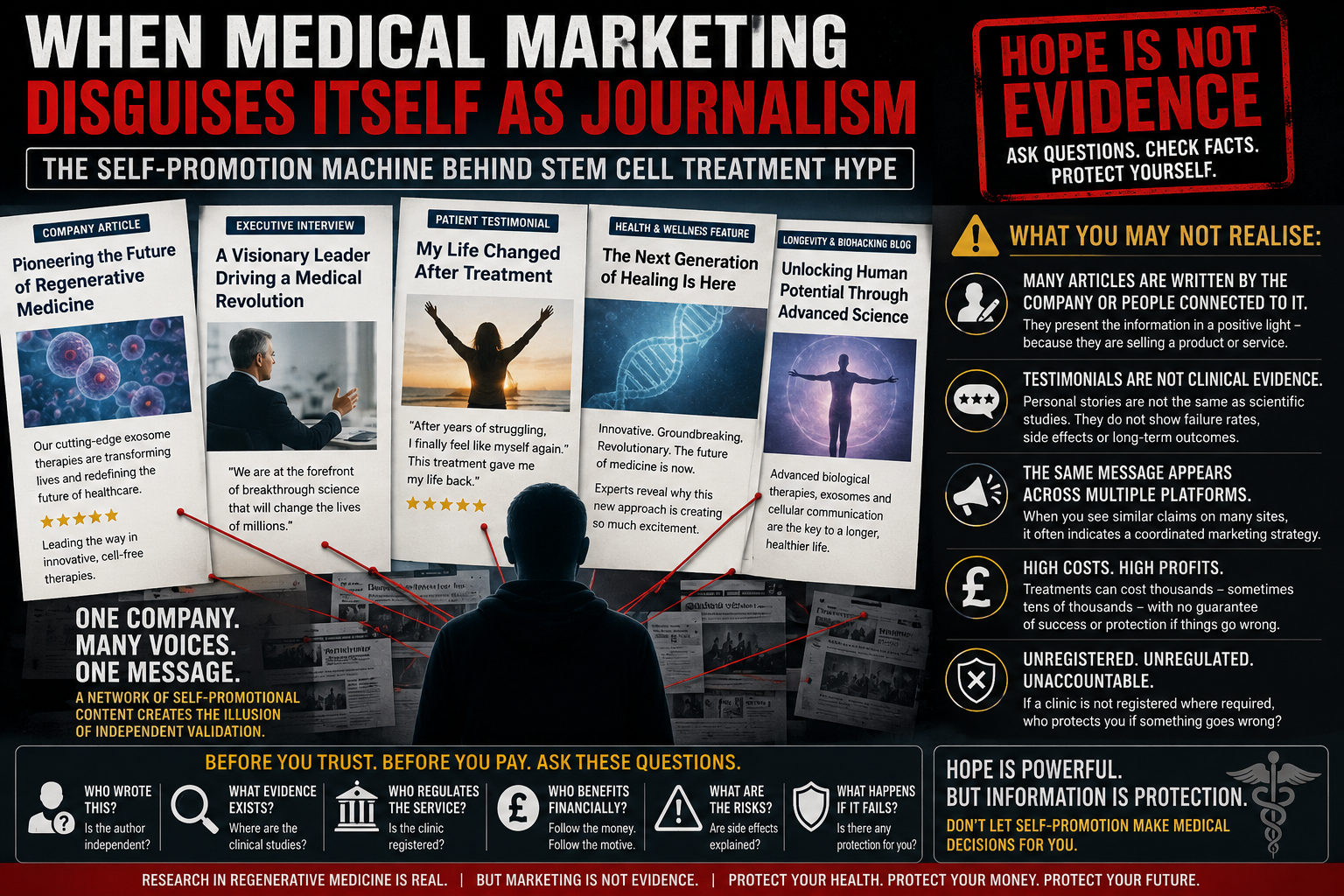
Its websites are filled with stories of innovation, scientific discovery and medical possibility.
Patients are shown impressive laboratories.
They are introduced to leadership teams.
They read articles discussing breakthroughs and future therapies.
They see testimonials from people claiming life-changing results.
But throughout our investigation into this rapidly expanding sector, one question repeatedly emerged.
A question so simple that many consumers never think to ask it.
- Who is actually treating you?
- Not who owns the company.
- Not who wrote the article.
- Not who appears in the interview.
- Not who answers the telephone.
The actual medical professional responsible for your care.
Because when things go right, everyone is happy.
The real test comes when things go wrong.
The Confusion At The Heart Of Modern Regenerative Medicine
Many consumers assume that the company they are dealing with is also the clinic providing the treatment.
That assumption is not always correct.
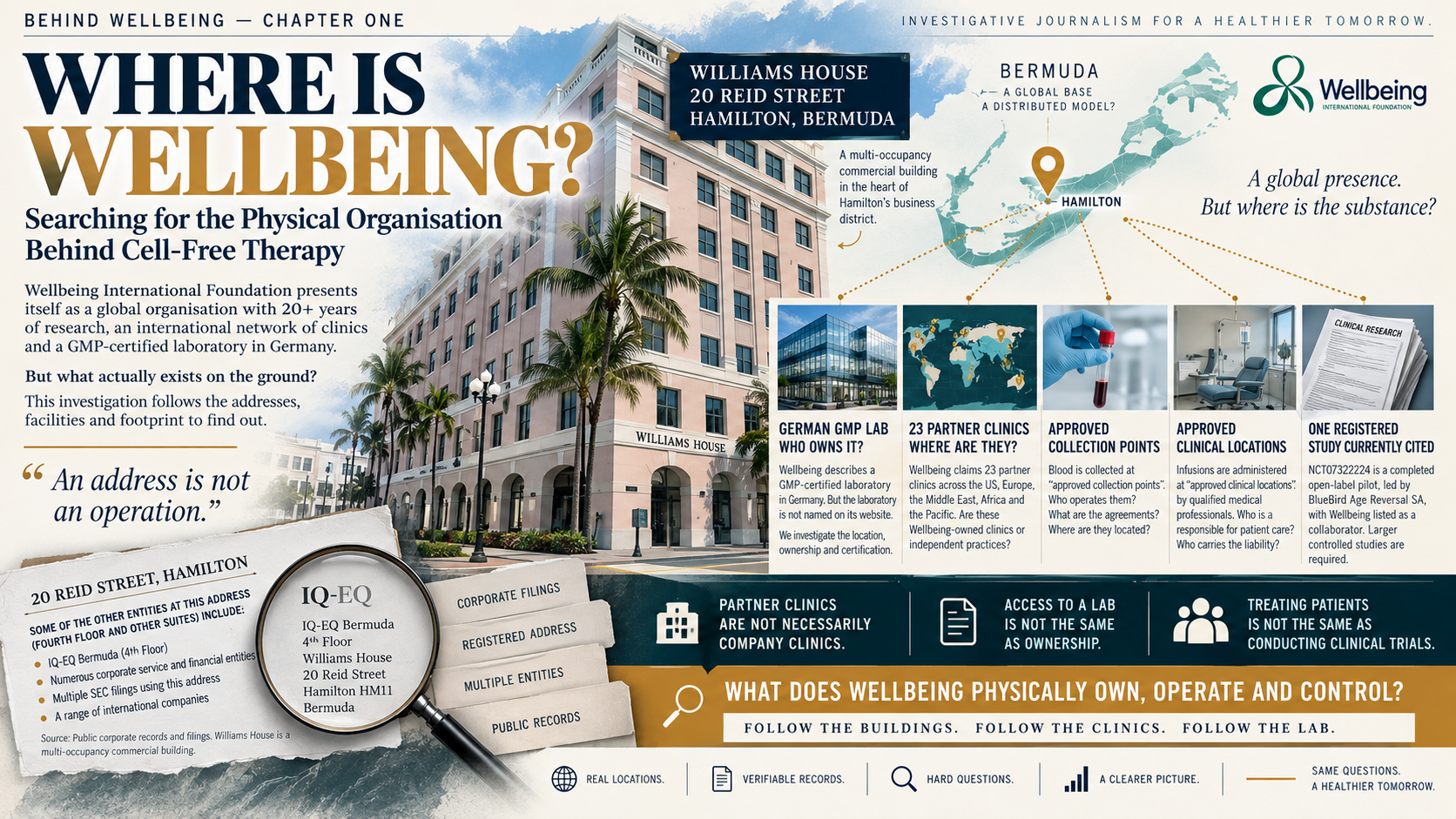
In some cases, businesses promote treatments that are ultimately delivered by separate practitioners, separate clinics, separate laboratories or even separate organisations operating in different countries.
This can create a confusing chain of responsibility.
Patients may know the company brand.
They may know the sales representative.
They may know the person who arranged the consultation.
Yet they may know surprisingly little about the person who will ultimately be responsible for their medical care.
That should concern every consumer.
The Most Important Name On The Form
When undergoing any medical procedure, one name matters more than any other.
The clinician responsible for treatment.
- Who examined you?
- Who reviewed your medical history?
- Who assessed the risks?
- Who decided you were suitable?
- Who obtained informed consent?
- Who authorised the procedure?
- Who takes responsibility if complications occur?
These are not technical questions.
They are fundamental patient-safety questions.
Yet many consumers entering the regenerative medicine marketplace focus almost entirely on the treatment being sold rather than the medical professional providing it.
The Power Of Branding
Modern healthcare marketing is highly sophisticated.
- A consumer may encounter:
- A professional website.
- A polished executive interview.
- A scientific-looking article.
- A patient testimonial.
- A business profile.
- A social media campaign.
- A corporate leadership team.
All of these elements create trust.
The problem is that branding can sometimes become more visible than the medicine itself.
Consumers begin to trust the organisation without fully understanding who is clinically accountable.
In healthcare, that distinction matters enormously.
What Happens If Something Goes Wrong?
It is an uncomfortable question.
But it is the question every patient should ask before handing over money.
- What happens if complications occur?
- Who do you contact?
- Who carries professional indemnity insurance?
- Who investigates concerns?
- Who reviews adverse outcomes?
- Who accepts responsibility?
If a company cannot clearly explain these processes, consumers should proceed with caution.
Transparency should be a basic requirement in healthcare.
Not an optional extra.
The Difference Between Marketing Responsibility And Medical Responsibility
Many businesses in the regenerative medicine sector are exceptionally good at marketing.
They produce articles.
They publish testimonials.
They conduct interviews.
They explain complex science in simple language.
There is nothing wrong with that.
The problem arises when marketing visibility becomes confused with clinical responsibility.
A person may be highly visible within an organisation while having no direct responsibility for patient treatment.
Likewise, the person carrying medical responsibility may be largely invisible to the consumer.
Patients deserve clarity.
They deserve to know exactly who is responsible for their care.
The Questions Consumers Should Demand Answers To
Before proceeding with any treatment, ask:
Who is the treating clinician?
What qualifications do they hold?
Which professional body regulates them?
Where are they licensed?
What experience do they have?
Who carries responsibility if complications occur?
Who holds the medical records?
Who carries professional indemnity cover?
Who regulates the facility?
What complaints process exists?
If clear answers are unavailable, consumers should stop and investigate further.
Why Vulnerable Patients Need Extra Protection
The regenerative medicine industry attracts people searching for solutions.
Many have chronic illness.
Many have long-term pain.
Many have exhausted conventional options.
Many are frightened.
Many are desperate.
That vulnerability creates an ethical responsibility.
Healthcare businesses should be held to higher standards than ordinary commercial enterprises.
The more vulnerable the patient, the greater the responsibility to provide transparency.
Not less.
The Accountability Gap
Perhaps the greatest risk facing consumers today is what investigators increasingly refer to as the accountability gap.
Patients know who marketed the treatment.
Patients know who sold the treatment.
Patients know who promoted the treatment.
But when problems arise, identifying who is actually responsible can become much harder.
That gap benefits nobody except those who prefer not to answer difficult questions.
Healthcare should never operate in a grey area.
Patients deserve certainty.
Patients deserve accountability.
Patients deserve answers.
Trust Must Be Earned
Trust is essential in medicine.
Without trust, healthcare cannot function.
But trust should never be based solely on websites, testimonials, articles or corporate branding.
Trust should be earned through:
Transparency.
Evidence.
Professional qualifications.
Regulatory oversight.
Clear accountability.
And honest communication.
Anything less places patients at risk.
The Bottom Line
The regenerative medicine industry may well play an important role in the future of healthcare.
Research continues.
Science evolves.
New discoveries emerge every year.
But before committing your health, your hopes and your money to any treatment programme, ask one simple question:
Who is actually treating me?
Not who owns the company.
Not who appears in the marketing.
Not who wrote the article.
The person who accepts medical responsibility for your care.
Because when hope is being sold, accountability matters.
And in healthcare, accountability starts with knowing exactly who is responsible when the promises end and the treatment begins.