The internet has transformed the way people research healthcare.
Before making decisions about treatments, therapies, clinics, and medical providers, many patients turn to Google in search of answers. They read articles, watch videos, browse websites, and consume large amounts of content in the hope of finding trustworthy information.
But a growing problem is emerging.
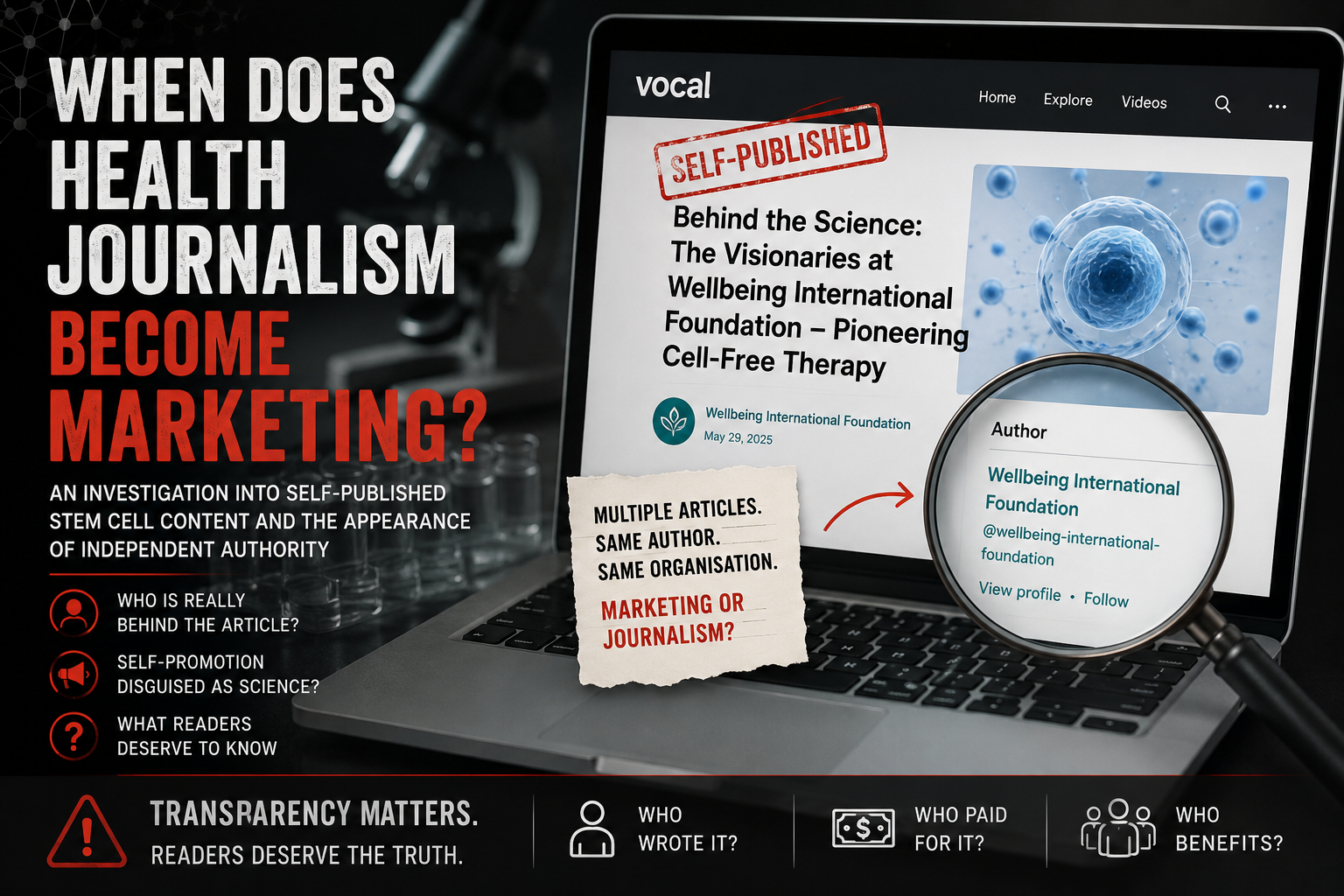
Many of the articles appearing in search results are not written by independent journalists, healthcare professionals, or scientific researchers.
Instead, they are being written by the very organisations that stand to benefit financially from the treatments being discussed.
The question is simple:
Are patients reading independent information, or are they reading marketing?
The Rise of Self-Published Authority
Modern digital publishing has created opportunities for anyone to become a publisher.
Companies no longer need to wait for journalists to write about them.
They can publish articles directly onto content platforms, business websites, online magazines, and media distribution networks.
There is nothing inherently wrong with this practice.
Businesses have every right to tell their story.
The issue arises when promotional content begins to resemble independent reporting.
Many readers see a professionally written article on a recognised platform and naturally assume the content has been researched and verified by an independent source.
In reality, that may not always be the case.
The Appearance of Credibility
Healthcare marketing has become increasingly sophisticated.
Rather than relying solely on traditional advertising, organisations now focus on creating educational content.
These articles often discuss:
- Scientific developments
- Medical innovation
- Patient success stories
- Industry leadership
- Future breakthroughs
On the surface, the content appears informative.
However, readers should always ask an important question:
Who wrote the article?
If the answer is the organisation itself, then the content should be viewed through a different lens.
The Language of Promotion
One of the easiest ways to identify promotional content is through the language used.
Marketing articles frequently contain phrases such as:
- Revolutionary
- Groundbreaking
- Visionary
- Innovative
- Transformational
- Pioneering
These words create excitement.
They build confidence.
But they are not evidence.
Independent journalism tends to focus on verification.
Marketing focuses on persuasion.
The difference is important.
What Independent Reporting Looks Like
A genuine investigative journalist is trained to ask difficult questions.
They seek multiple viewpoints.
They examine strengths and weaknesses.
They challenge claims.
They look for evidence.
An independent article discussing a healthcare treatment would typically explore:
- Clinical evidence
- Regulatory status
- Risks and limitations
- Independent expert opinions
- Contradictory findings
- Unanswered questions
When these elements are missing, readers should proceed with caution.
The Search Engine Effect
Search engines reward content.
The more articles that exist about a company, the more visible that company becomes online.
Over time, a collection of positive articles can create the impression of widespread support and validation.
Consumers may see multiple articles discussing the same organisation and conclude that independent media outlets have extensively covered the story.
Yet many of those articles may ultimately originate from the same source.
Different websites.
Different headlines.
Different formats.
The same underlying message.
This phenomenon has become increasingly common in sectors such as:
- Regenerative medicine
- Stem cell therapies
- Wellness treatments
- Longevity medicine
- Alternative healthcare
Why Transparency Matters
Transparency is not about accusing organisations of wrongdoing.
It is about helping readers understand where information originates.
Every healthcare article should prompt a few simple questions:
- Who wrote this?
- Who funded this?
- Was it independently researched?
- Does the author have a commercial interest?
- Is opposing evidence presented?
These questions are especially important when treatments involve significant costs or vulnerable patients seeking hope.
A Better Informed Public
Patients deserve accurate information.
They deserve transparency.
And they deserve to know whether they are reading journalism, advertising, public relations, or corporate content marketing.
The solution is not censorship.
The solution is awareness.
By understanding how online authority is created, consumers can make more informed decisions and better evaluate the claims presented to them.
The internet contains extraordinary amounts of valuable information.
It also contains marketing.
The challenge for modern consumers is learning the difference.
Editorial Note
This article discusses general publishing practices within healthcare marketing and digital media. It is intended to encourage transparency, critical thinking, and informed decision-making when evaluating online healthcare information.