For many people researching healthcare treatments online, the source of information often appears trustworthy.
The article is published on a professional website.
The branding looks credible.
The writing is polished.
The publication appears well established.
As a result, most readers naturally assume they are reading independent journalism.
Unfortunately, that assumption is not always correct.
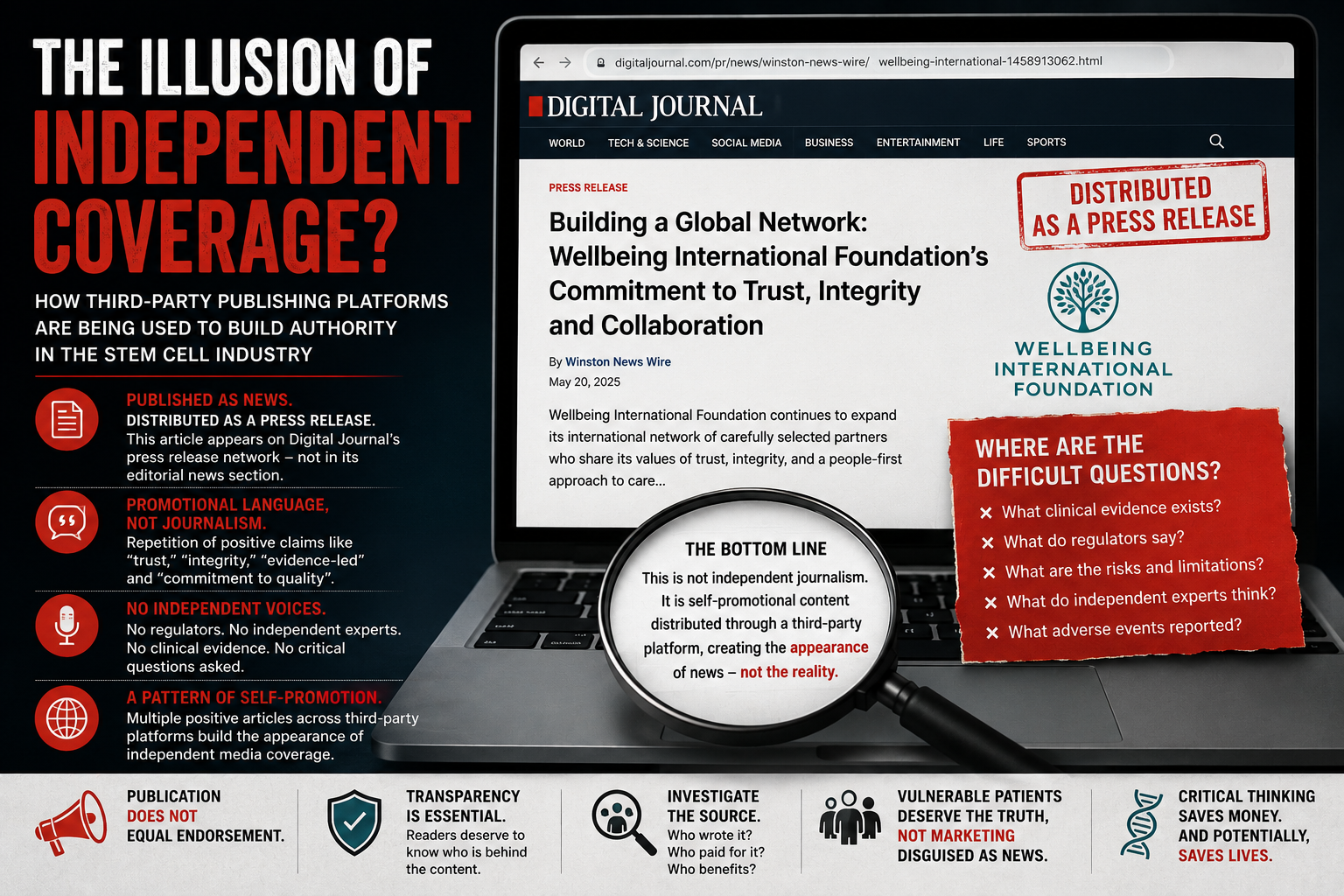
Across the healthcare sector, and particularly within emerging industries such as regenerative medicine, companies are increasingly using press release distribution services to place promotional content onto recognised news platforms.
The result can be confusing for consumers.
What appears to be news may actually be marketing.
Understanding the Modern Press Release
Press releases have existed for decades.
Traditionally, organisations would issue press releases to journalists, who would then decide whether the information was newsworthy enough to investigate and report on.
Today, the process often works differently.
Many press release services now distribute content directly to online publishing platforms.
Articles can appear on websites that resemble traditional news outlets, even though the content was supplied by the organisation being discussed.
This creates an important distinction.
Publication does not necessarily mean independent reporting.
In many cases, it simply means the content has been distributed through a media network.
The Appearance of Authority
The average reader rarely examines how an article was published.
Most people focus on:
- The headline
- The publication name
- The professional appearance of the website
Very few readers investigate whether the content was:
- Independently researched
- Written by a journalist
- Submitted by a public relations agency
- Distributed through a press release service
As a result, promotional content can gain credibility simply by appearing on a recognised platform.
The Questions That Often Go Unasked
Independent journalism is built upon scrutiny.
A journalist is expected to challenge claims, seek opposing viewpoints, verify information, and present balanced reporting.
When reading healthcare-related content, readers should look for evidence that these steps have taken place.
Important questions include:
- What evidence supports the claims?
- What do independent experts say?
- What limitations exist?
- What risks have been identified?
- What do regulators think?
- Is there any disagreement within the scientific community?
When these questions are absent, readers should consider whether the content is designed to inform or persuade.
The Language of Public Relations
Press releases are intended to create positive impressions.
Because of this, they often rely on carefully selected language.
Common examples include:
- Industry-leading
- Innovative
- Groundbreaking
- Revolutionary
- Trusted
- Pioneering
Such descriptions may be accurate.
However, they are also promotional.
Their purpose is to strengthen reputation and encourage confidence.
Journalism, by contrast, relies on evidence rather than adjectives.
Why Search Engines Matter
Search engines reward content.
The more content that exists discussing a particular organisation, the more visible that organisation becomes online.
This creates a powerful marketing opportunity.
A company may distribute multiple articles across different websites.
Each article reinforces similar messages.
Over time, potential customers searching online encounter article after article discussing the same organisation.
This repetition can create the impression of widespread independent recognition.
Yet many of those articles may ultimately originate from the same source.
Healthcare Requires Higher Standards
This issue becomes particularly important when discussing healthcare treatments.
Patients researching medical options are often vulnerable.
They may be seeking solutions for serious illnesses, chronic conditions, pain management, or quality-of-life concerns.
In these situations, transparency matters.
Readers deserve to know:
- Who created the content.
- Who paid for the content.
- Whether the article was independently researched.
- Whether commercial interests are involved.
Without that transparency, consumers may struggle to distinguish between information and promotion.
A Simple Rule for Readers
When you encounter an impressive healthcare article online, pause before accepting it at face value.
Ask yourself:
Who wrote this?
Who benefits if I believe it?
Who paid for it?
Was it independently investigated?
The answers may not change the facts being presented.
But they will help you understand the context.
And in healthcare, context can be just as important as the claims themselves.
The Bottom Line
Press releases are not inherently bad.
Sponsored content is not inherently bad.
Corporate communications are not inherently bad.
The problem occurs when readers mistake promotional material for independent journalism.
The internet contains more information than at any point in human history.
It also contains more marketing.
Understanding the difference may be one of the most important skills modern consumers can develop.
Editorial Note
This article examines general publishing practices within digital media and healthcare marketing. It is intended to encourage transparency, critical thinking, and informed evaluation of healthcare-related information found online.