The internet has changed the way people consume information.
A patient researching a new treatment no longer relies solely on their doctor, medical journals, or traditional media. Instead, they are likely to search online, read articles, watch videos, and browse websites in an effort to better understand their options.
But in today's digital world, one important question is often overlooked:
Who is really behind the content being read?
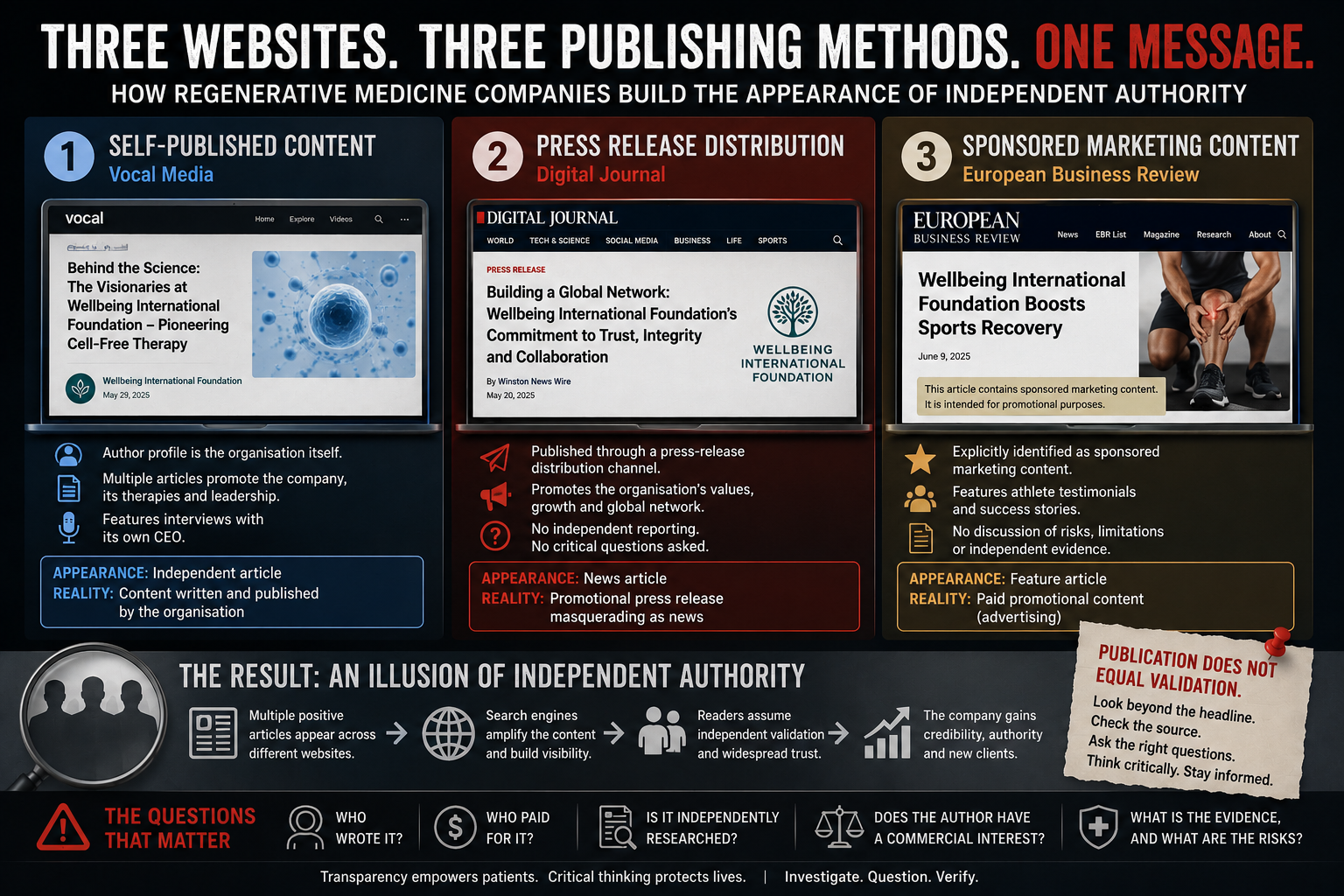
As healthcare marketing becomes increasingly sophisticated, sponsored articles are becoming more common across business websites, online magazines, and industry publications.
Many readers never realise they are reading promotional material.
They simply see a respected publication, a professional layout, and an article discussing exciting developments in medicine.
The distinction between journalism and advertising can quickly become blurred.
The Rise of Sponsored Healthcare Content
Sponsored content is not a new concept.
For decades, companies have paid publications to distribute marketing messages to targeted audiences.
What has changed is how these advertisements are presented.
Rather than traditional banner adverts or obvious promotions, modern sponsored content often takes the form of a professionally written article.
The format resembles journalism.
The structure resembles journalism.
The language resembles journalism.
Yet the purpose remains promotion.
This style of content is commonly referred to as native advertising because it blends into the publication around it.
For the average reader, identifying the difference can be difficult.
The Credibility Transfer Effect
One reason sponsored content is so effective is because of what media experts sometimes call the "credibility transfer effect."
When content appears on a recognised publication, readers naturally associate the article with the reputation of that publication.
The publication may have spent years building trust with its audience.
When a sponsored article appears alongside editorial content, some of that trust can transfer to the advertiser.
As a result, readers may assume:
- The publication independently investigated the claims.
- The publication endorses the organisation.
- The publication verified the information.
- The publication supports the conclusions.
In reality, that may not be the case.
The article may simply be paid promotional content.
The Missing Questions
Independent journalism is designed to challenge claims.
Good journalists ask difficult questions.
They seek opposing viewpoints.
They look for weaknesses as well as strengths.
They investigate.
Sponsored content works differently.
Its purpose is typically to highlight positive aspects of an organisation, product, or service.
As a result, readers may notice that sponsored articles often omit discussions about:
- Risks and limitations
- Regulatory concerns
- Contradictory evidence
- Alternative viewpoints
- Independent criticism
- Scientific uncertainty
This does not necessarily mean the information is incorrect.
It simply means the content serves a different purpose.
Why Healthcare Requires Extra Caution
The distinction becomes especially important in healthcare.
Patients researching treatments are often facing difficult circumstances.
Some may be suffering from chronic illness.
Others may be seeking solutions after conventional treatments have failed.
Many are looking for hope.
This makes transparency particularly important.
Consumers deserve to know:
- Whether the article is sponsored.
- Whether the author has a commercial interest.
- Whether independent experts were consulted.
- Whether competing viewpoints were considered.
Without that information, it becomes harder to make informed decisions.
Reading Beyond the Headline
Most readers focus on headlines and main content.
Few scroll to the bottom of an article.
Yet important disclosures are often found there.
Sponsored content may contain statements such as:
- "Paid content"
- "Sponsored article"
- "Marketing feature"
- "Promotional material"
- "Partner content"
These disclosures provide valuable context.
Unfortunately, many readers never see them.
The article is read.
The message is absorbed.
The source is forgotten.
The Search Engine Strategy
Modern content marketing extends far beyond a company's own website.
Organisations often seek visibility across multiple third-party platforms.
This creates additional search engine exposure and helps establish authority online.
When potential customers search for information, they may encounter:
- Interviews
- Features
- Sponsored articles
- Press releases
- Corporate blogs
Together, these pieces create a large digital footprint.
The average consumer may interpret this as widespread independent recognition.
However, publication alone does not prove independent validation.
Transparency Builds Trust
There is nothing inherently wrong with sponsored content.
There is nothing inherently wrong with advertising.
Businesses have every right to promote their services.
The key issue is transparency.
Readers should be able to easily understand:
- Who created the content.
- Why it was published.
- Whether financial interests are involved.
- What level of editorial independence exists.
When those details are clear, consumers can make informed judgments for themselves.
A Simple Test
The next time you read a healthcare article online, ask yourself five simple questions:
- Who wrote this article?
- Who paid for it?
- Is the author independent?
- Are opposing viewpoints included?
- What evidence supports the claims?
The answers may tell you far more than the headline ever could.
The Bottom Line
The internet is full of valuable information.
It is also full of marketing.
The challenge for modern consumers is not finding information.
The challenge is understanding where that information comes from.
In healthcare, where decisions can affect finances, wellbeing, and quality of life, that distinction matters.
Transparency does not prevent people from making choices.
It helps them make better ones.
Editorial Note
This article examines general trends in healthcare publishing, sponsored content, and digital marketing. It is intended to encourage transparency, critical thinking, and informed evaluation of healthcare information available online. No allegation of wrongdoing is made against any individual, organisation, or publication.