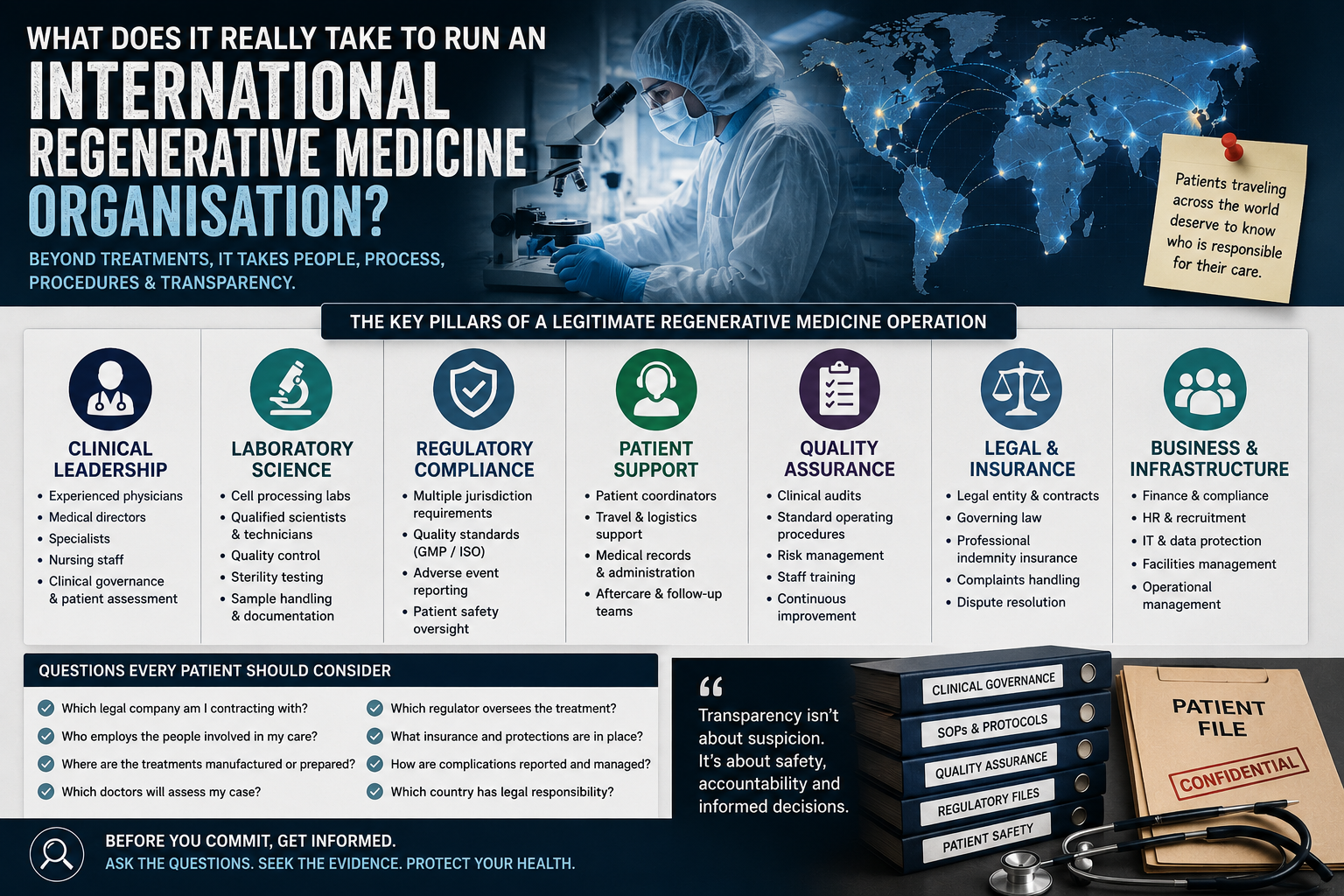
When most people think about stem cell therapy or regenerative medicine, they picture a consultation room, a doctor and perhaps a laboratory.
In reality, that's only a tiny part of the picture.
Modern regenerative medicine is one of the most complex areas of healthcare. Behind every consultation lies an extensive network of specialists, governance, regulation, quality control and administration that most patients never see.
Understanding that infrastructure isn't just interesting—it can help you make better decisions when choosing where to place your health, and often a significant financial investment.
It starts long before the patient arrives
Every reputable regenerative medicine provider should have systems in place before a patient even walks through the door.
Those systems typically include:
- Clinical governance.
- Medical leadership.
- Patient assessment procedures.
- Laboratory partnerships.
- Regulatory compliance.
- Quality assurance.
- Data protection.
- Financial and legal oversight.
These aren't optional extras.
They're the foundations that support safe and accountable healthcare.
Doctors are only one part of the team
A successful regenerative medicine programme is rarely built around one individual.
Behind the scenes, patients would normally expect to find a multidisciplinary team that may include:
- Consultant physicians.
- Medical directors.
- Specialist clinicians.
- Registered nurses.
- Laboratory scientists.
- Quality managers.
- Patient coordinators.
- Administrative staff.
- Compliance specialists.
- Customer support teams.
Each plays a different role in ensuring treatments are delivered consistently and responsibly.
The laboratory is often the heart of the operation
Whether treatments involve stem cells, cell-free therapies, biologics or other regenerative products, laboratory standards are critical.
Patients may reasonably wish to understand:
- Where are products prepared?
- Who is responsible for quality control?
- What standards are followed?
- How is sterility maintained?
- What safeguards exist to ensure consistency?
Many providers work with specialist laboratories rather than operating their own.
There is nothing unusual about that.
The important point is that patients should understand who those laboratories are and what role they play in the treatment process.
Healthcare is heavily regulated for a reason
Unlike many industries, healthcare operates within strict regulatory frameworks designed to protect patients.
Depending on the countries involved, a regenerative medicine provider may need to comply with multiple legal and professional requirements.
Patients may wish to ask:
- Which country's regulations apply?
- Which professional bodies oversee the clinicians?
- What standards govern the laboratory work?
- How are complications reported?
- What systems exist for patient safety?
Clear answers to these questions help build confidence.
Quality doesn't happen by accident
Some of the most important work within a healthcare organisation happens away from patients.
Quality assurance teams monitor systems, review procedures, investigate incidents and continually improve the service.
Although much of this work is invisible, it is fundamental to maintaining high standards.
Without robust governance, even experienced clinicians can find themselves working within systems that lack consistency or accountability.
Looking beyond the treatment itself
Patients often focus on outcomes.
Understandably so.
But asking questions about the organisation itself can be just as important.
For example:
- Who employs the clinical staff?
- Which company provides the treatment?
- Who carries legal responsibility?
- What professional insurance exists?
- How are complaints handled?
- Who oversees patient safety?
These questions don't imply that something is wrong.
They simply help patients understand the organisation they are placing their trust in.
Transparency builds confidence
Many excellent healthcare providers openly explain how they operate.
They identify their clinical leadership.
They describe their laboratory partnerships.
They explain their governance arrangements.
They provide clear information about the legal entities involved in patient care.
That level of openness allows prospective patients to make informed choices.
It also demonstrates confidence in the systems supporting the treatment.
Before making your decision...
If you're considering regenerative medicine, don't just ask about success rates or testimonials.
Ask about the organisation itself.
Ask how it operates.
Ask who is responsible.
Ask how quality is maintained.
Ask who stands behind the treatment—not just medically, but organisationally.
Because the strongest healthcare providers are built on far more than promising therapies.
They're built on transparent governance, experienced professionals, robust systems and a willingness to answer the questions that every patient has the right to ask.