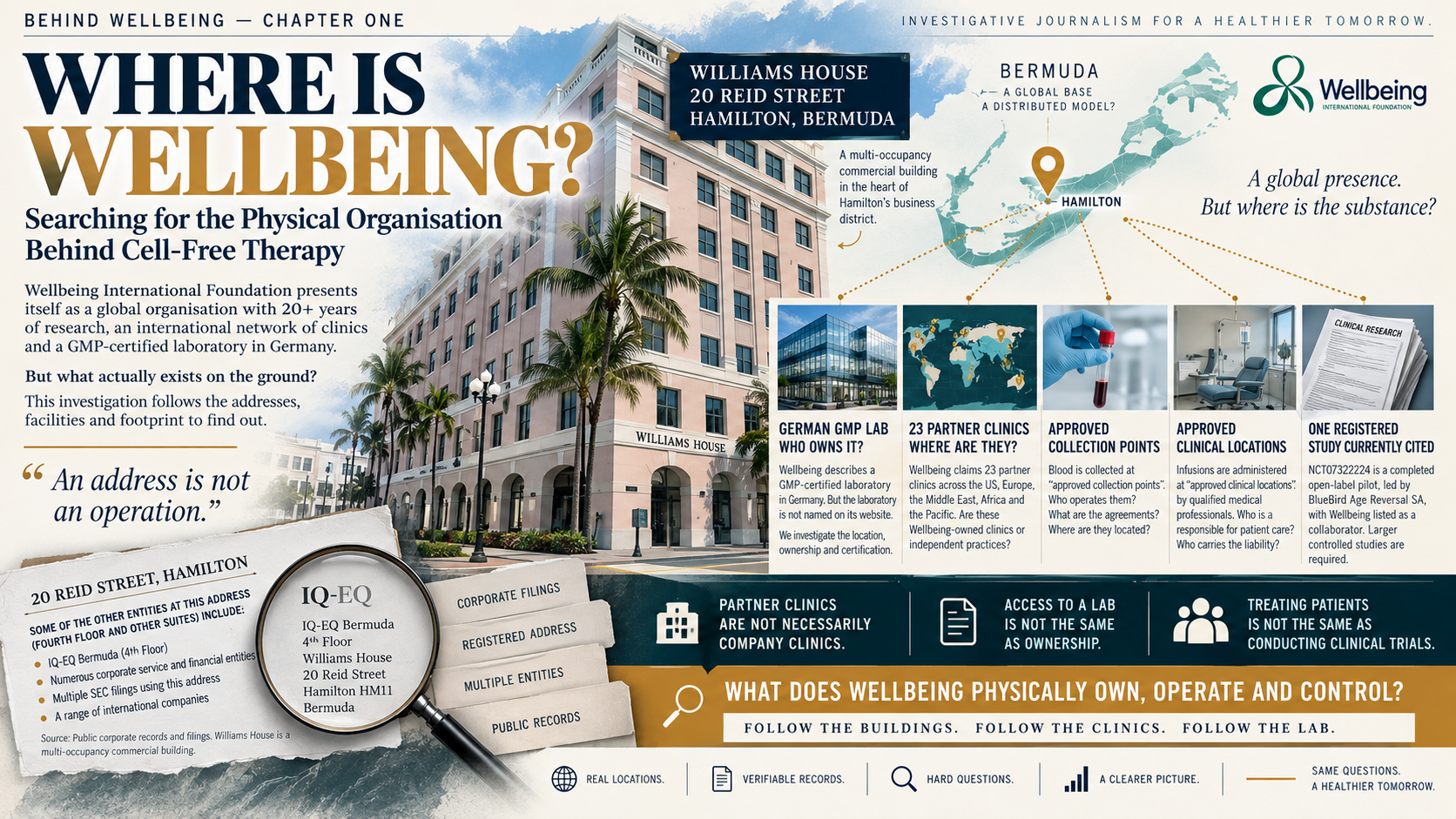
When a healthcare organisation tells the public it operates through a large international network of partner clinics, most people would expect those clinics to be easy to identify.
Patients would expect names.
They would expect locations.
They would expect doctors.
They would expect some clear route to understanding where treatment is delivered and who is responsible for their care.
That expectation is not unreasonable. In healthcare, transparency is not simply a matter of marketing. It is part of trust.
This investigation began with a simple public-interest question.
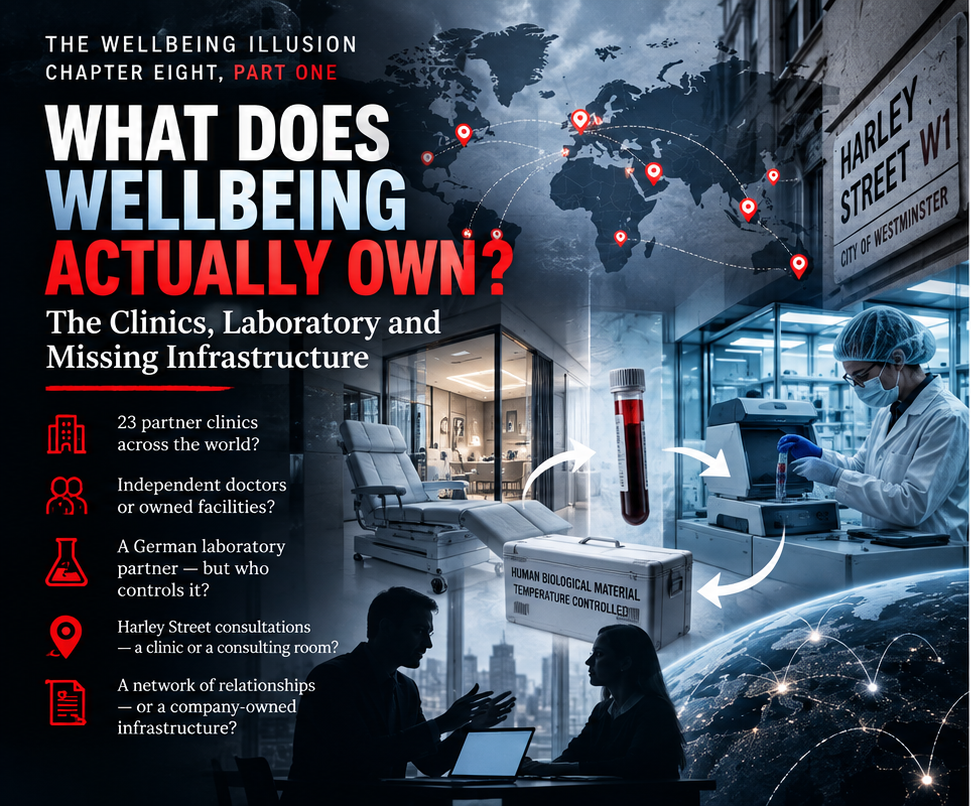
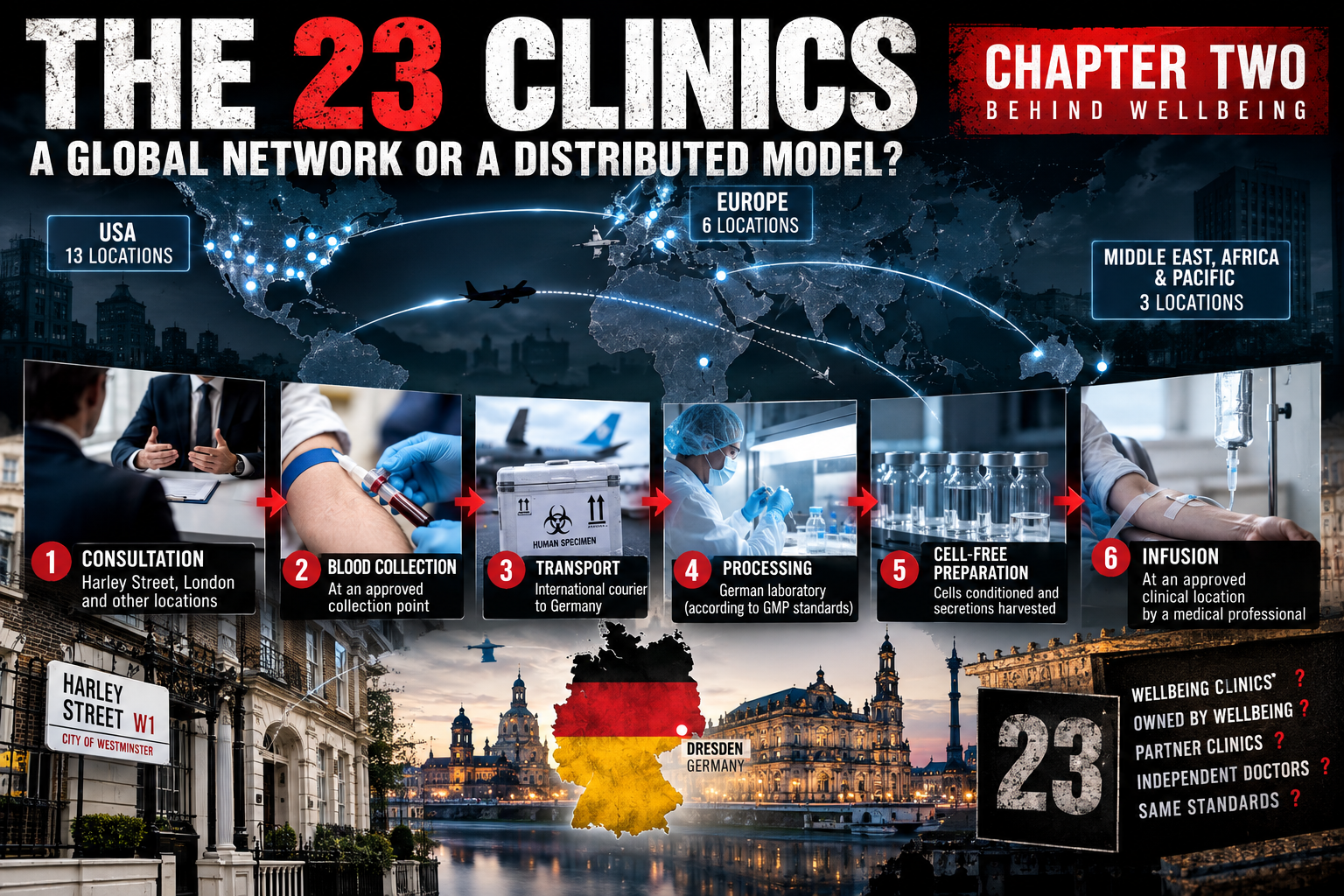
Wellbeing International Foundation publicly describes a delivery network of more than twenty partner clinics across the United States and internationally. Its website refers to multiple locations, including cities across America and other parts of the world.
At first glance, that creates the impression of a significant medical network.
But when we began looking for the individual clinics behind that claim, the public record became far less clear.
This article is not about whether any treatment works.
It is not about individual patients.
It is not an allegation that clinics do not exist.
It asks something much simpler:
If Wellbeing International Foundation says it has more than twenty partner clinics, why are those clinics not clearly listed for the public to see?
The Claim
The Foundation’s own public material presents a picture of international reach.
It refers to a network of partner clinics across the United States and beyond. Cities listed include Austin, Dallas, Detroit, Los Angeles, Louisville, New Orleans, New York, Philadelphia, Reno, San Francisco, Seattle, St Louis and Virginia Beach.
These are real places.
But they are cities, not clinic names.
A city does not tell a patient where to go.
It does not identify the doctor.
It does not identify the clinic owner.
It does not provide a licence number, address, medical director or direct contact point.
That distinction matters.
There is a major difference between saying treatment is available in “Dallas” and naming the actual Dallas clinic responsible for delivering it.
For a patient, that difference is everything.
What We Looked For
Our investigation focused only on publicly available information.
We reviewed the Foundation’s website, public promotional material and the information available to prospective patients before making direct contact with the organisation.
We looked for:
clinic names;
clinic addresses;
doctors attached to each location;
medical directors;
public appointment pages;
location-specific phone numbers;
clinic websites;
and a directory of partner clinics.
What we found was a public description of a network.
What we did not find was a clear public directory identifying the clinics that make up that network.
That does not prove the clinics do not exist.
It does not prove treatment is not being delivered.
It simply means that, based on the public information reviewed, a patient may struggle to independently identify the clinics before entering the enquiry process.
That is the issue.
Why This Matters
Healthcare is not like buying an ordinary product.
Patients may be vulnerable.
They may be seriously ill.
They may be making emotional decisions.
They may be spending large sums of money.
They may be travelling internationally.
Before committing to treatment, patients should be able to understand the basic structure of the organisation they are dealing with.
Where will I be treated?
Who will treat me?
Who regulates that clinic?
Who carries medical responsibility?
Who do I contact if something goes wrong?
Those are not hostile questions.
They are normal questions.
They are the questions any responsible patient, family member or referring doctor should ask.
A transparent healthcare organisation should welcome them.
Cities Are Not Clinics
One of the clearest findings from this review is the difference between a geographic claim and a clinical directory.
A map with city names may suggest scale.
But it does not provide verification.
If a healthcare provider says it has a partner clinic in Seattle, the public should ideally be able to identify the clinic.
If it says it has a partner in New York, the public should be able to see who that partner is.
If it says it has a network across the United States, patients should be able to understand whether those clinics are active, permanent, contracted, occasional or independently owned.
Without that information, the phrase “partner clinic” remains unclear.
Does it mean a formal clinic relationship?
Does it mean an independent physician?
Does it mean a treatment location?
Does it mean a past arrangement?
Does it mean a referral contact?
The public cannot know unless the organisation explains it.
The Accountability Question
The lack of a public clinic directory also raises a second issue: accountability.
If treatment is delivered through independent partner clinics, who is responsible for each stage of the patient journey?
The Foundation?
The clinic?
The doctor?
The laboratory?
Another company?
This becomes especially important in cross-border healthcare, where biological material may be collected in one location, processed elsewhere and administered in another jurisdiction.
Patients should not have to guess who is responsible.
They should be able to understand the chain of care.
That is not only a legal issue.
It is a patient safety issue.
What Transparency Could Look Like
The questions raised in this investigation could be answered very simply.
The Foundation could publish a clear partner clinic directory.
That directory could include:
the name of each clinic;
the city and address;
the lead physician or medical director;
the clinic’s website;
the role of each clinic in the treatment process;
whether the location is currently active;
and how patients are matched to clinics.
Providing this information would not weaken the Foundation’s position.
It would strengthen it.
Transparency builds confidence.
It allows patients to verify claims.
It allows journalists to check facts.
It allows doctors to understand referral pathways.
It allows regulators to see how the network is structured.
If the clinic network is as extensive as described, then public identification of those clinics should support the claim rather than undermine it.
What We Are Not Saying
It is important to be clear.
This article does not claim Wellbeing International Foundation has no partner clinics.
It does not claim patients have not received treatment.
It does not claim individual doctors are not involved.
It does not claim wrongdoing.
What it does say is that the public-facing information reviewed does not appear to provide a clear list of the clinics behind the claimed network.
That is a fair and legitimate subject for scrutiny.
When a healthcare organisation makes a significant public claim, that claim should be capable of independent verification.
Questions for Wellbeing International Foundation
We believe the following questions deserve clear public answers:
What are the names of the 23 partner clinics?
Where is each clinic located?
Which clinics are currently active?
Who are the treating physicians at each location?
Are the clinics owned by the Foundation or independently operated?
What formal relationship exists between the Foundation and each clinic?
How are partner clinics selected?
How are patients matched to clinics?
Who is responsible for patient consent?
Who carries medical liability if something goes wrong?
These questions are not accusations.
They are basic transparency questions.
Right of Reply
Wellbeing International Foundation is invited to respond to any aspect of this article.
If the organisation wishes to provide the names and locations of its partner clinics, clarify how the network operates, correct any factual point or explain its patient pathway, we will review that information and update this article where appropriate.
This investigation is based solely on publicly available information.
We remain open to new evidence, clarification and correction.
Final Summary
This investigation began with one simple question:
Where are the 23 partner clinics?
The Foundation publicly presents itself as operating through a sizeable international network. Yet, based on the public information reviewed, the individual clinics behind that network do not appear to be clearly identified in a way that allows easy independent verification.
That matters because healthcare depends on trust.
Trust depends on transparency.
And transparency begins with patients knowing who is treating them, where they are being treated and who is responsible for their care.
Until those clinic names, doctors and locations are publicly identified, the question remains:
Where exactly is the clinic network?