The Wellbeing International Foundation blog article, “Performance, Recovery, and Resilience: Why Athletes Are Turning to Wellbeing International Foundation,” is not written like a hard medical paper.
It is written like soft persuasion.
That is what makes it dangerous.
The article does not directly say, “we regenerate athletes’ joints.”
It does not directly say, “we extend sporting careers.”
It does not directly say, “we prevent injury.”
Instead, it builds an emotional bridge.
Athletes.
Recovery.
Resilience.
Energy.
Movement.
Long-term wellbeing.
Then it asks the reader to walk across that bridge without ever being shown the evidence underneath.
The Claims Hidden Inside The Language
The article repeatedly uses careful, attractive phrases.
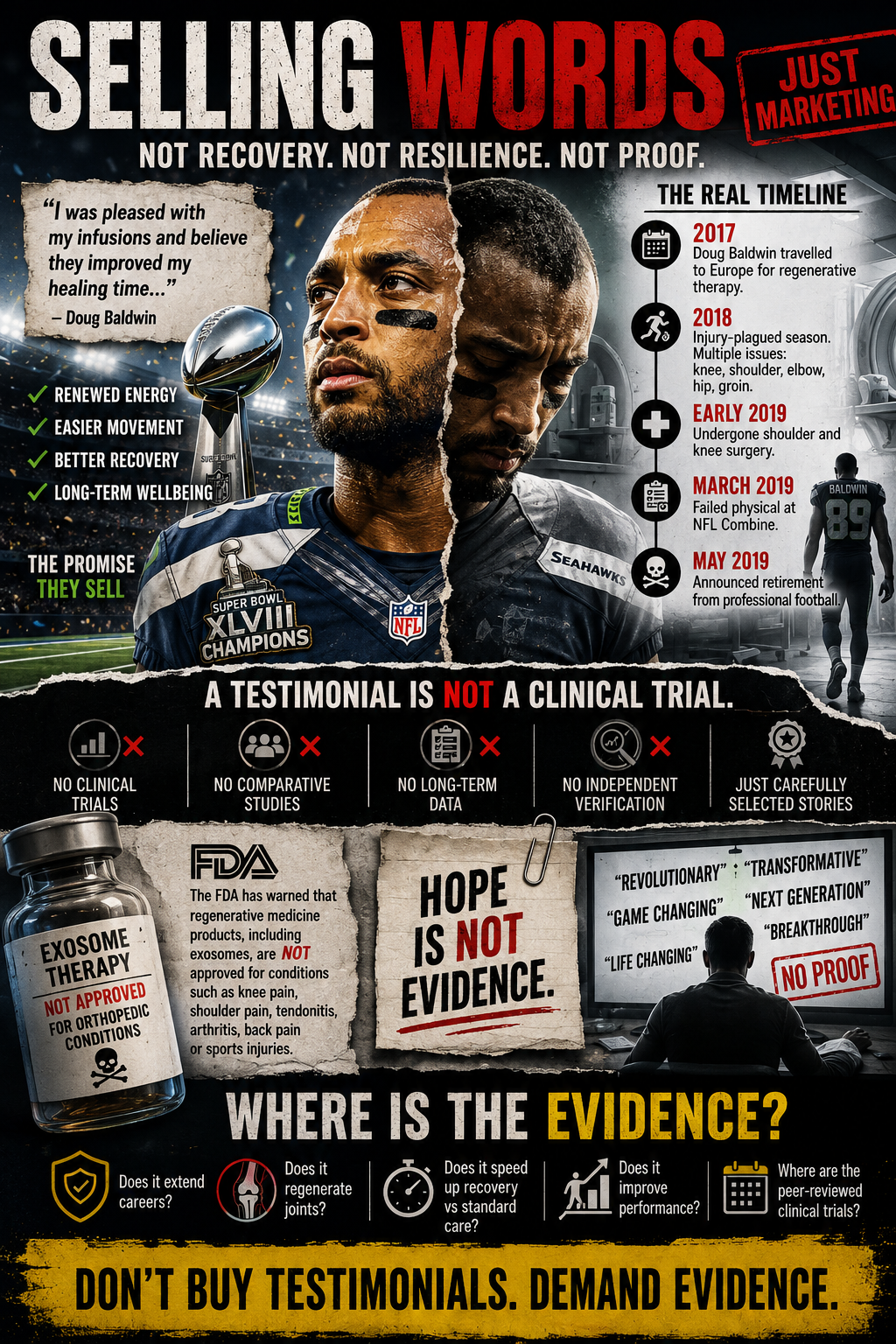
Athletes are said to describe “renewed energy,” “easier movement,” “better recovery rhythms,” and a sense of being more physically in sync.
This may sound harmless.
But in the context of a company promoting cell-free therapy, these are not neutral words. They are commercial signals.
They invite the reader to believe that the treatment is doing something measurable inside the body.
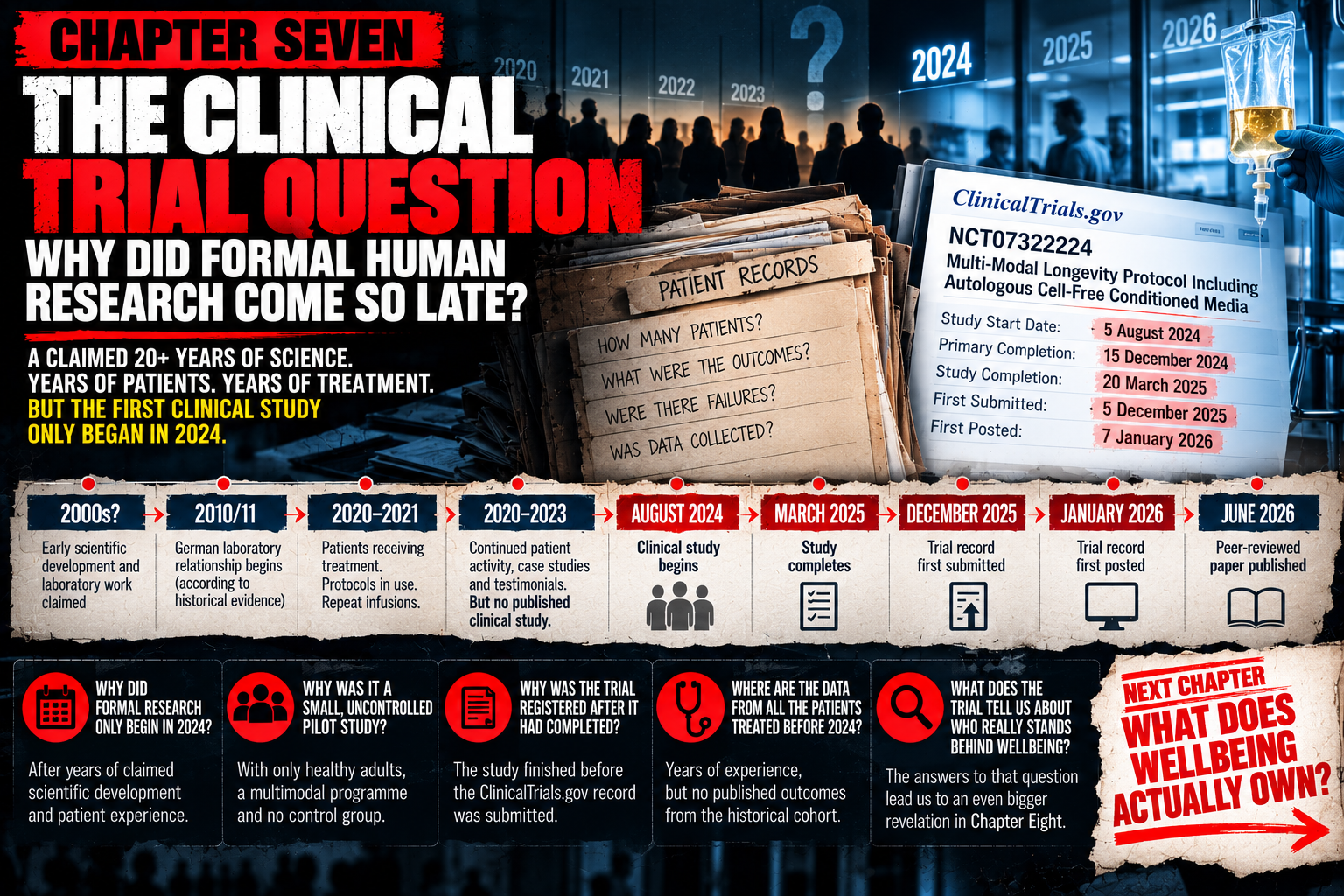
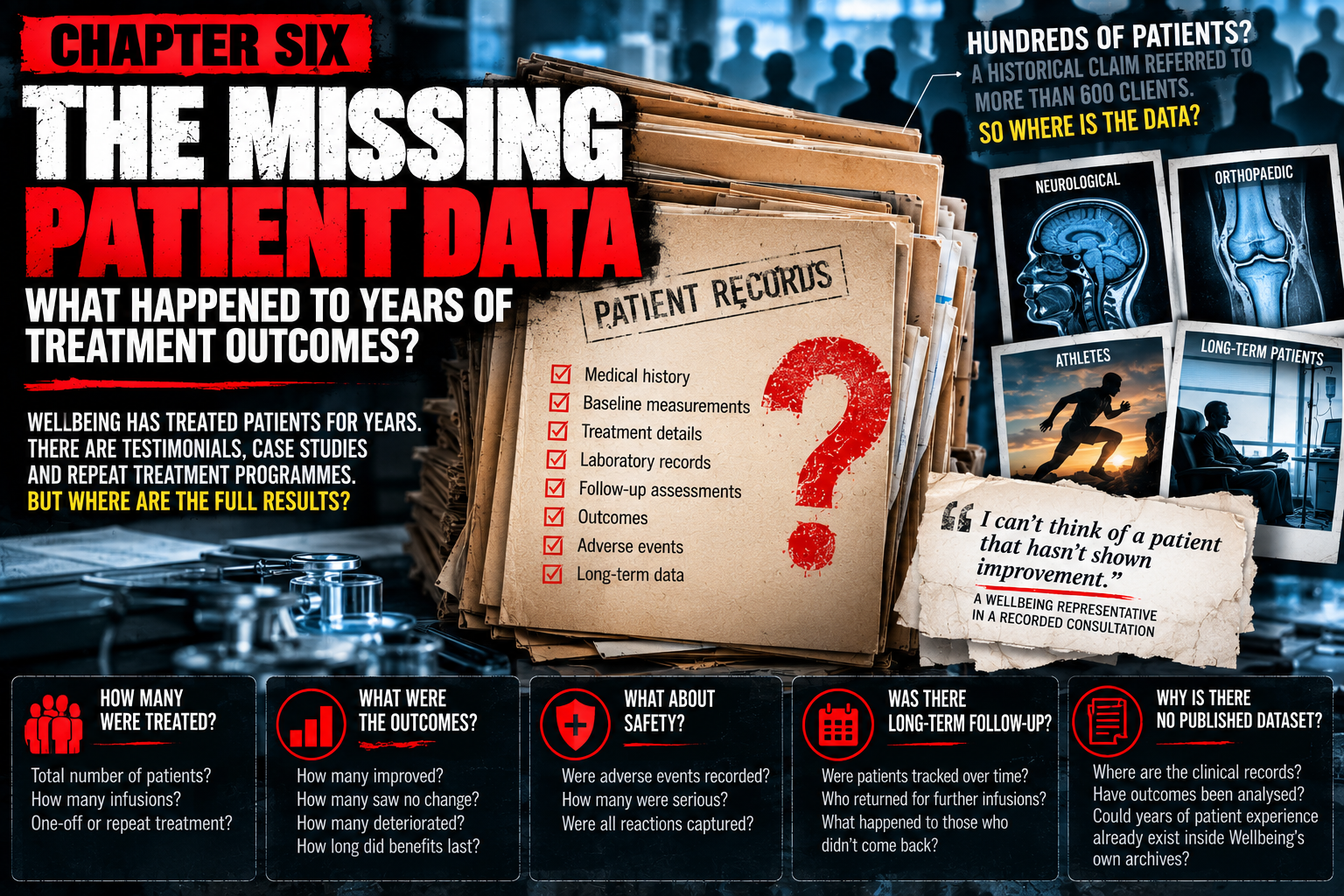
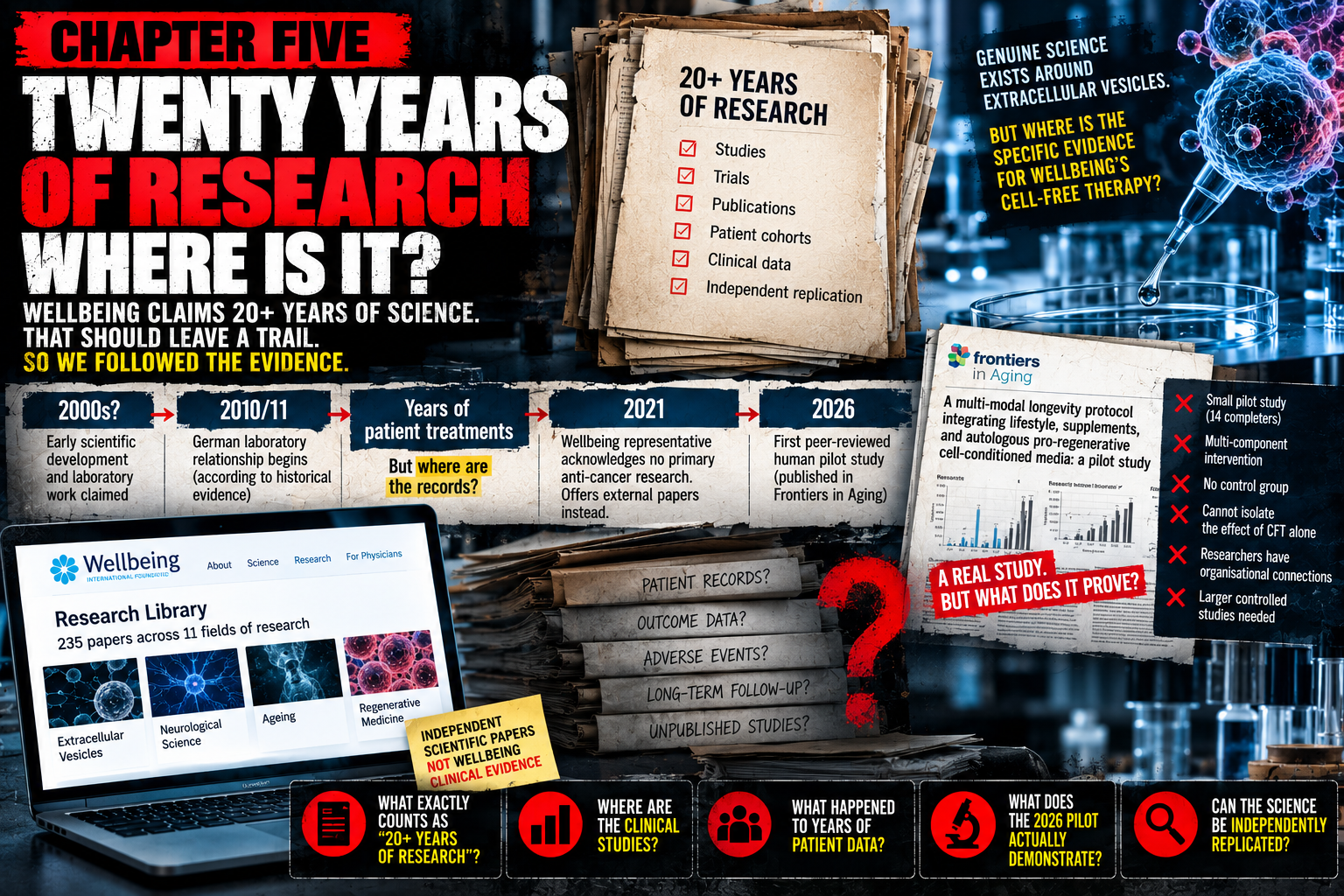
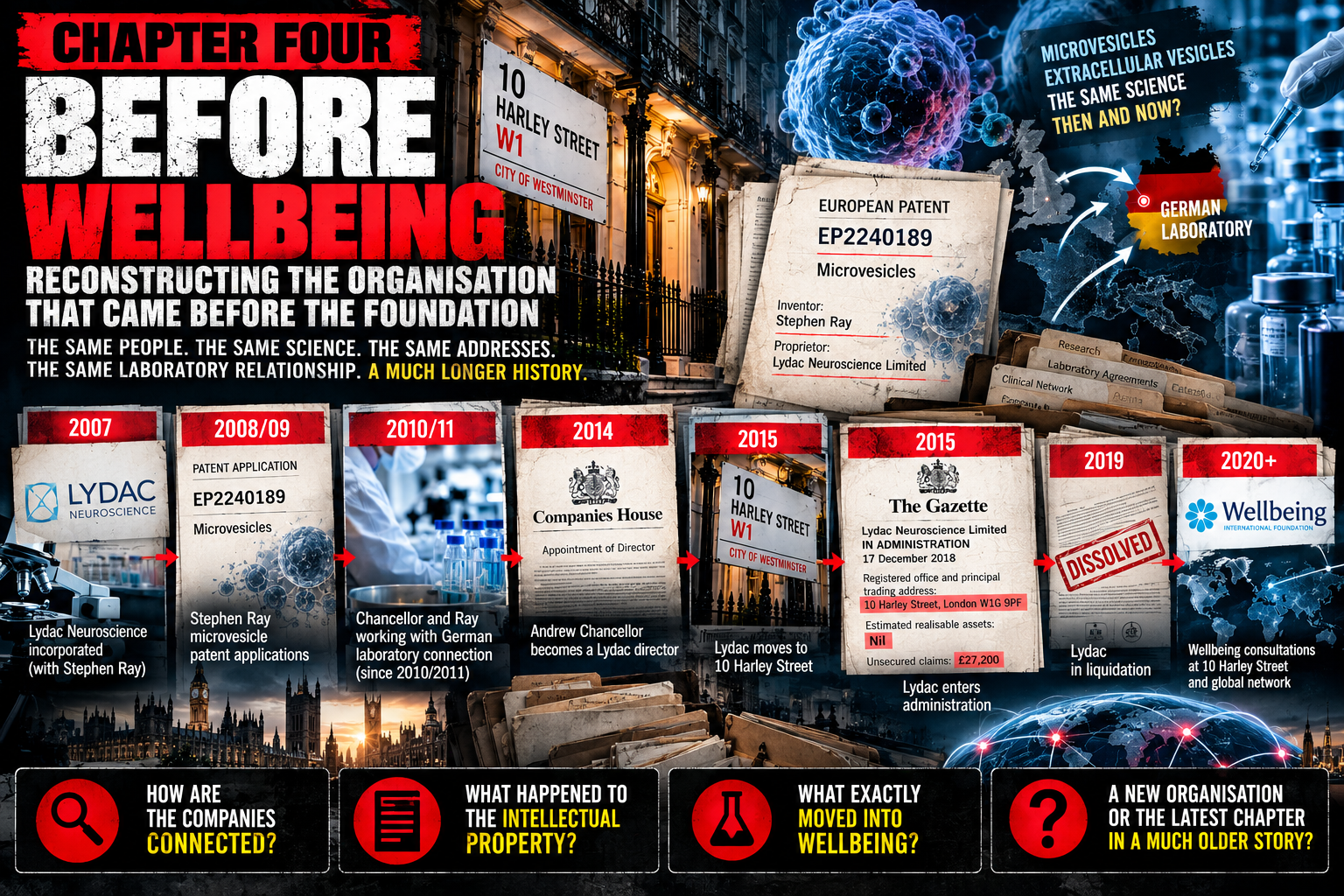
Yet the article provides no clinical trial data showing that athletes receiving this therapy recover faster than athletes who do not.
No randomised controlled trial.
No comparative injury data.
No independent long-term follow-up.
No objective performance outcomes.
Just stories.
Doug Baldwin: The Testimonial That Undermines The Message
The most important comparison is Doug Baldwin.
Wellbeing has used Baldwin’s testimonial as part of its promotional material. He stated that he was pleased with his infusions and believed they improved his healing time.
That is his personal experience, and he is entitled to describe it.
But personal experience is not proof.
Baldwin reportedly underwent regenerative treatment in 2017.
In 2018, he endured an injury-plagued season.
He battled multiple physical problems, including knee, shoulder, elbow, hip and groin issues.
In early 2019, he required further surgeries.
He failed a physical.
He was released by the Seattle Seahawks.
He then retired from professional football.
This does not prove the treatment failed.
But it absolutely destroys the suggestion that his testimonial can be used as evidence of long-term athletic recovery, joint preservation, career extension or meaningful sporting resilience.
If anything, Baldwin’s timeline shows exactly why testimonial marketing is so unreliable.
A man may feel better at one point.
A company may quote that feeling.
But the body’s real outcome may tell a far more complicated story.
“These Are Not Medical Claims”
The article attempts to protect itself by saying these accounts are not medical claims.
But this is where the contradiction appears.
If they are not medical claims, why are they being used in an article about performance, recovery and resilience?
If they are merely personal stories, why are they placed beside language about cell-free therapy, long-term wellbeing and athletes relying on physical performance?
The article wants the benefit of medical implication without the burden of medical proof.
That is the entire problem.
It dresses advertising in the tone of evidence, while carefully avoiding the responsibility that evidence demands.
The Missing Question
The article asks why athletes are turning to Wellbeing International.
But it never answers the more important question:
What measurable benefits have been proven in athletes?
Not felt.
Not believed.
Not reported in testimonials.
Proven.
Did treated athletes return faster from injury?
Did they require fewer surgeries?
Did they suffer fewer relapses?
Did their cartilage improve on imaging?
Did their careers last longer?
Did objective markers of inflammation improve compared with controls?
Did performance measurably increase?
The article provides no answers.
Because the article is not built on outcomes.
It is built on words.
The FDA Warning Matters
Regenerative medicine is not automatically illegitimate.
Research in this field is real.
But commercial claims must not outrun clinical evidence.
The FDA has warned that regenerative medicine products, including exosome-related products, are not approved for orthopedic conditions such as knee pain, shoulder pain, tendonitis, disc disease, back pain, hip pain, neck pain or osteoarthritis.
That warning matters because this is exactly the type of space where athletes and injured people can be emotionally vulnerable.
They want recovery.
They want movement.
They want one more season.
They want one more chance.
And where there is desperation, soft marketing becomes extremely powerful.
The Testimonial Machine
The article repeatedly relies on testimonials.
A former NFL player.
A runner.
A person with mobility problems.
A client with disc issues.
Manual workers.
Active grandparents.
These people may genuinely believe they improved.
But belief is not clinical evidence.
Pain fluctuates.
Recovery happens naturally.
Physiotherapy helps.
Surgery helps.
Rest helps.
Lifestyle changes help.
Expectation changes perception.
That is why proper medicine does not rely on testimonials.
It relies on controlled evidence.
Without that, nobody can separate treatment effect from placebo, timing, rehabilitation, natural recovery or simple hope.
Selling The Feeling
The article’s real product is not evidence.
It is feeling.
The feeling of being more capable.
The feeling of being lighter.
The feeling of recovery.
The feeling of hope.
But medicine cannot be allowed to sell feeling as proof.
Especially when the audience may include injured athletes, chronic pain sufferers, neurological patients and people who have already exhausted conventional options.
For these people, hope is not cheap.
Hope can cost thousands.
The Baldwin Problem Will Not Go Away
Doug Baldwin’s story should have made Wellbeing more careful, not more confident.
If a high-profile athlete receives treatment, believes it helps, but is then out of sport after injuries and surgeries, that story should be treated with caution.
It should not be used to imply sporting success.
It should not be used to imply long-term protection.
It should not be used to imply resilience.
The honest version would say:
Doug Baldwin reported feeling benefit after treatment. However, he later suffered significant injuries, underwent surgery, failed a physical and retired from professional football. His testimonial should not be taken as proof that the therapy regenerates joints, prevents injury, accelerates recovery or extends athletic careers.
That would be responsible.
But that is not the message being sold.
Conclusion: Words Are Not Evidence
The Wellbeing article is carefully written.
Too carefully.
It avoids making direct medical promises while surrounding the reader with language that implies medical benefit.
Recovery.
Resilience.
Energy.
Mobility.
Long-term wellbeing.
Athletic performance.
But where are the trials?
Where is the data?
Where is the independent evidence?
Where is the proof that athletes receiving this treatment do better than athletes who do not?
Until those answers are provided, the article should be seen for what it is:
not science,
not proof,
not clinical evidence,
but marketing.
A collection of carefully chosen words designed to make testimonials feel like medicine.
And that is the oldest trick in the wellness industry.
Sell the story.
Sell the hope.
Sell the placebo.
But never show the proof.