When a company sells a medical treatment through testimonials, the stories it chooses matter.
They are not neutral.
They are selected.
They are framed.
They are placed in front of frightened, desperate or hopeful people for a reason.
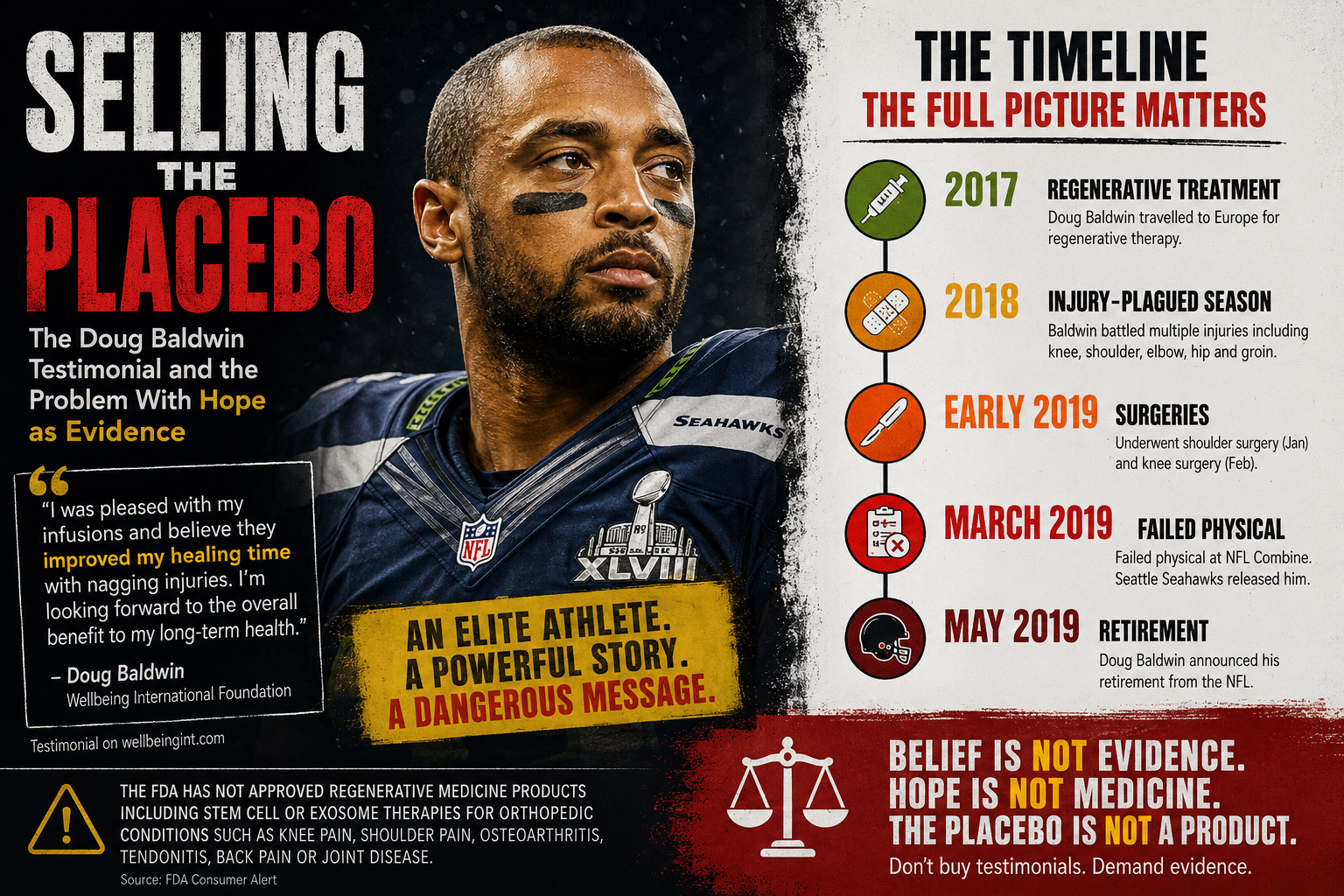
On the Wellbeing International Foundation website, one of the most powerful testimonials comes from former Seattle Seahawks wide receiver Doug Baldwin. He is not presented as an ordinary patient. He is presented as an elite athlete, a Super Bowl winner, a man whose body was once his profession.
His testimonial says he was pleased with his infusions. He says he believed the treatment improved his healing time with nagging injuries. He also says he was looking forward to the overall benefit to his long-term health.
That is powerful language.
But then comes the uncomfortable part.
Doug Baldwin reportedly travelled for regenerative treatment in 2017. In 2018, his body began to break down. That season he battled multiple injuries, including knee, shoulder, elbow, hip and groin problems. By early 2019, he had undergone shoulder and knee surgery. Shortly afterwards, the Seattle Seahawks released him after a failed physical. In May 2019, Baldwin indicated he was retiring from the sport.
This does not prove the treatment harmed him.
But it does destroy the marketing illusion.
Because if a testimonial is being used to imply healing, regeneration, recovery, protection or long-term physical benefit, then the full story matters. A man who received the treatment and was out of professional sport within roughly two years is not proof of regeneration. It is proof of how weak testimonial medicine can be.
And that is the danger.
A testimonial captures a feeling at a moment in time. It does not prove causation. It does not prove repair. It does not prove cartilage regeneration. It does not prove joint restoration. It does not prove long-term benefit.
It proves only that someone believed they felt better.
That may be real.
But belief is not medicine.
Hope is not evidence.
And the placebo effect is not a product.
The regenerative medicine industry has become expert at selling emotional certainty where scientific certainty does not yet exist. The formula is simple: take a recognisable athlete, attach the language of healing, recovery and performance, then allow the public to fill in the blanks.
The customer sees the name.
The customer sees the career.
The customer sees the words “improved healing”.
And the customer thinks: if it helped him, perhaps it can help me.
But did it help him?
That is the question the marketing does not answer.
Because the public facts show something very different from a clean success story. They show a world-class athlete still struggling with injuries, needing surgery, failing a physical and retiring from elite sport far earlier than he wanted.
Again, this does not prove failure of the treatment.
But it certainly does not prove success.
And that is the whole point.
Testimonials are not clinical trials. They are not independent medical evidence. They are not controlled. They are not blinded. They are not followed properly. They do not account for physiotherapy, surgery, rest, natural healing, elite medical support, painkillers, training changes, or the simple human desire to believe that an expensive treatment has worked.
This is where the placebo becomes commercial.
A patient pays for hope.
The body may feel different.
Pain may fluctuate.
Energy may improve.
Optimism may return.
But unless the claim is tested, measured and proven, the company is not selling science. It is selling interpretation.
And interpretation is dangerous when dressed up as medicine.
The FDA has repeatedly warned that regenerative medicine products, including stem cell and exosome-related products, have not been approved for orthopedic conditions such as knee pain, shoulder pain, tendonitis, osteoarthritis, back pain, neck pain or joint disease. The agency has also warned that patients may be misled by products that have not been shown to be safe or effective.
That warning matters here.
Because Doug Baldwin’s testimonial is not sitting in a private diary. It is sitting on a commercial-facing website, surrounded by other stories of recovery, neurological improvement, pain relief, athletic performance and renewed health.
That changes the purpose of the story.
It becomes part of the sales machine.
The public deserves to see the full picture.
Doug Baldwin may have genuinely believed the treatment helped him. That belief should not be mocked. Elite athletes live with pain most people cannot imagine. If he felt better at the time, that experience was real to him.
But a patient’s belief is not proof.
And a company using that belief to sell treatment has a responsibility to present the limitations honestly.
The honest version would say:
Doug Baldwin reported feeling benefit after treatment. However, he later suffered a serious run of injuries, underwent surgery, failed a team physical and retired from professional football. His testimonial should not be understood as proof that the treatment regenerates joints, prevents injury, extends athletic careers or produces long-term health benefits.
That would be honest.
But that is not how hope is sold.
Hope is sold by selecting the brightest sentence and removing the shadow behind it.
And that is why this matters.
Because the people buying these treatments are often not NFL athletes. They are ordinary people with arthritis, neurological disease, chronic pain, injury, fear and desperation. They do not have elite medical teams. They do not have NFL salaries. They do not have the luxury of spending thousands on a treatment that may only deliver belief.
They deserve evidence.
They deserve caution.
They deserve the truth.
The Doug Baldwin testimonial should not be treated as proof of regenerative medicine success.
It should be treated as a warning about testimonial marketing.
Because when the full timeline is examined, the story does not show a miracle.
It shows the oldest sales tool in medicine:
take hope, wrap it in celebrity, and sell the placebo.