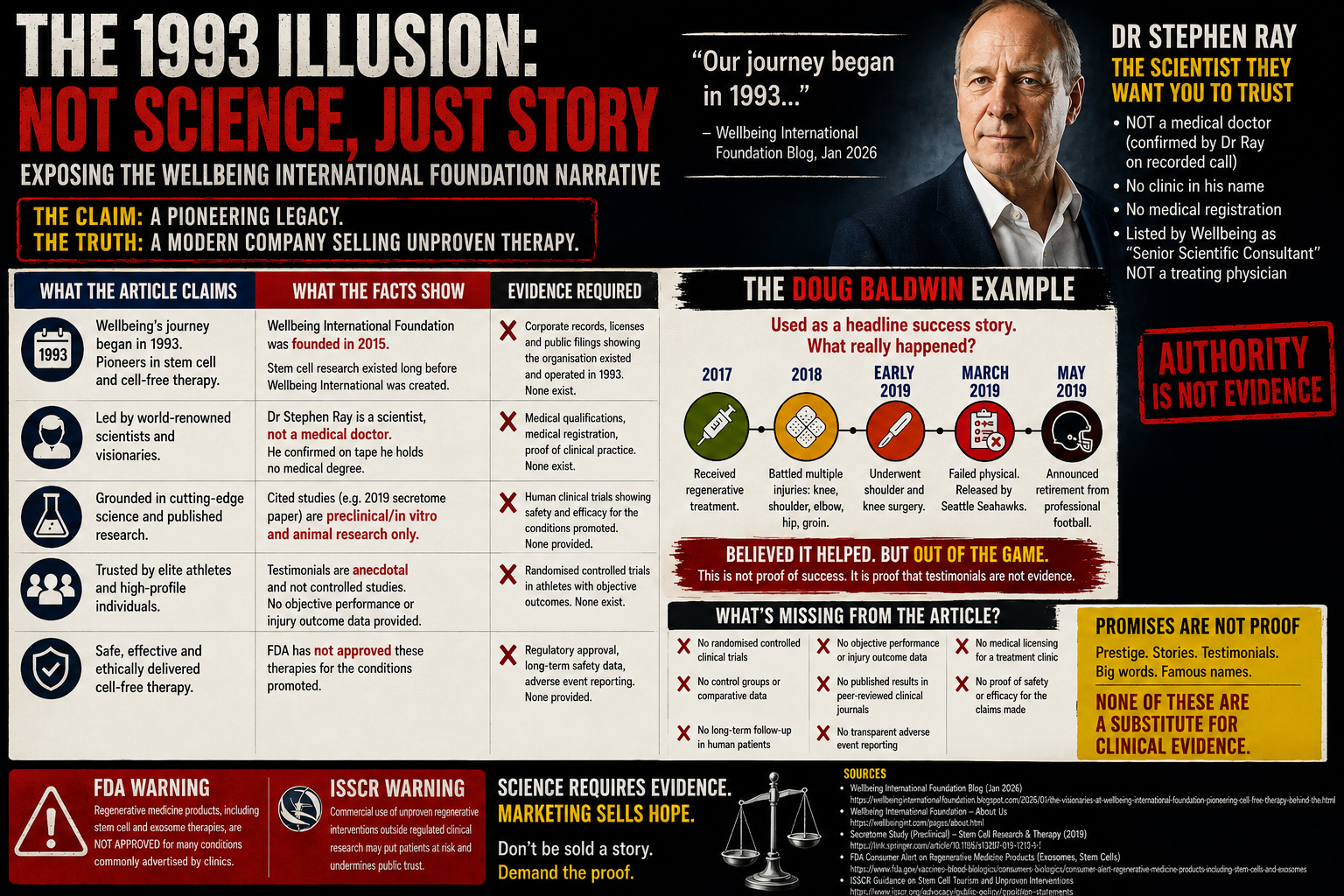
The blog claims Wellbeing’s “journey” began in 1993, but public company-facing records list Wellbeing International Foundation as founded in 2015. (wellbeinginternationalfoundation.blogspot.com) It presents Dr Stephen Ray as central to the science, while Wellbeing’s own site calls him “Senior Scientific Consultant,” not a medical doctor. (Wellbeing International Foundation) The cited 2019 secretome paper is preclinical/in vitro and animal work, not a human clinical proof of commercial treatment efficacy. (Springer) FDA and ISSCR guidance both warn against commercial use of unproven regenerative therapies outside properly regulated evidence pathways. (U.S. Food and Drug Administration)
The 1993 Illusion: How Wellbeing International Rewrites Scientific History
The Wellbeing International Foundation article titled “The Visionaries at Wellbeing International Foundation Pioneering Cell-Free Therapy: Behind the Science” reads like the origin story of a medical breakthrough.
It presents visionaries.
It presents discovery.
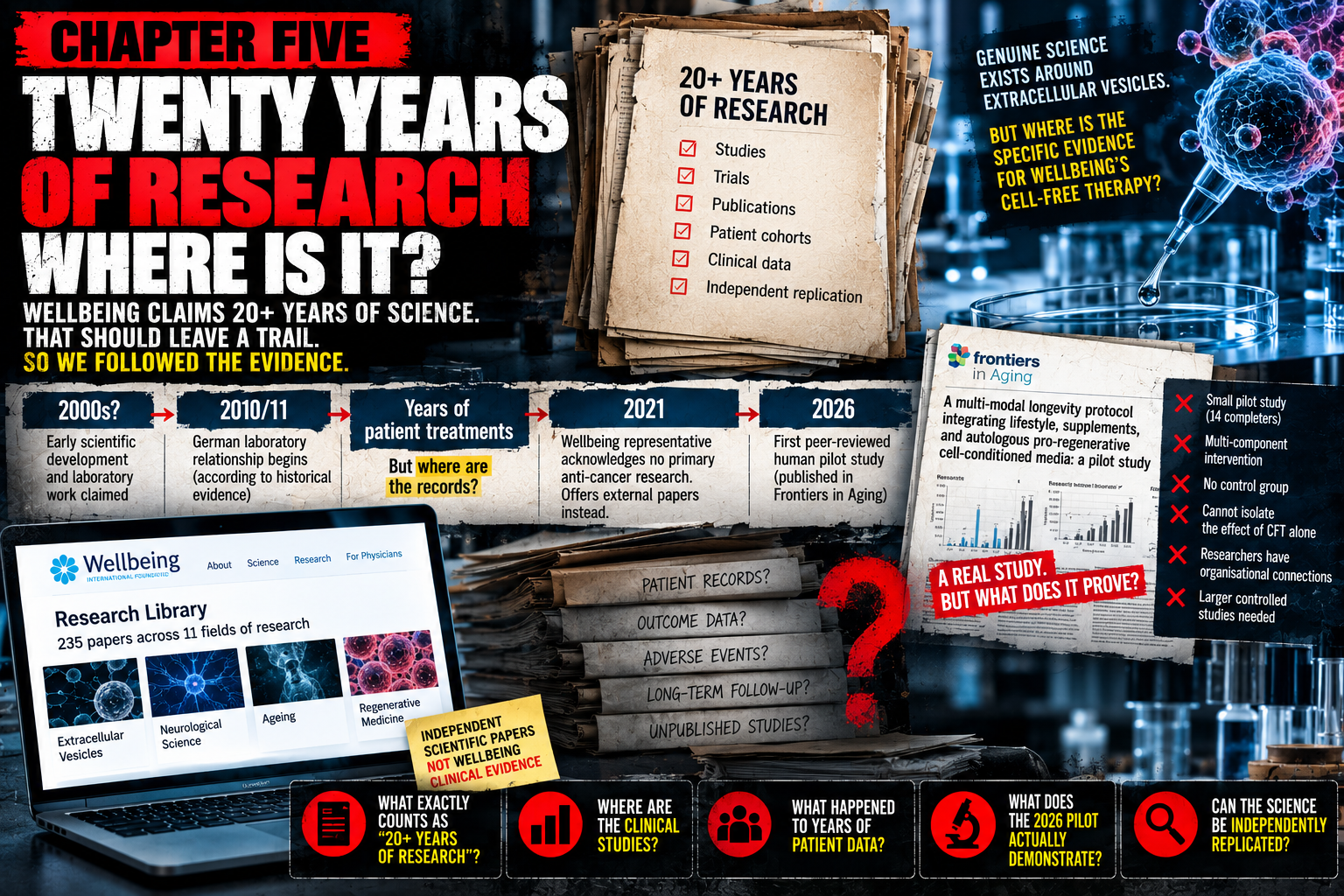
It presents decades of research.
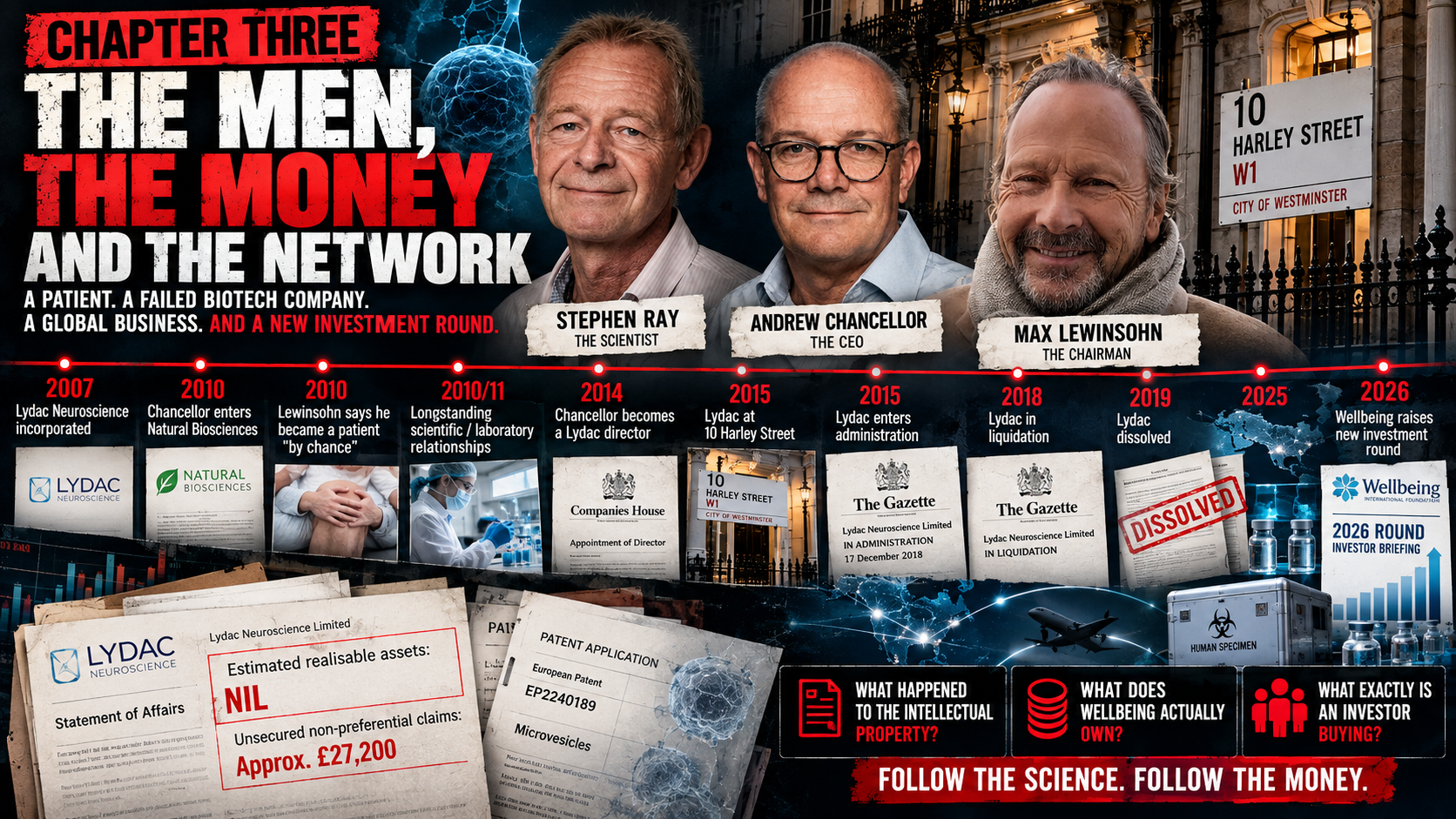
It presents Dr Stephen Ray as a central scientific figure.
It presents 1993 as though Wellbeing International itself was somehow there at the beginning of a revolutionary stem-cell discovery.
But when the claims are examined carefully, the story begins to fall apart.
The 1993 Problem
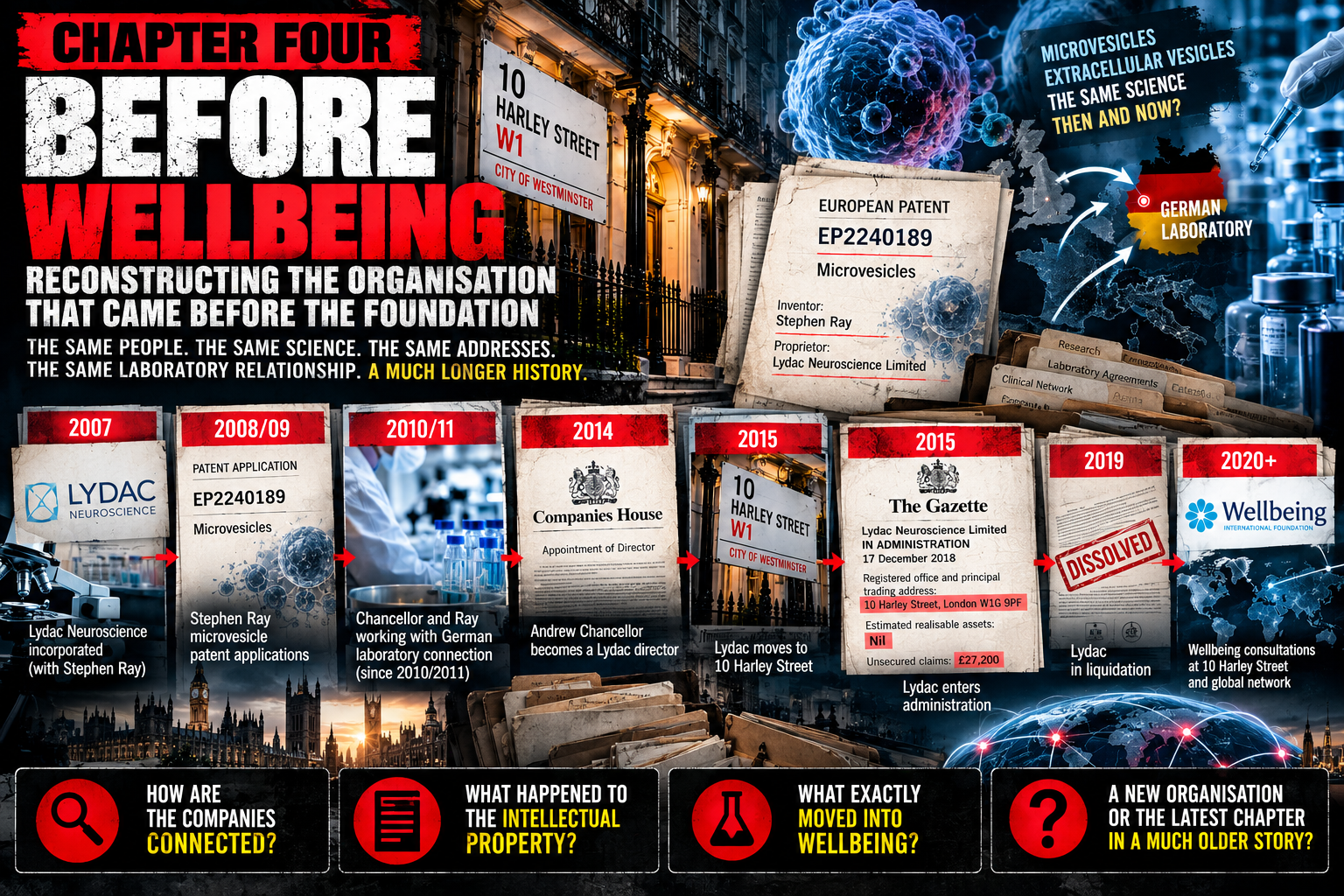
The article states that the “journey” of Wellbeing International Foundation began in 1993.
That is extraordinary wording.
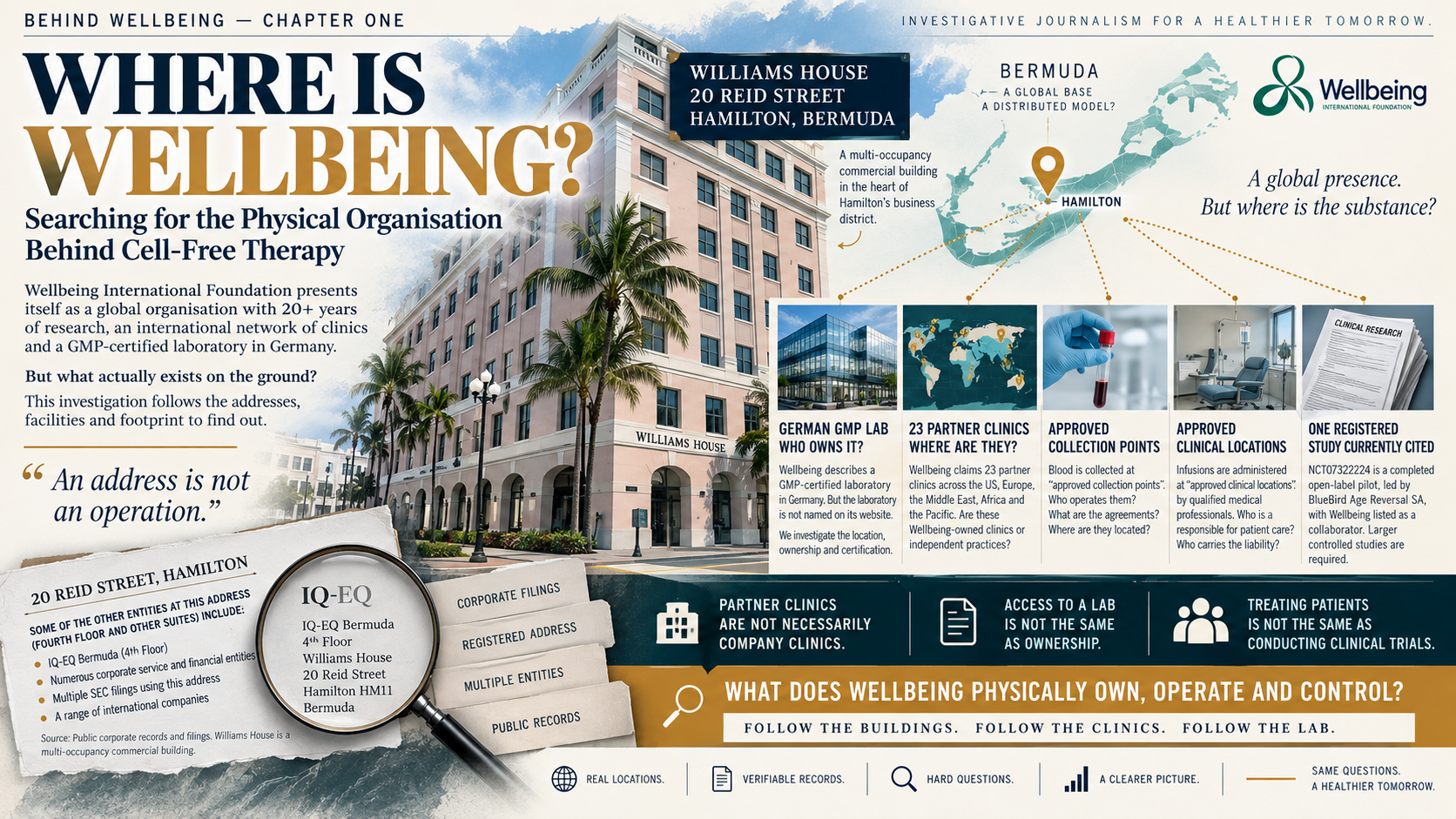
Because public-facing records list Wellbeing International Foundation as founded in 2015.
So what actually began in 1993?
Was Wellbeing International operating?
Was it treating patients?
Was it running regulated clinical trials?
Was it publishing human medical outcomes?
Was it licensed as a clinic?
Or is 1993 being used as a borrowed date — a way of attaching a modern commercial operation to decades of wider scientific development that it did not own?
That distinction matters.
Stem-cell science did not begin with Wellbeing International.
Extracellular vesicle research did not begin with Wellbeing International.
The idea that cells communicate through secreted factors did not begin with Wellbeing International.
Yet the article appears to place the company inside that historic scientific timeline, as though the organisation itself was part of the foundational discovery.
That is not evidence.
That is branding.
Dr Stephen Ray: Scientist, But Not A Medical Doctor
The article places heavy weight on Dr Stephen Ray.
It describes his scientific background, his experience, his academic work and his role in developing the company’s protocols.
But there is a crucial point the public must understand.
Dr Stephen Ray is not presented by Wellbeing International’s own website as a medical doctor treating patients.
He is listed as a Senior Scientific Consultant.
In our own recorded conversation, Dr Steve Ray stated clearly that he is not a medical doctor.
That matters.
Because the public reading this article could easily come away with the impression that they are dealing with a medically led clinical breakthrough.
But where is the medical registration?
Where is the clinic in his name?
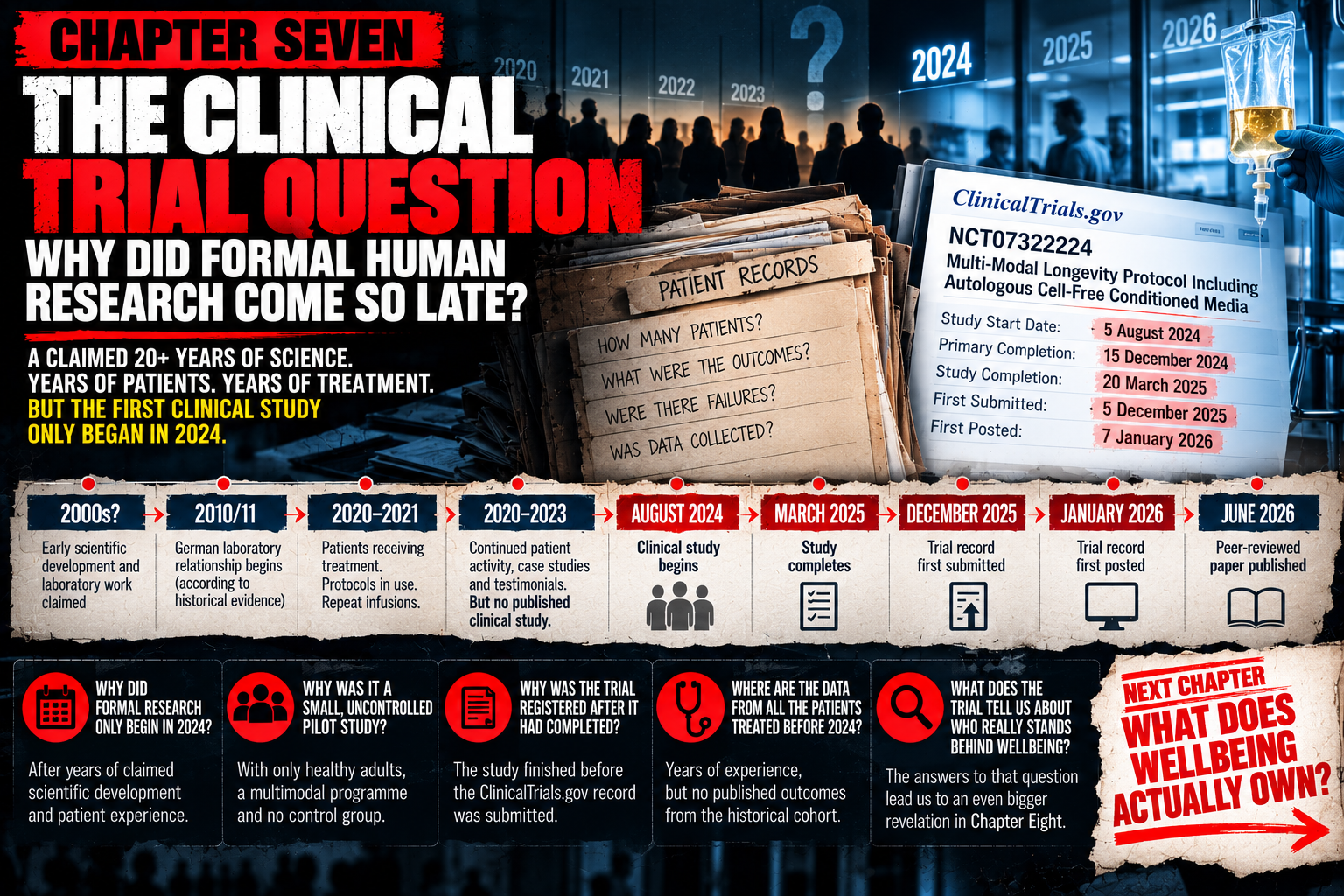
Where are the regulated human clinical trials proving the treatment works for the conditions being implied?
Where are the patient outcome studies?
Where is the evidence that this commercial therapy has been proven safe and effective through proper clinical pathways?
The article does not answer those questions.
Instead, it relies on authority language.
Academic experience.
Scientific acumen.
Faculty positions.
Collaborations.
Prestigious institutions.
But reputation language is not clinical proof.
Preclinical Science Is Not Commercial Proof
The article refers to published work showing that stem-cell secretome can accelerate tissue repair.
This is where the public needs to be extremely careful.
A laboratory study is not the same as a proven human treatment.
A mouse model is not the same as a regulated therapy.
Cell assays are not the same as clinical recovery.
Preclinical research may be interesting.
It may be promising.
It may justify further investigation.
But it does not justify selling certainty to sick or injured people.
This is one of the oldest tricks in the wellness industry:
take early-stage science,
translate it into emotional language,
then allow the customer to believe the treatment is already proven.
But promising biology is not proof of medical benefit.
The Missing Clinical Trial Problem
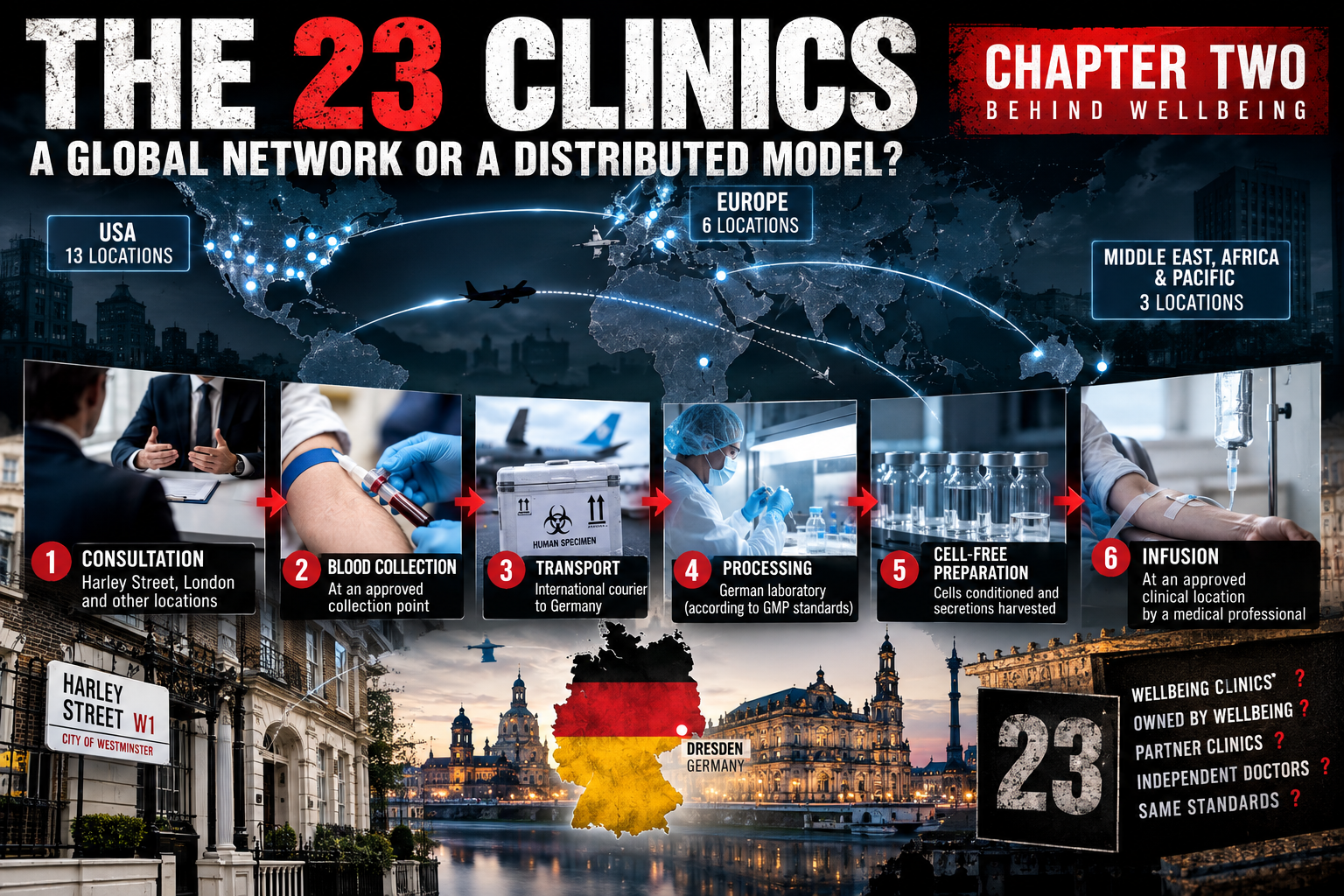
The article talks about safety, efficacy, ethical practice and clinical success.
But where are the trials?
Where are the randomised controlled studies?
Where are the independent peer-reviewed human trials showing that Wellbeing International’s specific treatment reverses disease, repairs joints, restores neurological function or extends sporting careers?
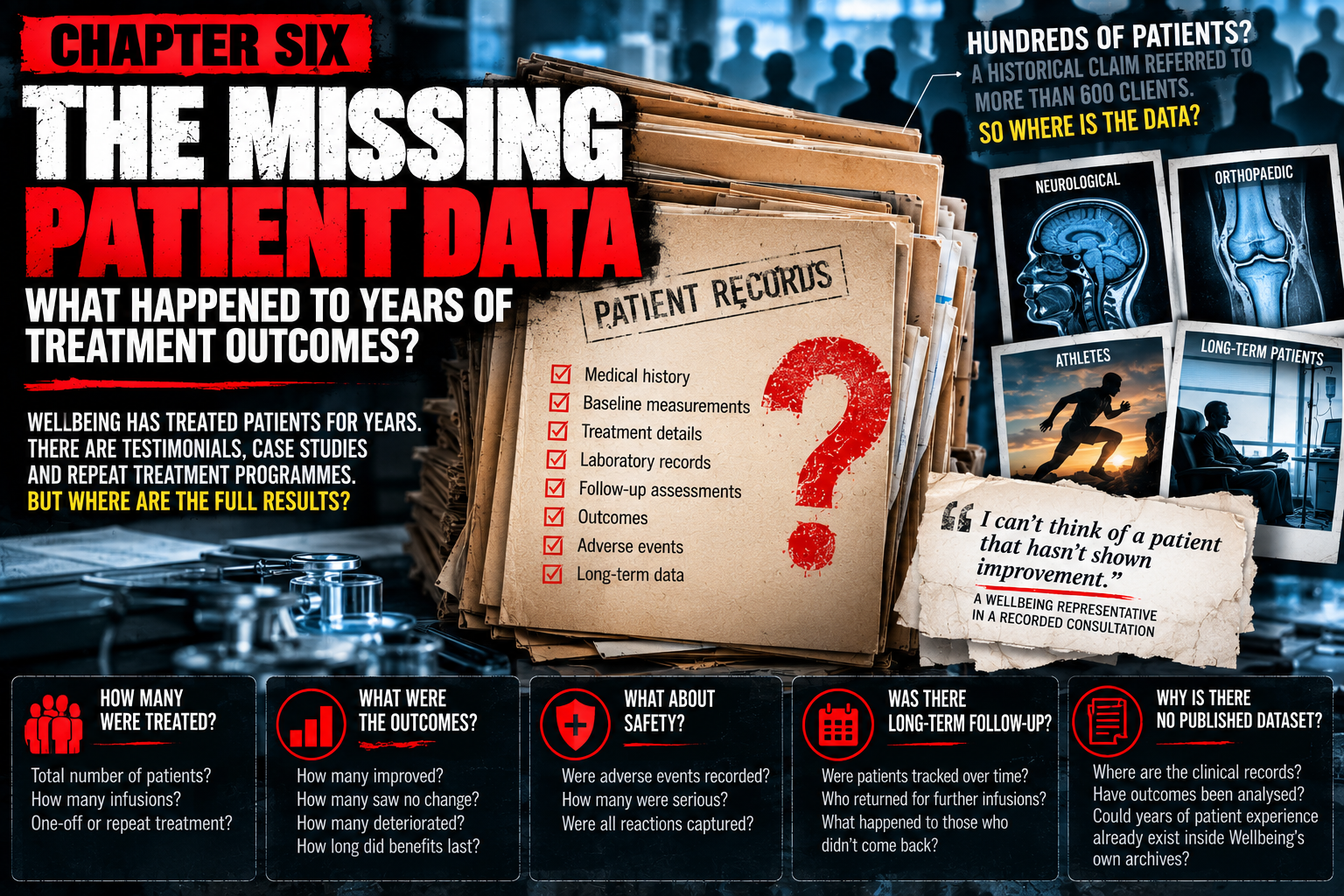
Where are the published outcomes from real patients?
Where is the dose-response data?
Where is the long-term safety data?
Where is the independent medical oversight?
Where are the adverse event records?
The article does not provide them.
Instead, it gives us testimonials.
Jimmy Graham.
Jameis Winston.
Max Lewinsohn.
Stories.
Feelings.
Anecdotes.
Belief.
But testimonials are not clinical evidence.
The “Patient 007” Problem
The article describes Max Lewinsohn as “patient number 007,” a man who came for treatment after a damaged knee and later became Chairman.
This is not presented as a warning.
It is presented as a success story.
But from an investigative perspective, it raises an obvious question:
How does a patient become a leader of the organisation selling the treatment?
That does not automatically mean anything improper happened.
But it does mean the story should be examined with caution.
When patient belief becomes commercial leadership, testimonial and business interest become difficult to separate.
The public deserves transparency.
Was this treatment independently assessed?
Were objective results published?
Was there imaging?
Was there medical follow-up?
Was there a controlled comparison?
Or was this simply a patient experience turned into a corporate origin myth?
Borrowed Prestige
The article repeatedly mentions prestigious research networks and institutions.
University College London.
Oxford.
Boston Children’s Hospital.
Toronto Sick Children’s Hospital.
University of Florida.
These names carry enormous weight.
But the reader must ask:
What exactly was the relationship?
Was Wellbeing International formally running clinical trials with these institutions?
Were these institutions validating the commercial treatment?
Were they supervising patient care?
Were they approving Wellbeing’s marketing claims?
Or were individual scientists connected to separate academic research that has now been used to create an aura of credibility?
Prestige by association is not proof.
A university name in a paragraph does not turn a commercial treatment into evidence-based medicine.
From Science To Sales Language
The article uses powerful phrases:
“revolutionary approach”
“true agents of repair”
“clinical success”
“profound results”
“transform lives”
“restore health and vitality”
These are not neutral scientific terms.
They are sales language.
They create expectation.
They suggest benefit.
They imply treatment effect.
And they do this while avoiding the one thing that would actually matter:
proper clinical proof.
What The Regulators Say
The FDA has warned that regenerative products, including stem-cell and exosome-related products, are not approved for many conditions commonly marketed by clinics, including orthopedic, neurological, cardiovascular and pulmonary conditions.
The ISSCR has also warned against the commercial use of unproven regenerative interventions outside proper clinical research or tightly regulated medical innovation.
That is the context in which this article must be read.
Not as a harmless blog post.
Not as science education.
But as part of a commercial narrative promoting an unproven regenerative therapy.
Conclusion: The Story Is Not The Science
The article wants readers to believe they are looking at the history of a medical breakthrough.
But what they are really seeing is a carefully constructed origin story.
1993 gives the impression of deep history.
Dr Stephen Ray gives the impression of scientific authority.
Prestigious institutions give the impression of validation.
Athlete and patient testimonials give the impression of clinical success.
But when the structure is stripped back, the same questions remain unanswered.
Where are the regulated clinical trials?
Where is the proven efficacy?
Where is the medical licensing?
Where is the transparent clinic?
Where is the independent evidence?
Where is the proof that this treatment does what the marketing implies?
Until those answers are provided, this article should not be treated as science.
It should be treated as reputation-building.
A story designed to make commercial therapy look like medical destiny.
Not proof.
Not clinical validation.
Not a breakthrough.
Just another carefully polished chapter in the sale of hope.