When I first began looking into this world, I believed I was investigating science. I expected to spend my time examining medical claims, analysing research papers, reviewing company structures and understanding the regulatory frameworks that surround emerging therapies. In many ways, that is exactly what I did.
But somewhere along the journey, the investigation changed.
Or perhaps I did.
The deeper I went, the less this became a story about science and the more it became a story about people.
Real people.
People living with Parkinson's disease, Multiple Sclerosis, Motor Neurone Disease, chronic pain, cancer, dementia and countless other conditions that slowly chip away at their independence, their confidence and, in some cases, their future. People who wake up each day carrying burdens most of us can scarcely imagine. People who have been told there is no cure, no simple answer and no guarantee that tomorrow will be any better than today.
What struck me most was not their illness.
It was their hope.
Hope is one of the most powerful forces a human being possesses. It keeps people moving forward when logic tells them to stop. It allows families to endure impossible circumstances and gives strength to those facing challenges that would otherwise seem unbearable.
When life is going well, hope is something we take for granted.
When illness arrives, hope becomes priceless.
And perhaps that is what broke my heart.
As the investigation progressed, I found myself reading stories late into the night. I listened to recordings. I reviewed testimonials. I spoke to people searching desperately for one more opportunity, one more breakthrough, one more chance to regain something their condition had taken away.
Some simply wanted relief from pain.
Some wanted more time.
Others wanted the chance to see their children grow up, to remain independent, to preserve their dignity or to hold on to a life they felt slowly slipping away.
It became impossible to view them as customers.
I saw fathers.
Mothers.
Grandparents.
Husbands.
Wives.
Children.
Human beings searching for a reason to believe that things could get better.
The more stories I encountered, the more one question began to trouble me.
At what point did desperation become a marketplace?
Because beyond the science, beyond the marketing and beyond the corporate structures, there is an uncomfortable reality that is difficult to ignore. Somewhere within parts of this industry, there appears to be a willingness to view suffering not as a tragedy, but as an opportunity.
An opportunity to sell.
An opportunity to market.
An opportunity to profit.
There is something profoundly unsettling about that.
Not because businesses should not make money. Of course they should. Innovation costs money. Research costs money. Medical progress costs money.
But there is a difference between offering hope and selling it.
There is a difference between exploring possibilities and presenting them as probabilities.
And there is a difference between supporting vulnerable people and building a business around their vulnerability.
The people seeking these treatments are often portrayed as naïve or gullible. My experience suggests otherwise.
Many are intelligent, accomplished and successful individuals. They are business owners, professionals, academics and parents who have spent their entire lives making sensible decisions. They have navigated careers, built companies, raised families and overcome challenges most people would struggle to comprehend.
What changes is not their intelligence.
It is their circumstances.
Illness changes the way people evaluate risk. Chronic pain changes the way people think about money. Fear changes the way people assess possibility.
When someone is healthy, they seek certainty.
When someone is frightened, they seek hope.
That distinction matters more than many people realise.
Hope can make extraordinary claims sound believable.
Hope can make distant possibilities feel tangible.
Hope can persuade people to take risks they would never normally consider.
And hope can convince someone to spend life-changing sums of money because the alternative feels too painful to accept.
For me, the hardest part of this investigation has never been reading scientific papers or reviewing company records. It has never been tracing offshore entities, examining corporate structures or understanding complex biological concepts.
The hardest part has been what comes afterwards.
Because not every victim loses money.
Some lose trust.
Some lose faith.
Some lose years of their lives pursuing promises that never materialise.
And some are left carrying a burden far heavier than financial loss — the belief that somehow they should have known better.
I have spoken to families who emptied savings accounts. Families who borrowed money. Families who genuinely believed they had finally found an answer, only to discover later that what they had purchased was disappointment.
That disappointment is rarely measured in pounds or dollars.
It is measured in sleepless nights.
In regret.
In self-blame.
In the painful realisation that somebody may have taken advantage of the most vulnerable moment of your life.
I wish I could tell you these stories are uncommon.
I no longer believe they are.
That is why I continue.
Not because I enjoy exposing companies.
Not because I enjoy conflict.
And certainly not because I have any personal vendetta against any individual organisation.
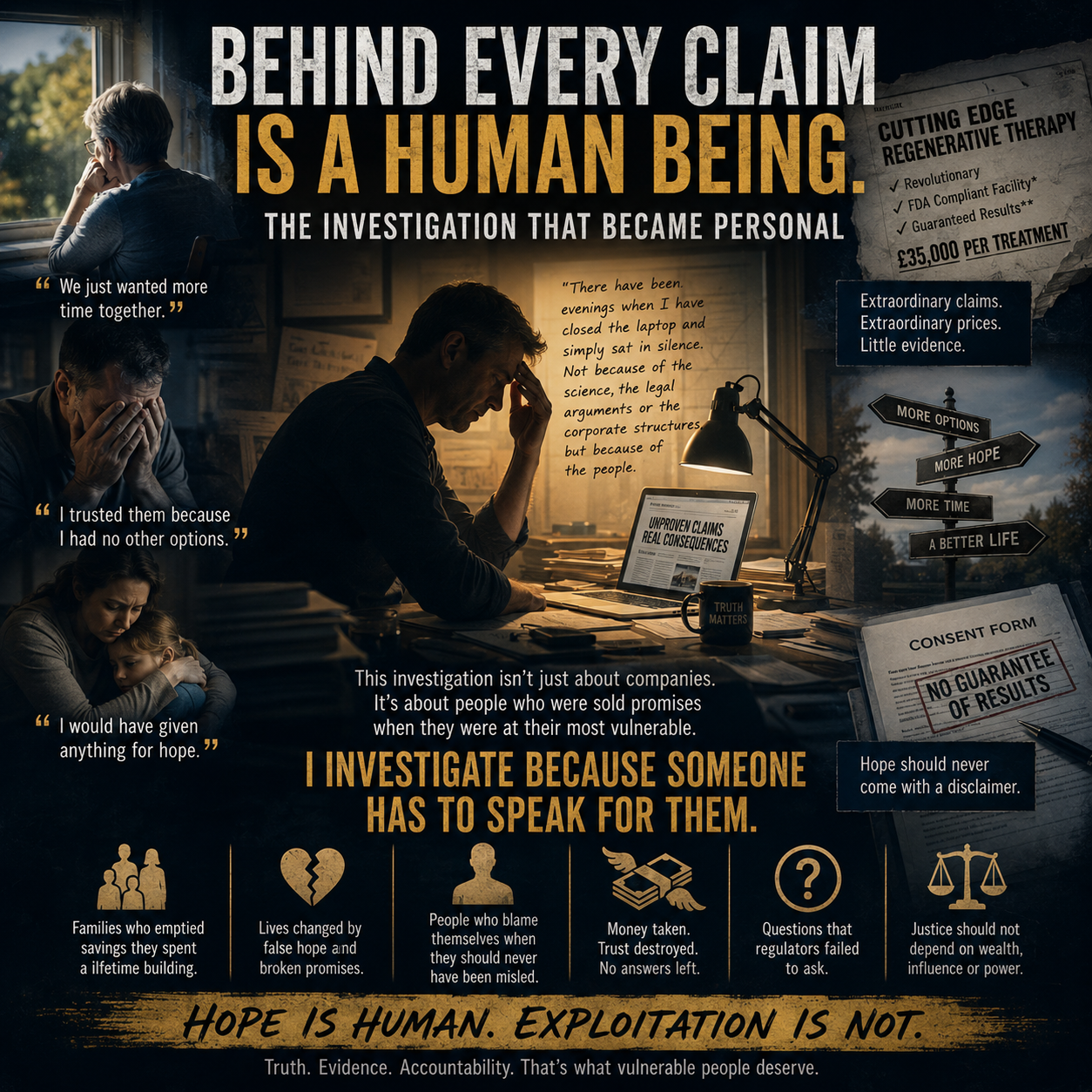
I continue because somebody has to speak for the people who are rarely heard.
The people who feel embarrassed.
The people who signed agreements they now regret.
The people who blame themselves when they should not.
The people who no longer have the strength, resources or energy to fight.
The people who quietly disappear once the money is gone and the promises have faded.
Investigative journalism is often portrayed as a profession driven by scepticism. There is some truth in that. Good investigators ask difficult questions and challenge accepted narratives.
But the longer I do this work, the more convinced I become that the best investigative journalism is not driven by scepticism at all.
It is driven by compassion.
It is driven by a belief that ordinary people deserve protection from those willing to exploit them.
It is driven by a belief that truth matters.
And it is driven by a belief that justice should not depend upon wealth, influence or power.
I am realistic enough to know that one article will not change an industry. One investigation will not close every loophole. One journalist will not solve every problem that exists within a rapidly evolving sector of medicine.
But if shining a light on these issues causes one family to pause, ask questions, seek independent advice and avoid becoming another cautionary tale, then every hour spent investigating has been worthwhile.
Because behind every case file is a person.
Behind every payment is a family.
And behind every promise is a responsibility.
The day we stop remembering that is the day we become part of the problem ourselves.
That is a line I refuse to cross.