Some investigations take an unexpected turn.
Ours began with a single company.
Like many journalists examining the rapidly expanding world of stem cell and regenerative medicine treatments, we started by asking questions about claims being made to patients, the evidence supporting those claims, and the increasingly complex corporate structures operating behind the scenes.
At first, it appeared to be a story about one organisation.
One company.
One set of claims.
One group of patients.
But then something happened.
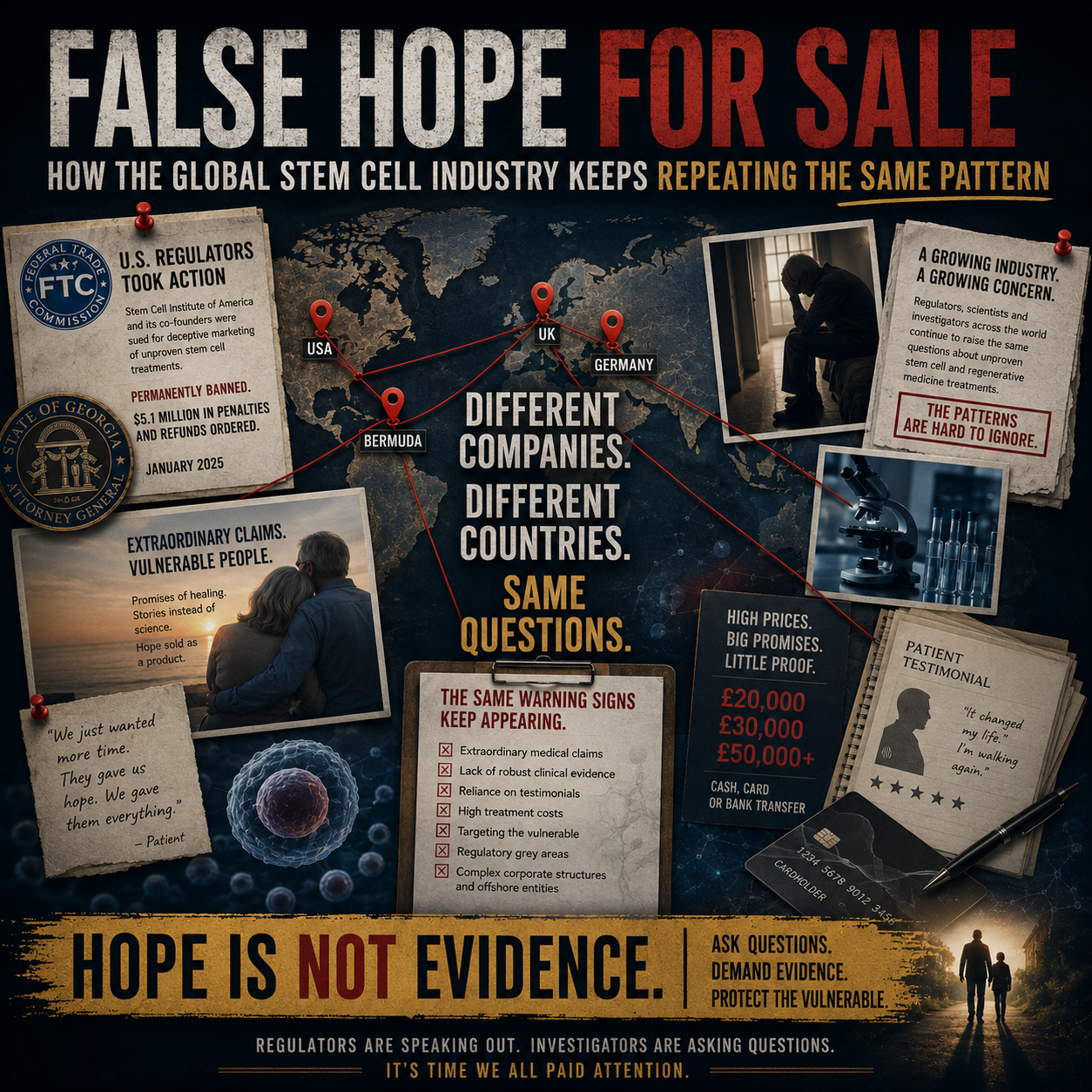
During our research, we came across an enforcement action by American regulators against a company called Stem Cell Institute of America.
It was a completely different business.
Different owners.
Different country.
Different patients.
Different regulators.
And yet, as we read through the allegations, an uncomfortable feeling emerged.
We had seen much of this before.
Not the names.
Not the locations.
The patterns.
The same patterns that had already begun to emerge throughout our own investigation.
That moment changed the direction of our work entirely.
Because the question was no longer whether concerns existed around a single provider.
The question became far more troubling.
Why were investigators, scientists and regulators on opposite sides of the Atlantic describing the same warning signs?
The FTC alleged that Stem Cell Institute of America promoted expensive stem cell procedures to people suffering from chronic pain and degenerative conditions using claims that regulators argued were not supported by reliable scientific evidence.
For anybody unfamiliar with the regenerative medicine sector, that may sound like an isolated allegation.
But the more deeply we examined the wider industry, the less isolated it appeared.
Across dozens of websites, promotional videos, patient testimonials and sales presentations, the language remained remarkably consistent.
Not identical.
Consistent.
The science was always described as revolutionary.
The treatment was always positioned as being at the forefront of medicine.
Patients were encouraged to believe they were accessing something that conventional healthcare had not yet caught up with.
And almost always, the target audience was the same.
People in pain.
People with chronic illness.
People living with degenerative conditions.
People who had already exhausted conventional options.
In other words, people most likely to grasp hold of hope.
There is, of course, nothing wrong with hope.
Hope has driven medical innovation throughout history.
Without hope there would be no clinical trials, no breakthroughs and no progress.
But hope becomes dangerous when it begins masquerading as evidence.
That distinction sits at the centre of virtually every controversy surrounding the regenerative medicine industry.
The public often assumes that because something sounds scientific, it must therefore be scientifically proven.
The two are not the same.
A treatment may be based upon genuine scientific concepts while still lacking sufficient evidence to support the claims being made about it.
That gap is where many of the industry's most persistent controversies appear to live.
What struck us most was not simply the language being used.
It was the extraordinary consistency with which certain themes appeared.
Whether examining businesses operating in the United Kingdom, Europe or North America, investigators repeatedly encountered testimonials presented alongside scientific terminology.
They encountered ambitious claims attached to emerging technologies.
They encountered complex explanations that were difficult for patients to independently verify.
And perhaps most notably, they encountered prices that often ran into tens of thousands of pounds.
For somebody suffering from a progressive illness, a neurological disorder or chronic pain, such costs can be life changing.
The decision to proceed is rarely a simple financial transaction.
It is often an emotional one.
Patients are not merely purchasing treatment.
They are purchasing possibility.
That reality places an enormous ethical burden on anybody operating in this space.
The stronger the claim, the stronger the evidence should be.
The greater the promise, the greater the responsibility to substantiate it.
Yet again and again, experts consulted during investigations appear to return to the same question.
Where is the clinical evidence?
Not the theories.
Not the laboratory research.
Not the patient stories.
The evidence.
The properly conducted human clinical trials demonstrating safety and effectiveness.
Because ultimately that is the dividing line between medicine and marketing.
As our investigation expanded, we began to realise that the most important story was no longer about any individual company.
It was about the emergence of an international industry that appears to operate faster than regulators can respond.
An industry built around some of the most exciting scientific developments of modern medicine.
But also one increasingly attracting scrutiny from scientists, regulators, consumer watchdogs and investigative journalists.
The American case was not significant because it involved one clinic.
It was significant because it demonstrated something larger.
When investigators separated by thousands of miles begin asking the same questions, those questions deserve attention.
And when those questions continue to appear across multiple companies, multiple countries and multiple regulatory systems, they become impossible to ignore.
The regenerative medicine revolution may one day transform healthcare.
Scientists around the world are working tirelessly to make that future a reality.
But until evidence catches up with ambition, patients deserve something that should never be negotiable.
Transparency.
Accountability.
And proof.
Not promises.