Instead, they research.
They search Google.
They read reviews.
They look at testimonials.
They seek out independent articles.
They watch videos.
They investigate success stories.
And increasingly, companies understand this behaviour better than consumers themselves.
The result is a sophisticated marketing strategy designed not simply to sell a product, but to surround potential customers with a network of reassuring information.
Our investigation into Wellbeing International Foundation suggests the organisation has built precisely this type of ecosystem around its Cell-Free Therapy programme.
The question is not whether this marketing is effective.
The question is whether patients can clearly distinguish between independent information and company-controlled promotion.
The Search for Credibility
Medical treatments are difficult to sell.
Consumers are naturally cautious.
Patients want reassurance before spending thousands of pounds on healthcare interventions.
This is especially true in regenerative medicine, where treatments often involve complex scientific terminology that most people do not fully understand.
Faced with uncertainty, consumers look for signals of trust.
These signals typically include:
- Testimonials
- Professional endorsements
- Media coverage
- Scientific references
- Athlete stories
- Independent reviews
The more of these signals a company can create, the more credible it appears.
This appears to be a central feature of Wellbeing International Foundation's marketing approach.
The Dedicated Testimonial Website
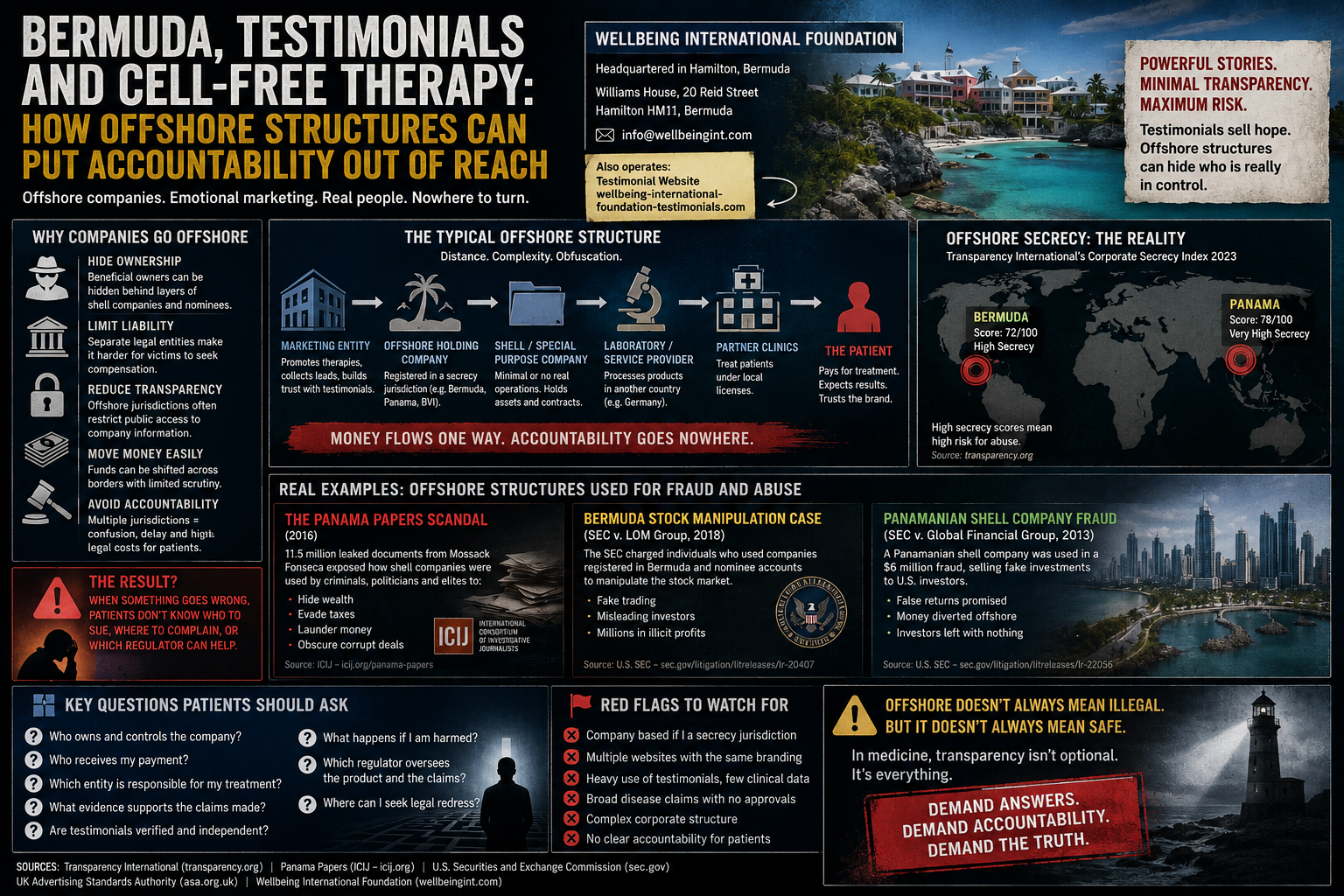
One of the most unusual discoveries during our investigation was the existence of a completely separate website devoted exclusively to testimonials.
Most healthcare companies simply include a testimonial section on their primary website.
Wellbeing went further.
The organisation created an entirely separate platform focused on success stories, athlete experiences, and patient outcomes.
The website shares the same corporate identity and contact information as Wellbeing International Foundation.
It is not an independent review platform.
It is not operated by a consumer organisation.
It is not controlled by a regulator.
It is a company-controlled promotional asset.
That distinction matters.
Because visitors may assume they are reading independent experiences when in reality they are consuming marketing material curated by the organisation itself.
The Athlete Strategy
Professional athletes appear prominently throughout Wellbeing's marketing.
The names of former NFL players, professional surfers, and other sporting figures are used to create credibility around Cell-Free Therapy.
This is a powerful strategy.
Athletes are viewed as individuals who depend upon their bodies for performance.
When consumers see a former professional athlete discussing treatment, many assume extensive due diligence has already taken place.
The problem is that celebrity endorsement is not scientific evidence.
An athlete's positive experience may be genuine.
But it remains a personal experience rather than a controlled clinical outcome.
The distinction is important.
Consumers often confuse authority with evidence.
The Rise of Sponsored Media
During our investigation, we also identified multiple favourable articles discussing Wellbeing International Foundation appearing across various online publications.
These articles often present themselves in a journalistic style.
They discuss innovation.
They discuss leadership.
They discuss scientific advancement.
They discuss global expansion.
At first glance, readers may assume they are reading independent journalism.
Closer examination frequently reveals a different picture.
Many of these articles originate from press releases, sponsored content, business promotion platforms, or syndicated distribution networks.
This is increasingly common across the healthcare industry.
The challenge for consumers is identifying the difference between:
Independent journalism.
And promotional content presented in a journalistic format.
The two can look remarkably similar.
The Authority Loop
What emerges is a fascinating marketing structure.
A consumer discovers Wellbeing.
They visit the corporate website.
They find a testimonial website.
They encounter athlete endorsements.
They locate positive media coverage.
They read favourable business articles.
They discover interviews.
They see references to scientific innovation.
Each element reinforces the next.
The result is what marketing professionals sometimes call an authority loop.
Every piece of content points toward the same conclusion:
This organisation must be legitimate because so many sources appear to support it.
Yet many of those sources ultimately originate from the same marketing ecosystem.
The Emotional Power of Testimonials
Testimonials occupy a unique place within healthcare marketing.
Scientific studies appeal to logic.
Testimonials appeal to emotion.
A clinical trial might discuss statistical significance.
A testimonial discusses hope.
And hope is powerful.
Especially when dealing with:
- Chronic illness
- Neurological conditions
- Injury recovery
- Ageing
- Pain
- Quality of life concerns
Patients are not simply purchasing a treatment.
They are often purchasing possibility.
This is why regulators pay such close attention to testimonial marketing.
A powerful story can influence decision-making more effectively than a scientific paper.
The Independent Evidence Question
One question repeatedly emerged throughout our investigation:
Where is the independent evidence?
Not the testimonials.
Not the athlete stories.
Not the promotional articles.
Not the business profiles.
The independent evidence.
Consumers researching healthcare products should always ask:
What do independent clinical studies show?
What do regulators say?
What do independent specialists conclude?
What evidence exists beyond marketing material?
These questions become even more important when treatments carry significant financial costs.
The Creation of Trust
Trust is one of the most valuable assets in healthcare.
Companies know this.
Marketers know this.
Public relations professionals know this.
The challenge is that trust can be created in different ways.
It can be earned through evidence.
Or it can be manufactured through perception.
The two are not always the same thing.
The existence of multiple websites, testimonial platforms, athlete endorsements, favourable business articles, and a broad online presence creates a powerful impression of credibility.
Whether that credibility is supported by sufficient independent evidence is a separate question.
The Bigger Picture
Wellbeing International Foundation is not unique.
Many organisations operating within the regenerative medicine sector use similar strategies.
The industry increasingly relies on:
- Influencers
- Testimonials
- Success stories
- Sponsored content
- Brand ambassadors
- Patient experiences
The result is an environment where consumers can easily become overwhelmed by positive messaging.
The danger is that marketing begins to replace investigation.
Stories begin to replace evidence.
Emotion begins to replace scrutiny.
Conclusion
Our investigation suggests that Wellbeing International Foundation has developed a sophisticated marketing ecosystem designed to surround prospective patients with positive information.
A dedicated testimonial website.
Athlete endorsements.
Business publication coverage.
Success stories.
Corporate branding.
Each component strengthens the others.
None of this proves wrongdoing.
None of it proves that treatments are ineffective.
But it does raise an important question.
When patients are evaluating expensive healthcare interventions, are they seeing independent evidence?
Or are they seeing different parts of the same marketing machine?
For consumers considering any regenerative medicine treatment, that distinction may be one of the most important questions they can ask.