People trust people.
Not scientific papers.
Not regulatory documents.
Not clinical statistics.
People trust stories.
That reality has become one of the most powerful marketing tools in modern healthcare, particularly in emerging sectors such as regenerative medicine, stem cell therapies, exosome treatments and so-called Cell-Free Therapy programmes.
Patients searching for solutions to chronic illness, pain, neurological conditions, injuries or age-related decline are often looking for hope.
And hope is most easily delivered through personal stories.
Our investigation into Wellbeing International Foundation revealed a marketing strategy that appears heavily focused on patient experiences, athlete endorsements and testimonial-driven promotion.
The question is not whether these stories are genuine.
The question is whether consumers fully understand the difference between a testimonial and evidence.
The Power of Personal Experience
A patient describing improved mobility after treatment is compelling.
An athlete discussing recovery from injury is persuasive.
A person talking about reduced symptoms creates an emotional connection that scientific studies rarely achieve.
This is why testimonials have become one of the most valuable assets in healthcare marketing.
Potential patients naturally identify with people who appear similar to themselves.
Someone suffering from pain looks for another person who experienced pain.
Someone living with a neurological condition seeks stories from others facing the same challenge.
When positive experiences are presented, they create optimism.
And optimism influences decision-making.
That is precisely why regulators pay attention to testimonials.
The Wellbeing Testimonial Network
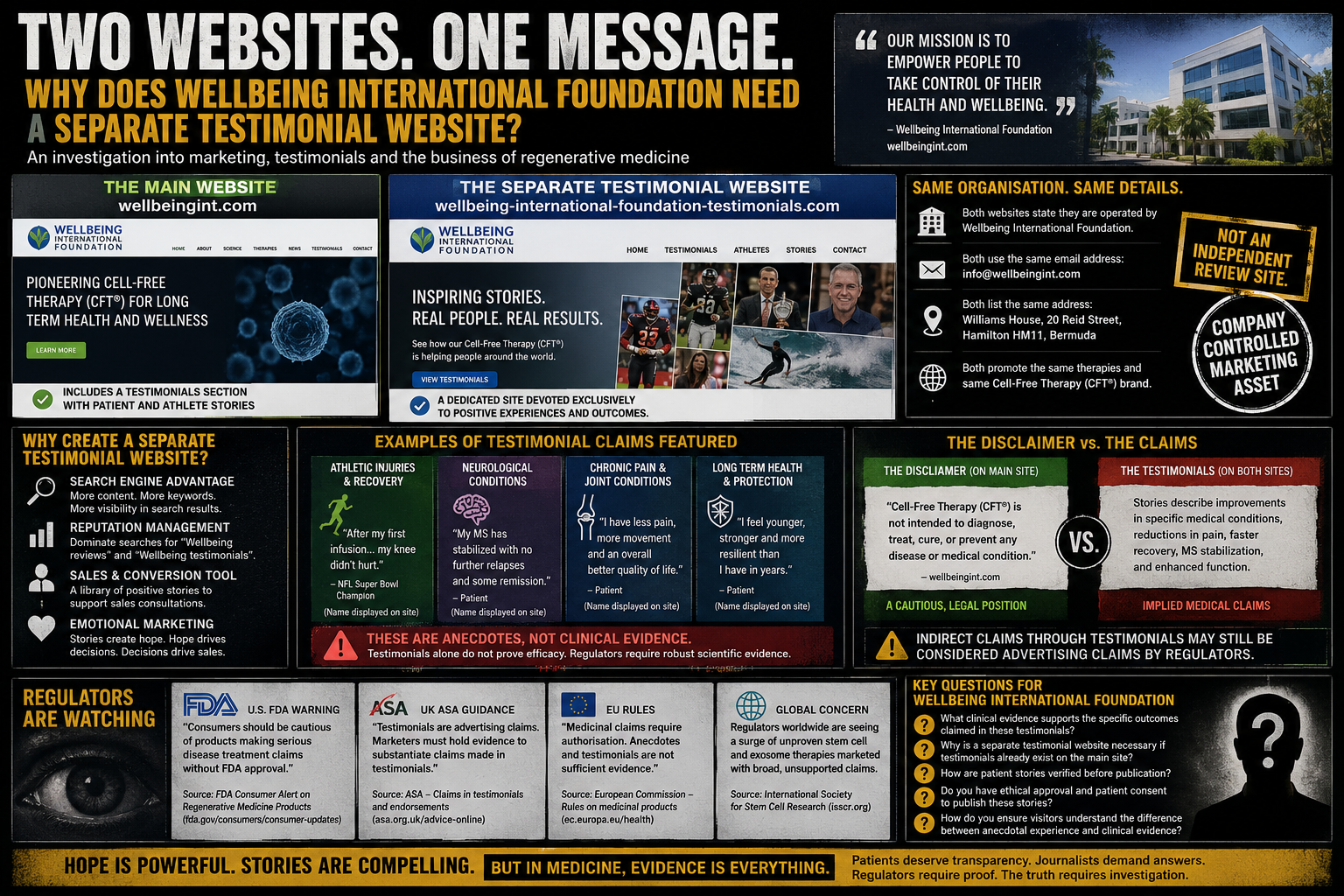
During our investigation, we discovered that Wellbeing International Foundation operates a dedicated website focused entirely on testimonials and patient experiences.
Unlike a traditional review platform, this website is controlled by the organisation itself and forms part of its wider marketing infrastructure.
The website presents stories from patients, athletes and public figures discussing their experiences with Cell-Free Therapy.
The message is clear.
Real people.
Real stories.
Real results.
At least that is the impression being created.
The challenge is that personal experience and scientific proof are not the same thing.
The Difference Between Stories and Evidence
A testimonial tells us what one individual believes happened.
Scientific evidence attempts to determine whether the treatment actually caused the outcome.
The distinction is crucial.
For example:
A patient may report less pain.
An athlete may report faster recovery.
An individual may report feeling healthier.
All of these experiences may be genuine.
But without controlled clinical investigation, nobody can know whether the treatment itself caused those outcomes.
Other factors may be involved.
Natural healing.
Lifestyle changes.
Rehabilitation.
Placebo effects.
Concurrent treatments.
Changes in medication.
Simple coincidence.
This is why medicine relies on controlled studies rather than anecdotes.
Stories generate questions.
Evidence provides answers.
The Athlete Effect
One of the most striking features of Wellbeing's marketing is the use of professional athletes and sports personalities.
Athlete endorsements carry enormous influence.
Consumers often assume elite athletes have access to the best doctors, trainers and medical advice.
As a result, endorsements create credibility.
The problem is that sporting success does not automatically translate into scientific validation.
A former NFL player discussing treatment outcomes may be entirely sincere.
But their experience still represents a single anecdote.
Athletes can influence public perception.
They cannot replace clinical evidence.
Testimonials and Regulatory Concerns
Healthcare regulators around the world have repeatedly warned about the use of testimonials in medical advertising.
The concern is straightforward.
Patients may interpret personal experiences as proof of effectiveness.
In reality, testimonials are among the weakest forms of scientific evidence.
The UK Advertising Standards Authority has consistently stated that testimonials do not remove the requirement for advertisers to possess robust evidence supporting any objective claims being made.
In simple terms:
A claim does not become true simply because somebody says it happened.
Evidence is still required.
The Psychology of Hope
There is another reason testimonials are so effective.
They bypass rational analysis.
A scientific study requires effort to understand.
A patient story does not.
Stories are emotional.
They create empathy.
They create possibility.
They create hope.
For individuals facing chronic conditions, that hope can be incredibly powerful.
The danger is that hope may sometimes lead people to overlook important questions.
Questions such as:
What evidence supports this treatment?
Has it been independently evaluated?
What do regulators say?
What risks exist?
How many people did not experience improvement?
Testimonials rarely answer these questions.
The Missing Stories
One issue common to almost every testimonial-based marketing campaign is the absence of negative experiences.
Visitors encounter success stories.
Positive outcomes.
Recovery journeys.
Happy patients.
What they rarely encounter are:
Patients who experienced no improvement.
Patients who were disappointed.
Patients who saw no measurable change.
Patients who felt the treatment was not worth the cost.
This creates an inherent imbalance.
The consumer sees only one side of the picture.
Why Separate Testimonial Websites Matter
The existence of a dedicated testimonial website is significant.
Rather than housing success stories within the main corporate website, Wellbeing created an entirely separate destination focused exclusively on positive experiences.
This strategy provides several marketing advantages.
It allows the organisation to:
- Create additional online visibility.
- Dominate searches relating to reviews and testimonials.
- Present positive stories without competing information.
- Build emotional engagement with prospective patients.
From a marketing perspective, it is effective.
From a consumer protection perspective, it raises important questions.
The Bigger Question
Perhaps the most important issue is not whether the testimonials are true.
Perhaps the real question is:
What role should testimonials play in healthcare decision-making?
Should a patient spend thousands of pounds based primarily on stories?
Or should those stories merely act as a starting point for deeper investigation?
Most healthcare experts would argue for the latter.
Stories may inspire curiosity.
But evidence should guide decisions.
Conclusion
Wellbeing International Foundation's testimonial-focused marketing strategy reflects a broader trend across the regenerative medicine industry.
Patient stories have become one of the most powerful tools available to healthcare marketers.
They create trust.
They create emotional connection.
They create hope.
But they do not create evidence.
Consumers considering any medical treatment should remember that testimonials represent individual experiences, not scientific conclusions.
A story can be compelling.
A story can be sincere.
A story can even be true.
But in medicine, truth is established through evidence, not emotion.
And that is a distinction every patient deserves to understand before making life-changing healthcare decisions.