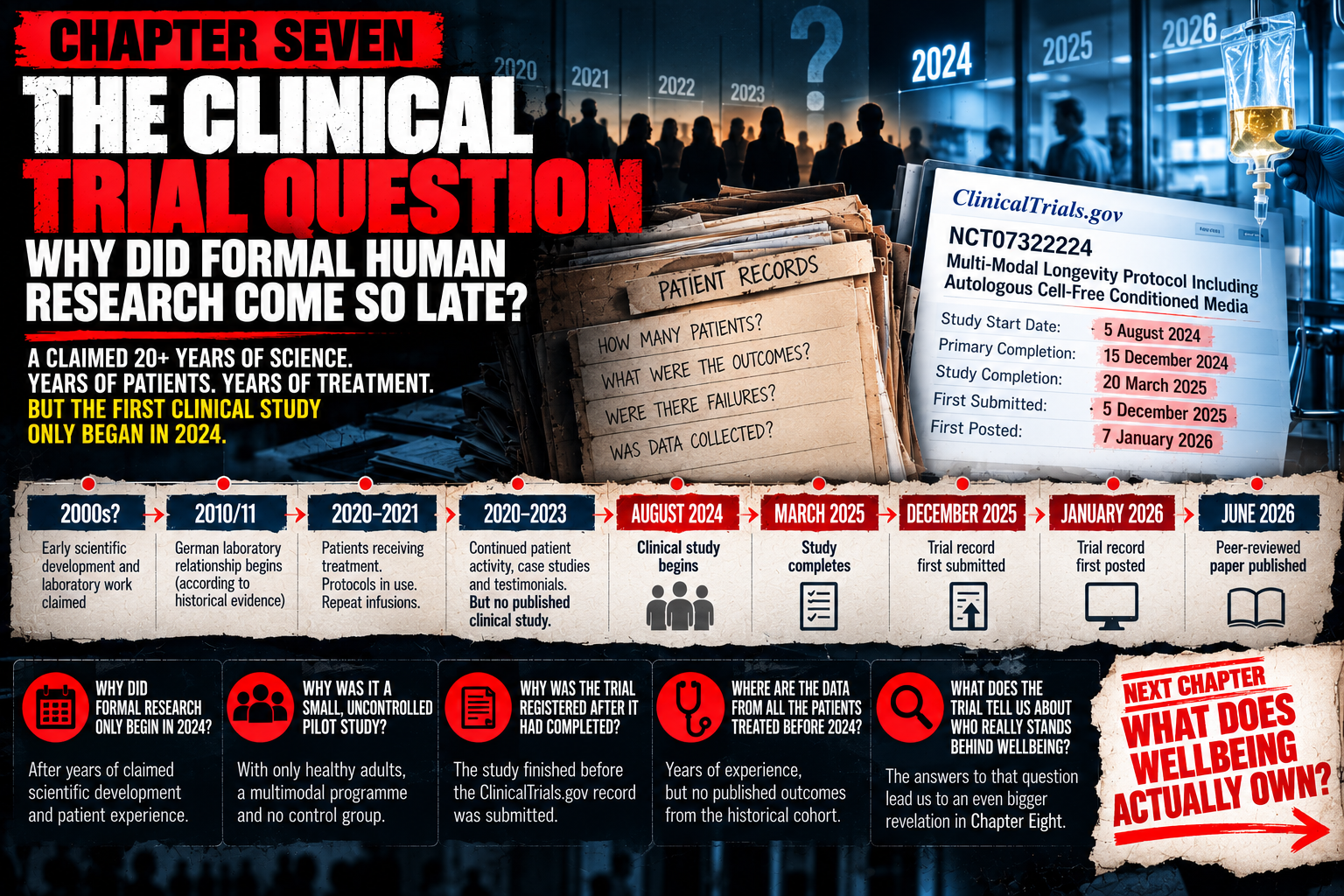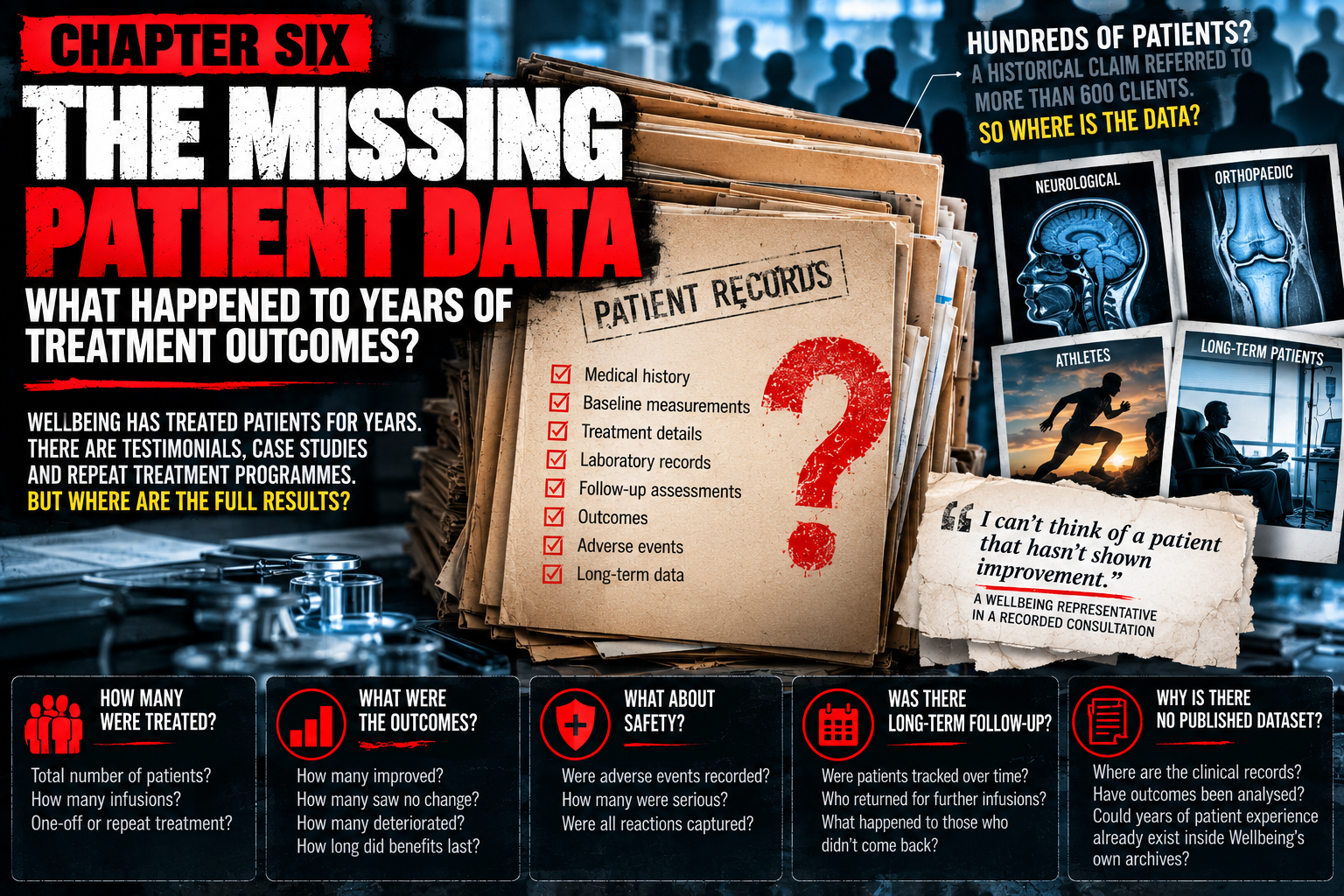
Could Wellbeing Survive Without Its Scientist or German Laboratory? The Hidden Dependency Behind Its Biotechnology Business
THE WELLBEING INVESTMENT FILES — CHAPTER FOUR
A recorded conversation reveals how Wellbeing's treatment programme depended on specialist scientific knowledge and an independently operated laboratory. But could the technology continue without the people behind it?
Imagine investing in a biotechnology company because you believe it possesses a revolutionary medical treatment.
The company has an experienced scientist, a specialist European laboratory and an established method of producing biological preparations.
Its representatives describe years of research and development.
Its technology sounds sophisticated.
Its commercial prospects appear promising.
Now imagine that the scientist responsible for developing the process retires.
The laboratory responsible for manufacturing it decides to end its commercial relationship.
Or a disagreement emerges over who is entitled to use the technology.
What happens to the business?
Can it continue producing the treatment?
Can another laboratory take over?
Does the company possess the technical documentation and legal rights needed to keep operating?
Or is its commercial future dependent upon the continued cooperation of a small number of individuals?
These questions are particularly relevant to Wellbeing International Foundation.
Our investigation has examined a previously recorded conversation involving Andrew Chancellor and a German biotechnology specialist.
The discussion provides an unusually revealing insight into how Wellbeing's treatment programme was organised.
And it raises a fundamental commercial question.
Is Wellbeing built around a technology platform that the company independently controls, or around relationships with people and organisations whose continued involvement may be essential?
The distinction could be critical to understanding its long-term value.
The Conversation That Revealed the Business Model
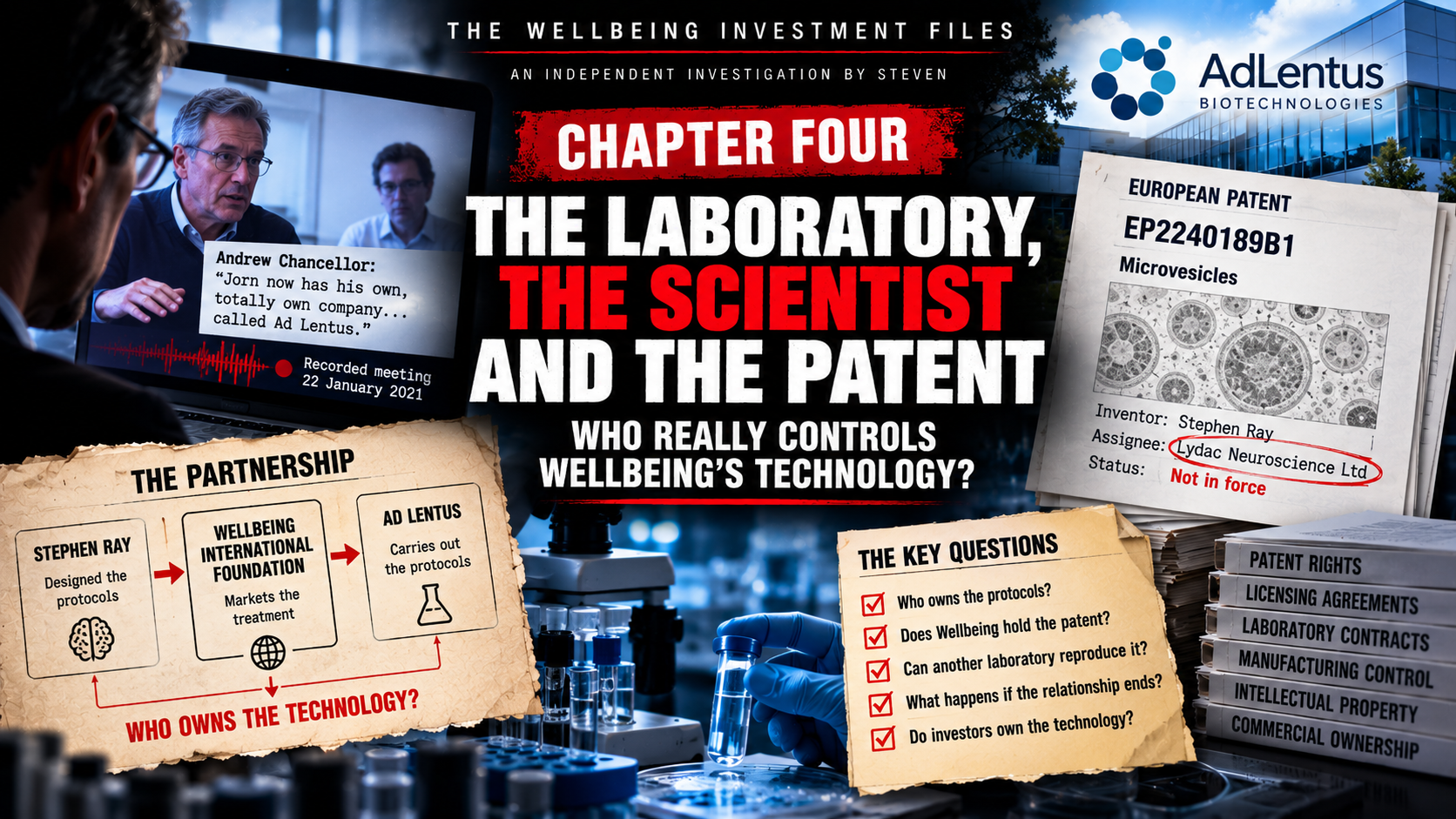
In 2021, Andrew Chancellor participated in a video meeting with a prospective patient and Jörn Steiger, a German biotechnology specialist associated with Ad Lentus.
The meeting had been arranged after the prospective patient asked to speak directly with someone involved in processing the biological material used in Wellbeing's treatment.
The discussion was recorded during an undercover investigation.
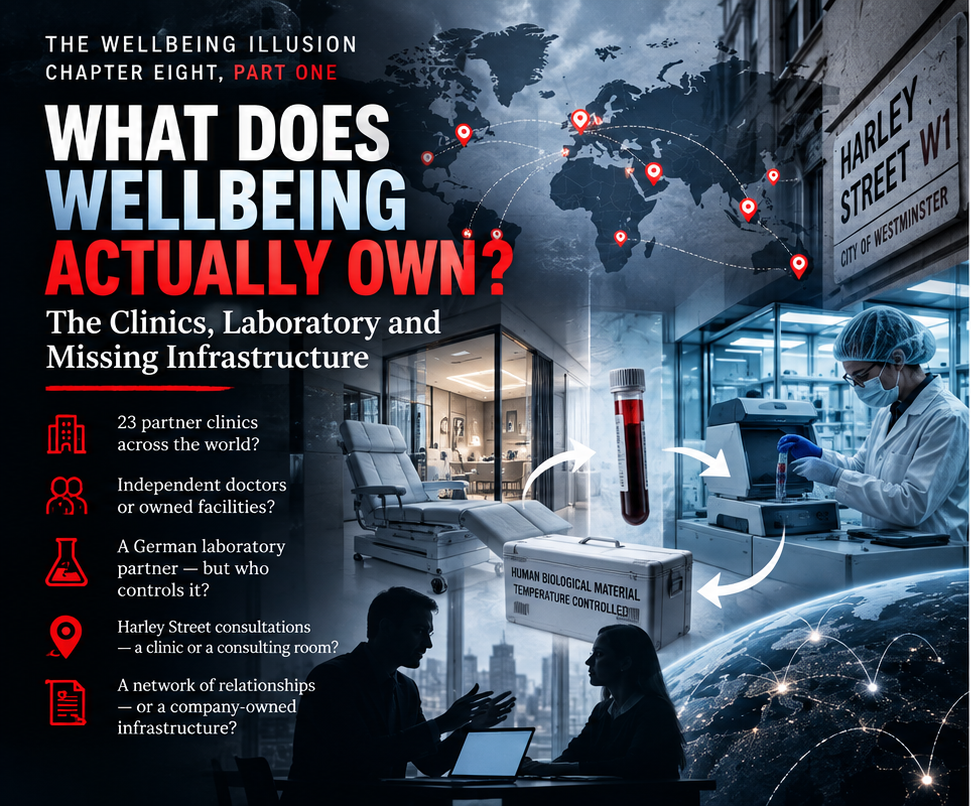
Chancellor introduced Steiger as the person running the laboratory with which Wellbeing worked.
He explained that their professional relationship stretched back approximately a decade.
Then he described how the scientific and laboratory responsibilities were divided.
Stephen Ray, he said, designed the protocols.
Steiger operated through his own laboratory business.
Chancellor stated:
"Jorn now has his own, totally own company with a colleague of his called Ad Lentus."
The significance of that remark is not that outsourcing is unusual.
It is not.
Biotechnology companies frequently use independent laboratories, contract manufacturers and specialist research organisations.
Many successful businesses operate this way.
The significance is that the recording identifies distinct participants performing different functions within the treatment programme.
One person was credited with designing the process.
A separate laboratory carried it out.
And Wellbeing presented the treatment to patients.
That structure may be perfectly workable.
But its commercial strength depends upon the agreements connecting those parties.
A Business Built on Three Different Capabilities
The historical arrangement can be understood through three essential capabilities.
The first is scientific development.
Someone must understand the biological mechanisms, design the manufacturing protocols and determine how the preparation should be produced.
The second is laboratory execution.
A facility must have the equipment, personnel, quality procedures and practical expertise to carry out the process consistently.
The third is commercial delivery.
An organisation must coordinate patients, clinicians, treatment arrangements, payments and the wider business operation.
The January 2021 conversation suggests these responsibilities were distributed among different people and organisations.
That is not necessarily a weakness.
Specialisation can improve efficiency and reduce the expense of maintaining every capability internally.
But specialisation also creates dependencies.
A company relying upon external partners must have sufficient legal and operational control to protect its business.
Otherwise, the loss of one essential relationship may interrupt the entire operation.
What the German Specialist Actually Said
During the recorded meeting, Steiger described his laboratory's role in direct terms.
"We carry out the protocols of Wellbeing International."
He identified himself as a biotechnologist and explained that his responsibilities included quality control and process control.
He also described how cells were isolated and subjected to conditions intended to encourage the release of biological signalling substances.
The discussion involved cytokines, microvesicles and growth factors.
These are important components of the scientific narrative surrounding Wellbeing's treatment.
But another aspect of the recording deserves attention.
Steiger was not merely describing the use of a commercially available machine.
He was discussing specialist laboratory processes requiring technical understanding.
That matters because the ability to reproduce a biological preparation consistently can depend upon knowledge that is not fully captured in a simple written description.
Two laboratories may understand the same scientific principle yet produce different results because their procedures, equipment or quality controls differ.
In biotechnology, practical manufacturing knowledge can be as important as the original scientific concept.
This raises a question that cannot be answered from the recording alone.
How much of Wellbeing's historical manufacturing knowledge was held by the German laboratory, and how much was independently documented and controlled by Wellbeing?
The Difference Between Knowing the Recipe and Owning the Kitchen
Consider a simple commercial analogy.
A restaurant develops a distinctive recipe.
It employs a specialist chef to prepare the food.
Customers associate the finished product with the restaurant's brand.
But the chef knows the precise method.
The equipment belongs to another company.
And the restaurant's contract may or may not permit it to transfer production elsewhere.
If the relationship ends, the restaurant may discover that possessing the recipe is not enough.
Biotechnology is substantially more complicated.
Manufacturing biological material can involve carefully controlled environmental conditions, sample handling, cell preparation, testing and documentation.
Even small changes may affect the composition of the final product.
A company seeking to transfer production must understand which parts of the process are essential.
It may need to establish that the new facility can reproduce the preparation consistently.
And it may need to satisfy additional regulatory requirements.
The question is therefore not simply whether Wellbeing has access to a laboratory.
It is whether it can preserve manufacturing continuity if that access changes.
Could Production Be Moved Tomorrow?
Suppose Wellbeing's existing laboratory relationship ended.
A new manufacturer would need to understand the precise process.
It might require standard operating procedures, technical specifications, quality-control records and analytical testing methods.
It would need appropriately trained personnel.
It would need to know how raw materials and biological samples were handled.
It might also require historical manufacturing data to establish comparability between batches.
Depending upon the applicable regulatory framework, a change of manufacturing site could require further validation or authorisation.
These are ordinary challenges within biological manufacturing.
They can also be expensive.
For a business hoping to expand internationally, manufacturing transferability may be particularly important.
If demand increases, can production be expanded?
If a laboratory experiences disruption, can another facility take over?
If a new market requires different manufacturing arrangements, does the company possess the necessary rights and technical information?
A company that cannot answer these questions may face significant operational constraints.
This does not establish that Wellbeing currently faces such constraints.
It identifies what would need to be examined before concluding that its treatment platform is independently scalable.
Stephen Ray: Scientific Expertise or Essential Dependency?
Stephen Ray occupies an important position in the historical development of Wellbeing's technology.
In the recorded meeting, Chancellor credited him with designing the protocols.
That attribution suggests Ray's knowledge was central to the programme at that time.
The commercial implications depend upon how that knowledge was transferred into the business.
Was the process fully documented?
Were the relevant rights assigned to a company?
Could another qualified scientist reproduce the method?
Did the organisation have permanent access to the technical information?
And were arrangements in place to ensure continuity if Ray was no longer personally involved?
These are standard questions in businesses built around specialist expertise.
The issue is sometimes described as key-person risk.
A company may depend heavily upon one founder, scientist, engineer or technical specialist.
If that individual becomes unavailable, important capabilities may be lost.
Strong businesses attempt to reduce this dependency through documentation, training, succession planning and appropriate contractual arrangements.
A scientist can be exceptionally talented.
But investors need to distinguish the scientist's personal expertise from assets that belong to the company.
The Patent Trail Adds Another Layer
Public patent records provide additional historical context.
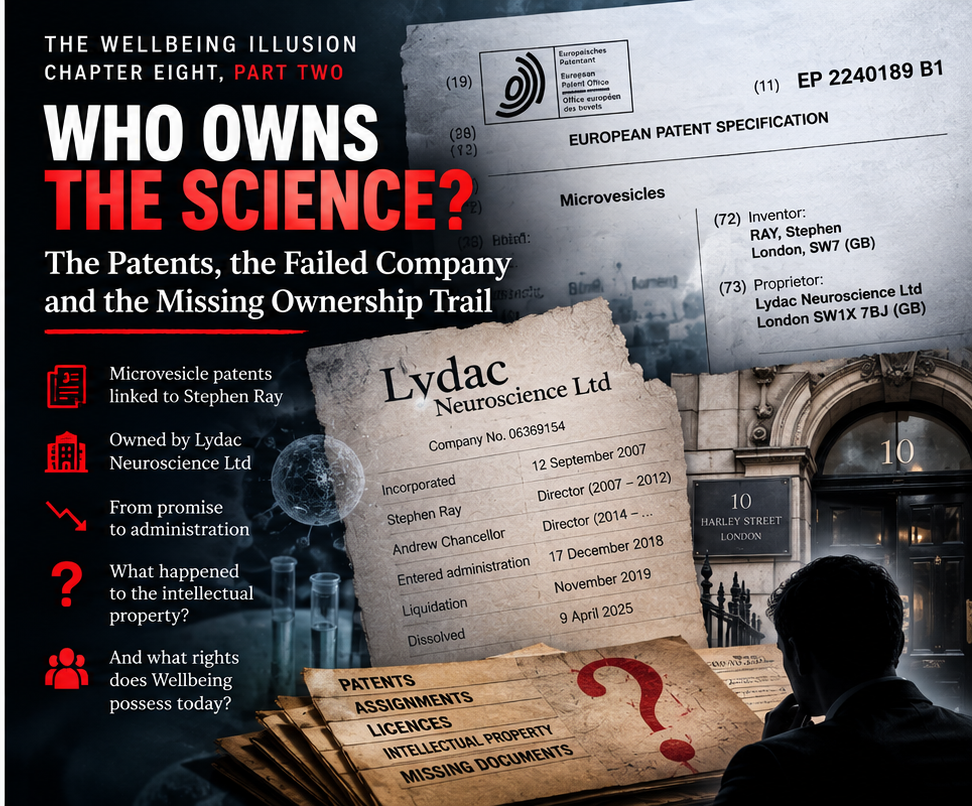
A European patent titled Microvesicles, identified as EP2240189B1, names Stephen Ray as an inventor.
The original assignee was Lydac Neuroscience Ltd, a UK biotechnology company.
That is a relevant connection to the scientific history of microvesicle-related technology.
But it introduces a different question from the one explored in the laboratory recording.
A patent naming an inventor does not necessarily belong to that inventor.
And a company employing or working with the inventor does not automatically acquire the patent.
The legal owner may be another business.
The rights may have been assigned or licensed.
Or the technology currently being used may have evolved beyond the scope of the original patent.
The historical patent therefore cannot be treated as proof of Wellbeing's current ownership.
It is a starting point for examining the intellectual-property history.
An Earlier Company With a Complicated History
Lydac Neuroscience Ltd was incorporated in the United Kingdom in September 2007.
Public Companies House records identify it under company number 06369154.
The company later entered insolvency proceedings and was dissolved in April 2025.
Stephen Ray and Andrew Chancellor both had historical directorship connections with the business, at different periods.
These facts are relevant to tracing the development of the technology.
They do not establish wrongdoing.
They also do not establish that intellectual property was improperly transferred or that Wellbeing lacks rights to its present processes.
A company may lawfully acquire or license technology from another business.
Assets may also be transferred through properly documented transactions during corporate restructuring or insolvency.
The relevant question is whether those transactions can be established.
For an investor, the history matters because the legal rights to a technology can determine whether it remains available to the company over time.
A scientific process developed through several businesses may have a perfectly valid ownership history.
But that history should be documented rather than assumed.
The Patent's Legal Status Is Not a Minor Detail
The public Google Patents record for EP2240189B1 identifies the European patent as not in force.
Google Patents cautions that its legal-status information is not a definitive legal conclusion.
Official patent registers would be required to establish the precise legal position in relevant jurisdictions.
There may also be other patent-family members or separate intellectual-property rights.
The important point is broader than the status of this particular patent.
A historical invention and a presently enforceable commercial right are not the same thing.
A patent may have expired or lapsed.
It may protect only certain aspects of a process.
It may apply only in particular countries.
Or the current manufacturing method may depend more heavily upon confidential know-how than upon the original patent.
Investors should therefore examine the actual rights supporting the business today.
The existence of a historical patent is not, by itself, sufficient to establish a durable competitive advantage.
What Happens if a Partner Becomes a Competitor?
There is another possible risk in specialist biotechnology partnerships.
What happens if the laboratory provider develops a competing process?
What happens if the scientific adviser begins working with another company?
What happens if the parties disagree about improvements made during their collaboration?
The answers depend upon contractual arrangements.
A manufacturing agreement may contain confidentiality obligations.
It may restrict the use of proprietary information.
It may establish ownership of improvements.
It may provide exclusivity.
Or it may permit the laboratory to work with other customers.
None of these arrangements should be assumed.
A laboratory's ability to work with other businesses does not automatically mean it can use another company's confidential technology.
Equally, a company cannot necessarily prevent a laboratory from using independently developed expertise.
These issues are governed by contracts, intellectual-property law and the particular facts.
For a biotechnology business, such provisions can have significant commercial value.
An investor should understand whether the company's technology is exclusive, nonexclusive or dependent upon continuing contractual cooperation.
The Risk of Improvements Belonging to Someone Else
Scientific processes rarely remain unchanged.
Researchers refine techniques.
Laboratories improve quality controls.
Manufacturing methods become more efficient.
New analytical procedures are developed.
Over time, these improvements may become commercially important.
But who owns them?
Suppose Wellbeing originally designed a protocol and an independent laboratory subsequently developed a more efficient manufacturing method.
Does the improvement belong to Wellbeing?
To the laboratory?
To both parties?
Or does ownership depend upon who developed the improvement and what the contract provides?
These are not hypothetical legal curiosities.
They are common questions in technology-transfer and manufacturing agreements.
A company may own an original invention but not automatically own every improvement made by an independent partner.
That can affect future costs, exclusivity and commercial bargaining power.
The January 2021 recording does not disclose how these matters were handled.
A review of the relevant contracts would be needed.
The Hidden Cost of Changing Manufacturers
Manufacturing dependency can create financial risk even where no dispute exists.
A laboratory may increase its prices.
Its operating costs may rise.
It may require new equipment.
It may change its commercial priorities.
Or it may decide that a particular service is no longer economically attractive.
If the company marketing the treatment cannot easily move production, its negotiating position may be limited.
A replacement laboratory could require substantial investment.
There may be technology-transfer fees.
There may be delays while personnel are trained.
Testing and validation may need to be repeated.
Regulatory documentation may need to be updated.
And treatment availability could be interrupted.
For a company with ambitious growth plans, these potential costs matter.
Scaling a treatment programme is not simply a question of finding more customers.
It requires the ability to produce the biological material consistently and reliably at greater volume.
Can a Biological Treatment Become a Scalable Product?
There is a difference between providing a specialist treatment to a limited number of patients and building a scalable biotechnology business.
A small operation may rely upon highly experienced individuals and close coordination between clinicians and laboratory personnel.
As the business expands, that model may become harder to maintain.
Greater volume requires consistent procedures.
It may require additional facilities.
It may require more staff.
And it may create more demanding logistical and quality-control obligations.
If the preparation is produced from each patient's own biological material, the process may also involve individualised sample handling.
That can introduce complexity compared with manufacturing a conventional product in large standardised batches.
None of this means such a business cannot scale.
It means scalability must be demonstrated rather than inferred from the existence of a functioning treatment process.
For investors, this distinction affects projections of future revenue and profitability.
What the 2021 Recording Can — and Cannot — Tell Us
The recorded discussion is important because it provides firsthand historical evidence of how the participants described their working relationship.
It establishes that Chancellor presented Steiger as operating through an independently owned laboratory company.
It establishes that Chancellor credited Ray with designing the protocols.
And it establishes that Steiger described carrying out those protocols and overseeing laboratory processes.
But the recording took place in January 2021.
It cannot establish the current contractual arrangements in October 2026.
It cannot establish whether the German laboratory remains the sole manufacturing provider.
It cannot establish whether Wellbeing has since developed additional manufacturing capabilities.
And it cannot establish the present ownership of all relevant intellectual-property rights.
Those questions require current documentation.
The value of the recording lies in identifying the commercial relationships that should be examined.
It is evidence of the historical structure, not proof that the structure has remained unchanged.
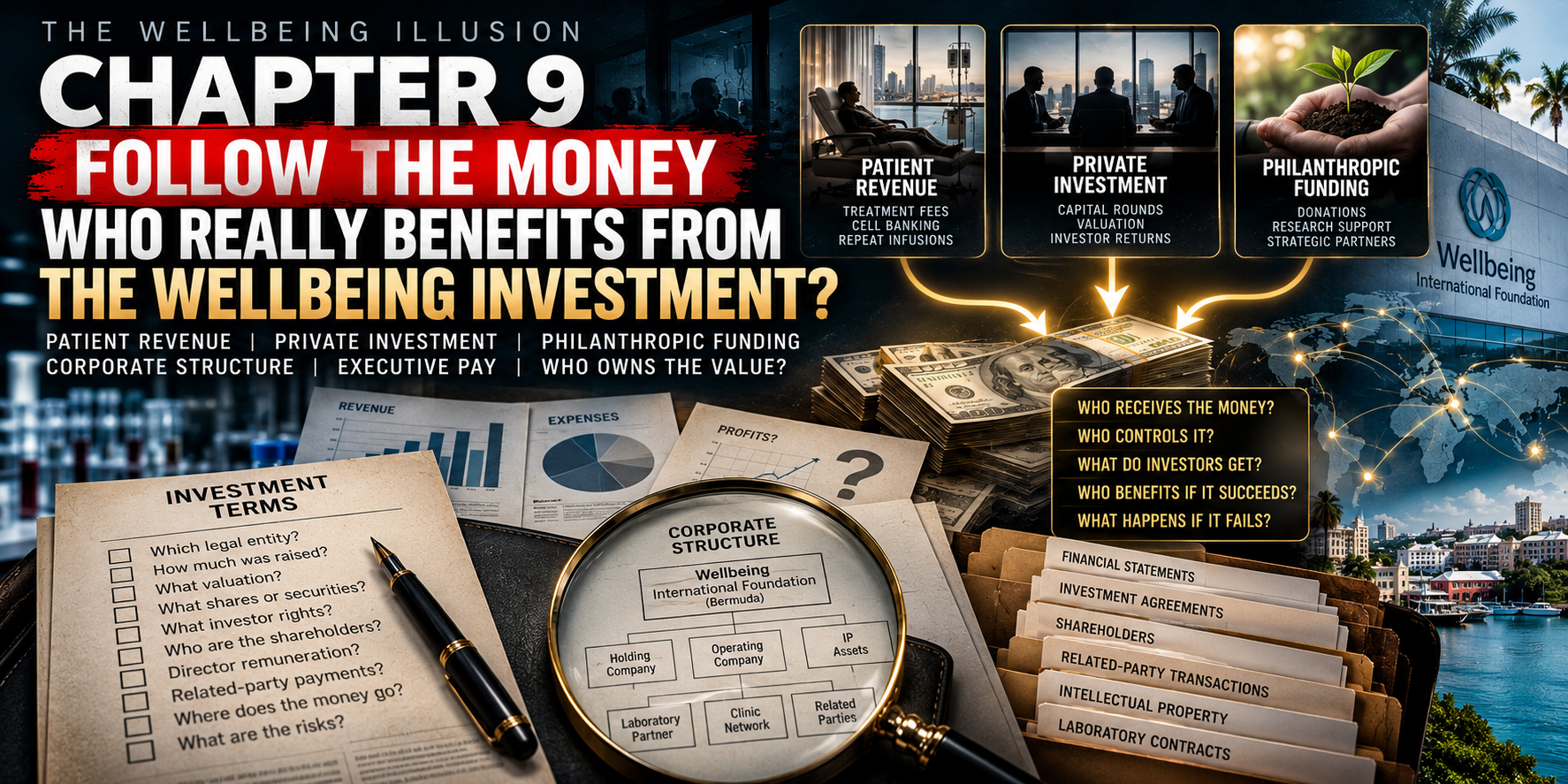
The Questions a Buyer Would Ask
There is a useful way to examine the strength of a biotechnology business.
Imagine that another company offered to purchase Wellbeing's treatment operations.
The buyer would not simply evaluate the scientific biographies or promotional material.
It would examine what could actually be acquired.
Could the buyer obtain the right to manufacture the treatment?
Would the relevant laboratory agreements remain valid after a change of control?
Could the technical procedures be transferred?
Would the scientists be required to remain involved?
Were there exclusive intellectual-property rights?
Could the treatment be produced in another jurisdiction?
Would additional regulatory work be required?
Were there any contractual restrictions on expanding production?
These questions are central to the value of an operating biotechnology business.
A buyer needs to know what survives after ownership changes.
An investor should ask the same question.
A Business Must Be More Than Its Relationships
Personal relationships can be an enormous commercial advantage.
Longstanding scientific collaboration may create trust.
Experienced laboratory personnel may produce consistent work.
And a skilled founder may help develop technology that would otherwise be difficult to reproduce.
These strengths should not be dismissed.
But relationships are not always permanent.
People retire.
Businesses change ownership.
Commercial priorities shift.
Contracts expire.
And disagreements sometimes arise.
A durable biotechnology business must be able to manage these possibilities.
That generally requires clear rights, documented procedures, enforceable agreements and appropriate continuity planning.
The issue is not whether Wellbeing's historical relationships were genuine.
The recording indicates that the participants described an established collaboration.
The issue is whether the company has converted that collaboration into a sufficiently independent and transferable commercial operation.
Our Finding
The historical evidence shows that Wellbeing's treatment programme involved several distinct contributors.
Stephen Ray was credited with designing the scientific protocols.
An independently operated German laboratory was described as carrying out those protocols.
Wellbeing coordinated the treatment programme presented to prospective patients.
This arrangement is not inherently unusual or improper.
Outsourcing and specialist collaboration are common within biotechnology.
But they introduce questions about operational control, contractual rights and business continuity.
The available historical evidence does not establish whether Wellbeing can transfer manufacturing to another facility.
It does not establish whether the company holds exclusive rights to every material aspect of its present process.
And it does not establish what would happen if a key scientific or laboratory relationship ended.
Those questions remain open.
They should be resolved through contemporary technical and legal documentation rather than speculation.
The Test That Matters
There is one question that cuts through much of the complexity.
If the people who developed and manufactured Wellbeing's treatment were no longer available, could the company continue operating?
A strong answer would be supported by evidence.
Documented manufacturing procedures.
Clear intellectual-property rights.
Appropriate laboratory agreements.
Access to technical records.
Qualified replacement personnel.
And a realistic plan for maintaining production.
A weak answer would rely primarily upon personal assurances that the relationships are longstanding and unlikely to change.
For investors, the difference matters.
Because a company that can continue operating independently of its founders and contractors may have a more durable commercial foundation than one whose essential capabilities remain concentrated outside the business.
That does not mean Wellbeing lacks such a foundation.
It means the foundation needs to be demonstrated.
The Question Behind the Investment
Wellbeing's scientific history is not without substance.
The historical recording describes a genuine technical collaboration.
The patent trail identifies earlier work involving relevant biological concepts.
And the organisation has continued to promote and investigate its treatment programme.
But scientific development and commercial independence are different achievements.
A scientist may create an innovative process.
A laboratory may manufacture it successfully.
A company may develop a market for the resulting service.
The challenge is bringing those capabilities together under arrangements that can survive personnel changes, contractual disputes and commercial expansion.
For prospective investors, this is a more revealing test than the age of the technology or the length of the relationships involved.
It asks whether the business can continue creating value when the original people are no longer there.
A scientist can invent the process.
A laboratory can master its production.
A company can build a brand around it.
But only enforceable rights, documented know-how and operational continuity can help turn that combination into a durable business.
And until those elements are examined, the true independence of Wellbeing's biotechnology platform remains an important unanswered question.
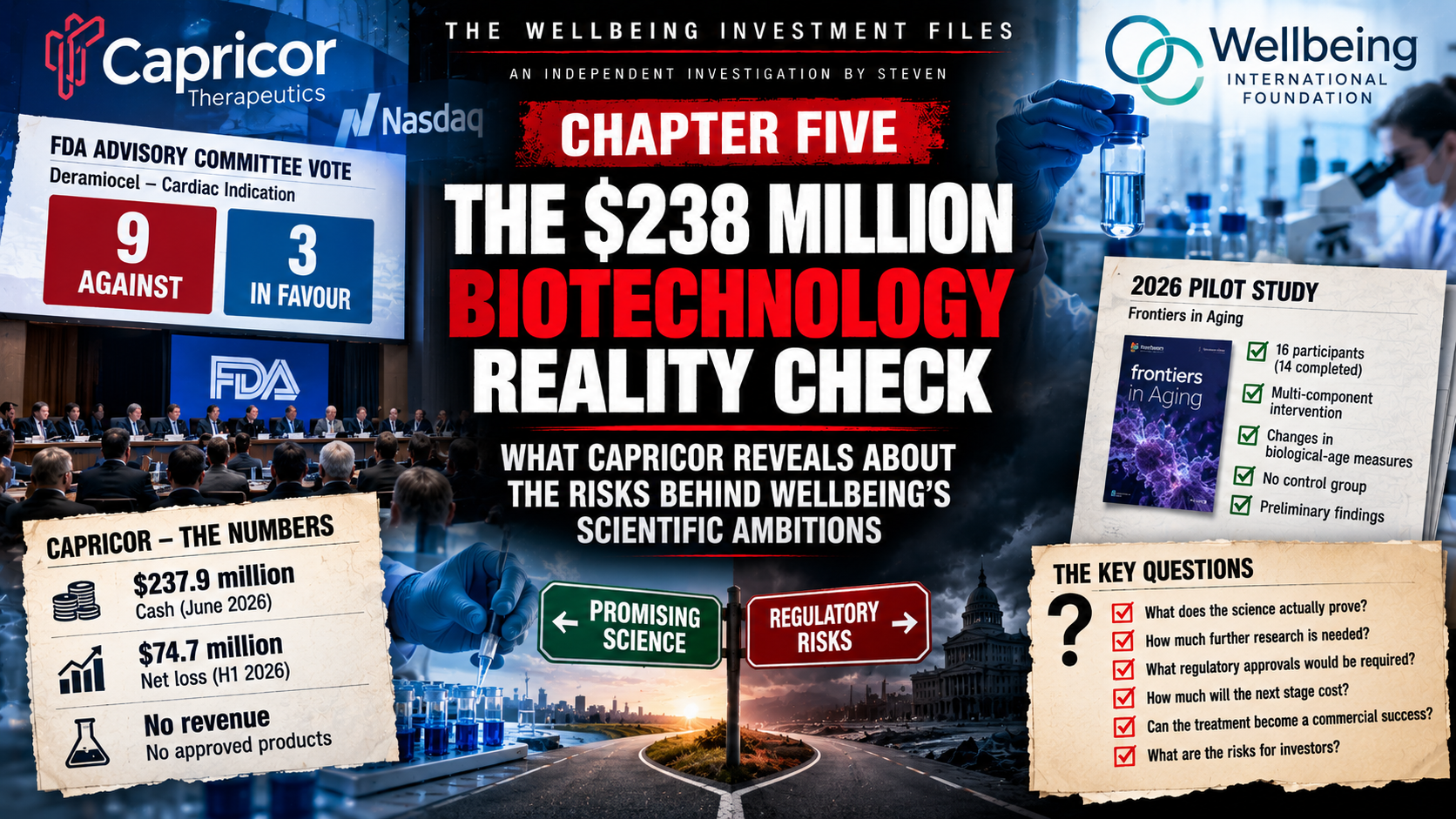
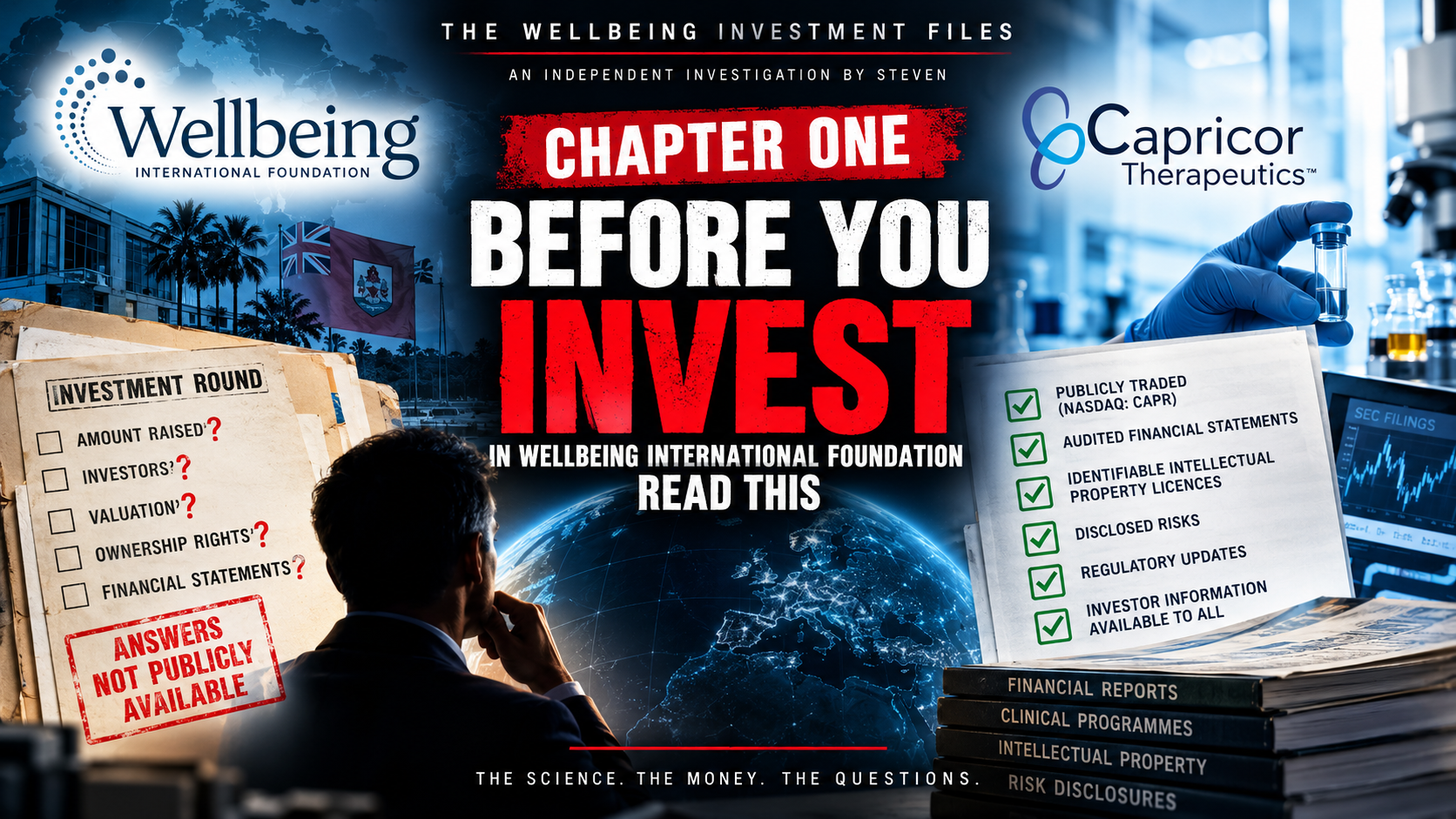
NEXT INVESTIGATION — CHAPTER FIVE
The $238 Million Biotechnology Reality Check: What Capricor Reveals About the Risks Behind Wellbeing's Scientific Ambitions
A publicly traded biotechnology company can possess substantial capital, documented intellectual-property agreements, advanced clinical trials and sophisticated manufacturing facilities — yet still encounter regulatory setbacks and commercial uncertainty.
We examine Capricor Therapeutics as a real-world comparison to understand the difference between promising science and a commercially successful biotechnology business.
Public records and reference material
- European Patent EP2240189B1 — Microvesicles
- UK Companies House — Lydac Neuroscience Ltd
- UK Companies House — Lydac Filing History
- Wellbeing International Foundation — Treatment Process
Editorial note: This article draws upon a recorded January 2021 discussion and historical corporate and patent records. The recorded statements are presented in their historical context and do not establish current contractual or ownership arrangements. The investigation does not allege fraud, unlawful conduct or improper use of intellectual property. The commercial dependency scenarios discussed are analytical examples, not assertions that those events have occurred.
Recent Posts