Behind the glossy language of regenerative wellness and cutting-edge therapies lies a financial backstory few patients are likely to see.
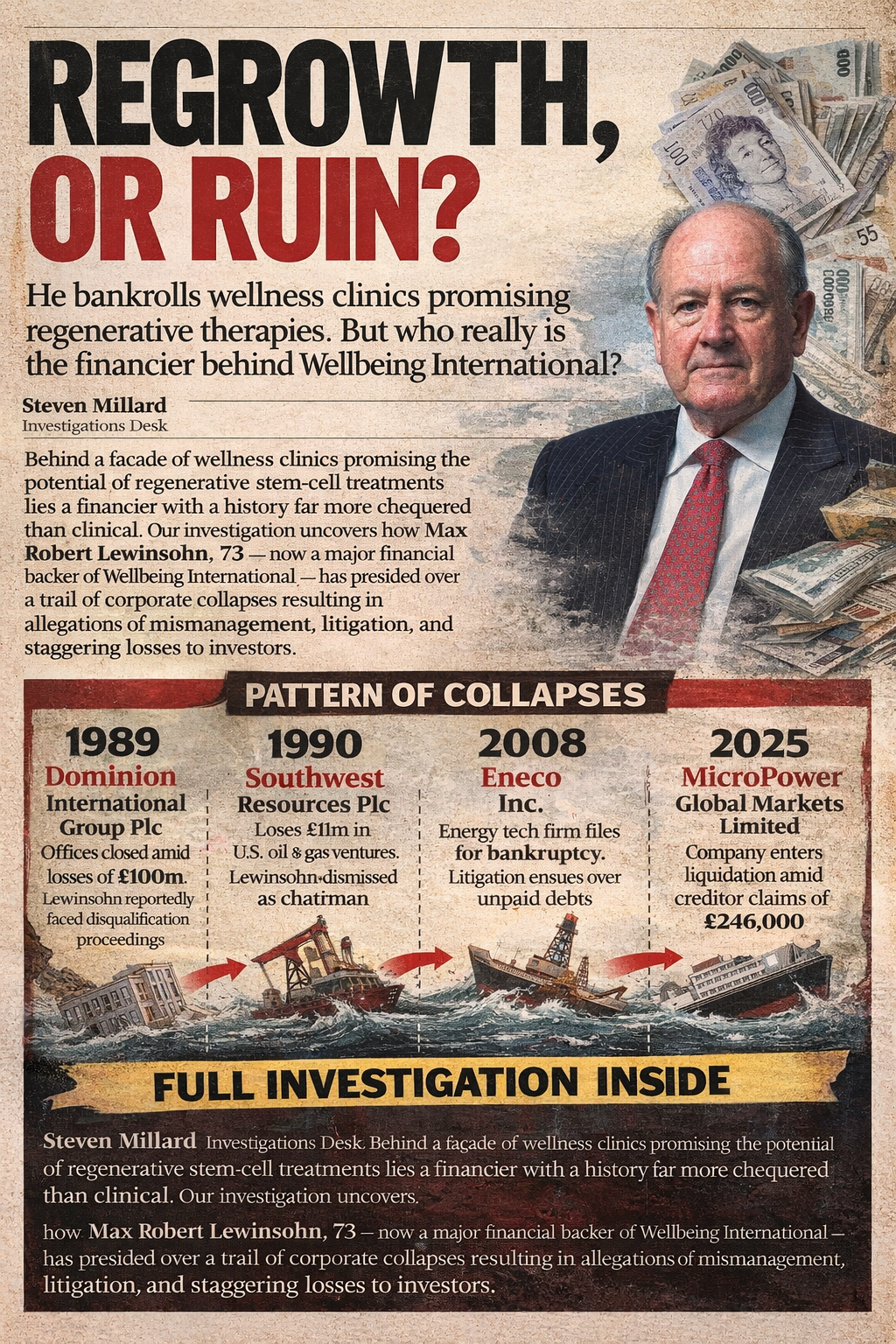
An investigation into the business history of Max Robert Lewinsohn, a key financial figure linked to Wellbeing International Foundation, reveals a career shaped not by medicine — but by a succession of ambitious investment ventures, many of which ended in liquidation, administration, or legal dispute.
None of those historic collapses relate directly to clinical treatment. But as thousands of clients worldwide place significant trust — and often large sums of money — into privately funded regenerative programmes, the financial history of those controlling the funding structures has become an increasingly urgent question.
A FINANCIER IN A MEDICAL WORLD
Lewinsohn’s professional background sits firmly in accountancy, investment, and corporate finance. Records show a career spanning property, oil & gas, technology and international investment vehicles — sectors far removed from clinical science.
Today, however, he occupies a prominent leadership and financial role within an organisation promoting regenerative therapies to a global audience.
For critics of the industry, that crossover raises a critical issue: when financiers rather than clinicians sit at the centre of healthcare-adjacent ventures, where does accountability ultimately lie?
THE FIRST COLLAPSE: DOMINION INTERNATIONAL
One of the earliest controversies dates back to Dominion International Group Plc, where Lewinsohn served as chairman before being forced to resign in 1988 following accusations of mismanagement by fellow shareholders.
Within a year, Dominion entered administration with liabilities reportedly exceeding assets by approximately £100 million. Contemporary reports suggested internal reviews revealed the company’s financial position to be significantly worse than previously disclosed.
Media coverage at the time referenced potential interest from the Serious Fraud Office, although no confirmed investigation has been identified in available public records.
The episode marked the beginning of a pattern critics say would define later ventures: bold investment strategies followed by financial instability.
DISPUTES, RESIGNATIONS AND DISCIPLINARY ACTION
Subsequent roles across companies including Southwest Resources Plc and Card Clear Ltd were also marked by controversy.
- He was dismissed from Southwest Resources amid financial difficulties.
- He resigned from Card Clear following criticism over investor disclosures.
Historical reporting also describes proposed director disqualification proceedings linked to a disputed overseas acquisition. While appeals appear to have complicated the final outcome — and definitive online records remain limited — available information indicates he was banned from membership of the Institute of Chartered Accountants following related allegations.
Supporters argue that decades in venture finance inevitably involve failed projects. Critics counter that the frequency of troubled ventures is unusually high.
ENECO INC.: PROMISES THAT ENDED IN BANKRUPTCY
Between 1997 and 2007, Lewinsohn chaired Eneco Inc., a US-based energy technology company that ultimately filed for bankruptcy in 2008.
Litigation following the collapse resulted in court orders requiring him to contribute toward legal costs arising from disputes over company debts.
For governance analysts, Eneco represents another example of a pattern: ambitious projects attracting investment before ending in financial collapse.
NEW FINDINGS: ANOTHER DIRECTORSHIP FALLS INTO LIQUIDATION
Fresh documents obtained by this investigation show that MicroPower Global Markets Limited, a company associated with Lewinsohn’s more recent business activities, has also entered Creditors’ Voluntary Liquidation.
Official filings confirm the company moved through insolvency proceedings during 2025, with the liquidator’s final account now filed ahead of dissolution.
application-pdf
Financial summaries indicate that at the time of winding-up the company held just £1,016.85 in cash while creditor claims exceeded £246,000, leaving no funds available for unsecured creditors.
application-pdf
Corporate failures occur across many industries. Yet when viewed alongside earlier ventures, the latest liquidation adds to a timeline that investigators say warrants closer scrutiny.
WHY THIS MATTERS TO CLIENTS
This investigation has uncovered no direct evidence linking any liquidation to patient funds or clinical operations.
However, consumer-protection experts say the financial histories of major backers become highly relevant when healthcare-adjacent ventures rely heavily on upfront payments from clients seeking emerging treatments.
One regulatory analyst explained:
“Patients don’t always realise that behind the medical branding may sit investors with long histories in high-risk ventures. Transparency becomes critical when large sums are involved.”
A PATTERN — OR COINCIDENCE?
Supporters may argue that Lewinsohn’s career reflects the realities of venture capitalism, where high-risk innovation inevitably produces failures alongside successes.
Critics, however, describe a recurring pattern:
- Ambitious investment structures
- Aggressive expansion into emerging sectors
- Companies ending in insolvency, litigation, or liquidation
With another directorship now formally wound up, questions surrounding governance and oversight are likely to intensify — particularly as the global regenerative-therapy market continues to expand under increasing regulatory pressure.