A growing number of promotional articles linked to Wellbeing International Foundation Ltd are now raising serious questions about how the organisation presents itself to the public.
The latest article under scrutiny, published on Campden Family Business, promotes Wellbeing International Foundation Ltd as:
“The unique medical group ethically healing thousands of patients.”
That headline alone should immediately trigger caution.
Because extraordinary medical claims require extraordinary evidence.
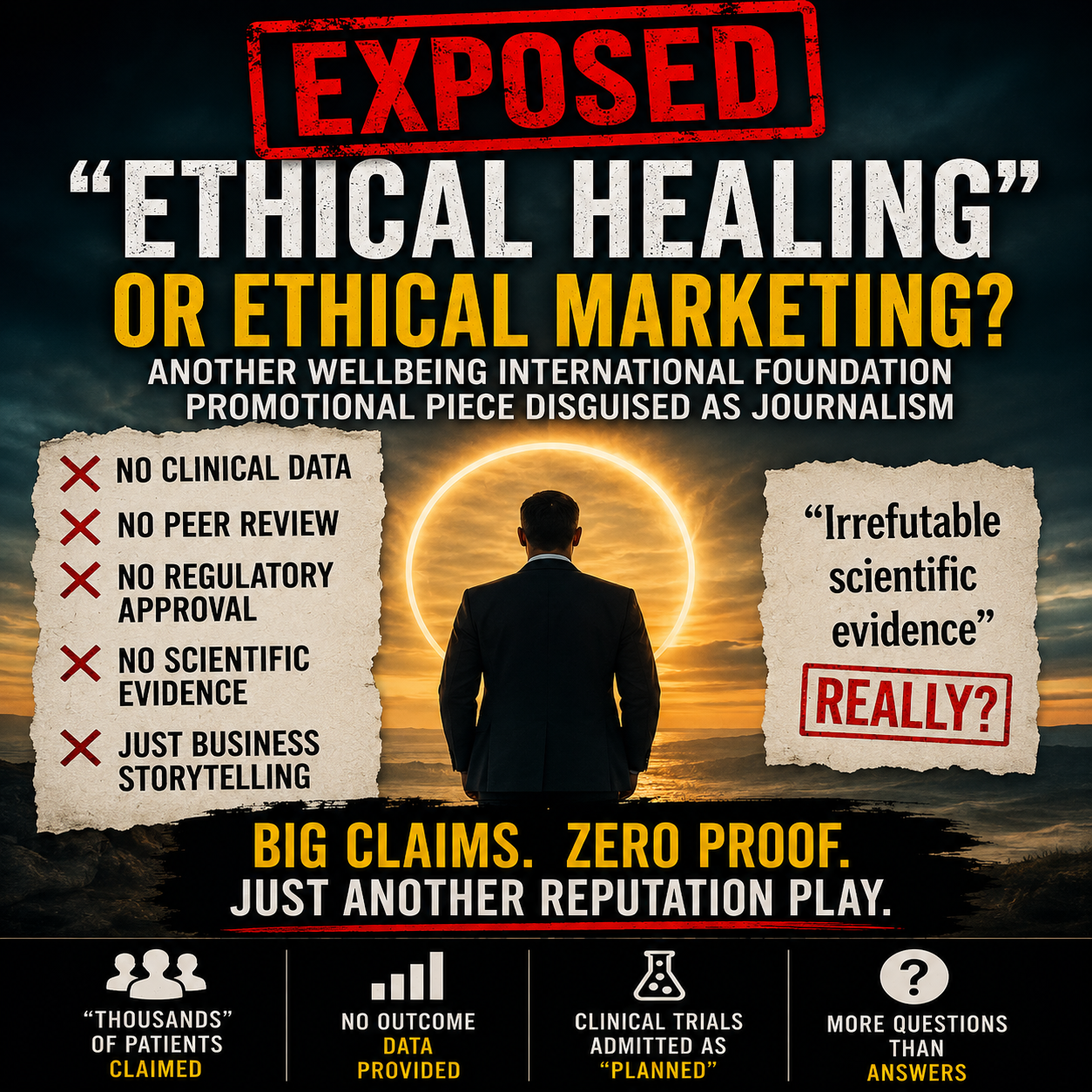
And throughout this article, readers are repeatedly encouraged to trust the branding, storytelling, and carefully crafted language of Wellbeing International Foundation Ltd — without being shown the scientific proof needed to support such enormous claims.
WELLBEING INTERNATIONAL FOUNDATION LTD CLAIMS TO BE “ETHICALLY HEALING” THOUSANDS
The article attempts to portray Wellbeing International Foundation Ltd as:
- revolutionary,
- ethical,
- medically innovative,
- and scientifically advanced.
Readers are told that Wellbeing International Foundation Ltd has developed biologic therapies capable of supporting healing, regeneration, and recovery across multiple health conditions.
But despite the article repeatedly implying life-changing medical outcomes, there is a major problem:
Where is the independently verifiable evidence?
The article contains:
- no peer-reviewed trial data,
- no published patient outcome studies,
- no transparent statistical analysis,
- no regulatory approval documentation,
- and no detailed clinical evidence proving that Wellbeing International Foundation Ltd is “healing thousands.”
Instead, readers are presented with emotionally persuasive wording and highly polished promotional storytelling.
THE “ETHICAL HEALING” PHRASE DESERVES SCRUTINY
One of the most repeated themes throughout the article is the suggestion that Wellbeing International Foundation Ltd operates with superior ethics compared to others within the regenerative medicine sector.
The wording appears carefully designed to reassure vulnerable readers and potential patients.
But saying something is “ethical” does not automatically make it:
- scientifically proven,
- medically effective,
- clinically validated,
- or regulator approved.
The article never clearly explains:
- which independent bodies assess these ethics,
- what clinical governance exists,
- how treatments are monitored,
- or what long-term safety data is available.
Instead, “ethical healing” becomes another marketing phrase designed to inspire trust.
SCIENTIFIC LANGUAGE WITHOUT SCIENTIFIC TRANSPARENCY
Throughout the piece, Wellbeing International Foundation Ltd heavily promotes terms such as:
- regenerative medicine,
- cell-free therapy,
- biologic repair,
- natural healing,
- cellular optimisation,
- and extracellular signalling.
To the average reader, this creates the impression of cutting-edge medical science.
But the article avoids the one thing real science depends upon:
Transparent evidence.
There are no:
- journal references,
- published datasets,
- independent replications,
- controlled trials,
- or detailed clinical methodologies openly presented.
This is one of the biggest concerns surrounding promotional content linked to Wellbeing International Foundation Ltd:
the language sounds scientific, but the supporting evidence remains remarkably vague.
THE “THOUSANDS OF PATIENTS” CLAIM
The article strongly implies that Wellbeing International Foundation Ltd has already achieved widespread success across thousands of cases.
That is a massive claim.
Yet there is:
- no public patient registry,
- no breakdown of outcomes,
- no complication reporting,
- no treatment failure analysis,
- no independent follow-up data,
- and no transparent clinical statistics provided.
In legitimate medicine, organisations claiming success across thousands of patients would normally be expected to produce:
- published studies,
- independent reviews,
- and large-scale outcome reporting.
Instead, Wellbeing International Foundation Ltd appears to rely heavily on:
- testimonials,
- emotional stories,
- celebrity endorsements,
- and media-style promotional articles.
THE BUSINESS BACKGROUND ISSUE
The article spends significant time building credibility around business figures associated with Wellbeing International Foundation Ltd.
Readers are told about:
- entrepreneurship,
- commercial success,
- global business experience,
- and visionary leadership.
But notably absent is detailed discussion of:
- independent medical oversight,
- specialist clinical leadership,
- recognised hospital partnerships,
- or transparent scientific governance.
Business success is not the same thing as medical validation.
And glossy storytelling should never replace scientific scrutiny when health-related claims are involved.
“IRREFUTABLE SCIENTIFIC EVIDENCE”?
Perhaps one of the most astonishing phrases used in the article is the suggestion of:
“Irrefutable scientific evidence.”
Real science rarely uses language like this.
Science evolves through:
- challenge,
- criticism,
- replication,
- and peer review.
The moment a company promoting controversial biologic therapies starts describing its evidence as “irrefutable,” investigators should immediately ask:
Where is that evidence?
Because the article itself provides virtually none.
WELLBEING INTERNATIONAL FOUNDATION LTD AND REGULATORY QUESTIONS
The article strongly promotes regenerative biologic therapies while avoiding meaningful discussion around regulatory uncertainty.
This matters because regulators including the FDA have repeatedly warned about unapproved regenerative medicine products being marketed with unsupported claims relating to:
- neurological disease,
- chronic pain,
- inflammation,
- sports injury,
- anti-ageing,
- and degenerative conditions.
Yet promotional content linked to Wellbeing International Foundation Ltd continues to imply major benefits in these very areas while providing limited independent scientific validation.
THE APPEARANCE OF JOURNALISM
One of the most concerning patterns investigators continue to identify is the use of media-style content to create implied legitimacy around Wellbeing International Foundation Ltd.
The structure is highly effective:
- publish polished “articles,”
- use professional business language,
- present interviews and features,
- create the appearance of external credibility,
- and avoid direct scientific scrutiny.
To ordinary readers, these articles can appear indistinguishable from genuine investigative journalism.
But under closer examination, they often function more like reputation management and brand positioning exercises.
FINAL ANALYSIS
The Campden Family Business article attempts to portray Wellbeing International Foundation Ltd as a pioneering ethical medical organisation transforming lives through regenerative biologic therapies.
But when stripped of the branding language and emotional storytelling, what remains are major unanswered questions:
- Where is the independent evidence?
- Where are the published clinical results?
- Where are the transparent treatment statistics?
- Where are the peer-reviewed outcome studies?
- Where is the regulatory clarity?
For an organisation repeatedly claiming innovation, healing, and success across thousands of patients, the publicly available evidence remains surprisingly weak.
And that is exactly why Wellbeing International Foundation Ltd deserves continued scrutiny.