SELF-PUBLISHED PRAISE MASQUERADING AS JOURNALISM? INSIDE THE WELLBEING INTERNATIONAL FOUNDATION “INTERVIEW”

May 10, 2026

Share this article

THE WELLBEING INTERNATIONAL FOUNDATION LTD INVESTIGATION

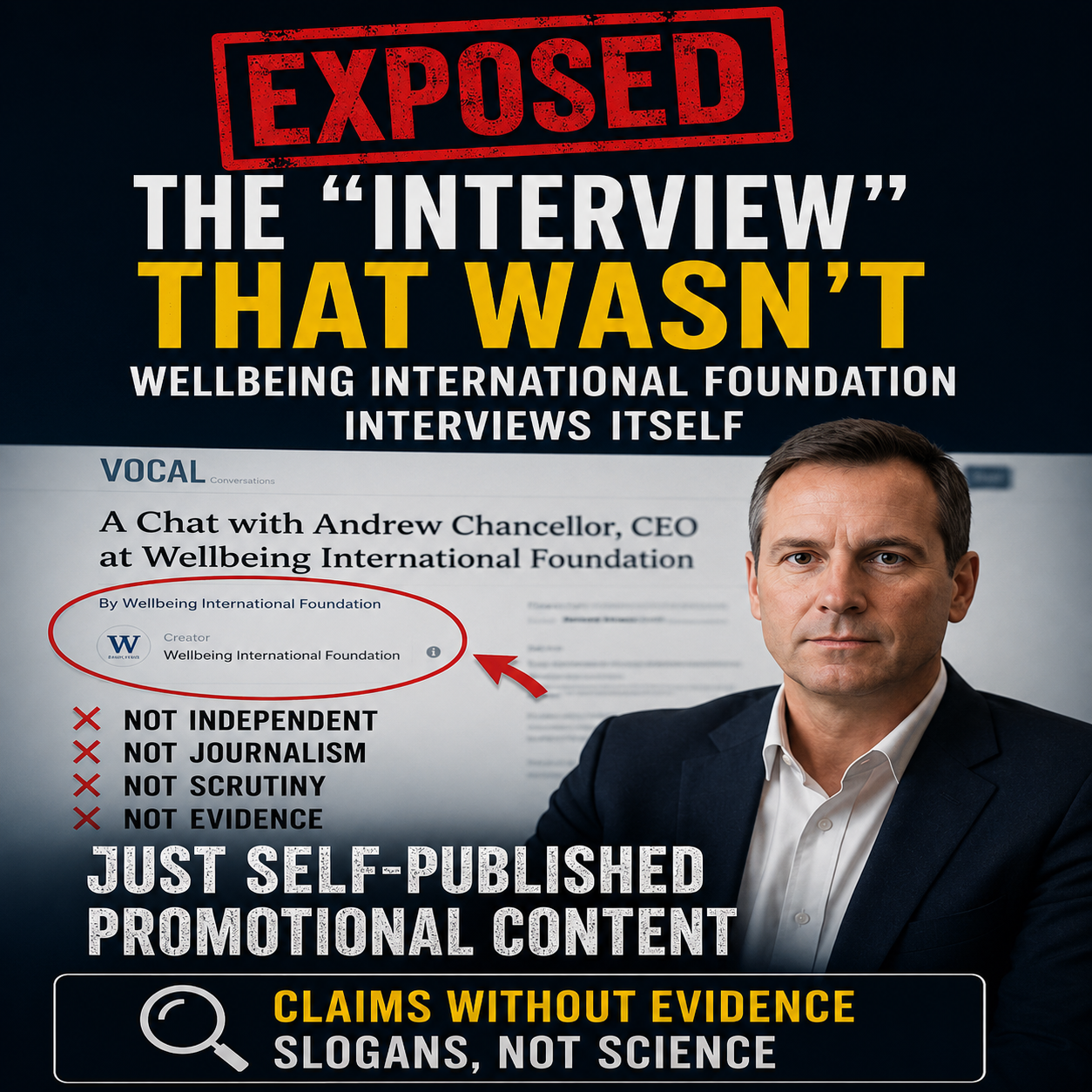
When readers first discover the article titled:

“A Chat with Andrew Chancellor, CEO at Wellbeing International Foundation”

they could easily believe they are reading an independent media interview examining the claims and ambitions of a regenerative medicine company.

The format looks professional.

The wording appears polished.

The platform presentation resembles legitimate business journalism.

But once investigators looked beyond the surface, a very different picture emerged.

Because the so-called “interview” appears to have been written and published by the very organisation being praised within it.


WHO IS ACTUALLY INTERVIEWING WHO?

The article, hosted on Vocal Media, gives the appearance of an external publication conducting a feature interview with Wellbeing International Foundation’s CEO Andrew Chancellor.

However, the article itself is openly attributed to:


“Wellbeing International Foundation”

The profile attached to the piece is also listed as Wellbeing International Foundation.

In simple terms:

This appears to be a company interviewing itself while presenting the content in a format that visually resembles independent media coverage.

That distinction matters enormously.

Because independent journalism is supposed to involve:

  • scrutiny,
  • challenge,
  • verification,
  • and critical questioning.

This article contains none of those things.

Instead, readers are presented with a carefully controlled promotional narrative designed entirely around positive messaging.


POLISHED WORDS — BUT WHERE IS THE EVIDENCE?

Throughout the article, Andrew Chancellor makes sweeping statements regarding:

  • regenerative medicine,
  • biological therapies,
  • healing,
  • longevity,
  • innovation,
  • and the future of healthcare.

The article repeatedly references concepts such as:

  • “ethical healing,”
  • “scientific discovery,”
  • “natural biological repair,”
  • and “helping people.”

But there is a major problem.

The article provides:

  • no peer-reviewed evidence,
  • no published clinical trial results,
  • no patient outcome statistics,
  • no regulatory approval documents,
  • no treatment success rates,
  • and no independent scientific verification.

Instead, readers are simply expected to trust the claims being made.


THE LANGUAGE OF SCIENCE WITHOUT THE SCIENCE

One of the most striking features of the article is its heavy use of scientific-sounding language without supporting scientific proof.

Terms like:

  • “autologous biologics,”
  • “repair systems,”
  • “cellular communication,”
  • and “healing pathways”

are repeatedly used throughout the piece.

To ordinary readers, this language creates the impression of advanced medical legitimacy.

But impressive terminology is not evidence.

Nowhere does the article explain:

  • how treatments are independently validated,
  • what trials support them,
  • what regulators approve them,
  • or how outcomes are scientifically measured.

This style of communication is common within parts of the global regenerative medicine industry:
wrap promotional claims in complex terminology while avoiding rigorous scrutiny.


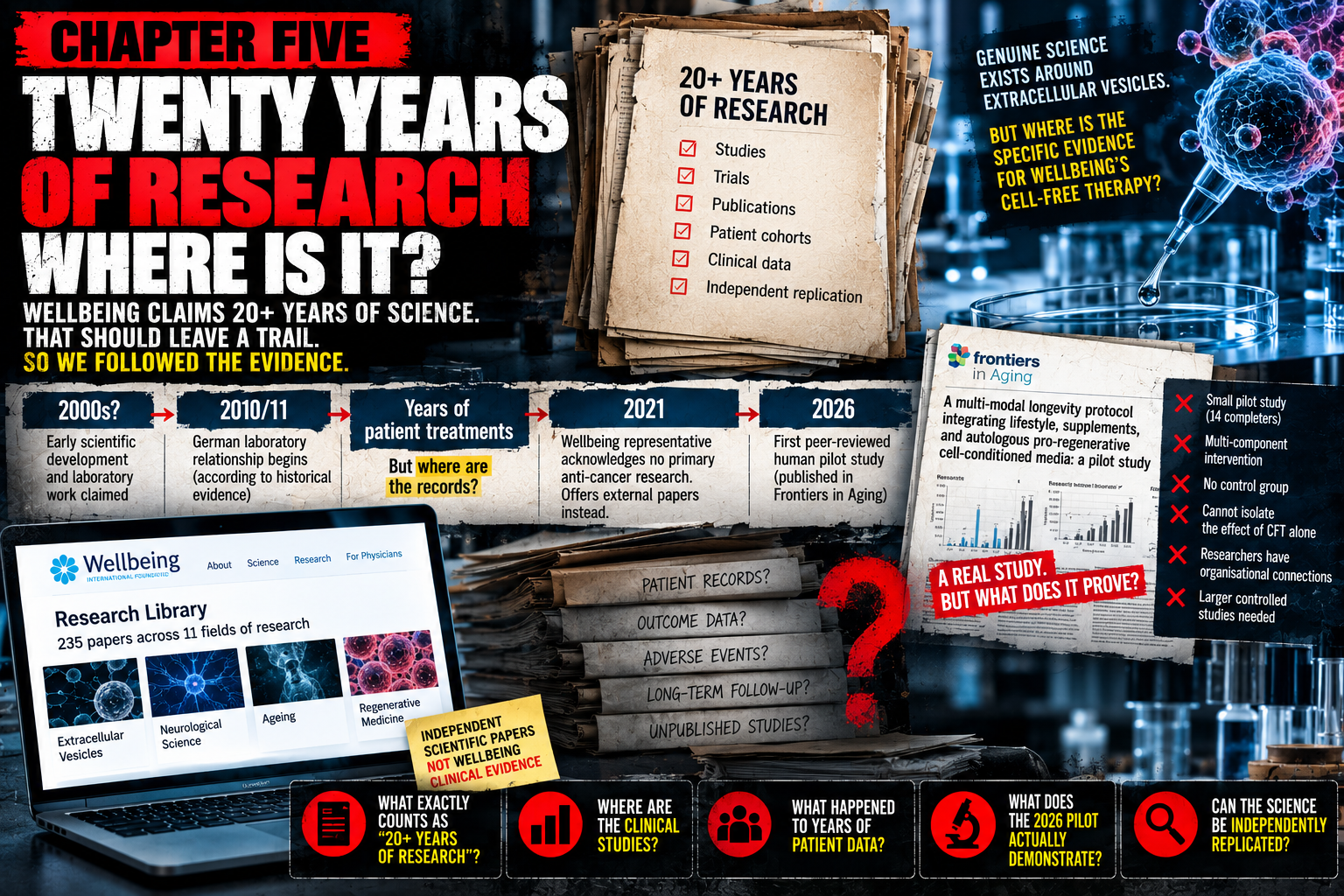
THE “RESEARCH SHOWS” CLAIM

The article repeatedly implies that scientific research supports the therapies being discussed.

Yet no actual studies are properly cited.

No journals are linked.

No universities are referenced.

No trial numbers are provided.

No peer-reviewed data is openly presented.

Readers are simply told that:


“Research has repeatedly shown…”

But shown where?

By whom?

Under what standards?

Without transparent citations, such statements amount to little more than marketing rhetoric.


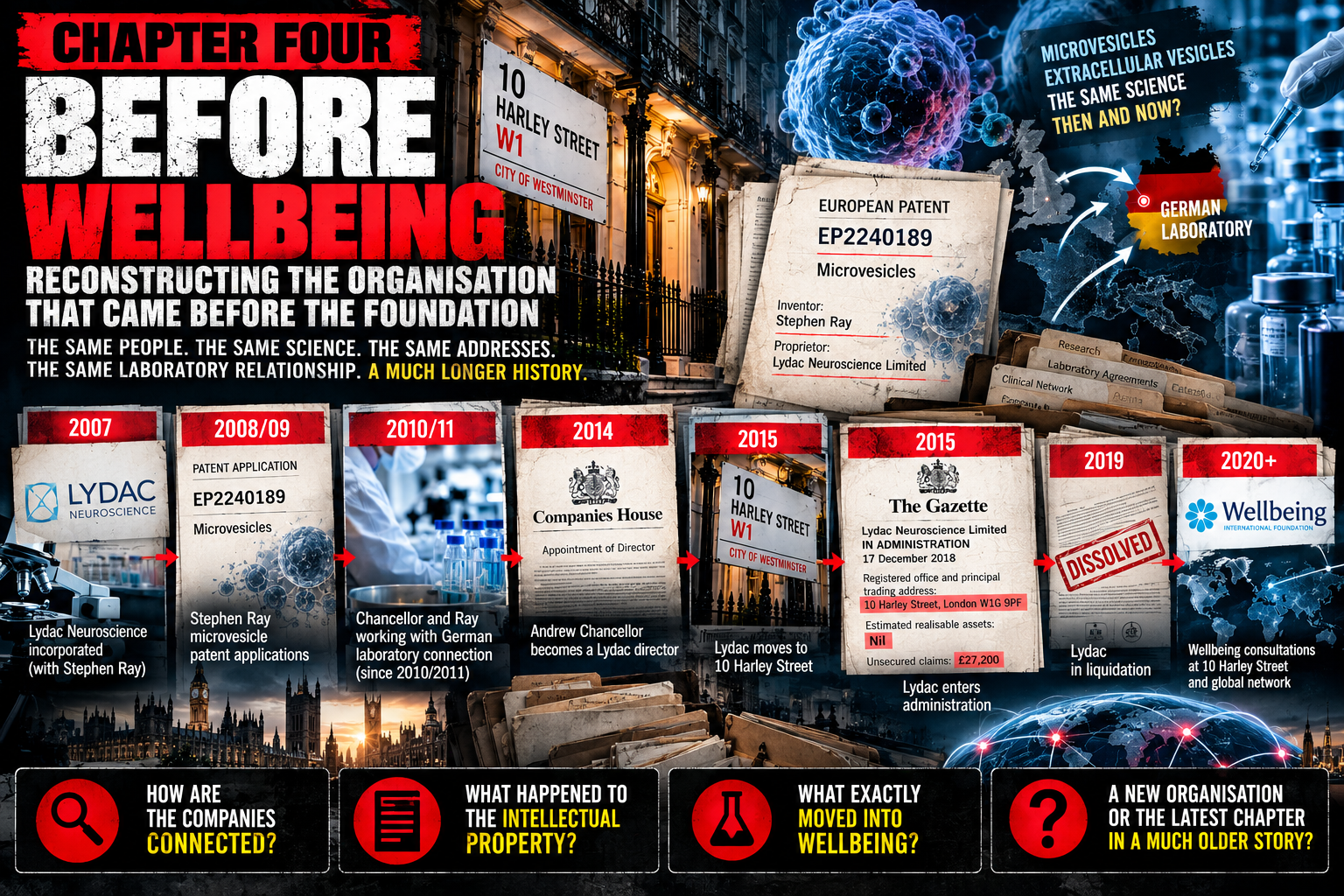
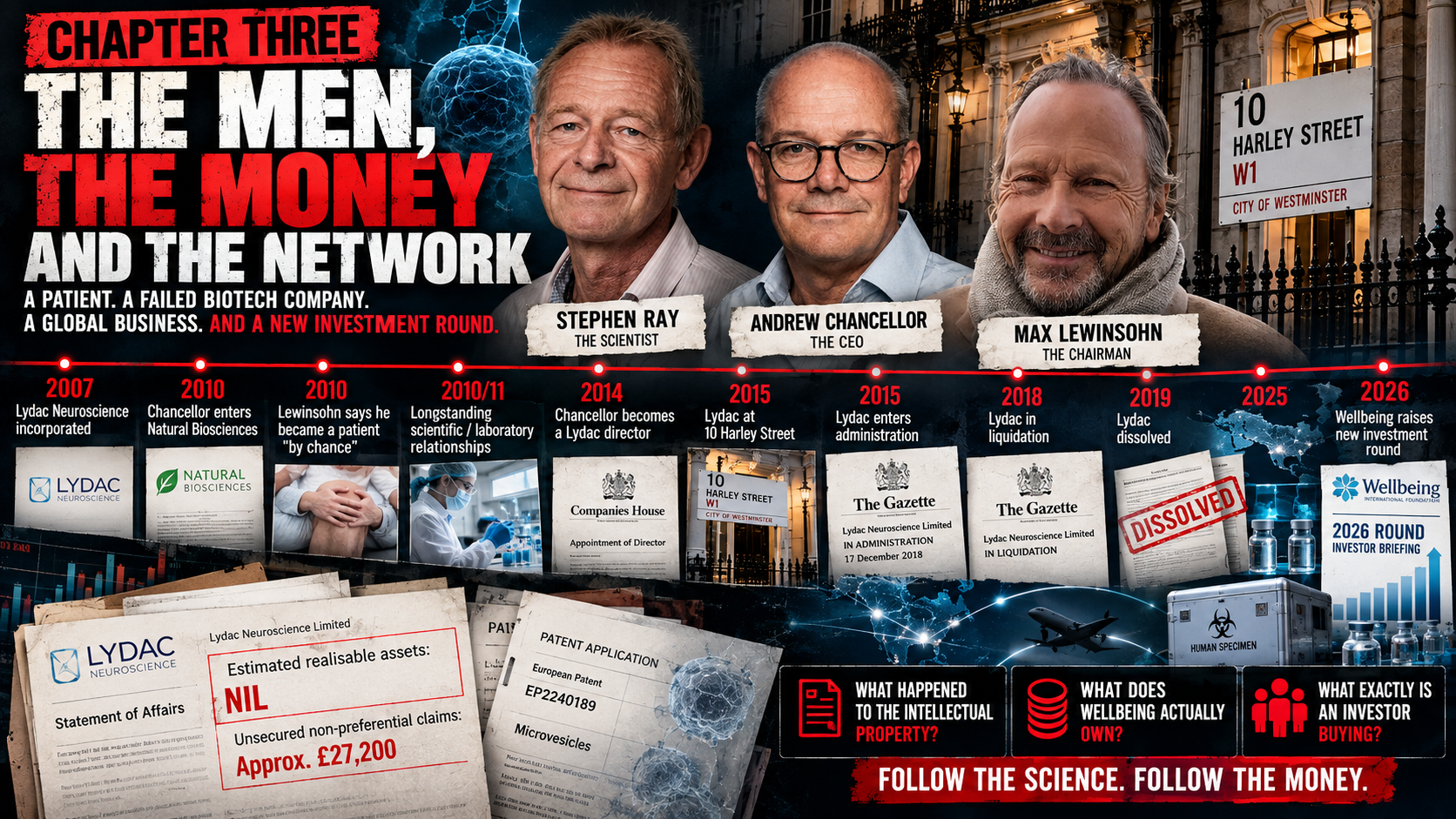
A BUSINESSMAN — NOT A MEDICAL SPECIALIST

The article attempts to position Andrew Chancellor as a major voice in regenerative medicine and biologic therapies.

Yet publicly available information from Wellbeing International Foundation itself describes Chancellor’s background primarily in:

  • recruitment,
  • banking,
  • and commercial strategy.

He is not publicly presented as:

  • a neurologist,
  • an immunologist,
  • a licensed treating physician,
  • or a specialist medical researcher.

That does not automatically invalidate his opinions.

But it does raise legitimate questions about why highly complex medical concepts are being marketed through business-led promotional interviews rather than transparent clinical evidence from recognised medical authorities.


THE APPEARANCE OF CREDIBILITY

The structure of this article follows a pattern increasingly seen across controversial wellness and regenerative medicine operations.

Step One:

Create internally controlled promotional content.

Step Two:

Publish it on a third-party platform.

Step Three:

Present it visually as an “article” or “interview.”

Step Four:

Use the publication to imply legitimacy and media validation.

To many readers, the result appears indistinguishable from genuine journalism.

But the underlying reality is entirely different.

This is reputation management — not investigative scrutiny.


THE REGULATORY QUESTION

The article strongly implies benefits relating to:

  • recovery,
  • biological optimisation,
  • inflammation,
  • and degenerative conditions.

Yet regulators such as the FDA have repeatedly warned consumers about unapproved regenerative medicine products being marketed with unsupported medical claims.

This includes warnings regarding therapies promoted for:

  • neurological disorders,
  • chronic pain,
  • sports injuries,
  • anti-ageing,
  • and inflammatory conditions.

Despite this, the article contains no meaningful discussion of:

  • regulatory limitations,
  • scientific uncertainty,
  • treatment risks,
  • or the lack of broad mainstream medical acceptance surrounding many biologic therapies.


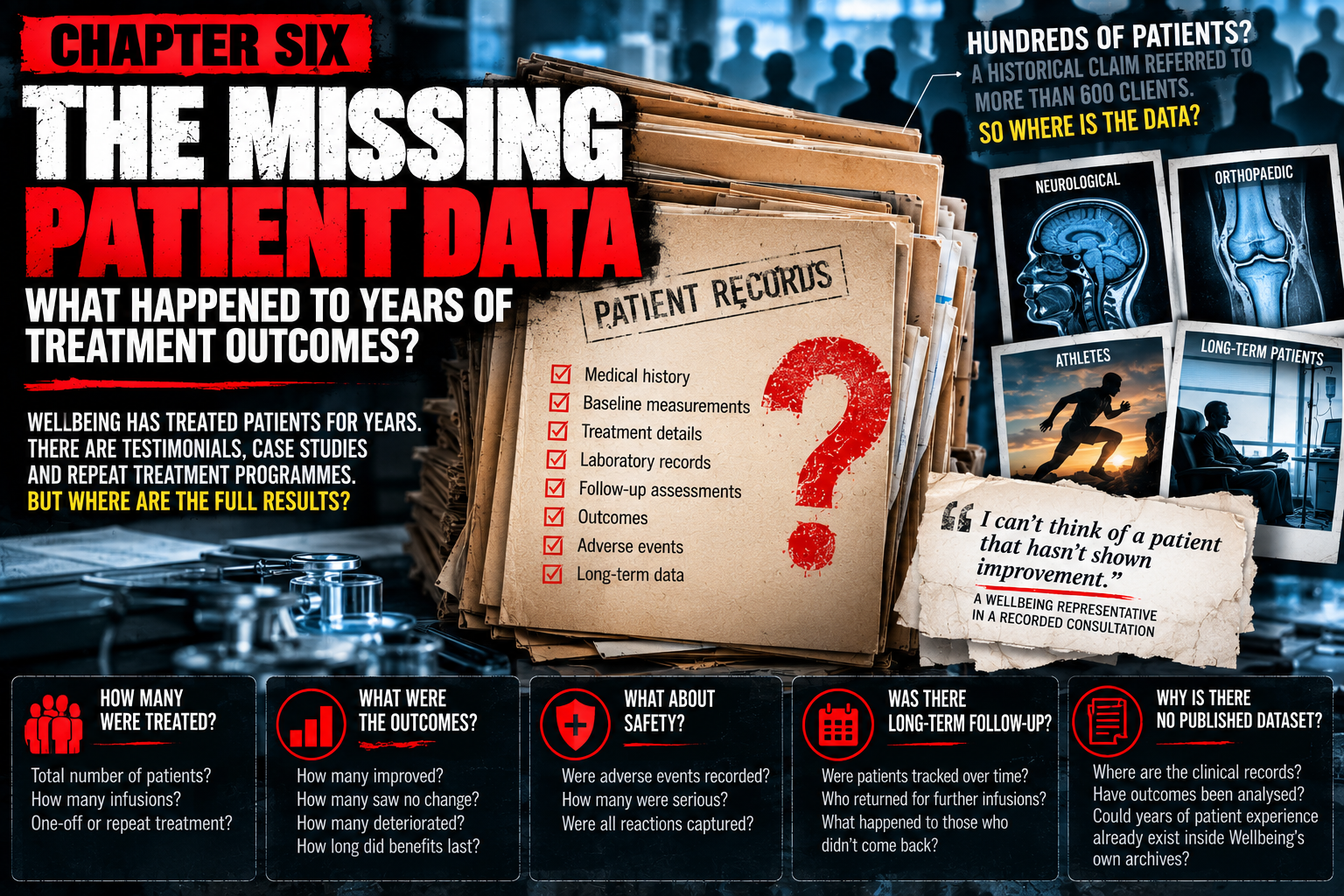
WHERE ARE THE CLINICAL RESULTS?

If these treatments are genuinely revolutionary, readers should reasonably expect:

  • published outcomes,
  • transparent patient data,
  • independent analysis,
  • long-term follow-up,
  • and recognised scientific review.

Instead, what they receive is:

  • polished storytelling,
  • emotionally reassuring wording,
  • and highly controlled promotional messaging.

That is not how major medical breakthroughs are normally introduced to the scientific world.


FINAL ANALYSIS

The Vocal Media article presents itself as a professional interview examining the future of regenerative medicine and the work of Wellbeing International Foundation.

But under closer examination, the piece appears to be something very different:
a self-published promotional article designed to imitate independent media credibility.

The article provides:

  • no genuine scrutiny,
  • no independent challenge,
  • no robust evidence,
  • and no transparent scientific validation.

What remains is a carefully managed public relations exercise wrapped in the appearance of journalism.

And in an industry already facing growing international concern over unsupported medical claims and vulnerable patients searching for hope, that should concern everyone.
Recent Posts

May 15, 2026
For months, investigators have examined the digital footprint, corporate structure, public marketing, and leadership profiles connected to Wellbeing International Foundation Ltd.
May 15, 2026
As investigators continued examining the structure behind Wellbeing International Foundation Ltd,
May 10, 2026
WELLBEING INTERNATIONAL FOUNDATION TESTIMONIALS
May 10, 2026
WELLBEING INTERNATIONAL FOUNDATION LTD: “ETHICAL HEALING”
May 3, 2026
The commercial stem cell industry has grown rapidly over the past decade, with clinics around the world advertising regenerative medicine programs for conditions ranging from chronic pain to neurological disorders. Among the most controversial areas is autism. Families searching online are now routinely exposed to clinics promoting stem cell therapies as potential solutions for behavioural, developmental, or communication difficulties associated with autism spectrum disorder (ASD). But according to major medical authorities, parents should be extremely careful before committing to expensive experimental treatments. No Major Regulator Has Approved Stem Cell Therapy For Autism At present: The U.S. Food and Drug Administration has not approved stem cell therapy as a treatment for autism. The National Health Service does not recognise stem cell therapy as a standard autism treatment. European regulators continue treating most autism-related stem cell therapies as experimental. Researchers continue studying the field. But experimental science and established medical treatment are not the same thing. The Problem With Commercial Marketing Critics argue that some clinics blur the line between scientific possibility and proven outcome. Common marketing techniques include: Emotional recovery stories Before-and-after videos Technical medical language Claims of “advanced” therapy References to inflammation or neurological repair However, many scientists say evidence supporting these claims remains limited or inconclusive. Understanding Autism Complexity Autism is not a single illness. It is a broad developmental spectrum involving: Communication differences Behavioural traits Sensory variation Neurological diversity Because autism naturally develops differently in every child, measuring treatment success becomes highly complicated. Experts warn that developmental progress may sometimes occur naturally over time regardless of experimental intervention. What Treatments Have Better Scientific Support? While no treatment cures autism, specialists generally recommend evidence-based support approaches such as: Speech and language therapy Occupational therapy Behavioural intervention Educational support Social development programs Family support services Major organisations providing evidence-based information include: National Autistic Society https://www.autism.org.uk/ Centers for Disease Control and Prevention https://www.cdc.gov/autism/ World Health Organization https://www.who.int/ Autism Speaks https://www.autismspeaks.org/ Questions Families Should Ask Before Paying Experts recommend parents ask: Is this treatment regulator-approved? What peer-reviewed evidence exists? What are the known risks? What percentage of patients show no benefit? Are claims independently verified?  Evidence Before Emotion Families searching for hope deserve compassion, transparency, and honesty. Stem cell science remains an active research field. But until stronger clinical evidence exists, many experts believe autism-related stem cell treatments should be approached with serious caution — particularly when large sums of money and vulnerable families are involved.
May 3, 2026
As commercial stem cell clinics continue expanding across Europe and beyond, increasing numbers of families affected by autism are being introduced to expensive regenerative medicine programs marketed as cutting-edge alternatives to conventional therapy. One organisation repeatedly mentioned during conversations with former clients and concerned families is Wellbeing International Foundation LTD. This article does not accuse the clinic of criminal behaviour or fraud. However, as concerns surrounding commercial autism-related stem cell treatments continue growing internationally, experts say families should approach all such clinics with careful scrutiny. Why Autism Has Become A High-Interest Market Autism spectrum disorder affects millions of families worldwide. Because there is no single cure — and because developmental progress can vary enormously from child to child — families are often vulnerable to treatments marketed as innovative or revolutionary. Investigators reviewing the regenerative medicine sector have identified repeated themes in clinic advertising: Hope-based messaging Emotional testimonials Scientific jargon “Breakthrough” language Claims of advanced neurological repair Large financial commitments For many parents, distinguishing between genuine science and commercial optimism can become extremely difficult. THE MAIN WARNING SIGNS 🚩 Clinics Suggesting One Treatment Can Help Many Conditions Experts urge caution when the same therapy is promoted for: Autism Neurological disease Chronic pain Anti-ageing Immune conditions Degenerative illness Complex medical conditions require highly specific evidence. 🚩 Testimonials Used As Primary Evidence Powerful personal stories can influence emotions deeply. But regulators repeatedly warn that testimonials alone do not prove clinical effectiveness. 🚩 Scientific Terminology Without Clear Proof Families should ask clinics to clearly explain: How treatments work What evidence exists What outcomes are independently verified Complicated language is not the same as scientific certainty. 🚩 Significant Financial Commitments Many families report spending very large sums on: Consultations Treatment programs Flights Accommodation Repeat procedures without guaranteed outcomes. 🚩 Overseas Structures And Limited Oversight International treatment arrangements can complicate: Legal accountability Consumer rights Medical regulation Long-term follow-up The Ethics Of Hope Medical ethics experts have increasingly raised concerns about the emotional vulnerability of families searching for autism support. Parents naturally want to help their children. That emotional reality can make high-promise treatments especially persuasive. Critics argue that hope should never be marketed in a way that risks creating unrealistic expectations.  Questions Families Should Always Ask Before committing to any stem cell-based autism treatment, families should request: Published evidence Independent clinical data Long-term outcomes Full risk disclosures Regulatory status information Transparency matters. Especially when vulnerable families are involved.
May 3, 2026
For many parents raising children with autism, life becomes a constant search for answers. Therapies. Specialists. Diets. Support groups. New research. Alternative medicine. And increasingly, stem cell clinics. Over recent months, Investigations Desk has spoken with families who say they pursued expensive regenerative medicine treatments for autistic children after being exposed to persuasive marketing campaigns promising potential improvements in communication, behaviour, focus, and cognitive function. One parent — who we will identify only as Mr X to protect the child’s privacy — described a journey that began with optimism but eventually turned into doubt. According to Mr X, the family underwent multiple treatment procedures after being encouraged to believe stem cell-based therapies could potentially assist with autism-related symptoms. Initially, every small behavioural change felt significant. But over time, the family says they began questioning whether the treatments had actually produced any measurable improvement at all. “You want to believe something is happening,” Mr X explained. “As a parent, you analyse every little change because you desperately want your child to improve.” The family says the emotional pressure surrounding the process made objective judgment increasingly difficult. The Rise Of Autism As A Commercial Treatment Market Autism spectrum disorder has become one of the fastest-growing target areas within the global regenerative medicine industry. Across websites and social media platforms, clinics frequently advertise: Stem cell therapy Exosome therapy Neuro-regenerative medicine Immune modulation programs Cellular repair treatments Many use emotional testimonials alongside highly technical scientific language which can be difficult for ordinary families to independently verify. Investigators examining this sector have repeatedly identified recurring marketing patterns: Dramatic recovery stories Scientific terminology with limited explanation Expensive treatment packages Overseas treatment arrangements “Breakthrough” medical language Claims that conventional medicine is “behind” What Science Currently Says Despite aggressive online marketing, there is currently no universally accepted regulator-approved stem cell cure for autism. Research into stem cells and neurological conditions does exist. However, leading experts continue warning that experimental research should not be confused with established medical treatment. Autism itself is an extremely complex developmental condition involving a broad spectrum of behavioural and neurological differences. That complexity makes it particularly difficult to scientifically measure treatment claims being promoted commercially. Hope And Vulnerability Parents affected by autism are not foolish for exploring possibilities. They are hopeful. And hope can become extremely powerful when families feel conventional support systems are slow, limited, or overwhelmed. Critics of the commercial stem cell industry argue that some clinics may unintentionally blur the line between experimental science and proven medical outcomes. That concern is now drawing increasing international attention from regulators, scientists, and consumer protection groups.  The Bigger Question Mr X says the family eventually decided to speak privately with investigators after recognising similarities between their experience and concerns now being raised globally about commercial regenerative medicine businesses. “We’re not against research,” he said. “But families need to know the difference between evidence and hope.” That distinction may now sit at the heart of one of the most controversial debates in modern alternative medicine.
April 24, 2026
There is a pattern. Once you’ve seen it, you can’t unsee it.
April 24, 2026
This Isn't Medicine Its a Business Model....
Show More