For patients facing terminal illness, hope can become the most valuable—and the most dangerous—commodity of all. Across Europe and beyond, a growing number of private clinics promote experimental stem cell therapies as life-changing breakthroughs, offering treatments that promise regeneration, recovery, and sometimes even survival where conventional medicine offers none.
But behind the polished marketing and emotional testimonials, the reality for many families is very different.
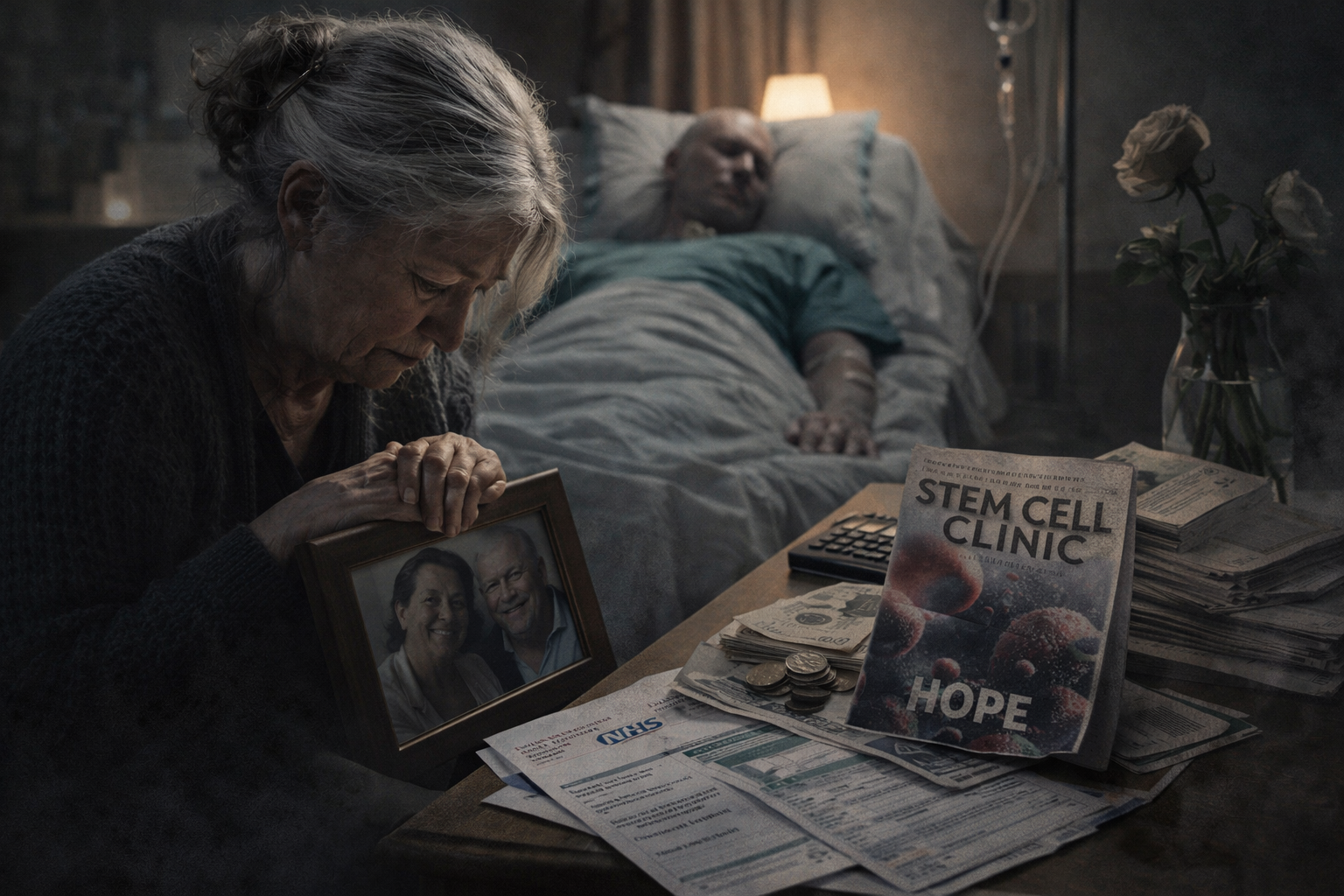
The case of Mr and Mrs Allwood from Stoke-on-Trent illustrates just how devastating the consequences can be when vulnerable patients are drawn into the world of unproven medical treatments.
A Diagnosis That Changed Everything
Mr Allwood had always been a practical man. A lifelong resident of Stoke-on-Trent, he spent decades working hard, building a life with his wife and family. Like many couples approaching later life, he and Mrs Allwood had begun planning a quieter future together.
That future changed dramatically when he received a devastating diagnosis.
Doctors informed him that he had developed advanced liver cancer. The prognosis was stark. Without a liver transplant, his life expectancy could be as little as three years.
The couple immediately began exploring the only option that offered genuine medical hope: finding a suitable liver donor.
But anyone familiar with the transplant system knows how complex and uncertain that process can be. Waiting lists are long, donor matches are rare, and time is often the enemy.
It was during this desperate search for options that the Allwoods encountered something else.
A stem cell clinic.
The Promise of Regeneration
The clinic’s marketing was persuasive. Their website featured scientific language, glossy images of laboratories, and stories of patients who claimed remarkable improvements after treatment.
Stem cells, they explained, were capable of regenerating damaged tissue. They suggested that their therapy could stimulate the body’s healing processes and potentially reverse disease progression.
For someone facing a terminal diagnosis, the message was powerful.
More importantly, the clinic did not simply advertise treatment. They offered consultations, personalised plans, and direct conversations with staff who appeared sympathetic and confident.
According to Mrs Allwood, the discussions were emotionally persuasive.
“They spoke to us like they understood exactly what we were going through,” she later recalled. “They made it sound like this treatment had helped many people before.”
Appointments were scheduled.
And with each conversation, the promise became clearer: this treatment might give Mr Allwood the extra time that conventional medicine could not.
The Cost of Hope
The price was substantial.
Like many clinics operating in this sector, the treatment was offered outside the framework of mainstream healthcare systems. It was presented as an advanced therapy that required specialist facilities and preparation.
Payment was required privately.
For the Allwoods, this meant committing a large portion of their savings to the procedure. But when the alternative is watching a loved one deteriorate, the decision becomes emotionally simple.
If there is even a small chance it might work, you try.
The treatment was arranged.
What Actually Happened
According to medical experts familiar with many clinics operating in the unregulated stem cell market, the treatments often differ significantly from the sophisticated regenerative procedures described in marketing materials.
In Mr Allwood’s case, the procedure involved intravenous infusions administered over several sessions.
Rather than complex regenerative stem cell therapy, the treatment largely consisted of saline fluids and vitamin infusions delivered through a drip.
Such treatments are not inherently harmful in themselves. Intravenous hydration and vitamin supplementation are widely used in medical settings.
But they are not stem cell therapy.
And they are not treatments for cancer.
Yet within the context created by the clinic—the language, the consultations, the framing of the procedure—Mr Allwood believed he had received something far more powerful.
The Placebo Effect
Following the treatment, Mr Allwood reported that he felt better.
He told his wife that his energy had improved. He believed the therapy had begun to work.
From a medical perspective, such responses are not uncommon. The placebo effect is a well-documented phenomenon in which patients experience perceived improvements simply because they believe they have received an effective treatment.
The psychological power of hope can produce real sensations of relief or improvement, even when the underlying disease remains unchanged.
For Mr Allwood, the experience reinforced the clinic’s narrative.
If the first treatment had helped, perhaps a second could help even more.
The Upsell
Shortly after the first course of treatment, clinic representatives suggested a follow-up procedure.
They explained that the initial treatment had prepared the body, and that a second, more intensive round could produce stronger results.
The language was persuasive.
The Allwoods agreed.
Once again, they paid.
For Mrs Allwood, the decision was driven by the same powerful force that draws so many families into these situations: the desire to fight for every possible chance.
But the reality of Mr Allwood’s illness had not changed.
His cancer continued to progress.
A Treatment That Never Finished
During the second course of treatment, Mr Allwood’s condition deteriorated rapidly.
He became weaker. Hospital visits increased. His body was struggling with the effects of the disease that had never been treated by the procedures he had undergone.
Before the treatment programme could be completed, Mr Allwood passed away.
He never returned to the clinic.
The Aftermath
For Mrs Allwood, the emotional impact was devastating.
She had lost her husband. But she had also lost the financial security they had spent a lifetime building.
Much of their savings had been spent pursuing treatments that had offered hope but delivered no measurable medical benefit.
“I thought we were doing everything we could,” she later said. “They made us believe there was a real chance.”
What remained was grief—and the painful question faced by many families in similar situations:
Were they sold hope that never existed?
A Wider Pattern
C
ases like the Allwoods’ are not isolated.
Across the world, regulators have repeatedly warned about clinics marketing unproven stem cell treatments for conditions ranging from neurological disorders to terminal cancers.
Many operate in jurisdictions where regulatory oversight is limited, and treatments are offered directly to patients without the rigorous clinical testing required for licensed therapies.
The language used in marketing often sits in a grey area—suggesting possibilities rather than making explicit claims, while still encouraging patients to believe meaningful medical improvement is likely.
For vulnerable patients and families, the distinction can be difficult to recognise.
The True Cost
The tragedy of cases like this is not only financial.
Families facing terminal illness are already navigating the most difficult moments of their lives. When hope becomes a product to be sold, the consequences extend far beyond the treatment room.
They leave families grieving not only the loss of a loved one, but also the loss of trust.
For Mrs Allwood, the experience has left a lasting mark.
Her husband’s fight against cancer ended where it was always likely to end—with the progression of the disease. But the journey in between was shaped by promises that ultimately delivered nothing.
Except the most expensive commodity of all.
Hope.